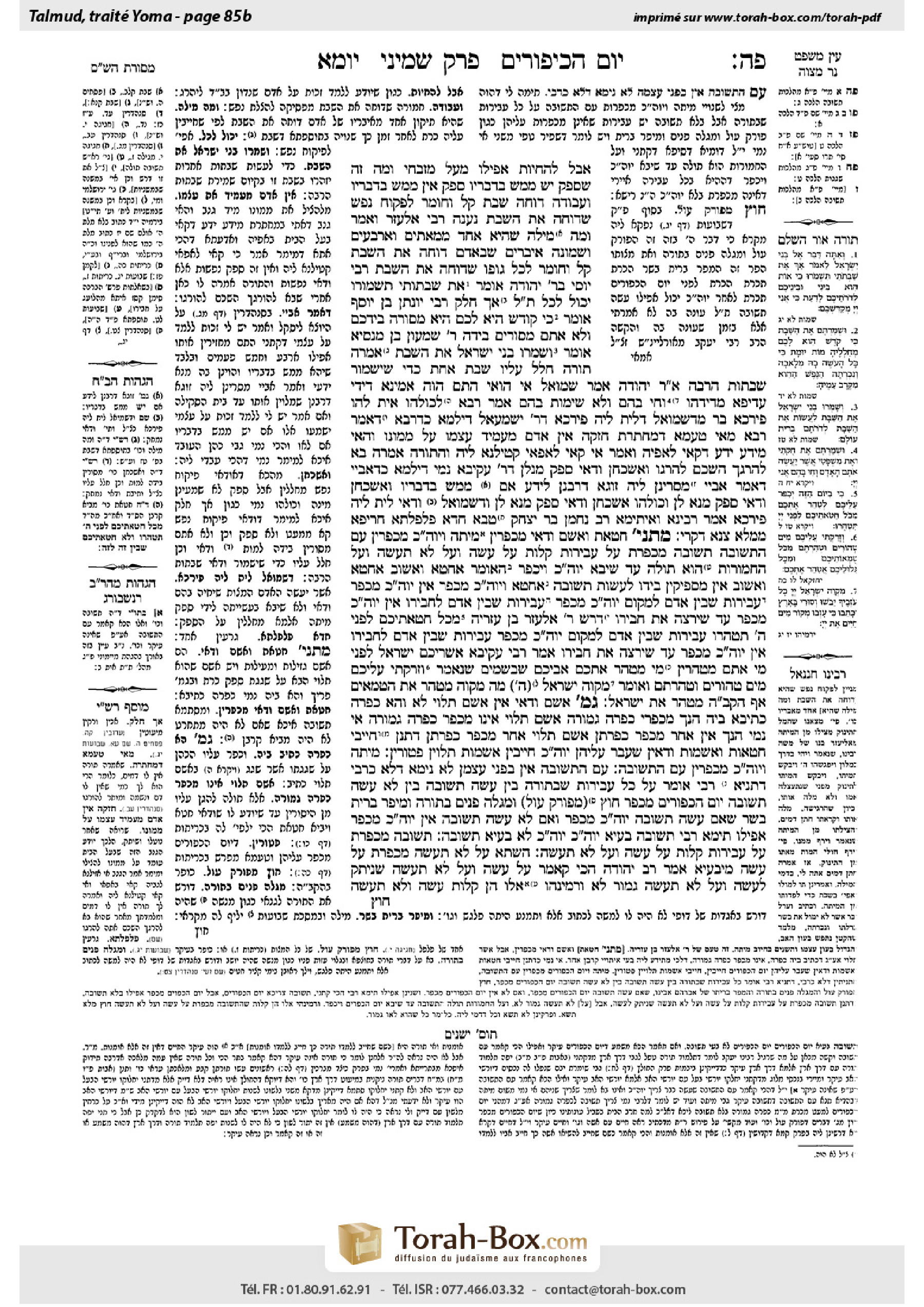
Yoma 85b: Talmud study for Daf Yomi
Daf Yomi is the daily study of one Talmud folio. Explore 37 tractates with scans, Hebrew text, Sefaria English and AI-generated French translations where annotated.
Passage selection and English or AI-generated French translation are available where the scan has annotations. Daf Study is independent of Torah-Box and Sefaria.
Browse Yoma · יומא · All tractatesYoma 85b text and translations
This page of Yoma includes the Aramaic text, an English translation and an AI-generated French translation, alongside the scan above.
יומא פ״ה ב · Aramaic and Hebrew text
אֲבָל לְהַחֲיוֹת — אֲפִילּוּ מֵעַל מִזְבְּחִי. וּמָה זֶה, שֶׁסָּפֵק יֵשׁ מַמָּשׁ בִּדְבָרָיו סָפֵק אֵין מַמָּשׁ בִּדְבָרָיו, וַעֲבוֹדָה דּוֹחָה שַׁבָּת — קַל וָחוֹמֶר לְפִקּוּחַ נֶפֶשׁ שֶׁדּוֹחֶה אֶת הַשַּׁבָּת. נַעֲנָה רַבִּי אֶלְעָזָר וְאָמַר: וּמָה מִילָה שֶׁהִיא אֶחָד מִמָּאתַיִם וְאַרְבָּעִים וּשְׁמוֹנָה אֵיבָרִים שֶׁבָּאָדָם דּוֹחָה אֶת הַשַּׁבָּת — קַל וָחוֹמֶר לְכׇל גּוּפוֹ שֶׁדּוֹחֶה אֶת הַשַּׁבָּת.
רַבִּי יוֹסֵי בְּרַבִּי יְהוּדָה אוֹמֵר: ״אֶת שַׁבְּתוֹתַי תִּשְׁמוֹרוּ״, יָכוֹל לַכֹּל — תַּלְמוּד לוֹמַר: ״אַךְ״ חָלַק. רַבִּי יוֹנָתָן בֶּן יוֹסֵף אוֹמֵר: ״כִּי קוֹדֶשׁ הִיא לָכֶם״, הִיא מְסוּרָה בְּיֶדְכֶם וְלֹא אַתֶּם מְסוּרִים בְּיָדָהּ.
רַבִּי שִׁמְעוֹן בֶּן מְנַסְיָא אוֹמֵר: ״וְשָׁמְרוּ בְנֵי יִשְׂרָאֵל אֶת הַשַּׁבָּת״, אָמְרָה תּוֹרָה: חַלֵּל עָלָיו שַׁבָּת אַחַת כְּדֵי שֶׁיִּשְׁמוֹר שַׁבָּתוֹת הַרְבֵּה. אָמַר רַב יְהוּדָה אָמַר שְׁמוּאֵל: אִי הֲוַאי הָתָם, הֲוָה אָמֵינָא דִּידִי עֲדִיפָא מִדִּידְהוּ: ״וְחַי בָּהֶם״ — וְלֹא שֶׁיָּמוּת בָּהֶם.
אָמַר רָבָא: לְכוּלְּהוּ אִית לְהוּ פִּירְכָא, בַּר מִדִּשְׁמוּאֵל דְּלֵית לֵיהּ פִּירְכָא. דְּרַבִּי יִשְׁמָעֵאל — דִּילְמָא כִּדְרָבָא. דְּאָמַר רָבָא: מַאי טַעְמָא דְּמַחְתֶּרֶת? חֲזָקָה, אֵין אָדָם מַעֲמִיד עַצְמוֹ עַל מָמוֹנוֹ. וְהַאי מִידָּע יָדַע דְּקָאֵי לְאַפֵּיהּ, וְאָמַר אִי קָאֵי לְאַפַּאי — קָטֵילְנָא לֵיהּ, וְהַתּוֹרָה אָמְרָה: בָּא לְהׇרְגְּךָ — הַשְׁכֵּם לְהׇרְגוֹ. וְאַשְׁכְּחַן וַדַּאי, סָפֵק מְנָלַן?
דְּרַבִּי עֲקִיבָא נָמֵי — דִּילְמָא כִּדְאַבָּיֵי. דְּאָמַר אַבָּיֵי: מָסְרִינַן לֵיהּ זוּגָא דְרַבָּנַן לֵידַע אִם מַמָּשׁ בִּדְבָרָיו. וְאַשְׁכְּחַן וַדַּאי, סָפֵק מְנָא לַן?
וְכוּלְּהוּ אַשְׁכְּחַן וַדַּאי, סָפֵק מְנָא לַן? וְדִשְׁמוּאֵל, וַדַּאי לֵית לֵיהּ פִּירְכָא. אָמַר רָבִינָא וְאִיתֵּימָא רַב נַחְמָן בַּר יִצְחָק: טָבָא חֲדָא פִּלְפַּלְתָּא חֲרִיפָא מִמְּלָא צַנָּא דְקָרֵי.
מַתְנִי׳ חַטָּאת וְאָשָׁם וַדַּאי — מְכַפְּרִין. מִיתָה וְיוֹם הַכִּפּוּרִים — מְכַפְּרִין עִם הַתְּשׁוּבָה. תְּשׁוּבָה — מְכַפֶּרֶת עַל עֲבֵירוֹת קַלּוֹת: עַל עֲשֵׂה, וְעַל לֹא תַעֲשֶׂה. וְעַל הַחֲמוּרוֹת הוּא תּוֹלֶה, עַד שֶׁיָּבֹא יוֹם הַכִּפּוּרִים וִיכַפֵּר. הָאוֹמֵר: אֶחֱטָא וְאָשׁוּב, אֶחֱטָא וְאָשׁוּב — אֵין מַסְפִּיקִין בְּיָדוֹ לַעֲשׂוֹת תְּשׁוּבָה. אֶחֱטָא וְיוֹם הַכִּפּוּרִים מְכַפֵּר — אֵין יוֹם הַכִּפּוּרִים מְכַפֵּר. עֲבֵירוֹת שֶׁבֵּין אָדָם לַמָּקוֹם — יוֹם הַכִּפּוּרִים מְכַפֵּר, עֲבֵירוֹת שֶׁבֵּין אָדָם לַחֲבֵירוֹ — אֵין יוֹם הַכִּפּוּרִים מְכַפֵּר, עַד שֶׁיְּרַצֶּה אֶת חֲבֵירוֹ.
דָּרַשׁ רַבִּי אֶלְעָזָר בֶּן עֲזַרְיָה: ״מִכֹּל חַטֹּאתֵיכֶם לִפְנֵי ה׳ תִּטְהָרוּ״. עֲבֵירוֹת שֶׁבֵּין אָדָם לַמָּקוֹם — יוֹם הַכִּפּוּרִים מְכַפֵּר. עֲבֵירוֹת שֶׁבֵּין אָדָם לַחֲבֵירוֹ — אֵין יוֹם הַכִּפּוּרִים מְכַפֵּר עַד שֶׁיְּרַצֶּה אֶת חֲבֵירוֹ. אָמַר רַבִּי עֲקִיבָא: אַשְׁרֵיכֶם יִשְׂרָאֵל! לִפְנֵי מִי אַתֶּם מִטַּהֲרִין, מִי מְטַהֵר אֶתְכֶם? אֲבִיכֶם שֶׁבַּשָּׁמַיִם, שֶׁנֶּאֱמַר: ״וְזָרַקְתִּי עֲלֵיכֶם מַיִם טְהוֹרִים וּטְהַרְתֶּם״, וְאוֹמֵר: ״מִקְוֵה יִשְׂרָאֵל (ה׳)״, מָה מִקְוֶה מְטַהֵר אֶת הַטְּמֵאִים — אַף הַקָּדוֹשׁ בָּרוּךְ הוּא מְטַהֵר אֶת יִשְׂרָאֵל.
גְּמָ׳ אָשָׁם וַדַּאי — אִין, אָשָׁם תָּלוּי — לָא. וְהָא כַּפָּרָה כְּתִיבָא בֵּיהּ? הָנָךְ מְכַפְּרִי כַּפָּרָה גְּמוּרָה, אָשָׁם תָּלוּי אֵינוֹ מְכַפֵּר כַּפָּרָה גְּמוּרָה.
אִי נָמֵי: הָנָךְ אֵין אַחֵר מְכַפֵּר כַּפָּרָתָן, אָשָׁם תָּלוּי אַחֵר מְכַפֵּר כַּפָּרָתָן, דִּתְנַן: חַיָּיבֵי חַטָּאוֹת וַאֲשָׁמוֹת וַדָּאִין שֶׁעָבַר עֲלֵיהֶן יוֹם הַכִּפּוּרִים — חַיָּיבִין, אֲשָׁמוֹת תְּלוּיִן — פְּטוּרִין.
מִיתָה וְיוֹם הַכִּפּוּרִים מְכַפְּרִין עִם הַתְּשׁוּבָה. עִם הַתְּשׁוּבָה — אִין, בִּפְנֵי עַצְמָן — לָא. נֵימָא דְּלָא כְּרַבִּי. דְּתַנְיָא, רַבִּי אוֹמֵר: עַל כׇּל עֲבֵירוֹת שֶׁבַּתּוֹרָה, בֵּין עָשָׂה תְּשׁוּבָה בֵּין לֹא עָשָׂה תְּשׁוּבָה — יוֹם הַכִּפּוּרִים מְכַפֵּר, חוּץ (מִפּוֹרֵק עוֹל), וּמְגַלֶּה פָּנִים בַּתּוֹרָה, וּמֵיפֵר בְּרִית בָּשָׂר, שֶׁאִם עָשָׂה תְּשׁוּבָה — יוֹם הַכִּפּוּרִים מְכַפֵּר, וְאִם לֹא עָשָׂה תְּשׁוּבָה — אֵין יוֹם הַכִּפּוּרִים מְכַפֵּר.
אֲפִילּוּ תֵּימָא רַבִּי: תְּשׁוּבָה בָּעֲיָא יוֹם הַכִּפּוּרִים, יוֹם הַכִּפּוּרִים לָא בָּעֲיָא תְּשׁוּבָה.
תְּשׁוּבָה מְכַפֶּרֶת עַל עֲבֵירוֹת קַלּוֹת: עַל עֲשֵׂה וְעַל לֹא תַעֲשֶׂה. הַשְׁתָּא עַל לֹא תַעֲשֶׂה מְכַפֶּרֶת, עַל עֲשֵׂה מִיבַּעְיָא? אָמַר רַב יְהוּדָה, הָכִי קָאָמַר: עַל עֲשֵׂה, וְעַל לֹא תַעֲשֶׂה שֶׁנִּיתַּק לַעֲשֵׂה.
וְעַל לֹא תַעֲשֶׂה גָּמוּר לָא? וּרְמִינְהוּ, אֵלּוּ הֵן קַלּוֹת: עֲשֵׂה וְלֹא תַעֲשֶׂה,
Yoma 85b · English translation
but to preserve a life, e.g., if the priest can testify to the innocence of one who is sentenced to death, one removes him even from on top of My altar, even while he is sacrificing an offering. Just as this priest, about whom there is uncertainty whether there is substance to his words of testimony or whether there is no substance to his words, is taken from the Temple service in order to save a life, and Temple service overrides Shabbat, so too, a fortiori, saving a life overrides Shabbat. Rabbi Elazar ben Azarya answered and said: Just as the mitzva of circumcision, which rectifies only one of the 248 limbs of the body, overrides Shabbat, so too, a fortiori, saving one’s whole body, which is entirely involved in mitzvot, overrides Shabbat.
Other tanna’im debated this same issue. Rabbi Yosei, son of Rabbi Yehuda, says that it is stated: “But keep my Shabbatot” (Exodus 31:13). One might have thought that this applies to everyone in all circumstances; therefore, the verse states “but,” a term that restricts and qualifies. It implies that there are circumstances where one must keep Shabbat and circumstances where one must desecrate it, i.e., to save a life. Rabbi Yonatan ben Yosef says that it is stated: “For it is sacred to you” (Exodus 31:14). This implies that Shabbat is given into your hands, and you are not given to it to die on account of Shabbat.
Rabbi Shimon ben Menasya said: It is stated: “And the children of Israel shall keep Shabbat, to observe Shabbat” (Exodus 31:16). The Torah said: Desecrate one Shabbat on his behalf so he will observe many Shabbatot. Rav Yehuda said that Shmuel said: If I would have been there among those Sages who debated this question, I would have said that my proof is preferable to theirs, as it states: “You shall keep My statutes and My ordinances, which a person shall do and live by them” (Leviticus 18:5), and not that he should die by them. In all circumstances, one must take care not to die as a result of fulfilling the mitzvot.
Rava commented on this: All of these arguments have refutations except for that of Shmuel, which has no refutation. The Gemara explains Rava’s claim: The proof brought by Rabbi Yishmael from the thief who breaks in could perhaps be refuted based on the principle of Rava, as Rava said: What is the reason for the halakha about the thief who breaks in? There is a presumption that while a person is being robbed he does not restrain himself with respect to his money. And this thief knows that the homeowner will rise to oppose him and said to himself from the start: If he rises against me, I will kill him. And the Torah states: If a person comes to kill you, rise to kill him first. We found a source for saving a life that is in certain danger, but from where do we derive that even in a case where there is uncertainty as to whether a life is in danger one may desecrate Shabbat? Consequently, Rabbi Yishmael’s argument is refuted.
The proof of Rabbi Akiva can also be refuted. He brought the case of removing a priest from altar service in order to have him testify on another’s behalf, since his testimony might acquit the accused and save him from execution. But perhaps that halakha is in accordance with the opinion of Abaye, as Abaye said: If the accused says he has a witness in his favor, we send a pair of rabbis on his behalf to determine if his words of testimony have substance. These rabbis would first check that the testimony of the priest is substantive before removing him from the altar. If so, we have found that one interrupts the Temple service to save a life from certain danger, but from where do we derive that one interrupts the Temple service when the likelihood of saving life is uncertain?
And for all the other arguments as well, we have found proofs for saving a life from certain danger. But for cases of uncertainty, from where do we derive this? For this reason, all the arguments are refuted. However, the proof that Shmuel brought from the verse: “And live by them,” which teaches that one should not even put a life in possible danger to observe mitzvot, there is certainly no refutation. Ravina said, and some say it was Rav Naḥman bar Yitzḥak who said with regard to this superior proof of Shmuel: One spicy pepper is better than a whole basket of squash, since its flavor is more powerful than all the others.
MISHNA: A sin-offering, which atones for unwitting performance of transgressions punishable by karet, and a definite guilt-offering, which is brought for robbery and misuse of consecrated items, atone for those sins. Death and Yom Kippur atone for sins when accompanied by repentance. Repentance itself atones for minor transgressions, for both positive mitzvot and negative mitzvot. And repentance places punishment for severe transgressions in abeyance until Yom Kippur comes and completely atones for the transgression. With regard to one who says: I will sin and then I will repent, I will sin and I will repent, Heaven does not provide him the opportunity to repent, and he will remain a sinner all his days. With regard to one who says: I will sin and Yom Kippur will atone for my sins, Yom Kippur does not atone for his sins. Furthermore, for transgressions between a person and God, Yom Kippur atones; however, for transgressions between a person and another, Yom Kippur does not atone until he appeases the other person.
Similarly, Rabbi Elazar ben Azarya taught that point from the verse: “From all your sins you shall be cleansed before the Lord” (Leviticus 16:30). For transgressions between a person and God, Yom Kippur atones; however, for transgressions between a person and another, Yom Kippur does not atone until he appeases the other person. In conclusion, Rabbi Akiva said: How fortunate are you, Israel; before Whom are you purified, and Who purifies you? It is your Father in Heaven, as it is stated: “And I will sprinkle purifying water upon you, and you shall be purified” (Ezekiel 36:25). And it says: “The ritual bath of Israel is God” (Jeremiah 17:13). Just as a ritual bath purifies the impure, so too, the Holy One, Blessed be He, purifies Israel.
GEMARA: The mishna says that a definite guilt-offering atones for sins. The Gemara analyzes this: With regard to a definite guilt-offering, yes, it does atone for sins. This implies that an uncertain guilt-offering does not. The Gemara asks: But isn’t atonement written with regard to it? Why, then, doesn’t it atone? The Gemara answers: Those, the sin-offerings and definite guilt-offerings, facilitate complete atonement, but an uncertain guilt-offering does not facilitate complete atonement. Instead, this offering provides temporary atonement for an individual, to protect him from punishment until he becomes aware of his sin and brings the appropriate offering.
Alternatively, there is this distinction: Nothing else facilitates the atonement of those sin-offerings and definite guilt-offerings, whereas something else does facilitate the atonement of the uncertain guilt-offering, as we learned in a mishna: If Yom Kippur passed, those who are obligated to bring sin-offerings and definite guilt-offerings are still obligated to bring their offerings; however, those obligated to bring uncertain guilt-offerings are exempt because Yom Kippur atoned for them.
§ It was taught in the mishna that death and Yom Kippur atone for sins when accompanied by repentance. The Gemara analyzes this: With repentance, yes, they do atone for sins; but by themselves, without repentance, they do not. Let us say that the mishna is not in accordance with the opinion of Rabbi Yehuda HaNasi, as it was taught in a baraita: Rabbi Yehuda HaNasi says that for all transgressions in the Torah, whether one repented or did not repent, Yom Kippur atones, with the exception of rejecting the yoke of Torah and mitzvot; and denying the Holy One, Blessed be He; and interpreting the Torah falsely; and violating the covenant of the flesh, i.e., circumcision. In these cases, if one repents Yom Kippur atones for his sin, and if one does not repent Yom Kippur does not atone for his sin.
The Gemara rejects this: This is no proof; even if you say that the mishna is in accordance with the opinion of Rabbi Yehuda HaNasi, the mishna can be understood as follows: Repentance still requires Yom Kippur in order to complete the atonement, whereas Yom Kippur does not require repentance but atones even without it.
§ It was taught in the mishna: Repentance itself atones for minor transgressions, for both a positive mitzva and for a negative mitzva. The Gemara is surprised at this: Now that it was stated that repentance atones for a negative mitzva, which is severe and warrants lashes, is it necessary to also teach that it atones for a positive mitzva, which is more lenient? Rav Yehuda said: This is what it said, i.e., the mishna should be understood as follows: Repentance atones for a positive mitzva and for a negative mitzva whose violation can be rectified by a positive mitzva. One is not punished by a court for violating a prohibition for which the Torah prescribes a positive act as a corrective measure and which thereby has the same halakha as a positive mitzva.
The Gemara asks: But does repentance not atone for a full-fledged negative mitzva? The Gemara raises a contradiction from a separate source: It was taught that these are minor transgressions: A positive mitzva and a negative mitzva,
Yoma 85b · Traduction française (IA)
mais pour sauver une vie, par exemple si le prêtre peut témoigner de l’innocence d’un homme condamné à mort, on le fait descendre même de dessus Mon autel, même pendant qu’il offre un sacrifice. De même que ce prêtre, alors qu’on ignore si son témoignage est fondé ou non, est retiré du service du Temple afin de sauver une vie, et que le service du Temple l’emporte sur le Chabbat, à plus forte raison le sauvetage d’une vie l’emporte-t-il sur le Chabbat. Rabbi Elazar ben Azarya répondit : De même que la mitsva de la circoncision, qui ne concerne qu’un seul des 248 membres du corps, l’emporte sur le Chabbat, à plus forte raison le sauvetage de tout le corps d’une personne, entièrement engagé dans l’accomplissement des mitsvot, l’emporte-t-il sur le Chabbat.
D’autres tannaïm débattirent de cette même question. Rabbi Yosei, fils de Rabbi Yehuda, dit qu’il est écrit : « Mais gardez Mes Chabbatot » (Exode 31,13). On aurait pu penser que cela s’applique à tous, en toutes circonstances ; c’est pourquoi le verset dit « mais », terme qui restreint et nuance. Cela implique qu’il existe des circonstances où l’on doit garder le Chabbat et d’autres où l’on doit le profaner, c’est-à-dire pour sauver une vie. Rabbi Yonatan ben Yosef dit qu’il est écrit : « Car il est saint pour vous » (Exode 31,14). Cela signifie que le Chabbat est remis entre vos mains, et que vous n’êtes pas remis entre ses mains au point de mourir à cause du Chabbat.
Rabbi Shimon ben Menasya dit : Il est écrit : « Les enfants d’Israël garderont le Chabbat, pour observer le Chabbat » (Exode 31,16). La Torah a dit : « Profane un Chabbat pour lui, afin qu’il puisse observer de nombreux Chabbatot. » Rav Yehuda dit au nom de Shmuel : Si j’avais été là, parmi les Sages qui débattaient de cette question, j’aurais dit que ma preuve est préférable à la leur, car il est écrit : « Vous observerez Mes lois et Mes règles, que l’homme mettra en pratique et par lesquelles il vivra » (Lévitique 18,5), et non qu’il mourra à cause d’elles. En toutes circonstances, il faut veiller à ne pas mourir du fait de l’accomplissement des mitsvot.
Rava fit cette remarque à ce sujet : Tous ces arguments peuvent être réfutés, à l’exception de celui de Shmuel, qui est irréfutable. La Guemara explique l’affirmation de Rava : On pourrait réfuter la preuve apportée par Rabbi Yishmael à partir du voleur qui s’introduit par effraction en s’appuyant sur le principe de Rava, car Rava a dit : Quelle est la raison de la halakha concernant le voleur qui s’introduit par effraction ? On présume qu’une personne qui se fait voler ne se retient pas lorsqu’il s’agit de son argent. Or, ce voleur sait que le propriétaire se lèvera pour lui résister et s’est dit dès le départ : « S’il se dresse contre moi, je le tuerai. » Et la Torah dit : « Si quelqu’un vient te tuer, lève-toi le premier pour le tuer. » Nous avons trouvé une source autorisant à sauver une vie menacée de façon certaine ; mais d’où déduisons-nous que même en cas d’incertitude quant au danger pour une vie, on peut profaner le Chabbat ? L’argument de Rabbi Yishmael est donc réfuté.
La preuve de Rabbi Akiva peut elle aussi être réfutée. Il a cité le cas du prêtre qu’on retire du service de l’autel afin qu’il témoigne en faveur d’un autre, puisque son témoignage pourrait acquitter l’accusé et le sauver de l’exécution. Mais cette halakha est peut-être conforme à l’opinion d’Abaye, car Abaye a dit : Si l’accusé affirme avoir un témoin en sa faveur, on envoie deux rabbins pour son compte afin de vérifier si son témoignage est fondé. Ces rabbins vérifieraient d’abord que le témoignage du prêtre est fondé avant de le retirer de l’autel. Si tel est le cas, nous avons trouvé qu’on interrompt le service du Temple pour sauver une vie d’un danger certain ; mais d’où déduisons-nous qu’on interrompt le service du Temple lorsque la possibilité de sauver une vie est incertaine ?
Pour tous les autres arguments également, nous avons trouvé des preuves concernant le sauvetage d’une vie menacée de façon certaine. Mais d’où déduisons-nous qu’il en va de même dans les cas d’incertitude ? C’est pourquoi tous les arguments sont réfutés. Cependant, la preuve apportée par Shmuel à partir du verset « et par lesquelles il vivra », qui enseigne qu’il ne faut même pas exposer une vie à un danger possible pour observer les mitsvot, est, elle, irréfutable. Ravina dit — et certains disent que c’est Rav Naḥman bar Yitzḥak qui l’a dit — au sujet de cette preuve supérieure de Shmuel : Un seul piment vaut mieux qu’un panier entier de courges, car sa saveur est plus puissante que celle de tous les autres.
Michna : Un sacrifice expiatoire, qui expie les transgressions commises par inadvertance et passibles de karet, et un sacrifice de culpabilité certain, offert pour le vol et l’usage abusif de biens consacrés, expient ces fautes. La mort et Yom Kippour expient les fautes lorsqu’ils s’accompagnent de repentir. Le repentir lui-même expie les transgressions mineures, qu’il s’agisse de mitsvot positives ou de mitsvot négatives. Le repentir suspend le châtiment des transgressions graves jusqu’à l’arrivée de Yom Kippour, qui expie alors complètement la transgression. Quant à celui qui dit : « Je vais fauter, puis je me repentirai ; je vais fauter, puis je me repentirai », le Ciel ne lui donnera pas l’occasion de se repentir et il restera pécheur tous ses jours. Quant à celui qui dit : « Je vais fauter et Yom Kippour expiera mes fautes », Yom Kippour n’expie pas ses fautes. De plus, pour les transgressions entre une personne et Dieu, Yom Kippour expie ; en revanche, pour les transgressions entre une personne et son prochain, Yom Kippour n’expie pas tant qu’elle n’a pas apaisé l’autre personne.
De même, Rabbi Elazar ben Azarya enseigna ce principe à partir du verset : « Vous serez purifiés de toutes vos fautes devant l’Éternel » (Lévitique 16,30). Pour les transgressions entre une personne et Dieu, Yom Kippour expie ; en revanche, pour les transgressions entre une personne et son prochain, Yom Kippour n’expie pas tant qu’elle n’a pas apaisé l’autre personne. En conclusion, Rabbi Akiva dit : « Comme vous êtes heureux, Israël ! Devant qui êtes-vous purifiés, et qui vous purifie ? C’est votre Père qui est dans les Cieux », comme il est dit : « Je répandrai sur vous une eau purificatrice, et vous serez purifiés » (Ézéchiel 36,25). Et il est dit : « Le mikvé d’Israël, c’est Dieu » (Jérémie 17,13). De même qu’un mikvé purifie celui qui est impur, ainsi le Saint, béni soit-Il, purifie Israël.
Guemara : La Michna dit qu’un sacrifice de culpabilité certain expie les fautes. La Guemara analyse : Un sacrifice de culpabilité certain, oui, expie les fautes. Cela implique qu’un sacrifice de culpabilité incertain ne les expie pas. La Guemara demande : Mais l’expiation n’est-elle pas mentionnée à son sujet ? Pourquoi, dès lors, n’expie-t-il pas ? La Guemara répond : Ces sacrifices — les sacrifices expiatoires et les sacrifices de culpabilité certains — permettent une expiation complète, tandis qu’un sacrifice de culpabilité incertain ne permet pas une expiation complète. Ce dernier procure plutôt à une personne une expiation temporaire, afin de la protéger du châtiment jusqu’à ce qu’elle prenne conscience de sa faute et apporte le sacrifice approprié.
Autre distinction : rien d’autre ne complète l’expiation obtenue par les sacrifices expiatoires et les sacrifices de culpabilité certains, tandis qu’un autre moyen complète l’expiation du sacrifice de culpabilité incertain, comme nous l’avons appris dans une Michna : si Yom Kippour est passé, ceux qui sont tenus d’apporter des sacrifices expiatoires et des sacrifices de culpabilité certains restent tenus d’apporter leurs sacrifices ; en revanche, ceux qui sont tenus d’apporter des sacrifices de culpabilité incertains en sont dispensés, car Yom Kippour a expié pour eux.
§ Il a été enseigné dans la Michna que la mort et Yom Kippour expient les fautes lorsqu’ils s’accompagnent de repentir. La Guemara analyse : Avec le repentir, oui, ils expient les fautes ; mais à eux seuls, sans repentir, ils ne les expient pas. Faut-il en déduire que la Michna n’est pas conforme à l’opinion de Rabbi Yehuda HaNasi ? Car il a été enseigné dans une baraïta : Rabbi Yehuda HaNasi dit que, pour toutes les transgressions de la Torah, que l’on se soit repenti ou non, Yom Kippour expie, à l’exception du rejet du joug de la Torah et des mitsvot, du reniement du Saint, béni soit-Il, de l’interprétation mensongère de la Torah et de la violation de l’alliance de la chair, c’est-à-dire de la circoncision. Dans ces cas, si l’on se repent, Yom Kippour expie la faute ; si l’on ne se repent pas, Yom Kippour ne l’expie pas.
La Guemara rejette cette conclusion : ce n’est pas une preuve ; même si l’on dit que la Michna est conforme à l’opinion de Rabbi Yehuda HaNasi, on peut comprendre la Michna ainsi : le repentir a encore besoin de Yom Kippour pour achever l’expiation, tandis que Yom Kippour n’a pas besoin du repentir et expie même sans lui.
§ Il a été enseigné dans la Michna : le repentir lui-même expie les transgressions mineures, aussi bien une mitsva positive qu’une mitsva négative. La Guemara s’étonne : Puisqu’il a été dit que le repentir expie une mitsva négative, qui est grave et passible de flagellation, est-il nécessaire d’enseigner également qu’il expie une mitsva positive, qui est moins sévère ? Rav Yehuda dit : Voici ce que cela signifie, c’est-à-dire que la Michna doit être comprise ainsi : le repentir expie une mitsva positive ainsi qu’une mitsva négative dont la violation peut être réparée par une mitsva positive. Le tribunal ne punit pas celui qui viole une interdiction pour laquelle la Torah prescrit un acte positif comme mesure corrective, et qui relève ainsi de la même halakha qu’une mitsva positive.
La Guemara demande : Mais le repentir n’expie-t-il pas une mitsva négative à part entière ? La Guemara soulève une contradiction à partir d’une autre source : il a été enseigné que les transgressions mineures sont les suivantes : une mitsva positive et une mitsva négative,
Traduction française générée par IA à partir de l’édition anglaise de Sefaria. Vérifie toujours un passage avec le texte source.
Text from Sefaria: William Davidson Edition - Vocalized Aramaic (CC BY NC); William Davidson Edition - English (CC BY NC).