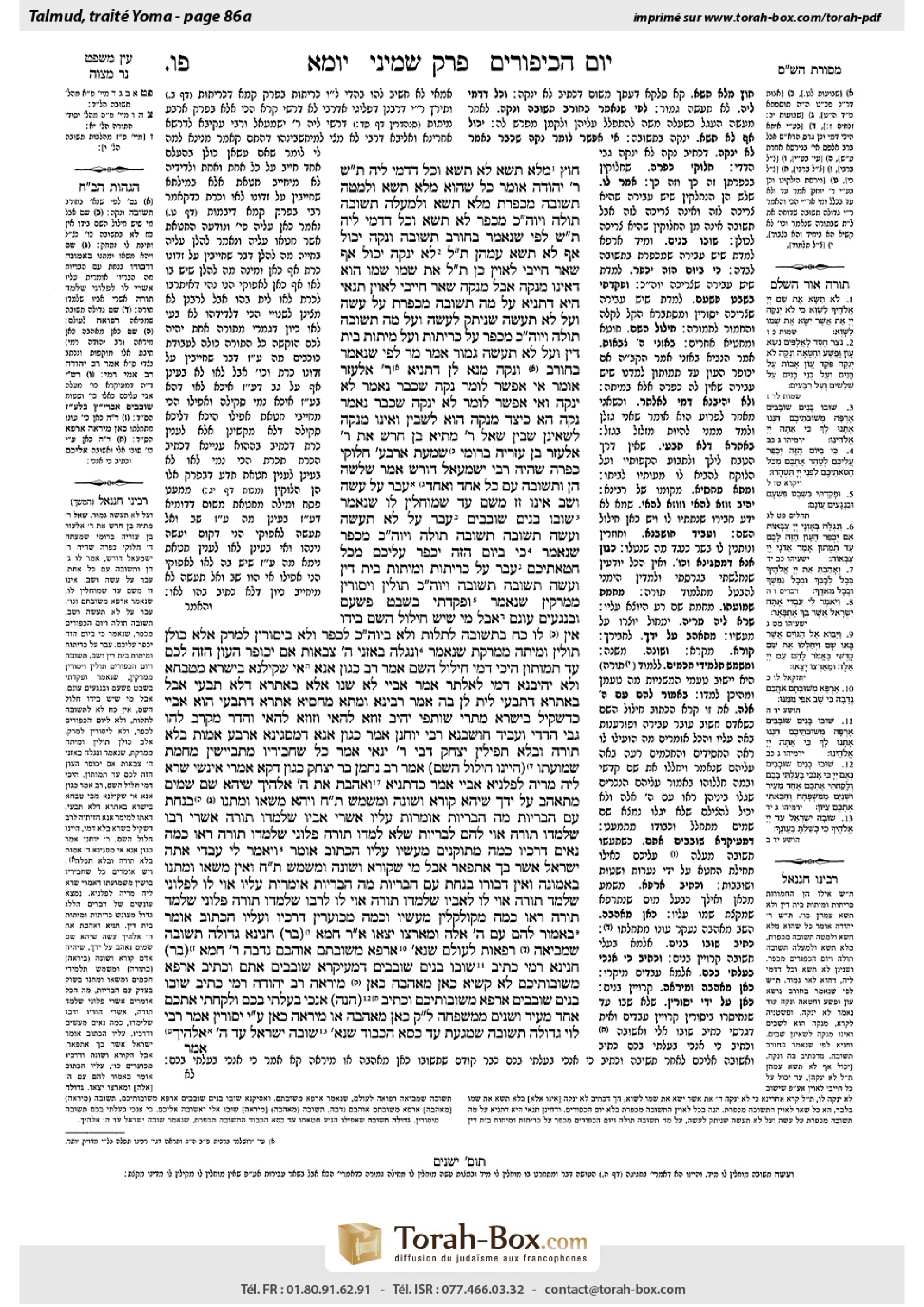
Yoma 86a: Talmud study for Daf Yomi
Daf Yomi is the daily study of one Talmud folio. Explore 37 tractates with scans, Hebrew text, Sefaria English and AI-generated French translations where annotated.
Passage selection and English or AI-generated French translation are available where the scan has annotations. Daf Study is independent of Torah-Box and Sefaria.
Browse Yoma · יומא · All tractatesYoma 86a text and translations
This page of Yoma includes the Aramaic text, an English translation and an AI-generated French translation, alongside the scan above.
יומא פ״ו א · Aramaic and Hebrew text
חוּץ מִ״לֹּא תִשָּׂא״! ״לֹא תִשָּׂא״ וְכֹל דְּדָמֵי לֵיהּ.
תָּא שְׁמַע, רַבִּי יְהוּדָה אוֹמֵר: כֹּל שֶׁהוּא מִ״לֹּא תִשָּׂא״ וּלְמַטָּה — תְּשׁוּבָה מְכַפֶּרֶת, מִ״לֹּא תִשָּׂא״ וּלְמַעְלָה — תְּשׁוּבָה תּוֹלָה וְיוֹם הַכִּפּוּרִים מְכַפֵּר. ״לֹא תִשָּׂא״ וְכׇל דְּדָמֵי לֵיהּ.
תָּא שְׁמַע: לְפִי שֶׁנֶּאֱמַר בְּחוֹרֵב תְּשׁוּבָה ״וְנַקֵּה״, יָכוֹל אַף ״לֹא תִשָּׂא״ עִמָּהֶן — תַּלְמוּד לוֹמַר: ״לֹא יְנַקֶּה״. יָכוֹל אַף שְׁאָר חַיָּיבֵי לָאוִין כֵּן — תַּלְמוּד לוֹמַר: ״אֶת שְׁמוֹ״, שְׁמוֹ הוּא דְּאֵינוֹ מְנַקֶּה, אֲבָל מְנַקֶּה שְׁאָר חַיָּיבֵי לָאוִין.
תַּנָּאֵי הִיא, דְּתַנְיָא: עַל מָה תְּשׁוּבָה מְכַפֶּרֶת — עַל עֲשֵׂה וְעַל לֹא תַעֲשֶׂה שֶׁנִּיתַּק לַעֲשֵׂה, וְעַל מָה תְּשׁוּבָה תּוֹלָה וְיוֹם הַכִּפּוּרִים מְכַפֵּר — עַל כָּרֵיתוֹת וְעַל מִיתוֹת בֵּית דִּין, וְעַל לֹא תַעֲשֶׂה גָּמוּר.
אָמַר מָר: לְפִי שֶׁנֶּאֱמַר בְּחוֹרֵב ״וְנַקֵּה״. מְנָא לַן? דְּתַנְיָא, רַבִּי אֶלְעָזָר אוֹמֵר: אִי אֶפְשָׁר לוֹמַר ״נַקֵּה״, שֶׁכְּבָר נֶאֱמַר ״לֹא יְנַקֶּה״, וְאִי אֶפְשָׁר לוֹמַר ״לֹא יְנַקֶּה״, שֶׁכְּבָר נֶאֱמַר ״נַקֵּה״. הָא כֵּיצַד? מְנַקֶּה הוּא לְשָׁבִין, וְאֵינוֹ מְנַקֶּה לְשֶׁאֵינָן שָׁבִין.
שָׁאַל רַבִּי מַתְיָא בֶּן חָרָשׁ אֶת רַבִּי אֶלְעָזָר בֶּן עֲזַרְיָה בְּרוֹמִי: שָׁמַעְתָּ אַרְבָּעָה חִלּוּקֵי כַפָּרָה שֶׁהָיָה רַבִּי יִשְׁמָעֵאל דּוֹרֵשׁ? אָמַר: שְׁלֹשָׁה הֵן, וּתְשׁוּבָה עִם כׇּל אֶחָד וְאֶחָד.
עָבַר עַל עֲשֵׂה וְשָׁב — אֵינוֹ זָז מִשָּׁם עַד שֶׁמּוֹחֲלִין לוֹ, שֶׁנֶּאֱמַר: ״שׁוּבוּ בָּנִים שׁוֹבָבִים״. עָבַר עַל לֹא תַעֲשֶׂה וְעָשָׂה תְּשׁוּבָה — תְּשׁוּבָה תּוֹלָה, וְיוֹם הַכִּפּוּרִים מְכַפֵּר. שֶׁנֶּאֱמַר: ״כִּי בַיּוֹם הַזֶּה יְכַפֵּר עֲלֵיכֶם מִכֹּל חַטֹּאתֵיכֶם״. עָבַר עַל כָּרֵיתוֹת וּמִיתוֹת בֵּית דִּין וְעָשָׂה תְּשׁוּבָה — תְּשׁוּבָה וְיוֹם הַכִּפּוּרִים תּוֹלִין, וְיִסּוּרִין מְמָרְקִין. שֶׁנֶּאֱמַר: ״וּפָקַדְתִּי בְשֵׁבֶט פִּשְׁעָם וּבִנְגָעִים עֲוֹנָם״.
אֲבָל מִי שֶׁיֵּשׁ חִילּוּל הַשֵּׁם בְּיָדוֹ — אֵין לוֹ כֹּחַ בִּתְשׁוּבָה לִתְלוֹת וְלֹא בְּיוֹם הַכִּפּוּרִים לְכַפֵּר וְלֹא בְּיִסּוּרִין לְמָרֵק, אֶלָּא כּוּלָּן תּוֹלִין, וּמִיתָה מְמָרֶקֶת, שֶׁנֶּאֱמַר: ״וְנִגְלָה בְאׇזְנָי ה׳ צְבָאוֹת אִם יְכוּפַּר הֶעָוֹן הַזֶּה לָכֶם עַד תְּמוּתוּן״.
הֵיכִי דָּמֵי חִילּוּל הַשֵּׁם? אָמַר רַב: כְּגוֹן אֲנָא, אִי שָׁקֵילְנָא בִּישְׂרָא מִטַּבָּחָא וְלָא יָהֵיבְנָא דְּמֵי לְאַלְתַּר. אָמַר אַבָּיֵי: לֹא שָׁנוּ אֶלָּא בְּאַתְרָא דְּלָא תָּבְעִי, אֲבָל בְּאַתְרָא דְּתָבְעִי — לֵית לַן בַּהּ.
אָמַר רָבִינָא: וּמָתָא מַחְסֵיָא אַתְרָא דְּתָבְעִי הוּא. אַבָּיֵי כִּדְשָׁקֵיל בִּישְׂרָא מִתְּרֵי שׁוּתָּפֵי, יָהֵיב זוּזָא לְהַאי וְזוּזָא לְהַאי, וַהֲדַר מְקָרֵב לְהוּ גַּבֵּי הֲדָדֵי וְעָבֵיד חוּשְׁבָּנָא.
רַבִּי יוֹחָנָן אָמַר: כְּגוֹן אֲנָא דִּמְסַגֵּינָא אַרְבַּע אַמּוֹת בְּלָא תּוֹרָה וּבְלָא תְּפִילִּין. יִצְחָק דְּבֵי רַבִּי יַנַּאי אָמַר: כׇּל שֶׁחֲבֵירָיו מִתְבַּיְּישִׁין מֵחֲמַת שְׁמוּעָתוֹ (הַיְינוּ חִילּוּל הַשֵּׁם). אָמַר רַב נַחְמָן בַּר יִצְחָק: כְּגוֹן דְּקָא אָמְרִי אִינָשֵׁי: שְׁרָא לֵיהּ מָרֵיהּ לִפְלָנְיָא.
אַבָּיֵי אָמַר, כִּדְתַנְיָא: ״וְאָהַבְתָּ אֵת ה׳ אֱלֹהֶיךָ״, שֶׁיְּהֵא שֵׁם שָׁמַיִם מִתְאַהֵב עַל יָדְךָ. שֶׁיְּהֵא קוֹרֵא וְשׁוֹנֶה וּמְשַׁמֵּשׁ תַּלְמִידֵי חֲכָמִים, וִיהֵא מַשָּׂאוֹ וּמַתָּנוֹ בְּנַחַת עִם הַבְּרִיּוֹת, מָה הַבְּרִיּוֹת אוֹמְרוֹת עָלָיו — אַשְׁרֵי אָבִיו שֶׁלִּמְּדוֹ תּוֹרָה, אַשְׁרֵי רַבּוֹ שֶׁלִּמְּדוֹ תּוֹרָה. אוֹי לָהֶם לַבְּרִיּוֹת שֶׁלֹּא לָמְדוּ תּוֹרָה, פְּלוֹנִי שֶׁלִּמְּדוֹ תּוֹרָה — רְאוּ כַּמָּה נָאִים דְּרָכָיו, כַּמָּה מְתוּקָּנִים מַעֲשָׂיו. עָלָיו הַכָּתוּב אוֹמֵר: ״וַיֹּאמֶר לִי עַבְדִּי אָתָּה יִשְׂרָאֵל אֲשֶׁר בְּךָ אֶתְפָּאָר״.
אֲבָל מִי שֶׁקּוֹרֵא וְשׁוֹנֶה וּמְשַׁמֵּשׁ תַּלְמִידֵי חֲכָמִים, וְאֵין מַשָּׂאוֹ וּמַתָּנוֹ בֶּאֱמוּנָה, וְאֵין דִּבּוּרוֹ בְּנַחַת עִם הַבְּרִיּוֹת, מָה הַבְּרִיּוֹת אוֹמְרוֹת עָלָיו — אוֹי לוֹ לִפְלוֹנִי שֶׁלָּמַד תּוֹרָה. אוֹי לוֹ לְאָבִיו שֶׁלִּמְּדוֹ תּוֹרָה, אוֹי לוֹ לְרַבּוֹ שֶׁלִּמְּדוֹ תּוֹרָה. פְּלוֹנִי שֶׁלָּמַד תּוֹרָה — רְאוּ כַּמָּה מְקוּלְקָלִין מַעֲשָׂיו וְכַמָּה מְכוֹעָרִין דְּרָכָיו, וְעָלָיו הַכָּתוּב אוֹמֵר: ״בֶּאֱמוֹר לָהֶם עַם ה׳ אֵלֶּה וּמֵאַרְצוֹ יָצָאוּ״.
אָמַר רַבִּי חָמָא (בַּר) חֲנִינָא: גְּדוֹלָה תְּשׁוּבָה שֶׁמְּבִיאָה רִפְאוּת לְעוֹלָם, שֶׁנֶּאֱמַר: ״אֶרְפָּא מְשׁוּבָתָם אוֹהֲבֵם נְדָבָה״.
רַבִּי חָמָא (בַּר) חֲנִינָא רָמֵי, כְּתִיב: ״שׁוּבוּ בָּנִים שׁוֹבָבִים״, דְּמֵעִיקָּרָא שׁוֹבָבִים אַתֶּם, וּכְתִיב: ״אֶרְפָּא מְשׁוּבוֹתֵיכֶם״! לָא קַשְׁיָא: כָּאן מֵאַהֲבָה, כָּאן מִיִּרְאָה.
רַב יְהוּדָה רָמֵי, כְּתִיב: ״שׁוּבוּ בָּנִים שׁוֹבָבִים אֶרְפָּא מְשׁוּבוֹתֵיכֶם״, וּכְתִיב: ״(הִנֵּה) אָנֹכִי בָּעַלְתִּי בָכֶם וְלָקַחְתִּי אֶתְכֶם אֶחָד מֵעִיר וּשְׁנַיִם מִמִּשְׁפָּחָה״! לָא קַשְׁיָא: כָּאן מֵאַהֲבָה אוֹ מִיִּרְאָה, כָּאן עַל יְדֵי יִסּוּרִין. אָמַר רַבִּי לֵוִי: גְּדוֹלָה תְּשׁוּבָה שֶׁמַּגַּעַת עַד כִּסֵּא הַכָּבוֹד, שֶׁנֶּאֱמַר: ״שׁוּבָה יִשְׂרָאֵל עַד ה׳ אֱלֹהֶיךָ״.
Yoma 86a · English translation
except for: “You shall not take the name of the Lord, your God, in vain” (Exodus 20:7), about which the Torah states: “For God will not absolve him who takes His name in vain” (Exodus 20:7). The Gemara answers: It is not that this is the only negative mitzva that is not a minor transgression; rather, it is: “You shall not take the name of the Lord, your God, in vain” and any prohibition similar to it, meaning all severe prohibitions that carry punishment by a court.
The Gemara proposes: Come and hear from that which was taught: Rabbi Yehuda says: For any sin from “You shall not take the name of the Lord, your God, in vain” and below, i.e., prohibitions less severe than that, repentance atones. For any sin from “You shall not take the name of the Lord, your God, in vain” and above, repentance suspends punishment and Yom Kippur atones. The Gemara rejects this: This does not constitute proof either, since one could say that it is referring to: “You shall not take the name of the Lord, your God, in vain” and anything similar to it.
Come and hear from a different source that was taught: Since it was stated at Horeb with regard to repentance: “Absolve,” one might have thought that even the transgression of: “You shall not take the name of the Lord, your God, in vain” is included among them; therefore, the verses states: “Will not absolve” (Exodus 20:6). One might have thought this is also true for those who are liable for violating all other prohibitions; therefore, the verse states: “His name.” God does not absolve the one who disrespects His name, but He absolves those who are liable for violating all other prohibitions and repent. This is proof that those who violate all other prohibitions are not comparable to one who violates: “You shall not take the name of the Lord, your God, in vain.”
The Gemara answers: This is a dispute between tanna’im, as it was taught in a baraita: For what does repentance atone? It atones for a positive mitzva and for a negative mitzva that can be rectified through a positive mitzva. And for what does repentance suspend punishment and Yom Kippur atone? It is for sins punishable by karet, and for sins punishable by the death penalty from the earthly court, and for full-fledged negative mitzvot. This indicates that there is a tanna who distinguishes between prohibitions that warrant lashes and those that do not. Therefore, there is a tannaitic dispute as to whether or not prohibitions that warrant punishment by the courts can be rectified by repentance alone.
§ Since the Gemara cited this baraita, it now clarifies part of it. The Master said: Since it was stated at Horeb with regard to repentance: “Absolve.” The Gemara asks: From where do we derive this concept that repentance was mentioned there? The Gemara answers: As it was taught in a baraita that Rabbi Elazar says: It is not possible to say “absolve” (Exodus 34:7) about all transgressions, since “will not absolve” is already stated (Exodus 34:7). And it is not possible to say “will not absolve,” since “absolve” is already stated. How so? The Holy One, Blessed be He, absolves those who repent and does not absolve those who do not repent. Therefore, both “repentance” and “absolve” were mentioned at Horeb.
Furthermore, with regard to the topic of repentance, Rabbi Matya ben Ḥarash asked Rabbi Elazar ben Azarya when Rabbi Elazar was in Rome: Have you heard the teaching that there are four distinctions in the process of atonement that Rabbi Yishmael would derive? He said to him: They are not four but three distinctions, and repentance is necessary with each one.
These are the categories: If one violates a positive mitzva and repents, he is forgiven even before he moves from his place, i.e. immediately, as it is stated: “Return, you backsliding children, I will heal your backsliding” (Jeremiah 3:22), implying that when one repents he is immediately forgiven. If one violates a prohibition and repents, repentance suspends his punishment and Yom Kippur atones for his sin, as it is stated: “For on this day shall atonement be made for you, to purify you from all your sins” (Leviticus 16:30). If one commits a transgression that warrants karet or a sin punishable by death from the earthly court and then repents, repentance and Yom Kippur suspend his punishment, and suffering absolves and completes the atonement, as it is stated: “Then will I visit their transgression with the rod, and their iniquity with strokes” (Psalms 89:33).
But in the case of one who has caused desecration of God’s name, his repentance has no power to suspend punishment, nor does Yom Kippur have power to atone for his sin, nor does suffering alone have power to absolve him. Rather, all these suspend punishment, and death absolves him, as it is stated: “And the Lord of Hosts revealed Himself to my ears: This iniquity shall not be atoned for until you die” (Isaiah 22:14).
§ The Gemara asks: What are the circumstances that cause desecration of God’s name? Rav said: For example, in the case of someone like me, since I am an important public figure, if I take meat from a butcher and do not give him money immediately, people are likely to think that I did not mean to pay at all. They would consider me a thief and learn from my behavior that one is permitted to steal. Abaye said: They taught this statement of Rav only in a place where they do not ask for the money, where it is not customary for the butcher himself to come and collect payment from the customer. When the customer does not pay immediately, people may suspect him of theft. But in a place where they ask for the money from the customer some time later, we have no problem with doing this. Since everyone understands he is buying on credit, he is not desecrating God’s name.
Ravina said: My native city of Meḥasya is a place where they ask for and collect the money. The Gemara relates that when Abaye bought meat from two partners, he would give the money to this one and the money to this one, so that each would know that he had paid. And afterward he would bring them together and perform the calculation to see whether he received his change.
Rabbi Yoḥanan said: What is an example of desecration of God’s name? For example, someone like me, if I would walk four cubits without Torah and without phylacteries, and the onlookers did not know that it is only on account of my body’s weakness, that would be a desecration of God’s name. Yitzḥak from the school of Rabbi Yannai said: Any case when one’s friends are embarrassed on account of his reputation, meaning his friends are embarrassed due to things they hear about him, this is a desecration of God’s name. Rav Naḥman bar Yitzḥak said: One creates a profanation of God’s name, for example, when people say about him: May his Master forgive so-and-so for the sins he has done.
Abaye said: As it was taught in a baraita that it is stated: “And you shall love the Lord your God” (Deuteronomy 6:5), which means that you shall make the name of Heaven beloved. How should one do so? One should do so in that he should read Torah, and learn Mishna, and serve Torah scholars, and he should be pleasant with people in his business transactions. What do people say about such a person? Fortunate is his father who taught him Torah, fortunate is his teacher who taught him Torah, woe to the people who have not studied Torah. So-and-so, who taught him Torah, see how pleasant are his ways, how proper are his deeds. The verse states about him and others like him: “You are My servant, Israel, in whom I will be glorified” (Isaiah 49:3).
But one who reads Torah, and learns Mishna, and serves Torah scholars, but his business practices are not done faithfully, and he does not speak pleasantly with other people, what do people say about him? Woe to so-and-so who studied Torah, woe to his father who taught him Torah, woe to his teacher who taught him Torah. So-and-so who studied Torah, see how destructive are his deeds, and how ugly are his ways. About him and others like him the verse states that the gentiles will say: “Men said of them: These are the people of the Lord, yet they had to leave His land” (Ezekiel 36:20). Through their sins and subsequent exile, such people have desecrated the name of God.
§ Further on the topic of repentance, Rabbi Ḥama bar Ḥanina said: Great is repentance, as it brings healing to the world, as it is stated: “I will heal their backsliding, I will love them freely” (Hosea 14:5), which teaches that repentance from sin brings healing.
Rabbi Ḥama bar Ḥanina raised a contradiction between two verses. It is written in one verse: “Return, you backsliding children” (Jeremiah 3:14), implying that initially when you sinned, it was only because you were backsliding, i.e., rebelling. It was merely an act of immaturity and foolishness and could be ignored as if it had never happened. But it is written: “I will heal your backsliding” (Jeremiah 3:22), implying that He will heal the sin from this point onward, and that they are still sinners. He resolved this contradiction, explaining that this is not difficult: Here, where everything is forgiven as if the Jewish people never sinned, it is referring to repentance out of love; there, where the sin is still remembered despite the forgiveness and repentance, it is referring to repentance out of fear.
Similarly, Rabbi Yehuda raised a contradiction between two verses. It is written: “Return, you backsliding children I will heal your backsliding” (Jeremiah 3:22), implying that anyone can achieve healing, which is dependent only on repentance. But it also states: “Return, O backsliding children, says the Lord, for I am a lord to you, and I will take you one from a city, and two from a family” (Jeremiah 3:14), implying that repentance is available only to certain individuals. He resolved the contradiction and explained that this is not difficult: Here, it is referring to repentance out of love or fear, which few people achieve; there, it referring is repentance through suffering, as everyone has thoughts of repentance when they suffer. Rabbi Levi said: Great is repentance, as it reaches the heavenly throne, as it is stated: “Return, Israel, to the Lord your God” (Hosea 14:2). This implies that repentance literally reaches to God.
Yoma 86a · Traduction française (IA)
à l’exception de : « Tu ne prendras pas en vain le nom du Seigneur, ton Dieu » (Exode 20:7), au sujet duquel la Torah dit : « Car le Seigneur ne tiendra pas pour quitte celui qui prend Son nom en vain » (Exode 20:7). La Guemara répond : Il ne s’agit pas de dire que c’est la seule mitsva négative qui ne constitue pas une faute mineure ; il s’agit plutôt de « Tu ne prendras pas en vain le nom du Seigneur, ton Dieu » et de toute interdiction semblable, c’est-à-dire de toutes les interdictions graves passibles d’une peine prononcée par un tribunal.
La Guemara propose : Viens et entends ce qui a été enseigné : Rabbi Yehouda dit : Pour toute faute relevant de « Tu ne prendras pas en vain le nom du Seigneur, ton Dieu » et des interdictions moins graves que celle-ci, le repentir apporte l’expiation. Pour toute faute relevant de « Tu ne prendras pas en vain le nom du Seigneur, ton Dieu » et des interdictions plus graves que celle-ci, le repentir suspend la peine et Yom Kippour apporte l’expiation. La Guemara rejette cette preuve : elle ne constitue pas non plus une preuve, car on pourrait dire qu’il s’agit de « Tu ne prendras pas en vain le nom du Seigneur, ton Dieu » et de toute interdiction semblable.
Viens et entends une autre source qui a été enseignée : puisqu’il est dit au Horeb, au sujet du repentir : « absoudre », on aurait pu penser que la transgression de « Tu ne prendras pas en vain le nom du Seigneur, ton Dieu » est elle aussi incluse parmi celles qui sont absoutes ; c’est pourquoi le verset dit : « ne tiendra pas pour quitte » (Exode 20:6). On aurait pu penser qu’il en va de même pour ceux qui sont passibles d’une peine pour avoir transgressé toutes les autres interdictions ; c’est pourquoi le verset dit : « Son nom ». Dieu ne tient pas pour quitte celui qui profane Son nom, mais Il tient pour quittes ceux qui sont passibles d’une peine pour avoir transgressé toutes les autres interdictions et qui se repentent. Cela prouve que ceux qui transgressent toutes les autres interdictions ne sont pas comparables à celui qui transgresse « Tu ne prendras pas en vain le nom du Seigneur, ton Dieu ».
La Guemara répond : Il s’agit d’une controverse entre tannaïm, comme on l’a enseigné dans une baraïta : De quoi le repentir apporte-t-il l’expiation ? Il apporte l’expiation pour une mitsva positive et pour une mitsva négative qui peut être réparée par l’accomplissement d’une mitsva positive. Et pour quelles fautes le repentir suspend-il la peine, tandis que Yom Kippour apporte l’expiation ? Pour les fautes passibles de karet, pour les fautes passibles de la peine de mort prononcée par un tribunal terrestre, et pour les mitsvot négatives à part entière. Cela indique qu’il existe un tanna qui distingue les interdictions passibles de flagellation de celles qui ne le sont pas. Il y a donc une controverse entre tannaïm quant à savoir si les interdictions passibles d’une peine prononcée par les tribunaux peuvent ou non être réparées par le seul repentir.
§ Puisque la Guemara a cité cette baraïta, elle en précise à présent une partie. Le maître a dit : « Puisqu’il est dit au Horeb, au sujet du repentir : “absoudre”. » La Guemara demande : D’où déduisons-nous que le repentir a été mentionné là-bas ? La Guemara répond : Comme on l’a enseigné dans une baraïta, Rabbi Elazar dit : Il est impossible de comprendre « absoudre » (Exode 34:7) comme s’appliquant à toutes les transgressions, puisque « ne tiendra pas pour quitte » est déjà dit (Exode 34:7). Et il est impossible de comprendre « ne tiendra pas pour quitte » comme s’appliquant à toutes les transgressions, puisque « absoudre » est déjà dit. Comment faut-il donc comprendre ? Le Saint, béni soit-Il, tient pour quittes ceux qui se repentent et ne tient pas pour quittes ceux qui ne se repentent pas. Ainsi, le « repentir » comme l’« absolution » ont été mentionnés au Horeb.
En outre, à propos du repentir, Rabbi Matya ben Ḥarash demanda à Rabbi Elazar ben Azarya, alors que celui-ci se trouvait à Rome : As-tu entendu l’enseignement selon lequel il existe quatre distinctions dans le processus d’expiation que Rabbi Yishmael déduisait ? Il lui répondit : Il n’y a pas quatre distinctions, mais trois, et le repentir est nécessaire dans chacune d’elles.
Voici les catégories : si quelqu’un transgresse une mitsva positive et se repent, il est pardonné avant même d’avoir quitté sa place, c’est-à-dire immédiatement, comme il est dit : « Revenez, enfants rebelles, Je guérirai votre rébellion » (Jérémie 3:22), ce qui implique que lorsqu’on se repent, on est immédiatement pardonné. Si quelqu’un transgresse une interdiction et se repent, le repentir suspend sa peine et Yom Kippour apporte l’expiation de sa faute, comme il est dit : « Car en ce jour, il sera fait expiation pour vous, afin de vous purifier de toutes vos fautes » (Lévitique 16:30). Si quelqu’un commet une transgression passible de karet ou une faute passible de la peine de mort prononcée par un tribunal terrestre, puis se repent, le repentir et Yom Kippour suspendent sa peine, et les souffrances l’absousent et achèvent l’expiation, comme il est dit : « Alors Je châtierai leur transgression par le bâton, et leur iniquité par des coups » (Psaumes 89:33).
Mais dans le cas de celui qui a provoqué la profanation du nom de Dieu, son repentir ne peut suspendre la peine, Yom Kippour ne peut pas non plus expier sa faute, et les souffrances seules ne peuvent pas l’absoudre. Au contraire, tous ces éléments suspendent la peine, et la mort l’absout, comme il est dit : « Le Seigneur des armées s’est révélé à mes oreilles : cette iniquité ne sera pas expiée jusqu’à votre mort » (Isaïe 22:14).
§ La Guemara demande : Dans quelles circonstances y a-t-il profanation du nom de Dieu ? Rav dit : Par exemple, dans le cas de quelqu’un comme moi, puisque je suis une personnalité publique importante : si je prends de la viande chez un boucher sans lui donner immédiatement l’argent, les gens risquent de penser que je n’ai pas l’intention de payer. Ils me considéreraient comme un voleur et apprendraient de mon comportement qu’il est permis de voler. Abayé dit : Cet enseignement de Rav ne s’applique que dans un endroit où l’on ne réclame pas l’argent, où il n’est pas d’usage que le boucher vienne lui-même percevoir le paiement auprès du client. Lorsque le client ne paie pas immédiatement, les gens peuvent le soupçonner de vol. Mais dans un endroit où l’on vient réclamer l’argent au client quelque temps plus tard, il n’y a aucun problème à agir ainsi. Puisque tout le monde comprend qu’il achète à crédit, il ne profane pas le nom de Dieu.
Ravina dit : Ma ville natale, Meḥasya, est un endroit où l’on vient réclamer et percevoir l’argent. La Guemara rapporte que lorsqu’Abayé achetait de la viande à deux associés, il donnait de l’argent à l’un et à l’autre, afin que chacun sache qu’il avait payé. Ensuite, il les réunissait et faisait le calcul pour vérifier s’il avait reçu sa monnaie.
Rabbi Yoḥanan dit : Quel est un exemple de profanation du nom de Dieu ? Dans le cas de quelqu’un comme moi : si je marchais quatre coudées sans Torah et sans phylactères, et que les personnes qui me regardaient ne savaient pas que c’était uniquement à cause de la faiblesse de mon corps, ce serait une profanation du nom de Dieu. Yitzḥak, de l’école de Rabbi Yannai, dit : Chaque fois que les amis d’une personne sont embarrassés à cause de sa réputation, c’est-à-dire par ce qu’ils entendent à son sujet, il y a profanation du nom de Dieu. Rav Naḥman bar Yitzḥak dit : Il y a profanation du nom de Dieu, par exemple, lorsque les gens disent à son sujet : « Que son Maître pardonne à untel les fautes qu’il a commises. »
Abayé dit : Comme on l’a enseigné dans une baraïta, il est dit : « Tu aimeras le Seigneur ton Dieu » (Deutéronome 6:5), ce qui signifie que tu rendras le nom du Ciel aimé. Comment faut-il s’y prendre ? Il faut lire la Torah, étudier la Michna, servir les érudits de la Torah et se montrer agréable envers les gens dans ses transactions commerciales. Que disent les gens d’une telle personne ? Heureux son père qui lui a enseigné la Torah, heureux son maître qui lui a enseigné la Torah ; malheur aux gens qui n’ont pas étudié la Torah. « Untel, qui lui a enseigné la Torah : voyez comme ses manières sont agréables et comme ses actes sont convenables. » Le verset dit à son sujet et au sujet de ceux qui lui ressemblent : « Tu es Mon serviteur, Israël, en qui Je serai glorifié » (Isaïe 49:3).
Mais que disent les gens de celui qui lit la Torah, étudie la Michna et sert les érudits de la Torah, mais dont les pratiques commerciales ne sont pas honnêtes et qui ne parle pas agréablement aux autres ? « Malheur à untel qui a étudié la Torah, malheur à son père qui lui a enseigné la Torah, malheur à son maître qui lui a enseigné la Torah. Untel a étudié la Torah : voyez comme ses actes sont destructeurs et comme ses manières sont laides. » À son sujet et au sujet de ceux qui lui ressemblent, le verset rapporte que les nations diront : « On disait d’eux : “Ce sont les gens du Seigneur”, et pourtant ils ont dû quitter Son pays » (Ézéchiel 36:20). Par leurs fautes et l’exil qui s’ensuivit, ces personnes ont profané le nom de Dieu.
§ Poursuivant le thème du repentir, Rabbi Ḥama bar Ḥanina dit : Le repentir est grand, car il apporte la guérison au monde, comme il est dit : « Je guérirai leur rébellion, Je les aimerai librement » (Osée 14:5), ce qui enseigne que le repentir après une faute apporte la guérison.
Rabbi Ḥama bar Ḥanina soulève une contradiction entre deux versets. Dans un verset, il est écrit : « Revenez, enfants rebelles » (Jérémie 3:14), ce qui implique qu’au départ, lorsque vous avez péché, c’était seulement parce que vous étiez rebelles, c’est-à-dire en révolte. Ce n’était qu’un acte d’immaturité et de sottise, que l’on pouvait ignorer comme s’il ne s’était jamais produit. Mais il est écrit : « Je guérirai votre rébellion » (Jérémie 3:22), ce qui implique qu’Il guérira la faute désormais et qu’ils sont encore pécheurs. Il résout cette contradiction en expliquant qu’il n’y a pas de difficulté : ici, lorsque tout est pardonné comme si le peuple juif n’avait jamais péché, il s’agit du repentir par amour ; là, lorsque la faute reste présente à la mémoire malgré le pardon et le repentir, il s’agit du repentir par crainte.
De même, Rabbi Yehouda soulève une contradiction entre deux versets. Il est écrit : « Revenez, enfants rebelles, Je guérirai votre rébellion » (Jérémie 3:22), ce qui implique que tout le monde peut parvenir à la guérison, puisqu’elle dépend uniquement du repentir. Mais il est également dit : « Revenez, enfants rebelles, dit le Seigneur, car Je suis votre maître, et Je vous prendrai, un d’une ville et deux d’une famille » (Jérémie 3:14), ce qui implique que le repentir n’est accessible qu’à certaines personnes. Il résout la contradiction et explique qu’il n’y a pas de difficulté : ici, il s’agit du repentir par amour ou par crainte, auquel peu de gens parviennent ; là, il s’agit du repentir provoqué par les souffrances, car tout le monde pense à se repentir lorsqu’il souffre. Rabbi Levi dit : Le repentir est grand, car il atteint le trône céleste, comme il est dit : « Reviens, Israël, au Seigneur ton Dieu » (Osée 14:2). Cela implique que le repentir atteint littéralement Dieu.
Traduction française générée par IA à partir de l’édition anglaise de Sefaria. Vérifie toujours un passage avec le texte source.
Text from Sefaria: William Davidson Edition - Vocalized Aramaic (CC BY NC); William Davidson Edition - English (CC BY NC).