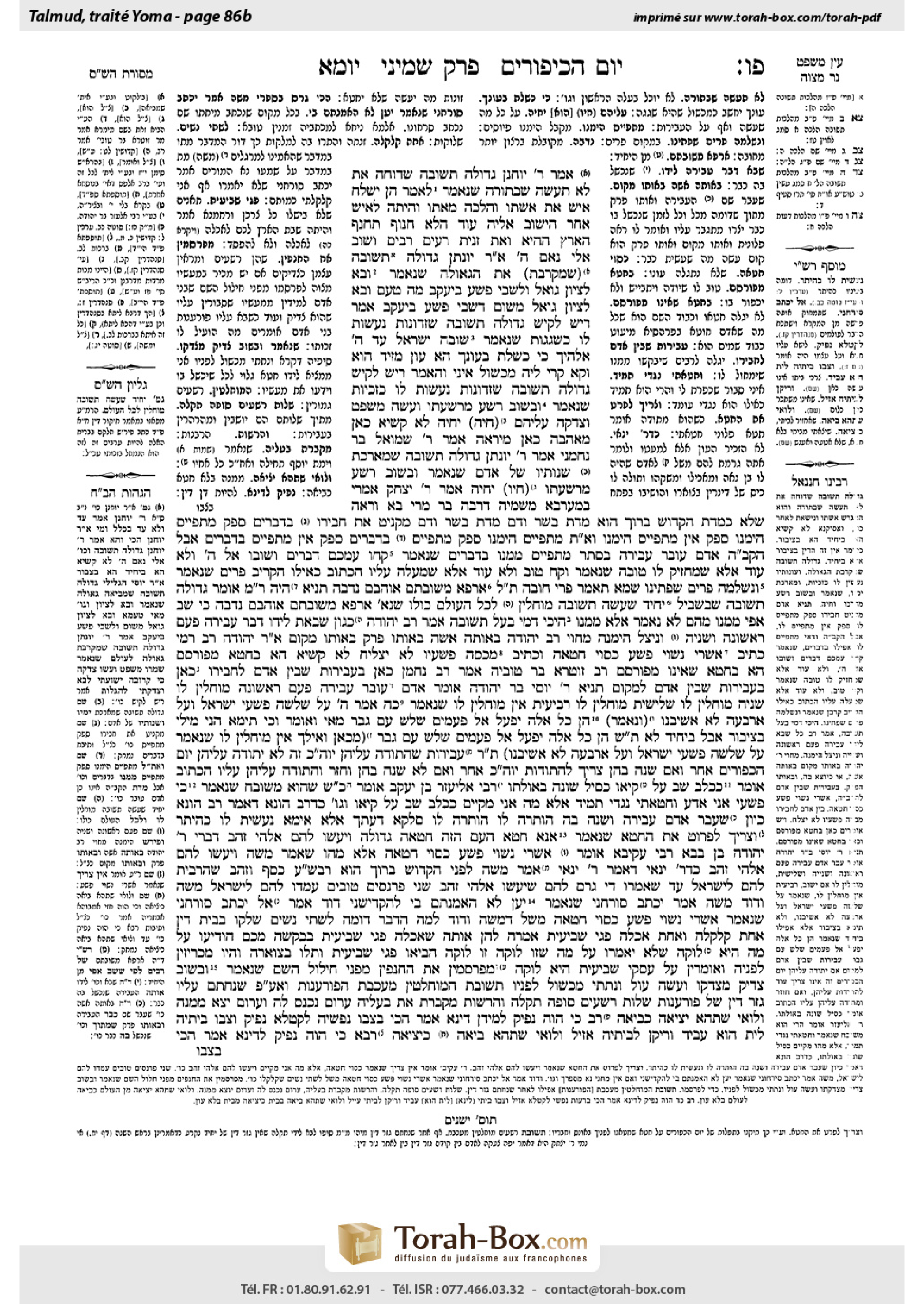
Yoma 86b: Talmud study for Daf Yomi
Daf Yomi is the daily study of one Talmud folio. Explore 37 tractates with scans, Hebrew text, Sefaria English and AI-generated French translations where annotated.
Passage selection and English or AI-generated French translation are available where the scan has annotations. Daf Study is independent of Torah-Box and Sefaria.
Browse Yoma · יומא · All tractatesYoma 86b text and translations
This page of Yoma includes the Aramaic text, an English translation and an AI-generated French translation, alongside the scan above.
יומא פ״ו ב · Aramaic and Hebrew text
אָמַר רַבִּי יוֹחָנָן: גְּדוֹלָה תְּשׁוּבָה שֶׁדּוֹחָה אֶת לֹא תַעֲשֶׂה שֶׁבַּתּוֹרָה, שֶׁנֶּאֱמַר: ״לֵאמֹר הֵן יְשַׁלַּח אִישׁ אֶת אִשְׁתּוֹ וְהָלְכָה מֵאִתּוֹ וְהָיְתָה לְאִישׁ אַחֵר הֲיָשׁוּב אֵלֶיהָ עוֹד הֲלֹא חָנוֹף תֶּחֱנַף הָאָרֶץ הַהִיא וְאַתְּ זָנִית רֵעִים רַבִּים וְשׁוֹב אֵלַי נְאֻם ה׳״.
אָמַר רַבִּי יוֹנָתָן: גְּדוֹלָה תְּשׁוּבָה (שֶׁמְּקָרֶבֶת) אֶת הַגְּאוּלָּה, שֶׁנֶּאֱמַר: ״וּבָא לְצִיּוֹן גּוֹאֵל וּלְשָׁבֵי פֶשַׁע בְּיַעֲקֹב״, מָה טַעַם ״וּבָא לְצִיּוֹן גּוֹאֵל״ — מִשּׁוּם דְּ״שָׁבֵי פֶשַׁע בְּיַעֲקֹב״.
אָמַר רֵישׁ לָקִישׁ: גְּדוֹלָה תְּשׁוּבָה שֶׁזְּדוֹנוֹת נַעֲשׂוֹת לוֹ כִּשְׁגָגוֹת, שֶׁנֶּאֱמַר: ״שׁוּבָה יִשְׂרָאֵל עַד ה׳ אֱלֹהֶיךָ כִּי כָשַׁלְתָּ בַּעֲוֹנֶךָ״, הָא ״עָוֹן״ — מֵזִיד הוּא, וְקָא קָרֵי לֵיהּ מִכְשׁוֹל. אִינִי?! וְהָאָמַר רֵישׁ לָקִישׁ: גְּדוֹלָה תְּשׁוּבָה שֶׁזְּדוֹנוֹת נַעֲשׂוֹת לוֹ כִּזְכִיּוֹת, שֶׁנֶּאֱמַר: ״וּבְשׁוּב רָשָׁע מֵרִשְׁעָתוֹ וְעָשָׂה מִשְׁפָּט וּצְדָקָה עֲלֵיהֶם (חָיֹה) יִחְיֶה״! לָא קַשְׁיָא: כָּאן מֵאַהֲבָה, כָּאן מִיִּרְאָה.
אָמַר רַבִּי שְׁמוּאֵל בַּר נַחְמָנִי אָמַר רַבִּי יוֹנָתָן: גְּדוֹלָה תְּשׁוּבָה שֶׁמַּאֲרֶכֶת שְׁנוֹתָיו שֶׁל אָדָם, שֶׁנֶּאֱמַר: ״וּבְשׁוּב רָשָׁע מֵרִשְׁעָתוֹ (חָיוֹ) יִחְיֶה״.
אָמַר רַבִּי יִצְחָק: אָמְרִי בְּמַעְרְבָא מִשְּׁמֵיהּ דְּרַבָּה בַּר מָרִי: בֹּא וּרְאֵה שֶׁלֹּא כְּמִדַּת הַקָּדוֹשׁ בָּרוּךְ הוּא מִדַּת בָּשָׂר וָדָם: מִדַּת בָּשָׂר וָדָם, מַקְנִיט אֶת חֲבֵירוֹ בִּדְבָרִים — סָפֵק מִתְפַּיֵּיס הֵימֶנּוּ, סָפֵק אֵין מִתְפַּיֵּיס הֵימֶנּוּ. וְאִם תֹּאמַר מִתְפַּיֵּיס הֵימֶנּוּ — סָפֵק מִתְפַּיֵּיס בִּדְבָרִים, סָפֵק אֵין מִתְפַּיֵּיס בִּדְבָרִים,
אֲבָל הַקָּדוֹשׁ בָּרוּךְ הוּא, אָדָם עוֹבֵר עֲבֵירָה בַּסֵּתֶר — מִתְפַּיֵּיס מִמֶּנּוּ בִּדְבָרִים, שֶׁנֶּאֱמַר: ״קְחוּ עִמָּכֶם דְּבָרִים וְשׁוּבוּ אֶל ה׳״. וְלֹא עוֹד, אֶלָּא שֶׁמַּחְזִיק לוֹ טוֹבָה, שֶׁנֶּאֱמַר: ״וְקַח טוֹב״. וְלֹא עוֹד אֶלָּא שֶׁמַּעֲלֶה עָלָיו הַכָּתוּב כְּאִילּוּ הִקְרִיב פָּרִים, שֶׁנֶּאֱמַר: ״וּנְשַׁלְּמָה פָּרִים שְׂפָתֵינוּ״. שֶׁמָּא תֹּאמַר פָּרֵי חוֹבָה, תַּלְמוּד לוֹמַר: ״אֶרְפָּא מְשׁוּבָתָם אוֹהֲבֵם נְדָבָה״.
תַּנְיָא, הָיָה רַבִּי מֵאִיר אוֹמֵר: גְּדוֹלָה תְּשׁוּבָה, שֶׁבִּשְׁבִיל יָחִיד שֶׁעָשָׂה תְּשׁוּבָה — מוֹחֲלִין לְכׇל הָעוֹלָם כּוּלּוֹ, שֶׁנֶּאֱמַר: ״אֶרְפָּא מְשׁוּבָתָם אוֹהֲבֵם נְדָבָה כִּי שָׁב אַפִּי מִמֶּנּוּ״. ״מֵהֶם״ לֹא נֶאֱמַר, אֶלָּא ״מִמֶּנּוּ״.
הֵיכִי דָּמֵי בַּעַל תְּשׁוּבָה? אָמַר רַב יְהוּדָה: כְּגוֹן שֶׁבָּאת לְיָדוֹ דְּבַר עֲבֵירָה פַּעַם רִאשׁוֹנָה וּשְׁנִיָּה וְנִיצַּל הֵימֶנָּה. מַחְוֵי רַב יְהוּדָה: בְּאוֹתָהּ אִשָּׁה, בְּאוֹתוֹ פֶּרֶק, בְּאוֹתוֹ מָקוֹם.
אָמַר רַב יְהוּדָה, רַב רָמֵי — כְּתִיב: ״אַשְׁרֵי נְשׂוּי פֶּשַׁע כְּסוּי חֲטָאָה״, וּכְתִיב: ״מְכַסֶּה פְשָׁעָיו לֹא יַצְלִיחַ״! לָא קַשְׁיָא: הָא בְּחֵטְא מְפוּרְסָם, הָא בְּחֵטְא שֶׁאֵינוֹ מְפוּרְסָם. רַב זוּטְרָא בַּר טוֹבִיָּה אָמַר רַב נַחְמָן: כָּאן בַּעֲבֵירוֹת שֶׁבֵּין אָדָם לַחֲבֵירוֹ, כָּאן בַּעֲבֵירוֹת שֶׁבֵּין אָדָם לַמָּקוֹם.
תַּנְיָא, רַבִּי יוֹסֵי בַּר יְהוּדָה אוֹמֵר: אָדָם עוֹבֵר עֲבֵירָה פַּעַם רִאשׁוֹנָה — מוֹחֲלִין לוֹ, שְׁנִיָּה — מוֹחֲלִין לוֹ, שְׁלִישִׁית — מוֹחֲלִין לוֹ, רְבִיעִית — אֵין מוֹחֲלִין לוֹ, שֶׁנֶּאֱמַר: ״כֹּה אָמַר ה׳ עַל שְׁלֹשָׁה פִּשְׁעֵי יִשְׂרָאֵל וְעַל אַרְבָּעָה לֹא אֲשִׁיבֶנּוּ״, (וְנֶאֱמַר:) ״הֵן כׇּל אֵלֶּה יִפְעַל אֵל פַּעֲמַיִם שָׁלֹשׁ עִם גָּבֶר״.
מַאי ״וְאוֹמֵר״? וְכִי תֵּימָא: הָנֵי מִילֵּי בְּצִיבּוּר, אֲבָל בְּיָחִיד — לָא, תָּא שְׁמַע: ״הֶן כׇּל אֵלֶּה יִפְעַל אֵל פַּעֲמַיִם שָׁלֹשׁ עִם גָּבֶר״. (מִכָּאן וְאֵילָךְ אֵין מוֹחֲלִין לוֹ, שֶׁנֶּאֱמַר: ״עַל שְׁלֹשָׁה פִּשְׁעֵי יִשְׂרָאֵל וְעַל אַרְבָּעָה לֹא אֲשִׁיבֶנּוּ״.)
תָּנוּ רַבָּנַן: עֲבֵירוֹת שֶׁהִתְוַדָּה עֲלֵיהֶן יוֹם הַכִּפּוּרִים זֶה, לֹא יִתְוַדֶּה עֲלֵיהֶן יוֹם הַכִּפּוּרִים אַחֵר. וְאִם שָׁנָה בָּהֶן — צָרִיךְ לְהִתְוַדּוֹת יוֹם הַכִּפּוּרִים אַחֵר. וְאִם לֹא שָׁנָה בָּהֶן, וְחָזַר וְהִתְוַדָּה — עֲלֵיהֶן עָלָיו הַכָּתוּב אוֹמֵר: ״כְּכֶלֶב שָׁב עַל קִיאוֹ כְּסִיל שׁוֹנֶה בְּאִוַּלְתּוֹ״.
רַבִּי אֱלִיעֶזֶר בֶּן יַעֲקֹב אוֹמֵר: כׇּל שֶׁכֵּן שֶׁהוּא מְשׁוּבָּח, שֶׁנֶּאֱמַר: ״כִּי פְשָׁעַי אֲנִי אֵדָע וְחַטָּאתִי נֶגְדִּי תָמִיד״. אֶלָּא מָה אֲנִי מְקַיֵּים ״כְּכֶלֶב שָׁב עַל קִיאוֹ וְגוֹ׳״ — כִּדְרַב הוּנָא. דְּאָמַר רַב הוּנָא, כֵּיוָן שֶׁעָבַר אָדָם עֲבֵירָה וְשָׁנָה בָּהּ — הוּתְּרָה לוֹ. הוּתְּרָה לוֹ סָלְקָא דַּעְתָּךְ?! אֶלָּא אֵימָא: נַעֲשֵׂית לוֹ כְּהֶיתֵּר.
וְצָרִיךְ לִפְרוֹט אֶת הַחֵטְא, שֶׁנֶּאֱמַר: ״אָנָּא חָטָא הָעָם הַזֶּה חֲטָאָה גְדוֹלָה וַיַּעֲשׂוּ לָהֶם אֱלֹהֵי זָהָב״, דִּבְרֵי רַבִּי יְהוּדָה בֶּן בָּבָא. רַבִּי עֲקִיבָא אוֹמֵר: ״אַשְׁרֵי נְשׂוּי פֶּשַׁע כְּסוּי חֲטָאָה״. אֶלָּא מַהוּ שֶׁאָמַר מֹשֶׁה: ״וַיַּעֲשׂוּ לָהֶם אֱלֹהֵי זָהָב״? כִּדְרַבִּי יַנַּאי. דְּאָמַר רַבִּי יַנַּאי: אָמַר מֹשֶׁה לִפְנֵי הַקָּדוֹשׁ בָּרוּךְ הוּא: רִבּוֹנוֹ שֶׁל עוֹלָם! כֶּסֶף וְזָהָב שֶׁהִרְבֵּיתָ לָהֶם לְיִשְׂרָאֵל עַד שֶׁאָמְרוּ דַּי — גָּרַם לָהֶם שֶׁיַּעֲשׂוּ אֱלֹהֵי זָהָב.
שְׁנֵי פַּרְנָסִים טוֹבִים עָמְדוּ לָהֶם לְיִשְׂרָאֵל: מֹשֶׁה וְדָוִד. מֹשֶׁה אָמַר: יִכָּתֵב סוּרְחָנִי, שֶׁנֶּאֱמַר: ״יַעַן לֹא הֶאֱמַנְתֶּם בִּי לְהַקְדִּישֵׁנִי״, דָּוִד אָמַר: אַל יִכָּתֵב סוּרְחָנִי. שֶׁנֶּאֱמַר: ״אַשְׁרֵי נְשׂוּי פֶּשַׁע כְּסוּי חֲטָאָה״.
מָשָׁל דְּמֹשֶׁה וְדָוִד לְמָה הַדָּבָר דּוֹמֶה? לִשְׁתֵּי נָשִׁים שֶׁלָּקוּ בְּבֵית דִּין, אַחַת קִלְקְלָה, וְאַחַת אָכְלָה פַּגֵּי שְׁבִיעִית. אָמְרָה לָהֶן אוֹתָהּ שֶׁאָכְלָה פַּגֵּי שְׁבִיעִית: בְּבַקָּשָׁה מִכֶּם, הוֹדִיעוּ עַל מָה הִיא לוֹקָה, שֶׁלֹּא יֹאמְרוּ: עַל מַה שֶּׁזּוֹ לוֹקָה — זוֹ לוֹקָה. הֵבִיאוּ פַּגֵּי שְׁבִיעִית וְתָלוּ בְּצַוָּארָהּ, וְהָיוּ מַכְרִיזִין לְפָנֶיהָ וְאוֹמְרִין: עַל עִסְקֵי שְׁבִיעִית הִיא לוֹקָה.
מְפַרְסְמִין אֶת הַחֲנֵפִין מִפְּנֵי חִילּוּל הַשֵּׁם, שֶׁנֶּאֱמַר: ״וּבְשׁוּב צַדִּיק מִצִּדְקוֹ וְעָשָׂה עָוֶל וְנָתַתִּי מִכְשׁוֹל לְפָנָיו״. תְּשׁוּבַת הַמּוּחְלָטִין מְעַכֶּבֶת הַפּוּרְעָנוּת, וְאַף עַל פִּי שֶׁנֶּחְתַּם עָלָיו גְּזַר דִּין שֶׁל פּוּרְעָנוּת.
שַׁלְוַת רְשָׁעִים סוֹפָהּ תַּקָּלָה, וְהָרְשׁוּת מְקַבֶּרֶת אֶת בְּעָלֶיהָ, עָרוֹם נִכְנָס לָהּ וְעָרוֹם יֵצֵא מִמֶּנָּה, וּלְוַאי שֶׁתְּהֵא יְצִיאָה כְּבִיאָה. רַב כִּי הֲוָה נָפֵיק לְמֵידַן דִּינָא אָמַר הָכִי: בִּצְבוּ נַפְשֵׁיהּ לִקְטָלָא נָפֵיק, וּצְבוּ בֵּיתֵיהּ לֵית הוּא עָבֵיד, וְרֵיקָן לְבֵיתֵיהּ אָזֵיל, וּלְוַאי שֶׁתְּהֵא בִּיאָה כִּיצִיאָה.
רָבָא כִּי הֲוָה נָפֵיק לְדִינָא אָמַר הָכִי:
Yoma 86b · English translation
§ Rabbi Yoḥanan said: Great is repentance, as it overrides even a prohibition of the Torah. How so? As it is stated that God said: “…Saying: If a man sends away his wife and she goes from him and becomes another man’s, may he return to her again? Will not that land be greatly polluted? But you have committed adultery with many lovers; and would you yet return to Me, said the Lord” (Jeremiah 3:1). Indeed, the Torah states: “Her former husband, who sent her away, may not take her again to be his wife after she has been made impure” (Deuteronomy 24:4). The relationship between the Jewish people and the Holy One, Blessed be He, is compared to that between a husband and wife. Just as it is prohibited for an adulterous wife to return to her husband, it should be prohibited for the Jewish people to return to God from their sins, yet repentance overrides this prohibition.
Rabbi Yonatan said: Great is repentance, which hastens the redemption, as it is stated: “And a redeemer will come to Zion, and to those who repent from transgression in Jacob” (Isaiah 59:20). What is the reason that a redeemer will come to Zion? It is because there are those who repent from transgression in Jacob.
Reish Lakish said: Great is repentance, as the penitent’s intentional sins are counted for him as unwitting transgressions, as it is stated: “Return, Israel, to the Lord your God, for you have stumbled in your iniquity” (Hosea 14:2). The Gemara analyzes this: Doesn’t “iniquity” mean an intentional sin? Yet the prophet calls it stumbling, implying that one who repents is considered as though he only stumbled accidentally in his transgression. The Gemara asks: Is that so? Didn’t Reish Lakish himself say: Great is repentance, as one’s intentional sins are counted for him as merits, as it is stated: “And when the wicked turns from his wickedness, and does that which is lawful and right, he shall live thereby” (Ezekiel 33:19), and all his deeds, even his transgressions, will become praiseworthy? The Gemara reconciles: This is not difficult: Here, when one repents out of love, his sins become like merits; there, when one repents out of fear, his sins are counted as unwitting transgressions.
Rabbi Shmuel bar Naḥmani said that Rabbi Yonatan said: Great is repentance, which lengthens the years of a person’s life, as it is stated: “When the wicked man turns from his wickedness that he has committed, and does that which is lawful and right, he will preserve his life” (Ezekiel 18:27).
§ Rabbi Yitzḥak said: They say in the West, Eretz Yisrael, in the name of Rabba bar Mari: Come and see that the attribute of flesh and blood is unlike the attribute of the Holy One, Blessed be He. With flesh and blood people, if one insults his friend with words, it is uncertain whether the victim will be appeased by him or will not be appeased by him. And if you say he will be appeased, it is still uncertain whether he will be appeased by words alone or will not be appeased by words alone, and one must try to appease him in other ways.
But with regard to the Holy One, Blessed be He, if a person commits a transgression in private, God is appeased by words, as it is stated: “Take with you words and return to God” (Hosea 14:3). And not only that, but God considers it as though he has done a favor for God by repenting, as it is stated: “Accept that which is good” (Hosea 14:3). And not only that, but the verse ascribes him credit as though he had sacrificed bulls, as it is stated: “So we will render for bulls the offering of our lips” (Hosea 14:3). Lest you say he is considered only like one who offers obligatory bulls, therefore the verse states: “I will heal their backsliding, I will love them freely” (Hosea 14:5). Repentance is considered as though it were the sacrifice of a free-will offering.
It was taught in a baraita that Rabbi Meir would say: Great is repentance because the entire world is forgiven on account of one individual who repents, as it is stated: “I will heal their backsliding, I will love them freely; for My anger has turned away from him” (Hosea 14:5). It does not say: From them, i.e., from the sinners, but “from him,” i.e., from that individual. Because he repented, everyone will be healed.
§ With regard to repentance, the Gemara asks: What are the circumstances that demonstrate that one has completely repented? Rav Yehuda said: For example, the prohibited matter came to his hand a first time and a second time, and he was saved from it, thereby proving that he has completely repented. Rav Yehuda demonstrated what he meant: If one has the opportunity to sin with the same woman he sinned with previously, at the same time and the same place, and everything is aligned as it was that first time when he sinned, but this time he overcomes his inclination, it proves his repentance is complete, and he is forgiven.
Rav Yehuda said that Rav raised a contradiction: It is written: “Fortunate is he whose transgression is forgiven, whose sin is hidden” (Psalms 32:1), implying that it is inappropriate for one to reveal his sins, and it is written: “He who hides his transgressions shall not prosper” (Proverbs 28:13). He resolved the contradiction as follows: This is not difficult. Here it is referring to a publicized sin; since his sin is public knowledge it is fitting for him to also publicize his repentance. There, it is referring to a sin that is not publicized, in which case it is inappropriate to publicize one’s repentance. Rav Zutra bar Toviya said that Rav Naḥman said: Here, it is referring to sins a person commits against another; he must publicize his repentance so that those who hear him may persuade the other to forgive him. There, it is referring to sins a person commits against God, in which case he need not repent publicly.
§ It was taught in a baraita that Rabbi Yosei bar Yehuda says: When a person commits a transgression the first time, he is forgiven; a second time, he is forgiven; a third time, he is forgiven; but the fourth time, he is not forgiven, as it is stated: “Thus said the Lord: For three transgressions of Israel, but for four I will not reverse it” (Amos 2:6). And it says: “All these things does God do twice or three times with a man” (Job 33:29).
The Gemara asks: What is: And it says? Why did he need to bring an additional biblical proof when the first verse seems to suffice? The Gemara explains: Lest you say that this statement that the Holy One, Blessed be He, forgives easily the first three times applies to a community but not to an individual, come and hear proof from another verse that states: “All these things does God do twice or three times with a man,” implying that this is so even for an individual. From this point onward, he is not forgiven, as it is stated: “For three transgressions of Israel, but for four I will not reverse it.”
§ The Sages taught in the Tosefta: With regard to transgressions that one confessed on this Yom Kippur, he should not confess them on another Yom Kippur, since he has already been forgiven. But if he repeated those same transgressions during the year, he must confess them again on another Yom Kippur. And if he did not repeat them but did confess them again, about him the verse states: “As a dog that returns to its vomit, so is a fool who repeats his folly” (Proverbs 26:11), since it is inappropriate to go back and mention one’s earlier sins.
Rabbi Eliezer ben Ya’akov says: If one confesses in subsequent years, all the more so is he praiseworthy, as he remembers his earlier sins and is thereby humbled, as it is stated: “For I know my transgressions; and my sin is ever before me” (Psalms 51:5). But how do I establish the meaning of the verse: “Like a dog that returns to its vomit”? It may be established in accordance with the opinion of Rav Huna, as Rav Huna said: When a person commits a transgression and repeats it, it is permitted to him. The Gemara is surprised at this: Can it enter your mind that it is permitted to him because he has sinned twice? Rather, say it becomes to him as if it were permitted.
Furthermore, during confession, one must detail the sin he committed and not suffice with a general admission of sin, as it is stated: “And Moses returned to the Lord and said: Please, this people have sinned a great sin, and have made themselves a god of gold” (Exodus 32:31); this is the statement of Rabbi Yehuda ben Bava. Rabbi Akiva says that the verse states: “Fortunate is he whose transgression is forgiven, whose sin is hidden” (Psalms 32:1), which teaches that one need not detail his sins. But what is the meaning of that which Moses said: “And have made themselves a god of gold” (Exodus 32:31)? It should be understood in accordance with the statement of Rabbi Yannai, as Rabbi Yannai said: Moses said before the Holy One, Blessed be He: Master of the universe, it is the silver and gold that you gave to the Jewish people in abundance, until they said: Enough, which caused them to make a god of gold. Consequently, the phrase: “And have made themselves a god of gold,” is not a description of the sin but an explanation and justification of it.
It is said that two good leaders arose for the Jewish people: Moses and David. Moses said: Let my disgrace be written, i.e., may the sin I committed be written explicitly, as it is stated: “Because you did not believe in Me, to sanctify Me” (Numbers 20:12). In contrast, David said: Let my disgrace not be written, as it is stated: “Fortunate is he whose transgression is forgiven, whose sin is hidden” (Psalms 32:1).
The Gemara explains: A parable with regard to Moses and David shows to what this may be compared. It may be compared to two women who were flogged in court for their sins. One of them sinned by engaging in forbidden relations, and one ate unripe figs of the Sabbatical Year although they are forbidden. The woman who ate the unripe figs of the Sabbatical Year said to the court: Please publicize the sin for which I am being flogged, so that people will not say that what that woman is being flogged for is also what this woman is being flogged for. They brought unripe figs of the Sabbatical Year, and hung them around her neck, and announced before her, saying: She is receiving lashes on account of the Sabbatical Year. Moses requested that his sin be publicized so that people would not think that he committed the same sins as the members of his generation, i.e., the Golden Calf and the report of the spies.
Furthermore, they said: One exposes the hypocrites due to the desecration of God’s name, so others will not think that they are truly righteous and that their deeds bear imitating, as it is stated: “When a righteous man turns from his righteousness and commits iniquity, I will lay a stumbling block before him” (Ezekiel 3:20). That is, when people do not know that someone is wicked to the core, he causes other people to err and this desecrates the name of God when it is revealed. The repentance of utterly wicked people prevents suffering from coming upon them. And although the sentence of judgment has already been signed against them for suffering, their repentance prevents them from being punished.
The tranquility of the wicked is ultimately their destruction, as in their contentment they sit and think about forbidden matters. And authority buries one who owns it. He was naked when he entered into power, and he will be naked when he leaves it, and if only his exit would be like his entrance, without sin and added iniquity. The Gemara relates: When Rav would leave his home to go to court to judge cases, he would say this of himself: Of his own will, he goes to die, because a judge who misjudges a case is liable to death at the hand of Heaven; and he does not fulfill the will of his household and he goes empty-handed to his household, because a judge does not receive a salary; and if only his entrance would be like his exit, without sin or transgression.
When Rava would go to judge, he would say this of himself:
Yoma 86b · Traduction française (IA)
§ Rabbi Yoḥanan a dit : Grande est la téchouva, car elle l’emporte même sur un interdit de la Torah. Comment cela ? Comme il est dit : « … disant : Si un homme renvoie sa femme, qu’elle le quitte et devienne la femme d’un autre, pourra-t-il revenir à elle ? Ce pays ne serait-il pas grandement souillé ? Et toi, tu t’es prostituée avec de nombreux amants, et tu reviendrais pourtant à Moi, dit l’Éternel » (Jérémie 3:1). En effet, la Torah dit : « Son premier mari, qui l’a renvoyée, ne pourra pas la reprendre pour qu’elle soit sa femme, après qu’elle a été rendue impure » (Deutéronome 24:4). La relation entre le peuple juif et le Saint, béni soit-Il, est comparée à celle d’un mari et de sa femme. De même qu’il est interdit à une femme adultère de retourner auprès de son mari, il devrait être interdit au peuple juif de revenir vers Dieu après avoir péché ; pourtant, la téchouva l’emporte sur cet interdit.
Rabbi Yonatan a dit : Grande est la téchouva, car elle hâte la délivrance, comme il est dit : « Un rédempteur viendra à Sion, et vers ceux qui, en Jacob, se détournent de la transgression » (Isaïe 59:20). Pourquoi un rédempteur viendra-t-il à Sion ? Parce qu’il y a des gens qui se détournent de la transgression en Jacob.
Reish Lakish a dit : Grande est la téchouva, car les péchés intentionnels du pénitent lui sont comptés comme des transgressions involontaires, comme il est dit : « Reviens, Israël, à l’Éternel ton Dieu, car tu as trébuché dans ton iniquité » (Osée 14:2). La Guemara analyse ce verset : « Iniquité » ne désigne-t-elle pas un péché intentionnel ? Pourtant, le prophète parle de trébucher, ce qui implique que celui qui fait téchouva est considéré comme n’ayant fait que trébucher involontairement dans sa transgression. La Guemara demande : En est-il ainsi ? Reish Lakish lui-même n’a-t-il pas dit : Grande est la téchouva, car les péchés intentionnels d’une personne lui sont comptés comme des mérites, comme il est dit : « Lorsque le méchant se détourne de sa méchanceté et fait ce qui est légal et juste, il vivra par cela » (Ézéchiel 33:19), et tous ses actes, même ses transgressions, deviennent dignes d’éloge ? La Guemara concilie : Il n’y a pas de contradiction : ici, lorsqu’une personne fait téchouva par amour, ses péchés deviennent comme des mérites ; là, lorsqu’elle fait téchouva par crainte, ses péchés sont comptés comme des transgressions involontaires.
Rabbi Shmuel bar Naḥmani a dit au nom de Rabbi Yonatan : Grande est la téchouva, car elle prolonge la vie d’une personne, comme il est dit : « Lorsque le méchant se détourne de la méchanceté qu’il a commise et fait ce qui est légal et juste, il préservera sa vie » (Ézéchiel 18:27).
§ Rabbi Yitzḥak a dit : En Occident, c’est-à-dire en Eretz Israël, on dit au nom de Rabba bar Mari : Viens et vois combien l’attitude des êtres de chair et de sang diffère de celle du Saint, béni soit-Il. Chez les êtres de chair et de sang, si quelqu’un insulte son prochain par des paroles, on ne sait pas si la personne offensée se laissera apaiser par lui ou non. Et même si l’on suppose qu’elle se laissera apaiser, on ne sait toujours pas si de simples paroles suffiront ou non ; il faut alors tenter de l’apaiser par d’autres moyens.
Mais à l’égard du Saint, béni soit-Il, si une personne commet une transgression en privé, Dieu se laisse apaiser par des paroles, comme il est dit : « Prenez avec vous des paroles et revenez vers Dieu » (Osée 14:3). Et ce n’est pas tout : Dieu considère que la personne lui a fait une faveur en faisant téchouva, comme il est dit : « Accueillez ce qui est bon » (Osée 14:3). Et ce n’est pas tout : le verset lui attribue le mérite comme si elle avait offert des taureaux, comme il est dit : « Nous offrirons en guise de taureaux le sacrifice de nos lèvres » (Osée 14:3). Pour que tu ne dises pas qu’elle est considérée seulement comme quelqu’un qui offre des taureaux prescrits, le verset ajoute : « Je guérirai leur infidélité, je les aimerai librement » (Osée 14:5). La téchouva est considérée comme le sacrifice d’une offrande volontaire.
Il est enseigné dans une baraïta que Rabbi Meir disait : Grande est la téchouva, car le monde entier est pardonné grâce à un seul individu qui fait téchouva, comme il est dit : « Je guérirai leur infidélité, je les aimerai librement, car ma colère s’est détournée de lui » (Osée 14:5). Le verset ne dit pas « d’eux », c’est-à-dire des pécheurs, mais « de lui », c’est-à-dire de cet individu. Parce qu’il a fait téchouva, tous seront guéris.
§ À propos de la téchouva, la Guemara demande : Dans quelles circonstances peut-on établir qu’une personne a complètement fait téchouva ? Rav Yehuda a dit : Par exemple, l’occasion de commettre l’acte interdit s’est présentée à elle une première fois, puis une deuxième fois, et elle en a été préservée, prouvant ainsi qu’elle a complètement fait téchouva. Rav Yehuda a expliqué ce qu’il voulait dire : si quelqu’un a l’occasion de pécher avec la même femme qu’auparavant, au même moment et au même endroit, et que tout se présente comme la première fois où il a péché, mais que cette fois-ci il maîtrise son penchant, cela prouve que sa téchouva est complète et qu’il est pardonné.
Rav Yehuda a rapporté que Rav avait soulevé une contradiction : il est écrit : « Heureux celui dont la transgression est pardonnée, dont le péché est couvert » (Psaumes 32:1), ce qui implique qu’il ne convient pas de révéler ses péchés ; et il est écrit : « Celui qui dissimule ses transgressions ne réussira pas » (Proverbes 28:13). Il a résolu la contradiction ainsi : il n’y a pas de difficulté. Ici, il s’agit d’un péché connu du public ; puisque son péché est de notoriété publique, il convient aussi qu’il rende publique sa téchouva. Là, il s’agit d’un péché qui n’est pas connu du public, auquel cas il ne convient pas de rendre publique sa téchouva. Rav Zutra bar Toviya a rapporté que Rav Naḥman avait dit : ici, il s’agit de péchés commis par une personne envers autrui ; elle doit rendre publique sa téchouva afin que ceux qui l’entendent puissent persuader l’autre de lui pardonner. Là, il s’agit de péchés commis par une personne envers Dieu, auquel cas elle n’a pas besoin de faire téchouva publiquement.
§ Il est enseigné dans une baraïta que Rabbi Yosei bar Yehuda dit : Lorsqu’une personne commet une transgression une première fois, elle est pardonnée ; une deuxième fois, elle est pardonnée ; une troisième fois, elle est pardonnée ; mais la quatrième fois, elle n’est pas pardonnée, comme il est dit : « Ainsi parle l’Éternel : Pour trois transgressions d’Israël, mais pour quatre, je ne reviendrai pas sur ma décision » (Amos 2:6). Et il est dit : « Dieu fait toutes ces choses deux fois ou trois fois avec un homme » (Job 33:29).
La Guemara demande : Que signifie « Et il est dit » ? Pourquoi fallait-il apporter une preuve biblique supplémentaire, alors que le premier verset semble suffire ? La Guemara explique : Pour que tu ne dises pas que cette affirmation — selon laquelle le Saint, béni soit-Il, pardonne facilement les trois premières fois — s’applique à une communauté, mais non à un individu, viens écouter la preuve tirée d’un autre verset, qui dit : « Dieu fait toutes ces choses deux fois ou trois fois avec un homme », ce qui implique que cela vaut aussi pour un individu. À partir de là, il n’est plus pardonné, comme il est dit : « Pour trois transgressions d’Israël, mais pour quatre, je ne reviendrai pas sur ma décision ».
§ Les Sages ont enseigné dans la Tosefta : En ce qui concerne les transgressions qu’une personne a confessées lors de ce Yom Kippour, elle ne doit pas les confesser lors d’un autre Yom Kippour, puisqu’elle a déjà été pardonnée. Mais si elle a répété ces mêmes transgressions au cours de l’année, elle doit les confesser de nouveau lors d’un autre Yom Kippour. Et si elle ne les a pas répétées, mais les confesse de nouveau, le verset dit à son sujet : « Comme un chien retourne à son vomi, ainsi un insensé répète sa folie » (Proverbes 26:11), car il ne convient pas de revenir mentionner ses péchés antérieurs.
Rabbi Eliezer ben Ya’akov dit : Si quelqu’un se confesse les années suivantes, il est d’autant plus digne d’éloge, car il se souvient de ses péchés antérieurs et en est ainsi humilié, comme il est dit : « Car je connais mes transgressions, et mon péché est constamment devant moi » (Psaumes 51:5). Mais comment faut-il comprendre le verset : « Comme un chien qui retourne à son vomi » ? On peut l’expliquer conformément à l’opinion de Rav Huna, car Rav Huna a dit : Lorsqu’une personne commet une transgression et la répète, cela lui devient permis. La Guemara s’étonne : Peut-on concevoir qu’il lui soit permis de pécher parce qu’il l’a fait deux fois ? Il faut plutôt dire que cela devient pour lui comme si c’était permis.
En outre, lors de la confession, il faut détailler le péché commis et ne pas se contenter d’une admission générale de péché, comme il est dit : « Moïse retourna vers l’Éternel et dit : Hélas ! Ce peuple a commis un grand péché et s’est fait un dieu d’or » (Exode 32:31). Telle est l’opinion de Rabbi Yehuda ben Bava. Rabbi Akiva dit que le verset affirme : « Heureux celui dont la transgression est pardonnée, dont le péché est couvert » (Psaumes 32:1), ce qui enseigne qu’il n’est pas nécessaire de détailler ses péchés. Mais que signifie alors ce que Moïse a dit : « Et s’est fait un dieu d’or » (Exode 32:31) ? Il faut le comprendre conformément à l’enseignement de Rabbi Yannai, car Rabbi Yannai a dit : Moïse a dit devant le Saint, béni soit-Il : Maître de l’univers, c’est l’argent et l’or que tu as donnés en abondance au peuple juif, au point qu’ils ont dit : « Assez », qui les ont conduits à se faire un dieu d’or. Par conséquent, l’expression « et s’est fait un dieu d’or » ne décrit pas le péché, mais l’explique et le justifie.
On rapporte que deux bons dirigeants se sont levés pour le peuple juif : Moïse et David. Moïse a dit : Que mon déshonneur soit écrit, c’est-à-dire que le péché que j’ai commis soit explicitement consigné, comme il est dit : « Parce que vous n’avez pas cru en Moi, pour Me sanctifier » (Nombres 20:12). David, au contraire, a dit : Que mon déshonneur ne soit pas écrit, comme il est dit : « Heureux celui dont la transgression est pardonnée, dont le péché est couvert » (Psaumes 32:1).
La Guemara explique : À quoi peut-on comparer la parabole de Moïse et de David ? À deux femmes qui furent fouettées au tribunal pour leurs péchés. L’une avait péché en ayant des relations interdites, et l’autre avait mangé des figues vertes de l’année sabbatique, bien que cela soit interdit. La femme qui avait mangé les figues vertes de l’année sabbatique dit au tribunal : Je vous en prie, faites connaître le péché pour lequel je suis fouettée, afin que les gens ne disent pas que cette femme est fouettée pour la même chose que l’autre. On apporta des figues vertes de l’année sabbatique, on les lui suspendit au cou et l’on proclama devant elle : Elle reçoit des coups à cause de l’année sabbatique. Moïse demanda que son péché soit rendu public afin que les gens ne pensent pas qu’il avait commis les mêmes péchés que les membres de sa génération, c’est-à-dire le Veau d’or et le rapport des explorateurs.
En outre, ils ont dit : On dévoile les hypocrites en raison de la profanation du nom de Dieu, afin que les autres ne pensent pas qu’ils sont véritablement justes et que leurs actes méritent d’être imités, comme il est dit : « Lorsque le juste se détourne de sa justice et commet l’iniquité, je placerai devant lui un obstacle » (Ézéchiel 3:20). Autrement dit, lorsque les gens ignorent que quelqu’un est foncièrement méchant, il induit les autres en erreur ; lorsque cela est révélé, le nom de Dieu est profané. La téchouva des personnes foncièrement méchantes empêche les souffrances de s’abattre sur elles. Et bien que la sentence les condamnant à souffrir ait déjà été scellée, leur téchouva les empêche d’être punies.
La tranquillité des méchants finit par causer leur perte, car, satisfaits de leur sort, ils s’assoient et pensent à des choses interdites. Et le pouvoir ensevelit celui qui le détient. Il était nu lorsqu’il y est entré, et il sera nu lorsqu’il en sortira ; si seulement sa sortie ressemblait à son entrée, sans péché ni iniquité supplémentaire. La Guemara rapporte : Lorsque Rav quittait sa maison pour aller au tribunal juger des affaires, il disait de lui-même : De son plein gré, il va mourir, car un juge qui rend un jugement erroné est passible de mort par la main du Ciel ; il ne satisfait pas les besoins de son foyer et rentre chez lui les mains vides, car un juge ne reçoit pas de salaire ; et si seulement son entrée ressemblait à sa sortie, sans péché ni transgression.
Lorsque Rava allait rendre la justice, il disait de lui-même :
Traduction française générée par IA à partir de l’édition anglaise de Sefaria. Vérifie toujours un passage avec le texte source.
Text from Sefaria: William Davidson Edition - Vocalized Aramaic (CC BY NC); William Davidson Edition - English (CC BY NC).