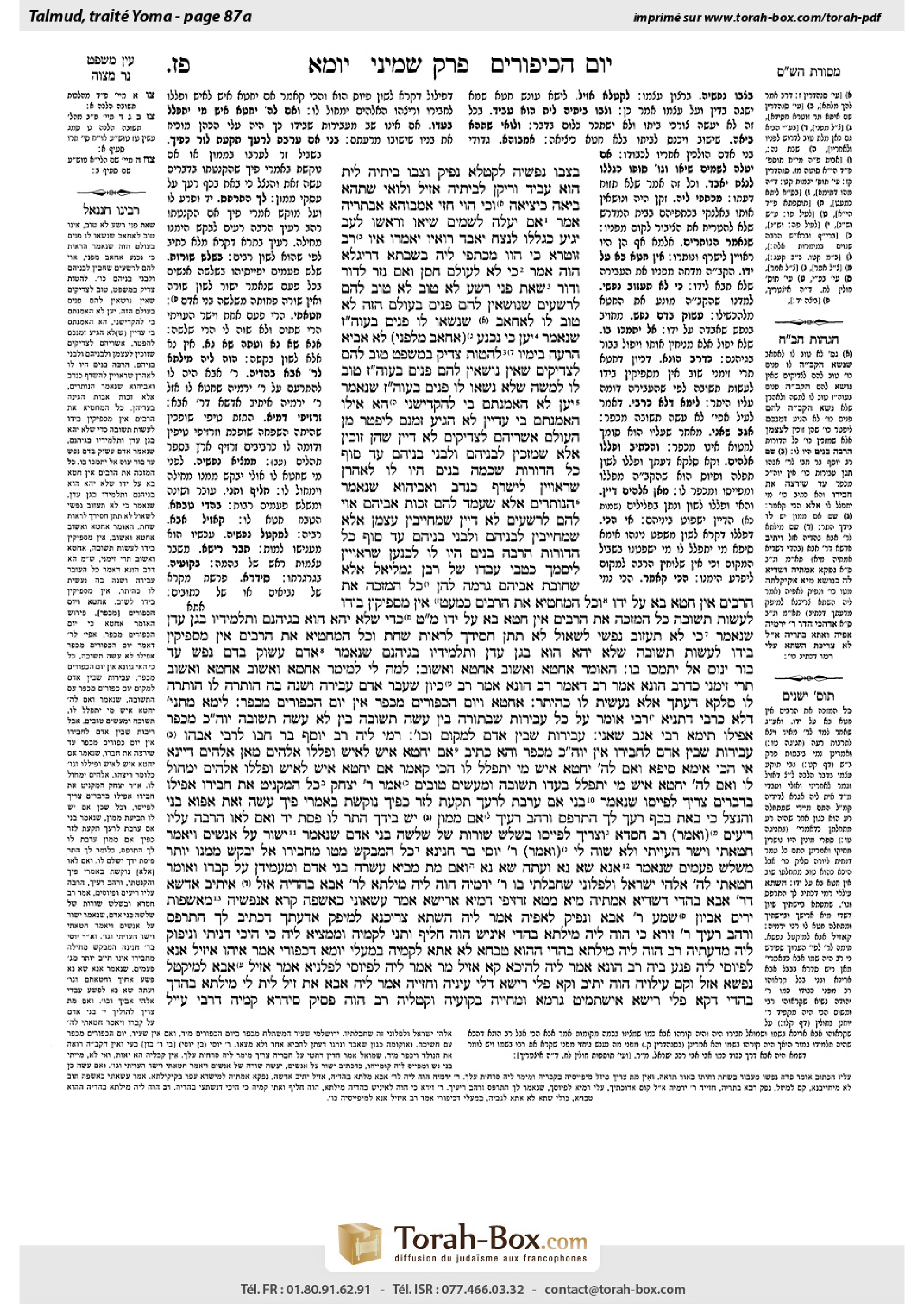
Yoma 87a: Talmud study for Daf Yomi
Daf Yomi is the daily study of one Talmud folio. Explore 37 tractates with scans, Hebrew text, Sefaria English and AI-generated French translations where annotated.
Passage selection and English or AI-generated French translation are available where the scan has annotations. Daf Study is independent of Torah-Box and Sefaria.
Browse Yoma · יומא · All tractatesYoma 87a text and translations
This page of Yoma includes the Aramaic text, an English translation and an AI-generated French translation, alongside the scan above.
יומא פ״ז א · Aramaic and Hebrew text
בִּצְבוּ נַפְשֵׁיהּ לִקְטָלָא נָפֵיק, וּצְבוּ בֵּיתֵיהּ לֵית הוּא עָבֵיד, וְרֵיקָן לְבֵיתֵיהּ אָזֵיל, וּלְוַאי שֶׁתְּהֵא בִּיאָה כִּיצִיאָה. וְכִי הָוֵי חָזֵי אַמְבּוּהָא אַבָּתְרֵיהּ, אָמַר: ״אִם יַעֲלֶה לַשָּׁמַיִם שִׂיאוֹ וְרֹאשׁוֹ לָעָב יַגִּיעַ. כְּגֶלֲלוֹ לָנֶצַח יֹאבֵד רוֹאָיו יֹאמְרוּ אַיּוֹ״. רַב זוּטְרָא, כִּי הֲווֹ מְכַתְּפִי לֵיהּ בְּשַׁבְּתָא דְרִיגְלָא, הֲוָה אָמַר: ״כִּי לֹא לְעוֹלָם חֹסֶן וְאִם נֵזֶר לְדוֹר וָדוֹר״.
״שְׂאֵת פְּנֵי רָשָׁע לֹא טוֹב״ — לֹא טוֹב לָהֶם לָרְשָׁעִים שֶׁנּוֹשְׂאִין לָהֶם פָּנִים בָּעוֹלָם הַזֶּה. לֹא טוֹב לוֹ לְאַחְאָב שֶׁנָּשְׂאוּ לוֹ פָּנִים בָּעוֹלָם הַזֶּה, שֶׁנֶּאֱמַר: ״יַעַן כִּי נִכְנַע (אַחְאָב מִלְּפָנָי) לֹא אָבִיא הָרָעָה בְּיָמָיו״.
״לְהַטּוֹת צַדִּיק בַּמִּשְׁפָּט״ — טוֹב לָהֶם לַצַּדִּיקִים שֶׁאֵין נוֹשְׂאִין לָהֶם פָּנִים בָּעוֹלָם הַזֶּה. טוֹב לוֹ לְמֹשֶׁה שֶׁלֹּא נָשְׂאוּ לוֹ פָּנִים בָּעוֹלָם הַזֶּה, שֶׁנֶּאֱמַר: ״יַעַן לֹא הֶאֱמַנְתֶּם בִּי לְהַקְדִּישֵׁנִי״, הָא אִילּוּ הֶאֱמַנְתֶּם בִּי — עֲדַיִין לֹא הִגִּיעַ זְמַנָּם לִיפָּטֵר מִן הָעוֹלָם.
אַשְׁרֵיהֶם לַצַּדִּיקִים, לֹא דַּיָּין שֶׁהֵן זוֹכִין, אֶלָּא שֶׁמְּזַכִּין לִבְנֵיהֶם וְלִבְנֵי בְנֵיהֶם עַד סוֹף כׇּל הַדּוֹרוֹת. שֶׁכַּמָּה בָּנִים הָיוּ לוֹ לְאַהֲרֹן שֶׁרְאוּיִין לִישָּׂרֵף כְּנָדָב וַאֲבִיהוּא, שֶׁנֶּאֱמַר: ״הַנּוֹתָרִים״, אֶלָּא שֶׁעָמַד לָהֶם זְכוּת אֲבִיהֶם.
אוֹי לָהֶם לָרְשָׁעִים, לֹא דַּיָּין שֶׁמְּחַיְּיבִין עַצְמָן, אֶלָּא שֶׁמְּחַיְּיבִין לִבְנֵיהֶם וְלִבְנֵי בְנֵיהֶם עַד סוֹף כׇּל הַדּוֹרוֹת. הַרְבֵּה בָּנִים הָיוּ לוֹ לִכְנַעַן שֶׁרְאוּיִין לִיסָּמֵךְ כְּטָבִי עַבְדּוֹ שֶׁל רַבָּן גַּמְלִיאֵל, אֶלָּא שֶׁחוֹבַת אֲבִיהֶם גָּרְמָה לָהֶן.
כׇּל הַמְזַכֶּה אֶת הָרַבִּים — אֵין חֵטְא בָּא עַל יָדוֹ, וְכׇל הַמַּחְטִיא אֶת הָרַבִּים — כִּמְעַט אֵין מַסְפִּיקִין בְּיָדוֹ לַעֲשׂוֹת תְּשׁוּבָה. כׇּל הַמְזַכֶּה אֶת הָרַבִּים — אֵין חֵטְא בָּא עַל יָדוֹ, מַאי טַעְמָא? כְּדֵי שֶׁלֹּא יְהֵא הוּא בְּגֵיהִנָּם וְתַלְמִידָיו בְּגַן עֵדֶן, שֶׁנֶּאֱמַר: ״כִּי לֹא תַעֲזוֹב נַפְשִׁי לִשְׁאוֹל לֹא תִתֵּן חֲסִידְךָ לִרְאוֹת שָׁחַת״. וְכׇל הַמַּחְטִיא אֶת הָרַבִּים — אֵין מַסְפִּיקִין בְּיָדוֹ לַעֲשׂוֹת תְּשׁוּבָה, שֶׁלֹּא יְהֵא הוּא בְּגַן עֵדֶן וְתַלְמִידָיו בְּגֵיהִנָּם, שֶׁנֶּאֱמַר: ״אָדָם עָשׁוּק בְּדַם נָפֶשׁ עַד בּוֹר יָנוּס אַל יִתְמְכוּ בוֹ״.
הָאוֹמֵר אֶחֱטָא וְאָשׁוּב אֶחֱטָא וְאָשׁוּב. לְמָה לִי לְמֵימַר ״אֶחֱטָא וְאָשׁוּב, אֶחֱטָא וְאָשׁוּב״ תְּרֵי זִימְנֵי? כִּדְרַב הוּנָא אָמַר רַב. דְּאָמַר רַב הוּנָא אָמַר רַב: כֵּיוָן שֶׁעָבַר אָדָם עֲבֵירָה וְשָׁנָה בָּהּ — הוּתְּרָה לוֹ. הוּתְּרָה לוֹ סָלְקָא דַּעְתָּךְ?! אֶלָּא: נַעֲשֵׂית לוֹ כְּהֶיתֵּר.
אֶחֱטָא וְיוֹם הַכִּפּוּרִים מְכַפֵּר — אֵין יוֹם הַכִּפּוּרִים מְכַפֵּר. לֵימָא מַתְנִיתִין דְּלָא כְּרַבִּי. דְּתַנְיָא, רַבִּי אוֹמֵר: עַל כׇּל עֲבֵירוֹת שֶׁבַּתּוֹרָה, בֵּין עָשָׂה תְּשׁוּבָה בֵּין לֹא עָשָׂה תְּשׁוּבָה — יוֹם הַכִּפּוּרִים מְכַפֵּר! אֲפִילּוּ תֵּימָא רַבִּי, אַגַּב שָׁאנֵי.
עֲבֵירוֹת שֶׁבֵּין אָדָם לַמָּקוֹם וְכוּ׳. רָמֵי לֵיהּ רַב יוֹסֵף בַּר חָבוּ לְרַבִּי אֲבָהוּ: עֲבֵירוֹת שֶׁבֵּין אָדָם לַחֲבֵירוֹ אֵין יוֹם הַכִּפּוּרִים מְכַפֵּר? וְהָא כְּתִיב: ״אִם יֶחֱטָא אִישׁ לְאִישׁ וּפִלְלוֹ אֱלֹהִים״! מַאן אֱלֹהִים — דַּיָּינָא.
אִי הָכִי, אֵימָא סֵיפָא: ״וְאִם לַה׳ יֶחֱטָא אִישׁ מִי יִתְפַּלֶּל לוֹ״! הָכִי קָאָמַר: ״אִם יֶחֱטָא אִישׁ לְאִישׁ וּפִלְלוֹ אֱלֹהִים״ — יִמְחוֹל לוֹ. ״וְאִם לַה׳ יֶחֱטָא אִישׁ מִי יִתְפַּלֶּל בַּעֲדוֹ״ — תְּשׁוּבָה וּמַעֲשִׂים טוֹבִים.
אָמַר רַבִּי יִצְחָק: כׇּל הַמַּקְנִיט אֶת חֲבֵירוֹ, אֲפִילּוּ בִּדְבָרִים — צָרִיךְ לְפַיְּיסוֹ, שֶׁנֶּאֱמַר: ״בְּנִי אִם עָרַבְתָּ לְרֵעֶךָ תָּקַעְתָּ לַזָּר כַּפֶּיךָ נוֹקַשְׁתָּ בְאִמְרֵי פִיךָ עֲשֵׂה זֹאת אֵפוֹא בְּנִי וְהִנָּצֵל כִּי בָאתָ בְכַף רֵעֶךָ לֵךְ הִתְרַפֵּס וּרְהַב רֵעֶיךָ״. אִם מָמוֹן יֵשׁ בְּיָדְךָ — הַתֵּר לוֹ פִּסַּת יָד, וְאִם לָאו — הַרְבֵּה עָלָיו רֵיעִים.
(וְאָמַר) רַב חִסְדָּא: וְצָרִיךְ לְפַיְּיסוֹ בְּשָׁלֹשׁ שׁוּרוֹת שֶׁל שְׁלֹשָׁה בְּנֵי אָדָם, שֶׁנֶּאֱמַר: ״יָשׁוֹר עַל אֲנָשִׁים וַיֹּאמֶר חָטָאתִי וְיָשָׁר הֶעֱוֵיתִי וְלֹא שָׁוָה לִי״.
(וְאָמַר) רַבִּי יוֹסֵי בַּר חֲנִינָא: כׇּל הַמְבַקֵּשׁ מָטוּ מֵחֲבֵירוֹ, אַל יְבַקֵּשׁ מִמֶּנּוּ יוֹתֵר מִשָּׁלֹשׁ פְּעָמִים, שֶׁנֶּאֱמַר: ״אָנָּא שָׂא נָא וְעַתָּה שָׂא נָא״. וְאִם מֵת — מֵבִיא עֲשָׂרָה בְּנֵי אָדָם וּמַעֲמִידָן עַל קִבְרוֹ, וְאוֹמֵר: חָטָאתִי לַה׳ אֱלֹהֵי יִשְׂרָאֵל וְלִפְלוֹנִי שֶׁחָבַלְתִּי בּוֹ.
רַבִּי יִרְמְיָה הֲוָה לֵיהּ מִילְּתָא לְרַבִּי אַבָּא בַּהֲדֵיהּ, אֲזַל אִיתִּיב אַדַּשָּׁא דְּרַבִּי אַבָּא בַּהֲדֵי דְּשָׁדְיָא אַמְּתֵיהּ מַיָּא, מְטָא זַרְזִיפֵי דְמַיָּא אַרֵישָׁא. אָמַר: עֲשָׂאוּנִי כְּאַשְׁפָּה. קְרָא אַנַּפְשֵׁיהּ: ״מֵאַשְׁפּוֹת יָרִים אֶבְיוֹן״. שְׁמַע רַבִּי אַבָּא וּנְפֵיק לְאַפֵּיהּ, אֲמַר לֵיהּ: הַשְׁתָּא צְרִיכְנָא לְמִיפַּק אַדַּעְתָּךְ, דִּכְתִיב: ״לֵךְ הִתְרַפֵּס וּרְהַב רֵעֶיךָ״.
רַבִּי זֵירָא כִּי הֲוָה לֵיהּ מִילְּתָא בַּהֲדֵי אִינִישׁ, הֲוָה חָלֵיף וְתָנֵי לְקַמֵּיהּ וּמַמְצֵי לֵיהּ, כִּי הֵיכִי דְּנֵיתֵי וְנִיפּוֹק לֵיהּ מִדַּעְתֵּיהּ.
רַב הֲוָה לֵיהּ מִילְּתָא בַּהֲדֵי הָהוּא טַבָּחָא, לָא אֲתָא לְקַמֵּיהּ. בְּמַעֲלֵי יוֹמָא דְכִפּוּרֵי אֲמַר אִיהוּ: אֵיזִיל אֲנָא לְפַיּוֹסֵי לֵיהּ. פְּגַע בֵּיהּ רַב הוּנָא, אֲמַר לֵיהּ: לְהֵיכָא קָא אָזֵיל מָר, אֲמַר לֵיהּ: לְפַיּוֹסֵי לִפְלָנְיָא. אָמַר: אָזֵיל אַבָּא לְמִיקְטַל נַפְשָׁא. אֲזַל וְקָם עִילָּוֵיהּ. הֲוָה יָתֵיב וְקָא פָלֵי רֵישָׁא, דַּלִּי עֵינֵיהּ וְחַזְיֵיהּ, אֲמַר לֵיהּ: אַבָּא אַתְּ? זִיל, לֵית לִי מִילְּתָא בַּהֲדָךְ. בַּהֲדֵי דְּקָא פָלֵי רֵישָׁא, אִישְׁתְּמִיט גַּרְמָא וּמַחְיֵיהּ בְּקוֹעֵיהּ וְקַטְלֵיהּ.
רַב הֲוָה פָּסֵיק סִידְרָא קַמֵּיהּ דְּרַבִּי. עֲיַיל
Yoma 87a · English translation
Of his own will, he goes to die; and he does not fulfill the will of his household, and he goes empty-handed to his household; and if only his entrance would be like his exit. And when he saw a line of people [ambuha] following after him out of respect for him, he said: “Though his excellency ascends to the heavens, and his head reaches to the clouds, yet he shall perish forever like his own dung; they who have seen him will say: Where is he?” (Job 20:6–7). This teaches that when one achieves power, it can lead to his downfall. When they would carry Rav Zutra on their shoulders during the Shabbat of the Festival when he taught, he would recite the following to avoid becoming arrogant: “For power is not forever, and does the crown endure for all generations?” (Proverbs 27:24).
§ It was further taught: “It is not good to respect the person of the wicked” (Proverbs 18:5), meaning, it is not good for wicked people when they are respected in this world and are not punished for their sins. For example, it was not good for Ahab to be respected in this world, as it is stated: “Because he humbled himself before Me, I will not bring the evil in his days” (I Kings 21:29), and Ahab thereby lost his share in the World-to-Come.
The opposite is also true. The complete verse states: “It is not good to respect the person of the wicked, to turn aside the righteous in judgment” (Proverbs 18:5), meaning: It is good for the righteous when they are not respected in this world and are punished in this world for their sins. For example, it was good for Moses that he was not respected in this world, as it is stated: “Because you did not believe in Me, to sanctify Me” (Numbers 20:12). The Gemara analyzes this: Had you believed in Me, your time still would not have come to depart the world.
They said: Fortunate are the righteous because not only do they accumulate merit for themselves, but they accumulate merit for their children and their children’s children until the end of all generations; as there were several sons of Aaron who essentially deserved to be burned like Nadav and Avihu, as it is stated: “The sons of Aaron who were left” (Leviticus 10:16), implying that others were left as well although they deserved to be burned with their brothers. But the merit of their father protected them, and they and their descendants were priests for all time.
On the other hand: Woe to the wicked, as not only do they render themselves liable, but they also render their children and children’s children liable until the end of all generations. For example, Canaan had many children who deserved to be ordained as rabbis and instructors of the public due to their great stature in Torah study, like Tavi, the servant of Rabban Gamliel, who was famous for his wisdom; but their father’s liability caused them to remain as slaves.
Furthermore: Whoever accumulates merit for the public will not have sin come to his hand, and God protects him from failing; but whoever causes the public to sin has almost no ability to repent. The Gemara explains: What is the reason that whoever accumulates merit for the public will not have sin come to his hand? It is so that he will not be in Gehenna while his students are in the Garden of Eden, as it is stated: “For You will not abandon my soul to the nether-world; neither will You suffer Your godly one to see the pit” (Psalms 16:10). On the other hand, whoever causes the public to sin has almost no ability to repent, so that he will not be in the Garden of Eden while his students are in Gehenna, as it is stated: “A man who is laden with the blood of any person shall hasten his steps to the pit; none will support him” (Proverbs 28:17). Since he oppressed others and caused them to sin, he shall have no escape.
§ The Gemara returns to interpreting the mishna. It states there that one who says: I will sin and I will repent, I will sin and I will repent, is not given the opportunity to repent.The Gemara asks: Why do I need the mishna to say twice: I will sin and I will repent, I will sin and repent? The Gemara explains that this is in accordance with that which Rav Huna said that Rav said, as Rav Huna said that Rav said: Once a person commits a transgression and repeats it, it becomes permitted to him. The Gemara is surprised at this: Can it enter your mind that it becomes permitted to him? Rather, say that it becomes to him as though it were permitted. Consequently, the sinner who repeats his sin has difficulty abandoning his sin, and the repetition of his sin is reflected in the repetition of the phrase.
It is stated in the mishna that if one says: I will sin and Yom Kippur will atone for my sins, Yom Kippur does not atone for his sins. The Gemara comments: Let us say that the mishna is not in accordance with the opinion of Rabbi Yehuda HaNasi, as it was taught in a baraita that Rabbi Yehuda HaNasi says: Yom Kippur atones for all transgressions of the Torah, whether one repented or did not repent. The Gemara answers: Even if you say that the mishna is in accordance with the opinion of Rabbi Yehuda HaNasi, it is different when it is on the basis of being permitted to sin. Even Rabbi Yehuda HaNasi agrees that Yom Kippur does not atone for the transgressions one commits only because he knows that Yom Kippur will atone for them.
§ It was taught in the mishna: Yom Kippur atones for sins committed against God but does not atone for sins committed against another person. Rav Yosef bar Ḥavu raised a contradiction before Rabbi Abbahu: The mishna states that Yom Kippur does not atone for sins committed against a fellow person, but isn’t it written: “If one man sin against another, God [Elohim] shall judge him [ufilelo]” (I Samuel 2:25). The word ufilelo, which may also refer to prayer, implies that if he prays, God will grant the sinner forgiveness. He answered him: Who is Elohim mentioned in the verse? It is referring to a judge [elohim] and not to God, and the word ufilelo in the verse indicates judgment. Atonement occurs only after justice has been done toward the injured party by means of a court ruling.
Rav Yosef bar Ḥavu said to him: If so, say the following with regard to the latter clause of the verse: “But if a man sin against the Lord, who shall entreat [yitpallel] for him?” (I Samuel 2:25). This is difficult, since it has been established that the root pll is interpreted in this verse as indicating judgment, and therefore the latter clause of the verse implies that if one sins toward God there is no one to judge him. Rabbi Abbahu answered him: This is what the verse is saying: If one man sins against another, God [Elohim] shall forgive him [ufilelo]; if the sinner appeases the person against whom he has sinned, he will be forgiven. But if a man sin against the Lord, who shall entreat [yitpallel] for him? Repentance and good deeds. The root pll is to be interpreted as indicating forgiveness rather than judgment.
§ Rabbi Yitzḥak said: One who angers his friend, even only verbally, must appease him, as it is stated: “My son, if you have become a guarantor for your neighbor, if you have struck your hands for a stranger, you are snared by the words of your mouth… Do this now, my son, and deliver yourself, seeing you have come into the hand of your neighbor. Go, humble yourself [hitrapes] and urge [rehav] your neighbor” (Proverbs 6:1–3). This should be understood as follows: If you have money that you owe him, open the palm of [hater pisat] your hand to your neighbor and pay the money that you owe; and if not, if you have sinned against him verbally, increase [harbe] friends for him, i.e., send many people as your messengers to ask him for forgiveness.
Rav Ḥisda said: And one must appease the one he has insulted with three rows of three people, as it is stated: “He comes [yashor] before men, and says: I have sinned, and perverted that which was right, and it profited me not” (Job 33:27). Rav Ḥisda interprets the word yashor as related to the word shura, row. The verse mentions sin three times: I have sinned, and perverted, and it profited me not. This implies that one should make three rows before the person from whom he is asking forgiveness.
Rabbi Yosei bar Ḥanina said: Anyone who asks forgiveness of his friend should not ask more than three times, as it is stated: “Please, please forgive the transgression of your brothers and their sin, for they did evil to you. And now, please forgive” (Genesis 50:17). The verse uses the word please three times, which shows that one need not ask more than three times, after which the insulted friend must be appeased and forgive. And if the insulted friend dies before he can be appeased, one brings ten people, and stands them at the grave of the insulted friend, and says in front of them: I have sinned against the Lord, the God of Israel, and against so-and-so whom I wounded.
The Gemara relates that Rabbi Yirmeya insulted Rabbi Abba, causing the latter to have a complaint against him. Rabbi Yirmeya went and sat at the threshold of Rabbi Abba’s house to beg him for forgiveness. When Rabbi Abba’s maid poured out the dirty water from the house, the stream of water landed on Rabbi Yirmeya’s head. He said about himself: They have made me into a trash heap, as they are pouring dirty water on me. He recited this verse about himself: “Who lifts up the needy out of the trash heap” (Psalms 113:7). Rabbi Abba heard what happened and went out to greet him. Rabbi Abba said to him: Now I must go out to appease you for this insult, as it is written: “Go, humble yourself [hitrapes] and urge your neighbor” (Proverbs 6:3).
It is related that when Rabbi Zeira had a complaint against a person who insulted him, he would pace back and forth before him and present himself, so that the person could come and appease him. Rabbi Zeira made himself available so that it would be easy for the other person to apologize to him.
It is further related that Rav had a complaint against a certain butcher who insulted him. The butcher did not come before him to apologize. On Yom Kippur eve, Rav said: I will go and appease him. He met his student Rav Huna, who said to him: Where is my Master going? He said to him: I am going to appease so-and-so. Rav Huna called Rav by his name and said: Abba is going to kill a person, for surely that person’s end will not be good. Rav went and stood by him. He found the butcher sitting and splitting the head of an animal. The butcher raised his eyes and saw him. He said to him: Are you Abba? Go, I have nothing to say to you. While he was splitting the head, one of the bones of the head flew out and struck him in the throat and killed him, thereby fulfilling Rav Huna’s prediction.
The Gemara further relates: Rav was reciting the Torah portion before Rabbi Yehuda HaNasi.
Yoma 87a · Traduction française (IA)
De son plein gré, il va mourir ; il ne réalise pas le souhait de sa maisonnée et retourne chez lui les mains vides ; si seulement son entrée ressemblait à sa sortie ! Lorsqu’il vit une file de gens [ambuha] le suivre par respect pour lui, il dit : « Quand bien même sa grandeur s’élèverait jusqu’aux cieux et sa tête atteindrait les nuées, il périra pourtant à jamais comme son propre fumier ; ceux qui l’auront vu diront : Où est-il ? » (Job 20, 6-7). Cela enseigne que lorsqu’on acquiert du pouvoir, celui-ci peut entraîner sa chute. Quand on portait Rav Zutra sur les épaules pendant le Chabbat de la fête, alors qu’il enseignait, il récitait ces paroles afin de ne pas devenir arrogant : « Car le pouvoir ne dure pas toujours, et la couronne subsiste-t-elle à toutes les générations ? » (Proverbes 27, 24).
§ Il fut encore enseigné : « Il n’est pas bon de favoriser la personne du méchant » (Proverbes 18, 5), c’est-à-dire qu’il n’est pas bon pour les méchants d’être honorés en ce monde et de ne pas être punis pour leurs fautes. Ainsi, il ne fut pas bon pour Ahab d’être honoré en ce monde, comme il est dit : « Parce qu’il s’est humilié devant Moi, Je ne ferai pas venir le malheur de son vivant » (I Rois 21, 29) ; Ahab perdit ainsi sa part au Monde futur.
L’inverse est également vrai. Le verset complet dit : « Il n’est pas bon de favoriser la personne du méchant, ni de faire dévier le juste dans un jugement » (Proverbes 18, 5), ce qui signifie qu’il est bon pour les justes de ne pas être honorés en ce monde et d’y être punis pour leurs fautes. Ainsi, il fut bon pour Moïse de ne pas être honoré en ce monde, comme il est dit : « Parce que vous n’avez pas cru en Moi, pour Me sanctifier » (Nombres 20, 12). La Guemara analyse ces paroles : Même si tu avais cru en Moi, le moment de quitter le monde ne serait pas encore venu pour toi.
On a dit : Heureux les justes, car non seulement ils accumulent du mérite pour eux-mêmes, mais ils en accumulent aussi pour leurs enfants et les enfants de leurs enfants jusqu’à la fin de toutes les générations. En effet, plusieurs fils d’Aaron méritaient en réalité d’être brûlés, comme Nadav et Avihou, ainsi qu’il est dit : « Les fils d’Aaron qui restaient » (Lévitique 10, 16), ce qui laisse entendre qu’il en restait d’autres aussi, bien qu’ils méritassent d’être brûlés avec leurs frères. Mais le mérite de leur père les protégea, et eux ainsi que leurs descendants furent prêtres pour toujours.
À l’inverse : Malheur aux méchants, car non seulement ils se rendent passibles de sanction, mais ils y rendent également passibles leurs enfants et les enfants de leurs enfants jusqu’à la fin de toutes les générations. Ainsi, Canaan eut de nombreux enfants qui méritaient d’être ordonnés rabbins et enseignants du public en raison de leur grande stature dans l’étude de la Torah, comme Tavi, le serviteur de Rabban Gamliel, célèbre pour sa sagesse ; mais la faute de leur père les condamna à rester esclaves.
De plus : Celui qui fait acquérir du mérite au public ne sera pas amené à pécher, et Dieu le protège de la chute ; mais celui qui fait pécher le public a presque aucune possibilité de se repentir. La Guemara explique : Pourquoi celui qui fait acquérir du mérite au public ne sera-t-il pas amené à pécher ? Afin qu’il ne se trouve pas dans la Géhenne tandis que ses élèves sont dans le Jardin d’Éden, comme il est dit : « Car Tu n’abandonneras pas mon âme au séjour des morts, Tu ne laisseras pas Ton fidèle voir la fosse » (Psaumes 16, 10). À l’inverse, celui qui fait pécher le public a presque aucune possibilité de se repentir, afin qu’il ne se trouve pas dans le Jardin d’Éden tandis que ses élèves sont dans la Géhenne, comme il est dit : « Un homme chargé du sang de toute personne se hâte vers la fosse ; personne ne le soutiendra » (Proverbes 28, 17). Puisqu’il a opprimé les autres et les a fait pécher, il n’aura aucun moyen d’échapper à son sort.
§ La Guemara revient à l’interprétation de la Michna. Il y est dit que celui qui déclare : « Je vais pécher et je me repentirai, je vais pécher et je me repentirai », ne se voit pas accorder la possibilité de se repentir. La Guemara demande : Pourquoi la Michna doit-elle répéter deux fois : « Je vais pécher et je me repentirai, je vais pécher et je me repentirai » ? La Guemara explique que cela concorde avec ce que Rav Houna a dit au nom de Rav, car Rav Houna a dit au nom de Rav : Lorsqu’une personne commet une transgression et la répète, elle devient pour elle permise. La Guemara s’étonne : Peut-on imaginer qu’elle lui devienne permise ? Il faut plutôt dire qu’elle lui apparaît comme si elle était permise. Par conséquent, le pécheur qui répète sa faute a du mal à y renoncer, et la répétition de sa faute se reflète dans la répétition de la formule.
La Michna enseigne que si quelqu’un dit : « Je vais pécher et Yom Kippour expiera mes fautes », Yom Kippour n’expie pas ses fautes. La Guemara remarque : Peut-on en conclure que la Michna ne suit pas l’opinion de Rabbi Yehouda HaNassi ? Car il a été enseigné dans une baraïta que Rabbi Yehouda HaNassi dit : Yom Kippour expie toutes les transgressions de la Torah, que l’on se soit repenti ou non. La Guemara répond : Même si tu dis que la Michna suit l’opinion de Rabbi Yehouda HaNassi, le cas est différent lorsqu’on se fonde sur l’idée qu’il est permis de pécher. Rabbi Yehouda HaNassi lui-même admet que Yom Kippour n’expie pas les transgressions qu’on commet uniquement parce qu’on sait que Yom Kippour les expiera.
§ Il a été enseigné dans la Michna que Yom Kippour expie les fautes commises envers Dieu, mais n’expie pas celles commises envers autrui. Rav Yosef bar Ḥavu souleva une contradiction devant Rabbi Abbahou : la Michna dit que Yom Kippour n’expie pas les fautes commises envers son prochain, mais n’est-il pas écrit : « Si un homme pèche contre un autre homme, Dieu [Elohim] le jugera [ufilelo] » (I Samuel 2, 25) ? Le mot ufilelo, qui peut aussi renvoyer à la prière, laisse entendre que si le pécheur prie, Dieu lui accordera le pardon. Rabbi Abbahou lui répondit : Qui est l’Elohim mentionné dans le verset ? Il s’agit d’un juge [elohim], et non de Dieu ; le mot ufilelo indique ici un jugement. L’expiation n’intervient qu’après que justice a été rendue à la partie lésée par une décision judiciaire.
Rav Yosef bar Ḥavu lui dit : Dans ce cas, interprète ainsi la seconde partie du verset : « Mais si un homme pèche contre le Seigneur, qui intercédera [yitpallel] pour lui ? » (I Samuel 2, 25). Cela pose difficulté, puisque l’on a établi que la racine pll est interprétée dans ce verset comme indiquant un jugement ; la seconde partie signifie donc que si quelqu’un pèche contre Dieu, personne ne peut le juger. Rabbi Abbahou lui répondit : Voici ce que dit le verset : « Si un homme pèche contre un autre homme, Dieu [Elohim] lui pardonnera [ufilelo] » ; si le pécheur apaise celui contre qui il a péché, il sera pardonné. « Mais si un homme pèche contre le Seigneur, qui intercédera [yitpallel] pour lui ? » Le repentir et les bonnes actions. La racine pll doit être interprétée comme indiquant le pardon, plutôt que le jugement.
§ Rabbi Yitzḥak dit : Celui qui met son ami en colère, ne serait-ce que par des paroles, doit l’apaiser, comme il est dit : « Mon fils, si tu t’es porté garant pour ton prochain, si tu as engagé ta main envers un étranger, tu es pris au piège par les paroles de ta bouche… Fais donc ceci, mon fils, et délivre-toi, puisque tu es tombé aux mains de ton prochain : va, humilie-toi [hitrapes] et insiste [rehav] auprès de ton prochain » (Proverbes 6, 1-3). Il faut comprendre ainsi : si tu lui dois de l’argent, ouvre la paume [hater pisat] de ta main à ton prochain et rembourse-lui ce que tu lui dois ; sinon, si tu as péché contre lui par des paroles, multiplie [harbe] ses amis, c’est-à-dire envoie de nombreuses personnes lui demander pardon en ton nom.
Rav Ḥisda dit : Il faut apaiser celui qu’on a insulté en se présentant devant lui avec trois rangées de trois personnes, comme il est dit : « Il vient [yashor] devant les hommes et dit : J’ai péché, j’ai perverti ce qui était droit, et cela ne m’a pas profité » (Job 33, 27). Rav Ḥisda interprète le mot yashor comme apparenté au mot shura, « rangée ». Le verset mentionne trois fois la faute : « J’ai péché », « j’ai perverti » et « cela ne m’a pas profité ». Cela implique qu’on doit se placer en trois rangées devant la personne à laquelle on demande pardon.
Rabbi Yossei bar Ḥanina dit : Quiconque demande pardon à son ami ne doit pas le faire plus de trois fois, comme il est dit : « De grâce, de grâce, pardonnez la faute de vos frères et leur péché, car ils vous ont fait du mal. Et maintenant, de grâce, pardonnez » (Genèse 50, 17). Le verset emploie trois fois le mot « de grâce », ce qui montre qu’il n’est pas nécessaire de demander pardon plus de trois fois ; après cela, l’ami offensé doit être apaisé et pardonner. Si l’ami offensé meurt avant qu’on ait pu l’apaiser, on rassemble dix personnes, on les fait se tenir près de sa tombe, et l’on dit devant elles : « J’ai péché contre le Seigneur, le Dieu d’Israël, et contre untel que j’ai blessé. »
La Guemara rapporte que Rabbi Yirmeya insulta Rabbi Abba, qui lui en tint rigueur. Rabbi Yirmeya alla s’asseoir au seuil de la maison de Rabbi Abba pour lui demander pardon. Lorsque la servante de Rabbi Abba déversa l’eau sale de la maison, le flot atteignit la tête de Rabbi Yirmeya. Il dit de lui-même : « Ils ont fait de moi un tas d’ordures, puisqu’ils me versent de l’eau sale dessus. » Il récita à son propre sujet ce verset : « Il relève le pauvre du tas d’ordures » (Psaumes 113, 7). Rabbi Abba apprit ce qui s’était passé et sortit à sa rencontre. Rabbi Abba lui dit : « À présent, c’est à moi de sortir pour t’apaiser de cette offense », comme il est écrit : « Va, humilie-toi [hitrapes] et insiste auprès de ton prochain » (Proverbes 6, 3).
On rapporte que lorsque Rabbi Zeira tenait rigueur à quelqu’un qui l’avait insulté, il faisait les cent pas devant lui et se rendait visible, afin que cette personne puisse venir l’apaiser. Rabbi Zeira se rendait disponible pour qu’il soit facile à l’autre de lui présenter ses excuses.
On rapporte également que Rav tenait rigueur à un certain boucher qui l’avait insulté. Le boucher ne vint pas le voir pour lui présenter ses excuses. La veille de Yom Kippour, Rav dit : « Je vais aller l’apaiser. » Il rencontra son élève Rav Houna, qui lui demanda : « Où va mon Maître ? » Rav lui répondit : « Je vais apaiser untel. » Rav Houna appela Rav par son nom et lui dit : « Abba va tuer un homme, car assurément cet homme ne finira pas bien. » Rav partit et se tint près du boucher. Il le trouva assis, fendant la tête d’un animal. Le boucher leva les yeux et le vit. Il lui dit : « C’est toi, Abba ? Va-t’en, je n’ai rien à te dire. » Tandis qu’il fendait la tête, un os du crâne vola et le frappa à la gorge, le tuant ainsi et réalisant la prédiction de Rav Houna.
La Guemara rapporte encore : Rav récitait le passage de la Torah devant Rabbi Yehouda HaNassi.
Traduction française générée par IA à partir de l’édition anglaise de Sefaria. Vérifie toujours un passage avec le texte source.
Text from Sefaria: William Davidson Edition - Vocalized Aramaic (CC BY NC); William Davidson Edition - English (CC BY NC).