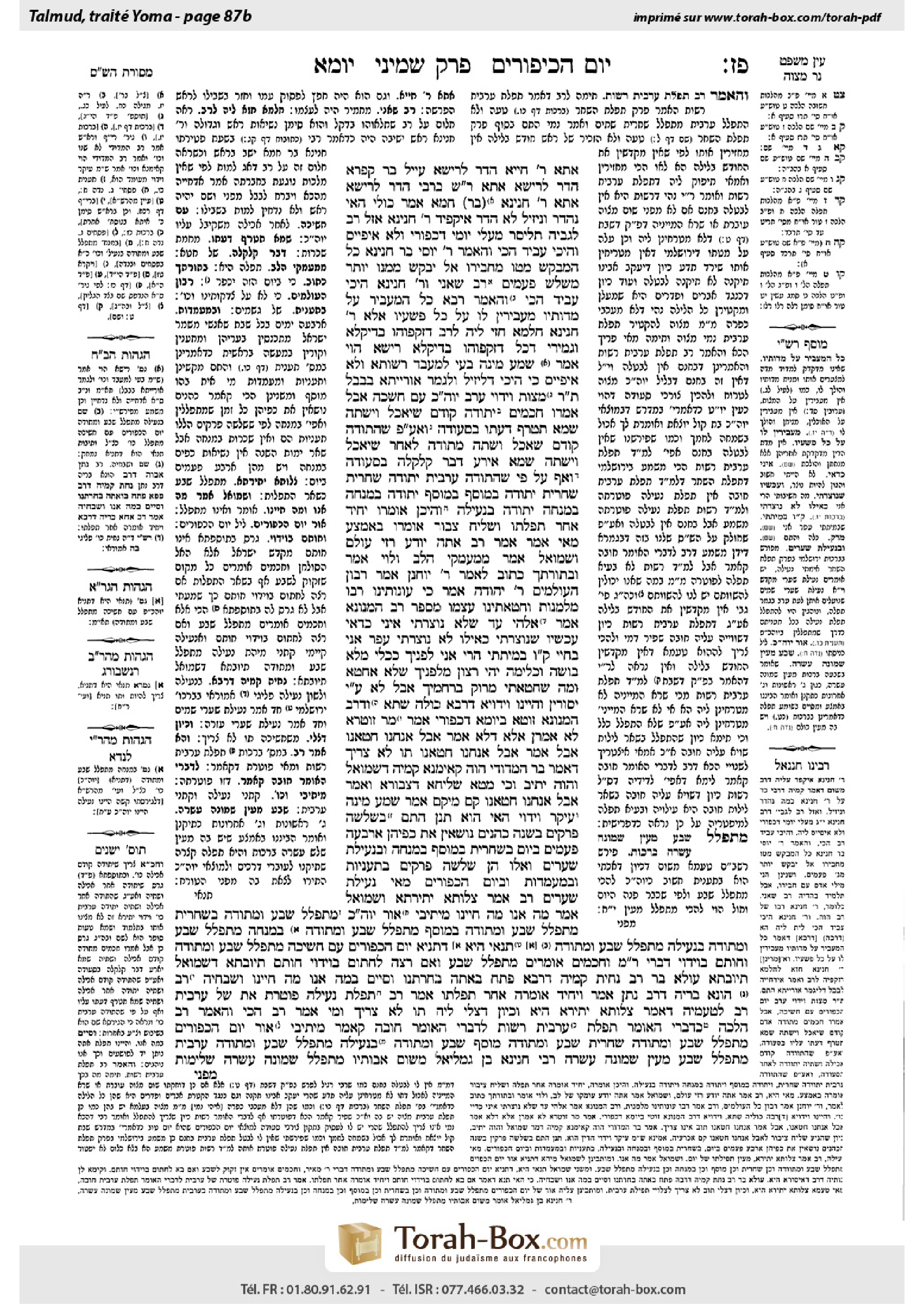
Yoma 87b: Talmud study for Daf Yomi
Daf Yomi is the daily study of one Talmud folio. Explore 37 tractates with scans, Hebrew text, Sefaria English and AI-generated French translations where annotated.
Passage selection and English or AI-generated French translation are available where the scan has annotations. Daf Study is independent of Torah-Box and Sefaria.
Browse Yoma · יומא · All tractatesYoma 87b text and translations
This page of Yoma includes the Aramaic text, an English translation and an AI-generated French translation, alongside the scan above.
יומא פ״ז ב · Aramaic and Hebrew text
אֲתָא רַבִּי חִיָּיא — הֲדַר לְרֵישָׁא. עֲיַיל בַּר קַפָּרָא — הֲדַר לְרֵישָׁא. אֲתָא רַבִּי שִׁמְעוֹן בְּרַבִּי — הֲדַר לְרֵישָׁא. אֲתָא רַבִּי חֲנִינָא (בַּר) חָמָא, אָמַר: כּוּלֵּי הַאי נֶהְדַּר וְנֵיזִיל? לָא הֲדַר. אִיקְּפִיד רַבִּי חֲנִינָא, אֲזַל רַב לְגַבֵּיהּ תְּלֵיסַר מַעֲלֵי יוֹמֵי דְּכִפּוּרֵי וְלָא אִיפַּיַּיס.
וְהֵיכִי עָבֵיד הָכִי? וְהָאָמַר רַבִּי יוֹסֵי בַּר חֲנִינָא: כׇּל הַמְבַקֵּשׁ מָטוּ מֵחֲבֵירוֹ אַל יְבַקֵּשׁ מִמֶּנּוּ יוֹתֵר מִשָּׁלֹשׁ פְּעָמִים! רַב שָׁאנֵי. וְרַבִּי חֲנִינָא, הֵיכִי עָבֵיד הָכִי? וְהָאָמַר רָבָא: כׇּל הַמַּעֲבִיר עַל מִדּוֹתָיו — מַעֲבִירִין לוֹ עַל כׇּל פְּשָׁעָיו!
אֶלָּא: רַבִּי חֲנִינָא חֶלְמָא חָזֵי לֵיהּ לְרַב דְּזַקְפוּהוּ בְּדִיקְלָא, וּגְמִירִי דְּכֹל דְּזַקְפוּהוּ בְּדִיקְלָא — רֵישָׁא הָוֵי. אָמַר: שְׁמַע מִינַּהּ בָּעֵי לְמֶעְבַּד רְשׁוּתָא וְלָא אִיפַּיַּיס, כִּי הֵיכִי דְּלֵיזִיל וְלִגְמַר אוֹרָיְיתָא בְּבָבֶל.
תָּנוּ רַבָּנַן: מִצְוַת וִידּוּי עֶרֶב יוֹם הַכִּפּוּרִים עִם חֲשֵׁכָה. אֲבָל אָמְרוּ חֲכָמִים: יִתְוַדֶּה קוֹדֶם שֶׁיֹּאכַל וְיִשְׁתֶּה, שֶׁמָּא תִּטָּרֵף דַּעְתּוֹ בִּסְעוּדָה. וְאַף עַל פִּי שֶׁהִתְוַדָּה קוֹדֶם שֶׁאָכַל וְשָׁתָה — מִתְוַדֶּה לְאַחַר שֶׁיֹּאכַל וְיִשְׁתֶּה, שֶׁמָּא אֵירַע דְּבַר קַלְקָלָה בַּסְּעוּדָה. וְאַף עַל פִּי שֶׁהִתְוַדָּה עַרְבִית — יִתְוַדֶּה שַׁחֲרִית. שַׁחֲרִית — יִתְוַדֶּה בְּמוּסָף, בְּמוּסָף — יִתְוַדֶּה בְּמִנְחָה, בְּמִנְחָה — יִתְוַדֶּה בִּנְעִילָה.
וְהֵיכָן אוֹמְרוֹ? יָחִיד אַחַר תְּפִלָּתוֹ, וּשְׁלִיחַ צִבּוּר אוֹמְרוֹ בָּאֶמְצַע. מַאי אָמַר? אָמַר רַב: ״אַתָּה יוֹדֵעַ רָזֵי עוֹלָם״. וּשְׁמוּאֵל אָמַר: ״מִמַּעֲמַקֵּי הַלֵּב״. וְלֵוִי אָמַר: ״וּבְתוֹרָתְךָ כָּתוּב לֵאמֹר״. רַבִּי יוֹחָנָן אָמַר: ״רִבּוֹן הָעוֹלָמִים״.
רַבִּי יְהוּדָה אָמַר: ״כִּי עֲוֹנוֹתֵינוּ רַבּוּ מִלִּמְנוֹת וְחַטֹּאתֵינוּ עָצְמוּ מִסַּפֵּר״. רַב הַמְנוּנָא אָמַר: ״אֱלֹהַי, עַד שֶׁלֹּא נוֹצַרְתִּי אֵינִי כְּדַאי. עַכְשָׁיו שֶׁנּוֹצַרְתִּי, כְּאִילּוּ לֹא נוֹצַרְתִּי. עָפָר אֲנִי בְּחַיַּי, קַל וָחוֹמֶר בְּמִיתָתִי. הֲרֵי אֲנִי לְפָנֶיךָ כִּכְלִי מָלֵא בּוּשָׁה וּכְלִימָּה. יְהִי רָצוֹן מִלְּפָנֶיךָ שֶׁלֹּא אֶחֱטָא, וּמַה שֶׁחָטָאתִי — מְרוֹק בְּרַחֲמֶיךָ, אֲבָל לֹא עַל יְדֵי יִסּוּרִין״. וְהַיְינוּ וִידּוּיָא דְרָבָא כּוּלַּהּ שַׁתָּא, וּדְרַב הַמְנוּנָא זוּטָא בְּיוֹמָא דְכִפּוּרֵי.
אָמַר מָר זוּטְרָא: לָא אֲמַרַן, אֶלָּא דְּלָא אָמַר: ״אֲבָל אֲנַחְנוּ חָטָאנוּ״, אֲבָל אָמַר: ״אֲבָל אֲנַחְנוּ חָטָאנוּ״ — תּוּ לָא צְרִיךְ. דְּאָמַר בַּר הַמְדּוּדֵי: הֲוָה קָאֵימְנָא קַמֵּיהּ דִּשְׁמוּאֵל, וַהֲוָה יָתֵיב, וְכִי מְטָא שְׁלִיחָא דְצִבּוּרָא וְאָמַר: ״אֲבָל אֲנַחְנוּ חָטָאנוּ״, קָם מֵיקָם, אֲמַר: שְׁמַע מִינַּהּ עִיקַּר וִידּוּי הַאי הוּא.
תְּנַן הָתָם: בִּשְׁלֹשָׁה פְּרָקִים בַּשָּׁנָה כֹּהֲנִים נוֹשְׂאִין אֶת כַּפֵּיהֶן אַרְבָּעָה פְּעָמִים בַּיּוֹם: בְּשַׁחֲרִית, בְּמוּסָף, בְּמִנְחָה, וּבִנְעִילַת שְׁעָרִים. וְאֵלּוּ הֵן שְׁלֹשָׁה פְּרָקִים: בְּתַעֲנִיּוֹת, וּבְמַעֲמָדוֹת, וּבְיוֹם הַכִּפּוּרִים.
מַאי נְעִילַת שְׁעָרִים? רַב אָמַר: צְלוֹתָא יַתִּירְתָּא. וּשְׁמוּאֵל אָמַר: ״מָה אָנוּ מֶה חַיֵּינוּ״. מֵיתִיבִי: אוֹר יוֹם הַכִּפּוּרִים מִתְפַּלֵּל שֶׁבַע וּמִתְוַדֶּה, בְּשַׁחֲרִית מִתְפַּלֵּל שֶׁבַע וּמִתְוַדֶּה, בְּמוּסָף מִתְפַּלֵּל שֶׁבַע וּמִתְוַדֶּה, בְּמִנְחָה מִתְפַּלֵּל שֶׁבַע וּמִתְוַדֶּה, בִּנְעִילָה מִתְפַּלֵּל שֶׁבַע וּמִתְוַדֶּה!
תַּנָּאֵי הִיא, דְּתַנְיָא: יוֹם הַכִּפּוּרִים עִם חֲשֵׁיכָה מִתְפַּלֵּל שֶׁבַע וּמִתְוַדֶּה, וְחוֹתֵם בְּוִידּוּי — דִּבְרֵי רַבִּי מֵאִיר. וַחֲכָמִים אוֹמְרִים: מִתְפַּלֵּל שֶׁבַע, וְאִם רָצָה לַחְתּוֹם בְּוִידּוּי — חוֹתֵם. תְּיוּבְתָּא דִשְׁמוּאֵל תְּיוּבְתָּא.
עוּלָּא בַּר רַב נְחֵית קַמֵּיהּ דְּרָבָא. פְּתַח בְּ״אַתָּה בְּחַרְתָּנוּ״ וְסַיֵּים בְּ״מָה אָנוּ מֶה חַיֵּינוּ״, וְשַׁבְּחֵיהּ. רַב הוּנָא בְּרֵיהּ דְּרַב נָתָן אָמַר: וְיָחִיד אוֹמְרָהּ אַחַר תְּפִלָּתוֹ.
אָמַר רַב: תְּפִלַּת נְעִילָה פּוֹטֶרֶת אֶת שֶׁל עַרְבִית. רַב לְטַעְמֵיהּ, דַּאֲמַר: צְלוֹתָא יַתִּירָה הִיא, וְכֵיוָן דְּצַלִּי לֵיהּ — תּוּ לָא צְרִיךְ.
וּמִי אָמַר רַב הָכִי? וְהָאָמַר רַב: הֲלָכָה כְּדִבְרֵי הָאוֹמֵר תְּפִלַּת עַרְבִית רְשׁוּת! לְדִבְרֵי הָאוֹמֵר חוֹבָה קָאָמַר.
מֵיתִיבִי: אוֹר יוֹם הַכִּפּוּרִים מִתְפַּלֵּל שֶׁבַע וּמִתְוַדֶּה, שַׁחֲרִית שֶׁבַע וּמִתְוַדֶּה, מוּסָף שֶׁבַע וּמִתְוַדֶּה, בִּנְעִילָה מִתְפַּלֵּל שֶׁבַע וּמִתְוַדֶּה, עַרְבִית מִתְפַּלֵּל שֶׁבַע מֵעֵין שְׁמוֹנֶה עֶשְׂרֵה. רַבִּי חֲנִינָא בֶּן גַּמְלִיאֵל מִשּׁוּם אֲבוֹתָיו: מִתְפַּלֵּל שְׁמוֹנֶה עֶשְׂרֵה שְׁלֵימוֹת,
Yoma 87b · English translation
Rabbi Ḥiyya, Rav’s uncle and teacher, came in, whereupon Rav returned to the beginning of the portion and began to read it again. Afterward, bar Kappara came in, and Rav returned to the beginning of the portion out of respect for bar Kappara. Then Rabbi Shimon, son of Rabbi Yehuda HaNasi, came in, and he returned again to the beginning of the portion. Then, Rabbi Ḥanina bar Ḥama came in, and Rav said to himself: Shall I go back and read so many times? He did not return but continued from where he was. Rabbi Ḥanina was offended because Rav showed that he was less important than the others. Rav went before Rabbi Ḥanina on Yom Kippur eve every year for thirteen years to appease him, but he would not be appeased.
The Gemara asks: How could Rav act this way? Didn’t Rabbi Yosei bar Ḥanina say: Anyone who requests forgiveness from another should not ask more than three times? The Gemara answers: Rav is different, since he was very pious and forced himself to act beyond the letter of the law. The Gemara asks: And how could Rabbi Ḥanina act this way and refuse to forgive Rav, though he asked many times? Didn’t Rava say: With regard to anyone who suppresses his honor and forgives someone for hurting him, God pardons all his sins?
The Gemara explains: Rather, this is what happened: Rabbi Ḥanina saw in a dream that Rav was being hung on a palm tree, and he learned as a tradition that anyone about whom there is a dream in which he was being hung on a palm tree will become the head of a yeshiva. He said: Learn from this that providence has decreed that he must eventually become the head of the yeshiva. Therefore, I will not be appeased, so that he will have to go and study Torah in Babylonia. He was conscious of the principle that one kingdom cannot overlap with another, and he knew that once Rav was appointed leader, he, Rabbi Ḥanina, would have to abdicate his own position or die. Therefore, he delayed being appeased, so that Rav would go to Babylonia and be appointed there as head of the yeshiva. In this way, the dream would be fulfilled, as Rav would indeed be appointed as head of a yeshiva, but since he would be in Babylonia, Rabbi Ḥanina would not lose his own position.
§ The Sages taught: The main mitzva of confession is on Yom Kippur eve when darkness falls. But the Sages said: One should also confess on Yom Kippur eve before he eats and drinks at his last meal before the fast lest he become confused at the meal, due to the abundance of food and drink, and be unable to confess afterward. And although one confessed before he ate and drank, he confesses again after he eats and drinks, as perhaps he committed some sin during the meal itself. And although one confessed during the evening prayer on the night of Yom Kippur, he should confess again during the morning prayer. Likewise, although one confessed during the morning prayer, he should still confess during the additional prayer. Similarly, although one confessed during the additional prayer, he should also confess during the afternoon prayer; and although one confessed during the afternoon prayer, he should confess again during the closing prayer [ne’ila].
And where in the Yom Kippur prayers does one say the confession? An individual says it after his Amida prayer, and the prayer leader says it in the middle of the Amida prayer. The Gemara asks: What does one say; what is the liturgy of the confession? Rav said: One says the prayer that begins: You know the mysteries of the universe, in accordance with the standard liturgy. And Shmuel said that the prayer begins with: From the depths of the heart. And Levi said that it begins: And in your Torah it is written, saying, and one then recites the forgiveness achieved by Yom Kippur as stated in the Torah. Rabbi Yoḥanan said that it begins: Master of the Universe.
Rabbi Yehuda said that one says: For our iniquities are too many to count and our sins are too great to number. Rav Hamnuna said: This is the liturgy of the confession: My God, before I was formed I was unworthy. Now that I have been formed, it is as if I had not been formed. I am dust while alive, how much more so when I am dead. See, I am before You like a vessel filled with shame and disgrace. May it be Your will that I may sin no more, and as for the sins I have committed before You, erase them in Your compassion, but not by suffering. The Gemara comments: This is the confession that Rava used all year long; and it was the confession that Rav Hamnuna Zuta used on Yom Kippur.
Mar Zutra said: We said only that one must follow all these versions when he did not say the words: But we have sinned. However, if he said the words: But we have sinned, he need not say anything further because that is the essential part of the confession. As bar Hamdudei said: I was standing before Shmuel and he was sitting; and when the prayer leader reached the words: But we have sinned, Shmuel stood. Bar Hamdudei said: Learn from here that this is the main part of the confession, and Shmuel stood up to emphasize the significance of these words.
§ We learned in a mishna there, in tractate Ta’anit: At three times in the year, priests raise their hands to recite the priestly benediction four times in a single day: In the morning prayer, in the additional prayer, in the afternoon prayer, and at the closing [ne’ila] of the gates. And these are the three times in the year: During communal fasts for lack of rain, on which the ne’ila prayer is recited; and during non-priestly watches [ma’amadot], when the Israelite members of the guard parallel to the priestly watch come and read the account of Creation (see Ta’anit 26a); and on Yom Kippur.
The Gemara asks: What is the closing of the gates, i.e., the ne’ila prayer? Rav said: It is an added prayer of Amida. And Shmuel said: It is not a full prayer but only a confession that begins with the words: What are we, what are our lives? The Gemara raises an objection to this from a baraita, as it was taught: On the night of Yom Kippur, one prays seven blessings in the Amida prayer and confesses; during the morning prayer, one prays seven blessings and confesses; during the additional prayer, one prays seven blessings and confesses; during the afternoon prayer, one prays seven blessings and confesses; and during the ne’ila prayer, one prays seven blessings and confesses. This concurs with Rav’s opinion that ne’ila is an added prayer.
This is a dispute between tanna’im They all agree that ne’ila is an added prayer but disagree about the obligation to confess at the ne’ila prayer, as it was taught in a baraita: At the end of Yom Kippur, as darkness falls, one prays seven blessings of the Amida and confesses and ends with the confession; this is the statement of Rabbi Meir. And the Rabbis say: He prays seven blessings of the Amida, and if he wishes to end his prayer with a confession, he ends it in this way. The Gemara says: If so, this is a refutation of the opinion of Shmuel, since all agree that ne’ila is a complete prayer. The Gemara concludes: Indeed, it is a conclusive refutation.
The Gemara relates: Ulla bar Rav went down to lead the ne’ila prayer before Rava, who was in the synagogue. He opened the prayer with: You have chosen us, and he concluded with: What are we, what are our lives? And Rava praised him. Rav Huna, son of Rav Natan, said: And an individual says it after his Amida prayer. The individual says the confession after his Amida prayer, not within the Amida prayer as the prayer leader does.
Rav said: The ne’ila prayer exempts one from the evening prayer. Since one recited an added prayer after the afternoon prayer, when darkness fell, it serves as the evening prayer. The Gemara comments that Rav conforms to his line of reasoning above, as he said: It is an added prayer, and since he has prayed it he needs no further prayer in the evening.
The Gemara is surprised at this: And did Rav actually say this? Didn’t Rav say: The halakha is in accordance with the statement of the one who says that the evening prayer is optional? If it is optional, why would Rav use the term exempt? One is exempt even if he does not pray the closing prayer. The Gemara answers: He said this in accordance with the statement of the one who says that the evening prayer is mandatory. Even according to the opinion that maintains that the evening prayer is mandatory, if one recites ne’ila, he has fulfilled his obligation to recite the evening prayer.
The Gemara raises an objection from that which we learned in a baraita: During the evening after Yom Kippur, one prays seven blessings in the Amida and confesses; during the morning prayer, one prays seven blessings in the Amida and confesses; during the additional prayer, one prays seven blessings in the Amida and confesses; during ne’ila one prays seven blessings in the Amida and confesses; and during the evening prayer, one prays seven blessings in an abridged version of the eighteen blessings of the weekday Amida prayer. One recites the first three blessings, the final three, and a middle blessing that includes an abbreviated form of the other weekday blessings. Rabbi Ḥanina ben Gamliel says in the name of his ancestors: One prays the full eighteen blessings of the weekday Amida prayer as usual,
Yoma 87b · Traduction française (IA)
Rabbi Ḥiyya, l’oncle et le maître de Rav, entra, et Rav retourna alors au début de la section et se remit à la lire. Ensuite, bar Kappara entra, et Rav retourna au début de la section par respect pour lui. Puis Rabbi Shimon, fils de Rabbi Yehuda HaNasi, entra, et Rav retourna de nouveau au début de la section. Enfin, Rabbi Ḥanina bar Ḥama entra, et Rav se dit : « Vais-je revenir en arrière et la lire tant de fois ? » Il ne retourna pas en arrière, mais poursuivit là où il en était. Rabbi Ḥanina en fut offensé, car Rav avait montré qu’il le jugeait moins important que les autres. Chaque année, à la veille de Yom Kippour, Rav se rendit auprès de Rabbi Ḥanina pendant treize ans pour l’apaiser, mais celui-ci ne se laissa pas apaiser.
La Guemara demande : Comment Rav a-t-il pu agir ainsi ? Rabbi Yosei bar Ḥanina n’a-t-il pas dit : Quiconque demande pardon à autrui ne doit pas le lui demander plus de trois fois ? La Guemara répond : Rav faisait exception, car il était très pieux et s’imposait d’agir au-delà de ce qu’exige la lettre de la loi. La Guemara demande : Et comment Rabbi Ḥanina a-t-il pu agir ainsi et refuser de pardonner à Rav, alors que celui-ci le lui avait demandé à de nombreuses reprises ? Rava n’a-t-il pas dit : Dieu pardonne toutes les fautes de quiconque ravale son honneur et pardonne à celui qui l’a blessé ?
La Guemara explique : Voici plutôt ce qui s’est passé. Rabbi Ḥanina vit en rêve que Rav était pendu à un palmier, et il avait appris par tradition que quiconque se voit pendu à un palmier en rêve deviendra le chef d’une yeshiva. Il se dit : « Il faut en déduire que la Providence a décrété qu’il deviendra un jour chef de la yeshiva. Je ne me laisserai donc pas apaiser, afin qu’il soit obligé d’aller étudier la Torah en Babylonie. » Il avait conscience du principe selon lequel un royaume ne peut empiéter sur un autre, et savait qu’une fois Rav nommé à la tête de la yeshiva, lui-même, Rabbi Ḥanina, devrait abandonner sa propre fonction ou mourir. Il retarda donc le moment où il se laisserait apaiser, afin que Rav se rende en Babylonie et y soit nommé à la tête de la yeshiva. Ainsi, le rêve se réaliserait : Rav serait effectivement nommé à la tête d’une yeshiva, mais, puisqu’il se trouverait en Babylonie, Rabbi Ḥanina ne perdrait pas sa propre fonction.
§ Les Sages ont enseigné : La mitsva principale de la confession a lieu à la veille de Yom Kippour, à la tombée de la nuit. Mais les Sages ont dit qu’il faut aussi se confesser à la veille de Yom Kippour, avant de manger et de boire lors du dernier repas précédant le jeûne, de peur que l’on ne soit troublé pendant le repas par l’abondance de nourriture et de boisson et ne puisse ensuite se confesser. Et bien que l’on se soit confessé avant de manger et de boire, on se confesse de nouveau après avoir mangé et bu, car on a peut-être commis une faute pendant le repas lui-même. Et bien que l’on se soit confessé pendant la prière du soir, la nuit de Yom Kippour, on doit se confesser de nouveau pendant la prière du matin. De même, bien que l’on se soit confessé pendant la prière du matin, on doit encore se confesser pendant la prière supplémentaire. De même, bien que l’on se soit confessé pendant la prière supplémentaire, on doit aussi se confesser pendant la prière de l’après-midi ; et bien que l’on se soit confessé pendant la prière de l’après-midi, on doit se confesser de nouveau pendant la prière de clôture [ne’ila].
Et à quel moment des prières de Yom Kippour dit-on la confession ? Un particulier la dit après sa prière de la Amida, tandis que l’officiant la dit au milieu de la prière de la Amida. La Guemara demande : Que dit-on ? Quelle est la formule de la confession ? Rav dit que l’on récite la prière qui commence ainsi : « Toi qui connais les mystères de l’univers », conformément à la formule liturgique habituelle. Shmuel dit que la prière commence ainsi : « Du fond du cœur ». Levi dit qu’elle commence ainsi : « Et dans Ta Torah, il est écrit, en disant », puis on récite ce que la Torah dit du pardon obtenu grâce à Yom Kippour. Rabbi Yoḥanan dit qu’elle commence ainsi : « Maître de l’univers ».
Rabbi Yehuda dit que l’on récite : « Car nos iniquités sont trop nombreuses pour être comptées et nos fautes trop grandes pour être dénombrées. » Rav Hamnuna dit : Voici la formule de la confession : « Mon Dieu, avant d’être formé, j’étais indigne. Maintenant que j’ai été formé, c’est comme si je n’avais pas été formé. Je suis poussière de mon vivant ; à combien plus forte raison le suis-je après ma mort. Vois, je suis devant Toi comme un récipient rempli de honte et d’humiliation. Que telle soit Ta volonté : que je ne faute plus ; et quant aux fautes que j’ai commises devant Toi, efface-les dans Ta compassion, mais non par la souffrance. » La Guemara fait remarquer : Telle était la confession que Rava récitait toute l’année ; et telle était celle que Rav Hamnuna Zuta récitait à Yom Kippour.
Mar Zutra dit : Nous avons dit que l’on doit suivre toutes ces formules uniquement lorsqu’on n’a pas prononcé les mots : « Mais nous avons fauté. » En revanche, si l’on a prononcé les mots : « Mais nous avons fauté », il n’est pas nécessaire d’ajouter quoi que ce soit, car c’est là l’essentiel de la confession. En effet, bar Hamdudei a dit : « Je me tenais devant Shmuel, qui était assis ; lorsque l’officiant atteignit les mots : “Mais nous avons fauté”, Shmuel se leva. » Bar Hamdudei dit : « Déduisez-en que c’est là l’essentiel de la confession ; Shmuel s’est levé pour souligner l’importance de ces mots. »
§ Nous avons appris dans une Michna, dans le traité Ta’anit : Trois fois dans l’année, les prêtres lèvent les mains pour réciter la bénédiction sacerdotale quatre fois au cours d’une même journée : pendant la prière du matin, la prière supplémentaire, la prière de l’après-midi et à la clôture [ne’ila] des portes. Ces trois occasions sont les suivantes : les jeûnes publics décrétés en raison du manque de pluie, durant lesquels on récite la prière de ne’ila ; les périodes de service des gardes non sacerdotales [ma’amadot], lorsque les membres israélites de la garde correspondant à la garde sacerdotale viennent lire le récit de la Création (voir Ta’anit 26a) ; et Yom Kippour.
La Guemara demande : Qu’est-ce que la clôture des portes, c’est-à-dire la prière de ne’ila ? Rav dit qu’il s’agit d’une prière supplémentaire de la Amida. Shmuel dit qu’il ne s’agit pas d’une prière complète, mais seulement d’une confession qui commence par les mots : « Que sommes-nous, que sont nos vies ? » La Guemara soulève une objection à partir d’une baraïta, car il a été enseigné : La nuit de Yom Kippour, on récite sept bénédictions dans la prière de la Amida et on se confesse ; pendant la prière du matin, on récite sept bénédictions et on se confesse ; pendant la prière supplémentaire, on récite sept bénédictions et on se confesse ; pendant la prière de l’après-midi, on récite sept bénédictions et on se confesse ; et pendant la prière de ne’ila, on récite sept bénédictions et on se confesse. Cela concorde avec l’avis de Rav, selon lequel ne’ila est une prière supplémentaire.
Il s’agit d’une controverse entre des tannaïm. Tous s’accordent à dire que ne’ila est une prière supplémentaire, mais ils divergent quant à l’obligation de se confesser pendant la prière de ne’ila, comme il a été enseigné dans une baraïta : À la fin de Yom Kippour, à la tombée de la nuit, on récite sept bénédictions de la Amida, on se confesse et l’on conclut par la confession ; telle est l’opinion de Rabbi Meir. Les Sages disent : On récite sept bénédictions de la Amida et, si l’on souhaite terminer sa prière par une confession, on la termine ainsi. La Guemara dit : Dans ce cas, cela réfute l’opinion de Shmuel, puisque tous s’accordent à dire que ne’ila est une prière complète. La Guemara conclut : En effet, c’est une réfutation définitive.
La Guemara rapporte : Ulla bar Rav descendit pour diriger la prière de ne’ila devant Rava, qui se trouvait dans la synagogue. Il commença la prière par : « Tu nous as choisis », et la conclut par : « Que sommes-nous, que sont nos vies ? » Rava fit son éloge. Rav Huna, fils de Rav Natan, dit : « Et un particulier la dit après sa prière de la Amida. » Le particulier dit la confession après sa prière de la Amida, et non au milieu de celle-ci, comme le fait l’officiant.
Rav dit : La prière de ne’ila dispense de la prière du soir. Puisqu’on a récité une prière supplémentaire après celle de l’après-midi, à la tombée de la nuit, elle tient lieu de prière du soir. La Guemara fait remarquer que Rav reste cohérent avec son raisonnement précédent : il a dit qu’il s’agit d’une prière supplémentaire et que, puisqu’on l’a récitée, il n’est pas nécessaire de réciter une autre prière le soir.
La Guemara s’en étonne : Rav a-t-il vraiment dit cela ? Rav n’a-t-il pas dit que la halakha est conforme à l’avis de celui qui dit que la prière du soir est facultative ? Si elle est facultative, pourquoi Rav emploierait-il le terme « dispense » ? On en est dispensé même si l’on ne récite pas la prière de clôture. La Guemara répond : Il a parlé conformément à l’avis de celui qui dit que la prière du soir est obligatoire. Même selon l’opinion qui considère la prière du soir comme obligatoire, si l’on récite ne’ila, on s’est acquitté de son obligation de réciter la prière du soir.
La Guemara soulève une objection à partir de ce que nous avons appris dans une baraïta : Le soir après Yom Kippour, on récite sept bénédictions dans la Amida et on se confesse ; pendant la prière du matin, on récite sept bénédictions dans la Amida et on se confesse ; pendant la prière supplémentaire, on récite sept bénédictions dans la Amida et on se confesse ; pendant ne’ila, on récite sept bénédictions dans la Amida et on se confesse ; et pendant la prière du soir, on récite sept bénédictions dans une version abrégée des dix-huit bénédictions de la Amida des jours de semaine. On récite les trois premières bénédictions, les trois dernières et une bénédiction intermédiaire qui comprend une forme abrégée des autres bénédictions des jours de semaine. Rabbi Ḥanina ben Gamliel dit au nom de ses ancêtres : On récite les dix-huit bénédictions complètes de la Amida des jours de semaine, comme à l’ordinaire,
Traduction française générée par IA à partir de l’édition anglaise de Sefaria. Vérifie toujours un passage avec le texte source.
Text from Sefaria: William Davidson Edition - Vocalized Aramaic (CC BY NC); William Davidson Edition - English (CC BY NC).