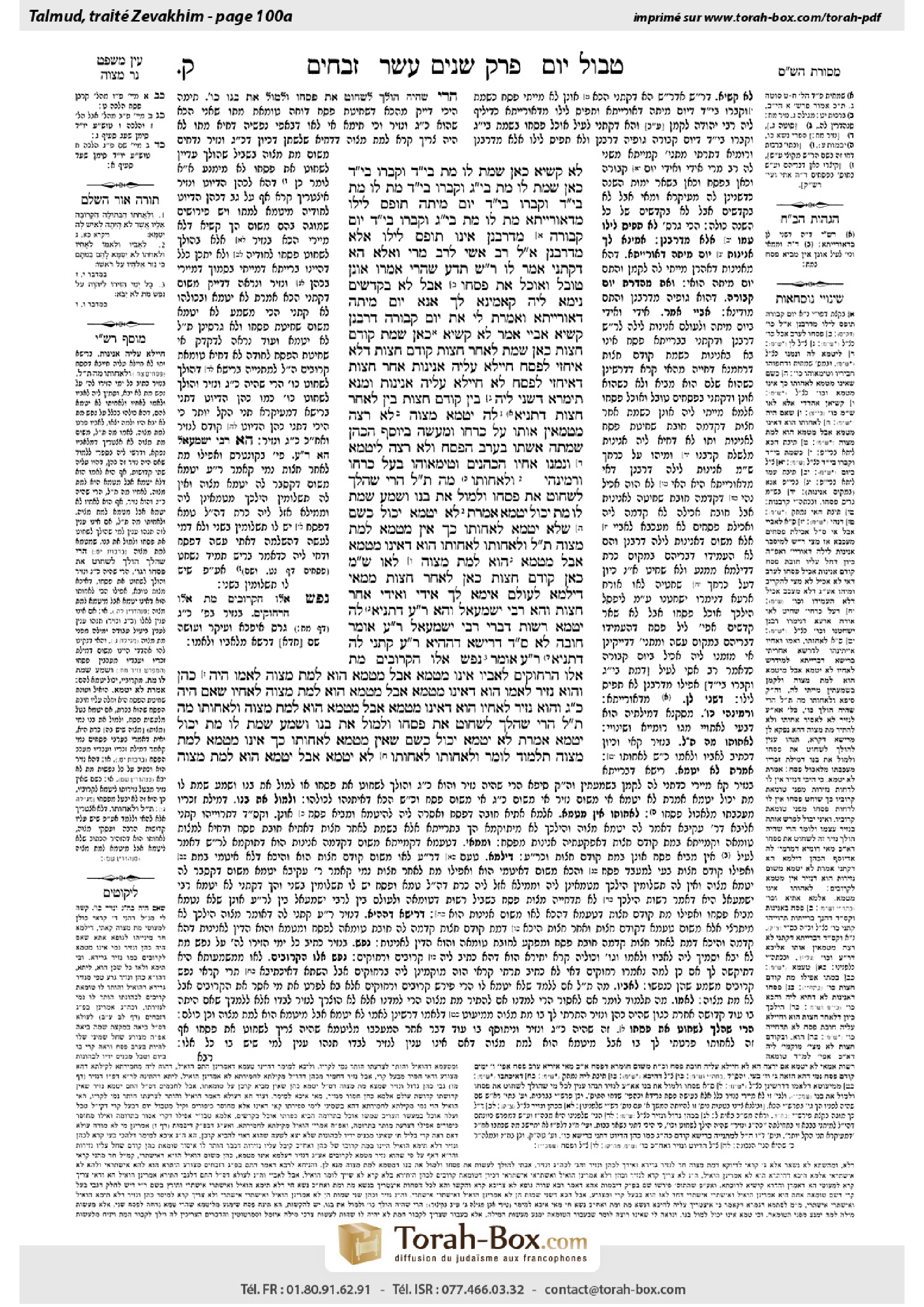
Zevachim 100a: Talmud study for Daf Yomi
Daf Yomi is the daily study of one Talmud folio. Explore 37 tractates with scans, Hebrew text, Sefaria English and AI-generated French translations where annotated.
Passage selection and English or AI-generated French translation are available where the scan has annotations. Daf Study is independent of Torah-Box and Sefaria.
Browse Zevachim · זבחים · All tractatesZevachim 100a text and translations
This page of Zevachim includes the Aramaic text, an English translation and an AI-generated French translation, alongside the scan above.
זבחים ק׳ א · Aramaic and Hebrew text
לָא קַשְׁיָא; כָּאן שֶׁמֵּת לוֹ מֵת בְּאַרְבָּעָה עָשָׂר וּקְבָרוֹ בְּאַרְבָּעָה עָשָׂר, כָּאן שֶׁמֵּת לוֹ מֵת בִּשְׁלֹשָׁה עָשָׂר וּקְבָרוֹ בְּאַרְבָּעָה עָשָׂר.
מֵת לוֹ מֵת בְּאַרְבָּעָה עָשָׂר וּקְבָרוֹ בְּאַרְבָּעָה עָשָׂר – יוֹם מִיתָה תּוֹפֵס לֵילוֹ מִדְּאוֹרָיְיתָא. מֵת לוֹ מֵת בִּשְׁלֹשָׁה עָשָׂר וּקְבָרוֹ בְּאַרְבָּעָה עָשָׂר – יוֹם קְבוּרָה מִדְּרַבָּנַן, אֵינוֹ תּוֹפֵס לֵילוֹ אֶלָּא מִדְּרַבָּנַן.
אֲמַר לֵיהּ רַב אָשֵׁי לְרַב מָרִי: וְאֶלָּא הָא דְּקָתָנֵי, אָמַר לוֹ רַבִּי שִׁמְעוֹן: תֵּדַע, שֶׁהֲרֵי אָמְרוּ: אוֹנֵן טוֹבֵל וְאוֹכֵל אֶת פִּסְחוֹ אֲבָל לֹא בַּקֳּדָשִׁים; נֵימָא לֵיהּ: קָאָמֵינָא לָךְ אֲנָא יוֹם מִיתָה דְּאוֹרָיְיתָא, וְאָמְרַתְּ לִי אֶת יוֹם קְבוּרָה דְּרַבָּנַן?! קַשְׁיָא.
אַבָּיֵי אָמַר: לָא קַשְׁיָא; כָּאן שֶׁמֵּת קוֹדֶם חֲצוֹת, כָּאן שֶׁמֵּת לְאַחַר חֲצוֹת. קוֹדֶם חֲצוֹת, דְּלָא אִיחֲזִי לְפֶסַח – חָיְילָא עֲלֵיהּ אֲנִינוּת. אַחַר חֲצוֹת, דְּאִחֲזִי לְפֶסַח – לָא חָיְילָא עֲלֵיהּ אֲנִינוּת.
וּמְנָא תֵּימְרָא דְּשָׁנֵי לֵיהּ בֵּין קוֹדֶם חֲצוֹת בֵּין לְאַחַר חֲצוֹת? דְּתַנְיָא: ״לָהּ יִטַּמָּא״ – מִצְוָה. לֹא רָצָה – מְטַמְּאִין אוֹתוֹ עַל כׇּרְחוֹ. וּמַעֲשֶׂה בְּיוֹסֵף הַכֹּהֵן שֶׁמֵּתָה אִשְׁתּוֹ בְּעֶרֶב הַפֶּסַח, וְלֹא רָצָה לִיטַּמֵּא, וְנִמְנוּ אֶחָיו הַכֹּהֲנִים וְטִימְּאוּהוּ בְּעַל כׇּרְחוֹ.
וּרְמִינְהִי: ״וְלַאֲחוֹתוֹ״ מָה תַּלְמוּד לוֹמַר? הֲרֵי שֶׁהָלַךְ לִשְׁחוֹט אֶת פִּסְחוֹ וְלָמוּל אֶת בְּנוֹ, וְשָׁמַע שֶׁמֵּת לוֹ מֵת – יָכוֹל יִטַּמֵּא? אָמַרְתָּ לֹא יִטַּמֵּא.
יָכוֹל כְּשֵׁם שֶׁלֹּא יִטַּמֵּא לַאֲחוֹתוֹ, כָּךְ אֵין מִטַּמֵּא לְמֵת מִצְוָה? תַּלְמוּד לוֹמַר: ״וְלַאֲחוֹתוֹ״ – לַאֲחוֹתוֹ הוּא דְּאֵינוֹ מִטַּמֵּא, אֲבָל מִטַּמֵּא הוּא לְמֵת מִצְוָה.
לָאו שְׁמַע מִינַּהּ: כָּאן קוֹדֶם חֲצוֹת, כָּאן לְאַחַר חֲצוֹת?
מִמַּאי? דִּילְמָא לְעוֹלָם אֵימָא לְךָ: אִידֵּי וְאִידֵּי אַחַר חֲצוֹת; וְהָא רַבִּי יִשְׁמָעֵאל וְהָא רַבִּי עֲקִיבָא. דְּתַנְיָא: ״לָהּ יִטַּמָּא״ – רְשׁוּת. דִּבְרֵי רַבִּי יִשְׁמָעֵאל. רַבִּי עֲקִיבָא אוֹמֵר: חוֹבָה.
לָא סָלְקָא דַּעְתָּךְ; דְּרֵישָׁא דְּהָהִיא – רַבִּי עֲקִיבָא קָתָנֵי לַהּ. דְּתַנְיָא, רַבִּי עֲקִיבָא אוֹמֵר: ״נֶפֶשׁ״ – אֵלּוּ הַקְּרוֹבִים, ״מֵת״ – אֵלּוּ הָרְחוֹקִים.
״לְאָבִיו״ אֵינוֹ מִטַּמֵּא, אֲבָל מִטַּמֵּא הוּא לְמֵת מִצְוָה. ״לְאִמּוֹ״ – הָיָה כֹּהֵן וְהוּא נָזִיר, לְאִמּוֹ הוּא דְּאֵינוֹ מִטַּמֵּא, אֲבָל מִטַּמֵּא הוּא לְמֵת מִצְוָה. ״לְאָחִיו״ – שֶׁאִם הָיָה כֹּהֵן גָּדוֹל וְהוּא נָזִיר, לְאָחִיו הוּא דְּאֵינוֹ מִטַּמֵּא, אֲבָל מִטַּמֵּא הוּא לְמֵת מִצְוָה.
״וְלַאֲחוֹתוֹ״ מָה תַּלְמוּד לוֹמַר? הֲרֵי שֶׁהָלַךְ לִשְׁחוֹט אֶת פִּסְחוֹ וְלָמוּל אֶת בְּנוֹ, וְשָׁמַע שֶׁמֵּת לוֹ מֵת – יָכוֹל יִטַּמֵּא? אָמַרְתָּ: לֹא יִטַּמֵּא. יָכוֹל כְּשֵׁם שֶׁאֵין מִטַּמֵּא לַאֲחוֹתוֹ, כָּךְ אֵינוֹ מִטַּמֵּא לְמֵת מִצְוָה? תַּלְמוּד לוֹמַר: ״וְלַאֲחוֹתוֹ״ – לַאֲחוֹתוֹ לֹא יִטַּמֵּא, אֲבָל מִטַּמֵּא הוּא לְמֵת מִצְוָה.
Zevachim 100a · English translation
It is not difficult. Here, in the baraita where Rabbi Shimon holds an acute mourner may not send a Paschal offering, since acute mourning at night is by Torah law, it is referring to a case where his relative died on the fourteenth day of Nisan and he buried him on the fourteenth itself. There, the ruling in the mishna in tractate Pesaḥim, which teaches that an acute mourner immerses and partakes of the Paschal offering in the evening, since acute mourning at night is by rabbinic law, is referring to a case where his relative died on the thirteenth day of Nisan and he buried him on the fourteenth of Nisan.
Rav Mari explains: In a case where his relative died on the fourteenth day of Nisan and he buried him on the fourteenth itself, his acute mourning is due to the day of death and is therefore by Torah law. Consequently, it takes hold of its following night by Torah law, and the mitzva of the Paschal offering does not override it. By contrast, in a case where his relative died on the thirteenth day of Nisan and he buried him on the fourteenth of Nisan, the fourteenth is only the day of burial, and his acute mourning is therefore by rabbinic law. Consequently, it takes hold of its following night only by rabbinic law, and the mitzva of the Paschal offering overrides it.
Rav Ashi said to Rav Mari: But if so, it is difficult to understand that which the baraita teaches: Rabbi Shimon said to Rabbi Yehuda: Know that this so, as the Sages said: An acute mourner immerses on the fourteenth of Nisan and partakes of his Paschal offering in the evening, but he may not partake of other sacrificial meat. According to your explanation of this statement, let Rabbi Yehuda say to Rabbi Shimon that this is no proof: I am telling you a halakha about the day of death, when acute mourning is by Torah law, and you tell me that you have a proof from a mishna that deals with the day of burial, when acute mourning is by rabbinic law. The Gemara concludes: This indeed poses a difficulty for Rav Mari.
Abaye said a different resolution to the contradiction between the statements of Rabbi Shimon: It is not difficult. Here, in the baraita where Rabbi Shimon holds that an acute mourner may not send a Paschal offering, it is referring to a case where his relative died before midday on the fourteenth of Nisan. There, the ruling in the mishna in tractate Pesaḥim, which teaches that an acute mourner immerses and partakes of the Paschal offering in the evening, it is a case where his relative died after midday on the fourteenth of Nisan. When his relative died before midday, in which case he was not ever fit for bringing a Paschal offering since the obligation begins at midday, the status of acute mourning applies to him, and it is prohibited for him to bring a Paschal offering. But if his relative dies after midday, when he is already fit for bringing a Paschal offering, the status of acute mourning does not apply to him with regard to this matter, so he may immerse and partake of the Paschal offering in the evening.
The Gemara explains: And from where do you say that the halakha is different depending on whether his relative died before midday on the fourteenth of Nisan or whether he died after midday? As it is taught in a baraita: The Torah states with regard to a priest: “And for his sister a virgin, that is near unto him, that has had no husband, for her may he become impure” (Leviticus 21:3). From here it is derived that it is a mitzva for a priest to become impure in order to bury his deceased relatives, and if he did not want to do so, others must render him impure against his will. And an incident occurred involving Yosef the priest, where his wife died on Passover eve, and he did not want to become impure, as he wanted to offer the Paschal offering; and his brethren the priests voted and rendered him impure against his will.
And the Sages raise a contradiction from another baraita: What is the meaning when the verse states with regard to a nazirite: “He shall not become impure for his father, or for his mother, for his brother, or for his sister when they die; because his consecration unto God is upon his head” (Numbers 6:7)? If a nazirite went to slaughter his Paschal offering or to circumcise his son, mitzvot for which failure to fulfill them is punishable by karet, and he heard that a relative of his died, one might have thought that he should become impure in order to bury his relative even if this will result in his not bringing the Paschal offering. You rather say, based on this verse, that “he shall not become impure.”
One might have thought that just as he may not become impure to bury his sister, so too he may not become impure to bury a corpse with no one to bury it [met mitzva]. The verse states: “Or for his sister,” teaching that it is only to bury his sister that he may not become impure, but he does become impure to bury a met mitzva.
In the first baraita, contracting impurity from a dead relative is obligatory, and in the second baraita it is forbidden. Do you not learn from this contradiction that there must be a distinction between the cases? Here, in the first baraita concerning a priest, it must be referring to a case where the relative died before midday, so he was obligated to become impure before the obligation for the Paschal offering took effect. There, in the second baraita concerning a nazirite, it must be referring to a case where the relative died after midday. This distinction, between death before and after midday, also applies to acute mourning.
The Gemara rejects this explanation: From where do you infer that this is the resolution to the contradiction? Actually, perhaps I will say to you: Both this baraita and that baraita are discussing deaths that occurred after midday. And this baraita, about a nazirite, is in accordance with the opinion of Rabbi Yishmael, and that baraita, about Yosef the priest, is in accordance with the opinion of Rabbi Akiva. As it is taught in a baraita: The Torah states with regard to a priest: “And for his sister a virgin, that is near unto him, that has had no husband, for her may he become impure” (Leviticus 21:3). This is optional, i.e., a priest is not obligated to become impure to bury his sister; this is the statement of Rabbi Yishmael. Rabbi Akiva says: It is mandatory.
The Gemara responds: This should not enter your mind, because it is Rabbi Akiva who teaches the first clause of the baraita about a nazirite. As it is taught in the full version of that baraita: The Torah states: “All the days that he consecrates himself unto the Lord he shall not come near to a dead body. He shall not become impure for his father, or for his mother, for his brother, or for his sister when they die; because his consecration unto God is upon his head” (Numbers 6:7). Rabbi Akiva says: The term “body [nefesh]” is referring to relatives. The term “dead [met]” is referring to non-relatives.
The verse specifies: “For his father,” even though his father is included among his relatives, to teach that he may not become impure to bury his father, but he does become impure to bury a met mitzva. The verse states: “For his mother,” to teach that even if he was a priest and he was a nazirite, and therefore doubly prohibited from becoming impure, nevertheless, he may not become impure to bury his mother but he does become impure to bury a met mitzva. The verse states: “For his brother,” to teach that even if he was a High Priest, who may not become impure even for his relatives, and he was also a nazirite, nevertheless, he may not become impure to bury his brother but he does become impure to bury a met mitzva.
What is the meaning when the verse states: “Or for his sister”? If a nazirite went to slaughter his Paschal offering or to circumcise his son, and he heard that a relative of his died, one might have thought that he should become impure. You rather say that he may not become impure. One might have thought that just as he may not become impure to bury his sister, so too he may not become impure to bury a met mitzva. The verse states: “Or for his sister,” to teach that he may not become impure to bury his sister but he does become impure to bury a met mitzva. Consequently, the statement of the baraita concerning a nazirite represents the opinion of Rabbi Akiva.
Zevachim 100a · Traduction française (IA)
Il n’y a pas de difficulté. Ici, dans la baraïta où Rabbi Chimon estime qu’un endeuillé en période d’aninout ne peut pas envoyer d’offrande pascale, il s’agit du cas où son proche est mort le quatorzième jour de Nissan et où il l’a enterré ce même jour. Là, dans la Michna du traité Pessa’him, qui enseigne qu’un endeuillé en période d’aninout se trempe au mikvé et prend part à l’offrande pascale le soir, puisque l’aninout nocturne relève du droit rabbinique, il s’agit du cas où son proche est mort le treizième jour de Nissan et où il l’a enterré le quatorzième jour de Nissan.
Rav Mari explique : lorsque son proche est mort le quatorzième jour de Nissan et qu’il l’a enterré ce même jour, son aninout découle du jour du décès et relève donc du droit de la Torah. Par conséquent, elle s’étend à la nuit suivante en vertu du droit de la Torah, et la mitsva de l’offrande pascale ne l’emporte pas sur elle. En revanche, lorsque son proche est mort le treizième jour de Nissan et qu’il l’a enterré le quatorzième jour de Nissan, le quatorzième jour est seulement le jour de l’enterrement, et son aninout relève donc du droit rabbinique. Par conséquent, elle s’étend à la nuit suivante uniquement en vertu du droit rabbinique, et la mitsva de l’offrande pascale l’emporte sur elle.
Rav Ashi dit à Rav Mari : Mais alors, il est difficile de comprendre ce qu’enseigne la baraïta : Rabbi Chimon dit à Rabbi Yehouda : « Sache qu’il en est bien ainsi, car les Sages ont dit : Un endeuillé en période d’aninout se trempe au mikvé le quatorzième jour de Nissan et prend part à son offrande pascale le soir, mais il ne peut pas prendre part à la consommation des autres offrandes sacrificielles. » Selon votre explication de cette déclaration, Rabbi Yehouda aurait dû répondre à Rabbi Chimon que ce n’est pas une preuve : « Je vous parle d’une halakha concernant le jour du décès, où l’aninout relève du droit de la Torah, et vous me donnez comme preuve une Michna qui traite du jour de l’enterrement, où l’aninout relève du droit rabbinique. » La Guemara conclut : Cela constitue effectivement une difficulté pour Rav Mari.
Abayé propose une autre résolution à la contradiction entre les déclarations de Rabbi Chimon : il n’y a pas de difficulté. Ici, dans la baraïta où Rabbi Chimon estime qu’un endeuillé en période d’aninout ne peut pas envoyer d’offrande pascale, il s’agit du cas où son proche est mort avant midi le quatorzième jour de Nissan. Là, dans la Michna du traité Pessa’him, qui enseigne qu’un endeuillé en période d’aninout se trempe au mikvé et prend part à l’offrande pascale le soir, il s’agit du cas où son proche est mort après midi le quatorzième jour de Nissan. Lorsque son proche est mort avant midi, il n’a jamais été apte à apporter une offrande pascale, puisque l’obligation ne commence qu’à midi ; le statut d’endeuillé en période d’aninout s’applique donc à lui, et il lui est interdit d’apporter une offrande pascale. Mais si son proche meurt après midi, alors qu’il est déjà apte à apporter une offrande pascale, le statut d’endeuillé en période d’aninout ne s’applique pas à lui en ce qui concerne cette question ; il peut donc se tremper au mikvé et prendre part à l’offrande pascale le soir.
La Guemara explique : Et d’où déduis-tu que la halakha diffère selon que son proche est mort avant ou après midi le quatorzième jour de Nissan ? De ce qu’enseigne une baraïta : À propos d’un prêtre, la Torah dit : « Et pour sa sœur vierge, qui est proche de lui et qui n’a pas eu de mari, il pourra se rendre impur pour elle » (Lévitique 21:3). On en déduit que c’est une mitsva pour un prêtre de se rendre impur afin d’enterrer ses proches décédés ; s’il ne le souhaite pas, d’autres doivent le rendre impur contre son gré. Un incident est survenu au sujet de Yossef le prêtre : sa femme est morte la veille de Pessa’h et il ne voulait pas se rendre impur, car il souhaitait offrir l’offrande pascale ; ses frères prêtres votèrent et le rendirent impur contre son gré.
Et les Sages soulèvent une contradiction à partir d’une autre baraïta : Que signifie le verset concernant un nazir : « Il ne se rendra pas impur pour son père, ni pour sa mère, ni pour son frère, ni pour sa sœur lorsqu’ils mourront, car la consécration de son Dieu est sur sa tête » (Nombres 6:7) ? Si un nazir s’est mis en route pour faire égorger son offrande pascale ou faire circoncire son fils — des mitsvot dont l’inaccomplissement est passible de karet — et qu’il apprend qu’un de ses proches est mort, on aurait pu penser qu’il doit se rendre impur afin d’enterrer son proche, même si cela l’empêche d’apporter l’offrande pascale. Le verset enseigne au contraire : « Il ne se rendra pas impur. »
On aurait pu penser que, de même qu’il ne peut pas se rendre impur pour enterrer sa sœur, il ne peut pas non plus se rendre impur pour enterrer un mort qui n’a personne pour l’enterrer [met mitsva]. Le verset dit : « Ou pour sa sœur », ce qui enseigne que c’est seulement pour enterrer sa sœur qu’il ne peut pas se rendre impur, mais qu’il se rend impur pour enterrer un met mitsva.
Dans la première baraïta, il est obligatoire de se rendre impur au contact d’un proche décédé, tandis que dans la seconde baraïta, cela est interdit. Ne déduis-tu pas de cette contradiction qu’il faut distinguer les cas ? Ici, dans la première baraïta concernant un prêtre, il doit s’agir du cas où son proche est mort avant midi, de sorte que le prêtre était tenu de se rendre impur avant que l’obligation d’apporter l’offrande pascale ne prenne effet. Là, dans la seconde baraïta concernant un nazir, il doit s’agir du cas où son proche est mort après midi. Cette distinction entre un décès avant et après midi s’applique également à l’aninout.
La Guemara rejette cette explication : D’où déduis-tu que c’est là la résolution de la contradiction ? Peut-être te dirai-je plutôt que les deux baraïtot traitent de décès survenus après midi. Cette baraïta, au sujet d’un nazir, est conforme à l’opinion de Rabbi Yichmaël, tandis que cette baraïta, au sujet de Yossef le prêtre, est conforme à l’opinion de Rabbi Akiva. En effet, une baraïta enseigne : À propos d’un prêtre, la Torah dit : « Et pour sa sœur vierge, qui est proche de lui et qui n’a pas eu de mari, il pourra se rendre impur pour elle » (Lévitique 21:3). Cela est facultatif, c’est-à-dire qu’un prêtre n’est pas obligé de se rendre impur pour enterrer sa sœur ; telle est l’opinion de Rabbi Yichmaël. Rabbi Akiva dit : C’est obligatoire.
La Guemara répond : Cette possibilité ne doit pas te venir à l’esprit, car c’est Rabbi Akiva qui enseigne la première partie de la baraïta au sujet d’un nazir. En effet, la version complète de cette baraïta enseigne : La Torah dit : « Tous les jours où il se consacre au Seigneur, il ne s’approchera pas d’un mort. Il ne se rendra pas impur pour son père, ni pour sa mère, ni pour son frère, ni pour sa sœur lorsqu’ils mourront, car la consécration de son Dieu est sur sa tête » (Nombres 6:7). Rabbi Akiva dit : Le terme « corps [nefesh] » désigne les proches. Le terme « mort [met] » désigne les personnes qui ne sont pas ses proches.
Le verset précise : « Pour son père », alors que son père est déjà compris parmi ses proches, afin d’enseigner qu’il ne peut pas se rendre impur pour enterrer son père, mais qu’il se rend impur pour enterrer un met mitsva. Le verset dit : « Pour sa mère », afin d’enseigner que même s’il était prêtre et nazir, et donc soumis à une double interdiction de se rendre impur, il ne peut néanmoins pas se rendre impur pour enterrer sa mère, mais il se rend impur pour enterrer un met mitsva. Le verset dit : « Pour son frère », afin d’enseigner que même s’il était grand prêtre, qui ne peut pas se rendre impur même pour ses proches, et également nazir, il ne peut néanmoins pas se rendre impur pour enterrer son frère, mais il se rend impur pour enterrer un met mitsva.
Que signifie le verset : « Ou pour sa sœur » ? Si un nazir s’est mis en route pour faire égorger son offrande pascale ou faire circoncire son fils et qu’il apprend qu’un de ses proches est mort, on aurait pu penser qu’il doit se rendre impur. Le verset enseigne au contraire qu’il ne peut pas se rendre impur. On aurait pu penser que, de même qu’il ne peut pas se rendre impur pour enterrer sa sœur, il ne peut pas non plus se rendre impur pour enterrer un met mitsva. Le verset dit : « Ou pour sa sœur », afin d’enseigner qu’il ne peut pas se rendre impur pour enterrer sa sœur, mais qu’il se rend impur pour enterrer un met mitsva. Par conséquent, la déclaration de la baraïta au sujet d’un nazir représente l’opinion de Rabbi Akiva.
Traduction française générée par IA à partir de l’édition anglaise de Sefaria. Vérifie toujours un passage avec le texte source.
Text from Sefaria: William Davidson Edition - Vocalized Aramaic (CC BY NC); William Davidson Edition - English (CC BY NC).