Zevachim 100b: Talmud study for Daf Yomi
Daf Yomi is the daily study of one Talmud folio. Explore 37 tractates with scans, Hebrew text, Sefaria English and AI-generated French translations where annotated.
Passage selection and English or AI-generated French translation are available where the scan has annotations. Daf Study is independent of Torah-Box and Sefaria.
Browse Zevachim · זבחים · All tractatesZevachim 100b text and translations
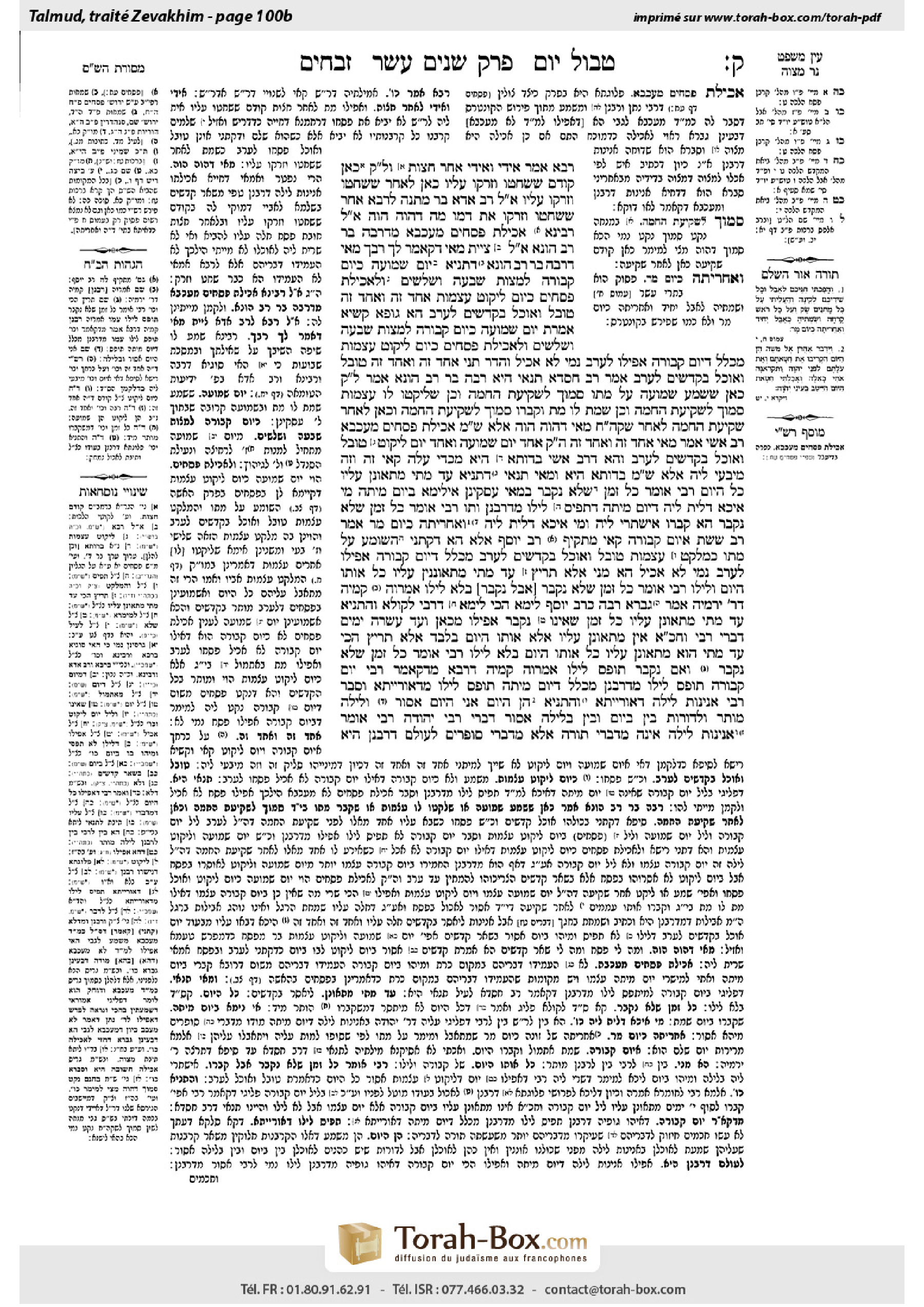
This page of Zevachim includes the Aramaic text, an English translation and an AI-generated French translation, alongside the scan above.
זבחים ק׳ ב · Aramaic and Hebrew text
רָבָא אָמַר: אִידֵּי וְאִידֵּי אַחַר חֲצוֹת, וְלָא קַשְׁיָא; כָּאן קוֹדֶם שֶׁשָּׁחֲטוּ וְזָרְקוּ עָלָיו, כָּאן לְאַחַר שֶׁשָּׁחֲטוּ וְזָרְקוּ עָלָיו.
אֲמַר לֵיהּ רַב אַדָּא בַּר מַתְנָה לְרָבָא: אַחַר שֶׁשָּׁחֲטוּ וְזָרְקוּ אֶת דָּמוֹ – מָה דַּהֲוָה הֲוָה! אֲמַר לֵיהּ רָבִינָא: אֲכִילַת פְּסָחִים מְעַכְּבָא, מִדְּרַבָּה בַּר רַב הוּנָא. אֲמַר לֵיהּ: צָיֵית מַאי דְּקָאָמַר לָךְ רַבָּךְ.
מַאי דְּרַבָּה בַּר רַב הוּנָא? דְּתַנְיָא: יוֹם שְׁמוּעָה כְּיוֹם קְבוּרָה לְמִצְוַת שִׁבְעָה וּשְׁלֹשִׁים; וְלַאֲכִילַת פְּסָחִים – כְּיוֹם לִיקּוּט עֲצָמוֹת. אֶחָד זֶה וְאֶחָד זֶה – טוֹבֵל וְאוֹכֵל בַּקֳּדָשִׁים לָעֶרֶב.
הָא גּוּפַהּ קַשְׁיָא! אָמְרַתְּ יוֹם שְׁמוּעָה כְּיוֹם קְבוּרָה לְמִצְוַת שִׁבְעָה וּשְׁלֹשִׁים, וְלַאֲכִילַת פְּסָחִים כְּיוֹם לִיקּוּט עֲצָמוֹת – מִכְּלָל דְּיוֹם קְבוּרָה אֲפִילּוּ לָעֶרֶב נָמֵי לָא אָכֵיל; וַהֲדַר תָּנֵי: אֶחָד זֶה וְאֶחָד זֶה טוֹבֵל וְאוֹכֵל בַּקֳּדָשִׁים לָעֶרֶב!
אָמַר רַב חִסְדָּא: תַּנָּאֵי הִיא.
רַבָּה בַּר רַב הוּנָא אָמַר: לָא קַשְׁיָא; כָּאן שֶׁשָּׁמַע שְׁמוּעָה עַל מֵתוֹ סָמוּךְ לִשְׁקִיעַת הַחַמָּה, וְכֵן שֶׁלִּיקְּטוּ לוֹ עֲצָמוֹת סָמוּךְ לִשְׁקִיעַת הַחַמָּה, וְכֵן שֶׁמֵּת לוֹ מֵת וּקְבָרוֹ סָמוּךְ לִשְׁקִיעַת הַחַמָּה; וְכָאן לְאַחַר שְׁקִיעַת הַחַמָּה.
לְאַחַר שְׁקִיעַת הַחַמָּה – מַאי דַהֲוָה הֲוָה! אֶלָּא שְׁמַע מִינַּהּ: אֲכִילַת פְּסָחִים מְעַכְּבָא.
רַב אָשֵׁי אָמַר: מַאי אֶחָד זֶה וְאֶחָד זֶה? הָכִי קָאָמַר: אֶחָד יוֹם שְׁמוּעָה וְאֶחָד יוֹם לִיקּוּט – טוֹבֵל וְאוֹכֵל בַּקֳּדָשִׁים לָעֶרֶב.
וְהָא דְּרַב אָשֵׁי בְּדוּתָא הִיא; מִכְּדֵי עֲלַהּ קָאֵי, ״זֶה וָזֶה״ מִיבְּעֵי לֵיהּ! אֶלָּא שְׁמַע מִינַּהּ בְּדוּתָא הִיא.
וּמַאי תַּנָּאֵי? דְּתַנְיָא: עַד מָתַי מִתְאוֹנֵן עָלָיו? כׇּל הַיּוֹם. רַבִּי אוֹמֵר: כׇּל זְמַן שֶׁלֹּא נִקְבַּר.
בְּמַאי עָסְקִינַן? אִילֵימָא בְּיוֹם מִיתָה – מִי אִיכָּא דְּלֵית לֵיהּ דְּיוֹם מִיתָה דְּתָפֵיס לֵילוֹ מִדְּרַבָּנַן?!
וְתוּ, רַבִּי אוֹמֵר: כׇּל זְמַן שֶׁלֹּא נִקְבַּר. הָא קְבָרוֹ – אִישְׁתְּרִי לֵיהּ; וּמִי אִיכָּא דְּלֵית לֵיהּ ״וְאַחֲרִיתָהּ כְּיוֹם מָר״?!
אָמַר רַב שֵׁשֶׁת: אַיּוֹם קְבוּרָה קָאֵי.
מַתְקֵיף רַב יוֹסֵף, אֶלָּא הָא דְּקָתָנֵי: הַשּׁוֹמֵעַ עַל מֵתוֹ – כִּמְלַקֵּט עֲצָמוֹת, טוֹבֵל וְאוֹכֵל בַּקֳּדָשִׁים לָעֶרֶב; מִכְּלָל דְּיוֹם קְבוּרָה – אֲפִילּוּ לָעֶרֶב נָמֵי לָא אָכֵיל; הָא מַנִּי? אֶלָּא תָּרֵיץ: עַד מָתַי מִתְאוֹנְנִין עָלָיו? כׇּל אוֹתוֹ הַיּוֹם וְלֵילוֹ. רַבִּי אוֹמֵר: כׇּל זְמַן שֶׁלֹּא נִקְבַּר; [אֲבָל נִקְבַּר] – בְּלֹא לֵילוֹ.
אַמְרוּהָ קַמֵּיהּ דְּרַבִּי יִרְמְיָה, אָמַר: גַּבְרָא רַבָּה כְּרַב יוֹסֵף לֵימָא הָכִי?! לֵימָא דְּרַבִּי לְקוּלָּא?! וְהָתַנְיָא: עַד מָתַי מִתְאוֹנֵן עָלָיו? כׇּל זְמַן שֶׁאֵינוֹ נִקְבָּר, אֲפִילּוּ מִכָּאן וְעַד עֲשָׂרָה יָמִים. דִּבְרֵי רַבִּי. וַחֲכָמִים אוֹמְרִים: אֵין מִתְאוֹנֵן עָלָיו אֶלָּא אוֹתוֹ הַיּוֹם בִּלְבַד!
אֶלָּא תָּרֵיץ הָכִי: עַד מָתַי הוּא מִתְאוֹנֵן עָלָיו? כׇּל אוֹתוֹ הַיּוֹם בְּלֹא לֵילוֹ. רַבִּי אוֹמֵר: כׇּל זְמַן שֶׁלֹּא נִקְבַּר. וְאִם נִקְבַּר – תּוֹפֵס לֵילוֹ.
אַמְרוּהָ קַמֵּיהּ דְּרָבָא; מִדְּקָאָמַר רַבִּי: יוֹם קְבוּרָה תּוֹפֵס לֵילוֹ מִדְּרַבָּנַן – מִכְּלָל דְּיוֹם מִיתָה תּוֹפֵס לֵילוֹ מִדְּאוֹרָיְיתָא;
וְסָבַר רַבִּי אֲנִינוּת לַיְלָה דְּאוֹרָיְיתָא?! וְהָתַנְיָא: ״הֵן הַיּוֹם״ – אֲנִי הַיּוֹם אָסוּר וְלַיְלָה מוּתָּר, וּלְדוֹרוֹת בֵּין בַּיּוֹם וּבֵין בַּלַּיְלָה אָסוּר. דִּבְרֵי רַבִּי יְהוּדָה. רַבִּי אוֹמֵר: אֲנִינוּת לַיְלָה אֵינָהּ מִדִּבְרֵי תוֹרָה, אֶלָּא מִדִּבְרֵי סוֹפְרִים!
לְעוֹלָם דְּרַבָּנַן הִיא,
Zevachim 100b · English translation
Rava said there is a different resolution to the contradiction between the statements of Rabbi Shimon. Both this baraita and that baraita are discussing cases where the relative died after midday on the fourteenth of Nisan, and still it is not difficult. Here, his relative died before the priests would have slaughtered the Paschal offering and sprinkled its blood on his account, and he may not send the offering. There, the relative died after the priests slaughtered the Paschal offering and sprinkled its blood on his account. Since acute mourning at night is by rabbinic law, it is suspended to allow him to consume an offering that was already sacrificed.
Rav Adda bar Mattana said to Rava: In a case where one’s relative died after the priests slaughtered the Paschal offering and sprinkled its blood, why should he be permitted to partake of the Paschal offering? What was, was, and although the offering was sacrificed, isn’t he still an acute mourner by rabbinic law? Ravina said to Rav Adda bar Mattana: Partaking of the Paschal offering is indispensable for the mitzva, as is seen from that which Rabba bar Rav Huna taught, as the Gemara will explain. Therefore, the Sages did not prohibit the acute mourner from partaking of the Paschal offering as they do for other offerings, for which consumption of the meat is dispensable. Rava said to Rav Adda bar Mattana: Listen to what your master, Ravina, told you, as his explanation is correct.
What is the statement of Rabba bar Rav Huna that teaches that partaking of the Paschal offering is indispensable? As it is taught in a baraita: The day that a person receives tidings that his relative died is considered as if it were the day of burial with regard to the mitzva of the seven-day mourning period, when he may not bathe or wear shoes, and with regard to the thirty-day period when he may not wear ironed garments. And with regard to partaking of the Paschal offering, the day he receives the tidings is like the day of the gathering of the bones of the deceased after the flesh decomposed (see Pesaḥim 92a). In both this and that case, he immerses and partakes of sacrificial meat in the evening.
The Gemara challenges: This baraita itself is difficult. At first you say: The day of tidings is considered as if it were the day of burial for the mitzva of the seven-day and thirty-day mourning periods; and with regard to partaking of the Paschal offering, it is like the day of the gathering of bones, when one may immerse and partake of sacrificial meat in the evening. By inference, one concludes that on the day of burial, he may not partake of the Paschal offering even in the evening, and all the more so other sacrificial meat. And then it is taught: In both this and that case, i.e., on both the day of burial and the day of the gathering of bones, he immerses and partakes of sacrificial meat in the evening.
Rav Ḥisda said: Whether it is permitted to partake of sacrificial meat the night after the day of burial is a dispute between tanna’im, as the Gemara will explain.
Rabba bar Rav Huna said: This is not difficult. Here, in the latter clause, where the baraita teaches that on both the day of burial and the day of the gathering of bones he immerses and partakes of sacrificial meat in the evening, it is referring to a case where he heard tidings of his dead relative just before sunset, and likewise a case where they gathered the bones for him just before sunset, and likewise a case where his relative died and he buried him just before sunset. But there, in the first clause, from which it is inferred that he may not consume any sacrificial meat the night after the day of burial, the burial occurred after sunset, i.e., on the night of the fifteenth of Nisan itself.
The Gemara objects: If so, why not say that even if he gathered bones after sunset, then what was, was? Why did the Sages permit him to partake of the Paschal offering, as opposed to other sacrificial meat? Rather, learn from this baraita that partaking of the Paschal offering is indispensable to fulfilling the obligation, and due to the severity of the mitzva, the Sages suspended their decree prohibiting one from partaking of it.
Rav Ashi said there is another resolution to this question: What is meant by the latter clause in the baraita: In both this and that case? It does not mean both the day of burial and the day of the gathering of bones. Rather, this is what the baraita is saying: Both on the day of tidings and on the day of the gathering of bones, the mourner immerses and partakes of sacrificial meat in the evening. But after the day of burial, he may not partake of the Paschal offering, and all the more so of other sacrificial meat, as indicated in the first clause in the baraita.
The Gemara notes: And this resolution of Rav Ashi is a mistake, since the tanna is already discussing those two cases and equating them. According to Rav Ashi’s resolution, it is extraneous to say: In both this and that case; the tanna should have simply said: In this and that case. Rather, learn from the language of the baraita that Rav Ashi’s resolution is a mistake.
The Gemara returns to discuss Rav Ḥisda’s resolution: And what is the dispute between tanna’im with regard to the night following the day of burial? As it is taught in a baraita: Until when does a person mourn acutely for his relative, such that he is prohibited to partake of sacrificial meat? The entire day. Rabbi Yehuda HaNasi says: As long as his relative has not been buried.
The Gemara asks: What are we dealing with? If we say we are dealing with the day of death, is there a tanna who does not hold that the day of death takes hold of its following night, at least by rabbinic law? In accordance with whose opinion is the statement of the first tanna, who says that the acute mourning is only during the day, and not at night?
And furthermore, if we are dealing with the day of death, then when Rabbi Yehuda HaNasi says: As long as his relative has not been buried, it indicates that consequently, once he has buried him, it becomes permitted for him to partake of sacrificial meat, even on the day of death itself. But is there a tanna who does not hold that acute mourning extends for the entire day of death, even after burial? The verse states: “And I will turn your feasts into mourning, and all your songs into lamentation; and I will bring up sackcloth upon all loins, and baldness upon every head; and I will make it as the mourning for an only son, and the end thereof as a bitter day” (Amos 8:10).
Rav Sheshet said: The tanna of this baraita is discussing the day of burial when it is not the day of death. The tanna’im disagree whether the acute mourning lasts only until the burial, or until the end of the day of burial.
Rav Yosef objects to this: But there is that which is taught in a baraita: One who hears tidings of his dead relative is considered as one who gathers his relative’s bones, in that he may immerse and partake of sacrificial meat in the evening. By inference, on the day of burial he may not partake even in the evening. In accordance with whose opinion is this? This is the opinion of neither the first tanna nor Rabbi Yehuda HaNasi. Rather, one must answer that the baraita means: Until when does a person mourn acutely for his relative? That entire day of burial and its following night. Rabbi Yehuda HaNasi says: He continues into the night only as long as his relative has not been buried; but once he is buried, the acute mourning lasts only for the rest of the day, without its night.
The Sages said this statement of Rav Yosef before Rabbi Yirmeya. Rabbi Yirmeya said in surprise: Would a great man like Rav Yosef say this? Would he say that the opinion of Rabbi Yehuda HaNasi is the more lenient of the two? But isn’t it taught in a baraita: Until when does a person mourn acutely for his relative? As long as his relative has not been buried, even if he remains unburied from now until ten days from now. This is the statement of Rabbi Yehuda HaNasi. And the Sages say: He mourns acutely for his relative only on that same day. The opinion of Rabbi Yehuda HaNasi is more stringent than that of the Sages.
Rather, answer like this: Until when does a person mourn acutely for his relative? That entire day of burial, without its night. Rabbi Yehuda HaNasi says: The acute mourning continues as long as his relative has not been buried, even for ten days, and once he is buried, that day takes hold of its night. This is the dispute to which Rav Ḥisda referred.
The Sages said this statement before Rava. Rava said: Since Rabbi Yehuda HaNasi says that the day of burial, when acute mourning is by rabbinic law, takes hold of its night by rabbinic law, by inference, he must hold that the day of death, when acute mourning is by Torah law, takes hold of its night by Torah law. The Sages would not be more stringent with their ordinance than the parallel law of the Torah.
The Gemara objects: And does Rabbi Yehuda HaNasi hold that acute mourning at night is by Torah law? But isn’t it taught in a baraita: On the last day of the inauguration of the Tabernacle, after two of Aaron’s sons died, Aaron said to Moses: “Behold, today…there have befallen me such things as these; and if I had consumed the sin offering today, would it have been good in the eyes of the Lord?” (Leviticus 10:19). The word “today” teaches that Aaron is saying: I am prohibited from partaking today but permitted to partake at night; but for future generations, an acute mourner is prohibited from partaking of sacrificial meat whether during the day or at night. This is the statement of Rabbi Yehuda. Rabbi Yehuda HaNasi says: For future generations, acute mourning at night is not by Torah law, but rather by rabbinic law.
The Gemara answers: Actually, Rabbi Yehuda HaNasi holds that acute mourning on the night after death is by rabbinic law, not Torah law.
Zevachim 100b · Traduction française (IA)
Rava dit qu’il existe une autre manière de résoudre la contradiction entre les propos de Rabbi Shimon. Les deux baraïtot, celle-ci comme celle-là, traitent de cas où le proche est décédé après midi, le quatorze Nissan, et il n’y a pourtant aucune difficulté. Ici, le proche est décédé avant que les prêtres n’aient égorgé l’offrande pascale et aspergé son sang en son nom ; il ne peut donc pas envoyer l’offrande. Là, le proche est décédé après que les prêtres ont égorgé l’offrande pascale et aspergé son sang en son nom. Puisque le deuil immédiat nocturne relève de la loi rabbinique, cette interdiction est suspendue afin de lui permettre de consommer une offrande qui a déjà été sacrifiée.
Rav Adda bar Mattana dit à Rava : Dans le cas où le proche est décédé après que les prêtres ont égorgé l’offrande pascale et aspergé son sang, pourquoi devrait-on permettre à la personne en deuil de consommer l’offrande pascale ? Ce qui est fait est fait ; et bien que l’offrande ait été sacrifiée, n’est-elle pas toujours en deuil immédiat selon la loi rabbinique ? Ravina dit à Rav Adda bar Mattana : La consommation de l’offrande pascale est indispensable à l’accomplissement de la mitsva, comme le montre l’enseignement de Rabba bar Rav Huna, que la Guemara va expliquer. C’est pourquoi les Sages n’ont pas interdit à la personne en deuil immédiat de consommer l’offrande pascale, contrairement aux autres offrandes, dont la consommation de la viande n’est pas indispensable. Rava dit à Rav Adda bar Mattana : Écoute ce que ton maître, Ravina, t’a dit, car son explication est juste.
Quel est l’enseignement de Rabba bar Rav Huna, qui établit que la consommation de l’offrande pascale est indispensable ? Il est enseigné dans une baraïta : Le jour où une personne apprend le décès de son proche est considéré comme le jour de l’inhumation pour la mitsva de la période de deuil de sept jours, durant laquelle elle ne peut ni se baigner ni porter de chaussures, et pour la période de trente jours, durant laquelle elle ne peut porter de vêtements repassés. En ce qui concerne la consommation de l’offrande pascale, le jour où elle apprend la nouvelle équivaut au jour du rassemblement des ossements du défunt, après la décomposition de la chair (voir Pessa'him 92a). Dans ces deux cas, elle s’immerge et consomme de la viande sacrificielle le soir.
La Guemara objecte : Cette baraïta elle-même pose problème. Tu dis d’abord que le jour où l’on apprend la nouvelle est considéré comme le jour de l’inhumation pour les périodes de deuil de sept et de trente jours ; et qu’en ce qui concerne la consommation de l’offrande pascale, il équivaut au jour du rassemblement des ossements, où l’on peut s’immerger et consommer de la viande sacrificielle le soir. On en déduit que le jour de l’inhumation, on ne peut pas consommer l’offrande pascale, même le soir, et à plus forte raison aucune autre viande sacrificielle. Puis il est enseigné : Dans ces deux cas, c’est-à-dire le jour de l’inhumation et celui du rassemblement des ossements, on s’immerge et on consomme de la viande sacrificielle le soir.
Rav Ḥisda dit : La question de savoir s’il est permis de consommer de la viande sacrificielle la nuit qui suit le jour de l’inhumation fait l’objet d’un désaccord entre tannaïm, comme la Guemara va l’expliquer.
Rabba bar Rav Huna dit : Il n’y a pas de difficulté. Ici, dans la dernière partie de la baraïta, où il est enseigné que le jour de l’inhumation comme celui du rassemblement des ossements, on s’immerge et on consomme de la viande sacrificielle le soir, il s’agit d’un cas où la personne a appris le décès de son proche juste avant le coucher du soleil ; de même, les ossements ont été rassemblés pour elle juste avant le coucher du soleil ; et de même, son proche est décédé et elle l’a enterré juste avant le coucher du soleil. Mais là, dans la première partie, dont on déduit qu’on ne peut consommer aucune viande sacrificielle la nuit qui suit le jour de l’inhumation, l’inhumation a eu lieu après le coucher du soleil, c’est-à-dire dans la nuit du quinze Nissan même.
La Guemara objecte : Dans ce cas, pourquoi ne pas dire que, même si les ossements ont été rassemblés après le coucher du soleil, ce qui est fait est fait ? Pourquoi les Sages auraient-ils permis de consommer l’offrande pascale, contrairement aux autres viandes sacrificielles ? Il faut plutôt déduire de cette baraïta que la consommation de l’offrande pascale est indispensable à l’accomplissement de l’obligation et que, compte tenu de l’importance de la mitsva, les Sages ont suspendu leur décret interdisant de la consommer.
Rav Ashi propose une autre réponse à cette question : Que signifie la dernière partie de la baraïta, « dans ces deux cas » ? Elle ne désigne pas le jour de l’inhumation et celui du rassemblement des ossements. La baraïta dit plutôt ceci : Tant le jour où l’on apprend la nouvelle que le jour du rassemblement des ossements, la personne en deuil s’immerge et consomme de la viande sacrificielle le soir. Mais après le jour de l’inhumation, elle ne peut consommer l’offrande pascale, et à plus forte raison aucune autre viande sacrificielle, comme l’indique la première partie de la baraïta.
La Guemara remarque : La réponse de Rav Ashi est erronée, car le tanna parle déjà de ces deux cas et les met en parallèle. Selon la réponse de Rav Ashi, il serait superflu de dire « dans ces deux cas » ; le tanna aurait simplement dû dire « dans ces cas ». Il faut donc déduire de la formulation de la baraïta que la réponse de Rav Ashi est erronée.
La Guemara revient à la réponse de Rav Ḥisda : En quoi consiste le désaccord entre les tannaïm au sujet de la nuit qui suit le jour de l’inhumation ? Il est enseigné dans une baraïta : Jusqu’à quand une personne est-elle en deuil immédiat de son proche, au point qu’il lui est interdit de consommer de la viande sacrificielle ? Toute la journée. Rabbi Yehuda HaNasi dit : Tant que son proche n’a pas été enterré.
La Guemara demande : De quoi s’agit-il ? Si nous parlons du jour du décès, existe-t-il un tanna qui ne considère pas que le jour du décès s’étend à la nuit qui le suit, au moins selon la loi rabbinique ? De qui le premier tanna, qui dit que le deuil immédiat ne dure que le jour et non la nuit, exprime-t-il l’opinion ?
De plus, si nous parlons du jour du décès, lorsque Rabbi Yehuda HaNasi dit : « Tant que son proche n’a pas été enterré », cela implique qu’une fois qu’il l’a enterré, il lui est permis de consommer de la viande sacrificielle, même le jour du décès. Mais existe-t-il un tanna qui ne considère pas que le deuil immédiat dure toute la journée du décès, même après l’inhumation ? Le verset dit : « Je changerai vos fêtes en deuil, et tous vos chants en lamentation ; je mettrai le sac sur tous les reins, et la tonsure sur toutes les têtes ; je ferai de cela le deuil d’un fils unique, et sa fin sera comme un jour amer » (Amos 8:10).
Rav Sheshet dit : Le tanna de cette baraïta parle du jour de l’inhumation, lorsqu’il ne s’agit pas du jour du décès. Les tannaïm sont en désaccord sur le point de savoir si le deuil immédiat dure seulement jusqu’à l’inhumation ou jusqu’à la fin du jour de l’inhumation.
Rav Yosef objecte : Or, il est enseigné dans une baraïta : Celui qui apprend le décès de son proche est considéré comme quelqu’un qui rassemble les ossements de son proche, en ce qu’il peut s’immerger et consommer de la viande sacrificielle le soir. On en déduit que le jour de l’inhumation, il ne peut consommer de viande sacrificielle, même le soir. De qui est-ce l’opinion ? Ce n’est ni celle du premier tanna ni celle de Rabbi Yehuda HaNasi. Il faut plutôt répondre que la baraïta veut dire : Jusqu’à quand une personne est-elle en deuil immédiat de son proche ? Toute la journée de l’inhumation et la nuit qui suit. Rabbi Yehuda HaNasi dit : Le deuil immédiat se prolonge dans la nuit tant que son proche n’a pas été enterré ; mais une fois qu’il l’est, le deuil immédiat ne dure que jusqu’à la fin de la journée, sans la nuit qui suit.
Les Sages rapportèrent cet enseignement de Rav Yosef devant Rabbi Yirmeya. Rabbi Yirmeya s’exclama avec surprise : Un grand homme comme Rav Yosef dirait-il cela ? Dirait-il que l’opinion de Rabbi Yehuda HaNasi est la plus indulgente des deux ? Or, n’est-il pas enseigné dans une baraïta : Jusqu’à quand une personne est-elle en deuil immédiat de son proche ? Tant que son proche n’a pas été enterré, même s’il ne l’est pas avant dix jours. Telle est l’opinion de Rabbi Yehuda HaNasi. Et les Sages disent : Il n’est en deuil immédiat de son proche que ce jour-là. L’opinion de Rabbi Yehuda HaNasi est plus rigoureuse que celle des Sages.
Il faut plutôt répondre ainsi : Jusqu’à quand une personne est-elle en deuil immédiat de son proche ? Toute la journée de l’inhumation, sans la nuit qui suit. Rabbi Yehuda HaNasi dit : Le deuil immédiat se poursuit tant que son proche n’a pas été enterré, même pendant dix jours ; une fois qu’il l’est, le jour de l’inhumation s’étend à la nuit qui suit. Voilà le désaccord auquel Rav Ḥisda faisait référence.
Les Sages rapportèrent cet enseignement devant Rava. Rava dit : Puisque Rabbi Yehuda HaNasi dit que le jour de l’inhumation, où le deuil immédiat relève de la loi rabbinique, s’étend à la nuit qui le suit selon la loi rabbinique, on en déduit qu’il considère que le jour du décès, où le deuil immédiat relève de la Torah, s’étend à la nuit qui le suit selon la Torah. Les Sages ne rendraient pas leur décret plus rigoureux que la loi correspondante de la Torah.
La Guemara objecte : Rabbi Yehuda HaNasi considère-t-il que le deuil immédiat nocturne relève de la Torah ? Or, n’est-il pas enseigné dans une baraïta : Le dernier jour de l’inauguration du Tabernacle, après la mort de deux des fils d’Aaron, Aaron dit à Moïse : « Voici, aujourd’hui… de telles choses me sont arrivées ; et si j’avais consommé le sacrifice expiatoire aujourd’hui, cela aurait-il été agréable aux yeux de l’Éternel ? » (Lévitique 10:19). Le mot « aujourd’hui » enseigne qu’Aaron dit : Il m’est interdit de consommer aujourd’hui, mais cela m’est permis la nuit ; tandis que, pour les générations futures, il est interdit à la personne en deuil immédiat de consommer de la viande sacrificielle, de jour comme de nuit. Telle est l’opinion de Rabbi Yehuda. Rabbi Yehuda HaNasi dit : Pour les générations futures, le deuil immédiat nocturne ne relève pas de la Torah, mais de la loi rabbinique.
La Guemara répond : En réalité, Rabbi Yehuda HaNasi considère que le deuil immédiat pendant la nuit qui suit le décès relève de la loi rabbinique, et non de la Torah.
Traduction française générée par IA à partir de l’édition anglaise de Sefaria. Vérifie toujours un passage avec le texte source.
Text from Sefaria: William Davidson Edition - Vocalized Aramaic (CC BY NC); William Davidson Edition - English (CC BY NC).