Zevachim 101a: Talmud study for Daf Yomi
Daf Yomi is the daily study of one Talmud folio. Explore 37 tractates with scans, Hebrew text, Sefaria English and AI-generated French translations where annotated.
Passage selection and English or AI-generated French translation are available where the scan has annotations. Daf Study is independent of Torah-Box and Sefaria.
Browse Zevachim · זבחים · All tractatesZevachim 101a text and translations
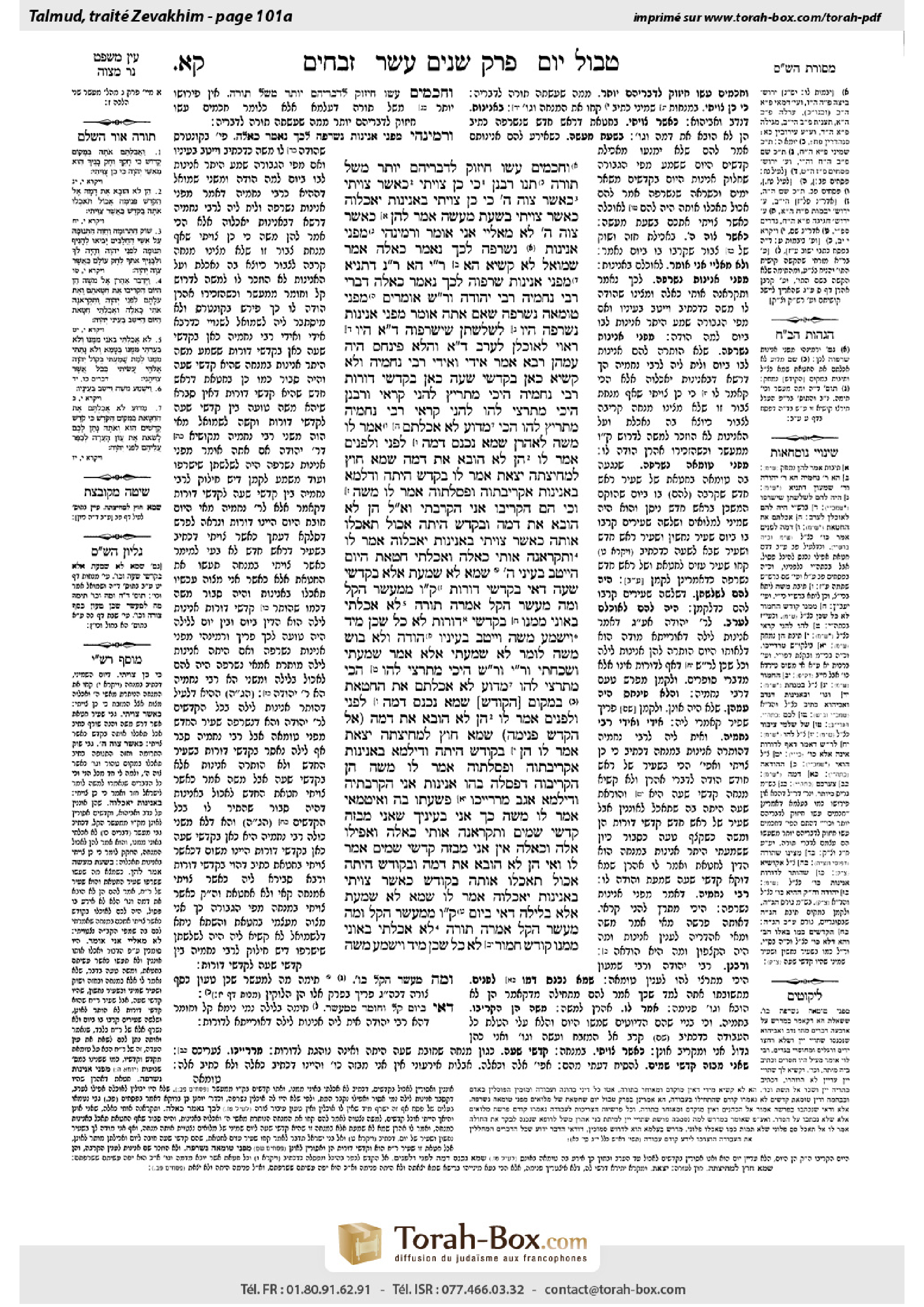
This page of Zevachim includes the Aramaic text, an English translation and an AI-generated French translation, alongside the scan above.
זבחים ק״א א · Aramaic and Hebrew text
וַחֲכָמִים עָשׂוּ חִיזּוּק לְדִבְרֵיהֶם יוֹתֵר מִשֶּׁל תּוֹרָה.
תָּנוּ רַבָּנַן: ״כִּי כֵן צֻוֵּיתִי״, ״כַּאֲשֶׁר צִוֵּיתִי״, ״כַּאֲשֶׁר צִוָּה ה׳״; ״כִּי כֵן צֻוֵּיתִי״ – בַּאֲנִינוּת יֹאכְלוּהָ, ״כַּאֲשֶׁר צִוֵּיתִי״ – בִּשְׁעַת מַעֲשֶׂה אָמַר לָהֶן, ״כַּאֲשֶׁר צִוָּה ה׳״ – לֹא מֵאֵלַיי אֲנִי אוֹמֵר.
וּרְמִינְהִי: מִפְּנֵי אֲנִינוּת נִשְׂרְפָה, לְכָךְ נֶאֱמַר: ״כָּאֵלֶּה״!
אָמַר שְׁמוּאֵל: לָא קַשְׁיָא; הָא רַבִּי יְהוּדָה, הָא רַבִּי נְחֶמְיָה.
דְּתַנְיָא: מִפְּנֵי אֲנִינוּת שְׂרָפוּהָ, לְכָךְ נֶאֱמַר: ״כָּאֵלֶּה״. דִּבְרֵי רַבִּי נְחֶמְיָה. רַבִּי יְהוּדָה וְרַבִּי שִׁמְעוֹן אוֹמְרִים: מִפְּנֵי טוּמְאָה נִשְׂרְפָה. שֶׁאִם אַתָּה אוֹמֵר מִפְּנֵי אֲנִינוּת נִשְׂרְפָה – (הָיוּ) [הָיָה] לִשְׁלׇשְׁתָּן שֶׁיִּשָּׂרְפוּ. דָּבָר אַחֵר: (הָיוּ) [הָיָה] רָאוּי לְאוֹכְלָן לָעֶרֶב. דָּבָר אַחֵר: וַהֲלֹא פִּינְחָס הָיָה עִמָּהֶן!
רָבָא אָמַר: אִידֵּי וְאִידֵּי רַבִּי נְחֶמְיָה, וְלָא קַשְׁיָא; כָּאן בְּקׇדְשֵׁי שָׁעָה, כָּאן בְּקׇדְשֵׁי דוֹרוֹת.
רַבִּי נְחֶמְיָה הֵיכִי מְתָרֵיץ לְהָנֵי קְרָאֵי, וְרַבָּנַן הֵיכִי מְתָרְצִי לְהוּ לְהָנֵי קְרָאֵי?
רַבִּי נְחֶמְיָה מְתָרֵיץ לְהוּ הָכִי: ״מַדּוּעַ לֹא אֲכַלְתֶּם״ – אָמַר לוֹ מֹשֶׁה לְאַהֲרֹן: שֶׁמָּא נִכְנַס דָּמָהּ לִפְנַי וְלִפְנִים? אָמַר לוֹ: ״הֵן לֹא הוּבָא אֶת דָּמָהּ״. שֶׁמָּא חוּץ לִמְחִיצָתָהּ יָצָאת? אָמַר לוֹ: בַּקֹּדֶשׁ הָיְתָה.
וְדִלְמָא בַּאֲנִינוּת אַקְרֵיבְתּוּהָ וּפְסַלְתּוּהָ? אָמַר לוֹ: מֹשֶׁה, וְכִי הֵם הִקְרִיבוּ?! אֲנִי הִקְרַבְתִּי! וְאָמַר לוֹ: ״הֵן לֹא הוּבָא אֶת דָּמָהּ״ וּבַקֹּדֶשׁ הָיָתָה – ״אָכוֹל תֹּאכְלוּ אוֹתָהּ כַּאֲשֶׁר צִוֵּיתִי״, בַּאֲנִינוּת יֹאכְלוּהָ.
אָמַר לוֹ: ״וַתִּקְרֶאנָה אֹתִי כָּאֵלֶּה וְאָכַלְתִּי חַטָּאת הַיּוֹם, הַיִּיטַב בְּעֵינֵי ה׳״ – שֶׁמָּא לֹא שָׁמַעְתָּ אֶלָּא בְּקׇדְשֵׁי שָׁעָה?
דְּאִי בְּקׇדְשֵׁי דוֹרוֹת, קַל וְחוֹמֶר מִמַּעֲשֵׂר הַקַּל: וּמָה מַעֲשֵׂר הַקַּל, אָמְרָה תּוֹרָה: ״לֹא אָכַלְתִּי בְאֹנִי מִמֶּנּוּ״; בְּקׇדְשֵׁי דוֹרוֹת לֹא כׇּל שֶׁכֵּן?!
מִיָּד ״וַיִּשְׁמַע מֹשֶׁה וַיִּיטַב בְּעֵינָיו״ – הוֹדָה וְלֹא בּוֹשׁ מֹשֶׁה לוֹמַר ״לֹא שָׁמַעְתִּי״, אֶלָּא אָמַר: ״שָׁמַעְתִּי וְשָׁכַחְתִּי״.
וְרַבִּי יְהוּדָה וְרַבִּי שִׁמְעוֹן הֵיכִי מְתָרְצִי לְהוּ? הָכִי מְתָרְצִי לְהוּ: ״מַדּוּעַ לֹא אֲכַלְתֶּם אֶת הַחַטָּאת בִּמְקוֹם [הַקֹּדֶשׁ]״ – שֶׁמָּא נִכְנַס דָּמָהּ לִפְנַי וְלִפְנִים? אָמַר לוֹ: ״הֵן לֹא הוּבָא אֶת דָּמָהּ אֶל הַקֹּדֶשׁ פְּנִימָה״.
שֶׁמָּא חוּץ לִמְחִיצָתָהּ יָצָאת? אָמַר לוֹ: הֵן בַּקּוֹדֶשׁ הָיְתָה. וְדִילְמָא בַּאֲנִינוּת אַקְרֵיבְתּוּהָ וּפְסַלְתּוּהָ? אָמַר לוֹ: מֹשֶׁה, הֵן הִקְרִיבוּהָ – דְּפָסְלָה בְּהוּ אֲנִינוּת?! אֲנִי הִקְרַבְתִּיהָ!
וְדִילְמָא אַגַּב מְרָרַיְיכוּ פְּשַׁעְתּוּ בַּהּ וְאִיטַּמַּאי? אָמַר לוֹ: מֹשֶׁה, כָּךְ אֲנִי בְּעֵינֶיךָ, שֶׁאֲנִי מְבַזֶּה קׇדְשֵׁי שָׁמַיִם?! ״וַתִּקְרֶאנָה אֹתִי כָּאֵלֶּה״; וַאֲפִילּוּ אֵלֶּה וְכָאֵלֶּה – אֵין אֲנִי מְבַזֶּה קׇדְשֵׁי שָׁמַיִם!
אָמַר לוֹ: וְאִי ״הֵן לֹא הוּבָא אֶת דָּמָהּ״, וּבַקּוֹדֶשׁ הָיְתָה – ״אָכוֹל תֹּאכְלוּ אֹתָהּ בַּקּוֹדֶשׁ כַּאֲשֶׁר צִוֵּיתִי״, בַּאֲנִינוּת יֹאכְלוּהָ!
אָמַר לוֹ: שֶׁמָּא לֹא שָׁמַעְתָּ אֶלָּא בַּלַּיְלָה; דְּאִי בַּיּוֹם – קַל וָחוֹמֶר מִמַּעֲשֵׂר הַקַּל: וּמָה מַעֲשֵׂר הַקַּל, אָמְרָה תּוֹרָה: ״לֹא אָכַלְתִּי בְאֹנִי מִמֶּנּוּ״; קוֹדֶשׁ חָמוּר – לֹא כׇּל שֶׁכֵּן?!
מִיָּד ״וַיִּשְׁמַע מֹשֶׁה
Zevachim 101a · English translation
And the same holds for the night after the day of burial, even though the acute mourning of that day itself is by rabbinic law, because the Sages reinforced their pronouncements with greater severity than Torah law.
§ The Sages taught in a baraita: On the eighth day of the inauguration of the Tabernacle, on which two of Aaron’s sons died, Moses spoke to Aaron and his sons using three different forms of the word command: “For so I am commanded [tzuveiti]” (Leviticus 10:13), “as I commanded [tziveiti]” (Leviticus 10:18), and “as the Lord has commanded [tziva]” (Leviticus 10:15). Moses said to Aaron: “And you shall eat it…for so I am commanded,” to teach that Aaron and his remaining sons shall partake of the offerings even in acute mourning. The statement: “You should certainly have eaten it…as I commanded,” Moses said to them at the time of the incident, when Aaron and his sons burned the sin offering for the New Moon. Moses said: “As the Lord has commanded,” to emphasize that it is not of my own initiative that I say this, but it is from the word of God.
And the Sages raise a contradiction from another baraita: The sin offering was burned due to the acute mourning of Aaron and his sons, since they felt they could not partake of it. Therefore, it is stated in Aaron’s explanation: “There have befallen me such things as these; and if I had consumed the sin offering today, would it have been good in the eyes of the Lord?” (Leviticus 10:19). Moses conceded to Aaron that he was correct (see Leviticus 10:20), indicating that it was not permitted for Aaron to partake of the sin offering in acute mourning.
Shmuel said: This is not difficult. This first baraita, according to which Moses commanded Aaron and his sons to consume the sacrificial meat in acute mourning, is in accordance with the opinion of Rabbi Yehuda; and that baraita, according to which they acted properly in refraining from eating it, is in accordance with the opinion of Rabbi Neḥemya.
This is as it is taught in a baraita: Aaron and his sons burned the sin offering due to their acute mourning. Therefore, it is stated: “As these”; this is the statement of Rabbi Neḥemya. Rabbi Yehuda and Rabbi Shimon say: The sin offering was burned due to ritual impurity. As, if you say that it was burned due to acute mourning, they should have burned all three of the sin offerings offered that day. Alternatively, if it was burned due to acute mourning, they would have been fit to partake of the sin offerings in the evening, and there would have been no need to burn them. Alternatively, if it was burned due to acute mourning, wasn’t Pinehas, son of Elazar the priest, with them? He was not in mourning, and he could have partaken of the sin offering.
Rava said: Both this baraita and that baraita are in accordance with the opinion of Rabbi Neḥemya, who holds that the sin offering was burned due to acute mourning. And this is not difficult. Here, the baraita according to which Moses commanded that Aaron and his sons partake of the offering as acute mourners is referring to the offerings of a particular time, i.e., the meal offering, which was unique to the inauguration ceremony. There, the baraita according to which they rightly burned the sin offering, due to acute mourning, is referring to the offerings of all future generations. That sin offering was brought for the New Moon of Nisan, and such an offering would be brought at every New Moon from that day onward. Moses conceded that such offerings should not be consumed by acute mourners.
The Gemara asks: How would Rabbi Neḥemya reconcile these apparently contradictory verses about the sin offering, and how would the Sages reconcile these verses (see Leviticus 10:17–20)?
Rabbi Neḥemya would reconcile them like this: When Moses asked: “Why have you not eaten the sin offering?” (Leviticus 10:17), this is what Moses said to Aaron: Perhaps the blood of this sin offering entered the innermost sanctum, thereby disqualifying it (see Leviticus 6:23). Is this why you burned it? Aaron said to him: “Behold, the blood of it was not brought into the Sanctuary within” (Leviticus 10:18). Moses then asked: Perhaps it went outside its partition, i.e., it exited the courtyard of the Tabernacle, and was thereby disqualified? Aaron said to him: It was inside the sacred area at all times.
Moses then suggested: But perhaps you sacrificed it in acute mourning, which is prohibited for ordinary priests, and disqualified it. Aaron said to him: Moses, was it they, i.e., my sons, who sacrificed the offering? I sacrificed the offering, and as High Priest, I may serve even as an acute mourner (see Leviticus 21:10–12). And Moses said to him: “Behold, the blood of it was not brought into the Sanctuary within,” and it was inside the sacred area at all times; therefore: “You should certainly have consumed it in the sacred area, as I commanded” (Leviticus 10:18), i.e., just as I commanded that the priests should consume today’s meal offering in acute mourning.
Aaron said to him: “Behold, today have they sacrificed their sin offering and their burnt offering before the Lord, and there have befallen me such things as these; and if I had consumed the sin offering today, would it have been good in the eyes of the Lord?” (Leviticus 10:19). Perhaps you heard the command to consume the offering only with regard to offerings of a particular time, i.e., the meal offering, which was unique to that day.
As, if you claim that it also applies to the offerings of all generations, then one can prove this is not so via an a fortiori inference from the second tithe, for which the halakha is more lenient than for sacrificial meat: Just as with regard to the second tithe, for which the halakha is more lenient, the Torah stated: “I have not eaten thereof in my mourning [ve’oni]” (Deuteronomy 26:14), teaching that an acute mourner [onen] is prohibited from partaking of it, all the more so is it not clear that with regard to the offerings of all generations, an acute mourner is prohibited from partaking of them?
Moses immediately conceded to Aaron, as the verse states: “And Moses heard, and it was good in his eyes” (Leviticus 10:20). And Moses was not embarrassed and did not attempt to justify himself by saying: I did not hear of this halakha until now. Rather, he said: I heard it, and I forgot it, as the verse indicates by stating: “Moses heard.”
The Gemara continues: And how would Rabbi Yehuda and Rabbi Shimon, who hold that the sin offering was burned due to ritual impurity, reconcile those verses? They would reconcile them like this: When Moses said to Aaron and his sons: “Why have you not eaten the sin offering in the place of the Sanctuary?” (Leviticus 10:17), he meant: Perhaps its blood entered the innermost sanctum, disqualifying the offering. Aaron said to him in response: “Behold, the blood of it was not brought into the Sanctuary within” (Leviticus 10:18).
Moses then asked: Perhaps it went outside its partition, i.e., the courtyard of the Tabernacle, and was thereby disqualified? Aaron said to him: It was inside the sacred area at all times. Moses then asked: But perhaps you sacrificed it in acute mourning and disqualified it? Aaron said to him: Moses, was it my sons who sacrificed the offering, that their acute mourning would disqualify the offering? I, the High Priest, sacrificed the offering, and I may serve even in acute mourning.
Moses then asked: Or perhaps, due to your bitterness in mourning, were you neglectful of the offering and it became impure? Aaron said to him: Moses, am I in your eyes such a person, that I would treat an offering consecrated to Heaven with contempt? “There have befallen me such things as these” (Leviticus 10:19), i.e., even if these tragedies and more such as them should befall me, I would not treat an offering consecrated to Heaven with contempt.
Moses said to him: If so, and if, as you say: “Behold, the blood of it was not brought into the Sanctuary within,” and it was inside the sacred area at all times, then: “You should certainly have eaten it in the sacred area, as I commanded,” i.e., as I commanded that the priests should consume the meal offering even in acute mourning.
Aaron said to him: Perhaps you heard the command to consume the offering only with regard to the night following the day of acute mourning, but during the day itself the prohibition stands. As, if you claim that it may be consumed during the day itself, I can prove that this is not so via an a fortiori inference from the second tithe, for which the halakha is more lenient than for sacrificial meat: Just as with regard to the second tithe, for which the halakha is more lenient, the Torah stated: I have not eaten thereof in my mourning, all the more so is it not clear that in the stringent case of sacrificial meat, an acute mourner is prohibited from partaking of it?
Moses immediately conceded to Aaron, as the verse states: “And Moses heard,
Zevachim 101a · Traduction française (IA)
Il en va de même pour la nuit qui suit le jour de l’inhumation, bien que le deuil aigu observé ce jour-là relève de la loi rabbinique, car les Sages ont donné à leurs décrets une rigueur supérieure à celle de la loi de la Torah.
§ Les Sages ont enseigné dans une baraïta : Le huitième jour de l’inauguration du Tabernacle, où deux des fils d’Aaron moururent, Moïse s’adressa à Aaron et à ses fils en employant trois formes différentes du mot « ordonner » : « car c’est ce qui m’a été ordonné [tzuveiti] » (Lévitique 10,13), « comme je l’ai ordonné [tziveiti] » (Lévitique 10,18) et « comme le Seigneur l’a ordonné [tziva] » (Lévitique 10,15). Moïse dit à Aaron : « Et vous la mangerez… car c’est ce qui m’a été ordonné », pour enseigner qu’Aaron et ses fils survivants devaient prendre part aux offrandes même en état de deuil aigu. La déclaration « Vous auriez certainement dû la manger… comme je l’ai ordonné », Moïse la leur adressa au moment de l’incident, lorsqu’Aaron et ses fils brûlèrent le sacrifice expiatoire de la nouvelle lune. Moïse dit : « Comme le Seigneur l’a ordonné », pour souligner que ce n’était pas de sa propre initiative qu’il parlait, mais que cela venait de la parole de Dieu.
Les Sages soulèvent une contradiction à partir d’une autre baraïta : Le sacrifice expiatoire fut brûlé en raison du deuil aigu d’Aaron et de ses fils, car ils estimaient ne pas pouvoir en prendre part. C’est pourquoi Aaron expliqua : « De telles choses me sont arrivées ; et si j’avais mangé le sacrifice expiatoire aujourd’hui, cela aurait-il été agréable aux yeux du Seigneur ? » (Lévitique 10,19). Moïse reconnut qu’Aaron avait raison (voir Lévitique 10,20), ce qui indique qu’Aaron n’était pas autorisé à prendre part au sacrifice expiatoire en état de deuil aigu.
Chmouel dit : Il n’y a pas de difficulté. Cette première baraïta, selon laquelle Moïse ordonna à Aaron et à ses fils de consommer la viande sacrificielle en état de deuil aigu, suit l’opinion de Rabbi Yehouda ; tandis que l’autre baraïta, selon laquelle ils agirent correctement en s’abstenant de la manger, suit l’opinion de Rabbi Neḥemya.
C’est ce qui est enseigné dans une baraïta : Aaron et ses fils brûlèrent le sacrifice expiatoire en raison de leur deuil aigu. C’est pourquoi il est dit : « de telles choses » ; telle est l’opinion de Rabbi Neḥemya. Rabbi Yehouda et Rabbi Shimon disent : Le sacrifice expiatoire fut brûlé en raison d’une impureté rituelle. En effet, si tu dis qu’il fut brûlé en raison du deuil aigu, ils auraient dû brûler les trois sacrifices expiatoires offerts ce jour-là. Autre possibilité : s’il avait été brûlé en raison du deuil aigu, ils auraient pu prendre part aux sacrifices expiatoires le soir, et il n’aurait pas été nécessaire de les brûler. Autre possibilité : s’il avait été brûlé en raison du deuil aigu, Pinehas, fils d’Eléazar le prêtre, n’était-il pas avec eux ? Il n’était pas en deuil et aurait pu prendre part au sacrifice expiatoire.
Rava dit : Les deux baraïtot suivent l’opinion de Rabbi Neḥemya, selon laquelle le sacrifice expiatoire fut brûlé en raison du deuil aigu. Il n’y a pas de difficulté : ici, la baraïta selon laquelle Moïse ordonna à Aaron et à ses fils de prendre part à l’offrande en état de deuil aigu concerne les offrandes propres à cette occasion, c’est-à-dire l’offrande de farine, particulière à la cérémonie d’inauguration. Là, la baraïta selon laquelle ils brûlèrent à juste titre le sacrifice expiatoire en raison du deuil aigu concerne les offrandes de toutes les générations futures. Ce sacrifice expiatoire fut offert pour la nouvelle lune de Nissan, et une offrande de ce type serait apportée à chaque nouvelle lune à partir de ce jour. Moïse reconnut que de telles offrandes ne devaient pas être consommées par des personnes en deuil aigu.
La Guemara demande : Comment Rabbi Neḥemya concilierait-il ces versets apparemment contradictoires au sujet du sacrifice expiatoire, et comment les Sages les concilieraient-ils (voir Lévitique 10,17–20) ?
Rabbi Neḥemya les concilierait ainsi : Lorsque Moïse demanda : « Pourquoi n’avez-vous pas mangé le sacrifice expiatoire ? » (Lévitique 10,17), voici ce qu’il dit à Aaron : Peut-être le sang de ce sacrifice expiatoire est-il entré dans le sanctuaire intérieur, le disqualifiant ainsi (voir Lévitique 6,23). Est-ce pour cela que vous l’avez brûlé ? Aaron lui répondit : « Voici, son sang n’a pas été apporté à l’intérieur du Sanctuaire » (Lévitique 10,18). Moïse demanda ensuite : Peut-être est-il sorti de son enceinte, c’est-à-dire qu’il a quitté la cour du Tabernacle, et a ainsi été disqualifié ? Aaron lui répondit qu’il était toujours resté dans l’enceinte sacrée.
Moïse suggéra ensuite : Mais peut-être l’avez-vous offert en état de deuil aigu, ce qui est interdit aux prêtres ordinaires, et l’avez-vous ainsi disqualifié ? Aaron lui répondit : Moïse, est-ce eux, c’est-à-dire mes fils, qui ont offert le sacrifice ? C’est moi qui l’ai offert et, en tant que grand prêtre, je peux officier même en état de deuil aigu (voir Lévitique 21,10–12). Moïse lui dit alors : « Voici, son sang n’a pas été apporté à l’intérieur du Sanctuaire » et il était toujours resté dans l’enceinte sacrée ; par conséquent : « Vous auriez certainement dû le consommer dans l’enceinte sacrée, comme je l’ai ordonné » (Lévitique 10,18), c’est-à-dire comme j’ai ordonné aux prêtres de consommer aujourd’hui l’offrande de farine en état de deuil aigu.
Aaron lui répondit : « Voici, aujourd’hui ils ont offert leur sacrifice expiatoire et leur holocauste devant le Seigneur, et de telles choses me sont arrivées ; et si j’avais mangé le sacrifice expiatoire aujourd’hui, cela aurait-il été agréable aux yeux du Seigneur ? » (Lévitique 10,19). Peut-être n’as-tu entendu l’ordre de consommer l’offrande qu’à propos des offrandes propres à cette occasion, c’est-à-dire l’offrande de farine, particulière à ce jour.
En effet, si tu prétends que cela s’applique aussi aux offrandes de toutes les générations, on peut démontrer que ce n’est pas le cas par un raisonnement a fortiori fondé sur la seconde dîme, dont la halakha est moins stricte que celle de la viande sacrificielle : si, à propos de la seconde dîme, dont la halakha est moins stricte, la Torah déclare : « Je n’en ai pas mangé dans mon deuil [ve’oni] » (Deutéronome 26,14), enseignant qu’une personne en deuil aigu [onen] n’a pas le droit d’en prendre part, à plus forte raison n’est-il pas évident que, s’agissant des offrandes de toutes les générations, une personne en deuil aigu n’a pas le droit d’y prendre part ?
Moïse reconnut aussitôt qu’Aaron avait raison, comme le dit le verset : « Et Moïse entendit, et cela lui parut juste » (Lévitique 10,20). Moïse ne fut pas gêné et ne tenta pas de se justifier en disant : « Je n’ai entendu parler de cette halakha que maintenant. » Au contraire, il dit : « Je l’avais entendue et je l’avais oubliée », comme l’indique le verset en disant : « Moïse entendit ».
La Guemara poursuit : Comment Rabbi Yehouda et Rabbi Shimon, qui estiment que le sacrifice expiatoire fut brûlé en raison d’une impureté rituelle, concilieraient-ils ces versets ? Ils les concilieraient ainsi : Lorsque Moïse dit à Aaron et à ses fils : « Pourquoi n’avez-vous pas mangé le sacrifice expiatoire à l’endroit du Sanctuaire ? » (Lévitique 10,17), il voulait dire : Peut-être son sang est-il entré dans le sanctuaire intérieur, disqualifiant ainsi l’offrande. Aaron lui répondit : « Voici, son sang n’a pas été apporté à l’intérieur du Sanctuaire » (Lévitique 10,18).
Moïse demanda ensuite : Peut-être est-il sorti de son enceinte, c’est-à-dire de la cour du Tabernacle, et a ainsi été disqualifié ? Aaron lui répondit qu’il était toujours resté dans l’enceinte sacrée. Moïse demanda alors : Mais peut-être l’avez-vous offert en état de deuil aigu et l’avez-vous disqualifié ? Aaron lui répondit : Moïse, est-ce mes fils qui ont offert le sacrifice, de sorte que leur deuil aigu aurait disqualifié l’offrande ? C’est moi, le grand prêtre, qui l’ai offert, et je peux officier même en état de deuil aigu.
Moïse demanda ensuite : Ou bien, peut-être, dans l’amertume de votre deuil, avez-vous négligé l’offrande, qui est alors devenue impure ? Aaron lui répondit : Moïse, me crois-tu capable de traiter avec mépris une offrande consacrée au Ciel ? « De telles choses me sont arrivées » (Lévitique 10,19), c’est-à-dire : même si ces tragédies, et d’autres encore, devaient m’arriver, je ne traiterais pas avec mépris une offrande consacrée au Ciel.
Moïse lui dit : Si c’est ainsi, et si, comme tu le dis, « son sang n’a pas été apporté à l’intérieur du Sanctuaire » et qu’il était toujours resté dans l’enceinte sacrée, alors : « Vous auriez certainement dû le manger dans l’enceinte sacrée, comme je l’ai ordonné », c’est-à-dire comme j’ai ordonné aux prêtres de consommer l’offrande de farine même en état de deuil aigu.
Aaron lui répondit : Peut-être n’as-tu entendu l’ordre de consommer l’offrande qu’à propos de la nuit qui suit le jour du deuil aigu, tandis que l’interdiction reste en vigueur pendant la journée même. En effet, si tu prétends qu’on peut en prendre part pendant la journée même, je peux démontrer le contraire par un raisonnement a fortiori fondé sur la seconde dîme, dont la halakha est moins stricte que celle de la viande sacrificielle : si, à propos de la seconde dîme, dont la halakha est moins stricte, la Torah déclare : « Je n’en ai pas mangé dans mon deuil », à plus forte raison n’est-il pas évident que, dans le cas plus strict de la viande sacrificielle, une personne en deuil aigu n’a pas le droit d’y prendre part ?
Moïse reconnut aussitôt qu’Aaron avait raison, comme le dit le verset : « Et Moïse entendit,
Traduction française générée par IA à partir de l’édition anglaise de Sefaria. Vérifie toujours un passage avec le texte source.
Text from Sefaria: William Davidson Edition - Vocalized Aramaic (CC BY NC); William Davidson Edition - English (CC BY NC).