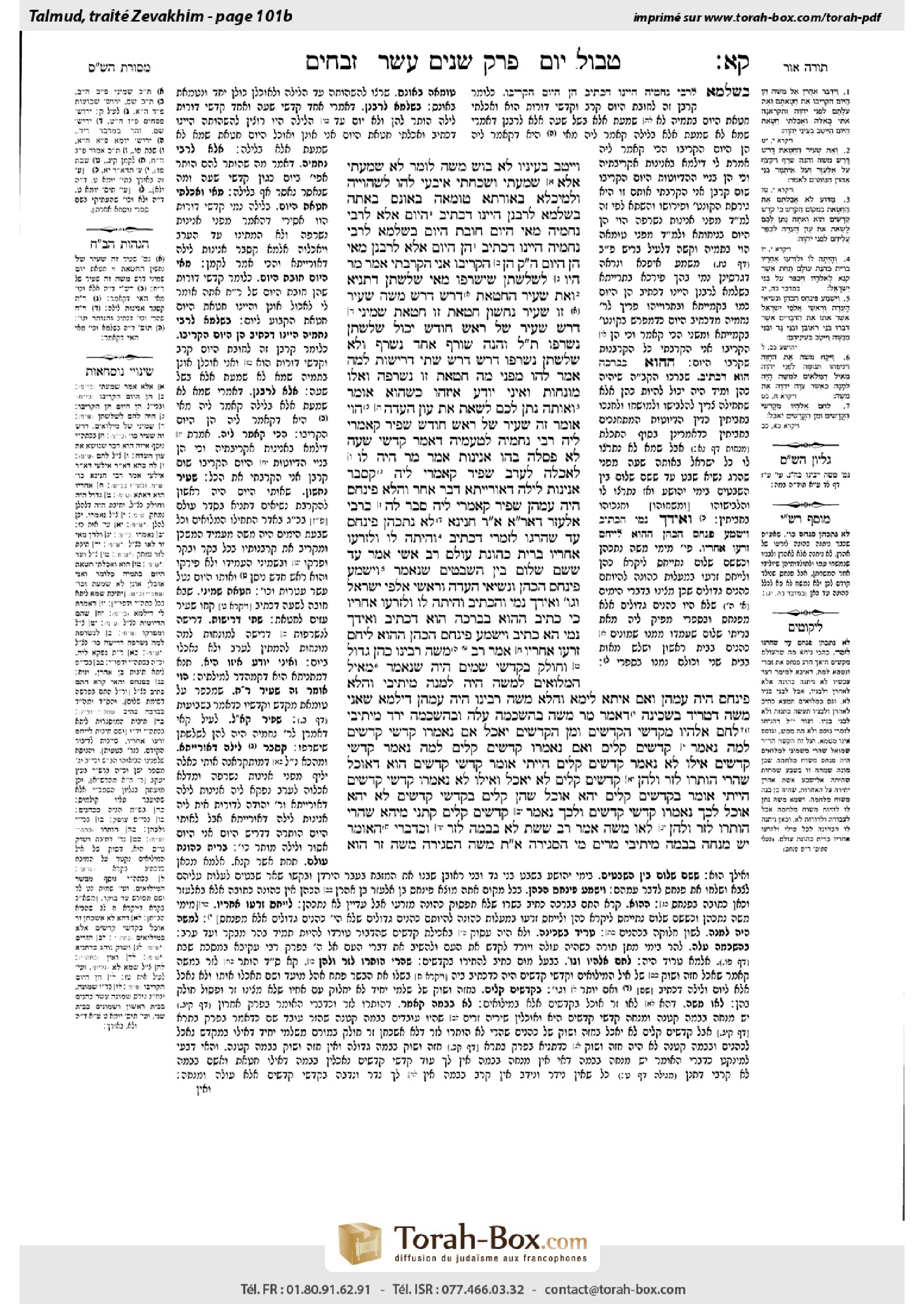
Zevachim 101b: Talmud study for Daf Yomi
Daf Yomi is the daily study of one Talmud folio. Explore 37 tractates with scans, Hebrew text, Sefaria English and AI-generated French translations where annotated.
Passage selection and English or AI-generated French translation are available where the scan has annotations. Daf Study is independent of Torah-Box and Sefaria.
Browse Zevachim · זבחים · All tractatesZevachim 101b text and translations
This page of Zevachim includes the Aramaic text, an English translation and an AI-generated French translation, alongside the scan above.
זבחים ק״א ב · Aramaic and Hebrew text
וַיִּיטַב בְּעֵינָיו״ – לֹא בּוֹשׁ מֹשֶׁה לוֹמַר ״לֹא שָׁמַעְתִּי״, אֶלָּא ״שָׁמַעְתִּי וְשָׁכַחְתִּי״.
אִיבְּעִי לְהוּ לְשַׁהוֹיַיהּ, וּלְמֵיכְלַהּ בְּאוּרְתָּא! טוּמְאָה בְּאוֹנֶס בָּאתָה.
בִּשְׁלָמָא לְרַבָּנַן, הַיְינוּ דִּכְתִיב: ״הַיּוֹם״; אֶלָּא לְרַבִּי נְחֶמְיָה, מַאי ״הַיּוֹם״? חוֹבַת הַיּוֹם.
בִּשְׁלָמָא לְרַבִּי נְחֶמְיָה, הַיְינוּ דִּכְתִיב ״הֵן הַיּוֹם״; אֶלָּא לְרַבָּנַן, מַאי ״הֵן הַיּוֹם״? הָכִי קָאָמַר: הֵן הִקְרִיבוּ?! אֲנִי הִקְרַבְתִּי!
אָמַר מָר: (הָיוּ) [הָיָה] לִשְׁלׇשְׁתָּן שֶׁיִּשָּׂרְפוּ. מַאי שְׁלָשְׁתָּן?
דְּתַנְיָא: ״וְאֵת שְׂעִיר הַחַטָּאת דָּרֹשׁ דָּרַשׁ מֹשֶׁה״; ״שְׂעִיר״ – זוֹ שָׂעִיר נַחְשׁוֹן, ״חַטָּאת״ – זוֹ חַטַּאת שְׁמִינִי, ״דָּרַשׁ״ – שָׂעִיר שֶׁל רֹאשׁ חוֹדֶשׁ.
יָכוֹל שְׁלָשְׁתָּן נִשְׂרְפוּ? תַּלְמוּד לוֹמַר: ״וְהִנֵּה שֹׂרָף״ – אֶחָד נִשְׂרַף וְלֹא שְׁלָשְׁתָּן נִשְׂרְפוּ. ״דָּרֹשׁ דָּרַשׁ״ – שְׁתֵּי דְרִישׁוֹת לָמָּה? אֲמַר לְהוּ: מִפְּנֵי מָה חַטָּאת זוֹ נִשְׂרְפָה, וְאֵלּוּ מוּנָּחוֹת? וְאֵינִי יוֹדֵעַ אֵיזֶהוּ; כְּשֶׁהוּא אוֹמֵר: ״וְאֹתָהּ נָתַן לָכֶם לָשֵׂאת אֶת עֲוֹן הָעֵדָה״, הֱוֵי אוֹמֵר זֶה שָׂעִיר שֶׁל רֹאשׁ חוֹדֶשׁ.
שַׁפִּיר קָאָמְרִי לֵיהּ! רַבִּי נְחֶמְיָה לְטַעְמֵיהּ, דְּאָמַר: קׇדְשֵׁי שָׁעָה לָא פָּסְלָה בְּהוּ אֲנִינוּת.
אָמַר מָר: הָיָה לוֹ לְאׇכְלָהּ לָעֶרֶב. שַׁפִּיר קָאָמְרִי לֵיהּ! קָסָבַר: אֲנִינוּת לַיְלָה – דְּאוֹרָיְיתָא.
דָּבָר אַחֵר: וַהֲלֹא פִּינְחָס הָיָה עִמָּהֶן. שַׁפִּיר קָאָמְרִי לֵיהּ! סָבַר לַהּ כְּרַבִּי אֶלְעָזָר, דְּאָמַר רַבִּי אֶלְעָזָר אָמַר רַבִּי חֲנִינָא: לֹא נִתְכַּהֵן פִּינְחָס עַד שֶׁהֲרָגוֹ לְזִמְרִי, דִּכְתִיב: ״וְהָיְתָה לּוֹ וּלְזַרְעוֹ אַחֲרָיו בְּרִית כְּהֻנַּת עוֹלָם״.
רַב אָשֵׁי אָמַר: עַד שֶׁשָּׂם שָׁלוֹם בֵּין הַשְּׁבָטִים, שֶׁנֶּאֱמַר: ״וַיִּשְׁמַע פִּינְחָס הַכֹּהֵן וּנְשִׂיאֵי הָעֵדָה וְרָאשֵׁי אַלְפֵי יִשְׂרָאֵל וְגוֹ׳״.
וְאִידַּךְ נָמֵי, וְהָכְתִיב: ״וְהָיְתָה לּוֹ וּלְזַרְעוֹ אַחֲרָיו״! כִּי כְתִיב הָהוּא, בִּבְרָכָה הוּא דִּכְתִיב.
וְאִידַּךְ נָמֵי, הָא כְּתִיב: ״וַיִּשְׁמַע פִּינְחָס הַכֹּהֵן״! הָהוּא לְיַחֵס זַרְעוֹ אַחֲרָיו.
אָמַר רַב: מֹשֶׁה רַבֵּינוּ – כֹּהֵן גָּדוֹל וְחוֹלֵק בְּקׇדְשֵׁי שָׁמַיִם הָיָה, שֶׁנֶּאֱמַר: ״מֵאֵיל הַמִּלֻּאִים לְמֹשֶׁה הָיָה לְמָנָה״.
מֵיתִיבִי: וַהֲלֹא פִּינְחָס הָיָה עִמָּהֶן. וְאִם אִיתָא, לֵימָא: וַהֲלֹא מֹשֶׁה רַבֵּינוּ הָיָה עִמָּהֶן! דִּילְמָא שָׁאנֵי מֹשֶׁה, דִּטְרִיד בִּשְׁכִינָה; דְּאָמַר מָר: מֹשֶׁה בְּהַשְׁכָּמָה עָלָה וּבְהַשְׁכָּמָה יָרַד.
מֵיתִיבִי: ״לֶחֶם אֱלֹהָיו מִקׇּדְשֵׁי הַקֳּדָשִׁים וּמִן הַקֳּדָשִׁים יֹאכֵל״ – אִם נֶאֶמְרוּ קׇדְשֵׁי קָדָשִׁים, לָמָּה (נאמר) [נֶאֶמְרוּ] קָדָשִׁים קַלִּים? וְאִם נֶאֶמְרוּ קָדָשִׁים קַלִּים, לָמָּה (נאמר) [נֶאֶמְרוּ] קׇדְשֵׁי קָדָשִׁים?
אִילּוּ לֹא (נאמר) [נֶאֶמְרוּ] קָדָשִׁים קַלִּים, הָיִיתִי אוֹמֵר: קׇדְשֵׁי קָדָשִׁים הוּא דְּאוֹכֵל, שֶׁהֲרֵי הוּתְּרוּ לְזָר וְלָהֶן; קָדָשִׁים קַלִּים – לֹא יֹאכַל. וְאִילּוּ לֹא נֶאֶמְרוּ קׇדְשֵׁי קָדָשִׁים, הָיִיתִי אוֹמֵר: בְּקָדָשִׁים קַלִּים יְהֵא אוֹכֵל, שֶׁהֵן קַלִּים; בְּקׇדְשֵׁי קֳדָשִׁים – לֹא יְהֵא אוֹכֵל. לְכָךְ נֶאֶמְרוּ קׇדְשֵׁי קָדָשִׁים, וּלְכָךְ (נאמר) [נֶאֶמְרוּ] קָדָשִׁים קַלִּים.
קָתָנֵי מִיהָא: שֶׁהֲרֵי הוּתְּרוּ לְזָר וְלָהֶן. לָאו מֹשֶׁה? אָמַר רַב שֵׁשֶׁת: לָא; בְּבָמָה לְזָר, וּכְדִבְרֵי הָאוֹמֵר: יֵשׁ מִנְחָה בְּבָמָה.
מֵיתִיבִי: מִרְיָם מִי הִסְגִּירָהּ? אִם תֹּאמַר מֹשֶׁה הִסְגִּירָהּ – מֹשֶׁה זָר הוּא,
Zevachim 101b · English translation
and it was good in his eyes” (Leviticus 10:20). Moses was not embarrassed and did not attempt to justify himself by saying: I did not hear this halakha until now. Rather, he said: I heard it, and I forgot it.
The Gemara asks: According to this opinion, why was the sin offering burned? They should have delayed its consumption and consumed it that night. The Gemara answers: Ritual impurity came upon this sin offering due to circumstances beyond the priests’ control, and they were forced to burn it.
The Gemara asks: Granted, according to the Rabbis, i.e., Rabbi Yehuda and Rabbi Shimon, this is as it is written: “And if I had consumed the sin offering today, would it have been good in the eyes of the Lord”? The verse indicates that Aaron could have eaten it at night. But according to Rabbi Neḥemya, who holds that Aaron distinguished between the offerings of that particular time and the offerings of all later generations, what did Aaron mean by the word “today”? The Gemara answers: He meant: And if I had eaten the sin offering of the New Moon, which is today’s obligation, would it have been good in the eyes of the Lord?
The Gemara asks: Granted, according to Rabbi Neḥemya, this is as it is written: “Behold, today have they sacrificed their sin offering and their burnt offering before the Lord,” i.e., they offered it as the obligation of the day. But according to the Rabbis, i.e., Rabbi Yehuda and Rabbi Shimon, what did Aaron mean by the phrase “behold [hen], today”? The Gemara answers: This is what Aaron is saying: Did they [hen], my sons, sacrifice the offering today, which would have been prohibited to them in acute mourning? No, I sacrificed the offering, and as High Priest, I may perform the service in acute mourning.
§ The Gemara continues to analyze the baraita. The Master says: If the sin offering was burned due to acute mourning, then the priests should have burned all three of the sin offerings offered that day. The Gemara asks: What is meant by: All three of the sin offerings?
The Gemara responds: As it is taught in a baraita: The verse states: “And Moses diligently inquired for the goat of the sin offering, and behold, it was burned” (Leviticus 10:16). When the verse states: “The goat,” this is referring to the goat of Nahshon, son of Amminadav, the prince of the tribe of Judah, who brought the offering on the first day of the Tabernacle’s inauguration (see Numbers 7:12). When the verse states: “The sin offering,” this is referring to the sin offering that the people brought on the eighth day of the inauguration (see Leviticus 9:13). The term “inquired” is referring to the goat sacrificed at every New Moon (see Numbers 28:15). The Tabernacle was erected on the New Moon of Nisan (see Exodus 40:17). These are the three goats that were sacrificed that day.
One might have thought that all three of them were burned. Therefore, the verse states: “And Moses diligently inquired for the goat of the sin offering, and, behold, it was burned,” to teach that one of the offerings was burned, but not all three of them were burned. The verse states: “And Moses diligently inquired [darosh darash].” Why were there two inquiries? Moses said to them: For what reason is this sin offering burned, and secondly, for what reason are those left unburned? The baraita comments: Still, I do not know which of them was burned. When it states with regard to the burned goat: “And He has given it to you to bear the iniquity of the congregation” (Leviticus 10:17), you must say: This is the goat of the New Moon, which atones for impurity in the Temple.
The Gemara comments: Rabbi Yehuda and Rabbi Shimon say well to Rabbi Neḥemya; if the sin offering was burned due to acute mourning, then all three goats should have been burned. How would Rabbi Neḥemya respond? The Gemara explains: Rabbi Neḥemya conforms to his line of reasoning, as he says: Acute mourning does not disqualify offerings of a particular time. Therefore, they burned only the New Moon sin offering, which applies to future generations as well.
The Master says in the baraita: If the sin offering was burned due to acute mourning, why was it burned at all? He should have eaten it in the evening. The Gemara comments: Rabbi Yehuda and Rabbi Shimon say well to Rabbi Neḥemya in posing this difficulty. How would he respond? The Gemara explains: He holds that acute mourning in the evening is by Torah law, and therefore the priests were not permitted to eat it even then.
Rabbi Yehuda and Rabbi Shimon also stated: Alternatively, wasn’t Pinehas, son of Elazar the priest, with them? He was not an acute mourner. The Gemara comments: Rabbi Yehuda and Rabbi Shimon say well to Rabbi Neḥemya. The Gemara explains: He holds in accordance with the opinion of Rabbi Elazar. As Rabbi Elazar says that Rabbi Ḥanina says: Pinehas did not become a priest until he killed Zimri, who had engaged in intercourse with a Midianite woman (see Numbers 25:6–8). As it is written only after that incident concerning Pinehas: “And it shall be unto him and to his seed after him the covenant of an everlasting priesthood” (Numbers 25:13). Before that incident, at the time of the inauguration of the Tabernacle, the only priests were Aaron and his sons.
Rav Ashi said: Pinehas did not become a priest until he made peace among the tribes at the time of the conquest of Eretz Yisrael, when the tribes east of the Jordan River built their own altar and nearly provoked a civil war. Before this, Pinehas was always referred to as: Son of Elazar the priest, but during this incident he is himself referred to as a priest for the first time, as it is stated: “And Pinehas the priest, and the princes of the congregation, and the heads of the thousands of Israel that were with him, heard the words that the children of Reuben and the children of Gad and the children of Manasseh spoke, and it pleased them well” (Joshua 22:30).
The Gemara asks: And for the other Sage, Rav Ashi, as well, isn’t it written: “And it shall be unto him, and to his seed after him, the covenant of an everlasting priesthood”? Apparently, Pinehas became a priest after he killed Zimri. The Gemara responds: When that verse is written, it is with regard to the blessing that it is written, that his descendants would always be priests. It did not indicate that Pinehas became a priest immediately.
The Gemara asks: And for the other Sages as well, who hold that Pinehas became a priest immediately after he killed Zimri, isn’t it written: “And Pinehas the priest…heard”? Apparently he became a priest only after the conquest of Eretz Yisrael. The Gemara answers: That verse serves to entitle his descendants after him, that they would continue as High Priests through his merit.
§ Rav says: Moses, our teacher, was a High Priest and would receive a share of offerings consecrated to Heaven, as it is stated: “And Moses took the breast, and waved it for a wave offering before the Lord; it was Moses’ portion of the ram of inauguration, as the Lord commanded Moses” (Leviticus 8:29).
The Gemara raises an objection: In the baraita, Rabbi Yehuda and Rabbi Shimon claim that acute mourning was not the reason the sin offering was burned by asking: Wasn’t Pinehas with them? And if it is so that Moses could partake of sacrificial meat, let them say: Wasn’t Moses, our teacher, with them? The Gemara responds: Perhaps Moses is different, since as a prophet, he was preoccupied with the Divine Presence, and was not available. As the Master says: Moses ascended Mount Sinai early in the morning, and he descended early in the morning.
The Gemara raises an objection to Rav’s statement from another baraita: The verse states with regard to a blemished priest: “He may eat the bread of his God, both of the most sacred, and of the sacred” (Leviticus 21:22). If offerings of the most sacred order are stated, that a blemished priest may eat them, then why are offerings of lesser sanctity also stated? And if offerings of lesser sanctity are stated, why are offerings of the most sacred order stated?
The baraita answers: Had offerings of lesser sanctity not been stated, I would have said: It is only offerings of the most sacred order that a blemished priest may eat, as they were permitted both to a non-priest and to the priests, but a blemished priest may not eat offerings of lesser sanctity, which were not permitted to non-priests. And had offerings of the most sacred order not been stated, I would have said: A blemished priest may eat offerings of lesser sanctity, as they are of lesser sanctity, but he may not eat of offerings of the most sacred order, as they are of higher sanctity. Therefore, offerings of the most sacred order are stated, and therefore, offerings of lesser sanctity are stated.
The Gemara explains the objection: In any event, the baraita teaches: As they were permitted both to a non-priest and to the priests. What non-priest is permitted to eat offerings of the most sacred order? Is this not referring to Moses? This indicates that Moses was not considered a High Priest, contrary to Rav’s statement. Rav Sheshet said: No, this is referring to a non-priest sacrificing on a private altar. Once the Jewish people entered Eretz Yisrael, it was permitted for a time for them to build private altars, on which even non-priests could serve. And although only offerings of lesser sanctity were offered on private altars, this baraita is in accordance with the statement of the Sage who says: There is a meal offering that may be offered on a private altar. Meal offerings are of the most sacred order.
The Gemara raises an objection to Rav’s statement: When Miriam became a leper (see Numbers 12:10), who diagnosed and quarantined her? If you say that Moses quarantined her, that is difficult, as Moses was a non-priest,
Zevachim 101b · Traduction française (IA)
« Et cela fut bon à ses yeux » (Lévitique 10:20). Moïse ne fut pas embarrassé et ne tenta pas de se justifier en disant : « Je n’ai entendu cette halakha que maintenant. » Il dit plutôt : « Je l’avais entendue, mais je l’ai oubliée. »
La Guemara demande : Selon cette opinion, pourquoi le sacrifice expiatoire fut-il brûlé ? Ils auraient dû en différer la consommation et le manger cette nuit-là. La Guemara répond : Ce sacrifice expiatoire devint rituellement impur en raison de circonstances indépendantes de la volonté des prêtres, qui furent contraints de le brûler.
La Guemara demande : Certes, selon les rabbins, c’est-à-dire Rabbi Yehouda et Rabbi Shimon, cela correspond à ce qui est écrit : « Et si j’avais consommé le sacrifice expiatoire aujourd’hui, cela aurait-il été bon aux yeux de l’Éternel ? » Le verset indique qu’Aaron aurait pu le manger le soir. Mais selon Rabbi Neḥemya, qui considère qu’Aaron distinguait les offrandes de cette époque particulière de celles des générations ultérieures, que voulait dire Aaron par le mot « aujourd’hui » ? La Guemara répond : Il voulait dire : « Et si j’avais mangé le sacrifice expiatoire de la Nouvelle Lune, qui est l’obligation du jour, cela aurait-il été bon aux yeux de l’Éternel ? »
La Guemara demande : Certes, selon Rabbi Neḥemya, cela correspond à ce qui est écrit : « Voici, aujourd’hui, ils ont offert leur sacrifice expiatoire et leur holocauste devant l’Éternel », c’est-à-dire qu’ils l’ont offert au titre de l’obligation du jour. Mais selon les rabbins, c’est-à-dire Rabbi Yehouda et Rabbi Shimon, que voulait dire Aaron par l’expression « voici [hen], aujourd’hui » ? La Guemara répond : Voici ce que dit Aaron : « Est-ce que [hen] mes fils ont offert l’offrande aujourd’hui, ce qui leur aurait été interdit en période de deuil aigu ? Non, c’est moi qui ai offert l’offrande et, en tant que grand prêtre, je peux accomplir le service en période de deuil aigu. »
§ La Guemara poursuit l’analyse de la baraïta. Le maître dit : Si le sacrifice expiatoire fut brûlé à cause du deuil aigu, alors les prêtres auraient dû brûler les trois sacrifices expiatoires offerts ce jour-là. La Guemara demande : Que signifie « les trois sacrifices expiatoires » ?
La Guemara répond : Comme l’enseigne une baraïta : le verset dit : « Moïse s’enquit avec soin au sujet du bouc du sacrifice expiatoire, et voici, il avait été brûlé » (Lévitique 10:16). Lorsque le verset dit « le bouc », il s’agit du bouc de Nahshon, fils d’Amminadav, prince de la tribu de Juda, qui apporta l’offrande le premier jour de l’inauguration du Tabernacle (voir Nombres 7:12). Lorsque le verset dit « le sacrifice expiatoire », il s’agit du sacrifice expiatoire que le peuple apporta le huitième jour de l’inauguration (voir Lévitique 9:13). Le terme « s’enquit » désigne le bouc offert à chaque Nouvelle Lune (voir Nombres 28:15). Le Tabernacle fut érigé à la Nouvelle Lune de Nisan (voir Exode 40:17). Ce sont les trois boucs qui furent sacrifiés ce jour-là.
On aurait pu penser que les trois avaient été brûlés. Le verset dit donc : « Moïse s’enquit avec soin au sujet du bouc du sacrifice expiatoire et, voici, il avait été brûlé », pour enseigner qu’une seule des offrandes fut brûlée, et non les trois. Le verset dit : « Moïse s’enquit avec soin [darosh darash]. » Pourquoi y eut-il deux enquêtes ? Moïse leur dit : « Pour quelle raison ce sacrifice expiatoire est-il brûlé ? Et, deuxièmement, pour quelle raison ceux-là ne sont-ils pas brûlés ? » La baraïta ajoute : Pourtant, je ne sais toujours pas lequel des trois fut brûlé. Lorsque le verset dit au sujet du bouc brûlé : « Il vous l’a donné pour porter la faute de la communauté » (Lévitique 10:17), il faut en conclure qu’il s’agit du bouc de la Nouvelle Lune, qui expie l’impureté dans le Temple.
La Guemara remarque : Rabbi Yehouda et Rabbi Shimon opposent une objection valable à Rabbi Neḥemya : si le sacrifice expiatoire fut brûlé à cause du deuil aigu, les trois boucs auraient dû être brûlés. Comment Rabbi Neḥemya répondrait-il ? La Guemara explique : Rabbi Neḥemya reste fidèle à son raisonnement, car il considère que le deuil aigu ne disqualifie pas les offrandes propres à une époque particulière. Ils ne brûlèrent donc que le sacrifice expiatoire de la Nouvelle Lune, qui s’applique également aux générations ultérieures.
Le maître dit dans la baraïta : Si le sacrifice expiatoire fut brûlé à cause du deuil aigu, pourquoi fut-il brûlé ? Il aurait dû être mangé le soir. La Guemara remarque : Rabbi Yehouda et Rabbi Shimon opposent une objection valable à Rabbi Neḥemya en soulevant cette difficulté. Comment celui-ci répondrait-il ? La Guemara explique : Il considère que le deuil aigu du soir relève de la Torah écrite ; les prêtres n’étaient donc pas autorisés à le manger, même alors.
Rabbi Yehouda et Rabbi Shimon ont également dit : En outre, Pinehas, fils d’Elazar le prêtre, n’était-il pas avec eux ? Il n’était pas en période de deuil aigu. La Guemara remarque : Rabbi Yehouda et Rabbi Shimon opposent une objection valable à Rabbi Neḥemya. La Guemara explique : Celui-ci suit l’opinion de Rabbi Elazar. Car Rabbi Elazar dit au nom de Rabbi Ḥanina : Pinehas ne devint prêtre qu’après avoir tué Zimri, qui avait eu des relations avec une femme midianite (voir Nombres 25:6–8). En effet, c’est seulement après cet épisode que l’Écriture dit au sujet de Pinehas : « Ce sera pour lui et pour sa descendance après lui une alliance de sacerdoce perpétuel » (Nombres 25:13). Avant cet épisode, à l’époque de l’inauguration du Tabernacle, les seuls prêtres étaient Aaron et ses fils.
Rav Ashi dit : Pinehas ne devint prêtre qu’après avoir rétabli la paix entre les tribus au moment de la conquête d’Eretz Yisrael, lorsque les tribus établies à l’est du Jourdain construisirent leur propre autel et faillirent déclencher une guerre civile. Jusque-là, Pinehas était toujours désigné comme « fils d’Elazar le prêtre » ; mais, lors de cet épisode, il est lui-même désigné pour la première fois comme prêtre, ainsi qu’il est dit : « Pinehas le prêtre, les princes de la communauté et les chefs des milliers d’Israël qui étaient avec lui entendirent les paroles prononcées par les fils de Ruben, les fils de Gad et les fils de Manassé, et cela leur plut » (Josué 22:30).
La Guemara demande : Mais pour l’autre Sage, Rav Ashi, n’est-il pas également écrit : « Ce sera pour lui et pour sa descendance après lui une alliance de sacerdoce perpétuel » ? Cela semble indiquer que Pinehas devint prêtre après avoir tué Zimri. La Guemara répond : Ce verset est écrit à propos de la bénédiction, selon laquelle ses descendants seraient toujours prêtres. Il n’indiquait pas que Pinehas était devenu prêtre immédiatement.
La Guemara demande : Mais pour les autres Sages aussi, qui considèrent que Pinehas devint prêtre immédiatement après avoir tué Zimri, n’est-il pas écrit : « Pinehas le prêtre… entendit » ? Cela semble indiquer qu’il ne devint prêtre qu’après la conquête d’Eretz Yisrael. La Guemara répond : Ce verset sert à accorder à ses descendants le mérite de lui succéder comme grands prêtres, grâce à son mérite.
§ Rav dit : Moïse, notre maître, était grand prêtre et recevait une part des offrandes consacrées à Dieu, comme il est dit : « Moïse prit la poitrine et la balança comme offrande balancée devant l’Éternel ; c’était la part de Moïse dans le bélier d’investiture, comme l’Éternel l’avait ordonné à Moïse » (Lévitique 8:29).
La Guemara soulève une objection : Dans la baraïta, Rabbi Yehouda et Rabbi Shimon affirment que le deuil aigu n’était pas la raison pour laquelle le sacrifice expiatoire fut brûlé, en demandant : Pinehas n’était-il pas avec eux ? Or, si Moïse pouvait consommer de la viande sacrificielle, qu’ils disent donc : « Moïse, notre maître, n’était-il pas avec eux ? » La Guemara répond : Peut-être Moïse était-il différent, car, en tant que prophète, il était absorbé par la Présence divine et n’était pas disponible. Car le maître dit : Moïse monta au mont Sinaï tôt le matin et en descendit tôt le matin.
La Guemara soulève une objection à l’affirmation de Rav à partir d’une autre baraïta : le verset dit au sujet d’un prêtre ayant un défaut physique : « Il pourra manger le pain de son Dieu, tant des offrandes de sainteté suprême que des offrandes de moindre sainteté » (Lévitique 21:22). Si les offrandes de sainteté suprême sont mentionnées pour enseigner qu’un prêtre ayant un défaut physique peut les manger, pourquoi les offrandes de moindre sainteté sont-elles également mentionnées ? Et si les offrandes de moindre sainteté sont mentionnées, pourquoi les offrandes de sainteté suprême sont-elles mentionnées ?
La baraïta répond : Si les offrandes de moindre sainteté n’avaient pas été mentionnées, j’aurais dit qu’un prêtre ayant un défaut physique peut manger uniquement les offrandes de sainteté suprême, car elles étaient permises aussi bien aux non-prêtres qu’aux prêtres ; mais qu’un prêtre ayant un défaut physique ne peut pas manger les offrandes de moindre sainteté, qui n’étaient pas permises aux non-prêtres. Et si les offrandes de sainteté suprême n’avaient pas été mentionnées, j’aurais dit qu’un prêtre ayant un défaut physique peut manger les offrandes de moindre sainteté, puisqu’elles sont de moindre sainteté, mais qu’il ne peut pas manger les offrandes de sainteté suprême, puisqu’elles sont de sainteté supérieure. C’est pourquoi les offrandes de sainteté suprême sont mentionnées, et les offrandes de moindre sainteté le sont également.
La Guemara explique l’objection : Quoi qu’il en soit, la baraïta enseigne : « Car elles étaient permises aussi bien aux non-prêtres qu’aux prêtres. » Quel non-prêtre est autorisé à manger des offrandes de sainteté suprême ? N’est-ce pas de Moïse qu’il s’agit ? Cela indique que Moïse n’était pas considéré comme grand prêtre, contrairement à l’affirmation de Rav. Rav Sheshet dit : Non, il s’agit d’un non-prêtre qui offrait un sacrifice sur un autel privé. Après l’entrée du peuple juif en Eretz Yisrael, il leur fut permis, pendant un certain temps, de construire des autels privés, sur lesquels même des non-prêtres pouvaient officier. Et bien que seules des offrandes de moindre sainteté fussent offertes sur les autels privés, cette baraïta suit l’avis du Sage qui dit qu’il existe une offrande végétale pouvant être offerte sur un autel privé. Les offrandes végétales sont de sainteté suprême.
La Guemara soulève une objection à l’affirmation de Rav : lorsque Myriam devint lépreuse (voir Nombres 12:10), qui établit son diagnostic et la mit en quarantaine ? Si tu dis que Moïse l’a mise en quarantaine, cela pose difficulté, car Moïse n’était pas prêtre,
Traduction française générée par IA à partir de l’édition anglaise de Sefaria. Vérifie toujours un passage avec le texte source.
Text from Sefaria: William Davidson Edition - Vocalized Aramaic (CC BY NC); William Davidson Edition - English (CC BY NC).