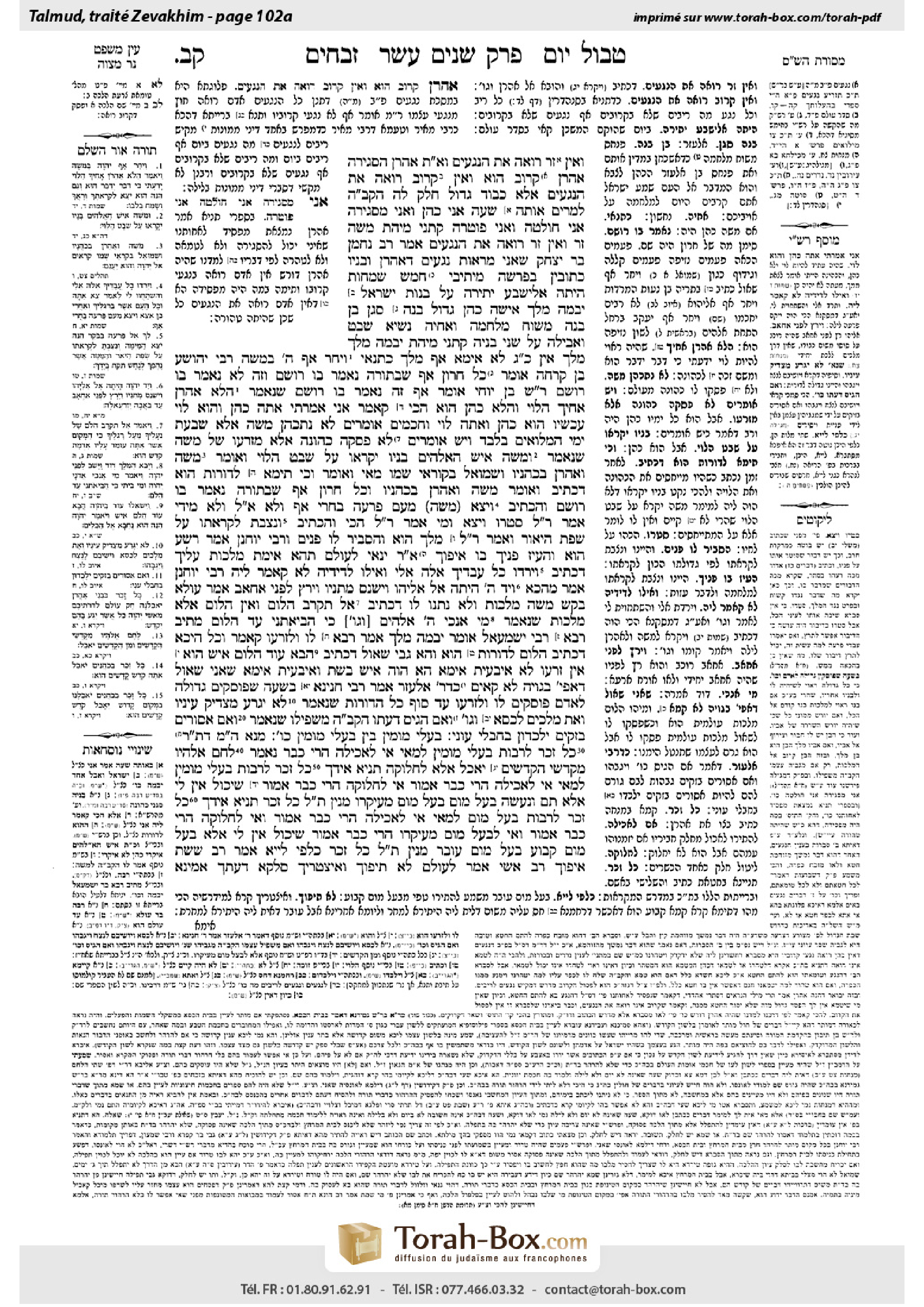
Zevachim 102a: Talmud study for Daf Yomi
Daf Yomi is the daily study of one Talmud folio. Explore 37 tractates with scans, Hebrew text, Sefaria English and AI-generated French translations where annotated.
Passage selection and English or AI-generated French translation are available where the scan has annotations. Daf Study is independent of Torah-Box and Sefaria.
Browse Zevachim · זבחים · All tractatesZevachim 102a text and translations
This page of Zevachim includes the Aramaic text, an English translation and an AI-generated French translation, alongside the scan above.
זבחים ק״ב א · Aramaic and Hebrew text
וְאֵין זָר רוֹאֶה אֶת הַנְּגָעִים! וְאִם תֹּאמַר אַהֲרֹן הִסְגִּירָהּ – אַהֲרֹן קָרוֹב הוּא, וְאֵין קָרוֹב רוֹאֶה אֶת הַנְּגָעִים! אֶלָּא כָּבוֹד גָּדוֹל חָלַק לָהּ הַקָּדוֹשׁ בָּרוּךְ הוּא לְמִרְיָם אוֹתָהּ שָׁעָה: אֲנִי כֹּהֵן וַאֲנִי מַסְגִּירָהּ, אֲנִי חוֹלְטָהּ וַאֲנִי פּוֹטְרָהּ.
קָתָנֵי מִיהַת: מֹשֶׁה זָר, וְאֵין זָר רוֹאֶה אֶת הַנְּגָעִים!
אָמַר רַב נַחְמָן בַּר יִצְחָק: שָׁאנֵי מַרְאוֹת נְגָעִים, דְּאַהֲרֹן וּבָנָיו כְּתוּבִין בַּפָּרָשָׁה.
מֵיתִיבִי: חָמֵשׁ שְׂמָחוֹת הָיְתָה אֱלִישֶׁבַע יְתֵירָה עַל בְּנוֹת יִשְׂרָאֵל – יְבָמָהּ מֶלֶךְ, אִישָׁהּ כֹּהֵן גָּדוֹל, בְּנָהּ סְגָן, בֶּן בְּנָהּ מְשׁוּחַ מִלְחָמָה, וְאָחִיהָ נְשִׂיא שֵׁבֶט; וַאֲבֵילָה עַל שְׁנֵי בָּנֶיהָ.
קָתָנֵי מִיהַת: יְבָמָהּ מֶלֶךְ – מֶלֶךְ אִין, כֹּהֵן גָּדוֹל לָא! אֵימָא: אַף מֶלֶךְ.
כְּתַנָּאֵי: ״וַיִּחַר אַף ה׳ בְּמֹשֶׁה״ – רַבִּי יְהוֹשֻׁעַ בֶּן קׇרְחָה אוֹמֵר: כׇּל חֲרוֹן אַף שֶׁבַּתּוֹרָה נֶאֱמַר בּוֹ רוֹשֶׁם, וְזֶה לֹא נֶאֱמַר בּוֹ רוֹשֶׁם.
רַבִּי שִׁמְעוֹן בֶּן יוֹחַי אוֹמֵר: אַף זֶה נֶאֱמַר בּוֹ רוֹשֶׁם, שֶׁנֶּאֱמַר: ״הֲלֹא אַהֲרֹן אָחִיךָ הַלֵּוִי״ – וַהֲלֹא כֹּהֵן הוּא! הָכִי קָאָמַר: אֲנִי אָמַרְתִּי אַתָּה כֹּהֵן וְהוּא לֵוִי, עַכְשָׁיו הוּא כֹּהֵן וְאַתָּה לֵוִי.
וַחֲכָמִים אוֹמְרִים: לֹא נִתְכַּהֵן מֹשֶׁה, אֶלָּא שִׁבְעַת יְמֵי הַמִּלּוּאִים בִּלְבַד. וְיֵשׁ אוֹמְרִים: לֹא פָּסְקָה כְּהוּנָּה אֶלָּא מִזַּרְעוֹ שֶׁל מֹשֶׁה, שֶׁנֶּאֱמַר: ״וּמֹשֶׁה אִישׁ הָאֱלֹהִים בָּנָיו יִקָּרְאוּ עַל שֵׁבֶט הַלֵּוִי״, וְאוֹמֵר: ״מֹשֶׁה וְאַהֲרֹן בְּכֹהֲנָיו וּשְׁמוּאֵל בְּקֹרְאֵי שְׁמוֹ״.
מַאי וְאוֹמֵר? וְכִי תֵּימָא לְדוֹרוֹת הוּא דִּכְתִיב, וְאוֹמֵר: ״מֹשֶׁה וְאַהֲרֹן בְּכֹהֲנָיו״.
וְכׇל חֲרוֹן אַף שֶׁבַּתּוֹרָה נֶאֱמַר בּוֹ רוֹשֶׁם?! וְהָכְתִיב: ״וַיֵּצֵא מֹשֶׁה מֵעִם פַּרְעֹה בׇּחֳרִי אָף״, וְלָא אֲמַר לֵיהּ וְלָא מִידֵּי! אֲמַר רֵישׁ לָקִישׁ: סְטָרוֹ וְיָצָא.
וּמִי אָמַר רֵישׁ לָקִישׁ הָכִי?! וְהָכְתִיב: ״וְנִצַּבְתָּ לִקְרָאתוֹ עַל שְׂפַת הַיְאֹר״, וְאָמַר רֵישׁ לָקִישׁ: מֶלֶךְ הוּא וְהַסְבֵּיר לוֹ פָּנִים, וְרַבִּי יוֹחָנָן אָמַר: רָשָׁע הוּא וְהָעֵיז פָּנֶיךָ בּוֹ! אֵיפוֹךְ.
אָמַר רַבִּי יַנַּאי: לְעוֹלָם תְּהֵא אֵימַת מַלְכוּת עָלֶיךָ; דִּכְתִיב: ״וְיָרְדוּ כׇל עֲבָדֶיךָ אֵלֶּה אֵלַי״ – וְאִילּוּ לְדִידֵיהּ לָא קָאָמַר לֵיהּ.
רַבִּי יוֹחָנָן אָמַר מֵהָכָא: ״וְיַד ה׳ הָיְתָה אֶל אֵלִיָּהוּ, וַיְשַׁנֵּס מׇתְנָיו וַיָּרׇץ לִפְנֵי אַחְאָב״.
אָמַר עוּלָּא: בִּקֵּשׁ מֹשֶׁה מַלְכוּת, וְלֹא נָתְנוּ לוֹ; דִּכְתִיב: ״אַל תִּקְרַב הֲלֹם״, וְאֵין ״הֲלוֹם״ אֶלָּא מַלְכוּת – שֶׁנֶּאֱמַר: ״מִי אָנֹכִי ה׳ אֱלֹהִים [וְגוֹ׳] כִּי הֲבִיאֹתַנִי עַד הֲלֹם״.
מֵתִיב רָבָא, רַבִּי יִשְׁמָעֵאל אוֹמֵר: יְבָמָהּ מֶלֶךְ! אָמַר רָבָא: לוֹ וּלְזַרְעוֹ קָאָמַר.
וְכֹל הֵיכָא דִּכְתִיב ״הֲלוֹם״ – לְדוֹרוֹת הוּא?! וְהָא גַּבֵּי שָׁאוּל דִּכְתִיב: ״הֲבָא עוֹד הֲלֹם אִישׁ״ – הוּא אִין, זַרְעוֹ לָא!
אִיבָּעֵית אֵימָא: הָא הֲוָה אִישׁ בּשֶׁת, וְאִיבָּעֵית אֵימָא: שָׁאנֵי שָׁאוּל – דַּאֲפִילּוּ בְּגַוֵּיהּ לָא קָאֵים;
כִּדְרַבִּי אֶלְעָזָר אָמַר רַבִּי חֲנִינָא: בְּשָׁעָה שֶׁפּוֹסְקִים גְּדוּלָּה לָאָדָם – פּוֹסְקִים לוֹ וּלְזַרְעוֹ עַד סוֹף כׇּל הַדּוֹרוֹת, שֶׁנֶּאֱמַר: ״לֹא יִגְרַע מִצַּדִּיק עֵינָיו וְאֶת מְלָכִים לַכִּסֵּא וְגוֹ׳״. וְאִם הֵגֵיס דַּעְתּוֹ – הַקָּדוֹשׁ בָּרוּךְ הוּא מַשְׁפִּילוֹ, שֶׁנֶּאֱמַר: ״וְאִם אֲסוּרִים בַּזִּקִּים יִלָּכְדוּן בְּחַבְלֵי עֹנִי״.
בַּעֲלֵי מוּמִין, בֵּין בַּעֲלֵי מוּמִין כּוּ׳. מְנָא הָנֵי מִילֵּי? דְּתָנוּ רַבָּנַן: ״כׇּל זָכָר״ – לְרַבּוֹת בַּעֲלֵי מוּמִין.
לְמַאי? אִי לַאֲכִילָה – הֲרֵי כְּבָר נֶאֱמַר: ״לֶחֶם אֱלֹהָיו מִקׇּדְשֵׁי הַקֳּדָשִׁים יֹאכֵל״! אֶלָּא לַחֲלוּקָּה.
תַּנְיָא אִידַּךְ: ״כׇּל זָכָר״ – לְרַבּוֹת בַּעֲלֵי מוּמִין. לְמַאי? אִי לַאֲכִילָה – הֲרֵי כְּבָר אָמוּר! אִי לַחֲלוּקָּה – הֲרֵי כְּבָר אָמוּר! שֶׁיָּכוֹל אֵין לִי אֶלָּא תָּם וְנַעֲשָׂה בַּעַל מוּם, בַּעַל מוּם מֵעִיקָּרוֹ מִנַּיִן? תַּלְמוּד לוֹמַר: ״כׇּל זָכָר״.
תַּנְיָא אִידַּךְ: ״כׇּל זָכָר״ – לְרַבּוֹת בַּעַל מוּם. לְמַאי? אִי לַאֲכִילָה – הֲרֵי כְּבָר אָמוּר! וְאִי לַחֲלוּקָּה – הֲרֵי כְּבָר אָמוּר! וְאִי לְבַעַל מוּם מֵעִיקָּרוֹ – הֲרֵי כְּבָר אָמוּר! שֶׁיָּכוֹל אֵין לִי אֶלָּא בַּעַל מוּם קָבוּעַ, בַּעַל מוּם עוֹבֵר מִנַּיִן? תַּלְמוּד לוֹמַר: ״כׇּל זָכָר״.
כְּלַפֵּי לְיָיא? אָמַר רַב שֵׁשֶׁת: אֵיפוֹךְ.
רַב אָשֵׁי אָמַר: לְעוֹלָם לָא תֵּיפוֹךְ; וְאִיצְטְרִיךְ, סָלְקָא דַּעְתָּךְ אָמֵינָא:
Zevachim 102a · English translation
and a non-priest may not inspect the shades of leprous marks to diagnose them. And if you say that Aaron quarantined her, that is difficult, as Aaron was a relative, Miriam’s brother, and a relative may not inspect the shades of leprous marks. Rather, the Holy One, Blessed be He, bestowed a great honor on Miriam at that time, and said: I Myself am a priest, and I will quarantine her for seven days to see if the shades of leprous marks persist, and I will declare her a leper if she is impure, and I will exempt her if she is not impure.
In any event, the midrash teaches: Moses was a non-priest, and a non-priest may not inspect the shades of leprous marks, which contradicts the statement of Rav that Moses was a priest.
Rav Naḥman bar Yitzḥak said: The halakhot of the examination of shades of leprous marks are different, because specifically Aaron and his sons, and not Moses, are written in the passage that discusses them: “Then he shall be brought unto Aaron the priest, or unto one of his sons the priests” (Leviticus 13:2). Therefore, there is no proof from this baraita that Moses was not a priest.
The Gemara raises an objection to Rav’s statement from a baraita: Elisheva, the daughter of Amminadav and the wife of Aaron, had five more reasons for joy than the other daughters of Israel on the day the Tabernacle was dedicated: Her brother-in-law, Moses, was a king; her husband, Aaron, was the High Priest; her son, Elazar, was the deputy High Priest; her son’s son, Pinehas, was the priest anointed for war, who would lead the army out to battle; and her brother, Nahshon, son of Amminadav, was the prince of the tribe of Judah, who brought his offering on that day, as the first of all the princes. But on that same day of joy she was in mourning for her two sons, Nadav and Avihu, who died on that day.
In any event, the baraita teaches: Her brother-in-law, Moses, was a king. From this one can infer that yes, he was a king, but he was not a High Priest, contrary to Rav’s statement. The Gemara responds: Say that the baraita means: Moses was a king as well, in addition to being a High Priest.
The Gemara comments: The question of whether Moses was a High Priest is subject to a dispute among tanna’im, as is taught in a baraita: When Moses was at the burning bush and expressed hesitation to deliver God’s message to Pharaoh, the verse states: “And the anger of the Lord burned against Moses, and He said: Is there not Aaron your brother the Levite? I know that he can speak well. And also, behold, he comes forth to meet you, and when he sees you, he will be glad in his heart” (Exodus 4:14). Rabbi Yehoshua ben Korḥa says: For every burning anger that is stated in the Torah, its effect is also stated, i.e., the Torah records an action or pronouncement as a consequence of that anger, but in this case no effect of the anger is stated.
Rabbi Shimon ben Yoḥai says: Even in this case the anger’s effect is stated, as it is stated there: “Is there not Aaron your brother the Levite? I know that he can speak well.” But isn’t Aaron a priest? Why is he referred to as a Levite? This is what God is saying to Moses: I initially said that you would be the priest and he would be the Levite; now he will be the priest and you will be the Levite.
And the Rabbis say: Moses became a priest for the seven days of inauguration alone, and after that his priesthood expired. And some say: The priesthood expired only for the descendants of Moses, but Moses himself remained a priest, as it is stated: “But as for Moses the man of God, his sons are named among the tribe of Levi” (I Chronicles 23:14). This verse indicates that it was his sons who were Levites, but he himself remained a priest. And so too the verse states: “Moses and Aaron among His priests, and Samuel among them that call upon His name, did call upon the Lord, and He answered them” (Psalms 99:6).
The Gemara asks: What is meant by: And so too the verse states? Why did the tanna need to cite a second proof? The Gemara explains: And if you would say the first verse is written only for future generations, to include Moses’ descendants in the tribe of Levi but not to exclude him, then there is a second proof: And so too, the verse states: “Moses and Aaron among His priests.” The statement of Rav that Moses was a High Priest is in accordance with the opinion in this baraita.
The Gemara challenges the statement of Rabbi Yehoshua ben Korḥa: And is it true that for every burning anger that is stated in the Torah, its effect is also stated? But isn’t it written with regard to Moses: “And he went out from Pharaoh in hot anger” (Exodus 11:8)? And Moses did not say anything to Pharaoh. Reish Lakish said: Moses slapped him and left.
The Gemara challenges: And does Reish Lakish actually say this? But isn’t it written: “Go unto Pharaoh in the morning; lo, he goes out unto the water; and you shall stand by the river’s brink to meet him, and the rod which was turned to a serpent shall you take in your hand” (Exodus 7:15); and Reish Lakish says: God meant: Pharaoh is a king, and so you should be amiable toward him, and Rabbi Yoḥanan says: God meant: Pharaoh is wicked, and so you should be insolent toward him. If according to Reish Lakish Moses was commanded to greet Pharaoh with respect, how could he say that Moses slapped Pharaoh? The Gemara answers: Reverse the names of the Sages in this dispute; it is Reish Lakish who says that Moses was commanded to be insolent.
With regard to the respect accorded to a king, Rabbi Yannai says: Fear of the kingship should always be upon you, even when the king does not deserve respect, as it is written that Moses said to Pharaoh: “And all these your servants shall come down unto me and bow down unto me, saying: Get you out, and all the people that follow you, and after that I will go out” (Exodus 11:8). He mentioned Pharaoh’s servants, but he did not say this of Pharaoh himself, even though this was the eventual outcome. Rather, he spoke to Pharaoh with the respect due to a king.
Rabbi Yoḥanan says: Derive the principle from here: “And the hand of the Lord was on Elijah, and he girded up his loins and ran before Ahab to the entrance of Jezreel” (I Kings 18:46). Elijah the prophet ran before the evil king Ahab out of respect.
The Gemara continues to discuss the roles of Moses: Ulla says: Moses requested that he be given the kingship, but it was not given to him, as it is written: “Do not draw hither” (Exodus 3:5); and the word “hither” refers to nothing other than kingship, as it is stated: “Then David the king went in and sat before the Lord, and he said: Who am I, O Lord God, and what is my house, that You have brought me hither”? (II Samuel 7:18).
Rava raises an objection from the baraita cited earlier: Rabbi Yishmael says: Elisheva’s brother-in-law, Moses, was a king. This teaches that Moses was in fact granted kingship. Rava said: Ulla is saying that Moses did not receive kingship for himself and for his descendants, i.e., it was not bequeathed to his sons.
The Gemara counters: And is it so that anywhere that it is written “hither” the verse is referring to kingship for future generations as well? But isn’t it written about the kingship of Saul: “They asked of the Lord further: Is there yet a man who comes hither” (I Samuel 10:22), and Saul was indeed a king, but his descendants were not.
The Gemara responds: If you wish, say: There was Ish-Bosheth, Saul’s son, who was a king (see II Samuel 2:10), indicating that Saul’s kingship did pass to his son. And if you wish, say instead: Saul is different, because the kingship did not stand even for himself, and this is why it did not pass on to his descendants.
The second response is in accordance with that which Rabbi Elazar says that Rabbi Ḥanina says: When greatness is apportioned to a person in Heaven, it is apportioned to him and to his descendants until the end of all generations, as it is stated: “He withdraws not His eyes from the righteous; but with kings upon the throne He sets them forever, and they are exalted” (Job 36:7). But if he then became arrogant, the Holy One, Blessed be He, humiliates him, as is stated in the next verse: “And if they be bound in fetters, and be held in cords of affliction” (Job 36:8). This was the case with Saul.
§ The mishna teaches: Blemished priests, whether they are temporarily blemished or permanently blemished, receive a share and partake of offerings, but do not sacrifice them. The Gemara explains: From where are these matters derived? As the Sages taught in a baraita: The verse states with regard to the meal offering: “Every male among the sons of Aaron shall eat it” (Leviticus 6:11). The phrase “every male” serves to include blemished priests.
The Gemara clarifies: For what matter is this derivation necessary? If one suggests it is for the matter of consumption, it is already stated explicitly: “Any man of the seed of Aaron the priest who has a blemish…He may eat the bread of his God, of the most sacred, and of the sacred” (Leviticus 21:21–22). Rather, Leviticus 6:11 is necessary for the matter of receiving a share, teaching that blemished priests may do so along with the other priests. This is the source for the mishna’s statement.
It is taught in another baraita: The verse states with regard to the sin offering: “Every male among the priests may eat thereof” (Leviticus 6:22). The phrase “every male” serves to include blemished priests. The Gemara explains: For what matter is this derivation necessary? If one suggests it is for the matter of consumption, isn’t that already stated in Leviticus, chapter 21? If one suggests it is for the matter of receiving a share, isn’t that already stated in verse 6:11? Rather, the verse is necessary because one might have thought that I have derived only the halakha with regard to a priest who was at first unblemished and later became blemished. From where is it derived that one blemished from birth also receives a share? The verse states here: “Every male.”
It is taught in another baraita: The verse states with regard to the guilt offering: “Every male among the priests may eat thereof” (Leviticus 7:6). The phrase “every male” serves to include a blemished priest. The Gemara explains: For what matter is this derivation necessary? If one suggests it is for the matter of eating, isn’t that already stated? And if one suggests it is for the matter of receiving a share, isn’t that already stated? And if one suggests it is for a priest blemished from birth, isn’t that already stated? Rather, the verse is necessary because one might have thought that I have derived only the halakha with regard to a permanently blemished priest. From where is it derived that a temporarily blemished priest also receives a share? The verse states here: “Every male.”
The Gemara objects: Isn’t it the opposite [kelapei layya]? Wouldn’t I have thought that a priest with a permanent blemish would be treated more stringently than one with a temporary blemish? Rav Sheshet said: Reverse the wording as follows: One might have thought that I have derived only the halakha with regard to a priest with a temporary blemish; from where is it derived that one with a permanent blemish also receives a share?
Rav Ashi said: Actually, do not reverse the wording, and this is not difficult. It was necessary to teach that even a priest with a temporary blemish receives a share, because it might enter your mind to say
Zevachim 102a · Traduction française (IA)
et un non-prêtre ne peut pas examiner les nuances des lésions de tsaraat pour les diagnostiquer. Et si tu dis qu’Aaron l’a mise en quarantaine, cela pose problème, car Aaron était un proche parent, le frère de Miriam, et un proche parent ne peut pas examiner les nuances des lésions de tsaraat. En réalité, le Saint, béni soit-Il, accorda alors un grand honneur à Miriam et dit : « C’est Moi-même qui suis prêtre ; Je la mettrai en quarantaine pendant sept jours pour voir si les nuances des lésions de tsaraat persistent, Je la déclarerai lépreuse si elle est impure, et Je la dispenserai si elle n’est pas impure. »
Quoi qu’il en soit, le midrash enseigne que Moïse était un non-prêtre et qu’un non-prêtre ne peut pas examiner les nuances des lésions de tsaraat, ce qui contredit la déclaration de Rav selon laquelle Moïse était prêtre.
Rav Naḥman bar Yitzḥak dit : Les règles relatives à l’examen des nuances des lésions de tsaraat sont différentes, car seuls Aaron et ses fils, et non Moïse, sont mentionnés dans le passage qui les traite : « Il sera amené devant Aaron le prêtre ou devant l’un de ses fils, les prêtres » (Lévitique 13:2). Cette baraïta ne prouve donc pas que Moïse n’était pas prêtre.
La Guemara soulève une objection à la déclaration de Rav à partir d’une baraïta : Elisheva, fille d’Amminadav et épouse d’Aaron, avait cinq raisons de plus que les autres filles d’Israël de se réjouir le jour de l’inauguration du Tabernacle : son beau-frère Moïse était roi ; son mari Aaron était le grand prêtre ; son fils Elazar était le grand prêtre adjoint ; son petit-fils Pinehas était le prêtre oint pour la guerre, chargé de conduire l’armée au combat ; et son frère Nahshon, fils d’Amminadav, était le prince de la tribu de Juda et apporta son offrande ce jour-là, le premier de tous les princes. Mais ce même jour de joie, elle était en deuil de ses deux fils, Nadav et Avihu, qui moururent ce jour-là.
Quoi qu’il en soit, la baraïta enseigne que son beau-frère Moïse était roi. On peut en déduire qu’il était bien roi, mais qu’il n’était pas grand prêtre, contrairement à la déclaration de Rav. La Guemara répond : Comprends plutôt que la baraïta veut dire que Moïse était également roi, en plus d’être grand prêtre.
La Guemara fait remarquer que la question de savoir si Moïse était grand prêtre fait l’objet d’un désaccord entre les tannaïm, comme l’enseigne une baraïta : Lorsque Moïse se trouvait devant le buisson ardent et hésitait à transmettre le message de Dieu à Pharaon, le verset dit : « La colère de l’Éternel s’enflamma contre Moïse, et Il dit : “Aaron, ton frère le Lévite, n’est-il pas là ? Je sais qu’il parle bien. Et voici qu’il vient à ta rencontre ; quand il te verra, il se réjouira dans son cœur” » (Exode 4:14). Rabbi Yehoshua ben Korḥa dit : Chaque fois qu’une colère ardente est mentionnée dans la Torah, son effet est également indiqué, c’est-à-dire que la Torah rapporte une action ou une déclaration qui en découle ; mais, dans ce cas, aucun effet de la colère n’est mentionné.
Rabbi Shimon ben Yoḥai dit : Même dans ce cas, l’effet de la colère est indiqué, comme il est dit : « Aaron, ton frère le Lévite, n’est-il pas là ? Je sais qu’il parle bien. » Mais Aaron n’est-il pas prêtre ? Pourquoi est-il appelé Lévite ? Voici ce que Dieu dit à Moïse : « J’avais d’abord dit que tu serais prêtre et lui Lévite ; maintenant, lui sera prêtre et toi, tu seras Lévite. »
Et les Sages disent : Moïse ne fut prêtre que pendant les sept jours de l’inauguration ; ensuite, sa prêtrise prit fin. Certains disent : La prêtrise prit fin uniquement pour les descendants de Moïse, mais Moïse lui-même demeura prêtre, comme il est dit : « Quant à Moïse, l’homme de Dieu, ses fils sont comptés dans la tribu de Lévi » (I Chroniques 23:14). Ce verset indique que ses fils étaient Lévites, mais que lui-même demeura prêtre. De même, le verset dit : « Moïse et Aaron parmi Ses prêtres, et Samuel parmi ceux qui invoquent Son nom ; ils invoquaient l’Éternel, et Il leur répondait » (Psaumes 99:6).
La Guemara demande : Que signifie « de même, le verset dit » ? Pourquoi le tanna devait-il apporter une deuxième preuve ? La Guemara explique : Et si tu dis que le premier verset ne concerne que les générations futures, pour inclure les descendants de Moïse dans la tribu de Lévi sans pour autant l’en exclure lui-même, il existe une deuxième preuve : de même, le verset dit : « Moïse et Aaron parmi Ses prêtres. » La déclaration de Rav selon laquelle Moïse était grand prêtre est conforme à l’opinion exprimée dans cette baraïta.
La Guemara conteste la déclaration de Rabbi Yehoshua ben Korḥa : Est-il vrai que chaque fois qu’une colère ardente est mentionnée dans la Torah, son effet est également indiqué ? Or, il est écrit au sujet de Moïse : « Il sortit de chez Pharaon dans une grande colère » (Exode 11:8), et Moïse ne dit rien à Pharaon. Reish Lakish dit : Moïse lui donna une gifle et partit.
La Guemara objecte : Reish Lakish dit-il vraiment cela ? Or, il est écrit : « Va vers Pharaon le matin ; voici, il sort vers l’eau ; tu te tiendras au bord du fleuve pour le rencontrer, et tu prendras dans ta main le bâton qui a été changé en serpent » (Exode 7:15). Et Reish Lakish dit que Dieu voulait dire : « Pharaon est un roi, tu dois donc te montrer aimable envers lui » ; tandis que Rabbi Yoḥanan dit que Dieu voulait dire : « Pharaon est méchant, tu dois donc te montrer insolent envers lui. » Si, selon Reish Lakish, Moïse avait reçu l’ordre de saluer Pharaon avec respect, comment peut-il dire que Moïse lui donna une gifle ? La Guemara répond : Inverse les noms des Sages dans ce désaccord ; c’est Reish Lakish qui dit que Moïse avait reçu l’ordre de se montrer insolent.
Au sujet du respect dû à un roi, Rabbi Yannai dit : La crainte de la royauté doit toujours être présente à ton esprit, même lorsque le roi ne mérite pas le respect, comme il est écrit que Moïse dit à Pharaon : « Tous tes serviteurs descendront vers moi et se prosterneront devant moi, en disant : “Sors, toi et tout le peuple qui te suit ; après cela, je sortirai” » (Exode 11:8). Il parla des serviteurs de Pharaon, mais ne dit pas cela de Pharaon lui-même, alors même que c’est ce qui devait finalement se produire. Il s’adressa plutôt à Pharaon avec le respect dû à un roi.
Rabbi Yoḥanan dit : Déduis ce principe de ce verset : « La main de l’Éternel fut sur Élie ; il ceignit ses reins et courut devant Achab jusqu’à l’entrée de Jezréel » (I Rois 18:46). Le prophète Élie courut devant Achab, le roi méchant, par respect.
La Guemara poursuit son examen des fonctions de Moïse : Ulla dit : Moïse demanda qu’on lui accorde la royauté, mais elle ne lui fut pas accordée, comme il est écrit : « N’approche pas d’ici » (Exode 3:5). Or, le terme « ici » ne désigne rien d’autre que la royauté, comme il est dit : « Le roi David entra et s’assit devant l’Éternel, et dit : “Qui suis-je, Seigneur Dieu, et qu’est-ce que ma maison, pour que Tu m’aies amené ici ?” » (II Samuel 7:18).
Rava soulève une objection à partir de la baraïta citée précédemment : Rabbi Yishmael dit que Moïse, le beau-frère d’Elisheva, était roi. Cela enseigne que la royauté lui fut bel et bien accordée. Rava dit : Ulla veut dire que Moïse ne reçut pas la royauté pour lui-même et pour ses descendants, c’est-à-dire qu’elle ne fut pas transmise à ses fils.
La Guemara rétorque : Chaque fois que le terme « ici » est écrit, le verset fait-il référence à une royauté qui se transmet également aux générations futures ? Or, il est écrit au sujet de la royauté de Saül : « Ils consultèrent encore l’Éternel : “Y a-t-il un homme qui soit venu ici ?” » (I Samuel 10:22). Saül fut bien roi, mais ses descendants ne le furent pas.
La Guemara répond : Si tu veux, dis qu’il y eut Ish-Bosheth, fils de Saül, qui fut roi (voir II Samuel 2:10), ce qui indique que la royauté de Saül fut transmise à son fils. Et si tu veux, dis plutôt que Saül était différent, car la royauté ne dura même pas pour lui-même ; c’est pourquoi elle ne fut pas transmise à ses descendants.
La deuxième réponse est conforme à ce que Rabbi Elazar dit au nom de Rabbi Ḥanina : Lorsque la grandeur est attribuée à une personne au Ciel, elle lui est attribuée ainsi qu’à ses descendants jusqu’à la fin de toutes les générations, comme il est dit : « Il ne détourne pas les yeux des justes ; Il les établit pour toujours avec les rois sur le trône, et ils sont élevés » (Job 36:7). Mais si cette personne devient ensuite arrogante, le Saint, béni soit-Il, l’humilie, comme il est dit au verset suivant : « S’ils sont enchaînés dans des entraves et retenus par les liens de l’affliction » (Job 36:8). Ce fut le cas de Saül.
§ La Michna enseigne : Les prêtres atteints d’un défaut, temporaire ou permanent, reçoivent une part des offrandes et en mangent, mais ne les offrent pas. La Guemara explique : De quoi ces règles sont-elles déduites ? Les Sages enseignent dans une baraïta : À propos de l’offrande de farine, le verset dit : « Tout mâle parmi les fils d’Aaron la mangera » (Lévitique 6:11). L’expression « tout mâle » vient inclure les prêtres atteints d’un défaut.
La Guemara précise : À quelle fin cette déduction est-elle nécessaire ? Si l’on propose qu’elle concerne la consommation, cela est déjà explicitement indiqué : « Tout homme de la descendance d’Aaron le prêtre qui a un défaut… pourra manger le pain de son Dieu, des choses très saintes et des choses saintes » (Lévitique 21:21–22). Lévitique 6:11 est donc nécessaire pour établir le droit de recevoir une part et enseigner que les prêtres atteints d’un défaut peuvent en recevoir une avec les autres prêtres. Telle est la source de l’enseignement de la Michna.
Il est enseigné dans une autre baraïta : À propos du sacrifice expiatoire, le verset dit : « Tout mâle parmi les prêtres pourra en manger » (Lévitique 6:22). L’expression « tout mâle » vient inclure les prêtres atteints d’un défaut. La Guemara explique : À quelle fin cette déduction est-elle nécessaire ? Si l’on propose qu’elle concerne la consommation, n’est-ce pas déjà indiqué au chapitre 21 du Lévitique ? Si l’on propose qu’elle concerne le droit de recevoir une part, n’est-ce pas déjà indiqué au verset 6:11 ? Le verset est donc nécessaire, car on aurait pu penser que la halakha ne concernait que le prêtre qui était d’abord sans défaut et qui a ensuite été atteint d’un défaut. D’où déduit-on que celui qui est atteint d’un défaut depuis sa naissance reçoit lui aussi une part ? Le verset dit ici : « Tout mâle. »
Il est enseigné dans une autre baraïta : À propos du sacrifice de culpabilité, le verset dit : « Tout mâle parmi les prêtres pourra en manger » (Lévitique 7:6). L’expression « tout mâle » vient inclure un prêtre atteint d’un défaut. La Guemara explique : À quelle fin cette déduction est-elle nécessaire ? Si l’on propose qu’elle concerne la consommation, n’est-ce pas déjà indiqué ? Et si l’on propose qu’elle concerne le droit de recevoir une part, n’est-ce pas déjà indiqué ? Et si l’on propose qu’elle concerne un prêtre atteint d’un défaut depuis sa naissance, n’est-ce pas déjà indiqué ? Le verset est donc nécessaire, car on aurait pu penser que la halakha ne concernait que le prêtre atteint d’un défaut permanent. D’où déduit-on qu’un prêtre atteint d’un défaut temporaire reçoit lui aussi une part ? Le verset dit ici : « Tout mâle. »
La Guemara objecte : N’est-ce pas le contraire [kelapei layya] ? N’aurais-je pas pensé qu’un prêtre atteint d’un défaut permanent serait soumis à une règle plus stricte qu’un prêtre atteint d’un défaut temporaire ? Rav Sheshet dit : Inverse les termes comme suit : On aurait pu penser que la halakha ne concernait que le prêtre atteint d’un défaut temporaire ; d’où déduit-on que celui qui est atteint d’un défaut permanent reçoit lui aussi une part ?
Rav Ashi dit : En réalité, n’inverse pas les termes, et il n’y a pas de difficulté. Il était nécessaire d’enseigner que même un prêtre atteint d’un défaut temporaire reçoit une part, car on aurait pu penser que
Traduction française générée par IA à partir de l’édition anglaise de Sefaria. Vérifie toujours un passage avec le texte source.
Text from Sefaria: William Davidson Edition - Vocalized Aramaic (CC BY NC); William Davidson Edition - English (CC BY NC).