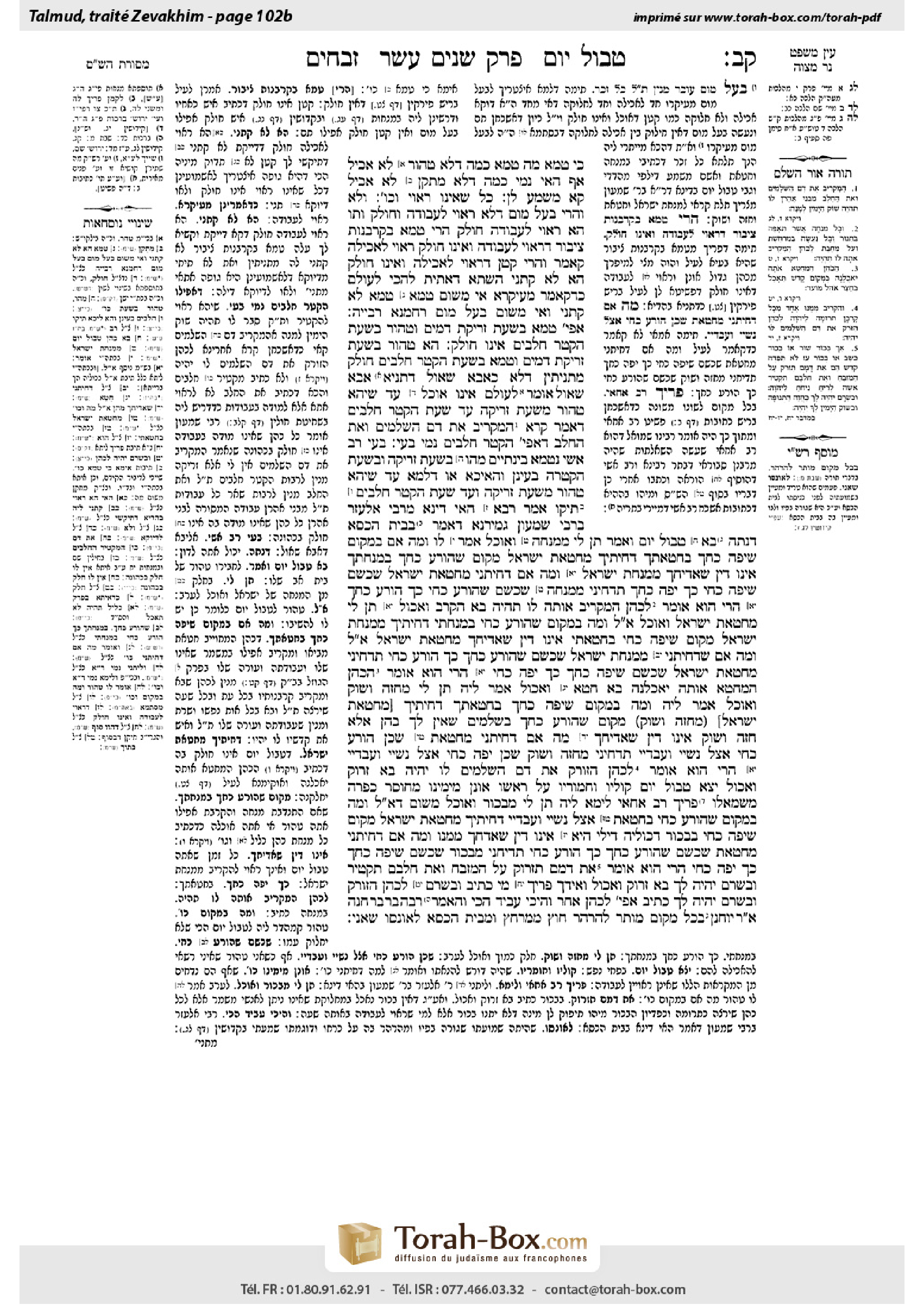
Zevachim 102b: Talmud study for Daf Yomi
Daf Yomi is the daily study of one Talmud folio. Explore 37 tractates with scans, Hebrew text, Sefaria English and AI-generated French translations where annotated.
Passage selection and English or AI-generated French translation are available where the scan has annotations. Daf Study is independent of Torah-Box and Sefaria.
Browse Zevachim · זבחים · All tractatesZevachim 102b text and translations
This page of Zevachim includes the Aramaic text, an English translation and an AI-generated French translation, alongside the scan above.
זבחים ק״ב ב · Aramaic and Hebrew text
כִּי טָמֵא; מָה טָמֵא – כַּמָּה דְּלָא טָהוֹר לָא אָכֵיל, אַף הַאי נָמֵי – כַּמָּה דְּלָא מִתְּקַן לָא אָכֵיל; קָא מַשְׁמַע לַן.
כֹּל שֶׁאֵינוֹ רָאוּי וְכוּ׳. וְלָא?! וַהֲרֵי בַּעַל מוּם, דְּלֹא רָאוּי לָעֲבוֹדָה, וְחוֹלֵק! וְתוּ, הָא רָאוּי לָעֲבוֹדָה חוֹלֵק?! הֲרֵי טָמֵא בְּקׇרְבְּנוֹת צִיבּוּר, דְּרָאוּי לָעֲבוֹדָה, וְאֵינוֹ חוֹלֵק!
רָאוּי לַאֲכִילָה קָאָמַר.
וַהֲרֵי קָטָן, דְּרָאוּי לַאֲכִילָה, וְאֵינוֹ חוֹלֵק! הָא לָא קָתָנֵי.
הַשְׁתָּא דְּאָתֵית לְהָכִי, לְעוֹלָם (כדקאמר) [כִּדְקָאָמְרַתְּ] מֵעִיקָּרָא; אִי מִשּׁוּם טָמֵא – טָמֵא לָא קָתָנֵי, וְאִי מִשּׁוּם בַּעַל מוּם – רַחֲמָנָא רַבְּיֵיהּ.
אֲפִילּוּ טָמֵא בִּשְׁעַת זְרִיקַת דָּמִים, וְטָהוֹר בִּשְׁעַת הֶקְטֵר חֲלָבִים – אֵינוֹ חוֹלֵק. הָא טָהוֹר בִּשְׁעַת זְרִיקַת דָּמִים, וְטָמֵא בִּשְׁעַת הֶקְטֵר חֲלָבִים – חוֹלֵק;
מַתְנִיתִין דְּלָא כְּאַבָּא שָׁאוּל. דְּתַנְיָא, אַבָּא שָׁאוּל אוֹמֵר: לְעוֹלָם אֵינוֹ אוֹכֵל, עַד שֶׁיְּהֵא טָהוֹר מִשְּׁעַת זְרִיקָה עַד שְׁעַת הֶקְטֵר חֲלָבִים; דְּאָמַר קְרָא: ״הַמַּקְרִיב אֶת דַּם הַשְּׁלָמִים וְאֶת הַחֵלֶב״ – דַּאֲפִילּוּ הֶקְטֵר חֲלָבִים נָמֵי בָּעֵי.
בָּעֵי רַב אָשֵׁי: נִטְמָא בֵּינְתַיִים מַהוּ? בִּשְׁעַת זְרִיקָה וּבִשְׁעַת הַקְטָרָה בָּעֵינַן, וְהָאִיכָּא; אוֹ דִּלְמָא עַד שֶׁיְּהֵא טָהוֹר מִשְּׁעַת זְרִיקָה וְעַד שְׁעַת הֶקְטֵר חֲלָבִים? תֵּיקוּ.
אָמַר רָבָא: הַאי דִּינָא – מֵרַבִּי אֶלְעָזָר בְּרַבִּי שִׁמְעוֹן גְּמִירְנָא, דְּאָמַר בְּבֵית הַכִּסֵּא דַּנְתָּהּ – בָּא טְבוּל יוֹם וְאָמַר: תֵּן לִי מִמִּנְחָה וְאוֹכַל.
אָמַר לוֹ: וּמָה אִם בִּמְקוֹם שֶׁיִּפָּה כֹּחֲךָ – בְּחַטָּאתֶךָ, דְּחִיתִיךְ מֵחַטַּאת יִשְׂרָאֵל; מְקוֹם שֶׁהוֹרַע כֹּחֲךָ – בְּמִנְחָתֶךָ, אֵינוֹ דִּין שֶׁאֶדְחֲךָ מִמִּנְחַת יִשְׂרָאֵל?!
וּמָה אִם דְּחִיתַנִי מֵחַטַּאת יִשְׂרָאֵל – שֶׁכְּשֵׁם שֶׁיִּפָּה כֹּחִי כָּךְ יִפָּה כֹּחֶךָ; תִּדְחֵינִי (מִמִּנְחָה) [מִמִּנְחַת יִשְׂרָאֵל], שֶׁכְּשֵׁם שֶׁהוֹרַע כֹּחִי כָּךְ הוֹרַע כֹּחֶךָ!
הֲרֵי הוּא אוֹמֵר: ״לַכֹּהֵן הַמַּקְרִיב אֹתָהּ לוֹ תִהְיֶה״ – בֹּא הַקְרֵב וֶאֱכוֹל.
תֵּן לִי מֵחַטַּאת יִשְׂרָאֵל וְאוֹכַל –
אָמַר לוֹ: וּמָה בִּמְקוֹם שֶׁהוֹרַע כֹּחִי – בְּמִנְחָתִי, דְּחִיתִיךְ מִמִּנְחַת יִשְׂרָאֵל; מְקוֹם שֶׁיִּפָּה כֹּחִי – בְּחַטָּאתִי, אֵינוֹ דִּין שֶׁאֶדְחֲךָ מֵחַטַּאת יִשְׂרָאֵל?!
אָמַר לוֹ: וּמָה אִם שֶׁדְּחִיתַנִי מִמִּנְחַת יִשְׂרָאֵל – שֶׁכְּשֵׁם שֶׁהוֹרַע כֹּחֶךָ כָּךְ הוֹרַע כֹּחִי; תִּדְחֵינִי מֵחַטַּאת יִשְׂרָאֵל – שֶׁכְּשֵׁם שֶׁיִּפָּה כֹּחֶךָ כָּךְ יִפָּה כֹּחִי?!
הֲרֵי הוּא אוֹמֵר: ״הַכֹּהֵן הַמְחַטֵּא אֹתָהּ יֹאכְלֶנָּה״ – בֹּא חַטֵּא וֶאֱכוֹל.
אָמַר לוֹ: תֵּן לִי מֵחָזֶה וָשׁוֹק וְאוֹכַל –
אָמַר לוֹ: וּמָה בִּמְקוֹם שֶׁיִּפָּה כֹּחֲךָ – בְּחַטָּאתֶךָ, דְּחִיתִיךְ [מֵחַטַּאת יִשְׂרָאֵל] (מֵחָזֶה וָשׁוֹק); מְקוֹם שֶׁהוֹרַע כֹּחֲךָ – בִּשְׁלָמִים, שֶׁאֵין לָךְ בָּהֶן אֶלָּא חָזֶה וָשׁוֹק, אֵינוֹ דִּין שֶׁאֶדְחֲךָ?!
מָה אִם דְּחִיתַנִי מֵחַטָּאת – שֶׁכֵּן הוֹרַע כֹּחִי אֵצֶל נָשַׁיי וַעֲבָדַיי; תִּדְחֵינִי מֵחָזֶה וָשׁוֹק – שֶׁכֵּן יִפָּה כֹּחִי אֵצֶל נָשַׁיי וַעֲבָדַי?!
הֲרֵי הוּא אוֹמֵר: ״לַכֹּהֵן הַזּוֹרֵק אֶת דַּם הַשְּׁלָמִים לוֹ יִהְיֶה״ – בֹּא זְרוֹק וֶאֱכוֹל.
יָצָא טְבוּל יוֹם קוּלָּיו וַחֲמוּרָיו עַל רֹאשׁוֹ, אוֹנֵן מִימִינוֹ, מְחוּסַּר כַּפָּרָה מִשְּׂמֹאלוֹ.
פָּרֵיךְ רַב אַחַאי, לֵימָא לֵיהּ: תֵּן לִי מִבְּכוֹר וְאוֹכַל!
מִשּׁוּם דְּאָמַר לֵיהּ: וּמָה בִּמְקוֹם שֶׁהוֹרַע כֹּחִי – בְּחַטָּאת, אֵצֶל נָשַׁיי וַעֲבָדַיי, דְּחִיתִיךְ מֵחַטַּאת יִשְׂרָאֵל; מְקוֹם שֶׁיִּפָּה כֹּחִי – בִּבְכוֹר, דְּכוּלֵּיהּ דִּילִי הִיא – אֵינוֹ דִּין שֶׁאֶדְחֲךָ מִמֶּנּוּ?
וּמָה אִם דְּחִיתַנִי מֵחַטָּאת – שֶׁכְּשֵׁם שֶׁהוֹרַע כֹּחֲךָ כָּךְ הוֹרַע כֹּחִי; תִּדְחֵינִי מִבְּכוֹר – שֶׁכְּשֵׁם שֶׁיִּפָּה כֹּחֲךָ כָּךְ יִפָּה כֹּחִי?!
הֲרֵי הוּא אוֹמֵר: ״אֶת דָּמָם תִּזְרֹק עַל הַמִּזְבֵּחַ וְאֶת חֶלְבָּם תַּקְטִיר... וּבְשָׂרָם יִהְיֶה לְךָ״ – בֹּא זְרוֹק וֶאֱכוֹל.
וְאִידַּךְ פָּרֵיךְ: מִי כְּתִיב ״וּבְשָׂרָם לַכֹּהֵן הַזּוֹרֵק״?! ״וּבְשָׂרָם יִהְיֶה לָךְ״ כְּתִיב – אֲפִילּוּ לְכֹהֵן אַחֵר.
וְהֵיכִי עָבֵיד הָכִי? וְהָאָמַר רַבָּה בַּר בַּר חָנָה אָמַר רַבִּי יוֹחָנָן: בְּכׇל מְקוֹם מוּתָּר לְהַרְהֵר, חוּץ מִמֶּרְחָץ וּמִבֵּית הַכִּסֵּא! לְאוֹנְסוֹ שָׁאנֵי.
Zevachim 102b · English translation
that the halakha of this priest is like that of a ritually impure priest: Just as an impure priest may not partake as long as he is not pure, so too, this priest with a temporary blemish may not partake as long as he does not become fit. The verse therefore teaches us that he may receive a share even before his blemish heals.
§ The mishna teaches: The principle is: Any priest who is unfit for the service that day does not receive a share of the sacrificial meat. The Gemara objects: But doesn’t he? Isn’t there a blemished priest, who is not fit for the service and who nevertheless receives a share of the meat, as the mishna itself teaches? And furthermore, this principle indicates that only priests unfit for the service do not receive a share, but any priest who is fit for the service does receive a share. But isn’t there an impure priest, who, with regard to offerings of the community, is fit for the service, and who nevertheless does not receive a share?
The Gemara answers: The mishna is saying that any priest who is not fit for partaking of sacrificial meat does not receive a share. Blemished priests may partake of sacrificial meat, and impure priests may not.
The Gemara objects: This indicates that any priest who is fit to partake may receive a share. But isn’t there a minor, who is fit for partaking and who does not receive a share? The Gemara answers: This inverse principle, that any priest who is fit to partake may receive a share, is not taught. The mishna means to teach only that any priest who is unfit does not receive a share.
The Gemara notes: Now that you have arrived at this conclusion, that the mishna’s statement only teaches what it says explicitly, one can say that the mishna actually means what the Gemara said at the outset, that no priest unfit for the service receives a share. If one raises an objection with regard to an impure priest, who is fit for the service of communal offerings but does not receive a share, answer that the mishna does not teach that every fit priest, even an impure one, receives a share, only the inverse. And if you raise an objection with regard to a blemished priest, who is unfit for the service but nevertheless receives a share, answer that the Merciful One included him as an exception by the phrase: Every male, as derived above (102a).
§ The mishna teaches: Even if the priest was ritually impure only at the time of the sprinkling of the blood of the offering, and he was pure at the time of the burning of the fats, he still does not receive a share of the meat. The Gemara notes: Consequently, one can infer that a priest who was pure at the time of the sprinkling of the blood, even one who was impure at the time of the burning of the fats, does receive a share.
The Gemara comments: The mishna is not in accordance with the opinion of Abba Shaul, as it is taught in a baraita: Abba Shaul says: A priest never partakes, i.e., receives a share, of sacrificial meat, unless he is pure from the time of sprinkling until the time of the burning of the fats, as the verse states: “He among the sons of Aaron who sacrifices the blood of the peace offerings and the fat shall have the right thigh for a portion” (Leviticus 7:33). The verse requires that the priest be pure even at the time of the burning of the fats.
Rav Ashi raises a dilemma: According to the opinion of Abba Shaul, in a case where the priest became impure between the sprinkling of the blood and the burning of the fats but became pure again before the latter, what is the halakha? Do we require only that he be pure both at the time of sprinkling and at the time of the burning of the fats, and there is purity at these times? Or perhaps Abba Shaul meant that the priest may not receive a share in the meat unless he is pure from the time of sprinkling until the time of the burning of the fats, without interruption. The Gemara concludes: The dilemma shall stand unresolved.
§ The mishna teaches that an impure priest who immersed that day, such that he will not be pure until sunset, and likewise an acute mourner and one who has not yet brought an atonement offering, do not receive a share of sacrificial meat in order to partake of it in the evening. Rava says: I learned this halakha from Rabbi Elazar, son of Rabbi Shimon, who said in the bathroom: You can contend by way of a story: A priest who immersed that day came and said to a pure priest of the same patrilineal priestly family serving in the Temple that day, who was apportioning the sacrificial food: Give me a share of a meal offering, and I will partake of it in the evening.
The pure priest said an a fortiori inference to him: Just as with regard to a matter where your right is superior, i.e., in the case of your own sin offering, to which you have a right even when your family is not serving in the Temple, I can nevertheless deny you a share of the sin offering of an Israelite because you immersed today; is it not logical that with regard to a matter where your right is inferior, i.e., in the case of your own meal offering, as the meal offering of a priest is not eaten at all, that I can deny you a share of the meal offering of an Israelite?
The priest who immersed that day responded: But even if you can deny me a share of the sin offering of an Israelite on the day I immersed, perhaps this is since just as my right is superior in the case of my own sin offering, so too, your right is superior in the case of your own sin offering. If so, is it necessarily so that you can refuse me a share of the meal offering of an Israelite, where just as my right is inferior, so your right is inferior, as neither of us may eat from our own meal offerings?
The pure priest responded: The verse states: “And every meal offering that is baked in the oven, and all that is dressed in the stewing pan, and on the griddle, shall be the priest’s that offers it” (Leviticus 7:9). If you wish to receive a share of a meal offering, come sacrifice and partake of one. Since you cannot sacrifice a meal offering, having immersed only today, neither can you receive a share.
The priest who immersed that day made another demand: Give me a share of the sin offering of an Israelite, and I will partake of it in the evening when I am pure.
The pure priest said to him: Just as with regard to a matter where my right is inferior, i.e., in the case of my own meal offering, which is not eaten, I can deny you a share of the meal offering of an Israelite, as I explained; so too, is it not logical that with regard to a matter where my right is superior, i.e., in the case of my own sin offering, to which I have a right even when my family is not serving in the Temple, I can deny you a share of the sin offering of an Israelite?
The priest who immersed that day said to him: But if you can deny me a share of the meal offering of an Israelite, where just as your right is inferior, so too my right is inferior, is it necessarily so that you can deny me a share of the sin offering of an Israelite, where just as your right is superior in the case of your own sin offering, so too my right is superior in the case of my own sin offering?
The pure priest responded: The verse states with regard to the sin offering: “The priest who effects atonement shall eat it” (Leviticus 6:19). If you wish to receive a share of a sin offering, come effect atonement and partake of one. Since you cannot perform the service of a sin offering, having immersed only today, you cannot receive a share in its meat either.
The priest who immersed that day made another demand, and said to him: Give me a share of the breast and thigh, the portions that priests receive of peace offerings, and I will partake of it in the evening when I am pure.
The pure priest said to him: Just as with regard to a matter where your right is superior, i.e., in the case of your own sin offering, to which you have a right to its meat in its entirety, I can deny you a share of the sin offering of an Israelite, as I explained, so too is it not logical that with regard to a matter where your right is inferior, i.e., in the case of a peace offering, of which you have only the right to a share of the breast and thigh, I can deny you a share?
The priest who immersed that day responded: But if you can deny me a share of a sin offering, where my right is inferior with regard to my wives and my slaves, as a sin offering can be consumed only by male priests, is it necessarily so that you can deny me a share of the breast and thigh of a peace offering, where my right is superior with regard to my wives and my slaves, who may also partake of them?
The pure priest responded: The verse states with regard to the peace offering: “It shall be the priest’s that sprinkles the blood of the peace offerings against the altar” (Leviticus 7:14). If you wish to partake of a peace offering, come sprinkle its blood and partake of it. Since you cannot perform this service, having immersed only today, you cannot receive a share of its meat either.
The story concludes: The priest who immersed that day left in disappointment, with his a fortiori inferences upon his head, as they did not help him. And along with him walked an acute mourner on his right and a priest who had not yet brought an atonement offering on his left. They too were denied shares, because they were unfit for the Temple service.
Rav Aḥai refutes this: Rabbi Elazar, son of Rabbi Shimon, could have added to the contentions described in the story. Let the priest who immersed that day say to the pure priest: Give me a share of a firstborn offering, and I will partake of it in the evening.
Perhaps it is because the pure priest could say to him: Just as with regard to a sin offering, where my right is inferior with regard to my wives and my slaves, since it may be eaten only by male priests, I can nevertheless deny you a share of the sin offering of an Israelite, as I explained; so too is it not logical that with regard to a first-born, where my right is superior because all of its meat is mine, as firstborn offerings are given to a specific priest, I can deny you a share of it?
But the priest who immersed that day could respond: But if you can deny me a share of a sin offering, where just as your right is inferior, so is my right inferior; is it necessarily so that you can deny me a share of a firstborn offering, where just as your right is superior, so my right is superior?
The pure priest could respond: The verse says with regard to a firstborn offering: “You shall sprinkle their blood on the altar and shall make their fat smoke for an offering made by fire, for a pleasing aroma to the Lord. And the flesh of them shall be yours, as the breast and as the thigh, it shall be yours” (Numbers 18:17–18). If you wish to receive a share in the meat of a firstborn, come sprinkle its blood and partake of it. Why did Rabbi Elazar, son of Rabbi Shimon, not include this exchange as another stage in his story?
The Gemara responds: But the other priest, the one who immersed that day, could refute this proof: Is it written: And the flesh of them shall be for the priest who sprinkles, as is written with regard to a meal offering, a sin offering, and a peace offering? Rather, it is written: “And the flesh of them shall be yours,” indicating that it can be given even to a priest other than the one who sacrificed it. This is why Rabbi Elazar, son of Rabbi Shimon, did not include this exchange in his story.
The Gemara returns to Rava’s statement that Rabbi Elazar, son of Rabbi Shimon, taught this halakha in the bathroom. And how did Rabbi Elazar, son of Rabbi Shimon, do this? But doesn’t Rabba bar bar Ḥana say that Rabbi Yoḥanan says: It is permitted to contemplate matters of Torah in all places except the bathhouse and the bathroom? The Gemara answers: A case where the matter was involuntary is different. Rabbi Elazar, son of Rabbi Shimon, was so preoccupied by the issue that he taught it even though he was in the bathroom.
Zevachim 102b · Traduction française (IA)
que la halakha applicable à ce prêtre est semblable à celle d’un prêtre rituellement impur : de même qu’un prêtre impur ne peut pas consommer tant qu’il n’est pas pur, ce prêtre atteint d’un défaut temporaire ne peut pas non plus consommer tant qu’il n’est pas redevenu apte. Le verset nous enseigne donc qu’il peut recevoir une part même avant la guérison de son défaut.
§ La Michna enseigne : Tout prêtre inapte au service ce jour-là ne reçoit pas de part de la viande sacrificielle. La Guemara objecte : Pourtant, n’y a-t-il pas un prêtre atteint d’un défaut, qui est inapte au service et reçoit néanmoins une part de la viande, comme la Michna elle-même l’enseigne ? De plus, ce principe indique que seuls les prêtres inaptes au service ne reçoivent pas de part, tandis que tout prêtre apte au service en reçoit une. Pourtant, n’y a-t-il pas un prêtre impur qui, pour les sacrifices communautaires, est apte au service et ne reçoit néanmoins pas de part ?
La Guemara répond : La Michna veut dire que tout prêtre inapte à consommer de la viande sacrificielle ne reçoit pas de part. Les prêtres atteints d’un défaut peuvent consommer de la viande sacrificielle, tandis que les prêtres impurs ne le peuvent pas.
La Guemara objecte : Cela implique que tout prêtre apte à consommer peut recevoir une part. Pourtant, n’y a-t-il pas un mineur, qui est apte à consommer et ne reçoit pas de part ? La Guemara répond : Ce principe inverse, selon lequel tout prêtre apte à consommer peut recevoir une part, n’est pas enseigné. La Michna veut seulement enseigner que tout prêtre inapte ne reçoit pas de part.
La Guemara remarque : Puisque nous sommes parvenus à cette conclusion, selon laquelle la Michna enseigne seulement ce qu’elle énonce explicitement, on peut dire que la Michna veut en réalité dire ce que la Guemara a dit au départ : aucun prêtre inapte au service ne reçoit de part. Si l’on objecte qu’un prêtre impur, qui est apte au service des sacrifices communautaires, ne reçoit pas de part, on répondra que la Michna n’enseigne pas que tout prêtre apte, même s’il est impur, reçoit une part, mais seulement le principe inverse. Et si l’on objecte qu’un prêtre atteint d’un défaut, qui est inapte au service, reçoit néanmoins une part, on répondra que le Miséricordieux l’a inclus à titre d’exception par l’expression « tout mâle », comme cela a été déduit plus haut (102a).
§ La Michna enseigne : Même si le prêtre était rituellement impur uniquement au moment de l’aspersion du sang du sacrifice et pur au moment de la combustion des graisses, il ne reçoit toujours pas de part de la viande. La Guemara remarque : On peut donc en déduire qu’un prêtre qui était pur au moment de l’aspersion du sang reçoit une part, même s’il était impur au moment de la combustion des graisses.
La Guemara fait remarquer : La Michna n’est pas conforme à l’opinion d’Abba Shaul, car il est enseigné dans une baraïta : Abba Shaul dit : Un prêtre ne consomme jamais — c’est-à-dire ne reçoit jamais de part — de viande sacrificielle à moins d’être pur depuis le moment de l’aspersion jusqu’au moment de la combustion des graisses, comme le dit le verset : « Celui des fils d’Aaron qui offre le sang des sacrifices de paix et la graisse aura la cuisse droite comme part » (Lévitique 7, 33). Le verset exige que le prêtre soit pur même au moment de la combustion des graisses.
Rav Ashi soulève un dilemme : selon l’opinion d’Abba Shaul, quelle est la halakha si le prêtre est devenu impur entre l’aspersion du sang et la combustion des graisses, mais est redevenu pur avant cette dernière ? Exige-t-on seulement qu’il soit pur à la fois au moment de l’aspersion et au moment de la combustion des graisses, conditions qu’il remplit ? Ou bien Abba Shaul voulait-il dire que le prêtre ne peut recevoir une part de la viande que s’il demeure pur sans interruption depuis le moment de l’aspersion jusqu’à celui de la combustion des graisses ? La Guemara conclut : Le dilemme reste sans réponse.
§ La Michna enseigne qu’un prêtre impur qui s’est immergé ce jour-là, de sorte qu’il ne sera pur qu’au coucher du soleil, ainsi qu’un endeuillé en état d’aninout et un prêtre qui n’a pas encore apporté son sacrifice expiatoire, ne reçoivent pas de part de viande sacrificielle à consommer le soir. Rava dit : J’ai appris cette halakha de Rabbi Elazar, fils de Rabbi Shimon, qui l’a énoncée dans les toilettes : on peut défendre cette thèse à l’aide d’un récit. Un prêtre qui s’était immergé ce jour-là vint trouver un prêtre pur de la même famille sacerdotale patrilinéaire, qui assurait le service au Temple ce jour-là et répartissait la nourriture sacrificielle, et lui dit : « Donne-moi une part d’une offrande de farine, et je la consommerai le soir. »
Le prêtre pur lui opposa un raisonnement a fortiori : Puisque, même dans un domaine où ton droit est supérieur — le cas de ton propre sacrifice expiatoire, auquel tu as droit même lorsque ta famille n’assure pas le service au Temple —, je peux néanmoins te refuser une part du sacrifice expiatoire d’un Israélite parce que tu t’es immergé aujourd’hui, n’est-il pas logique que, dans un domaine où ton droit est inférieur — le cas de ta propre offrande de farine, puisque l’offrande de farine d’un prêtre n’est pas consommée du tout —, je puisse te refuser une part de l’offrande de farine d’un Israélite ?
Le prêtre qui s’était immergé ce jour-là répondit : Même si tu peux me refuser une part du sacrifice expiatoire d’un Israélite le jour où je me suis immergé, peut-être est-ce parce que, de même que mon droit est supérieur dans le cas de mon propre sacrifice expiatoire, ton droit l’est aussi dans le cas de ton propre sacrifice expiatoire. S’ensuit-il nécessairement que tu puisses me refuser une part de l’offrande de farine d’un Israélite, alors que, de même que mon droit y est inférieur, le tien l’est aussi, puisque ni l’un ni l’autre ne pouvons consommer nos propres offrandes de farine ?
Le prêtre pur répondit : Le verset dit : « Toute offrande de farine cuite au four, ainsi que toute celle qui est préparée dans une marmite ou sur une plaque, sera pour le prêtre qui l’offre » (Lévitique 7, 9). Si tu veux recevoir une part d’une offrande de farine, viens en offrir une et la consommer. Puisque tu ne peux pas offrir une offrande de farine après t’être immergé seulement aujourd’hui, tu ne peux pas non plus en recevoir une part.
Le prêtre qui s’était immergé ce jour-là formula une autre demande : « Donne-moi une part du sacrifice expiatoire d’un Israélite, et je le consommerai le soir, lorsque je serai pur. »
Le prêtre pur lui dit : De même que, dans un domaine où mon droit est inférieur — le cas de ma propre offrande de farine, qui n’est pas consommée —, je peux te refuser une part de l’offrande de farine d’un Israélite, comme je l’ai expliqué, n’est-il pas logique que, dans un domaine où mon droit est supérieur — le cas de mon propre sacrifice expiatoire, auquel j’ai droit même lorsque ma famille n’assure pas le service au Temple —, je puisse te refuser une part du sacrifice expiatoire d’un Israélite ?
Le prêtre qui s’était immergé ce jour-là lui dit : Si tu peux me refuser une part de l’offrande de farine d’un Israélite, où ton droit comme le mien est inférieur, s’ensuit-il nécessairement que tu puisses me refuser une part du sacrifice expiatoire d’un Israélite, où, de même que ton droit est supérieur dans le cas de ton propre sacrifice expiatoire, le mien l’est aussi dans le cas de mon propre sacrifice expiatoire ?
Le prêtre pur répondit : Le verset dit au sujet du sacrifice expiatoire : « Le prêtre qui fait l’expiation le mangera » (Lévitique 6, 19). Si tu veux recevoir une part d’un sacrifice expiatoire, viens en accomplir le service d’expiation et le consommer. Puisque tu ne peux pas accomplir le service d’un sacrifice expiatoire après t’être immergé seulement aujourd’hui, tu ne peux pas non plus recevoir une part de sa viande.
Le prêtre qui s’était immergé ce jour-là formula une autre demande et lui dit : « Donne-moi une part de la poitrine et de la cuisse, les portions que les prêtres reçoivent des sacrifices de paix, et je les consommerai le soir, lorsque je serai pur. »
Le prêtre pur lui dit : De même que, dans un domaine où ton droit est supérieur — le cas de ton propre sacrifice expiatoire, dont tu as droit à toute la viande —, je peux te refuser une part du sacrifice expiatoire d’un Israélite, comme je l’ai expliqué, n’est-il pas logique que, dans un domaine où ton droit est inférieur — le cas d’un sacrifice de paix, dont tu n’as droit qu’à une part de la poitrine et de la cuisse —, je puisse te refuser une part ?
Le prêtre qui s’était immergé ce jour-là répondit : Si tu peux me refuser une part d’un sacrifice expiatoire, où mon droit est inférieur en ce qui concerne mes femmes et mes esclaves, car un sacrifice expiatoire ne peut être consommé que par des prêtres mâles, s’ensuit-il nécessairement que tu puisses me refuser une part de la poitrine et de la cuisse d’un sacrifice de paix, où mon droit est supérieur en ce qui concerne mes femmes et mes esclaves, qui peuvent elles aussi en consommer ?
Le prêtre pur répondit : Le verset dit au sujet du sacrifice de paix : « Elle sera pour le prêtre qui asperge le sang des sacrifices de paix contre l’autel » (Lévitique 7, 14). Si tu veux consommer un sacrifice de paix, viens en asperger le sang et le consommer. Puisque tu ne peux pas accomplir ce service après t’être immergé seulement aujourd’hui, tu ne peux pas non plus recevoir une part de sa viande.
Le récit s’achève ainsi : Le prêtre qui s’était immergé ce jour-là s’en alla déçu, ses raisonnements a fortiori sur la tête, car ils ne lui avaient servi à rien. Un endeuillé en état d’aninout marchait à sa droite, et un prêtre qui n’avait pas encore apporté son sacrifice expiatoire à sa gauche. Eux aussi se virent refuser des parts, car ils étaient inaptes au service du Temple.
Rav Aḥai réfute cet argument : Rabbi Elazar, fils de Rabbi Shimon, aurait pu ajouter d’autres arguments à ceux qui sont rapportés dans le récit. Le prêtre qui s’était immergé ce jour-là aurait pu dire au prêtre pur : « Donne-moi une part d’un sacrifice de premier-né, et je le consommerai le soir. »
Peut-être le prêtre pur pourrait-il lui répondre : De même que, dans le cas d’un sacrifice expiatoire, où mon droit est inférieur en ce qui concerne mes femmes et mes esclaves, puisqu’il ne peut être consommé que par des prêtres mâles, je peux néanmoins te refuser une part du sacrifice expiatoire d’un Israélite, comme je l’ai expliqué, n’est-il pas logique que, dans le cas d’un premier-né, où mon droit est supérieur parce que toute sa viande m’appartient, les sacrifices de premier-né étant attribués à un prêtre déterminé, je puisse t’en refuser une part ?
Mais le prêtre qui s’était immergé ce jour-là pourrait répondre : Si tu peux me refuser une part d’un sacrifice expiatoire, où ton droit comme le mien est inférieur, s’ensuit-il nécessairement que tu puisses me refuser une part d’un sacrifice de premier-né, où ton droit comme le mien est supérieur ?
Le prêtre pur pourrait répondre : Le verset dit au sujet d’un sacrifice de premier-né : « Vous aspergerez leur sang sur l’autel et vous ferez fumer leur graisse en offrande consumée par le feu, en odeur agréable pour le Seigneur. Leur viande sera à vous ; comme la poitrine et la cuisse, elle sera à vous » (Nombres 18, 17-18). Si tu veux recevoir une part de la viande d’un premier-né, viens en asperger le sang et la consommer. Pourquoi Rabbi Elazar, fils de Rabbi Shimon, n’a-t-il pas inclus cet échange comme une étape supplémentaire de son récit ?
La Guemara répond : Mais l’autre prêtre, celui qui s’était immergé ce jour-là, pourrait réfuter cette preuve : Est-il écrit : « Leur viande sera au prêtre qui asperge », comme il est écrit au sujet de l’offrande de farine, du sacrifice expiatoire et du sacrifice de paix ? Il est plutôt écrit : « Leur viande sera à vous », ce qui indique qu’elle peut être donnée même à un prêtre autre que celui qui l’a sacrifiée. C’est pourquoi Rabbi Elazar, fils de Rabbi Shimon, n’a pas inclus cet échange dans son récit.
La Guemara revient à la déclaration de Rava selon laquelle Rabbi Elazar, fils de Rabbi Shimon, a enseigné cette halakha dans les toilettes. Comment Rabbi Elazar, fils de Rabbi Shimon, a-t-il pu faire cela ? Rabba bar bar Ḥana ne dit-il pas au nom de Rabbi Yoḥanan : Il est permis de méditer sur des sujets de Torah partout, sauf aux bains et dans les toilettes ? La Guemara répond : Le cas où cela s’est produit involontairement est différent. Rabbi Elazar, fils de Rabbi Shimon, était tellement préoccupé par la question qu’il l’a enseignée alors même qu’il se trouvait dans les toilettes.
Traduction française générée par IA à partir de l’édition anglaise de Sefaria. Vérifie toujours un passage avec le texte source.
Text from Sefaria: William Davidson Edition - Vocalized Aramaic (CC BY NC); William Davidson Edition - English (CC BY NC).