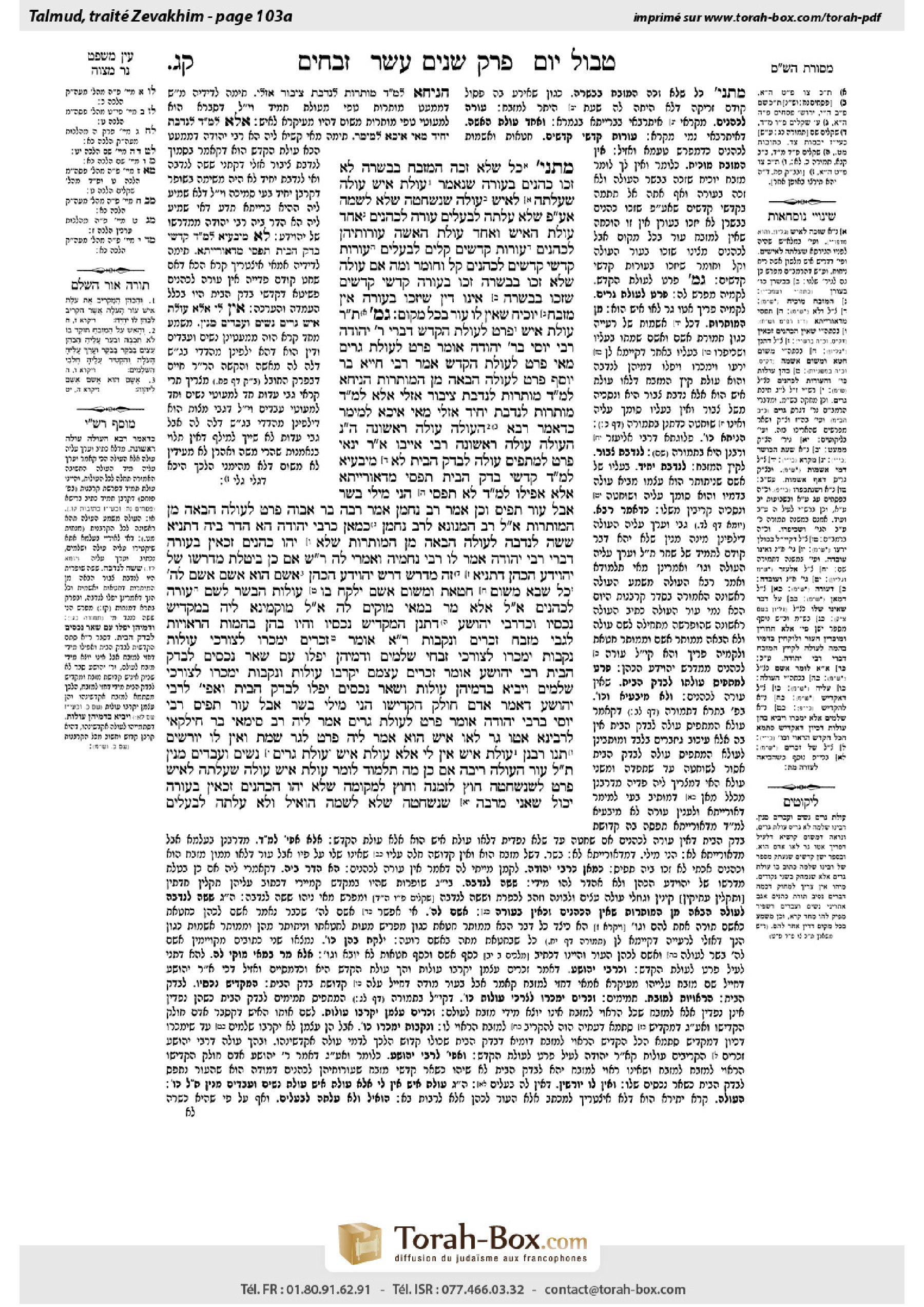
Zevachim 103a: Talmud study for Daf Yomi
Daf Yomi is the daily study of one Talmud folio. Explore 37 tractates with scans, Hebrew text, Sefaria English and AI-generated French translations where annotated.
Passage selection and English or AI-generated French translation are available where the scan has annotations. Daf Study is independent of Torah-Box and Sefaria.
Browse Zevachim · זבחים · All tractatesZevachim 103a text and translations
This page of Zevachim includes the Aramaic text, an English translation and an AI-generated French translation, alongside the scan above.
זבחים ק״ג א · Aramaic and Hebrew text
מַתְנִי׳ כׇּל שֶׁלֹּא זָכָה הַמִּזְבֵּחַ בִּבְשָׂרָהּ – לֹא זָכוּ כֹּהֲנִים בְּעוֹרָהּ; שֶׁנֶּאֱמַר: ״עֹלַת אִישׁ״ – עוֹלָה שֶׁעָלְתָה לָאִישׁ.
עוֹלָה שֶׁנִּשְׁחֲטָה שֶׁלֹּא לִשְׁמָהּ – אַף עַל פִּי שֶׁלֹּא עָלְתָה לַבְּעָלִים, עוֹרָהּ לַכֹּהֲנִים. אֶחָד עוֹלַת הָאִישׁ וְאֶחָד עוֹלַת הָאִשָּׁה, עוֹרוֹתֵיהֶן לְכֹהֲנִים.
עוֹרוֹת קָדָשִׁים קַלִּים לִבְעָלִים, עוֹרוֹת קׇדְשֵׁי קָדָשִׁים לְכֹהֲנִים. קַל וָחוֹמֶר: וּמָה אִם עוֹלָה, שֶׁלֹּא זָכוּ בִּבְשָׂרָהּ – זָכוּ בְּעוֹרָהּ; קׇדְשֵׁי קָדָשִׁים, שֶׁזָּכוּ בִּבְשָׂרָהּ – אֵינוֹ דִּין שֶׁיִּזְכּוּ בְּעוֹרָהּ?! אֵין מִזְבֵּחַ יוֹכִיחַ – שֶׁאֵין לוֹ עוֹר בְּכׇל מָקוֹם.
גְּמָ׳ תָּנוּ רַבָּנַן: ״עֹלַת אִישׁ״ – פְּרָט לְעוֹלַת הֶקְדֵּשׁ. דִּבְרֵי רַבִּי יְהוּדָה. רַבִּי יוֹסֵי בְּרַבִּי יְהוּדָה אוֹמֵר: פְּרָט לְעוֹלַת גֵּרִים.
מַאי פְּרָט לְעוֹלַת הֶקְדֵּשׁ? אָמַר רַבִּי חִיָּיא בַּר יוֹסֵף: פְּרָט לְעוֹלָה הֲבָאָה מִן הַמּוֹתָרוֹת.
הָנִיחָא לְמַאן דְּאָמַר: מוֹתָרוֹת לְנִדְבַת צִיבּוּר אָזְלִי; אֶלָּא לְמַאן דְּאָמַר: מוֹתָרוֹת לְנִדְבַת יָחִיד אָזְלִי – מַאי אִיכָּא לְמֵימַר?
כִּדְאָמַר רָבָא: ״הָעֹלָה״ – עוֹלָה רִאשׁוֹנָה; הָכָא נָמֵי, ״הָעֹלָה״ – עוֹלָה רִאשׁוֹנָה.
רַבִּי אַיְיבוּ אָמַר רַבִּי יַנַּאי: פְּרָט לְמַתְפִּיס עוֹלָה לְבֶדֶק הַבַּיִת.
לָא מִיבַּעְיָא לְמַאן דְּאָמַר: קׇדְשֵׁי בֶּדֶק הַבַּיִת תָּפְסִי מִדְּאוֹרָיְיתָא; אֶלָּא אֲפִילּוּ לְמַאן דְּאָמַר לָא תָּפְסִי – הָנֵי מִילֵּי בָּשָׂר, אֲבָל עוֹר תָּפֵיס.
וְכֵן אָמַר רַב נַחְמָן אָמַר רַבָּה בַּר אֲבוּהּ: פְּרָט לְעוֹלָה הֲבָאָה מִן הַמּוֹתָרוֹת.
אֲמַר לֵיהּ רַב הַמְנוּנָא לְרַב נַחְמָן: כְּמַאן, כְּרַבִּי יְהוּדָה?! הָא הֲדַר בֵּיהּ! דְּתַנְיָא: שִׁשָּׁה לִנְדָבָה – לְעוֹלָה הֲבָאָה מִן הַמּוֹתָרוֹת, שֶׁלֹּא יְהוּ כֹּהֲנִים זַכָּאִין בְּעוֹרָהּ. דִּבְרֵי רַבִּי יְהוּדָה.
אָמַר לוֹ רַבִּי נְחֶמְיָה, וְאָמְרִי לַהּ רַבִּי שִׁמְעוֹן: אִם כֵּן, בִּיטַּלְתָּ מִדְרָשׁוֹ שֶׁל יְהוֹיָדָע הַכֹּהֵן! דְּתַנְיָא, זֶה מִדְרָשׁ דָּרַשׁ יְהוֹיָדָע הַכֹּהֵן: ״אָשָׁם הוּא אָשֹׁם אָשַׁם לַה׳״ – כׇּל שֶׁבָּא מִשּׁוּם חַטָּאת וּמִשּׁוּם אָשָׁם, יִלָּקַח בּוֹ עוֹלוֹת; הַבָּשָׂר לַשֵּׁם, עוֹרָהּ לַכֹּהֲנִים.
אֲמַר לֵיהּ: אֶלָּא מָר בְּמַאי מוֹקֵים לַהּ? אֲמַר לֵיהּ: מוֹקֵמְינָא לֵיהּ בְּמַקְדִּישׁ נְכָסָיו.
וְכִדְרַבִּי יְהוֹשֻׁעַ; דִּתְנַן: הַמַּקְדִּישׁ נְכָסָיו וְהָיוּ בָּהֶן בְּהֵמוֹת הָרְאוּיוֹת לְגַבֵּי מִזְבֵּחַ, זְכָרִים וּנְקֵבוֹת – רַבִּי אֱלִיעֶזֶר אוֹמֵר: זְכָרִים יִמָּכְרוּ לְצוֹרְכֵי עוֹלוֹת, נְקֵבוֹת יִמָּכְרוּ לְצוֹרְכֵי זִבְחֵי שְׁלָמִים, וּדְמֵיהֶן יִפְּלוּ עִם שְׁאָר נְכָסִים לְבֶדֶק הַבַּיִת.
רַבִּי יְהוֹשֻׁעַ אוֹמֵר: זְכָרִים עַצְמָם יִקָּרְבוּ עוֹלוֹת, וּנְקֵבוֹת יִמָּכְרוּ לְצוֹרְכֵי שְׁלָמִים וְיָבִיא בִּדְמֵיהֶן עוֹלוֹת, וּשְׁאָר נְכָסִים יִפְּלוּ לְבֶדֶק הַבַּיִת.
וַאֲפִילּוּ לְרַבִּי יְהוֹשֻׁעַ דְּאָמַר אָדָם חוֹלֵק הֶקְדֵּישׁוֹ – הָנֵי מִילֵּי בָּשָׂר, אֲבָל עוֹר תָּפֵיס.
רַבִּי יוֹסֵי בְּרַבִּי יְהוּדָה אוֹמֵר: פְּרָט לְעוֹלַת גֵּרִים. אֲמַר לֵיהּ רַב סִימַאי בַּר חִילְקַאי לְרָבִינָא: אַטּוּ גֵּר לָאו אִישׁ הוּא?! אֲמַר לֵיהּ: פְּרָט לְגֵר שֶׁמֵּת וְאֵין לוֹ יוֹרְשִׁים.
תָּנוּ רַבָּנַן: ״עֹלַת אִישׁ״ – אֵין לִי אֶלָּא עוֹלַת אִישׁ; עוֹלַת גֵּרִים נָשִׁים וַעֲבָדִים מִנַּיִן? תַּלְמוּד לוֹמַר: ״עוֹר הָעֹלָה״ – רִיבָּה.
וְאִם כֵּן, מָה תַּלְמוּד לוֹמַר: ״עֹלַת אִישׁ״? עוֹלָה שֶׁעָלְתָה לְאִישׁ; פְּרָט לְשֶׁנִּשְׁחֲטָה חוּץ לִזְמַנָּהּ וְחוּץ לִמְקוֹמָהּ, שֶׁלֹּא יְהוּ הַכֹּהֲנִים זַכָּאִין בְּעוֹרָהּ.
יָכוֹל שֶׁאֲנִי מְרַבֶּה שֶׁנִּשְׁחֲטָה שֶׁלֹּא לִשְׁמָהּ – הוֹאִיל וְלֹא עָלְתָה לַבְּעָלִים,
Zevachim 103a · English translation
MISHNA: In the case of any burnt offering for which the altar did not acquire its flesh, e.g., if it was disqualified prior to the sprinkling of its blood, the priests did not acquire its hide, as it is stated with regard to the burnt offering: “And the priest that sacrifices a man’s burnt offering, the priest shall have to himself the hide of the burnt offering that he has sacrificed” (Leviticus 7:8), indicating that the priest acquires only the hide of a burnt offering that satisfied the obligation of a man.
Nevertheless, in a case of a burnt offering that was slaughtered not for its sake but for the sake of another offering, although it did not satisfy the obligation of the owner, its hide goes to the priests. In addition, although the verse states: “A man’s burnt offering,” in the case of both the burnt offering of a man and the burnt offering of a woman, their hides go to the priests.
The hides of offerings of lesser sanctity belong to the owners; the hides of offerings of the most sacred order belong to the priests. The right of priests to hides of offerings of the most sacred order is derived via an a fortiori inference: If for a burnt offering, for which the priests do not acquire its flesh, as it is burned in its entirety, they acquire its hide, then for other offerings of the most sacred order, for which the priests acquire its flesh, is it not right that they should acquire its hide? And there is no room to contend that the altar will prove that this is not a valid inference, as it acquires the flesh of a burnt offering but not its hide, since it does not have the right to the hide of an offering in any place.
GEMARA: The Sages taught in a baraita: The phrase “a man’s burnt offering” in the verse mentioned above serves to exclude the burnt offering of consecrated property, meaning that the priests do not acquire the hides of such offerings. This is the statement of Rabbi Yehuda. Rabbi Yosei, son of Rabbi Yehuda, says: The phrase serves to exclude the burnt offering of converts.
The Gemara clarifies: What does Rabbi Yehuda mean when he says that the phrase serves to exclude the burnt offering of consecrated property? Rabbi Ḥiyya bar Yosef says: He means it serves to exclude a burnt offering that comes from property that was left over. For example, if an animal consecrated as a guilt offering remains alive after its owner has achieved atonement by sacrificing another animal, the owner must wait until it acquires a blemish and then sell it. The proceeds are used to purchase a communal gift offering, which is sacrificed when there are no other offerings to be burned on the altar (see Temura 20b). Because it is a communal offering, it is not considered a man’s burnt offering, and the priests therefore have no right to the hide.
The Gemara asks: This works out well according to the one who says: Leftover consecrated property goes toward communal gift offerings. But according to the one who says: Leftover consecrated property goes toward an individual’s gift offering, what can be said? As this is a man’s burnt offering, the priests should have a right to the hides.
The Gemara answers: According to that opinion, the halakha is as Rava says: The verse states: “And the priest shall kindle wood on it every morning; and he shall lay the burnt offering in order upon it” (Leviticus 6:5). The verse states: “The burnt offering,” with the definite article, to teach that the daily burnt offering is the first burnt offering sacrificed each day in the Temple. Here too, the verse states: “The priest shall have to himself the hide of the burnt offering which he has offered,” to teach that the priest acquires the hide of a first burnt offering, i.e., an animal that was initially designated as a burnt offering, but not of a burnt offering purchased from proceeds left over from another offering.
Rabbi Aivu says that Rabbi Yannai says: Rabbi Yehuda’s statement can be interpreted differently. The phrase “a man’s burnt offering” serves to exclude a case of one who consecrates a burnt offering for Temple maintenance. Since the owner seeks to shift its ownership to the Temple, the priests have no right to its hides.
The Gemara comments: It is not necessary to teach this halakha according to the one who says that consecration for Temple maintenance applies by Torah law to offerings already consecrated to the altar, as the animal in fact ceases to belong to the individual, and the priests clearly have no claim to its hide. Rather, even according to the one who says that it does not apply by Torah law, because the offering is already consecrated for the altar, this matter applies only to the meat; but as for the hide, the consecration for Temple maintenance applies and nullifies the priests’ claim to it.
The Gemara returns to the explanation of Rabbi Ḥiyya bar Yosef and comments: And so says Rav Naḥman that Rabba bar Avuh says: The phrase “a man’s burnt offering” serves to exclude a burnt offering that comes from property that was left over.
Rav Hamnuna said to Rav Naḥman: In accordance with whose statement is your opinion? It is in accordance with the opinion of Rabbi Yehuda. But didn’t Rabbi Yehuda retract this statement? As it is taught in a baraita: The mishna in tractate Shekalim (6:5) states that the Temple had six collection boxes shaped like horns, for communal gift offerings. These funds would go toward burnt offerings that come from money that was left over. For example, if someone dedicated money to purchasing an offering, and after his purchase some of the sum remained, he would put it in these boxes. The halakha is that the priests have no right to the hide of such an offering. This is the statement of Rabbi Yehuda.
Rabbi Neḥemya said to Rabbi Yehuda, and some say that Rabbi Shimon said to him: If so, you have nullified the interpretation of Jehoiada the priest. As it is taught in a mishna (Shekalim 6:6) that Jehoiada the priest taught this interpretation: The verse states: “It is a guilt offering; he is certainly guilty before the Lord” (Leviticus 5:19). The phrase “before the Lord” teaches that if any money comes on account of a sin offering or on account of a guilt offering, i.e., it is left over after their purchase, burnt offerings must be purchased with it, and their flesh must be burned on the altar to the Lord. But its hide shall go to the priests. Rabbi Yehuda did not respond, indicating that he conceded that the hides of such offerings go to the priests.
Rav Naḥman said to Rav Hamnuna: But how does the Master interpret the phrase: “A man’s burnt offering,” as meaning? Rav Hamnuna said to him: I interpret it as referring to one who consecrates all his property, including animals fit for burnt offerings. If these animals are later sacrificed as burnt offerings, the priests do not acquire the hides, since the offerings are consecrated property.
And this is in accordance with the opinion of Rabbi Yehoshua, as we learned in a mishna (Shekalim 4:7): If one consecrates his property without specifying the purpose, generally speaking, it goes toward Temple maintenance. But if among it were animals fit to be sacrificed on the altar, either male or female, then Rabbi Eliezer says: Animals that are fit for offerings must be sacrificed. Therefore, the male animals shall be sold for the purpose of burnt offerings to those who need to bring such offerings, and the female animals, which cannot be brought as burnt offerings, shall be sold for the purpose of peace offerings to those who need to bring such offerings. And because they were consecrated for Temple maintenance, their proceeds shall be allocated with the rest of the person’s property for Temple maintenance.
Rabbi Yehoshua says: The donor intended that all animals fit for sacrifice be brought as burnt offerings, and the rest of his property be given for Temple maintenance. Therefore, the males shall be sacrificed themselves as burnt offerings; and the females shall be sold for the purpose of being sacrificed as peace offerings, and he shall bring burnt offerings with their proceeds; and the rest of his property shall be allocated for Temple maintenance.
Rav Hamnuna explains: And even according to the opinion of Rabbi Yehoshua, who says that a person divides his consecrated property, as he rules that the animals are themselves sacrificed while the other property is given for Temple maintenance, this statement applies specifically to the flesh, which is fit to be burned on the altar; but as for the hide, which is not, the fund for Temple maintenance acquires it from the outset, and the priests therefore have no right to it. This is the halakha that Rabbi Yehuda derives from the phrase “a man’s burnt offering.”
The baraita states: Rabbi Yosei, son of Rabbi Yehuda, says: The phrase “a man’s burnt offering” serves to exclude the burnt offering of converts. The priests do not acquire the hides of such offerings. Rav Simai bar Ḥilkai said to Ravina: Is that to say that a convert is not included in the category of a man? Ravina said to him: Rabbi Yosei, son of Rabbi Yehuda, meant that the verse serves to exclude the burnt offering of a convert who died and has no heirs. The offering has no owner, and therefore the priests do not acquire its hide.
§ The Sages taught in a baraita: The verse states: “And the priest that offers a man’s burnt offering, the priest shall have to himself the hide of the burnt offering that he has sacrificed” (Leviticus 7:8). From this verse I have derived the halakha only with regard to a man’s burnt offering, i.e., that of a born-Jewish male. From where is the same derived with regard to the burnt offering of converts, women, or Canaanite slaves? The verse states: “The hide of the burnt offering,” and it thereby included these as well.
And if so, why must the verse state: “A man’s burnt offering”? It serves to teach that the priests acquire the hide only of a burnt offering that satisfied the obligation of a man, i.e., to exclude a burnt offering that was slaughtered with the intention of consuming it beyond its designated time or outside its designated area and was thereby disqualified. The verse teaches that the priests have no right to the hide of such an offering.
One might have thought that I include a burnt offering that was not slaughtered for its own sake but for the sake of another offering. Since it does not satisfy the obligation of the owner,
Zevachim 103a · Traduction française (IA)
MICHNA : Pour tout holocauste dont l’autel n’a pas acquis la chair, par exemple s’il a été disqualifié avant l’aspersion de son sang, les prêtres n’acquièrent pas la peau. En effet, il est dit au sujet de l’holocauste : « Et le prêtre qui offre l’holocauste d’un homme aura pour lui la peau de l’holocauste qu’il a offert » (Lévitique 7:8), ce qui indique que le prêtre n’acquiert que la peau d’un holocauste qui a acquitté l’obligation d’un homme.
Néanmoins, dans le cas d’un holocauste abattu non pour lui-même, mais pour une autre offrande, bien qu’il n’ait pas acquitté l’obligation du propriétaire, sa peau revient aux prêtres. En outre, bien que le verset dise « l’holocauste d’un homme », la peau de l’holocauste d’un homme comme de celui d’une femme revient aux prêtres.
Les peaux des offrandes de moindre sainteté appartiennent à leurs propriétaires ; celles des offrandes de très haute sainteté appartiennent aux prêtres. Le droit des prêtres aux peaux des offrandes de très haute sainteté se déduit par un raisonnement a fortiori : si, pour un holocauste dont les prêtres n’acquièrent pas la chair, puisqu’il est entièrement brûlé, ils acquièrent la peau, alors, pour les autres offrandes de très haute sainteté, dont les prêtres acquièrent la chair, n’est-il pas d’autant plus juste qu’ils acquièrent la peau ? On ne peut objecter que l’autel prouverait l’invalidité de ce raisonnement, puisqu’il acquiert la chair d’un holocauste, mais non sa peau : l’autel n’a en aucun cas droit à la peau d’une offrande.
GUEMARA : Les Sages ont enseigné dans une baraïta : L’expression « l’holocauste d’un homme », dans le verset mentionné plus haut, vient exclure l’holocauste provenant de biens consacrés ; autrement dit, les prêtres n’acquièrent pas la peau de telles offrandes. Telle est l’opinion de Rabbi Yehouda. Rabbi Yossei, fils de Rabbi Yehouda, dit : cette expression vient exclure l’holocauste des convertis.
La Guemara précise : Que veut dire Rabbi Yehouda lorsqu’il dit que cette expression vient exclure l’holocauste provenant de biens consacrés ? Rabbi Ḥiyya bar Yosef dit : Il veut dire qu’elle vient exclure un holocauste provenant de biens laissés en surplus. Par exemple, si un animal consacré comme sacrifice de culpabilité demeure vivant après que son propriétaire a obtenu l’expiation en sacrifiant un autre animal, le propriétaire doit attendre qu’il présente un défaut, puis le vendre. Le produit de la vente sert à acheter une offrande volontaire communautaire, qui est sacrifiée lorsqu’il n’y a pas d’autres offrandes à brûler sur l’autel (voir Temoura 20b). Comme il s’agit d’une offrande communautaire, elle n’est pas considérée comme l’holocauste d’un homme ; les prêtres n’ont donc aucun droit à sa peau.
La Guemara demande : Cela convient selon celui qui dit que les biens consacrés laissés en surplus servent à financer des offrandes volontaires communautaires. Mais que peut-on répondre selon celui qui dit qu’ils servent à financer une offrande volontaire individuelle ? Puisqu’il s’agit de l’holocauste d’un homme, les prêtres devraient avoir droit à sa peau.
La Guemara répond : Selon cette opinion, la halakha est conforme à ce que dit Rava : le verset énonce : « Et le prêtre y allumera du bois chaque matin ; il disposera l’holocauste dessus » (Lévitique 6:5). L’article défini dans l’expression « l’holocauste » enseigne que l’holocauste quotidien est le premier holocauste sacrifié chaque jour dans le Temple. De même ici, les mots « le prêtre aura pour lui la peau de l’holocauste qu’il a offert » enseignent que le prêtre acquiert la peau d’un holocauste initial, c’est-à-dire d’un animal désigné dès l’origine comme holocauste, mais non celle d’un holocauste acheté avec le produit laissé en surplus d’une autre offrande.
Rabbi Aivu dit au nom de Rabbi Yannai : la déclaration de Rabbi Yehouda peut être interprétée autrement. L’expression « l’holocauste d’un homme » vient exclure le cas de celui qui consacre un holocauste à l’entretien du Temple. Puisque le propriétaire cherche à en transférer la propriété au Temple, les prêtres n’ont aucun droit à sa peau.
La Guemara commente : Il n’est pas nécessaire d’enseigner cette halakha selon celui qui dit que, d’après la Torah, la consécration à l’entretien du Temple s’applique aux offrandes déjà consacrées à l’autel, car l’animal cesse effectivement d’appartenir à l’individu et les prêtres n’ont manifestement aucun droit à sa peau. Mais même selon celui qui dit que cette consécration ne s’applique pas d’après la Torah, parce que l’offrande est déjà consacrée à l’autel, cette règle ne concerne que la viande ; quant à la peau, la consécration à l’entretien du Temple s’applique et annule le droit que les prêtres pourraient revendiquer sur elle.
La Guemara revient à l’explication de Rabbi Ḥiyya bar Yosef et commente : Rav Naḥman dit également au nom de Rabba bar Avuh : l’expression « l’holocauste d’un homme » vient exclure un holocauste provenant de biens laissés en surplus.
Rav Hamnuna dit à Rav Naḥman : De l’avis de qui est ton opinion ? De celui de Rabbi Yehouda. Mais Rabbi Yehouda n’a-t-il pas rétracté cette déclaration ? En effet, il est enseigné dans une baraïta : la Michna du traité Chekalim (6:5) indique que le Temple avait six troncs de collecte en forme de cornes, destinés aux offrandes volontaires communautaires. Ces fonds servaient à financer des holocaustes avec l’argent laissé en surplus. Par exemple, si quelqu’un consacrait de l’argent à l’achat d’une offrande et qu’il en restait une partie après son achat, il la déposait dans ces troncs. La halakha est que les prêtres n’ont aucun droit à la peau d’une telle offrande. Telle est l’opinion de Rabbi Yehouda.
Rabbi Neḥemya dit à Rabbi Yehouda — et certains disent que c’est Rabbi Shimon qui le lui dit : Si c’est ainsi, tu as annulé l’interprétation de Yehoyada le prêtre. En effet, il est enseigné dans une Michna (Chekalim 6:6) que Yehoyada le prêtre enseigna cette interprétation : le verset dit : « C’est un sacrifice de culpabilité ; il est certainement coupable devant le Seigneur » (Lévitique 5:19). L’expression « devant le Seigneur » enseigne que si de l’argent provient d’un sacrifice expiatoire ou d’un sacrifice de culpabilité, c’est-à-dire s’il en reste après l’achat de ces offrandes, il faut acheter des holocaustes avec cet argent et en brûler la chair sur l’autel pour le Seigneur. Mais leur peau revient aux prêtres. Rabbi Yehouda ne répondit pas, ce qui indique qu’il admit que les peaux de telles offrandes reviennent aux prêtres.
Rav Naḥman dit à Rav Hamnuna : Mais comment le Maître interprète-t-il l’expression « l’holocauste d’un homme » ? Rav Hamnuna lui répondit : Je l’interprète comme désignant celui qui consacre tous ses biens, y compris des animaux aptes à être offerts en holocauste. Si ces animaux sont ensuite sacrifiés comme holocaustes, les prêtres n’acquièrent pas leur peau, puisque les offrandes proviennent de biens consacrés.
Cela correspond à l’opinion de Rabbi Yehoshua, comme nous l’avons appris dans une Michna (Chekalim 4:7) : si quelqu’un consacre ses biens sans en préciser la destination, ils sont généralement affectés à l’entretien du Temple. Mais si ces biens comprennent des animaux aptes à être sacrifiés sur l’autel, mâles ou femelles, Rabbi Eliezer dit : les animaux aptes à être offerts doivent être sacrifiés. Les mâles seront donc vendus à des personnes qui doivent apporter des holocaustes, afin qu’ils soient offerts en holocaustes ; et les femelles, qui ne peuvent pas être offertes en holocaustes, seront vendues à des personnes qui doivent apporter des offrandes de paix, afin qu’elles soient offertes en sacrifices de paix. Puisqu’ils ont été consacrés à l’entretien du Temple, leur produit sera affecté, avec le reste des biens de la personne, à l’entretien du Temple.
Rabbi Yehoshua dit : Le donateur avait l’intention que tous les animaux aptes au sacrifice soient offerts en holocaustes et que le reste de ses biens soit affecté à l’entretien du Temple. Les mâles seront donc sacrifiés eux-mêmes comme holocaustes ; les femelles seront vendues afin d’être sacrifiées comme sacrifices de paix, et des holocaustes seront achetés avec leur produit ; le reste de ses biens sera affecté à l’entretien du Temple.
Rav Hamnuna explique : même selon l’opinion de Rabbi Yehoshua, qui dit qu’une personne répartit ses biens consacrés, puisqu’il statue que les animaux sont eux-mêmes sacrifiés tandis que les autres biens sont affectés à l’entretien du Temple, cette règle ne concerne que la chair, qui peut être brûlée sur l’autel ; quant à la peau, qui ne le peut pas, le fonds destiné à l’entretien du Temple en acquiert la propriété dès le départ, et les prêtres n’y ont donc aucun droit. Telle est la halakha que Rabbi Yehouda déduit de l’expression « l’holocauste d’un homme ».
La baraïta dit : Rabbi Yossei, fils de Rabbi Yehouda, dit que l’expression « l’holocauste d’un homme » vient exclure l’holocauste des convertis. Les prêtres n’acquièrent pas la peau de telles offrandes. Rav Simai bar Ḥilkai dit à Ravina : Cela signifie-t-il qu’un converti n’entre pas dans la catégorie d’un homme ? Ravina lui répondit : Rabbi Yossei, fils de Rabbi Yehouda, voulait dire que le verset vient exclure l’holocauste d’un converti mort sans héritiers. L’offrande n’a pas de propriétaire ; les prêtres n’acquièrent donc pas sa peau.
§ Les Sages ont enseigné dans une baraïta : le verset dit : « Et le prêtre qui offre l’holocauste d’un homme aura pour lui la peau de l’holocauste qu’il a offert » (Lévitique 7:8). De ce verset, j’ai déduit cette halakha uniquement au sujet de l’holocauste d’un homme, c’est-à-dire d’un homme né juif. Comment déduire la même chose au sujet de l’holocauste des convertis, des femmes ou des esclaves cananéens ? Le verset dit : « La peau de l’holocauste », incluant ainsi également ceux-ci.
Si tel est le cas, pourquoi le verset doit-il dire « l’holocauste d’un homme » ? Cela enseigne que les prêtres n’acquièrent la peau que d’un holocauste qui a acquitté l’obligation d’un homme, c’est-à-dire que cette expression exclut un holocauste abattu avec l’intention de le consommer après le délai prescrit ou hors de la zone prescrite, ce qui le disqualifie. Le verset enseigne que les prêtres n’ont aucun droit à la peau d’une telle offrande.
On aurait pu penser que cela inclut un holocauste qui n’a pas été abattu pour lui-même, mais pour une autre offrande. Puisqu’il n’acquitte pas l’obligation du propriétaire,
Traduction française générée par IA à partir de l’édition anglaise de Sefaria. Vérifie toujours un passage avec le texte source.
Text from Sefaria: William Davidson Edition - Vocalized Aramaic (CC BY NC); William Davidson Edition - English (CC BY NC).