Zevachim 103b: Talmud study for Daf Yomi
Daf Yomi is the daily study of one Talmud folio. Explore 37 tractates with scans, Hebrew text, Sefaria English and AI-generated French translations where annotated.
Passage selection and English or AI-generated French translation are available where the scan has annotations. Daf Study is independent of Torah-Box and Sefaria.
Browse Zevachim · זבחים · All tractatesZevachim 103b text and translations
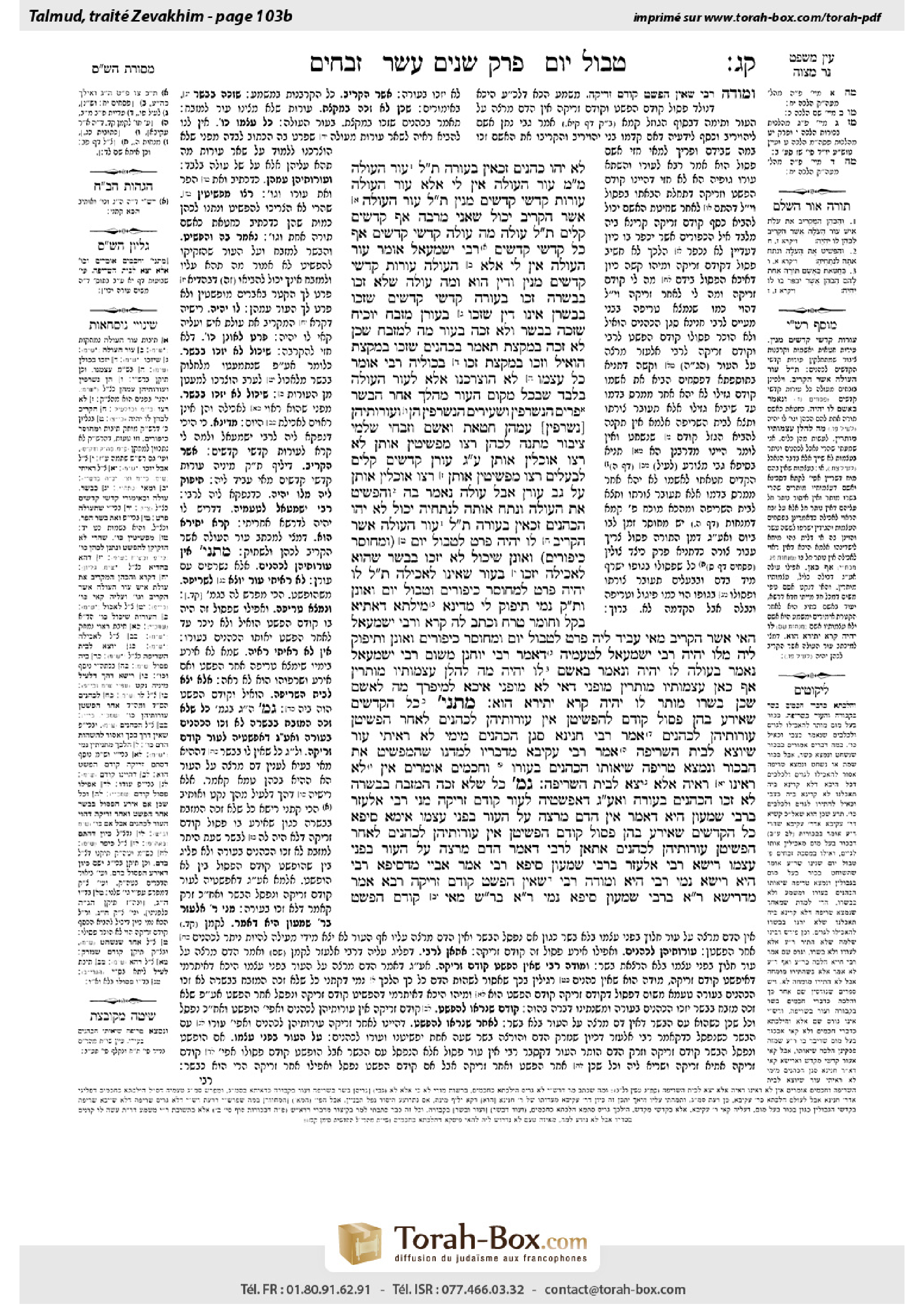
This page of Zevachim includes the Aramaic text, an English translation and an AI-generated French translation, alongside the scan above.
זבחים ק״ג ב · Aramaic and Hebrew text
לֹא יְהוּ כֹּהֲנִים זַכָּאִין בְּעוֹרָהּ? תַּלְמוּד לוֹמַר: ״עוֹר הָעֹלָה״ מִכׇּל מָקוֹם.
״עוֹר הָעֹלָה״ – אֵין לִי אֶלָּא עוֹר הָעוֹלָה, עוֹרוֹת קׇדְשֵׁי קָדָשִׁים מִנַּיִן? תַּלְמוּד לוֹמַר: ״עוֹר הָעֹלָה אֲשֶׁר הִקְרִיב״. יָכוֹל שֶׁאֲנִי מְרַבֶּה אַף קָדָשִׁים קַלִּים? תַּלְמוּד לוֹמַר ״עֹלָה״ – מָה עוֹלָה קׇדְשֵׁי קָדָשִׁים, אַף כֹּל קׇדְשֵׁי קָדָשִׁים.
רַבִּי יִשְׁמָעֵאל אוֹמֵר: ״עוֹר הָעֹלָה״ – אֵין לִי אֶלָּא הָעוֹלָה, עוֹרוֹת קׇדְשֵׁי קָדָשִׁים מִנַּיִן? וְדִין הוּא: וּמָה עוֹלָה, שֶׁלֹּא זָכוּ בִּבְשָׂרָהּ – זָכוּ בְּעוֹרָהּ; קׇדְשֵׁי קָדָשִׁים, שֶׁזָּכוּ בִּבְשָׂרָן – אֵינוֹ דִּין שֶׁזָּכוּ בְּעוֹרָן?!
מִזְבֵּחַ יוֹכִיחַ – שֶׁזָּכָה בְּבָשָׂר וְלֹא זָכָה בְּעוֹר! מָה לְמִזְבֵּחַ – שֶׁכֵּן לֹא זָכָה בְּמִקְצָת; תֹּאמַר בַּכֹּהֲנִים – שֶׁזָּכוּ בְּמִקְצָת?! הוֹאִיל וְזָכוּ בְּמִקְצָת, זָכוּ בְּכוּלֵּיהּ.
רַבִּי אוֹמֵר: כׇּל עַצְמוֹ לֹא הוּצְרַכְנוּ אֶלָּא לְעוֹר הָעוֹלָה בִּלְבַד. שֶׁבְּכׇל מָקוֹם הָעוֹר מְהַלֵּךְ אַחַר הַבָּשָׂר.
פָּרִים הַנִּשְׂרָפִין וּשְׂעִירִים הַנִּשְׂרָפִין – הֵן וְעוֹרוֹתֵיהֶן נִשְׂרָפִין עִמָּהֶן. חַטָּאת וְאָשָׁם וְזִבְחֵי שַׁלְמֵי צִיבּוּר – מַתָּנָה לַכֹּהֵן; רָצוּ – מַפְשִׁיטִין אוֹתָן, לֹא רָצוּ – אוֹכְלִין אוֹתָן עַל גַּבֵּי עוֹרָן. קָדָשִׁים קַלִּים – לַבְּעָלִים; רָצוּ – מַפְשִׁיטִין אוֹתָן, רָצוּ – אוֹכְלִין אוֹתָן עַל גַּב עוֹרָן.
אֲבָל עוֹלָה נֶאֱמַר בָהּ: ״וְהִפְשִׁיט אֶת הָעֹלָה וְנִתַּח אֹתָהּ לִנְתָחֶיהָ״. יָכוֹל לֹא יְהוּ הַכֹּהֲנִים זַכָּאִין בְּעוֹרָהּ? תַּלְמוּד לוֹמַר: ״עוֹר הָעֹלָה אֲשֶׁר הִקְרִיב״.
״לוֹ יִהְיֶה״ – פְּרָט לִטְבוּל יוֹם וּמְחוּסַּר כִּיפּוּרִים וְאוֹנֵן. שֶׁיָּכוֹל לֹא יִזְכּוּ בְּבָשָׂר – שֶׁהוּא לַאֲכִילָה, יִזְכּוּ בְּעוֹר – שֶׁאֵינוֹ לַאֲכִילָה; תַּלְמוּד לוֹמַר: ״לוֹ יִהְיֶה״ – פְּרָט לִמְחוּסַּר כִּיפּוּרִים וּטְבוּל יוֹם וְאוֹנֵן.
וְתַנָּא קַמָּא נָמֵי תִּיפּוֹק לִי מִדִּינָא! מִילְּתָא דְּאָתְיָא בְּקַל וְחוֹמֶר, טָרַח וְכָתַב לַהּ קְרָא.
וְרַבִּי יִשְׁמָעֵאל, הַאי ״אֲשֶׁר הִקְרִיב״ מַאי עָבֵיד לֵיהּ? פְּרָט לִטְבוּל יוֹם וּמְחוּסַּר כִּיפּוּרִים וְאוֹנֵן.
וְתִיפּוֹק לֵיהּ מִ״לוֹ יִהְיֶה״! רַבִּי יִשְׁמָעֵאל לְטַעְמֵיהּ, דְּאָמַר רַבִּי יוֹחָנָן מִשּׁוּם רַבִּי יִשְׁמָעֵאל: נֶאֱמַר בְּעוֹלֶה ״לוֹ יִהְיֶה״, וְנֶאֱמַר בְּאָשַׁם ״לוֹ יִהְיֶה״; מָה לְהַלָּן עַצְמוֹתָיו מוּתָּרִין, אַף כָּאן עַצְמוֹתָיו מוּתָּרִין.
מוּפְנֵי; דְּאִי לָא מוּפְנֵי, אִיכָּא לְמִיפְרַךְ: מָה לְאָשָׁם שֶׁכֵּן בְּשָׂרוֹ מוּתָּר לוֹ; ״יִהְיֶה״ – קְרָא יַתִּירָא הוּא.
מַתְנִי׳ כׇּל הַקֳּדָשִׁים שֶׁאֵירַע בָּהֶן פְּסוּל קוֹדֶם לְהֶפְשֵׁיטָן – אֵין עוֹרוֹתֵיהֶן לַכֹּהֲנִים. לְאַחַר הֶפְשֵׁיטָן – עוֹרוֹתֵיהֶן לְכֹהֲנִים. אָמַר רַבִּי חֲנִינָא סְגַן הַכֹּהֲנִים: מִיָּמַי לֹא רָאִיתִי עוֹר שֶׁיּוֹצֵא לְבֵית הַשְּׂרֵיפָה.
אָמַר רַבִּי עֲקִיבָא: מִדְּבָרָיו לָמַדְנוּ, שֶׁהַמַּפְשִׁיט אֶת הַבְּכוֹר וְנִמְצָא טְרֵיפָה – שֶׁיֵּאוֹתוּ הַכֹּהֲנִים בְּעוֹרוֹ. וַחֲכָמִים אוֹמְרִים: אֵין ״לֹא רָאִינוּ״ רְאָיָה, אֶלָּא יֵצֵא לְבֵית הַשְּׂרֵיפָה.
גְּמָ׳ כׇּל שֶׁלֹּא זָכָה הַמִּזְבֵּחַ בִּבְשָׂרָהּ – לֹא זָכוּ הַכֹּהֲנִים בְּעוֹרָהּ, וְאַף עַל גַּב דְּאַפְּשָׁטֵיהּ לְעוֹר קוֹדֶם זְרִיקָה. מַנִּי? רַבִּי אֶלְעָזָר בְּרַבִּי שִׁמְעוֹן הִיא, דְּאָמַר: אֵין הַדָּם מְרַצֶּה עַל הָעוֹר בִּפְנֵי עַצְמוֹ.
אֵימָא סֵיפָא: כׇּל הַקֳּדָשִׁים שֶׁאֵירַע בָּהֶן פְּסוּל קוֹדֶם הֶפְשֵׁיטָן – אֵין עוֹרוֹתֵיהֶן לְכֹהֲנִים. לְאַחַר הֶפְשֵׁיטָן – עוֹרוֹתֵיהֶן לְכֹהֲנִים. אֲתָאן לְרַבִּי, דְּאָמַר: ״הַדָּם מְרַצֶּה עַל הָעוֹר בִּפְנֵי עַצְמוֹ״. רֵישָׁא רַבִּי אֶלְעָזָר בְּרַבִּי שִׁמְעוֹן, סֵיפָא רַבִּי?!
אָמַר אַבָּיֵי: מִדְּסֵיפָא רַבִּי הִיא, רֵישָׁא נָמֵי רַבִּי הִיא; וּמוֹדֶה רַבִּי שֶׁאֵין הֶפְשֵׁט קוֹדֶם זְרִיקָה.
רָבָא אָמַר: מִדְּרֵישָׁא רַבִּי אֶלְעָזָר בְּרַבִּי שִׁמְעוֹן, סֵיפָא נָמֵי רַבִּי אֶלְעָזָר בְּרַבִּי שִׁמְעוֹן; מַאי קוֹדֶם הֶפְשֵׁט
Zevachim 103b · English translation
I might have thought that the priests have no right to its hide. Therefore, the verse states: “The hide of the burnt offering,” to teach that in any case where the offering is not disqualified, the priests acquire its hide, even if it did not satisfy the owner’s obligation.
And from the phrase “the hide of the burnt offering” I have derived only that the priests acquire the hide of the burnt offering. From where do I derive that they acquire the hides of all offerings of the most sacred order? The verse states: “The hide of the burnt offering which he has offered,” which serves to include any offering that the priests sacrifice. If so, one might have thought that I include even offerings of lesser sanctity. Therefore, the verse states: “Burnt offering,” and not simply: Offering, to teach that just as a burnt offering is an offering of the most sacred order, so too the priests acquire the hides only of all offerings of the most sacred order; they do not acquire the hides of offerings of lesser sanctity.
The baraita continues: Rabbi Yishmael says there is a different derivation. From the phrase “the hide of the burnt offering,” I have derived only that the priests acquire the hide of the burnt offering. From where is it derived that they acquire the hides of all offerings of the most sacred order? It is based on a logical inference: Just as in the case of a burnt offering, for which the priests do not acquire its meat, the priests nevertheless acquire its hide, then in the case of offerings of the most sacred order, for which the priests do acquire its meat, is it not logical that they acquire their hides?
One may counter: Let the altar prove that this is not a valid a fortiori inference, as it acquires the meat, and still it does not acquire the hide. One may respond: What is notable about the altar? It is notable in that it does not acquire hides in any instance. Will you say the halakha concerning the altar should teach the halakha concerning the priests, who acquire hides of some of the offerings, as the Torah explicitly grants them the hides of burnt offerings? Rather say: Since the priests acquire hides of some of the offerings, they acquire the hides of all offerings of the most sacred order.
Rabbi Yehuda HaNasi says: There is no need to derive that hides of offerings of the most sacred order go to the priests. We need the verse itself only to teach that this is the halakha with regard to the hide of the burnt offering. As the Torah does not generally require that an offering be flayed, in all other cases the hide of the offering follows the flesh of the offering.
For example, bulls that are burned and goats that are burned must be burned themselves, and their hides burned with them, as the Torah states explicitly (see Leviticus 4:11–12). A sin offering, and a guilt offering, and a communal peace offering are given as a gift to the priest (see Leviticus 7:7); if the priests want, they may flay them and use the hides, and if they do not want to use the hides, they may eat the offerings together with their hides. Offerings of lesser sanctity are given to the owners; if they want, they may flay them and use the hides, and if they want, they may eat the offerings together with their hides.
But with regard to a burnt offering it is stated: “And he shall flay the burnt offering, and cut it into its pieces” (Leviticus 1:6). One might have thought that, because all the flesh of the burnt offering is burned on the altar, the priests have no right to its hide. Therefore, the verse states: “The priest shall have to himself the hide of the burnt offering that he has sacrificed” (Leviticus 7:8).
The phrase “the priest shall have to himself” serves to exclude a priest who immersed that day and a priest who has not yet brought an atonement offering, and an acute mourner, i.e., meaning that they do not receive a share of the hides, just as they do not receive a share of the meat. As one might have thought that although these priests will not acquire the meat, this is because it is for consumption, and they are not permitted to partake of it; but they will acquire the hide, because it is not for consumption. Therefore, the verse states: “Shall have to himself,” to exclude a priest who has not yet brought an atonement offering, and a priest who immersed that day, and an acute mourner.
The Gemara asks: But let the first tanna also derive the halakha logically, as Rabbi Yishmael did. Why did he cite a verse? The Gemara answers: Often when there is a matter that can be derived through an a fortiori inference, the verse nevertheless takes the trouble and writes it explicitly.
And as for Rabbi Yishmael, what does he do with this phrase: “The hide of the burnt offering that he has sacrificed,” from which the first tanna derives the halakha? He holds that it serves to exclude a priest who immersed that day, and a priest who has not yet brought an atonement offering, and an acute mourner, who do not receive a share in the hides.
The Gemara challenges: But let Rabbi Yishmael derive this halakha from the phrase: “Shall have to himself,” as does Rabbi Yehuda HaNasi. The Gemara explains: Rabbi Yishmael conforms to his line of reasoning, that the phrase teaches a different halakha. As Rabbi Yoḥanan says in the name of Rabbi Yishmael: It is stated: “Shall have to himself” (Leviticus 7:8), with regard to a burnt offering, and it is stated: “The priest that makes atonement, he shall have to himself” (Leviticus 7:7), with regard to a guilt offering. The following verbal analogy is derived from here: Just as there, after the blood of a guilt offering is presented, its bones become permitted to the priest for any use, since only the portions intended for consumption on the altar are sacrificed whereas the rest of the animal is given to the priests, so too here, with regard to a burnt offering, its bones that are not attached to the flesh and are therefore not intended for the altar are permitted.
With regard to this verbal analogy the Gemara comments: It must be that those terms are free, i.e., superfluous in their context and therefore available for the purpose of establishing a verbal analogy. As, if they are not free, the verbal analogy can be refuted as follows: What is notable about a guilt offering? It is notable in that its meat is permitted to the priests, unlike the flesh of a burnt offering, which is burned upon the altar, and perhaps this is why the bones of a guilt offering are also permitted. Since the phrase: “Shall have it to himself,” is a superfluous term in each verse, the analogy stands, because a verbal analogy based on free terms cannot be refuted logically.
MISHNA: If any offerings of the most sacred order were disqualified prior to their flaying, their hides do not go to the priests; rather, they are burned together with the flesh in the place of burning. If they were disqualified after their flaying, their hides go to the priests. Rabbi Ḥanina, the deputy High Priest, said: In all my days, I never saw a hide going out to the place of burning.
Rabbi Akiva said: From the statement of Rabbi Ḥanina, the deputy High Priest, we learned that in a case where one flays the firstborn offering, and the animal is later discovered to have a wound that would have caused it to die within twelve months [tereifa], the halakha is that the priests may derive benefit [sheye’otu] from its hide. And the Rabbis say: The claim: We did not see, is no proof; rather, if after flaying it is discovered that the animal was unfit before it was flayed, the hide goes out to the place of burning.
GEMARA: The previous mishna (103a) teaches: In the case of any burnt offering for which the altar did not acquire its flesh, e.g., if it was disqualified prior to the sprinkling of its blood, the priests did not acquire its hide. The mishna does not state any qualification, indicating that this is the halakha even if the priest flayed the hide before the sprinkling of the blood on the altar. The Gemara posits: Whose opinion is this? It is the opinion of Rabbi Elazar, son of Rabbi Shimon, who says: The blood does not effect acceptance of the hide by itself; i.e., it effects acceptance of the hide only together with the flesh. Since the flesh is disqualified and the sprinkling does not effect its acceptance, the sprinkling does not effect acceptance for the hide either.
The Gemara challenges: Say the latter clause, i.e., the mishna here: If any offerings of the most sacred order were disqualified prior to their flaying, their hides do not go to the priests. If they were disqualified after their flaying, their hides go to the priests. This indicates that once the hides are flayed, they go to the priests even if the flesh was disqualified before the sprinkling of the blood. If so, we arrive at the opinion of Rabbi Yehuda HaNasi, who says: The blood effects acceptance of the hide, i.e., renders the hide permitted to the priests, by itself. Can it be that the former clause of the mishna is in accordance with the opinion of Rabbi Elazar, son of Rabbi Shimon, and the latter clause is in accordance with the opinion of Rabbi Yehuda HaNasi?
Abaye said: Since the latter clause is the opinion of Rabbi Yehuda HaNasi, it must be that the former clause is also the opinion of Rabbi Yehuda HaNasi. And although Rabbi Yehuda HaNasi holds that in principle the priests should acquire the hides if they are removed before the flesh is disqualified, in any case Rabbi Yehuda HaNasi concedes that the flaying is not done before the sprinkling. Since the offering cannot be disqualified before the hide is removed, practically speaking, the priests will never acquire the hides unless the altar acquires the flesh, as taught in the former clause.
Rava said: On the contrary, since the former clause is the opinion of Rabbi Elazar, son of Rabbi Shimon, it must be that the latter clause is also the opinion of Rabbi Elazar, son of Rabbi Shimon. When the mishna states that the priests acquire the hides if the flesh was disqualified after the flaying, it must mean that the flesh was disqualified after the sprinkling. Therefore, what does the mishna mean by the phrase: Before flaying,
Zevachim 103b · Traduction française (IA)
J’aurais pu penser que les prêtres n’ont aucun droit sur sa peau. C’est pourquoi le verset dit : « La peau de l’holocauste », pour enseigner que, dans tous les cas où l’offrande n’est pas disqualifiée, les prêtres acquièrent sa peau, même si elle n’a pas acquitté l’obligation du propriétaire.
De l’expression « la peau de l’holocauste », j’ai seulement déduit que les prêtres acquièrent la peau de l’holocauste. D’où déduis-je qu’ils acquièrent les peaux de toutes les offrandes de sainteté suprême ? Le verset dit : « La peau de l’holocauste qu’il a offert », ce qui inclut toute offrande que les prêtres sacrifient. On aurait alors pu penser que cela inclut même les offrandes de moindre sainteté. C’est pourquoi le verset dit « holocauste », et non simplement « offrande », pour enseigner que, de même qu’un holocauste est une offrande de sainteté suprême, les prêtres n’acquièrent les peaux que des offrandes de sainteté suprême ; ils n’acquièrent pas celles des offrandes de moindre sainteté.
La baraïta poursuit : Rabbi Yishmael dit qu’il existe une autre déduction. De l’expression « la peau de l’holocauste », j’ai seulement déduit que les prêtres acquièrent la peau de l’holocauste. D’où déduit-on qu’ils acquièrent les peaux de toutes les offrandes de sainteté suprême ? On le déduit par raisonnement logique : de même que, dans le cas d’un holocauste, dont les prêtres n’acquièrent pas la viande, ils acquièrent néanmoins la peau, à plus forte raison, dans le cas des offrandes de sainteté suprême, dont les prêtres acquièrent la viande, acquièrent-ils leurs peaux.
On peut objecter : que l’autel serve à prouver que cette déduction a fortiori n’est pas valable : il acquiert la viande et, pourtant, n’acquiert pas la peau. On peut répondre : qu’est-ce qui caractérise l’autel ? Le fait qu’il n’acquiert jamais de peaux. Peut-on prétendre que la halakha concernant l’autel enseigne celle qui concerne les prêtres, lesquels acquièrent les peaux de certaines offrandes, puisque la Torah leur attribue explicitement les peaux des holocaustes ? Il faut plutôt dire que, puisque les prêtres acquièrent les peaux de certaines offrandes, ils acquièrent les peaux de toutes les offrandes de sainteté suprême.
Rabbi Yehuda HaNasi dit : il n’est pas nécessaire de déduire que les peaux des offrandes de sainteté suprême reviennent aux prêtres. Le verset lui-même est nécessaire uniquement pour enseigner que telle est la halakha concernant la peau de l’holocauste. En effet, comme la Torah n’exige généralement pas que l’on dépouille une offrande, dans tous les autres cas, la peau de l’offrande revient avec sa chair.
Par exemple, les taureaux et les boucs destinés à être brûlés doivent être brûlés eux-mêmes, et leurs peaux doivent l’être avec eux, comme la Torah le dit explicitement (voir Lévitique 4:11–12). Un sacrifice expiatoire, un sacrifice de culpabilité et une offrande de paix communautaire sont remis au prêtre (voir Lévitique 7:7) ; si les prêtres le souhaitent, ils peuvent les dépouiller et utiliser les peaux ; s’ils ne souhaitent pas les utiliser, ils peuvent manger les offrandes avec leurs peaux. Les offrandes de moindre sainteté sont remises à leurs propriétaires ; s’ils le souhaitent, ils peuvent les dépouiller et utiliser les peaux, ou manger les offrandes avec leurs peaux.
Mais au sujet de l’holocauste, il est dit : « Il dépouillera l’holocauste et le découpera en morceaux » (Lévitique 1:6). On aurait pu penser que, puisque toute la chair de l’holocauste est brûlée sur l’autel, les prêtres n’ont aucun droit sur sa peau. C’est pourquoi le verset dit : « Le prêtre aura pour lui la peau de l’holocauste qu’il a offert » (Lévitique 7:8).
L’expression « le prêtre aura pour lui » exclut le prêtre qui s’est immergé ce jour-là, celui qui n’a pas encore apporté son sacrifice expiatoire et l’endeuillé en période aiguë : ils ne reçoivent aucune part des peaux, tout comme ils ne reçoivent aucune part de la viande. On aurait pu penser que, même si ces prêtres n’acquièrent pas la viande parce qu’elle est destinée à la consommation et qu’ils n’ont pas le droit d’en manger, ils acquièrent néanmoins la peau, puisqu’elle n’est pas destinée à la consommation. C’est pourquoi le verset dit : « aura pour lui », pour exclure le prêtre qui n’a pas encore apporté son sacrifice expiatoire, celui qui s’est immergé ce jour-là et l’endeuillé en période aiguë.
La Guemara demande : Le premier tanna ne pourrait-il pas, lui aussi, déduire la halakha par raisonnement logique, comme Rabbi Yishmael ? Pourquoi a-t-il cité un verset ? La Guemara répond : souvent, lorsqu’une règle peut être déduite par une inférence a fortiori, le verset prend néanmoins la peine de l’énoncer explicitement.
Et que fait Rabbi Yishmael de l’expression « la peau de l’holocauste qu’il a offert », dont le premier tanna déduit la halakha ? Selon lui, elle sert à exclure le prêtre qui s’est immergé ce jour-là, celui qui n’a pas encore apporté son sacrifice expiatoire et l’endeuillé en période aiguë, qui ne reçoivent aucune part des peaux.
La Guemara objecte : Rabbi Yishmael ne pourrait-il pas déduire cette halakha de l’expression « aura pour lui », comme Rabbi Yehuda HaNasi ? La Guemara explique : Rabbi Yishmael reste fidèle à son raisonnement, selon lequel cette expression enseigne une autre halakha. En effet, Rabbi Yoḥanan dit au nom de Rabbi Yishmael : L’expression « aura pour lui » est employée à propos de l’holocauste (Lévitique 7:8), et l’expression « le prêtre qui fait expiation l’aura pour lui » est employée à propos du sacrifice de culpabilité (Lévitique 7:7). On établit ici une analogie verbale : de même que là, après que le sang du sacrifice de culpabilité a été présenté, ses os deviennent permis au prêtre pour tout usage, puisque seules les parties destinées à être brûlées sur l’autel sont offertes, tandis que le reste de l’animal est remis aux prêtres, de même ici, dans le cas de l’holocauste, les os qui ne sont pas attachés à la chair et ne sont donc pas destinés à l’autel sont permis.
À propos de cette analogie verbale, la Guemara fait remarquer que ces expressions doivent être disponibles, c’est-à-dire superflues dans leur contexte et donc utilisables pour établir une analogie verbale. Si elles ne sont pas disponibles, on peut réfuter l’analogie ainsi : qu’est-ce qui caractérise le sacrifice de culpabilité ? Le fait que sa viande soit permise aux prêtres, contrairement à la chair de l’holocauste, qui est brûlée sur l’autel ; peut-être est-ce pour cette raison que les os du sacrifice de culpabilité sont eux aussi permis. Puisque l’expression « l’aura pour lui » est superflue dans chacun des versets, l’analogie tient : une analogie verbale fondée sur des expressions disponibles ne peut pas être réfutée par un raisonnement logique.
MICHNA : Si des offrandes de sainteté suprême sont disqualifiées avant d’être dépouillées, leurs peaux ne reviennent pas aux prêtres ; elles sont brûlées avec la chair au lieu de l’incinération. Si elles sont disqualifiées après avoir été dépouillées, leurs peaux reviennent aux prêtres. Rabbi Ḥanina, le vice-grand prêtre, dit : De toute ma vie, je n’ai jamais vu une peau être emportée au lieu de l’incinération.
Rabbi Akiva dit : De la déclaration de Rabbi Ḥanina, le vice-grand prêtre, nous avons appris que, si l’on dépouille le premier-né et que l’on découvre ensuite que l’animal avait une blessure qui l’aurait fait mourir dans les douze mois [tereifa], les prêtres peuvent tirer profit [sheye’otu] de sa peau. Les Sages disent : L’affirmation « nous n’avons pas vu » ne constitue pas une preuve ; au contraire, si l’on découvre après l’avoir dépouillé que l’animal était impropre avant d’être dépouillé, la peau est emportée au lieu de l’incinération.
GUEMARA : La Michna précédente (103a) enseigne que, dans le cas de tout holocauste dont l’autel n’a pas acquis la chair — par exemple, s’il a été disqualifié avant l’aspersion de son sang —, les prêtres n’ont pas acquis sa peau. La Michna ne précise aucune réserve, ce qui indique que telle est la halakha même si le prêtre a dépouillé la peau avant l’aspersion du sang sur l’autel. La Guemara avance : de qui est-ce l’opinion ? C’est celle de Rabbi Elazar, fils de Rabbi Shimon, qui dit que le sang n’opère pas à lui seul l’acceptation de la peau, c’est-à-dire qu’il ne l’opère qu’avec la chair. Puisque la chair est disqualifiée et que l’aspersion n’opère pas son acceptation, elle n’opère pas non plus l’acceptation de la peau.
La Guemara objecte : considérons la dernière clause, c’est-à-dire la Michna ici : si des offrandes de sainteté suprême sont disqualifiées avant d’être dépouillées, leurs peaux ne reviennent pas aux prêtres ; si elles sont disqualifiées après avoir été dépouillées, leurs peaux reviennent aux prêtres. Cela indique qu’une fois les peaux retirées, elles reviennent aux prêtres même si la chair a été disqualifiée avant l’aspersion du sang. Nous arrivons donc à l’opinion de Rabbi Yehuda HaNasi, qui dit que le sang opère à lui seul l’acceptation de la peau, c’est-à-dire la rend permise aux prêtres. Se peut-il que la première clause de la Michna suive l’opinion de Rabbi Elazar, fils de Rabbi Shimon, et la dernière clause celle de Rabbi Yehuda HaNasi ?
Abaye dit : puisque la dernière clause exprime l’opinion de Rabbi Yehuda HaNasi, la première clause doit également l’exprimer. Bien que Rabbi Yehuda HaNasi estime qu’en principe les prêtres devraient acquérir les peaux si elles sont retirées avant que la chair soit disqualifiée, il reconnaît néanmoins que le dépouillement n’a pas lieu avant l’aspersion. Puisque l’offrande ne peut pas être disqualifiée avant que la peau soit retirée, en pratique, les prêtres n’acquerront jamais les peaux à moins que l’autel n’acquière la chair, comme l’enseigne la première clause.
Rava dit : au contraire, puisque la première clause exprime l’opinion de Rabbi Elazar, fils de Rabbi Shimon, la dernière clause doit également exprimer son opinion. Lorsque la Michna dit que les prêtres acquièrent les peaux si la chair a été disqualifiée après le dépouillement, cela signifie que la chair a été disqualifiée après l’aspersion. Dès lors, que signifie dans la Michna l’expression « avant le dépouillement » ?
Traduction française générée par IA à partir de l’édition anglaise de Sefaria. Vérifie toujours un passage avec le texte source.
Text from Sefaria: William Davidson Edition - Vocalized Aramaic (CC BY NC); William Davidson Edition - English (CC BY NC).