Zevachim 104a: Talmud study for Daf Yomi
Daf Yomi is the daily study of one Talmud folio. Explore 37 tractates with scans, Hebrew text, Sefaria English and AI-generated French translations where annotated.
Passage selection and English or AI-generated French translation are available where the scan has annotations. Daf Study is independent of Torah-Box and Sefaria.
Browse Zevachim · זבחים · All tractatesZevachim 104a text and translations
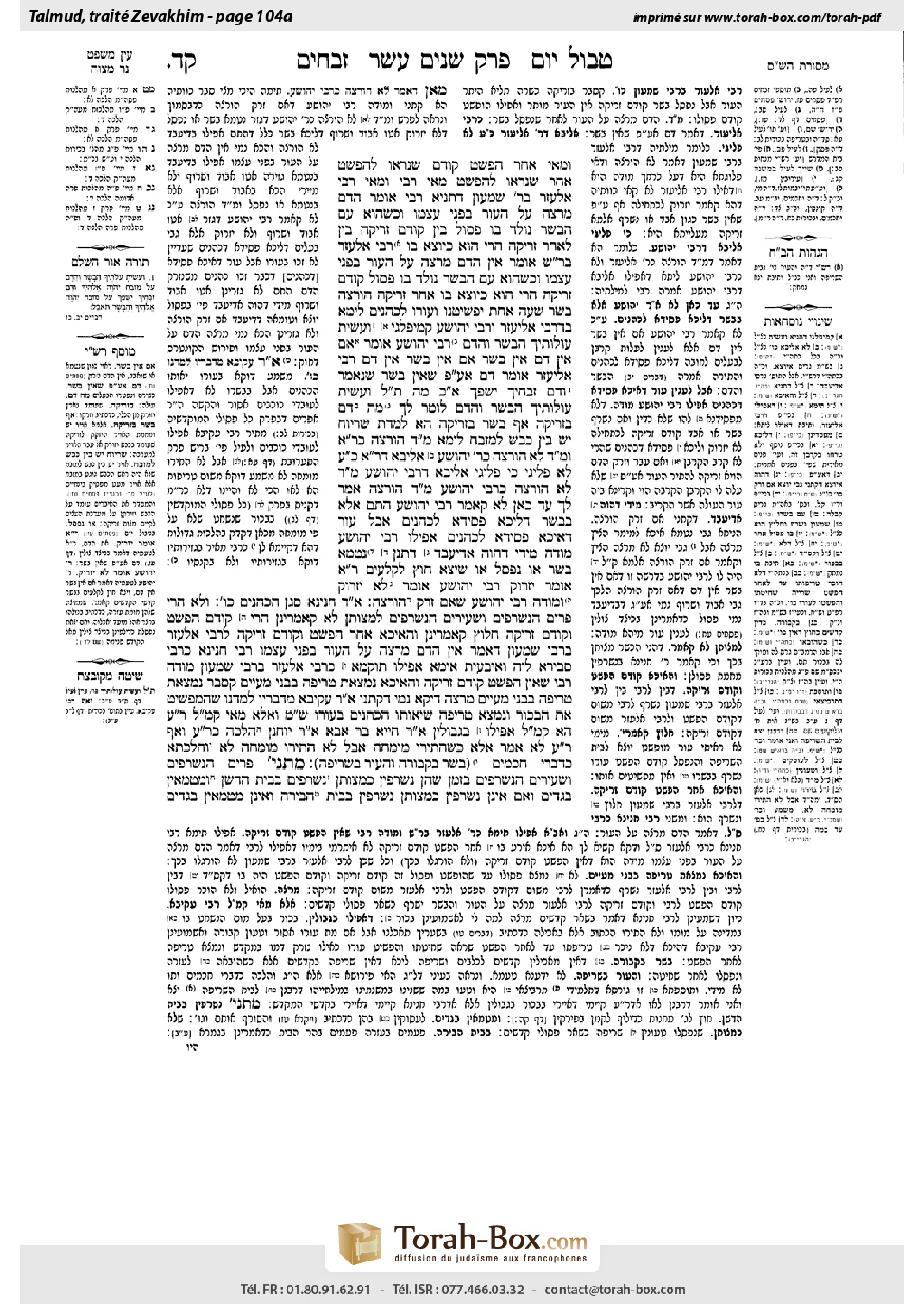
This page of Zevachim includes the Aramaic text, an English translation and an AI-generated French translation, alongside the scan above.
זבחים ק״ד א · Aramaic and Hebrew text
וּמַאי אַחֵר הֶפְשֵׁט – קוֹדֶם שֶׁנִּרְאוּ לְהֶפְשֵׁט, אַחַר שֶׁנִּרְאוּ לְהֶפְשֵׁט.
מַאי רַבִּי וּמַאי רַבִּי אֶלְעָזָר בְּרַבִּי שִׁמְעוֹן? דְּתַנְיָא, רַבִּי אוֹמֵר: הַדָּם מְרַצֶּה עַל הָעוֹר בִּפְנֵי עַצְמוֹ. וּכְשֶׁהוּא עִם הַבָּשָׂר, נוֹלַד בּוֹ פְּסוּל בֵּין קוֹדֶם זְרִיקָה בֵּין לְאַחַר זְרִיקָה – הֲרֵי הוּא כְּיוֹצֵא בּוֹ.
רַבִּי אֶלְעָזָר בְּרַבִּי שִׁמְעוֹן אוֹמֵר: אֵין הַדָּם מְרַצֶּה עַל הָעוֹר בִּפְנֵי עַצְמוֹ. וּכְשֶׁהוּא עִם הַבָּשָׂר – נוֹלַד בּוֹ פְּסוּל קוֹדֶם זְרִיקָה, הֲרֵי הוּא כְּיוֹצֵא בּוֹ. אַחַר זְרִיקָה, הוּרְצָה בָּשָׂר שָׁעָה אַחַת; יַפְשִׁיטֶנּוּ, וְעוֹרוֹ לַכֹּהֲנִים.
לֵימָא בִּדְרַבִּי אֱלִיעֶזֶר וְרַבִּי יְהוֹשֻׁעַ קָמִיפַּלְגִי? ״וְעָשִׂיתָ עֹלֹתֶיךָ הַבָּשָׂר וְהַדָּם״ – רַבִּי יְהוֹשֻׁעַ אוֹמֵר: אִם אֵין דָּם אֵין בָּשָׂר, אִם אֵין בָּשָׂר אֵין דָּם.
רַבִּי אֱלִיעֶזֶר אוֹמֵר: דָּם – אַף עַל פִּי שֶׁאֵין בָּשָׂר, שֶׁנֶּאֱמַר: ״וְדַם זְבָחֶיךָ יִשָּׁפֵךְ״. אִם כֵּן, מָה תַּלְמוּד לוֹמַר: ״וְעָשִׂיתָ עֹלֹתֶיךָ הַבָּשָׂר וְהַדָּם״? לוֹמַר לְךָ: מָה דָּם בִּזְרִיקָה, אַף בָּשָׂר בִּזְרִיקָה. הָא לָמַדְתָּ שֶׁרֶיוַח יֵשׁ בֵּין כֶּבֶשׁ לַמִּזְבֵּחַ.
לֵימָא מַאן דְּאָמַר הוּרְצָה – כְּרַבִּי אֱלִיעֶזֶר, וּמַאן דְּאָמַר לֹא הוּרְצָה – כְּרַבִּי יְהוֹשֻׁעַ?
אַלִּיבָּא דְּרַבִּי אֱלִיעֶזֶר – כּוּלֵּי עָלְמָא לָא פְּלִיגִי; כִּי פְּלִיגִי אַלִּיבָּא דְּרַבִּי יְהוֹשֻׁעַ.
מַאן דְּאָמַר לֹא הוּרְצָה – כְּרַבִּי יְהוֹשֻׁעַ. מַאן דְּאָמַר הוּרְצָה אָמַר לָךְ: עַד כָּאן לָא קָאָמַר רַבִּי יְהוֹשֻׁעַ הָתָם – אֶלָּא בְּבָשָׂר, דְּלֵיכָּא פְּסֵידָא לַכֹּהֲנִים; אֲבָל עוֹר, דְּאִיכָּא פְּסֵידָא לַכֹּהֲנִים – אֲפִילּוּ רַבִּי יְהוֹשֻׁעַ מוֹדֶה.
מִידֵי דְּהָוֵה אַדִּיעֲבַד; דִּתְנַן: נִטְמָא בָּשָׂר אוֹ נִפְסַל, אוֹ שֶׁיָּצָא חוּץ לַקְּלָעִים – רַבִּי אֱלִיעֶזֶר אוֹמֵר יִזְרוֹק, רַבִּי יְהוֹשֻׁעַ אוֹמֵר לֹא יִזְרוֹק. וּמוֹדֶה רַבִּי יְהוֹשֻׁעַ שֶׁאִם זָרַק – הוּרְצָה.
אָמַר רַבִּי חֲנִינָא סְגַן הַכֹּהֲנִים כּוּ׳. וְלֹא?! הֲרֵי פָּרִים הַנִּשְׂרָפִים וּשְׂעִירִים הַנִּשְׂרָפִים!
לְמִצְוָתָן לָא קָאָמְרִינַן.
הֲרֵי קוֹדֶם הֶפְשֵׁט וְקוֹדֶם זְרִיקָה! חָלוּץ קָאָמְרִינַן.
וְהָאִיכָּא אַחַר הֶפְשֵׁט וְקוֹדֶם זְרִיקָה לְרַבִּי אֶלְעָזָר בְּרַבִּי שִׁמְעוֹן, דְּאָמַר: אֵין הַדָּם מְרַצֶּה עַל הָעוֹר בִּפְנֵי עַצְמוֹ!
רַבִּי חֲנִינָא כְּרַבִּי סְבִירָא לֵיהּ. וְאִיבָּעֵית אֵימָא: אֲפִילּוּ תּוֹקְמַהּ כְּרַבִּי אֶלְעָזָר בְּרַבִּי שִׁמְעוֹן – מוֹדֶה רַבִּי שֶׁאֵין הֶפְשֵׁט קוֹדֶם זְרִיקָה.
וְהָאִיכָּא נִמְצֵאת טְרֵיפָה בִּבְנֵי מֵעַיִים!
קָסָבַר: נִמְצֵאת טְרֵיפָה בִּבְנֵי מֵעַיִים – מְרַצֶּה. דַּיְקָא נָמֵי – דְּקָתָנֵי, אָמַר רַבִּי עֲקִיבָא: מִדְּבָרָיו לָמַדְנוּ, שֶׁהַמַּפְשִׁיט אֶת הַבְּכוֹר וְנִמְצָא טְרֵיפָה – שֶׁיֵּאוֹתוּ הַכֹּהֲנִים בְּעוֹרוֹ! שְׁמַע מִינַּהּ.
וְאֶלָּא מַאי קָא מַשְׁמַע לַן רַבִּי עֲקִיבָא? הָא קָא מַשְׁמַע לַן: אֲפִילּוּ בִּגְבוּלִין.
אָמַר רַבִּי חִיָּיא בַּר אַבָּא אָמַר רַבִּי יוֹחָנָן: הֲלָכָה כְּרַבִּי עֲקִיבָא. וְאַף רַבִּי עֲקִיבָא לֹא אָמַר אֶלָּא כְּשֶׁהִתִּירוֹ מוּמְחֶה, אֲבָל לֹא הִתִּירוֹ מוּמְחֶה – לֹא.
וְהִלְכְתָא כְּדִבְרֵי חֲכָמִים; בָּשָׂר בִּקְבוּרָה, וְהָעוֹר בִּשְׂרֵיפָה.
מַתְנִי׳ פָּרִים הַנִּשְׂרָפִים וּשְׂעִירִים הַנִּשְׂרָפִים, בִּזְמַן שֶׁהֵן נִשְׂרָפִין כְּמִצְוָתָן – נִשְׂרָפִים בְּבֵית הַדֶּשֶׁן וּמְטַמְּאִין בְּגָדִים, וְאִם אֵינָן נִשְׂרָפִין כְּמִצְוָתָן – נִשְׂרָפִין בְּבֵית הַבִּירָה וְאֵינָן מְטַמְּאִין בְּגָדִים.
Zevachim 104a · English translation
and what does it mean by the phrase: After flaying? It means before the moment the offerings became fit for flaying, and after the moment they became fit for flaying, i.e., before and after the sprinkling of the blood.
The Gemara clarifies: What is the opinion of Rabbi Yehuda HaNasi, and what is the opinion of Rabbi Elazar, son of Rabbi Shimon? Their opinions are as it is taught in a baraita: Rabbi Yehuda HaNasi says: The blood effects acceptance of the hide by itself, after it has been flayed, even if the flesh is disqualified. And if, when the hide is still with the flesh, a disqualification appears on the flesh, whether before the sprinkling of the blood or after the sprinkling of the blood, then the halakha with regard to the hide is parallel to the halakha with regard to the flesh: Both are burned.
Rabbi Elazar, son of Rabbi Shimon, says: The blood does not effect acceptance of the hide by itself. And if, when the hide is still with the flesh, a disqualification appears on the flesh before the sprinkling of the blood, then the halakha with regard to the hide is parallel to the halakha with regard to the flesh: Both are burned. If a disqualification develops on the flesh after the sprinkling of the blood, the flesh was already accepted for a time. Therefore, even though the flesh is disqualified, the priest may flay the animal before it is burned, and its hide goes to the priests.
The Gemara suggests: Shall we say that Rabbi Yehuda HaNasi and Rabbi Elazar disagree about the same principle as do Rabbi Eliezer and Rabbi Yehoshua? As it is taught in a baraita: The verse states: “And you shall offer your burnt offerings, the flesh and the blood, upon the altar of the Lord your God” (Deuteronomy 12:27). Rabbi Yehoshua says: The verse teaches that if there is no blood sprinkled on the altar, no flesh may be burned on the altar, and if there is no flesh to be burned on the altar, no blood may be sprinkled on the altar.
Rabbi Eliezer says: The blood must be sprinkled even if there is no flesh, as it is stated in the continuation of the verse: “And the blood of your sacrifices shall be poured out against the altar of the Lord your God, and you shall eat the flesh.” If so, what is taught when the verse states: “And you shall offer your burnt offerings, the flesh and the blood”? It is stated to tell you: Just as blood is placed on the altar by sprinkling, so too, the flesh is placed on the altar by tossing. Consequently, you learn that there is a space between the ramp and the altar, such that the priest must toss the flesh from the edge of the ramp.
The Gemara explains: Shall we say that the one who says that the hide is accepted independent of the flesh holds in accordance with the opinion of Rabbi Eliezer, that the blood is sprinkled independent of the flesh, and the one who says that the hide is not accepted independent of the flesh holds in accordance with the opinion of Rabbi Yehoshua, that if there is no flesh then the blood is not sprinkled?
The Gemara rejects this: According to the opinion of Rabbi Eliezer, who holds that the blood may be sprinkled even if the flesh is disqualified, everyone agrees that this sprinkling effects acceptance of the hide. When they disagree, it is according to the opinion of Rabbi Yehoshua.
The one who says that the hide is not accepted independently, i.e., Rabbi Elazar, son of Rabbi Shimon, holds in accordance with the straightforward meaning of the statement of Rabbi Yehoshua; once the flesh is disqualified, the blood cannot be sprinkled and does not effect acceptance of the hide. The one who says that the hide is accepted, i.e., Rabbi Yehuda HaNasi, could say to you: Rabbi Yehoshua says only there that the blood may not be sprinkled in a case where nothing but the flesh was at stake, where there is no loss for the priests, who never receive meat from burnt offerings. But in cases where the hide would go to waste, where there is a loss for the priests, perhaps even Rabbi Yehoshua concedes that the blood effects acceptance.
This latter interpretation of Rabbi Yehoshua’s opinion with regard to the hides is just as it is with regard to disqualified flesh after the fact. As we learned in a baraita: If the flesh contracted ritual impurity or was disqualified, or if it emerged beyond the curtains delineating its designated area, Rabbi Eliezer says: The priest must nevertheless sprinkle the blood on the altar. Rabbi Yehoshua says: The priest may not sprinkle the blood on the altar. And Rabbi Yehoshua concedes that if the priest nevertheless sprinkled the blood, the offering is accepted after the fact. Apparently, the sprinkling is sufficiently valid to effect acceptance of the hide.
§ The mishna teaches: Rabbi Ḥanina, the deputy High Priest, said: In all my days, I never saw a hide going out to the place of burning. The Gemara challenges: And is it so that he did not see? Aren’t there bulls that are burned and goats that are burned together with their hides as a matter of course?
The Gemara answers: We are not saying that Rabbi Ḥanina never saw hides go out to be burned in accordance with their mitzva; he certainly did. Rather, he never saw hides being burned because the offering was disqualified.
The Gemara challenges: But isn’t there a case where an offering is disqualified before flaying and before the sprinkling of the blood, in which case all agree that the animal is burned with its hide? The Gemara answers: We are saying that Rabbi Ḥanina never saw a hide go out stripped from its flesh.
The Gemara challenges: But isn’t there a case where an offering is disqualified after the flaying of the hide and before the sprinkling of the blood, in which case the hide is burned according to the opinion of Rabbi Elazar, son of Rabbi Shimon, who says: The blood does not effect acceptance of the hide by itself?
The Gemara answers: Rabbi Ḥanina holds in accordance with the opinion of Rabbi Yehuda HaNasi, that the blood does effect acceptance of the hide in such a case, and so it would not be burned. And if you wish, say instead that you can even interpret the opinion of Rabbi Ḥanina in accordance with the opinion of Rabbi Elazar, son of Rabbi Shimon, as Rabbi Yehuda HaNasi concedes that the flaying is not done before the sprinkling, and so in practice Rabbi Ḥanina never saw a hide that was flayed before the offering was disqualified.
The Gemara challenges: But isn’t there the case of an animal that, after the hide was flayed and the blood was sprinkled, was found to have a wound in its intestines rendering it a tereifa, in which case the offering was already disqualified when the blood was sprinkled?
The Gemara answers: Rabbi Ḥanina holds that in the case of an animal that was found to be a tereifa due to a wound in its intestines, the sprinkling of the blood nevertheless effects acceptance, because the wound was unknown at the time of the sprinkling. The language of the mishna is also precise, as it teaches: Rabbi Akiva said: From the statement of Rabbi Ḥanina, the deputy High Priest, we learned that in a case where one flays the firstborn offering, and the animal is later discovered to be a tereifa, the halakha is that the priests may derive benefit from its hide. This indicates that the sprinkling of the blood effects acceptance if the wound was unknown. The Gemara affirms: Indeed, learn from the mishna that this is so.
The Gemara challenges: But if this is what Rabbi Ḥanina meant, then what is Rabbi Akiva teaching us? His statement seems unnecessary. The Gemara answers: This is what Rabbi Akiva is teaching us: This halakha applies not just in the Temple but even in the outlying areas, e.g., with regard to a blemished firstborn animal, which is slaughtered outside the Temple. If it is discovered to be a tereifa before its slaughter, it must be buried with its hide, but if it is slaughtered and later discovered to be a tereifa, then its slaughter renders the hide permitted to the priests, just as the sprinkling of the blood renders the hide permitted in the Temple.
Rabbi Ḥiyya bar Abba says that Rabbi Yoḥanan says: The halakha is in accordance with the opinion of Rabbi Akiva. The Gemara adds: And even Rabbi Akiva said this halakha only in a case where an expert verified the firstborn animal’s blemish and permitted it to be slaughtered. But if an expert did not permit it, then its slaughter does not render the hide permitted to the priest.
The Gemara concludes: And the halakha is in accordance with the statement of the Rabbis, not Rabbi Akiva. Therefore, the flesh is discarded by burial and the hide by burning.
MISHNA: With regard to bulls that are burned, i.e., the bull of Yom Kippur, the bull of the anointed priest, and the bull brought for an unwitting communal sin, which are burned after their blood is sprinkled and their sacrificial portions burned on the altar, and goats that are burned, i.e., the goat of Yom Kippur and the goat brought for the unwitting communal transgression of the prohibition against idol worship, when they are burned in accordance with their mitzva, they are burned in the place of the ashes (see Leviticus 4:12) outside of Jerusalem, and they render the garments of the priests who tend to their burning impure (see Leviticus 4:25). And if these offerings are not burned in accordance with their mitzva because they were disqualified, and offerings that are disqualified are also burned, they are burned in the place of burning in the bira, and they do not render the garments of the priests who tend to their burning impure.
Zevachim 104a · Traduction française (IA)
Et que signifie l’expression « après le dépouillement » ? Elle désigne le moment précédant celui où les offrandes étaient aptes à être dépouillées, puis celui qui le suit, c’est-à-dire avant et après l’aspersion du sang.
La Guemara précise : Quelle est l’opinion de Rabbi Yehuda HaNassi, et quelle est celle de Rabbi Elazar, fils de Rabbi Shimon ? Leurs opinions sont celles qui sont enseignées dans une baraïta : Rabbi Yehuda HaNassi dit : Le sang fait à lui seul agréer la peau, une fois celle-ci dépouillée, même si la chair est disqualifiée. Mais si, alors que la peau est encore attachée à la chair, une disqualification atteint celle-ci, que ce soit avant ou après l’aspersion du sang, la halakha concernant la peau est la même que celle concernant la chair : toutes deux sont brûlées.
Rabbi Elazar, fils de Rabbi Shimon, dit : Le sang ne fait pas à lui seul agréer la peau. Si, alors que la peau est encore attachée à la chair, celle-ci est disqualifiée avant l’aspersion du sang, la halakha concernant la peau est la même que celle concernant la chair : toutes deux sont brûlées. Si la chair est disqualifiée après l’aspersion du sang, elle a déjà été agréée pendant un certain temps. Par conséquent, même si la chair est disqualifiée, le prêtre peut dépouiller l’animal avant qu’il soit brûlé, et sa peau revient aux prêtres.
La Guemara suggère : Peut-on dire que Rabbi Yehuda HaNassi et Rabbi Elazar sont en désaccord sur le même principe que Rabbi Eliezer et Rabbi Yehoshua ? Car il est enseigné dans une baraïta : Le verset dit : « Vous présenterez vos holocaustes, la chair et le sang, sur l’autel de l’Éternel votre Dieu » (Deutéronome 12, 27). Rabbi Yehoshua dit : Le verset enseigne que s’il n’y a pas de sang aspergé sur l’autel, aucune chair ne peut y être brûlée ; et que s’il n’y a pas de chair à brûler sur l’autel, aucun sang ne peut y être aspergé.
Rabbi Eliezer dit : Le sang doit être aspergé même s’il n’y a pas de chair, comme il est dit dans la suite du verset : « Le sang de tes sacrifices sera répandu contre l’autel de l’Éternel ton Dieu, et tu mangeras la chair. » Si tel est le cas, que nous enseigne le verset lorsqu’il dit : « Vous présenterez vos holocaustes, la chair et le sang » ? Il vient t’apprendre que, de même que le sang est placé sur l’autel par aspersion, la chair y est placée en la lançant. On en déduit donc qu’il y a un espace entre la rampe et l’autel, de sorte que le prêtre doit lancer la chair depuis le bord de la rampe.
La Guemara explique : Peut-on dire que celui qui affirme que la peau est agréée indépendamment de la chair soutient l’opinion de Rabbi Eliezer, selon laquelle le sang est aspergé indépendamment de la chair, et que celui qui affirme que la peau n’est pas agréée indépendamment de la chair soutient l’opinion de Rabbi Yehoshua, selon laquelle, s’il n’y a pas de chair, le sang n’est pas aspergé ?
La Guemara rejette cette proposition : Selon l’opinion de Rabbi Eliezer, qui soutient que le sang peut être aspergé même si la chair est disqualifiée, tous conviennent que cette aspersion fait agréer la peau. Leur désaccord porte sur l’opinion de Rabbi Yehoshua.
Celui qui affirme que la peau n’est pas agréée indépendamment de la chair, c’est-à-dire Rabbi Elazar, fils de Rabbi Shimon, s’en tient au sens direct de la déclaration de Rabbi Yehoshua : dès lors que la chair est disqualifiée, le sang ne peut pas être aspergé et ne fait pas agréer la peau. Celui qui affirme que la peau est agréée, c’est-à-dire Rabbi Yehuda HaNassi, pourrait te répondre : Rabbi Yehoshua dit seulement, dans ce cas, que le sang ne peut pas être aspergé lorsque seule la chair est en jeu, car les prêtres ne subissent aucune perte, eux qui ne reçoivent jamais de viande des holocaustes. Mais lorsque la peau serait perdue, ce qui entraînerait une perte pour les prêtres, peut-être même Rabbi Yehoshua reconnaît-il que le sang fait agréer la peau.
Cette interprétation de l’opinion de Rabbi Yehoshua concernant les peaux est semblable à ce qu’il dit concernant la chair disqualifiée après coup. En effet, nous avons appris dans une baraïta : Si la chair a contracté une impureté rituelle, a été disqualifiée ou est sortie au-delà des tentures qui délimitent son aire assignée, Rabbi Eliezer dit : Le prêtre doit néanmoins asperger le sang sur l’autel. Rabbi Yehoshua dit : Le prêtre ne doit pas asperger le sang sur l’autel. Rabbi Yehoshua reconnaît toutefois que si le prêtre a malgré tout aspergé le sang, l’offrande est agréée après coup. Il apparaît donc que l’aspersion est suffisamment valide pour faire agréer la peau.
§ La Michna enseigne : Rabbi Ḥanina, le vice-grand prêtre, a dit : De toute ma vie, je n’ai jamais vu une peau emportée au lieu où l’on brûle. La Guemara objecte : Est-il vrai qu’il n’en a pas vu ? N’y a-t-il pas des taureaux et des boucs que l’on brûle systématiquement avec leur peau ?
La Guemara répond : Nous ne disons pas que Rabbi Ḥanina n’a jamais vu de peaux emportées pour être brûlées conformément à leur mitsva ; il en a certainement vu. Mais il n’a jamais vu de peaux brûlées parce que l’offrande avait été disqualifiée.
La Guemara objecte : Mais n’y a-t-il pas le cas d’une offrande disqualifiée avant le dépouillement et avant l’aspersion du sang, auquel cas tous conviennent que l’animal est brûlé avec sa peau ? La Guemara répond : Nous voulons dire que Rabbi Ḥanina n’a jamais vu une peau séparée de la chair être emportée.
La Guemara objecte : Mais n’y a-t-il pas le cas d’une offrande disqualifiée après le dépouillement de la peau et avant l’aspersion du sang, auquel cas la peau est brûlée selon l’opinion de Rabbi Elazar, fils de Rabbi Shimon, qui dit : Le sang ne fait pas agréer la peau à lui seul ?
La Guemara répond : Rabbi Ḥanina soutient l’opinion de Rabbi Yehuda HaNassi, selon laquelle, dans un tel cas, le sang fait agréer la peau ; elle ne serait donc pas brûlée. Ou bien, si tu le souhaites, on peut même interpréter l’opinion de Rabbi Ḥanina conformément à celle de Rabbi Elazar, fils de Rabbi Shimon : Rabbi Yehuda HaNassi reconnaît que le dépouillement n’a pas lieu avant l’aspersion. Ainsi, en pratique, Rabbi Ḥanina n’a jamais vu une peau dépouillée avant que l’offrande soit disqualifiée.
La Guemara objecte : Mais n’y a-t-il pas le cas d’un animal dont on découvre, après le dépouillement de la peau et l’aspersion du sang, qu’il a une lésion aux intestins qui le rend tereifa, auquel cas l’offrande était déjà disqualifiée au moment de l’aspersion du sang ?
La Guemara répond : Rabbi Ḥanina soutient que, lorsqu’on découvre qu’un animal est tereifa à cause d’une lésion aux intestins, l’aspersion du sang fait néanmoins agréer sa peau, car la lésion était inconnue au moment de l’aspersion. La formulation de la Michna est également précise, puisqu’elle enseigne : Rabbi Akiva a dit : De la déclaration de Rabbi Ḥanina, le vice-grand prêtre, nous avons appris que si l’on dépouille le premier-né et que l’animal se révèle ensuite tereifa, les prêtres peuvent tirer profit de sa peau. Cela indique que l’aspersion du sang fait agréer la peau si la lésion était inconnue. La Guemara confirme : En effet, apprends de la Michna qu’il en est ainsi.
La Guemara objecte : Mais si telle est la pensée de Rabbi Ḥanina, qu’est-ce que Rabbi Akiva nous apprend ? Sa déclaration semble superflue. La Guemara répond : Voici ce que Rabbi Akiva nous apprend : cette halakha s’applique non seulement dans le Temple, mais aussi dans les régions périphériques, par exemple au premier-né atteint d’un défaut, qui est abattu hors du Temple. S’il se révèle tereifa avant son abattage, il doit être enterré avec sa peau ; mais s’il est abattu puis se révèle tereifa, son abattage rend sa peau permise aux prêtres, tout comme l’aspersion du sang rend la peau permise dans le Temple.
Rabbi Ḥiyya bar Abba dit au nom de Rabbi Yoḥanan : La halakha est conforme à l’opinion de Rabbi Akiva. La Guemara ajoute : Même Rabbi Akiva n’a énoncé cette halakha que dans le cas où un expert a examiné le défaut du premier-né et l’a autorisé à être abattu. Mais si un expert ne l’a pas autorisé, son abattage ne rend pas la peau permise au prêtre.
La Guemara conclut : La halakha est conforme à la déclaration des Sages, et non à celle de Rabbi Akiva. Par conséquent, la chair est éliminée par enterrement et la peau par incinération.
MICHNA : Les taureaux que l’on brûle — c’est-à-dire le taureau de Yom Kippour, le taureau du prêtre oint et le taureau offert pour une faute collective commise par inadvertance — sont brûlés après que leur sang a été aspergé et que leurs portions sacrificielles ont été brûlées sur l’autel. Quant aux boucs que l’on brûle — c’est-à-dire le bouc de Yom Kippour et le bouc offert pour la transgression collective, commise par inadvertance, de l’interdit de l’idolâtrie —, lorsqu’ils sont brûlés conformément à leur mitsva, ils le sont au lieu des cendres (voir Lévitique 4, 12), hors de Jérusalem, et ils rendent impurs les vêtements des prêtres qui s’occupent de les brûler (voir Lévitique 4, 25). Mais si ces offrandes ne sont pas brûlées conformément à leur mitsva parce qu’elles ont été disqualifiées — et les offrandes disqualifiées sont elles aussi brûlées —, elles sont brûlées au lieu d’incinération dans la bira, et elles ne rendent pas impurs les vêtements des prêtres qui s’occupent de les brûler.
Traduction française générée par IA à partir de l’édition anglaise de Sefaria. Vérifie toujours un passage avec le texte source.
Text from Sefaria: William Davidson Edition - Vocalized Aramaic (CC BY NC); William Davidson Edition - English (CC BY NC).