Zevachim 99b: Talmud study for Daf Yomi
Daf Yomi is the daily study of one Talmud folio. Explore 37 tractates with scans, Hebrew text, Sefaria English and AI-generated French translations where annotated.
Passage selection and English or AI-generated French translation are available where the scan has annotations. Daf Study is independent of Torah-Box and Sefaria.
Browse Zevachim · זבחים · All tractatesZevachim 99b text and translations
This page of Zevachim includes the Aramaic text, an English translation and an AI-generated French translation, alongside the scan above.
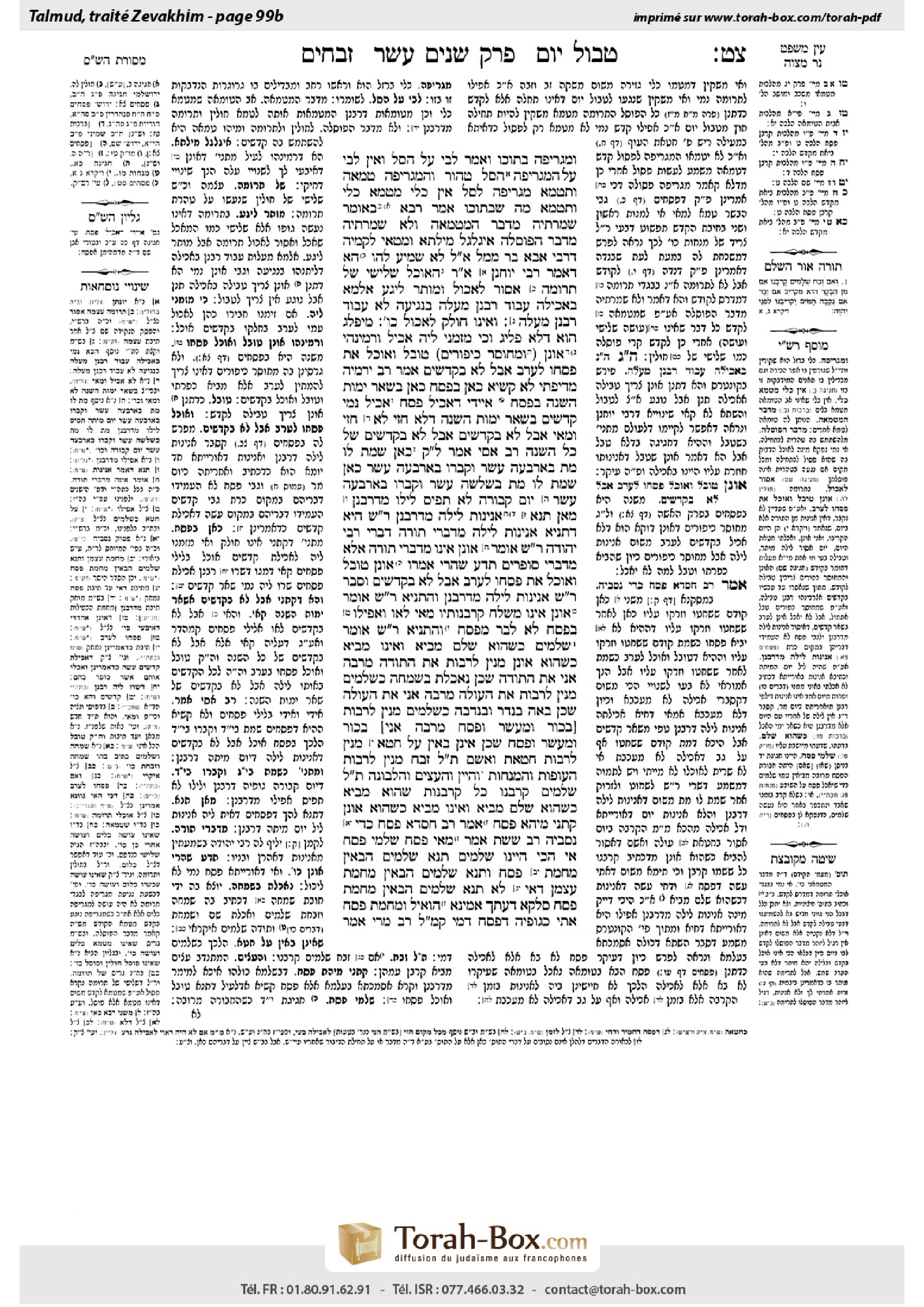
זבחים צ״ט ב · Aramaic and Hebrew text
וּמַגְרֵיפָה בְּתוֹכוֹ, וְאָמַר: ״לִבִּי עַל הַסַּל וְאֵין לִבִּי עַל הַמַּגְרֵיפָה״ – הַסַּל טָהוֹר וְהַמַּגְרֵיפָה טְמֵאָה.
וּתְטַמֵּא מַגְרֵיפָה לְסַל! אֵין כְּלִי מְטַמֵּא כְּלִי. וּתְטַמֵּא מַה שֶּׁבְּתוֹכוֹ! אָמַר רָבָא: בְּאוֹמֵר שְׁמַרְתִּיהָ מִדָּבָר הַמְטַמְּאָהּ, וְלֹא שְׁמַרְתִּיהָ מִדָּבָר הַפּוֹסְלָהּ.
אִיגַּלְגַּל מִילְּתָא, וּמְטַאי לְקַמֵּיהּ דְּרַבִּי אַבָּא בַּר מֶמֶל. אֲמַר לְהוּ, לָא שְׁמִיעַ לְהוּ הָא דְּאָמַר רַבִּי יוֹחָנָן אָמַר רַבִּי: הָאוֹכֵל שְׁלִישִׁי שֶׁל תְּרוּמָה – אָסוּר לֶאֱכוֹל וּמוּתָּר לִיגַּע?
אַלְמָא בַּאֲכִילָה עֲבוּד רַבָּנַן מַעֲלָה, בִּנְגִיעָה לָא עֲבוּד רַבָּנַן מַעֲלָה!
וְאֵינוֹ חוֹלֵק לֶאֱכוֹל כּוּ׳. מִיפְלָג הוּא דְּלָא פְּלִיג, וְכִי מְזַמְּנִי לֵיהּ – אָכֵיל;
וּרְמִינְהִי: אוֹנֵן (וּמְחוּסַּר כִּיפּוּרִים) – טוֹבֵל וְאוֹכֵל אֶת פִּסְחוֹ לָעֶרֶב, אֲבָל לֹא בְּקָדָשִׁים!
אָמַר רַב יִרְמְיָה מִדִּיפְתִּי: לָא קַשְׁיָא; כָּאן בְּפֶסַח, כָּאן בִּשְׁאָר יְמוֹת הַשָּׁנָה.
בְּפֶסַח – אַיְּידֵי דְּאָכֵיל פֶּסַח, אָכֵיל נָמֵי קָדָשִׁים. בִּשְׁאָר יְמוֹת הַשָּׁנָה – דְּלָא חֲזֵי, לָא חֲזֵי. וּמַאי ״אֲבָל לֹא בְּקָדָשִׁים״? אֲבָל לֹא בְּקָדָשִׁים שֶׁל כׇּל הַשָּׁנָה.
רַב אַסִּי אָמַר: לָא קַשְׁיָא; כָּאן שֶׁמֵּת לוֹ מֵת בְּאַרְבָּעָה עָשָׂר וּקְבָרוֹ בְּאַרְבָּעָה עָשָׂר, כָּאן שֶׁמֵּת לוֹ מֵת בִּשְׁלֹשָׁה עָשָׂר וּקְבָרוֹ בְּאַרְבָּעָה עָשָׂר; יוֹם קְבוּרָה לָא תָּפֵיס לֵילוֹ מִדְּרַבָּנַן.
מַאן תַּנָּא אֲנִינוּת לַיְלָה מִדְּרַבָּנַן? רַבִּי שִׁמְעוֹן הִיא. דְּתַנְיָא: אֲנִינוּת לַיְלָה מִדִּבְרֵי תוֹרָה. דִּבְרֵי רַבִּי יְהוּדָה. רַבִּי שִׁמְעוֹן אוֹמֵר: אוֹנֵן אֵינוֹ מִדִּבְרֵי תוֹרָה, אֶלָּא מִדִּבְרֵי סוֹפְרִים. תֵּדַע – שֶׁהֲרֵי אָמְרוּ: אוֹנֵן טוֹבֵל וְאוֹכֵל אֶת פִּסְחוֹ לָעֶרֶב, אֲבָל לֹא בַּקֳּדָשִׁים.
וְסָבַר רַבִּי שִׁמְעוֹן אֲנִינוּת לַיְלָה מִדְּרַבָּנַן?! וְהָתַנְיָא, רַבִּי שִׁמְעוֹן אוֹמֵר: אוֹנֵן אֵינוֹ מְשַׁלֵּחַ קׇרְבְּנוֹתָיו. מַאי, לָאו וַאֲפִילּוּ בְּפֶסַח? לָא; לְבַר מִפֶּסַח.
וְהָתַנְיָא, רַבִּי שִׁמְעוֹן אוֹמֵר: ״שְׁלָמִים״ – כְּשֶׁהוּא שָׁלֵם מֵבִיא, וְאֵינוֹ מֵבִיא כְּשֶׁהוּא אוֹנֵן. מִנַּיִן לְרַבּוֹת אֶת הַתּוֹדָה? מְרַבֶּה אֲנִי אֶת הַתּוֹדָה, שֶׁכֵּן נֶאֱכֶלֶת בְּשִׂמְחָה כִּשְׁלָמִים.
מִנַּיִן לְרַבּוֹת אֶת הָעוֹלָה? מְרַבֶּה אֲנִי אֶת הָעוֹלָה, שֶׁכֵּן בָּאָה בְּנֶדֶר וּבִנְדָבָה כִּשְׁלָמִים. מִנַּיִן לְרַבּוֹת בְּכוֹר וּמַעֲשֵׂר וָפֶסַח? מְרַבֶּה אֲנִי בְּכוֹר וּמַעֲשֵׂר וָפֶסַח, שֶׁכֵּן אֵינָן בָּאִין עַל חֵטְא. מִנַּיִן לְרַבּוֹת חַטָּאת וְאָשָׁם? תַּלְמוּד לוֹמַר: ״זֶבַח״.
מִנַּיִן לְרַבּוֹת הָעוֹפוֹת וְהַמְּנָחוֹת וְהַיַּיִן וְהָעֵצִים וְהַלְּבוֹנָה? תַּלְמוּד לוֹמַר: ״שְׁלָמִים קׇרְבָּנוֹ״; כׇּל קׇרְבְּנוֹת שֶׁהוּא מֵבִיא – כְּשֶׁהוּא שָׁלֵם מֵבִיא, וְאֵינוֹ מֵבִיא כְּשֶׁהוּא אוֹנֵן.
קָתָנֵי מִיהָא פֶּסַח!
אָמַר רַב חִסְדָּא: פֶּסַח – כְּדִי נַסְבֵיהּ.
רַב שֵׁשֶׁת אָמַר: מַאי פֶּסַח – שַׁלְמֵי פֶסַח. אִי הָכִי, הַיְינוּ שְׁלָמִים! תְּנָא שְׁלָמִים הַבָּאִין מֵחֲמַת פֶּסַח, וּתְנָא שְׁלָמִים הַבָּאִין מֵחֲמַת עַצְמָן.
דְּאִי לָא תְּנָא שְׁלָמִים הַבָּאִין מֵחֲמַת פֶּסַח, סָלְקָא דַּעְתָּךְ אָמֵינָא: הוֹאִיל וּמֵחֲמַת פֶּסַח אָתֵי – כְּגוּפֵיהּ דְּפֶסַח דָּמֵי; קָא מַשְׁמַע לַן.
רַב מָרִי אָמַר:
Zevachim 99b · English translation
and a shovel was in the basket, and he said: I am minding the basket, that it not become impure, but I am not minding the shovel, then the basket is pure, and the shovel is impure.
The Gemara challenges the ruling of the baraita: But wouldn’t the shovel render the basket impure? The Gemara answers: There is a principle that a vessel does not render another vessel ritually impure. The Gemara challenges: But wouldn’t the shovel render that which is in the basket, e.g., figs, impure? Rava said: The case is where he says: I safeguarded it, the shovel, from anything that would allow it to render another item impure, but I did not safeguard it from anything that would render it itself unfit, i.e., impure.
The Gemara returns to discuss the contradiction between the mishna, which permits an acute mourner to touch sacrificial meat, and the mishna in tractate Ḥagiga, which requires him to immerse. The Gemara relates: The matter circulated and came before Rabbi Abba bar Memel. He said to the Sages before him: Have they not heard that which Rabbi Yoḥanan says that Rabbi Yehuda HaNasi says: One who partakes of teruma that has third-degree impurity, i.e., teruma disqualified through contact with an item with second-degree impurity, is prohibited from partaking of teruma, but permitted to touch teruma.
Rabbi Abba bar Memel continued: Apparently, in a case of partaking, the Sages imposed a higher standard, whereas in a case of touching, the Sages did not impose a higher standard. Similarly, in a case of an acute mourner, the Sages require him to immerse before he may partake of sacrificial meat, as taught in tractate Ḥagiga, but they do not impose this standard for touching the meat, as taught in the mishna here.
§ The mishna teaches with regard to an acute mourner: And he does not receive a share of sacrificial meat in order to partake of it in the evening. The Gemara comments: The mishna indicates only that he may not receive a share of the meat, but when other priests invite him to join in their portions, he may partake of them in the evening.
And the Gemara raises a contradiction from a mishna (Pesaḥim 91b): An acute mourner immerses and partakes of his Paschal offering in the evening, but he may not partake of other sacrificial meat.
Rav Yirmeya of Difti said: This is not difficult. Here, the ruling of the mishna is stated with regard to the first night of Passover, whereas there, in tractate Pesaḥim, the ruling of the mishna is stated with regard to the rest of the days of the year.
What is the reason for the distinction between the two? On the first night of Passover, since he partakes of the Paschal offering, he may also partake of other sacrificial meat. But on the rest of the days of the year, when he is unfit to partake of sacrificial meat, he is unfit. And what does the mishna in Pesaḥim mean when it states: But he may not partake of other sacrificial meat? It means: But he may not partake of sacrificial meat of all of the rest of the year, other than the first night of Passover.
Rav Asi said there is a different resolution to the contradiction between the mishnayot: This is not difficult. Here, in the ruling of the mishna in tractate Pesaḥim, which prohibits an acute mourner from partaking of sacrificial meat, it is referring to a case where his relative died on the fourteenth day of Nisan, and he buried him on the fourteenth itself, in which case he is still considered an acute mourner by rabbinic law that evening. There, in the ruling of the mishna in this chapter, it is referring to a case where his relative died on the thirteenth of Nisan, and he buried him on the fourteenth of Nisan. The reason the mourner may partake is that since the day of burial is not the day of death, it does not take hold of its following night by rabbinic law.
The Gemara clarifies: Who is the tanna who taught that acute mourning the following night is by rabbinic law, as opposed to by Torah law? This is the opinion of Rabbi Shimon, as it is taught in a baraita: Acute mourning at night is by Torah law; this is the statement of Rabbi Yehuda. Rabbi Shimon says: His status as an acute mourner at night is not by Torah law, but by rabbinic law. Know that this so, as the Sages said: An acute mourner immerses and partakes of his Paschal offering in the evening, but he may still not partake of other sacrificial meat. If acute mourning at night were by Torah law, he would not be permitted to partake of the Paschal offering.
The Gemara asks: And does Rabbi Shimon hold that acute mourning at night is by rabbinic law and that consequently an acute mourner partakes of his Paschal offering in the evening? But isn’t it taught in a baraita: Rabbi Shimon says: An acute mourner does not send his offerings to the Temple to be sacrificed? What, is it not referring even to a Paschal offering? The Gemara rejects this: No, the baraita is referring to all offerings other than a Paschal offering.
The Gemara counters: But isn’t it taught in a baraita: With regard to the verse: “And if his offering be a sacrifice of peace offerings [shelamim]” (Leviticus 3:1), Rabbi Shimon says: The offering is called shelamim to teach that when a person is whole [shalem], i.e., in a state of contentment, he brings his offering, but he does not bring it when he is an acute mourner. From where is it derived to include that an acute mourner does not bring even a thanks offering? I include the thanks offering because it is consumed in a state of joy, like a peace offering.
From where is it derived that the verse also serves to include a burnt offering? I include the burnt offering because it comes as a vow offering and as a gift offering, like a peace offering. From where is it derived that the verse also serves to include a firstborn offering, and an animal tithe offering, and a Paschal offering, which are not brought voluntarily? I include a firstborn offering, and an animal tithe offering, and a Paschal offering, because they too, like a peace offering, do not come to atone for a sin. From where is it derived to include a sin offering and a guilt offering, which atone for sins? The verse states: “And if his offering be a sacrifice [zevaḥ] of peace offerings,” which teaches that an acute mourner may not sacrifice any slaughtered offering [zevaḥ].
From where is it derived to include even the bird offerings, and the meal offerings, and the wine, and the wood, and the frankincense brought for the Temple service? The verse states: “And if his offering be a sacrifice of peace offerings [shelamim korbano],” teaching that for all offerings [korbanot] that a person brings, he brings them when he is whole [shalem], but he does not bring them when he is an acute mourner.
The Gemara explains: In any event, Rabbi Shimon teaches that it is prohibited for an acute mourner to bring a Paschal offering, even though he will cease to be an acute mourner that night; this contradicts the first baraita.
Rav Ḥisda said: The latter baraita mentions a Paschal offering for no purpose. In other words, the halakha that an acute mourner does not bring an offering does not actually apply to a Paschal offering, and the baraita mentions it only out of habit, since a firstborn-animal offering, the animal tithe offering, and a Paschal offering are frequently mentioned together.
Rav Sheshet said: What is meant in this baraita by the term: Paschal offering? It is referring to the peace offerings of Passover, i.e., the peace offering that is sacrificed along with the Paschal offering. The Gemara objects: If so, that is the same as a peace offering, which Rabbi Shimon already mentioned. The Gemara answers: He taught the halakha with regard to peace offerings that come on account of the Paschal offering, and he taught separately the halakha with regard to peace offerings that come on their own account.
The Gemara explains: Rabbi Shimon needed to teach both cases explicitly, because if he did not teach the halakha with regard to peace offerings that come on account of the Paschal offering, it would enter your mind to say: Since they come on account of the Paschal offering, they are considered like the Paschal offering itself, and the acute mourner offers them as well. Therefore, Rabbi Shimon teaches us that these peace offerings are also forbidden to an acute mourner.
Rav Mari said a different resolution to the contradiction between the statements of Rabbi Shimon:
Zevachim 99b · Traduction française (IA)
et une pelle se trouvait dans le panier. Il dit : « Je veille sur le panier pour qu’il ne devienne pas impur, mais je ne veille pas sur la pelle. » Le panier est alors pur et la pelle, impure.
La Guemara conteste la décision de la baraïta : mais la pelle ne rendrait-elle pas le panier impur ? La Guemara répond qu’il existe un principe selon lequel un ustensile ne rend pas un autre ustensile rituellement impur. La Guemara objecte : mais la pelle ne rendrait-elle pas impurs les objets qui se trouvent dans le panier, par exemple des figues ? Rava dit : le cas est celui où il dit : « J’ai protégé la pelle de tout ce qui pourrait lui permettre de rendre un autre objet impur, mais je ne l’ai pas protégée de tout ce qui pourrait la rendre elle-même impropre, c’est-à-dire impure. »
La Guemara revient sur la contradiction entre la Michna, qui permet à un endeuillé immédiat de toucher de la viande sacrificielle, et la Michna du traité Ḥaguiga, qui exige qu’il s’immerge. La Guemara rapporte : l’affaire circula et fut portée devant Rabbi Abba bar Memel. Il dit aux Sages qui se trouvaient devant lui : « N’ont-ils donc pas entendu ce que Rabbi Yoḥanan dit au nom de Rabbi Yehuda HaNasi : celui qui consomme de la terouma ayant le statut de troisième degré d’impureté, c’est-à-dire une terouma disqualifiée par contact avec un objet ayant le statut de deuxième degré d’impureté, n’a pas le droit de consommer de terouma, mais il a le droit de toucher de la terouma ? »
Rabbi Abba bar Memel poursuivit : il ressort de là que, pour la consommation, les Sages ont imposé une exigence plus stricte, tandis qu’ils ne l’ont pas fait pour le simple contact. De même, dans le cas d’un endeuillé immédiat, les Sages exigent qu’il s’immerge avant de pouvoir consommer de la viande sacrificielle, comme on l’enseigne dans le traité Ḥaguiga, mais ils ne lui imposent pas cette exigence pour toucher la viande, comme l’enseigne la Michna ici.
§ La Michna enseigne au sujet d’un endeuillé immédiat : « Et il ne reçoit pas de part de viande sacrificielle pour la consommer le soir. » La Guemara fait remarquer que la Michna indique seulement qu’il ne peut pas recevoir de part de cette viande ; mais, lorsque d’autres prêtres l’invitent à prendre part à leurs portions, il peut les consommer le soir.
La Guemara soulève une contradiction à partir d’une Michna (Pessaḥim 91b) : un endeuillé immédiat s’immerge et consomme son sacrifice pascal le soir, mais il ne peut pas consommer d’autre viande sacrificielle.
Rav Yirmeya de Difti dit : il n’y a pas de difficulté. Ici, la décision de la Michna concerne la première nuit de Pessaḥ, tandis que là, dans le traité Pessaḥim, la décision de la Michna concerne le reste de l’année.
Quelle est la raison de cette distinction ? La première nuit de Pessaḥ, puisqu’il consomme le sacrifice pascal, il peut également consommer d’autre viande sacrificielle. Mais, le reste de l’année, lorsqu’il n’est pas apte à consommer de la viande sacrificielle, il ne l’est pas non plus. Et que signifie la Michna de Pessaḥim lorsqu’elle dit : « Mais il ne peut pas consommer d’autre viande sacrificielle » ? Cela signifie qu’il ne peut pas consommer de viande sacrificielle pendant tout le reste de l’année, à l’exception de la première nuit de Pessaḥ.
Rav Asi propose une autre résolution à la contradiction entre les Michnayot : il n’y a pas de difficulté. Ici, dans la décision de la Michna du traité Pessaḥim, qui interdit à un endeuillé immédiat de consommer de la viande sacrificielle, il s’agit du cas où son proche est mort le quatorze Nissan et où il l’a enterré le quatorze même ; il est alors encore considéré comme endeuillé immédiat, selon la loi rabbinique, ce soir-là. Là, dans la décision de la Michna de notre chapitre, il s’agit du cas où son proche est mort le treize Nissan et où il l’a enterré le quatorze Nissan. Si l’endeuillé peut consommer, c’est parce que, le jour de l’enterrement n’étant pas celui du décès, le statut d’endeuillé immédiat ne s’étend pas, selon la loi rabbinique, à la nuit qui suit.
La Guemara précise : quel est le tanna qui enseigne que le statut d’endeuillé immédiat durant la nuit relève de la loi rabbinique, et non de la Torah ? C’est l’opinion de Rabbi Shimon, comme l’enseigne une baraïta : le statut d’endeuillé immédiat durant la nuit relève de la Torah ; telle est la déclaration de Rabbi Yehuda. Rabbi Shimon dit : son statut d’endeuillé immédiat durant la nuit ne relève pas de la Torah, mais de la loi rabbinique. Sache qu’il en est bien ainsi, car les Sages ont dit : « Un endeuillé immédiat s’immerge et consomme son sacrifice pascal le soir, mais il ne peut toujours pas consommer d’autre viande sacrificielle. » Si le statut d’endeuillé immédiat durant la nuit relevait de la Torah, il ne serait pas autorisé à consommer le sacrifice pascal.
La Guemara demande : Rabbi Shimon considère-t-il donc que le statut d’endeuillé immédiat durant la nuit relève de la loi rabbinique et qu’en conséquence, un endeuillé immédiat consomme son sacrifice pascal le soir ? Pourtant, n’est-il pas enseigné dans une baraïta : « Rabbi Shimon dit qu’un endeuillé immédiat ne fait pas porter ses sacrifices au Temple pour qu’ils y soient offerts » ? Cela ne désigne-t-il pas même un sacrifice pascal ? La Guemara rejette cette interprétation : non, la baraïta parle de tous les sacrifices, à l’exception du sacrifice pascal.
La Guemara objecte : pourtant, n’est-il pas enseigné dans une baraïta, au sujet du verset « Et si son offrande est un sacrifice de paix [shelamim] » (Lévitique 3:1), que Rabbi Shimon dit : « L’offrande est appelée shelamim pour enseigner que lorsqu’une personne est entière [shalem], c’est-à-dire dans un état de contentement, elle apporte son offrande, mais qu’elle ne l’apporte pas lorsqu’elle est endeuillée immédiatement. » D’où apprend-on qu’il faut inclure le sacrifice d’action de grâce, qu’un endeuillé immédiat ne peut pas non plus apporter ? J’inclus le sacrifice d’action de grâce, car il est consommé dans la joie, comme un sacrifice de paix.
D’où apprend-on que le verset sert également à inclure l’holocauste ? J’inclus l’holocauste, car il est apporté comme offrande votive ou comme offrande volontaire, à l’instar du sacrifice de paix. D’où apprend-on que le verset sert également à inclure l’offrande du premier-né, l’offrande de la dîme du bétail et le sacrifice pascal, qui ne sont pas apportés volontairement ? J’inclus l’offrande du premier-né, l’offrande de la dîme du bétail et le sacrifice pascal, car eux aussi, comme le sacrifice de paix, ne sont pas apportés pour expier une faute. D’où apprend-on qu’il faut inclure le sacrifice expiatoire et le sacrifice de culpabilité, qui expient les fautes ? Le verset dit : « Et si son offrande est un sacrifice [zevaḥ] de paix », ce qui enseigne qu’un endeuillé immédiat ne peut offrir aucun sacrifice sanglant [zevaḥ].
D’où apprend-on qu’il faut aussi inclure les offrandes d’oiseaux, les offrandes de farine, le vin, le bois et l’encens apportés pour le service du Temple ? Le verset dit : « Et si son offrande est un sacrifice de paix [shelamim korbano] », ce qui enseigne que toutes les offrandes [korbanot] qu’une personne apporte doivent l’être lorsqu’elle est entière [shalem], et non lorsqu’elle est endeuillée immédiatement.
La Guemara explique : en tout état de cause, Rabbi Shimon enseigne qu’il est interdit à un endeuillé immédiat d’apporter un sacrifice pascal, bien qu’il cesse d’être endeuillé immédiat cette nuit-là ; cela contredit la première baraïta.
Rav Ḥisda dit : la baraïta ultérieure mentionne le sacrifice pascal sans que cela ait de portée. Autrement dit, la halakha selon laquelle un endeuillé immédiat n’apporte pas de sacrifice ne s’applique pas réellement au sacrifice pascal ; la baraïta ne le mentionne que par habitude, puisque l’offrande du premier-né, l’offrande de la dîme du bétail et le sacrifice pascal sont fréquemment mentionnés ensemble.
Rav Sheshet dit : que désigne dans cette baraïta l’expression « sacrifice pascal » ? Elle désigne les sacrifices de paix de Pessaḥ, c’est-à-dire le sacrifice de paix offert avec le sacrifice pascal. La Guemara objecte : dans ce cas, il s’agit de la même chose qu’un sacrifice de paix, que Rabbi Shimon a déjà mentionné. La Guemara répond : il a enseigné la halakha concernant les sacrifices de paix apportés à l’occasion du sacrifice pascal, et il a enseigné séparément la halakha concernant les sacrifices de paix apportés de leur propre chef.
La Guemara explique : Rabbi Shimon devait enseigner explicitement les deux cas, car s’il n’avait pas enseigné la halakha concernant les sacrifices de paix apportés à l’occasion du sacrifice pascal, on aurait pu penser : puisqu’ils sont apportés à l’occasion du sacrifice pascal, ils sont considérés comme le sacrifice pascal lui-même, et l’endeuillé immédiat les offre lui aussi. Rabbi Shimon nous enseigne donc que ces sacrifices de paix sont également interdits à un endeuillé immédiat.
Rav Mari propose une autre résolution à la contradiction entre les déclarations de Rabbi Shimon :
Traduction française générée par IA à partir de l’édition anglaise de Sefaria. Vérifie toujours un passage avec le texte source.
Text from Sefaria: William Davidson Edition - Vocalized Aramaic (CC BY NC); William Davidson Edition - English (CC BY NC).