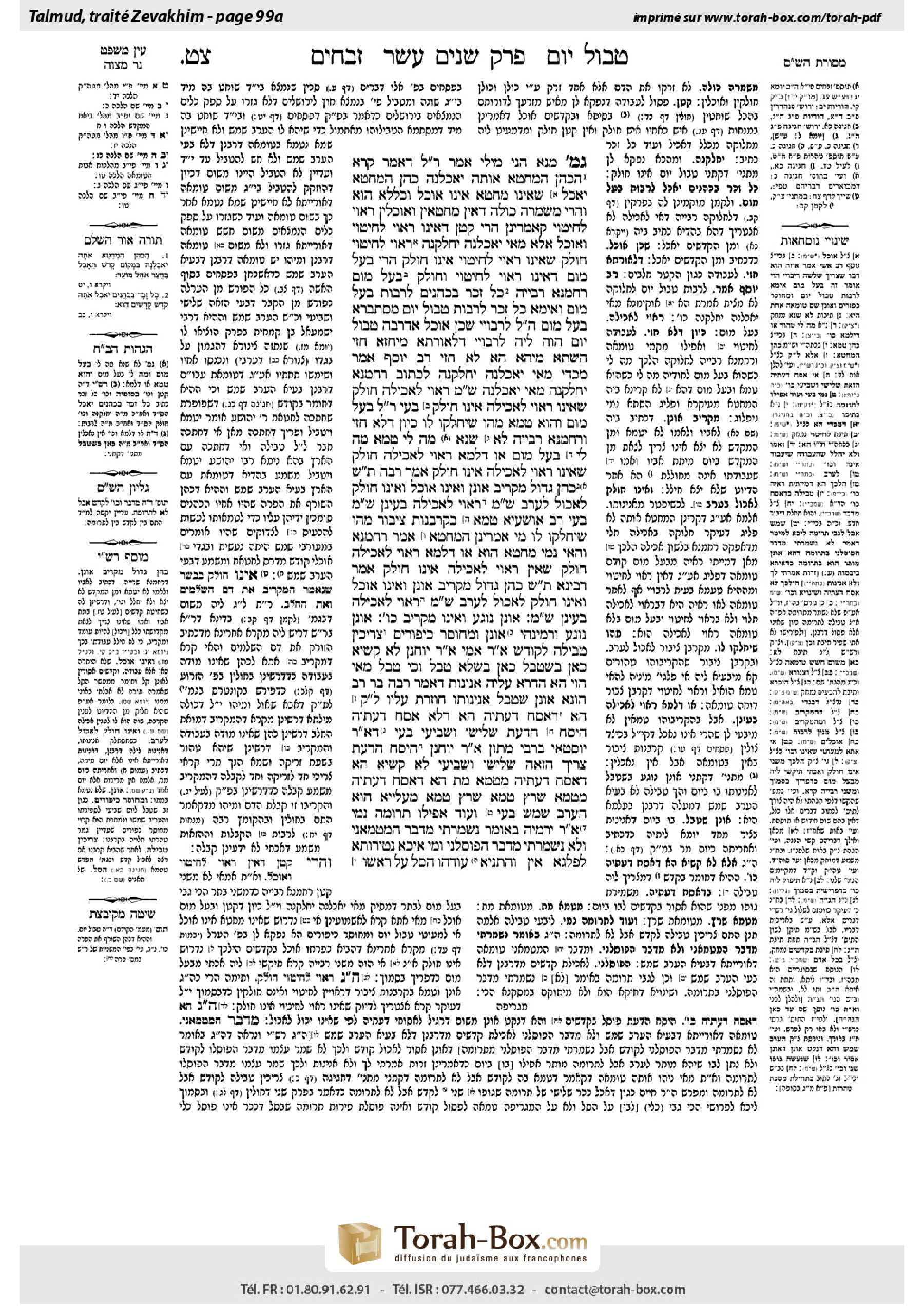
Zevachim 99a: Talmud study for Daf Yomi
Daf Yomi is the daily study of one Talmud folio. Explore 37 tractates with scans, Hebrew text, Sefaria English and AI-generated French translations where annotated.
Passage selection and English or AI-generated French translation are available where the scan has annotations. Daf Study is independent of Torah-Box and Sefaria.
Browse Zevachim · זבחים · All tractatesZevachim 99a text and translations
This page of Zevachim includes the Aramaic text, an English translation and an AI-generated French translation, alongside the scan above.
זבחים צ״ט א · Aramaic and Hebrew text
גְּמָ׳ מְנָא הָנֵי מִילֵּי? אָמַר רֵישׁ לָקִישׁ, דְּאָמַר קְרָא: ״הַכֹּהֵן הַמְחַטֵּא אֹתָהּ יֹאכְלֶנָּה״ – כֹּהֵן הַמְחַטֵּא יֹאכַל, שֶׁאֵינוֹ מְחַטֵּא אֵינוֹ אוֹכֵל.
וּכְלָלָא הוּא?! וַהֲרֵי מִשְׁמָרָה כּוּלָּהּ – דְּאֵין מְחַטְּאִין, וְאוֹכְלִין! רָאוּי לְחִיטּוּי קָאָמְרִינַן.
הֲרֵי קָטָן – דְּאֵינוֹ רָאוּי לְחִיטּוּי, וְאוֹכֵל! אֶלָּא מַאי ״יֹאכְלֶנָּה״ – יְחַלְּקֶנָּה. רָאוּי לְחִיטּוּי – חוֹלֵק, שֶׁאֵינוֹ רָאוּי לְחִיטּוּי – אֵינוֹ חוֹלֵק.
הֲרֵי בַּעַל מוּם – דְּאֵינוֹ רָאוּי לְחִיטּוּי, וְחוֹלֵק! בַּעַל מוּם רַחֲמָנָא רַבְּיֵיהּ: ״כׇּל זָכָר בַּכֹּהֲנִים״ – לְרַבּוֹת בַּעַל מוּם.
וְאֵימָא: ״כׇּל זָכָר״ – לְרַבּוֹת טְבוּל יוֹם! מִסְתַּבְּרָא בַּעַל מוּם הֲוָה לֵיהּ לְרַבּוֹיֵי, שֶׁכֵּן אוֹכֵל.
אַדְּרַבָּה – טְבוּל יוֹם הֲוָה לֵיהּ לְרַבּוֹיֵי, דִּלְאוּרְתָּא מִיחְזָא חֲזֵי! הַשְׁתָּא מִיהָא הָא לָא חֲזֵי.
רַב יוֹסֵף אָמַר: מִכְּדֵי מַאי ״יֹאכְלֶנָּה״ – יְחַלְּקֶנָּה; לִכְתּוֹב רַחֲמָנָא ״יְחַלְּקֶנָּה״! מַאי ״יֹאכְלֶנָּה״? שְׁמַע מִינַּהּ: רָאוּי לַאֲכִילָה – חוֹלֵק, שֶׁאֵינוֹ רָאוּי לַאֲכִילָה – אֵינוֹ חוֹלֵק.
בָּעֵי רֵישׁ לָקִישׁ: בַּעַל מוּם וְהוּא טָמֵא, מַהוּ שֶׁיַּחְלְקוּ לוֹ? כֵּיוָן דְּלָא חֲזֵי וְרַחֲמָנָא רַבְּיֵיהּ – לָא שְׁנָא, מָה לִי טָמֵא מָה לִי בַּעַל מוּם; אוֹ דִלְמָא, רָאוּי לַאֲכִילָה חוֹלֵק, שֶׁאֵינוֹ רָאוּי לַאֲכִילָה אֵינוֹ חוֹלֵק?
אָמַר רַבָּה, תָּא שְׁמַע: כֹּהֵן גָּדוֹל מַקְרִיב אוֹנֵן, וְאֵינוֹ אוֹכֵל, וְאֵינוֹ חוֹלֵק לֶאֱכוֹל לָעֶרֶב. שְׁמַע מִינַּהּ: רָאוּי לַאֲכִילָה בָּעֵינַן! שְׁמַע מִינַּהּ.
בָּעֵי רַב אוֹשַׁעְיָא: טָמֵא בְּקׇרְבְּנוֹת צִיבּוּר, מַהוּ שֶׁיַּחְלְקוּ לוֹ? מִי אָמְרִינַן: ״הַמְחַטֵּא״ אָמַר רַחֲמָנָא – וְהַאי נָמֵי מֵחֵטְא הוּא; אוֹ דִלְמָא, רָאוּי לַאֲכִילָה חוֹלֵק, שֶׁאֵין רָאוּי לַאֲכִילָה אֵינוֹ חוֹלֵק?
אָמַר רָבִינָא, תָּא שְׁמַע: כֹּהֵן גָּדוֹל מַקְרִיב אוֹנֵן, וְאֵינוֹ אוֹכֵל, וְאֵינוֹ חוֹלֵק לֶאֱכוֹל לָעֶרֶב. שְׁמַע מִינַּהּ: רָאוּי לַאֲכִילָה בָּעֵינַן! שְׁמַע מִינַּהּ.
אוֹנֵן נוֹגֵעַ וְאֵינוֹ מַקְרִיב כּוּ׳. אוֹנֵן נוֹגֵעַ?! וּרְמִינְהִי: אוֹנֵן וּמְחוּסַּר כִּיפּוּרִים – צְרִיכִין טְבִילָה לַקּוֹדֶשׁ!
אָמַר רַבִּי אַמֵּי אָמַר רַבִּי יוֹחָנָן: לָא קַשְׁיָא; כָּאן בְּשֶׁטָּבַל, כָּאן בְּשֶׁלֹּא טָבַל.
וְכִי טָבַל מַאי הָוֵי? הָא הָדְרָא עֲלֵיהּ אֲנִינוּת; דְּאָמַר רַבָּה בַּר רַב הוּנָא: אוֹנֵן שֶׁטָּבַל – אֲנִינוּתוֹ חוֹזֶרֶת עָלָיו!
לָא קַשְׁיָא; הָא דְּאַסַּח דַּעְתֵּיהּ, הָא דְּלָא אַסַּח דַּעְתֵּיהּ.
הֶיסַּח הַדַּעַת – שְׁלִישִׁי וּשְׁבִיעִי בָּעֵי; דְּאָמַר רַבִּי יוֹסְטַאי בְּרַבִּי מָתוּן אָמַר רַבִּי יוֹחָנָן: הֶיסַּח הַדַּעַת – צָרִיךְ הַזָּאָה שְׁלִישִׁי וּשְׁבִיעִי!
לָא קַשְׁיָא; הָא דְּאַסַּח דַּעְתֵּיהּ מִטְּמֵא מֵת, הָא דְּאַסַּח דַּעְתֵּיהּ מִטְּמֵא שֶׁרֶץ.
טְמֵא שֶׁרֶץ – טָמֵא מְעַלְּיָיא הוּא, הֶעֱרֵב שֶׁמֶשׁ בָּעֵי! וְעוֹד, אֲפִילּוּ תְּרוּמָה נָמֵי!
אָמַר רַבִּי יִרְמְיָה: בְּאוֹמֵר נִשְׁמַרְתִּי מִדָּבָר הַמְטַמְּאֵנִי, וְלֹא נִשְׁמַרְתִּי מִדָּבָר הַפּוֹסְלֵנִי.
וּמִי אִיכָּא נְטִירוּתָא לְפַלְגָא?! אִין; וְהָתַנְיָא: עוֹדֵהוּ הַסַּל עַל רֹאשׁוֹ
Zevachim 99a · English translation
GEMARA: The mishna teaches that a priest who is unfit for the Temple service does not receive a share of the sacrificial meat. The Gemara asks: From where are these matters derived? Reish Lakish said: It is derived from a verse, as the verse states about a sin offering: “The priest who effects atonement shall eat it; in a sacred place shall it be eaten, in the court of the Tent of Meeting” (Leviticus 6:19). This teaches that only a priest who effects atonement by performing the rites of the offering shall partake of its meat, but a priest who does not effect atonement does not partake of its meat.
The Gemara challenges: And is this an established principle? But there are all the priests of the priestly watch of that week in the Temple, who do not effect atonement for that offering, because the blood of a specific sin offering is presented by just one priest, and yet they all partake of its meat. The Gemara explains: We mean to say that any priest who is fit for effecting atonement may partake of it, even one who did not participate in the service.
The Gemara objects: But there is the case of a minor, who is unfit for effecting atonement, and who nevertheless partakes of sacrificial meat. The Gemara explains: Rather, what is meant by the term: “Shall eat it”? It means that he shall receive a share of it. The halakha is therefore that a priest who is fit for effecting atonement receives a share of the meat, but a priest who is unfit for effecting atonement does not receive a share of the meat. Minors do not receive a share, though they may partake of meat given to them by others.
The Gemara objects: But there is a blemished priest, who is unfit for effecting atonement, and yet he receives a share of its meat. The Gemara replies: The Merciful One included a blemished priest as an exception, as the verse that states: “Every male among the priests shall eat it” (Leviticus 6:22), serves to include a blemished priest.
The Gemara suggests: But say that the phrase “every male” serves to include one who immersed that day, teaching that he may also receive a share in the sacrificial meat. Why should it be understood as referring specifically to a blemished priest? The Gemara replies: It stands to reason that the Torah should include a blemished priest for receiving his own share of the meat, because he may partake of sacrificial meat in any event. By contrast, one who immersed that day is impure and may not touch or partake of sacrificial meat.
The Gemara rejects this: On the contrary, the Torah should include one who immersed that day, because, unlike a blemished priest, in the evening he will be fit to perform the service. The Gemara replies: Now, in any event, the one who immersed himself is not fit.
Rav Yosef said another explanation: Now what is meant by the term: “Shall eat it”? It means: He shall receive a share of it. But if so, let the Merciful One write: Shall receive a share of it. What is the reason for writing: “Shall eat it”? Learn from it that only a priest who is fit for partaking of sacrificial meat, which includes a blemished priest, receives a share in the meat; but a priest who is not fit for partaking of sacrificial meat, e.g., one who immersed that day, does not receive a share in the meat.
§ Reish Lakish raises a dilemma: If a priest is blemished and he is impure, what is the halakha? Must the other priests give him a share of the meat? Perhaps we say that since he is not fit to perform the rite as a blemished priest and nevertheless the Merciful One included him to receive a share in the meat, there is no difference: What is the difference to me if he is impure, and what is the difference to me if he is only blemished? In any event he is not fit, yet the Torah allows him to receive a share in the meat. Or perhaps he may not receive a share in the meat, because only a priest who is fit for partaking of sacrificial meat receives a share of the meat, but a priest who is not fit for partaking of sacrificial meat does not receive a share of the meat.
Rabba said: Come and hear a resolution to this dilemma from a baraita: If a High Priest is serving in the Temple and one of his immediate relatives dies, he sacrifices offerings even as an acute mourner. But he does not partake of sacrificial meat, and he does not receive a share to partake of it in the evening. Conclude from the baraita that in order for the priest to receive a share in sacrificial meat, we require that he be fit for partaking of it, and accordingly, a blemished priest who is impure does not receive a share. The Gemara affirms: Conclude from the baraita that this is so.
§ Rav Oshaya raises a dilemma: If a priest is impure, then in a case of communal offerings, which may be offered by an impure priest, what is the halakha? Do the other priests give him a share of the meat, so that he may partake of it in the evening when he becomes pure? Do we say that the Merciful One states: “The priest who effects atonement,” and therefore any priest who is fit for effecting atonement receives a share, as derived earlier, and this priest is also one who may effect atonement, since this is a communal offering? Or perhaps he may not, due to the principle that only a priest who is fit for partaking of sacrificial meat receives a share of the meat, but a priest who is unfit for partaking of sacrificial meat does not receive a share.
Ravina said: Come and hear a resolution to this dilemma from a baraita: If a High Priest is serving in the Temple and one of his relatives dies, he sacrifices offerings even as an acute mourner, but he does not partake of sacrificial meat and he does not receive a share of it to partake in the evening. Conclude from the baraita that in order for a priest to receive a share in sacrificial meat, we require that he be fit for partaking of it at the time of the service, without regard to whether he can perform the service. The Gemara affirms: Conclude from the baraita that this is so.
§ The mishna teaches: A priest who is an acute mourner is permitted to touch sacrificial meat, but he may not sacrifice offerings. The Gemara asks: Is it in fact permitted for an acute mourner to touch sacrificial meat? And the Gemara raises a contradiction from another mishna (Ḥagiga 21a): An acute mourner and one who has not yet brought an atonement offering, even after their respective disqualifications have expired, require immersion in order to eat sacrificial food. According to that mishna, an acute mourner who did not immerse may not touch sacrificial meat.
Rabbi Ami said that Rabbi Yoḥanan said: This is not difficult. Here, the ruling of the mishna is stated with regard to a case where the mourner immersed during his day of acute mourning. This is why he is permitted to touch the sacrificial meat. There, the ruling of the mishna in tractate Ḥagiga is stated with regard to a case where the mourner did not immerse.
The Gemara asks: And even if he immersed, what of it? But doesn’t his acute mourning return to him? As Rabba, son of Rav Huna, says: In a case of an acute mourner who immersed during his day of his acute mourning, his acute mourning returns to him.
The Gemara answers: This is not difficult. That case, in tractate Ḥagiga, is one where he was distracted from safeguarding his state of purity, so he may not touch sacrificial meat in the event that he is impure. This case, in the mishna here, is one where he was not distracted.
The Gemara counters: If the mishna in tractate Ḥagiga is discussing a case of distraction, then his status is like that of one who contracted ritual impurity imparted by a corpse, who requires sprinkling with water of purification on the third and seventh days of his impurity. As Rabbi Yustai, son of Rabbi Matun, says that Rabbi Yoḥanan says: One who experienced a distraction requires sprinkling with water of purification on the third and seventh days.
The Gemara responds: This is not difficult. That statement, that he requires sprinkling, is discussing a case where he was distracted and careless about contracting impurity imparted by a corpse. This mishna in tractate Ḥagiga, stating that he requires immersion but not sprinkling, is discussing a case where he was distracted and careless about contracting impurity imparted by the carcass of a creeping animal.
The Gemara counters: One who was careless about becoming impure due to the carcass of a creeping animal is fully impure, and so he requires not only immersion to become pure, but he also requires sunset. And furthermore, if the mishna in tractate Ḥagiga is discussing this case, the mourner should be prohibited from touching even teruma, not just sacrificial meat. Why does the mishna mention only the latter?
Rabbi Yirmeya said: The mishna is discussing a case where he says: I safeguarded myself from anything that would render me impure, so I am certain that I did not contract impurity that requires waiting until sunset; but I did not safeguard myself from anything that would render me unfit for touching sacrificial meat.
The Gemara asks: But is there such a concept of partial care, that one can claim to have safeguarded himself from one form of impurity but not another? The Gemara answers: Yes, and it is taught in a baraita: If one was carrying a basket, and the basket was still on his head,
Zevachim 99a · Traduction française (IA)
GUEMARA : La Michna enseigne qu’un prêtre inapte au service du Temple ne reçoit pas de part de la viande sacrificielle. La Guemara demande : De quoi déduit-on cela ? Reish Lakish dit : Cela se déduit d’un verset, car il est écrit à propos d’un sacrifice expiatoire : « Le prêtre qui accomplit l’expiation le mangera ; on le mangera dans un lieu saint, dans le parvis de la Tente de la Rencontre » (Lévitique 6, 19). Cela enseigne que seul le prêtre qui accomplit l’expiation en effectuant les rites du sacrifice peut en consommer la viande, tandis que le prêtre qui n’accomplit pas l’expiation ne peut pas en consommer.
La Guemara objecte : Est-ce donc là un principe établi ? Pourtant, tous les prêtres de la garde sacerdotale de cette semaine se trouvent dans le Temple et n’accomplissent pas l’expiation pour ce sacrifice, puisque le sang d’un sacrifice expiatoire particulier est présenté par un seul prêtre ; malgré cela, ils en consomment tous la viande. La Guemara explique : Il faut comprendre que tout prêtre apte à accomplir l’expiation peut en consommer, même s’il n’a pas participé au service.
La Guemara objecte : Pourtant, il y a le cas d’un mineur, qui est inapte à accomplir l’expiation et qui consomme néanmoins de la viande sacrificielle. La Guemara explique : Il faut plutôt comprendre l’expression « le mangera » ainsi : il en recevra une part. La halakha est donc qu’un prêtre apte à accomplir l’expiation reçoit une part de la viande, tandis qu’un prêtre qui ne l’est pas n’en reçoit pas. Les mineurs ne reçoivent pas de part, même s’ils peuvent consommer de la viande que d’autres leur donnent.
La Guemara objecte : Pourtant, un prêtre atteint d’un défaut physique est inapte à accomplir l’expiation et reçoit néanmoins une part de cette viande. La Guemara répond : Le Miséricordieux a prévu une exception pour le prêtre atteint d’un défaut physique, car le verset « Tout mâle parmi les prêtres en mangera » (Lévitique 6, 22) sert à l’inclure.
La Guemara suggère : Mais disons que l’expression « tout mâle » sert à inclure celui qui s’est immergé ce jour-là, enseignant qu’il peut lui aussi recevoir une part de la viande sacrificielle. Pourquoi comprendre qu’elle se rapporte spécifiquement à un prêtre atteint d’un défaut physique ? La Guemara répond : Il est logique que la Torah inclue le prêtre atteint d’un défaut physique pour qu’il reçoive sa propre part de viande, puisqu’il peut de toute façon consommer de la viande sacrificielle. En revanche, celui qui s’est immergé ce jour-là est impur et ne peut ni toucher ni consommer de viande sacrificielle.
La Guemara rejette cette explication : Au contraire, la Torah devrait inclure celui qui s’est immergé ce jour-là, car, contrairement au prêtre atteint d’un défaut physique, il sera apte au service le soir. La Guemara répond : Or, de toute façon, celui qui s’est immergé n’est pas apte à présent.
Rav Yosef donne une autre explication : Que signifie donc l’expression « le mangera » ? Elle signifie : il en recevra une part. Mais alors, que le Miséricordieux écrive : « Il en recevra une part » ! Pourquoi écrire « le mangera » ? Déduis-en que seul un prêtre apte à consommer de la viande sacrificielle — ce qui inclut un prêtre atteint d’un défaut physique — reçoit une part de la viande ; tandis qu’un prêtre inapte à en consommer, par exemple celui qui s’est immergé ce jour-là, n’en reçoit pas.
§ Reish Lakish soulève un dilemme : quelle est la halakha si un prêtre est atteint d’un défaut physique et qu’il est impur ? Les autres prêtres doivent-ils lui donner une part de la viande ? Peut-être dirons-nous que, puisqu’il est inapte à effectuer le rite en raison de son défaut physique et que, malgré cela, le Miséricordieux l’a inclus parmi ceux qui reçoivent une part de la viande, il n’y a pas de différence : qu’il soit impur ou qu’il ait seulement un défaut physique, qu’importe ? Dans tous les cas, il est inapte et pourtant la Torah lui permet de recevoir une part de la viande. Ou peut-être ne peut-il pas en recevoir, car seul un prêtre apte à consommer de la viande sacrificielle en reçoit une part, tandis qu’un prêtre inapte à en consommer n’en reçoit pas.
Rabba dit : Viens et écoute une réponse à ce dilemme tirée d’une baraïta : si le Grand Prêtre officie dans le Temple et que l’un de ses proches décède, il offre des sacrifices même en état de deuil immédiat. Mais il ne consomme pas de viande sacrificielle et ne reçoit pas de part à consommer le soir. Conclus de cette baraïta que, pour recevoir une part de viande sacrificielle, le prêtre doit être apte à en consommer ; en conséquence, un prêtre atteint d’un défaut physique et impur ne reçoit pas de part. La Guemara confirme : conclus de cette baraïta qu’il en est bien ainsi.
§ Rav Oshaya soulève un dilemme : quelle est la halakha si un prêtre est impur dans le cas de sacrifices communautaires, qui peuvent être offerts par un prêtre impur ? Les autres prêtres lui donnent-ils une part de la viande, afin qu’il puisse la consommer le soir, lorsqu’il sera redevenu pur ? Dirons-nous que le Miséricordieux dit : « Le prêtre qui accomplit l’expiation » et que, par conséquent, tout prêtre apte à accomplir l’expiation reçoit une part, comme on l’a déduit précédemment ; or ce prêtre peut lui aussi accomplir l’expiation, puisqu’il s’agit d’un sacrifice communautaire ? Ou peut-être ne peut-il pas en recevoir, selon le principe selon lequel seul un prêtre apte à consommer de la viande sacrificielle reçoit une part, tandis qu’un prêtre inapte à en consommer n’en reçoit pas.
Ravina dit : Viens et écoute une réponse à ce dilemme tirée d’une baraïta : si le Grand Prêtre officie dans le Temple et que l’un de ses proches décède, il offre des sacrifices même en état de deuil immédiat, mais il ne consomme pas de viande sacrificielle et n’en reçoit pas de part à consommer le soir. Conclus de cette baraïta que, pour recevoir une part de viande sacrificielle, le prêtre doit être apte à en consommer au moment du service, indépendamment de son aptitude à effectuer le service. La Guemara confirme : conclus de cette baraïta qu’il en est bien ainsi.
§ La Michna enseigne : Un prêtre en état de deuil immédiat est autorisé à toucher la viande sacrificielle, mais il ne peut pas offrir de sacrifices. La Guemara demande : Est-il vraiment permis à une personne en deuil immédiat de toucher de la viande sacrificielle ? La Guemara soulève une contradiction à partir d’une autre Michna (Ḥagiga 21a) : une personne en deuil immédiat et celui qui n’a pas encore apporté son sacrifice expiatoire doivent s’immerger avant de consommer des aliments sacrificiels, même après que les causes respectives de leur inaptitude ont pris fin. Selon cette Michna, une personne en deuil immédiat qui ne s’est pas immergée ne peut pas toucher de viande sacrificielle.
Rabbi Ami dit au nom de Rabbi Yoḥanan : Il n’y a pas de difficulté. Ici, la Michna traite du cas où la personne en deuil s’est immergée pendant sa journée de deuil immédiat. C’est pourquoi elle est autorisée à toucher la viande sacrificielle. Là, la Michna du traité Ḥagiga traite du cas où elle ne s’est pas immergée.
La Guemara demande : Même s’il s’est immergé, et alors ? Son état de deuil immédiat ne revient-il pas ? Car Rabba, fils de Rav Huna, dit : Dans le cas d’une personne en deuil immédiat qui s’est immergée pendant sa journée de deuil, son état de deuil immédiat revient.
La Guemara répond : Il n’y a pas de difficulté. Le cas évoqué dans le traité Ḥagiga est celui d’une personne qui a cessé de veiller à préserver son état de pureté ; elle ne peut donc pas toucher de viande sacrificielle, au cas où elle serait impure. Le cas de la Michna ici est celui d’une personne qui n’a pas cessé d’y veiller.
La Guemara objecte : Si la Michna du traité Ḥagiga traite d’un cas où la personne a cessé de veiller, son statut est alors celui de quelqu’un qui a contracté l’impureté rituelle transmise par un cadavre et qui doit recevoir l’aspersion de l’eau de purification les troisième et septième jours de son impureté. En effet, Rabbi Yustai, fils de Rabbi Matun, dit au nom de Rabbi Yoḥanan : Celui qui a cessé de veiller doit recevoir l’aspersion de l’eau de purification les troisième et septième jours.
La Guemara répond : Il n’y a pas de difficulté. La déclaration selon laquelle il doit recevoir l’aspersion traite d’un cas où il a cessé de veiller et a fait preuve de négligence quant au risque de contracter l’impureté transmise par un cadavre. Cette Michna du traité Ḥagiga, qui indique qu’il doit s’immerger mais pas recevoir d’aspersion, traite d’un cas où il a cessé de veiller et a fait preuve de négligence quant au risque de contracter l’impureté transmise par la carcasse d’un animal rampant.
La Guemara objecte : Celui qui a fait preuve de négligence quant au risque de devenir impur à cause de la carcasse d’un animal rampant est pleinement impur ; il doit donc non seulement s’immerger pour redevenir pur, mais aussi attendre le coucher du soleil. De plus, si la Michna du traité Ḥagiga traite de ce cas, il devrait être interdit à la personne en deuil de toucher même la terouma, et pas seulement la viande sacrificielle. Pourquoi la Michna ne mentionne-t-elle que cette dernière ?
Rabbi Yirmeya dit : La Michna traite du cas où la personne dit : « Je me suis gardée de tout ce qui aurait pu me rendre impur ; je suis donc certaine de n’avoir pas contracté une impureté qui exige d’attendre jusqu’au coucher du soleil. Mais je ne me suis pas gardée de tout ce qui aurait pu me rendre inapte à toucher de la viande sacrificielle. »
La Guemara demande : Mais peut-on parler de vigilance partielle, c’est-à-dire prétendre s’être gardé d’une forme d’impureté et pas d’une autre ? La Guemara répond : Oui, et une baraïta l’enseigne : si quelqu’un portait un panier et que celui-ci se trouvait encore sur sa tête,
Traduction française générée par IA à partir de l’édition anglaise de Sefaria. Vérifie toujours un passage avec le texte source.
Text from Sefaria: William Davidson Edition - Vocalized Aramaic (CC BY NC); William Davidson Edition - English (CC BY NC).