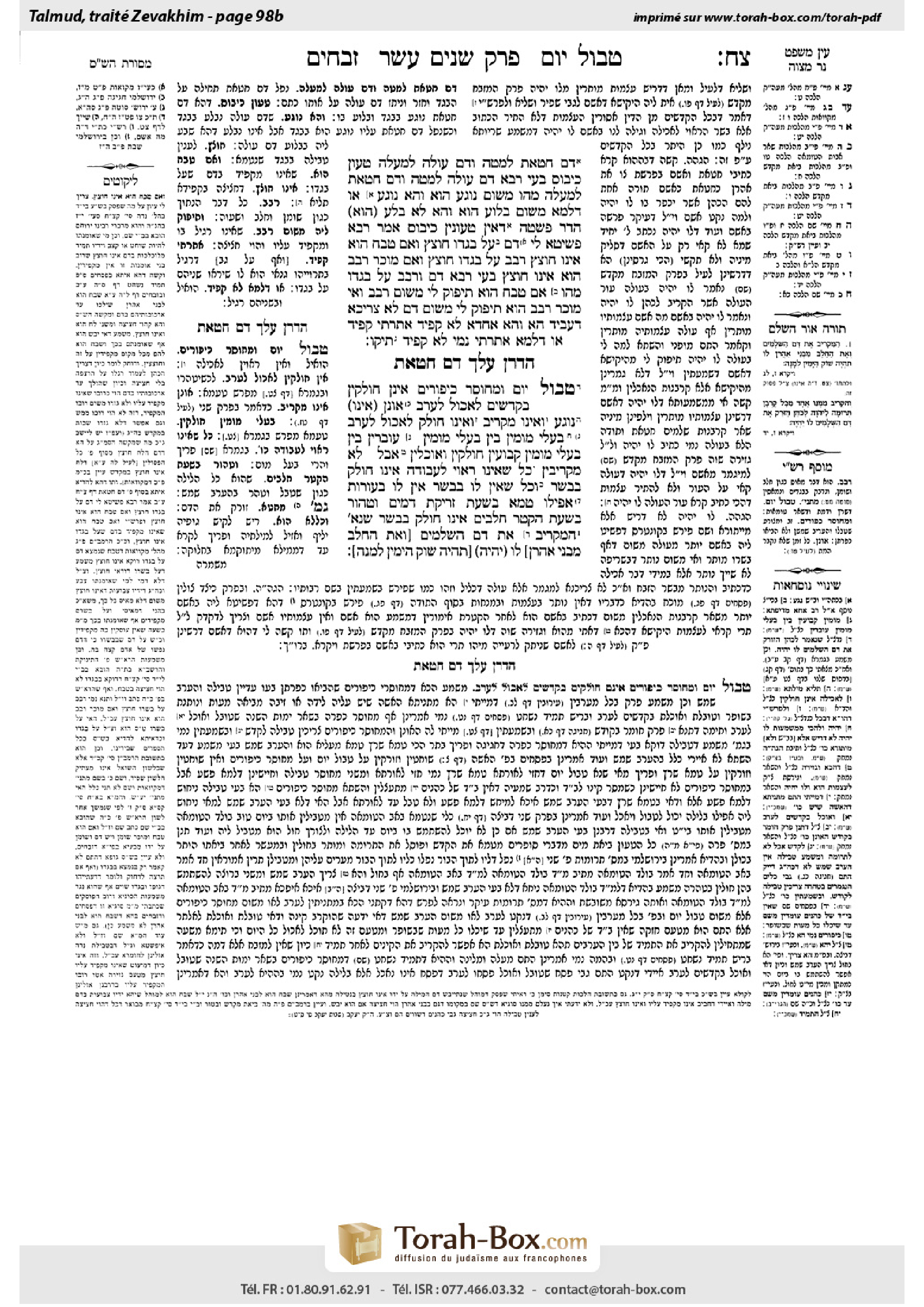
Zevachim 98b: Talmud study for Daf Yomi
Daf Yomi is the daily study of one Talmud folio. Explore 37 tractates with scans, Hebrew text, Sefaria English and AI-generated French translations where annotated.
Passage selection and English or AI-generated French translation are available where the scan has annotations. Daf Study is independent of Torah-Box and Sefaria.
Browse Zevachim · זבחים · All tractatesZevachim 98b text and translations
This page of Zevachim includes the Aramaic text, an English translation and an AI-generated French translation, alongside the scan above.
זבחים צ״ח ב · Aramaic and Hebrew text
דַּם חַטָּאת לְמַטָּה וְדַם עוֹלָה לְמַעְלָה, טָעוּן כִּיבּוּס.
בָּעֵי רָבָא: דַּם עוֹלָה לְמַטָּה וְדַם חַטָּאת לְמַעְלָה, מַהוּ? מִשּׁוּם נוֹגֵעַ הוּא – וְהָא נוֹגֵעַ; אוֹ דִלְמָא מִשּׁוּם בָּלוּעַ הוּא – וְהָא לָא בָּלַע (הוּא)? הֲדַר פַּשְׁטַהּ, דְּאֵין טְעוּנִין כִּיבּוּס.
אָמַר רָבָא: פְּשִׁיטָא לִי, דָּם עַל בִּגְדּוֹ – חוֹצֵץ, וְאִם טַבָּח הוּא – אֵינוֹ חוֹצֵץ. רְבָב עַל בִּגְדּוֹ – חוֹצֵץ, וְאִם מוֹכֵר רְבָב הוּא – אֵינוֹ חוֹצֵץ. בָּעֵי רָבָא: דָּם וּרְבָב עַל בִּגְדּוֹ, מַהוּ?
אִם טַבָּח הוּא, תִּיפּוֹק לִי מִשּׁוּם רְבָב! וְאִי מוֹכֵר רְבָב הוּא, תִּיפּוֹק לִי מִשּׁוּם דָּם! לָא צְרִיכָא, דְּעָבֵיד הָא וְהָא. אַחֲדָא לָא קָפֵיד, אַתַּרְתֵּי קָפֵיד; אוֹ דִּלְמָא אַתַּרְתֵּי נָמֵי לָא קָפֵיד? תֵּיקוּ.
הֲדַרַן עֲלָךְ דַּם חַטָּאת
מַתְנִי׳ טְבוּל יוֹם וּמְחוּסַּר כִּיפּוּרִים – אֵינָן חוֹלְקִין בַּקֳּדָשִׁים לֶאֱכוֹל לָעֶרֶב.
אוֹנֵן – (אֵינוֹ) נוֹגֵעַ וְאֵינוֹ מַקְרִיב, וְאֵינוֹ חוֹלֵק לֶאֱכוֹל לָעֶרֶב.
בַּעֲלֵי מוּמִין, בֵּין בַּעֲלֵי מוּמִין עוֹבְרִין בֵּין בַּעֲלֵי מוּמִין קְבוּעִין – חוֹלְקִין וְאוֹכְלִין, אֲבָל לֹא מַקְרִיבִין.
כֹּל שֶׁאֵינוֹ רָאוּי לַעֲבוֹדָה – אֵינוֹ חוֹלֵק בַּבָּשָׂר. וְכֹל שֶׁאֵין לוֹ בַּבָּשָׂר – אֵין לוֹ בָּעוֹרוֹת.
אֲפִילּוּ טָמֵא בִּשְׁעַת זְרִיקַת דָּמִים, וְטָהוֹר בִּשְׁעַת הֶקְטֵר חֲלָבִים – אֵינוֹ חוֹלֵק בַּבָּשָׂר; שֶׁנֶּאֱמַר: ״הַמַּקְרִיב אֶת דַּם הַשְּׁלָמִים [וְאֶת הַחֵלֶב מִבְּנֵי אַהֲרֹן] – לוֹ (יִהְיֶה) [תִהְיֶה שׁוֹק הַיָּמִין לְמָנָה]״.
Zevachim 98b · English translation
when the blood of a sin offering is below and the blood of a burnt offering is above, in a case in which the blood of a burnt offering is sprayed as a second layer on top of the blood of a sin offering that has already been sprayed and absorbed into a garment, the garment requires laundering.
Rava asks: When the blood of a burnt offering is below and the blood of a sin offering is above, what is the halakha? Is one required to launder a garment to remove the blood of a sin offering because the blood touches his garment, and in this case, this blood is touching the garment? Or perhaps is one required to launder it because of the absorption of the blood into the garment, and, in this case, since the garment has already absorbed the other blood, this garment did not absorb the blood? Rava then resolves his dilemma, ruling that such garments do not require laundering.
§ In a similar manner, with regard to the immersion of a garment that has become impure, Rava said: It is obvious to me that if there is blood on one’s garment, it interposes between the water of immersion and the garment, such that the immersion is ineffective. But if he is a butcher, used to having blood on his garments, a bloodstain does not interpose, and the immersion is effective, since a substance is not considered an interposition if the one immersing is not particular about it. Similarly, if there is a stain of fat [revav] on one’s garment, it interposes. But if he is a fat seller, such a stain does not interpose. Rava asks: If there is both blood and fat on one’s garment when he immerses it, what is the halakha?
The Gemara challenges the question: If he is a butcher, let me derive that the stain interposes due to the fat that he is not used to having on his garments; and conversely, if he is a fat seller, let me derive that the stain interposes due to the stain of blood that he is not used to having on his garments. The Gemara explains: No, this question is not superfluous; it is necessary with regard to a person who works both as this, a butcher, and as that, a fat seller. In such a case, the question is: Is it that he is not particular with regard to one stain, but he is particular with regard to two stains, so that the immersion is ineffective? Or, perhaps, is it that he is not particular even with regard to two stains, as neither is unusual for him? The Gemara provides no answer, and the question shall stand unresolved.
MISHNA: A priest who was ritually impure who immersed that day and is waiting for nightfall for the purification process to be completed, and a priest who has not yet brought an atonement offering to complete the purification process, e.g., a zav and a leper who did not bring their requisite atonement offerings, who are not yet permitted to partake of sacrificial meat, do not receive a share of sacrificial meat along with the other members of the patrilineal priestly family serving in the Temple that day, in order to partake of it in the evening after the offerings were sacrificed, even though after nightfall he would be permitted to partake of the offerings.
A priest who is an acute mourner, i.e., if one of his relatives for whom he is obligated to mourn died that day, is permitted to touch sacrificial meat, as he is not ritually impure. But he may not sacrifice offerings, and he does not receive a share of sacrificial meat in order to partake of it in the evening.
Blemished priests, whether they are temporarily blemished or whether they are permanently blemished, receive a share and partake of the offerings with their priestly brethren, but do not sacrifice the offerings.
The principle is: Any priest who is unfit for the service that specific day does not receive a share of the sacrificial meat, and anyone who has no share of the meat has no share in the hides of the animals, to which the priests are entitled as well.
Even if the priest was ritually impure only at the time of the sprinkling of the blood of the offering and he was pure at the time of the burning of the fats of that offering, he still does not receive a share of the meat, as it is stated: “He that sacrifices the blood of the peace offerings and the fat, from among the sons of Aaron, shall have the right thigh for a portion” (Leviticus 7:33). One who cannot sprinkle the blood does not receive a share in the meat.
Zevachim 98b · Traduction française (IA)
Lorsque le sang d’un sacrifice expiatoire est en dessous et celui d’un holocauste au-dessus, dans le cas où le sang d’un holocauste est aspergé en une seconde couche par-dessus le sang d’un sacrifice expiatoire déjà aspergé et absorbé par un vêtement, celui-ci doit être lavé.
Rava demande : lorsque le sang d’un holocauste est en dessous et celui d’un sacrifice expiatoire au-dessus, quelle est la halakha ? Faut-il laver un vêtement pour en retirer le sang d’un sacrifice expiatoire parce que ce sang touche le vêtement — et, dans ce cas, le sang le touche bien ? Ou bien faut-il le laver parce que le sang a été absorbé par le vêtement et, dans ce cas, puisque celui-ci a déjà absorbé l’autre sang, il n’a pas absorbé ce sang-ci ? Rava résout alors son dilemme et statue que de tels vêtements n’ont pas besoin d’être lavés.
§ De même, au sujet de l’immersion d’un vêtement devenu impur, Rava dit : il est évident pour moi que, s’il y a du sang sur le vêtement de quelqu’un, celui-ci fait écran entre l’eau de l’immersion et le vêtement, de sorte que l’immersion est inefficace. Mais s’il est boucher et a l’habitude d’avoir du sang sur ses vêtements, une tache de sang ne fait pas écran et l’immersion est efficace, car une substance n’est pas considérée comme faisant écran si la personne qui s’immerge ne s’en préoccupe pas. De même, une tache de graisse [revav] sur un vêtement fait écran. Mais si la personne vend de la graisse, une telle tache ne fait pas écran. Rava demande : quelle est la halakha si le vêtement porte à la fois une tache de sang et une tache de graisse lorsqu’il l’immerge ?
La Guemara conteste la question : s’il est boucher, ne peut-on pas en déduire que la tache fait écran à cause de la graisse, à laquelle il n’est pas habitué sur ses vêtements ? Et inversement, s’il vend de la graisse, ne peut-on pas en déduire que la tache fait écran à cause de la tache de sang, à laquelle il n’est pas habitué sur ses vêtements ? La Guemara explique : non, cette question n’est pas superflue ; elle est nécessaire dans le cas d’une personne qui exerce les deux métiers, celui de boucher et celui de vendeur de graisse. La question est alors la suivante : ne se préoccupe-t-il pas d’une seule tache, mais se préoccupe-t-il de deux taches, de sorte que l’immersion est inefficace ? Ou bien ne se préoccupe-t-il peut-être pas même de deux taches, puisqu’aucune des deux ne lui est inhabituelle ? La Guemara ne donne pas de réponse ; la question reste sans solution.
MICHNA : Un prêtre rituellement impur qui s’est immergé ce jour-là et attend le coucher du soleil pour que le processus de purification s’achève, ainsi qu’un prêtre qui n’a pas encore apporté de sacrifice expiatoire pour achever sa purification — par exemple, un zav ou un lépreux qui n’a pas apporté le sacrifice expiatoire requis — ne sont pas encore autorisés à consommer de la viande sacrificielle. Ils ne reçoivent pas de part de cette viande avec les autres membres de la famille sacerdotale patrilinéaire qui assurent le service au Temple ce jour-là, pour en manger le soir après le sacrifice des offrandes, même si, après le coucher du soleil, ils seraient autorisés à consommer ces offrandes.
Un prêtre en deuil immédiat, c’est-à-dire dont un proche parent pour lequel il est tenu d’observer le deuil est mort ce jour-là, est autorisé à toucher la viande sacrificielle, car il n’est pas rituellement impur. Mais il ne peut pas sacrifier les offrandes et ne reçoit pas de part de viande sacrificielle pour en manger le soir.
Les prêtres ayant une infirmité, temporaire ou permanente, reçoivent une part des offrandes et en mangent avec leurs frères prêtres, mais ne sacrifient pas les offrandes.
Le principe est le suivant : tout prêtre qui est inapte au service ce jour-là ne reçoit pas de part de la viande sacrificielle ; et quiconque n’a pas de part de cette viande n’a pas de part des peaux des animaux, auxquelles les prêtres ont également droit.
Même si le prêtre n’était rituellement impur qu’au moment de l’aspersion du sang de l’offrande et qu’il était pur au moment de la combustion des graisses de cette offrande, il ne reçoit tout de même pas de part de la viande, comme il est dit : « Celui, parmi les fils d’Aaron, qui offre le sang des sacrifices de paix et la graisse aura la cuisse droite pour part » (Lévitique 7, 33). Celui qui ne peut pas asperger le sang ne reçoit pas de part de la viande.
Traduction française générée par IA à partir de l’édition anglaise de Sefaria. Vérifie toujours un passage avec le texte source.
Text from Sefaria: William Davidson Edition - Vocalized Aramaic (CC BY NC); William Davidson Edition - English (CC BY NC).