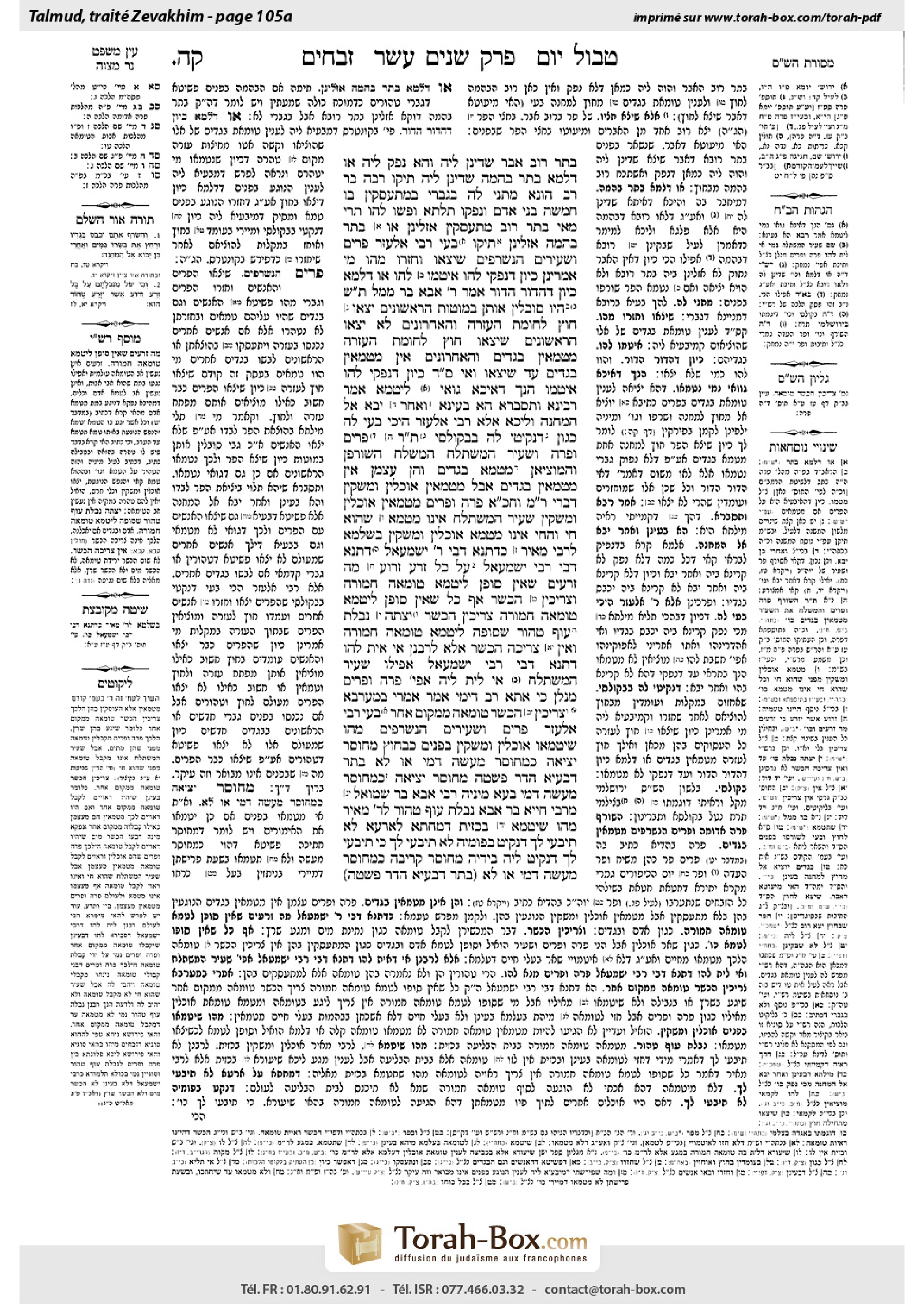
Zevachim 105a: Talmud study for Daf Yomi
Daf Yomi is the daily study of one Talmud folio. Explore 37 tractates with scans, Hebrew text, Sefaria English and AI-generated French translations where annotated.
Passage selection and English or AI-generated French translation are available where the scan has annotations. Daf Study is independent of Torah-Box and Sefaria.
Browse Zevachim · זבחים · All tractatesZevachim 105a text and translations
This page of Zevachim includes the Aramaic text, an English translation and an AI-generated French translation, alongside the scan above.
זבחים ק״ה א · Aramaic and Hebrew text
בָּתַר רוֹב אֵבֶר שָׁדֵינַן לֵיהּ, וְהָא נְפַק לֵיהּ; אוֹ דִלְמָא בָּתַר בְּהֵמָה שָׁדֵינַן לֵיהּ? תֵּיקוּ.
רַבָּה בַּר רַב הוּנָא מַתְנֵי לַהּ בְּגַבְרֵי, בְּמִתְעַסְּקִין בּוֹ חֲמִשָּׁה בְּנֵי אָדָם, וּנְפַקוּ תְּלָתָא וּפָשׁוּ לְהוּ תְּרֵי – מַאי? בָּתַר רוֹב מִתְעַסְּקִין אָזְלִינַן, אוֹ בָתַר בְּהֵמָה אָזְלִינַן? תֵּיקוּ.
בָּעֵי רַבִּי אֶלְעָזָר: פָּרִים וּשְׂעִירִים הַנִּשְׂרָפִים שֶׁיָּצְאוּ וְחָזְרוּ, מַהוּ? מִי אָמְרִינַן: כֵּיוָן דְּנָפְקִי לְהוּ – אִיטַּמּוֹ לְהוּ; אוֹ דִלְמָא, כֵּיוָן דַּהֲדוּר הֲדוּר?
אָמַר רַבִּי אַבָּא בַּר מֶמֶל, תָּא שְׁמַע: הָיוּ סוֹבְלִין אוֹתָן בְּמוֹטוֹת, הָרִאשׁוֹנִים יָצְאוּ חוּץ לְחוֹמַת הָעֲזָרָה וְהָאַחֲרוֹנִים לֹא יָצְאוּ – הָרִאשׁוֹנִים שֶׁיָּצְאוּ חוּץ לְחוֹמַת הָעֲזָרָה מְטַמְּאִין בְּגָדִים, וְהָאַחֲרוֹנִים אֵין מְטַמְּאִין בְּגָדִים עַד שֶׁיָּצְאוּ. וְאִי סָלְקָא דַעְתָּךְ כֵּיוָן דְּנָפְקִי לְהוּ אִיטַּמּוֹ – הָנָךְ דְּאִיכָּא גַּוַּאי (לִיטָּמֵא) [לִיטַּמּוֹ]!
אָמַר רָבִינָא: וְתִסְבְּרָא?! הָא בָּעֵינָא ״וְאַחַר יָבֹא אֶל הַמַּחֲנֶה״, וְלֵיכָּא!
אֶלָּא רַבִּי אֶלְעָזָר הֵיכִי בָּעֵי לַהּ? כְּגוֹן דִּנְקִיטִי לַהּ בְּבָקוּלְסֵי.
תָּנוּ רַבָּנַן: פָּרִים וּפָרָה וְשָׂעִיר הַמִּשְׁתַּלֵּחַ – הַמְשַׁלֵּחַ, הַשּׂוֹרְפָן וְהַמּוֹצִיאָן מְטַמֵּא בְּגָדִים; וְהֵן עַצְמָן אֵין מְטַמְּאִין בְּגָדִים, אֲבָל מְטַמְּאִין אֳוכָלִין וּמַשְׁקִין. דִּבְרֵי רַבִּי מֵאִיר. וַחֲכָמִים אוֹמְרִים: פָּרָה וּפָרִים מְטַמְּאִין אֳוכָלִין וּמַשְׁקִין, שָׂעִיר הַמִּשְׁתַּלֵּחַ אֵינוֹ מְטַמֵּא. שֶׁהוּא חַי, וְהַחַי אֵינוֹ מְטַמֵּא אֳוכָלִין וּמַשְׁקִין.
בִּשְׁלָמָא לְרַבִּי מֵאִיר – כִּדְתָנָא דְּבֵי רַבִּי יִשְׁמָעֵאל; דְּתָנָא דְּבֵי רַבִּי יִשְׁמָעֵאל: ״עַל כׇּל זֶרַע זֵרוּעַ״ –
מָה זְרָעִים – שֶׁאֵין סוֹפָן לְיטַמֵּא טוּמְאָה חֲמוּרָה, וּצְרִיכִין הֶכְשֵׁר; אַף כֹּל שֶׁאֵין סוֹפָן לְיטַמֵּא טוּמְאָה חֲמוּרָה, צְרִיכִין הֶכְשֵׁר. יָצְתָה נִבְלַת עוֹף טָהוֹר – שֶׁסּוֹפָהּ לְיטַמֵּא טוּמְאָה חֲמוּרָה, וְאֵין צְרִיכָה הֶכְשֵׁר.
אֶלָּא לְרַבָּנַן – אִי אִית לְהוּ דְּתָנָא דְּבֵי רַבִּי יִשְׁמָעֵאל, אֲפִילּוּ שָׂעִיר הַמִּשְׁתַּלֵּחַ! אִי לֵית לֵיהּ, אֲפִילּוּ פָּרָה וּפָרִים מְנָלַן?
כִּי אֲתָא רַב דִּימִי אֲמַר, אָמְרִי בְּמַעְרְבָא: צְרִיכִין הֶכְשֵׁר טוּמְאָה מִמָּקוֹם אַחֵר.
בָּעֵי רַבִּי אֶלְעָזָר: פָּרִים וּשְׂעִירִים הַנִּשְׂרָפִים, מַהוּ שֶׁיְּטַמְּאוּ אֳוכָלִין וּמַשְׁקִין בִּפְנִים כְּבַחוּץ? מְחוּסַּר יְצִיאָה כִּמְחוּסַּר מַעֲשֶׂה דָּמֵי, אוֹ לָא?
בָּתַר דְּבַעְיַאּ הֲדַר פַּשְׁטַהּ: מְחוּסַּר יְצִיאָה כִּמְחוּסַּר מַעֲשֶׂה דָּמֵי.
בְּעָא מִינֵּיהּ רַבִּי אַבָּא בַּר שְׁמוּאֵל מֵרַבִּי חִיָּיא בַּר אַבָּא: נִבְלַת עוֹף טָהוֹר, לְרַבִּי מֵאִיר, מַהוּ שֶׁתְּטַמֵּא בִּכְזַיִת?
דְּמַחֲתָא לְאַרְעָא – לָא תִּיבְּעֵי לָךְ; דְּנָקֵיט בְּפוּמֵּיהּ – לָא תִּיבְּעֵי לָךְ; כִּי תִּיבְּעֵי לָךְ – דְּנָקֵיט לֵיהּ בִּידֵיהּ: מְחוּסַּר קְרִיבָה כִּמְחוּסַּר מַעֲשֶׂה דָּמֵי, אוֹ לָא?
בָּתַר דְּבַעְיַאּ הֲדַר פַּשְׁטַהּ:
Zevachim 105a · English translation
by casting it after the majority of that limb, and the majority of that limb did leave? Or perhaps we determine its status by casting it after the half of the animal, which did not leave the courtyard. The Gemara concludes: The dilemma of Rabbi Elazar shall stand unresolved.
Rabba bar Rav Huna teaches this dilemma with regard to people: In a case where five people are handling an offering and carrying it out to be burned, and three of them emerged and two of them remained in the Temple courtyard, such that the animal is partly inside and partly outside, what is the halakha? Do we follow the majority of the people handling the offering, who have left the courtyard, or do we follow the animal, the majority of which did not yet leave? The Gemara concludes: The dilemma shall stand unresolved.
Rabbi Elazar raises another dilemma: If bulls and goats that are burned left the Temple courtyard and returned, what is the halakha with regard to the garments of those who carry them inside the courtyard? Do we say: Once they left, they became impure? Or perhaps once they return, they return and do not render garments impure?
Rabbi Abba bar Memel says: Come and hear the mishna: They would carry the bulls and the goats that are burned suspended on poles. When the first priests, carrying the front of the pole, emerged beyond the wall of the Temple courtyard and the latter ones did not yet emerge, the first ones, who emerged beyond the wall of the Temple courtyard, render their garments impure, but the latter ones do not render their garments impure until they emerge. Rabbi Abba bar Memel explains: And if it enters your mind to say that once they leave, they become impure, these latter ones mentioned in the mishna who are still inside should be rendered impure, since the offering itself has emerged. It follows that if the offering returns, their garments are not rendered impure.
Ravina said: And can you understand this as a proof? The reason that the latter ones’ garments are not rendered impure is that I require the fulfillment of the verse: “And he who burns them shall wash his garments, and bathe his flesh in water, and afterward he may come into the camp” (Leviticus 16:28). And since they have not yet left the camp, they cannot come into it, and therefore they do not contract the impurity described in the verse.
The Gemara asks: But if they can become impure only after they leave, how did Rabbi Elazar raise this dilemma? The Gemara answers: He raised the dilemma with regard to a case where they take the offering with staffs [bevakulsei], i.e., after the offering is returned to the Temple courtyard, other people stand outside the courtyard and bring it out again using staffs. Does the offering render these people impure, even though they are standing outside the courtyard? The dilemma of Rabbi Elazar remains unresolved.
§ The Sages taught in a baraita: With regard to bulls that are burned, and a red heifer, and the scapegoat of the Yom Kippur service, the one who sends them, the one who burns them, and the one who takes them out of the Temple courtyard render their garments impure. And the animals themselves, after they emerge from the Temple courtyard, do not render garments that they touch impure, but they render food and drink that they touch impure. This is the statement of Rabbi Meir. And the Rabbis say: A red heifer and bulls that are burned render food and drink impure, but the scapegoat does not transmit impurity at all, as it is still alive when it leaves the Temple, and a living being does not render food and drink impure.
The Gemara comments. Granted, according to Rabbi Meir there is no difficulty, as his opinion is in accordance with that which the school of Rabbi Yishmael taught. As the school of Rabbi Yishmael taught in a baraita: The verse states that seeds can contract impurity from the carcass of a creeping animal only if they first come in contact with water: “And if any part of their carcass fall upon any sowing seed which is to be sown, it is pure. But if water be put upon the seed, and any part of their carcass fall thereon, it is impure unto you” (Leviticus 11:37–38).
Just as is the case for seeds, which, like any food, can never contract impurity severe enough to transmit it to human beings, and they need exposure to liquid to be rendered susceptible to their less severe level of impurity, so too, all items that can never contract impurity severe enough to transmit it to human beings need exposure to liquid to be rendered susceptible to their less severe level of impurity and to transmit it. This serves to exclude the carcass of a kosher bird, which can contract impurity severe enough to be transmitted to a human being who swallows it, and therefore does not need to be rendered susceptible to ritual impurity in order to transmit ritual impurity. According to this baraita, bulls that are burned, a red heifer, and a scapegoat, which are all sources of impurity for human beings, are able to transmit impurity to food and drink on their own, even if they have not been exposed to liquid and have not come in contact with any source of impurity. Rabbi Meir’s opinion accords with this principle.
But for the opinion of the Rabbis, who disagree with Rabbi Meir and say that a scapegoat does not transmit impurity to food and drink, this is difficult. If they accept that which the school of Rabbi Yishmael taught, then even the scapegoat should transmit impurity to food and drink. And if they do not accept that statement, then from where do we derive that even a red heifer and bulls that are burned transmit impurity to food and drink?
When Rav Dimi came to Babylonia from Eretz Yisrael he said: The Sages in the West, Eretz Yisrael, say: The opinion of the Rabbis who disagree with Rabbi Meir is that bulls that are burned and a red heifer need to contract impurity from somewhere else to be able to transmit impurity to foods. Since the scapegoat cannot contract impurity, as it is alive, it cannot transmit impurity.
§ Rabbi Elazar raises a dilemma: With regard to bulls and goats that are burned, what is the halakha as to whether they can transmit impurity to food and drink inside the Temple courtyard, before they leave, as they do outside afterward? Is an offering that has not yet left the Temple considered as if it were an item for which a necessary action has not yet been performed, i.e., because it has not yet become a source of impurity to those who carry it, it also does not transmit impurity to food without being rendered susceptible by coming into contact with a liquid and then coming into contact with a source of impurity? Or perhaps no, because the offering will become a source of impurity to those who carry it once it leaves the Temple courtyard, it already transmits impurity to food without being rendered susceptible.
After Rabbi Elazar raised the dilemma, he then resolved it: An offering that has not yet left is considered as if it were an item for which a necessary action has not yet been performed, and it does not transmit impurity to food without being rendered susceptible.
§ Rabbi Abba bar Shmuel posed another dilemma to Rabbi Ḥiyya bar Abba: Food transmits impurity to other food or drink only if it is the volume of at least one egg-bulk and it is first rendered susceptible to impurity. The carcass of a kosher bird transmits impurity to a person who swallows it even if it is of the volume of at least one olive-bulk, and even if it has not been rendered susceptible to impurity. According to the opinion of Rabbi Meir, that the carcass of a kosher bird transmits impurity to other food without first being rendered susceptible to impurity, what is the halakha as to the requisite measure? Does the carcass of a kosher bird transmit impurity to food even if it is of the volume of an olive-bulk, as it would to a person?
The Gemara clarifies: Do not raise the dilemma in a case where the carcass lies on the ground, as in that case it certainly must be of the volume of an egg-bulk, like any other impure food. And do not raise the dilemma in a case where a person holds the bird’s flesh in his mouth, as it may be swallowed and transmit impurity to him even if it is of the volume of only an olive-bulk; in this case it certainly transmits impurity to food in the same measure. When you raise the dilemma, raise it in a case where he holds the bird’s flesh in his hand. When the flesh has not yet been brought close to being swallowed, is it considered to be like an item for which a necessary action has not yet been performed, in which case it is considered a normal food and must be of the volume of an egg-bulk, or perhaps not?
After Abba bar Shmuel raised the dilemma, he then resolved it:
Zevachim 105a · Traduction française (IA)
en la faisant sortir après la majorité de ce membre, et que la majorité de ce membre est effectivement sortie ? Ou bien déterminons-nous son statut en la faisant sortir après la moitié de l’animal, qui, elle, n’a pas quitté la cour ? La Guemara conclut : le dilemme de Rabbi Elazar reste sans réponse.
Rabba bar Rav Huna présente ce dilemme à propos de personnes : si cinq personnes manipulent une offrande et la portent à l’extérieur pour la brûler, et que trois d’entre elles sont sorties tandis que deux sont restées dans la cour du Temple, de sorte que l’animal se trouve en partie à l’intérieur et en partie à l’extérieur, quelle est la halakha ? Suivons-nous la majorité des personnes qui manipulent l’offrande, lesquelles ont quitté la cour, ou suivons-nous l’animal, dont la majeure partie n’est pas encore sortie ? La Guemara conclut : le dilemme reste sans réponse.
Rabbi Elazar soulève un autre dilemme : si des taureaux et des boucs destinés à être brûlés quittent la cour du Temple puis y reviennent, quelle est la halakha concernant les vêtements de ceux qui les portent à l’intérieur de la cour ? Doit-on dire qu’une fois sortis, ils sont devenus impurs ? Ou bien, lorsqu’ils reviennent, ne rendent-ils plus les vêtements impurs ?
Rabbi Abba bar Memel dit : Viens et écoute la Michna : on portait les taureaux et les boucs destinés à être brûlés, suspendus à des barres. Lorsque les premiers prêtres, qui portaient l’avant de la barre, franchissaient le mur de la cour du Temple, tandis que les derniers ne l’avaient pas encore franchi, les premiers, qui avaient franchi le mur de la cour du Temple, rendaient leurs vêtements impurs, mais les derniers ne rendaient pas leurs vêtements impurs avant d’être sortis. Rabbi Abba bar Memel explique : si tu pensais qu’une fois sortis, ils deviennent impurs, les derniers mentionnés dans la Michna, qui sont encore à l’intérieur, devraient être rendus impurs, puisque l’offrande elle-même est sortie. Il s’ensuit que si l’offrande revient, leurs vêtements ne sont pas rendus impurs.
Ravina dit : Peut-on vraiment y voir une preuve ? Si les vêtements des derniers ne sont pas rendus impurs, c’est parce que j’exige que le verset soit accompli : « Celui qui les brûlera lavera ses vêtements et baignera son corps dans l’eau ; ensuite, il pourra rentrer dans le camp » (Lévitique 16:28). Or, puisqu’ils ne sont pas encore sortis du camp, ils ne peuvent pas y rentrer ; ils ne contractent donc pas l’impureté décrite dans le verset.
La Guemara demande : mais s’ils ne peuvent devenir impurs qu’après être sortis, comment Rabbi Elazar a-t-il pu soulever ce dilemme ? La Guemara répond : il l’a soulevé à propos d’un cas où ils transportent l’offrande avec des perches [bevakulsei], c’est-à-dire qu’après que l’offrande a été ramenée dans la cour du Temple, d’autres personnes se tiennent à l’extérieur de la cour et la font de nouveau sortir à l’aide de perches. L’offrande rend-elle ces personnes impures, bien qu’elles se tiennent à l’extérieur de la cour ? Le dilemme de Rabbi Elazar reste sans réponse.
§ Les Sages ont enseigné dans une baraïta : pour les taureaux destinés à être brûlés, la vache rousse et le bouc émissaire du service de Yom Kippour, celui qui les envoie, celui qui les brûle et celui qui les fait sortir de la cour du Temple rendent leurs vêtements impurs. Quant aux animaux eux-mêmes, après leur sortie de la cour du Temple, ils ne rendent pas impurs les vêtements qu’ils touchent, mais ils rendent impurs les aliments et les boissons qu’ils touchent. Telle est l’opinion de Rabbi Meïr. Les Rabbins disent : la vache rousse et les taureaux destinés à être brûlés rendent impurs les aliments et les boissons, mais le bouc émissaire ne transmet aucune impureté, puisqu’il est encore vivant lorsqu’il quitte le Temple et qu’un être vivant ne rend pas impurs les aliments et les boissons.
La Guemara commente : certes, selon Rabbi Meïr, il n’y a pas de difficulté, car son opinion concorde avec ce qu’a enseigné l’école de Rabbi Yishmaël. En effet, l’école de Rabbi Yishmaël a enseigné dans une baraïta : le verset indique que les graines ne peuvent contracter l’impureté provenant de la carcasse d’un animal rampant que si elles ont d’abord été en contact avec de l’eau : « Si une partie de leur carcasse tombe sur une semence destinée à être semée, elle est pure. Mais si de l’eau a été mise sur la semence et qu’une partie de leur carcasse tombe dessus, elle est impure pour vous » (Lévitique 11:37-38).
De même que les graines, qui, comme tout aliment, ne peuvent jamais contracter une impureté assez grave pour la transmettre à des êtres humains, doivent être exposées à un liquide pour devenir susceptibles de contracter leur degré d’impureté moins grave, de même, tous les objets qui ne peuvent jamais contracter une impureté assez grave pour la transmettre à des êtres humains doivent être exposés à un liquide pour devenir susceptibles de contracter leur degré d’impureté moins grave et de la transmettre. Cela exclut la carcasse d’un oiseau pur, qui peut contracter une impureté assez grave pour être transmise à l’être humain qui l’avale ; elle n’a donc pas besoin d’être rendue susceptible à l’impureté rituelle pour la transmettre. Selon cette baraïta, les taureaux destinés à être brûlés, la vache rousse et le bouc émissaire, qui sont tous des sources d’impureté pour les êtres humains, peuvent transmettre d’eux-mêmes l’impureté aux aliments et aux boissons, même s’ils n’ont pas été exposés à un liquide ni mis en contact avec une source d’impureté. L’opinion de Rabbi Meïr concorde avec ce principe.
Mais l’opinion des Rabbins, qui contestent Rabbi Meïr et disent que le bouc émissaire ne transmet pas l’impureté aux aliments et aux boissons, pose une difficulté. S’ils acceptent ce qu’a enseigné l’école de Rabbi Yishmaël, alors le bouc émissaire lui aussi devrait transmettre l’impureté aux aliments et aux boissons. Et s’ils n’acceptent pas cet enseignement, d’où déduisons-nous que la vache rousse et les taureaux destinés à être brûlés transmettent eux aussi l’impureté aux aliments et aux boissons ?
Lorsque Rav Dimi arriva en Babylonie depuis Eretz Israël, il dit : les Sages d’Occident, c’est-à-dire d’Eretz Israël, disent que, selon les Rabbins qui contestent Rabbi Meïr, les taureaux destinés à être brûlés et la vache rousse doivent contracter l’impureté d’une autre source pour pouvoir la transmettre aux aliments. Puisque le bouc émissaire ne peut contracter l’impureté, car il est vivant, il ne peut pas la transmettre.
§ Rabbi Elazar soulève un dilemme : concernant les taureaux et les boucs destinés à être brûlés, quelle est la halakha quant à leur capacité à transmettre l’impureté aux aliments et aux boissons à l’intérieur de la cour du Temple, avant leur sortie, comme ils le font ensuite à l’extérieur ? Une offrande qui n’a pas encore quitté le Temple est-elle considérée comme un objet pour lequel une action requise n’a pas encore été accomplie ? Autrement dit, puisqu’elle n’est pas encore devenue une source d’impureté pour ceux qui la portent, ne transmet-elle pas non plus l’impureté aux aliments sans avoir été rendue susceptible par le contact avec un liquide, puis mise en contact avec une source d’impureté ? Ou bien non : puisque l’offrande deviendra une source d’impureté pour ceux qui la portent lorsqu’elle quittera la cour du Temple, transmet-elle déjà l’impureté aux aliments sans avoir été rendue susceptible ?
Après avoir soulevé le dilemme, Rabbi Elazar le résolut : une offrande qui n’est pas encore sortie est considérée comme un objet pour lequel une action requise n’a pas encore été accomplie, et elle ne transmet pas l’impureté aux aliments sans avoir été rendue susceptible.
§ Rabbi Abba bar Shmuel soumit un autre dilemme à Rabbi Ḥiyya bar Abba : un aliment ne transmet l’impureté à un autre aliment ou à une boisson que s’il a le volume d’au moins un œuf et a d’abord été rendu susceptible à l’impureté. La carcasse d’un oiseau pur transmet l’impureté à la personne qui l’avale même si elle a le volume d’au moins une olive, et même si elle n’a pas été rendue susceptible à l’impureté. Selon l’opinion de Rabbi Meïr, d’après laquelle la carcasse d’un oiseau pur transmet l’impureté à un autre aliment sans avoir d’abord été rendue susceptible à l’impureté, quelle est la halakha concernant la mesure requise ? La carcasse d’un oiseau pur transmet-elle l’impureté à un aliment même si elle n’a que le volume d’une olive, comme elle la transmettrait à une personne ?
La Guemara précise : ne soulève pas le dilemme dans le cas où la carcasse repose sur le sol, car dans ce cas elle doit certainement avoir le volume d’un œuf, comme tout autre aliment impur. Ne le soulève pas non plus dans le cas où une personne tient la chair de l’oiseau dans sa bouche, car elle peut l’avaler et lui transmettre l’impureté même si elle n’a que le volume d’une olive ; dans ce cas, elle transmet certainement l’impureté à un aliment selon la même mesure. Lorsque tu soulèves le dilemme, soulève-le dans le cas où il tient la chair de l’oiseau dans sa main. Tant que la chair n’a pas encore été rapprochée de la bouche au point de pouvoir être avalée, est-elle considérée comme un objet pour lequel une action requise n’a pas encore été accomplie, auquel cas elle est considérée comme un aliment ordinaire et doit avoir le volume d’un œuf, ou bien non ?
Après avoir soulevé le dilemme, Abba bar Shmuel le résolut :
Traduction française générée par IA à partir de l’édition anglaise de Sefaria. Vérifie toujours un passage avec le texte source.
Text from Sefaria: William Davidson Edition - Vocalized Aramaic (CC BY NC); William Davidson Edition - English (CC BY NC).