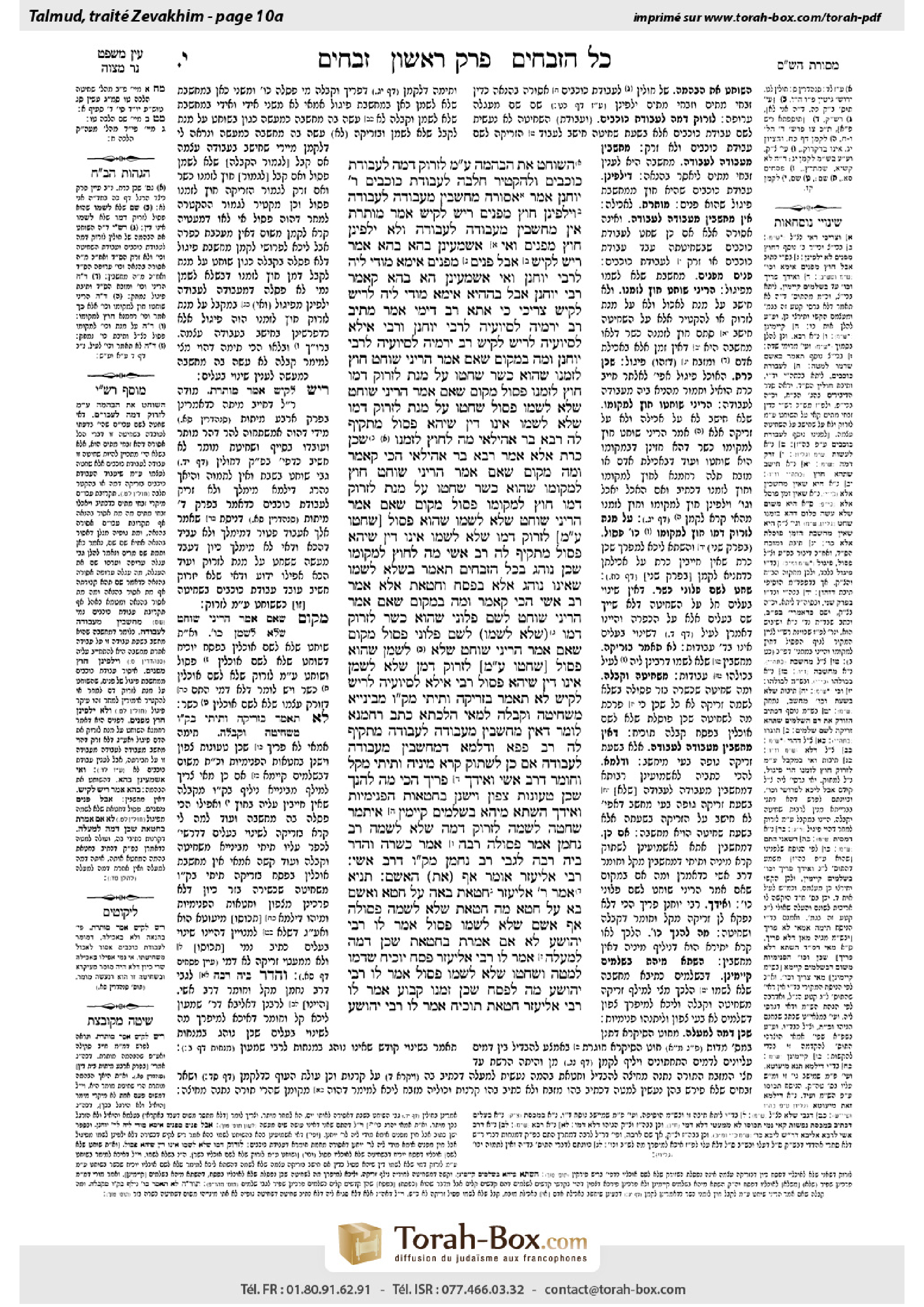
Zevachim 10a: Talmud study for Daf Yomi
Daf Yomi is the daily study of one Talmud folio. Explore 37 tractates with scans, Hebrew text, Sefaria English and AI-generated French translations where annotated.
Passage selection and English or AI-generated French translation are available where the scan has annotations. Daf Study is independent of Torah-Box and Sefaria.
Browse Zevachim · זבחים · All tractatesZevachim 10a text and translations
This page of Zevachim includes the Aramaic text, an English translation and an AI-generated French translation, alongside the scan above.
זבחים י׳ א · Aramaic and Hebrew text
הַשּׁוֹחֵט אֶת הַבְּהֵמָה עַל מְנָת לִזְרוֹק דָּמָהּ לַעֲבוֹדָה זָרָה, וּלְהַקְטִיר חֶלְבָּהּ לַעֲבוֹדָה זָרָה – רַבִּי יוֹחָנָן אָמַר: אֲסוּרָה; מְחַשְּׁבִין מֵעֲבוֹדָה לַעֲבוֹדָה, וְיָלְפִינַן חוּץ מִבִּפְנִים.
רֵישׁ לָקִישׁ אָמַר: מוּתֶּרֶת; אֵין מְחַשְּׁבִין מֵעֲבוֹדָה לַעֲבוֹדָה, וְלָא יָלְפִינַן חוּץ מִפְּנִים.
וְאִי אַשְׁמְעִינַן בְּהָא – בְּהָא אָמַר רֵישׁ לָקִישׁ, אֲבָל פְּנִים מִפְּנִים אֵימָא מוֹדֵי לֵיהּ לְרַבִּי יוֹחָנָן;
וְאִי אַשְׁמְעִינַן הָא – בְּהָא קָאָמַר רַבִּי יוֹחָנָן, אֲבָל בְּהַהִיא אֵימָא מוֹדֵי לֵיהּ לְרֵישׁ לָקִישׁ; צְרִיכִי.
כִּי אֲתָא רַב דִּימִי, אָמַר: מֵתִיב רַב יִרְמְיָה לְסַיּוֹעֵיהּ לְרַבִּי יוֹחָנָן, וְרַבִּי אִילָא לְסַיּוֹעֵיהּ לְרֵישׁ לָקִישׁ.
רַב יִרְמְיָה לְסַיּוֹעֵיהּ לְרַבִּי יוֹחָנָן: וּמָה בִּמְקוֹם שֶׁאִם אָמַר ״הֲרֵינִי שׁוֹחֵט חוּץ לִזְמַנּוֹ״ שֶׁהוּא כָּשֵׁר, שְׁחָטוֹ עַל מְנָת לִזְרוֹק דָּמוֹ חוּץ לִזְמַנּוֹ – פָּסוּל; מָקוֹם שֶׁאִם אָמַר ״הֲרֵינִי שׁוֹחֵט שֶׁלֹּא לִשְׁמוֹ״ – פָּסוּל, שְׁחָטוֹ עַל מְנָת לִזְרוֹק דָּמוֹ שֶׁלֹּא לִשְׁמוֹ – אֵינוֹ דִּין שֶׁיְּהֵא פָּסוּל?!
מַתְקֵיף לַהּ רָבָא בַּר אֲהִילַאי: מָה לְחוּץ לִזְמַנּוֹ, שֶׁכֵּן כָּרֵת!
אֶלָּא אָמַר רָבָא בַּר אֲהִילַאי, הָכִי קָאָמַר: וּמָה מָקוֹם שֶׁאִם אָמַר ״הֲרֵינִי שׁוֹחֵט חוּץ לִמְקוֹמוֹ״ שֶׁהוּא כָּשֵׁר, שְׁחָטוֹ עַל מְנָת לִזְרוֹק דָּמוֹ חוּץ לִמְקוֹמוֹ – פָּסוּל; מָקוֹם שֶׁאִם אָמַר ״הֲרֵינִי שׁוֹחֵט שֶׁלֹּא לִשְׁמוֹ״ שֶׁהוּא פָּסוּל, [שְׁחָטוֹ עַל מְנָת] לִזְרוֹק דָּמוֹ שֶׁלֹּא לִשְׁמוֹ – אֵינוֹ דִּין שֶׁיְּהֵא פָּסוּל?!
מַתְקֵיף לַהּ רַב אָשֵׁי: מַה לְחוּץ לִמְקוֹמוֹ – שֶׁכֵּן נוֹהֵג בְּכׇל הַזְּבָחִים; תֹּאמַר בְּשֶׁלֹּא לִשְׁמוֹ – שֶׁאֵינוֹ נוֹהֵג אֶלָּא בְּפֶסַח וְחַטָּאת?!
אֶלָּא אָמַר רַב אָשֵׁי, הָכִי קָאָמַר: וּמָה בְּמָקוֹם שֶׁאִם אָמַר ״הֲרֵינִי שׁוֹחֵט לְשֵׁם פְּלוֹנִי״ שֶׁהוּא כָּשֵׁר, לִזְרוֹק דָּמוֹ (שֶׁלֹּא לִשְׁמוֹ) לְשֵׁם פְּלוֹנִי – פָּסוּל; מָקוֹם שֶׁאִם אָמַר ״הֲרֵינִי שׁוֹחֵט שֶׁלֹּא לִשְׁמָן״ שֶׁהוּא פָּסוּל, [שְׁחָטוֹ עַל מְנָת] לִזְרוֹק דָּמָן שֶׁלֹּא לִשְׁמָן – אֵינוֹ דִּין שֶׁיְּהֵא פָּסוּל?!
רַבִּי אִילָא לְסַיּוֹעֵיהּ לְרֵישׁ לָקִישׁ: לֹא תֹּאמַר בִּזְרִיקָה, וְתֵיתֵי מִקַּל וָחוֹמֶר מִבֵּינַיָּיא מִשְּׁחִיטָה וְקַבָּלָה! לְמַאי הִלְכְתָא כְּתַב רַחֲמָנָא? לוֹמַר דְּאֵין מְחַשְּׁבִין מֵעֲבוֹדָה לַעֲבוֹדָה.
מַתְקֵיף לַהּ רַב פָּפָּא: וְדִלְמָא דִּמְחַשְּׁבִין מֵעֲבוֹדָה לַעֲבוֹדָה!
אִם כֵּן, לִשְׁתּוֹק קְרָא מִינֵּיהּ, וְתֵיתֵי מִקַּל וָחוֹמֶר דְּרַב אָשֵׁי.
וְאִידָּךְ פָּרֵיךְ הָכִי: מָה לְהָנָךְ – שֶׁכֵּן טְעוּנוֹת צָפוֹן, וְיֶשְׁנָן בְּחַטָּאוֹת הַפְּנִימִיּוֹת!
וְאִידַּךְ – הַשְׁתָּא מִיהָא בִּשְׁלָמִים קַיָּימִין.
אִיתְּמַר: שְׁחָטָהּ לִשְׁמָהּ, לִזְרוֹק דָּמָהּ שֶׁלֹּא לִשְׁמָהּ – רַב נַחְמָן אָמַר: פְּסוּלָה, רַבָּה אָמַר: כְּשֵׁרָה. וַהֲדַר בֵּיהּ רַבָּה לְגַבֵּי רַב נַחְמָן, מִקַּל וָחוֹמֶר דְּרַב אָשֵׁי.
רַבִּי אֱלִיעֶזֶר אוֹמֵר: אַף (אֶת) הָאָשָׁם. תַּנְיָא, אָמַר רַבִּי אֱלִיעֶזֶר: חַטָּאת בָּאָה עַל חֵטְא, וְאָשָׁם בָּא עַל חֵטְא; מָה חַטָּאת שֶׁלֹּא לִשְׁמָהּ – פְּסוּלָה, אַף אָשָׁם שֶׁלֹּא לִשְׁמוֹ – פָּסוּל.
אָמַר לוֹ רַבִּי יְהוֹשֻׁעַ: לֹא; אִם אָמַרְתָּ בְּחַטָּאת – שֶׁכֵּן דָּמָהּ לְמַעְלָה!
אָמַר לוֹ רַבִּי אֱלִיעֶזֶר: פֶּסַח יוֹכִיחַ – שֶׁדָּמוֹ לְמַטָּה, וּשְׁחָטוֹ שֶׁלֹּא לִשְׁמוֹ פָּסוּל.
אָמַר לוֹ רַבִּי יְהוֹשֻׁעַ: מָה לְפֶסַח – שֶׁכֵּן זְמַנּוֹ קָבוּעַ!
אָמַר לוֹ רַבִּי אֱלִיעֶזֶר: חַטָּאת תּוֹכִיחַ.
אָמַר לוֹ רַבִּי יְהוֹשֻׁעַ:
Zevachim 10a · English translation
With regard to one who slaughters an animal in order to sprinkle its blood for idol worship, or in order to burn its forbidden fat for idol worship, Rabbi Yoḥanan says: Deriving benefit from the animal is prohibited, as it is considered an offering to idol worship, even if ultimately its blood was not sprinkled or its fat burned to that effect. This is because one can have intention from one rite to affect another rite; idolatrous intent while slaughtering the animal renders it forbidden, even if the intention pertains not to the slaughter itself but to the sprinkling of the blood or the burning of the forbidden fat. And this halakha is derived from the halakhot of piggul, as we derive halakhot of idol worship, which are applicable even outside the Temple, from halakhot concerning intent that apply inside the Temple.
Reish Lakish says: Deriving benefit from the animal is permitted. One cannot have intention from one rite to affect another rite, and we do not derive halakhot applicable outside the Temple from halakhot that apply inside the Temple.
Although both disputes are essentially the same, each is necessary. And if the Sages had taught us the dispute only with regard to that issue, namely, an animal slaughtered with idolatrous intent, one would have reasoned that Reish Lakish says his opinion only with regard to that issue, as he maintains that halakhot applicable outside the Temple are not derived from halakhot applicable only inside the Temple. But with regard to an offering that was slaughtered with the intention of sprinkling its blood not for its sake, one might say that he concedes to Rabbi Yoḥanan that it is disqualified, as halakhot applicable inside the Temple can be derived from other halakhot applicable inside the Temple.
And if the Sages had taught us the dispute only with regard to this issue, namely, an offering that was slaughtered with the intention of sprinkling its blood not for its sake, one might claim that Rabbi Yoḥanan says his opinion only with regard to this issue, which concerns halakhot applicable inside the Temple. But with regard to that issue, an animal that was slaughtered with idolatrous intent, one would say that he concedes to the opinion of Reish Lakish that halakhot applicable outside the Temple are not derived from halakhot applicable only inside the Temple. Therefore, both statements are necessary.
When Rav Dimi came from Eretz Yisrael, he said: Rav Yirmeya responds to this dispute by eliciting evidence to support the opinion of Rabbi Yoḥanan; and Rabbi Ila elicits evidence to support the opinion of Reish Lakish.
Rav Dimi elaborated: Rav Yirmeya elicits evidence to support the opinion of Rabbi Yoḥanan by an a fortiori inference: Just as in the case of improper intent with regard to the offering’s time, where if the one slaughtering the offering said: I am hereby slaughtering it beyond its designated time, it is fit, and nevertheless, if he slaughtered it in order to sprinkle its blood beyond its designated time, it is unfit, so too, in the case of deviation from the type of offering, where even if he said: I am hereby slaughtering it not for its sake, it is unfit, isn’t it logical that if he slaughtered it in order to sprinkle its blood not for its sake, it should be unfit?
Rava bar Ahilai objects to this inference: One cannot claim that deviation from the type of offering is a more severe transgression than intent to consume it or sprinkle its blood beyond its designated time, since the latter has its own element of stringency. What is notable about intent beyond its designated time? It is notable in that one who eats the meat of such an offering is liable to be punished with karet, whereas one who eats the meat of an offering disqualified due to deviation from the type of offering is not.
Rather, Rava bar Ahilai says: Rav Yirmeya was actually referring to improper intent with regard to the offering’s designated area, since consumption of an offering thereby disqualified is not punishable by karet. And this is what he is saying: Just as in the case of improper intent with regard to the offering’s designated area, where if the one slaughtering the offering said: I am hereby slaughtering it outside its designated area, it is fit, and nevertheless, if he slaughtered it in order to sprinkle its blood outside its designated area, it is unfit, so too, in the case of deviation from the type of offering, where even if he said: I am hereby slaughtering it not for its sake, it is unfit, isn’t it logical that if he slaughtered it in order to sprinkle its blood not for its sake, it should be unfit?
Rav Ashi objects to this inference: What is notable about intent to sprinkle the blood outside its designated area? It is notable in that the disqualification applies to all slaughtered offerings. Can you say that the same halakhot govern the disqualification of an offering sacrificed not for its sake, which applies only to a Paschal offering and a sin offering?
Rather, Rav Ashi says: This is what Rav Yirmeya is saying: Just as in the case of deviation with regard to the owner, where, if the one slaughtering the offering said: I am hereby slaughtering it for the sake of so-and-so, it is fit, and nevertheless, if he slaughtered it in order to sprinkle its blood for the sake of so-and-so, it is unfit, so too, in the case of deviation from the type of offering, where even if he said: I am hereby slaughtering it not for its sake, it is unfit, isn’t it logical that if he slaughtered it in order to sprinkle its blood not for its sake, it should be unfit? The opinion of Rabbi Yoḥanan is supported by this logical line of reasoning.
Rabbi Ila elicits evidence to support the opinion of Reish Lakish, that performance of one rite with improper intent with regard to another rite is of no consequence: The Torah should not have stated the requirement of sacrificing an offering for its own sake with regard to sprinkling of the blood, and rather should have let one derive it by an a fortiori inference from the common element of two other rites, from slaughter and collection of the blood. If so, for what halakha does the Merciful One write this redundant requirement? It is in order to say that one cannot have intention from one rite to affect another rite.
Rav Pappa objects to this derivation: But perhaps the requirement is written to teach the opposite, that one can have intention from one rite to affect another rite. A redundant requirement should expand, not reduce, the scope of actions that can disqualify the offering.
The Gemara answers: If that were so, let the verse remain silent with regard to sprinkling the blood for the sake of the offering, and one could derive that one can have intention from one rite to affect another rite from Rav Ashi’s aforementioned a fortiori inference. The verse must be meant to counteract that inference and teach that one cannot have intention from one rite to affect another rite.
And the other amora, Rabbi Yoḥanan, would refute Rabbi Ila’s proof like this: It is necessary for the Torah to state the requirement with regard to sprinkling. It cannot be derived from the cases of slaughter and collection of the blood, since these two share an element of stringency that sprinkling lacks. What is notable about these? They are notable in that in offerings of the most sacred order they must be performed in the north of the Temple courtyard. And furthermore, they are performed in the sacrifice of inner sin offerings as well as external sin offerings, unlike the sprinkling of the blood on the external altar.
And the other amora, Reish Lakish, would respond that now, in any event, we stand in a discussion with regard to peace offerings, since the requirement of sacrifice for the offering’s sake is derived from the verses concerning peace offerings. Peace offerings are neither offerings of the most sacred order nor inner sin offerings, and therefore the elements of stringency mentioned above are irrelevant.
A parallel dispute was stated: If one slaughtered a sin offering for its sake but with intent to sprinkle its blood not for its sake, Rav Naḥman says that the offering is unfit, and Rabba says that it is fit. And Rabba retracted his opinion, and conceded to Rav Naḥman, due to Rav Ashi’s a fortiori inference.
§ The mishna teaches: Rabbi Eliezer says: The guilt offering, too, is unfit when sacrificed not for its sake. With regard to this it is taught in a baraita: Rabbi Eliezer said: A sin offering is brought for committing a transgression and a guilt offering is brought for committing a transgression. Just as a sin offering sacrificed not for its sake is unfit, so too, a guilt offering sacrificed not for its sake is unfit.
Rabbi Yehoshua said to him: The inference is not valid. If you say this with regard to a sin offering, whose blood is sprinkled above the red line that encircles the altar, should you necessarily say the same with regard to a guilt offering, whose blood is sprinkled below that line, like most animal offerings?
Rabbi Eliezer said to him: A Paschal offering can prove the point, as its blood is sprinkled below the red line, and nevertheless, if one slaughtered it not for its sake it is unfit.
Rabbi Yehoshua said to him: A Paschal offering cannot serve as the source either, since it possesses a unique element of stringency. What is notable about a Paschal offering? It is notable in that its designated time is fixed. A guilt offering does not have a fixed time.
Rabbi Eliezer said to him: A sin offering can prove the point, as it does not have a fixed time, and nevertheless, it is disqualified if sacrificed not for its sake.
Rabbi Yehoshua said to him:
Zevachim 10a · Traduction française (IA)
À propos de celui qui égorge un animal afin d’asperger son sang pour le culte idolâtre, ou de brûler son suif interdit pour le culte idolâtre, Rabbi Yoḥanan dit : il est interdit de tirer profit de l’animal, car celui-ci est considéré comme une offrande au culte idolâtre, même si, finalement, son sang n’a pas été aspergé ni son suif brûlé à cette fin. En effet, une intention concernant un rite peut avoir une incidence sur un autre rite : l’intention idolâtre formulée au moment de l’égorgement rend l’animal interdit, même si elle concerne non l’égorgement lui-même, mais l’aspersion du sang ou la combustion du suif interdit. Cette halakha se déduit des lois du piggoul : nous déduisons les lois du culte idolâtre, qui s’appliquent même hors du Temple, des lois relatives aux intentions qui s’appliquent dans le Temple.
Reish Lakish dit : il est permis de tirer profit de l’animal. Une intention concernant un rite ne peut pas avoir d’incidence sur un autre rite, et nous ne déduisons pas les lois applicables hors du Temple de celles qui s’appliquent dans le Temple.
Bien que ces deux désaccords portent au fond sur le même principe, chacun est nécessaire. Si les Sages nous avaient enseigné le désaccord uniquement à propos de cette question, à savoir celle d’un animal égorgé avec une intention idolâtre, on aurait pu penser que Reish Lakish ne soutient son avis que sur ce point, puisqu’il estime que les lois applicables hors du Temple ne se déduisent pas de celles qui s’appliquent uniquement dans le Temple. Mais, à propos d’une offrande égorgée avec l’intention d’asperger son sang autrement que pour elle-même, on aurait pu penser qu’il reconnaît à Rabbi Yoḥanan qu’elle est invalidée, puisque l’on peut déduire des lois applicables dans le Temple d’autres lois qui s’y appliquent également.
Et si les Sages nous avaient enseigné le désaccord uniquement à propos de cette question, à savoir celle d’une offrande égorgée avec l’intention d’asperger son sang autrement que pour elle-même, on aurait pu prétendre que Rabbi Yoḥanan ne soutient son avis que sur ce point, qui concerne les lois applicables dans le Temple. Mais, à propos de l’autre question, celle d’un animal égorgé avec une intention idolâtre, on aurait dit qu’il reconnaît l’avis de Reish Lakish, selon lequel les lois applicables hors du Temple ne se déduisent pas de celles qui s’appliquent uniquement dans le Temple. Les deux enseignements sont donc nécessaires.
Lorsque Rav Dimi arriva d’Eretz Israël, il dit : Rav Yirmeya apporte des preuves à l’appui de l’avis de Rabbi Yoḥanan, tandis que Rabbi Ila apporte des preuves à l’appui de l’avis de Reish Lakish.
Rav Dimi précisa : Rav Yirmeya étaye l’avis de Rabbi Yoḥanan au moyen d’un raisonnement a fortiori : de même que, dans le cas d’une intention irrégulière concernant le temps prévu pour l’offrande, si celui qui égorge l’offrande dit : « Voici que je l’égorge après le temps qui lui est fixé », elle reste apte, et que néanmoins, s’il l’a égorgée afin d’asperger son sang après le temps qui lui est fixé, elle est inapte ; de même, dans le cas d’un changement de catégorie d’offrande, où même si celui qui l’égorge a dit : « Voici que je l’égorge autrement que pour elle-même », elle est inapte, n’est-il pas logique que, s’il l’a égorgée afin d’asperger son sang autrement que pour elle-même, elle soit inapte ?
Rava bar Ahilai objecte à ce raisonnement : on ne peut pas affirmer qu’un changement de catégorie d’offrande constitue une transgression plus grave qu’une intention de la consommer ou d’en asperger le sang après le temps qui lui est fixé, car cette dernière comporte elle aussi un élément de rigueur. En quoi l’intention de dépasser le temps fixé est-elle remarquable ? En ceci que celui qui mange la viande d’une telle offrande encourt le châtiment du karet, tandis que celui qui mange la viande d’une offrande invalidée à la suite d’un changement de catégorie n’encourt pas ce châtiment.
Rava bar Ahilai dit plutôt : Rav Yirmeya faisait en réalité référence à une intention irrégulière concernant l’endroit prévu pour l’offrande, puisque la consommation d’une offrande invalidée de cette manière n’est pas passible du karet. Voici donc ce qu’il dit : de même que, dans le cas d’une intention irrégulière concernant l’endroit prévu pour l’offrande, si celui qui égorge l’offrande dit : « Voici que je l’égorge en dehors de l’endroit qui lui est prévu », elle reste apte, et que néanmoins, s’il l’a égorgée afin d’asperger son sang en dehors de cet endroit, elle est inapte ; de même, dans le cas d’un changement de catégorie d’offrande, où même si celui qui l’égorge a dit : « Voici que je l’égorge autrement que pour elle-même », elle est inapte, n’est-il pas logique que, s’il l’a égorgée afin d’asperger son sang autrement que pour elle-même, elle soit inapte ?
Rav Ashi objecte à ce raisonnement : en quoi l’intention d’asperger le sang en dehors de l’endroit prévu est-elle remarquable ? En ceci que cette invalidation s’applique à toutes les offrandes égorgées. Peut-on dire que les mêmes lois régissent l’invalidation d’une offrande sacrifiée autrement que pour elle-même, qui ne concerne que l’offrande pascale et le sacrifice expiatoire ?
Rav Ashi dit plutôt : voici ce que Rav Yirmeya veut dire : de même que, dans le cas d’un changement concernant le propriétaire, si celui qui égorge l’offrande dit : « Voici que je l’égorge pour Untel », elle reste apte, et que néanmoins, s’il l’a égorgée afin d’asperger son sang pour Untel, elle est inapte ; de même, dans le cas d’un changement de catégorie d’offrande, où même si celui qui l’égorge a dit : « Voici que je l’égorge autrement que pour elle-même », elle est inapte, n’est-il pas logique que, s’il l’a égorgée afin d’asperger son sang autrement que pour elle-même, elle soit inapte ? Ce raisonnement logique étaye l’avis de Rabbi Yoḥanan.
Rabbi Ila apporte des preuves à l’appui de l’avis de Reish Lakish, selon lequel accomplir un rite avec une intention irrégulière concernant un autre rite n’a aucune conséquence : la Torah n’aurait pas dû énoncer l’exigence d’accomplir l’aspersion du sang pour l’offrande elle-même ; il aurait plutôt fallu la déduire au moyen d’un raisonnement a fortiori, à partir de l’élément commun à deux autres rites, l’égorgement et le recueil du sang. Si tel est le cas, pourquoi le Miséricordieux, c’est-à-dire la Torah, a-t-il écrit cette exigence redondante ? C’est pour enseigner qu’une intention concernant un rite ne peut pas avoir d’incidence sur un autre rite.
Rav Pappa objecte à cette déduction : mais peut-être cette exigence a-t-elle été écrite pour enseigner le contraire, à savoir qu’une intention concernant un rite peut avoir une incidence sur un autre rite. Une exigence redondante devrait étendre, et non réduire, l’éventail des actes susceptibles d’invalider l’offrande.
La Guemara répond : si tel était le cas, que le verset garde le silence au sujet de l’aspersion du sang pour l’offrande elle-même, et l’on pourrait déduire, à partir du raisonnement a fortiori de Rav Ashi mentionné précédemment, qu’une intention concernant un rite peut avoir une incidence sur un autre rite. Le verset doit donc viser à contrecarrer cette déduction et à enseigner qu’une intention concernant un rite ne peut pas avoir d’incidence sur un autre rite.
L’autre amora, Rabbi Yoḥanan, réfuterait ainsi la preuve de Rabbi Ila : il était nécessaire que la Torah énonce cette exigence à propos de l’aspersion. On ne peut pas la déduire des cas de l’égorgement et du recueil du sang, car ces deux rites partagent un élément de rigueur dont l’aspersion est dépourvue. En quoi ces rites sont-ils remarquables ? En ceci que, pour les offrandes de sainteté suprême, ils doivent être accomplis au nord de la cour du Temple. De plus, ils sont accomplis aussi bien pour les sacrifices expiatoires intérieurs que pour les sacrifices expiatoires extérieurs, contrairement à l’aspersion du sang sur l’autel extérieur.
L’autre amora, Reish Lakish, répondrait qu’en tout état de cause, la discussion porte ici sur les offrandes de paix, puisque l’exigence de sacrifier l’offrande pour elle-même est déduite des versets concernant les offrandes de paix. Celles-ci ne sont ni des offrandes de sainteté suprême ni des sacrifices expiatoires intérieurs ; les éléments de rigueur mentionnés plus haut ne sont donc pas pertinents.
Un désaccord parallèle a été rapporté : si quelqu’un égorge un sacrifice expiatoire pour lui-même, mais avec l’intention d’asperger son sang autrement que pour lui-même, Rav Naḥman dit que l’offrande est inapte, tandis que Rabba dit qu’elle est apte. Rabba est revenu sur son avis et s’est rangé à celui de Rav Naḥman, en raison du raisonnement a fortiori de Rav Ashi.
§ La Michna enseigne : Rabbi Eliezer dit que le sacrifice de culpabilité, lui aussi, est inapte lorsqu’il est sacrifié autrement que pour lui-même. À ce propos, une baraïta enseigne : Rabbi Eliezer a dit : « Un sacrifice expiatoire est apporté pour avoir commis une transgression, et un sacrifice de culpabilité est apporté pour avoir commis une transgression. De même qu’un sacrifice expiatoire sacrifié autrement que pour lui-même est inapte, de même un sacrifice de culpabilité sacrifié autrement que pour lui-même est inapte. »
Rabbi Yehoshua lui dit : cette déduction n’est pas valable. Si tu affirmes cela au sujet d’un sacrifice expiatoire, dont le sang est aspergé au-dessus de la ligne rouge qui ceint l’autel, peux-tu nécessairement affirmer la même chose au sujet d’un sacrifice de culpabilité, dont le sang est aspergé au-dessous de cette ligne, comme pour la plupart des sacrifices animaux ?
Rabbi Eliezer lui dit : l’offrande pascale peut servir de preuve, car son sang est aspergé au-dessous de la ligne rouge et pourtant, si on l’égorge autrement que pour elle-même, elle est inapte.
Rabbi Yehoshua lui dit : l’offrande pascale ne peut pas non plus servir de source, car elle comporte un élément de rigueur particulier. En quoi l’offrande pascale est-elle remarquable ? En ceci que son temps est fixé. Le sacrifice de culpabilité, lui, n’a pas de temps fixé.
Rabbi Eliezer lui dit : le sacrifice expiatoire peut servir de preuve, car il n’a pas de temps fixé et pourtant, il est invalidé s’il est sacrifié autrement que pour lui-même.
Rabbi Yehoshua lui dit :
Traduction française générée par IA à partir de l’édition anglaise de Sefaria. Vérifie toujours un passage avec le texte source.
Text from Sefaria: William Davidson Edition - Vocalized Aramaic (CC BY NC); William Davidson Edition - English (CC BY NC).