Zevachim 10b: Talmud study for Daf Yomi
Daf Yomi is the daily study of one Talmud folio. Explore 37 tractates with scans, Hebrew text, Sefaria English and AI-generated French translations where annotated.
Passage selection and English or AI-generated French translation are available where the scan has annotations. Daf Study is independent of Torah-Box and Sefaria.
Browse Zevachim · זבחים · All tractatesZevachim 10b text and translations
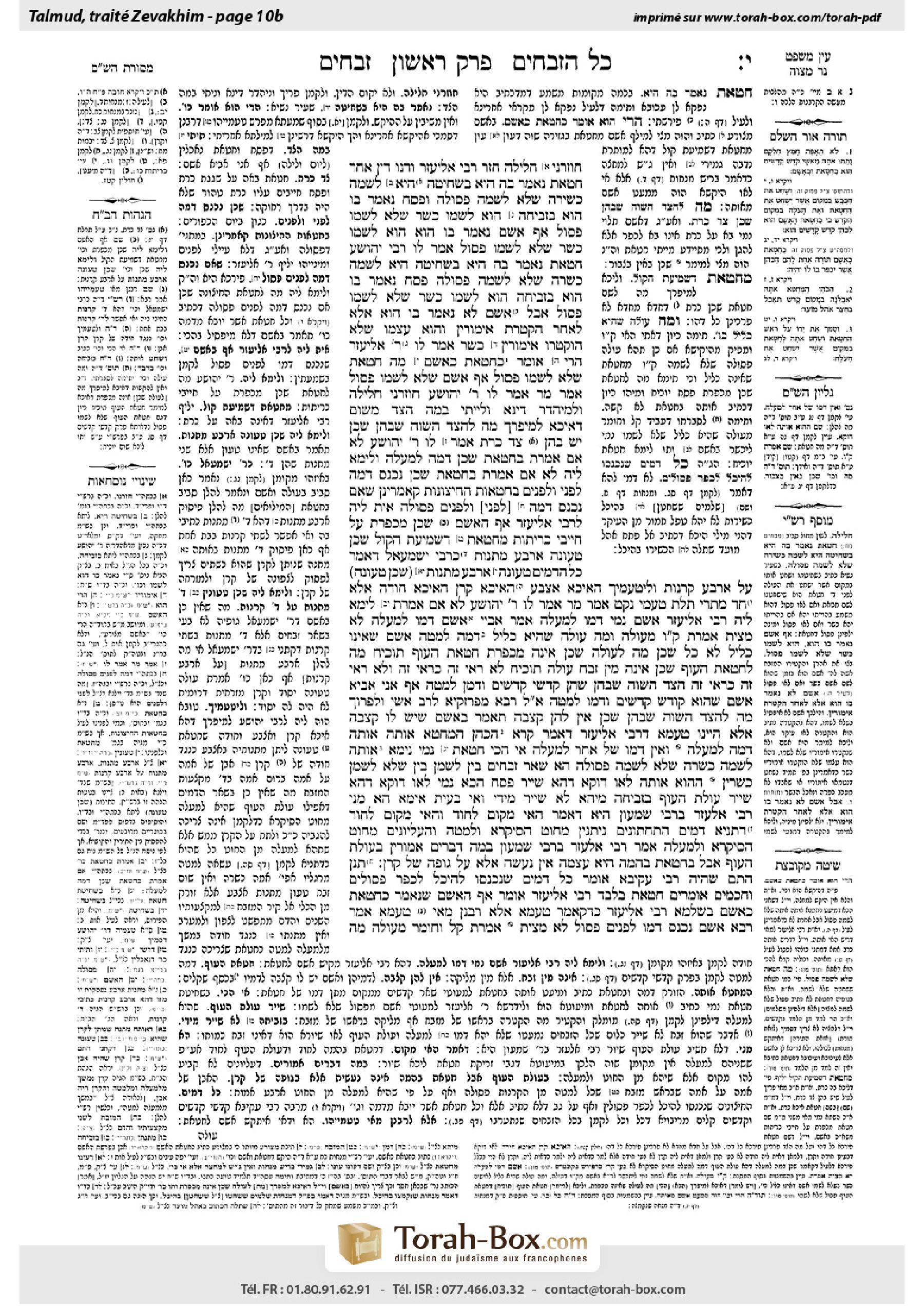
This page of Zevachim includes the Aramaic text, an English translation and an AI-generated French translation, alongside the scan above.
זבחים י׳ ב · Aramaic and Hebrew text
חוֹזְרַנִי חֲלִילָה.
חָזַר רַבִּי אֱלִיעֶזֶר וְדָנוֹ דִּין אַחֵר: חַטָּאת נֶאֱמַר בָּהּ ״הִיא״ בִּשְׁחִיטָה – הִיא לִשְׁמָהּ כְּשֵׁירָה, שֶׁלֹּא לִשְׁמָהּ פְּסוּלָה; וּפֶסַח נֶאֱמַר בּוֹ ״הוּא״ בִּזְבִיחָה – הוּא לִשְׁמוֹ כָּשֵׁר, שֶׁלֹּא לִשְׁמוֹ פָּסוּל;
אַף אָשָׁם נֶאֱמַר בּוֹ ״הוּא״ – הוּא לִשְׁמוֹ כָּשֵׁר, שֶׁלֹּא לִשְׁמוֹ פָּסוּל.
אָמַר לוֹ רַבִּי יְהוֹשֻׁעַ: חַטָּאת נֶאֱמַר בָּהּ ״הִיא״ בִּשְׁחִיטָה – הִיא לִשְׁמָהּ כְּשֵׁרָה, שֶׁלֹּא לִשְׁמָהּ פְּסוּלָה. פֶּסַח נֶאֱמַר בּוֹ ״הוּא״ בִּזְבִיחָה – הוּא לִשְׁמוֹ כָּשֵׁר, שֶׁלֹּא לִשְׁמוֹ פָּסוּל. אֲבָל אָשָׁם, לֹא נֶאֱמַר בּוֹ ״הוּא״ – אֶלָּא לְאַחַר הַקְטָרַת אֵימוּרִין, וְהוּא עַצְמוֹ שֶׁלֹּא הוּקְטְרוּ אֵימוּרִין – כָּשֵׁר!
אָמַר לוֹ רַבִּי אֱלִיעֶזֶר, הֲרֵי [הוּא] אוֹמֵר: ״כַּחַטָּאת כָּאָשָׁם״ – מָה חַטָּאת שֶׁלֹּא לִשְׁמוֹ פָּסוּל, אַף אָשָׁם שֶׁלֹּא לִשְׁמוֹ פָּסוּל.
אָמַר מָר: אָמַר לוֹ רַבִּי יְהוֹשֻׁעַ: חוֹזְרַנִי חֲלִילָה. וּלְמִיהְדַּר דִּינָא, וְלַיְיתֵי בְּ״מָה הַצַּד״!
מִשּׁוּם דְּאִיכָּא לְמִיפְרַךְ: מָה לְהַצַּד הַשָּׁוֶה שֶׁבָּהֶן – שֶׁכֵּן יֵשׁ בָּהֶן צַד כָּרֵת.
אָמַר לוֹ רַבִּי יְהוֹשֻׁעַ: לֹא; אִם אָמַרְתָּ בְּחַטָּאת – שֶׁכֵּן דָּמָהּ לְמַעְלָה! וְלֵימָא לֵיהּ: לֹא; אִם אָמַרְתָּ בְּחַטָּאת – שֶׁכֵּן נִכְנַס דָּמָהּ לִפְנַי וְלִפְנִים!
בְּחַטָּאוֹת הַחִיצוֹנוֹת קָאָמְרִינַן.
שֶׁאִם נִכְנַס דָּמָהּ [לִפְנַי] וְלִפְנִים – פְּסוּלָה!
אִית לֵיהּ לְרַבִּי אֱלִיעֶזֶר ״אַף הָאָשָׁם״.
שֶׁכֵּן מְכַפֶּרֶת עַל חַיָּיבֵי כָרֵיתוֹת!
מֵחַטָּאת דִּשְׁמִיעַת הַקּוֹל.
שֶׁכֵּן טְעוּנָה אַרְבַּע מַתָּנוֹת!
כְּרַבִּי יִשְׁמָעֵאל, דְּאָמַר: כׇּל הַדָּמִים (טְעוּנָה) [טְעוּנִין] אַרְבַּע מַתָּנוֹת.
שֶׁכֵּן טְעוּנָה עַל אַרְבַּע קְרָנוֹת!
וְלִיטַעְמָיךְ, הָאִיכָּא אֶצְבַּע! הָאִיכָּא קֶרֶן! הָאִיכָּא חוּדָּהּ! אֶלָּא חַד מִתְּרֵי תְּלָת טַעְמֵי נָקֵט.
אָמַר מָר, אָמַר לוֹ רַבִּי יְהוֹשֻׁעַ: לֹא, אִם אָמַרְתָּ. לֵימָא לֵיהּ רַבִּי אֱלִיעֶזֶר: אָשָׁם נָמֵי דָּמוֹ לְמַעְלָה!
אָמַר אַבָּיֵי: אָשָׁם דָּמוֹ לְמַעְלָה לָא מָצֵית אָמְרַתְּ, קַל וְחוֹמֶר מֵעוֹלָה; וּמָה עוֹלָה שֶׁהִיא כָּלִיל – דָּמָהּ לְמַטָּה, אָשָׁם שֶׁאֵינוֹ כָּלִיל – לֹא כׇּל שֶׁכֵּן?!
מָה לְעוֹלָה, שֶׁכֵּן אֵינָהּ מְכַפֶּרֶת!
חַטַּאת הָעוֹף תּוֹכִיחַ.
מָה לְחַטַּאת הָעוֹף, שֶׁכֵּן אֵינָהּ מִין זֶבַח!
עוֹלָה תּוֹכִיחַ. לֹא רְאִי זֶה כִּרְאִי זֶה, וְלֹא רְאִי זֶה כִּרְאִי זֶה. הַצַּד הַשָּׁוֶה שֶׁבָּהֶן – שֶׁהֵן קׇדְשֵׁי קָדָשִׁים, וְדָמָן לְמַטָּה; אַף אֲנִי אָבִיא אָשָׁם – שֶׁהוּא קוֹדֶשׁ קֳדָשִׁים, וְדָמוֹ לְמַטָּה.
אֲמַר לֵיהּ רָבָא מִפַּרְזִקְיָא לְרַב אָשֵׁי: וְלִפְרוֹךְ, מָה לְהַצַּד הַשָּׁוֶה שֶׁבָּהֶן – שֶׁכֵּן אֵין לָהֶן קִצְבָה; תֹּאמַר בְּאָשָׁם – שֶׁיֵּשׁ לוֹ קִצְבָה?!
אֶלָּא הַיְינוּ טַעְמָא דְּרַבִּי אֱלִיעֶזֶר, דְּאָמַר קְרָא: ״הַכֹּהֵן הַמְחַטֵּא אוֹתָהּ״ – אוֹתָהּ דָּמָהּ לְמַעְלָה, וְאֵין דָּמוֹ שֶׁל אַחֵר לְמַעְלָה.
אִי הָכִי, חַטָּאת נָמֵי נֵימָא: אוֹתָהּ – לִשְׁמָהּ כְּשֵׁרָה, שֶׁלֹּא לִשְׁמָהּ פְּסוּלָה; הָא שְׁאָר זְבָחִים – בֵּין לִשְׁמָן בֵּין שֶׁלֹּא לִשְׁמָן כְּשֵׁרִין!
הָהוּא ״אוֹתָהּ״ לָאו דַּוְקָא, דְּהָא שַׁיַּיר פֶּסַח.
הָכָא נָמֵי לָאו דַּוְקָא, דְּהָא שַׁיַּיר עוֹלַת הָעוֹף!
בִּזְבִיחָה מִיהָא לָא שַׁיַּיר מִידֵּי.
וְאִי בָּעֵית אֵימָא: הָא מַנִּי – רַבִּי אֶלְעָזָר בְּרַבִּי שִׁמְעוֹן הִיא, דְּאָמַר: הַאי מָקוֹם לְחוֹד, וְהַאי מָקוֹם לְחוֹד.
דְּתַנְיָא: דָּמִים הַתַּחְתּוֹנִים נִיתָּנִין מִחוּט הַסִּיקְרָא וּלְמַטָּה, וְהָעֶלְיוֹנִים מִחוּט הַסִּיקְרָא וּלְמַעְלָה. אָמַר רַבִּי אֶלְעָזָר בְּרַבִּי שִׁמְעוֹן: בַּמֶּה דְּבָרִים אֲמוּרִין – בְּעוֹלַת הָעוֹף; אֲבָל בְּחַטַּאת בְּהֵמָה – הִיא עַצְמָהּ אֵין נַעֲשֶׂה אֶלָּא עַל גּוּפָהּ שֶׁל קֶרֶן.
תְּנַן הָתָם, שֶׁהָיָה רַבִּי עֲקִיבָא אוֹמֵר: כׇּל דָּמִים שֶׁנִּכְנְסוּ לַהֵיכָל לְכַפֵּר – פְּסוּלִים. וַחֲכָמִים אוֹמְרִים: חַטָּאת בִּלְבַד. רַבִּי אֱלִיעֶזֶר אוֹמֵר: אַף הָאָשָׁם, שֶׁנֶּאֱמַר: ״כַּחַטָּאת כָּאָשָׁם״.
בִּשְׁלָמָא רַבִּי אֱלִיעֶזֶר – כִּדְקָאָמַר טַעְמָא, אֶלָּא רַבָּנַן מַאי טַעְמָא?
אָמַר רָבָא: אָשָׁם נִכְנַס דָּמוֹ לִפְנִים פָּסוּל – לָא מָצֵית אָמְרַתְּ, קַל וָחוֹמֶר מֵעוֹלָה; מָה
Zevachim 10b · English translation
I return to my previous claim that a sin offering is unique since its blood is sprinkled above the red line. The discussion is going around [ḥalila] in circles.
Rabbi Eliezer then presented a different logical inference: With regard to a sin offering, the word “it” is stated concerning slaughter, in the verse: “And slaughter it in the place where they kill the burnt offering before the Lord; it is a sin offering” (Leviticus 4:24). The word “it” teaches that if it is sacrificed for its sake it is fit; if it is sacrificed not for its sake it is unfit. And similarly, with regard to a Paschal offering, the word “it” is stated concerning slaughter [zeviḥa], in the verse: “It is the sacrifice [zevaḥ] of the Lord’s Passover” (Exodus 12:27). Here, the word “it” teaches that if it is sacrificed for its sake it is fit; if it is sacrificed not for its sake it is unfit.
And the word “it” is stated with regard to a guilt offering as well, in the verse: “It is a guilt offering” (Leviticus 7:5). Here too, say that the word “it” teaches that if it is sacrificed for its sake it is fit; if it is sacrificed not for its sake it is unfit.
Rabbi Yehoshua said to him: With regard to a sin offering, the word “it” is stated concerning slaughter, teaching that if it is sacrificed for its sake it is fit, but if it is sacrificed not for its sake it is unfit. With regard to a Paschal offering too, the word “it” is stated concerning slaughter, likewise teaching that if it is sacrificed for its sake it is fit, but if it is sacrificed not for its sake it is unfit. But with regard to a guilt offering, the word “it” is stated only after the burning of the sacrificial portions. And since the offering itself is fit even if the sacrificial portions were not burned at all, it is certainly fit if they were burned not for the sake of a guilt offering.
The baraita concludes: Rabbi Eliezer said to him: A sin offering and a guilt offering are juxtaposed in the verse that states: “As is the sin offering, so is the guilt offering” (Leviticus 7:7). The verse teaches that just as a sin offering sacrificed not for its sake is unfit, so too, a guilt offering sacrificed not for its sake is unfit.
§ The Gemara discusses the baraita. The Master said: Rabbi Yehoshua said to him: I return to my previous claim, that a sin offering is unique since its blood is sprinkled above the red line. The discussion is going around in circles. The Gemara asks: And let the derivation revert to its starting point, and let Rabbi Eliezer derive the point by analogy from the common element of the two sources, a sin offering and a Paschal offering. Together they can prove that a guilt offering sacrificed not for its sake is also unfit, since they share no element of stringency that the latter lacks.
The Gemara answers: Even such a derivation is not valid, as it can be refuted: What is notable about their common element? A sin offering and a Paschal offering are notable in that they both have an element of karet. A sin offering is brought for a transgression punishable by karet when committed intentionally, and one who refrains intentionally from bringing a Paschal offering is liable to be punished with karet. A guilt offering, by contrast, has no element of karet.
§ The baraita states: Rabbi Yehoshua said to him: Your comparison of a guilt offering to a sin offering is not valid. If you say a halakha with regard to a sin offering, whose blood is sprinkled above the red line, should you necessarily say the same with regard to a guilt offering, whose blood is sprinkled below that line? The Gemara challenges: And let Rabbi Yehoshua say to him another refutation: Your comparison is not valid, as if you say the halakha with regard to a sin offering, whose blood enters the innermost sanctum, i.e., the Holy of Holies, on Yom Kippur, must the same be said for a guilt offering, whose blood never enters the innermost sanctum?
The Gemara answers: We are stating a comparison of a guilt offering to a sin offering specifically with regard to the external sin offerings, whose blood does not enter the innermost sanctum.
The Gemara counters: If so, Rabbi Yehoshua could have refuted the comparison by pointing out another difference between a sin offering and a guilt offering, as, if the blood of an external sin offering enters the innermost sanctum, it is disqualified. This is not so in the case of the blood of a guilt offering.
The Gemara answers: Rabbi Eliezer holds that a guilt offering whose blood enters the innermost sanctum is also disqualified.
The Gemara counters: Rabbi Yehoshua could have pointed out another distinction, as a sin offering atones for transgressions for which one is liable to receive karet if he committed them intentionally.
The Gemara answers: Rabbi Eliezer derives the halakha specifically from a sin offering brought for hearing the voice, i.e., for falsely taking an oath that one is unable to testify in another’s case. This transgression is not punishable by karet.
The Gemara counters: Rabbi Yehoshua could have pointed out another distinction, that the blood of a sin offering requires four placements on the altar, whereas the blood of a guilt offering requires only two.
The Gemara answers: Perhaps Rabbi Eliezer holds in accordance with the opinion of Rabbi Yishmael, who says that the blood of almost all offerings requires four placements.
The Gemara counters: Rabbi Yehoshua could have pointed out another distinction, that a sin offering’s blood requires placement on all four corners of the altar, whereas the blood of a guilt offering, even according to Rabbi Yishmael, is sprinkled on only two corners.
The Gemara answers: And according to your reasoning, why didn’t Rabbi Yehoshua mention other distinctions between a sin offering and a guilt offering? Isn’t there the requirement that a priest place a sin offering’s blood on the altar with his finger? Isn’t there the requirement to place a sin offering’s blood on the corner of the altar? And even according to the opinion that it is not placed on the corner itself, isn’t there the requirement to place it on the edge of the corner? None of these requirements pertain to any offering other than a sin offering. Rather, Rabbi Yehoshua mentioned one of two or three valid claims at his disposal.
§ The Master says: Rabbi Yehoshua said to him: Your comparison is not valid. If you say this with regard to a sin offering, whose blood is sprinkled above the red line, should you necessarily say the same with regard to a guilt offering, whose blood is sprinkled below that line? The Gemara challenges: Let Rabbi Eliezer say to him: The blood of a guilt offering is also sprinkled above the red line, since Rabbi Eliezer holds that the halakhot of a guilt offering and a sin offering are parallel.
Abaye said: You cannot say that the blood of a guilt offering is presented above the red line, due to an a fortiori inference from the case of a burnt offering: Just as in the case of a burnt offering, which is treated stringently in that it is totally consumed on the altar, its blood is presented below the red line, all the more so is it not clear that in the case of a guilt offering, which is not totally consumed on the altar, its blood is presented below the red line?
The Gemara rejects the inference: What is notable about a burnt offering? It is notable in that it does not atone for a sin, unlike a guilt offering. Perhaps this is why its blood is presented below the red line.
The Gemara answers: A bird sin offering can prove the point, as it atones for a sin, and still its blood is presented below the red line.
The Gemara rejects this as well: What is notable about a bird sin offering? It is notable in that it is not a type of offering that is slaughtered; it is killed by pinching the nape of its neck. Perhaps this is why its blood is presented below the red line.
The Gemara answers: If so, a burnt offering can prove the point, since it is slaughtered, and its blood is still presented below the red line. Therefore, the halakha is derived from a combination of the halakhot of a burnt offering and a bird sin offering: The aspect of this case is not like the aspect of that case and the aspect of that case is not like the aspect of this case. Their common element is that they are offerings of the most sacred order, and their blood is presented below the red line. So too, I shall include a guilt offering in this halakha, as it is an offering of the most sacred order, and therefore its blood is presented below the red line.
Rava of Parzakya said to Rav Ashi: Let Rabbi Eliezer refute this inference: What is notable about the common element of the two cases? It is notable in that neither a burnt offering nor a bird sin offering has a fixed value. Need you say that the same halakhot apply to a guilt offering, which has a fixed value of two silver shekels (see Leviticus 5:15)?
Rather, this is Rabbi Eliezer’s reason for not claiming that the blood of a guilt offering is presented below the red line: As the verse states with regard to the presenting of the blood of a sin offering: “The priest who offers it” (Leviticus 6:19). The word “it” indicates that its blood is presented above the red line, but the blood of another slaughtered offering is not presented above the red line.
The Gemara asks: If so, if Rabbi Eliezer accepts that the word “it” indicates exclusivity, let him also say that the verse: “And slaughter it for a sin offering” (Leviticus 4:33), teaches that only a sin offering is fit if slaughtered for its sake, and unfit if slaughtered not for its sake. Consequently, other slaughtered offerings, whether slaughtered for their sake or not for their sake, are fit. Why then does Rabbi Eliezer deem a guilt offering unfit if slaughtered not for its sake?
The Gemara answers: That instance of the word “it” does not indicate that the halakha applies specifically to a sin offering and to no other offerings, as the Torah excludes the Paschal offering from such a generalization. A Paschal offering is certainly disqualified if sacrificed not for its sake.
The Gemara counters: If so, here too, with regard to the presenting of the blood above the red line, one must say the word “it” does not indicate that this halakha applies specifically to a sin offering and no other offerings, as the Torah excludes a bird burnt offering from such a generalization. The blood of a bird burnt offering is presented above the red line.
The Gemara answers: With regard to offerings that require slaughter, in any event, the Torah excluded nothing from the generalization. Bird offerings are irrelevant, as they are killed by the pinching of the nape.
And if you wish, say instead that even the blood of a bird burnt offering is presented in a manner different from that of a sin offering. In accordance with whose opinion is this suggestion? It is in accordance with the opinion of Rabbi Elazar, son of Rabbi Shimon, who says: This place where the blood of a sin offering is presented is discrete, and that place where the blood of a bird burnt offering is presented is discrete.
As it is taught in a baraita: The blood that must be placed on the lower half of the altar is placed anywhere from the red [hasikra] line and below, and the blood that must be placed on the upper half is placed anywhere from the red line and above. Rabbi Elazar, son of Rabbi Shimon, said: In what case is this statement said? It is said with regard to a bird burnt offering. But the placement of the blood of an animal sin offering is itself performed only on the actual corner of the altar.
§ We learned in a mishna elsewhere (81b): As Rabbi Akiva would say: Any blood that should have been sprinkled on the external altar but instead entered to atone in the Sanctuary is unfit. And the Rabbis say: That is the halakha only with regard to the blood of a sin offering. Rabbi Eliezer says: The halakhic status of a guilt offering is also like that of a sin offering, as it is stated: “As is the sin offering, so is the guilt offering” (Leviticus 7:7).
The Gemara asks: Granted, the opinion of Rabbi Eliezer is understandable, as he states the reason for his opinion. But what is the reason for the opinion of the Rabbis?
Rava said: You cannot say that the blood of a guilt offering that entered into the Sanctuary is disqualified, due to an a fortiori inference from the case of a burnt offering: Just as
Zevachim 10b · Traduction française (IA)
Je reviens à mon argument précédent : le sacrifice expiatoire est particulier, puisque son sang est aspergé au-dessus de la ligne rouge. La discussion tourne en rond [ḥalila].
Rabbi Eliezer présenta alors une autre déduction logique : au sujet du sacrifice expiatoire, le mot « lui » est employé à propos de l’abattage, dans le verset : « Et on l’abattra à l’endroit où l’on égorge l’holocauste, devant l’Éternel ; c’est un sacrifice expiatoire » (Lévitique 4,24). Le mot « lui » enseigne que, s’il est offert pour lui-même, il est valide, et que, s’il est offert sans être destiné à lui-même, il est invalide. De même, au sujet du sacrifice pascal, le mot « lui » est employé à propos de l’abattage [zeviḥa], dans le verset : « C’est le sacrifice [zevaḥ] de la Pâque de l’Éternel » (Exode 12,27). Ici, le mot « lui » enseigne que, s’il est offert pour lui-même, il est valide, et que, s’il est offert sans être destiné à lui-même, il est invalide.
Le mot « lui » est également employé au sujet du sacrifice de culpabilité, dans le verset : « C’est un sacrifice de culpabilité » (Lévitique 7,5). Ici aussi, disons que le mot « lui » enseigne que, s’il est offert pour lui-même, il est valide, et que, s’il est offert sans être destiné à lui-même, il est invalide.
Rabbi Yehoshua lui dit : au sujet du sacrifice expiatoire, le mot « lui » est employé à propos de l’abattage, enseignant que, s’il est offert pour lui-même, il est valide, mais que, s’il est offert sans être destiné à lui-même, il est invalide. Au sujet du sacrifice pascal aussi, le mot « lui » est employé à propos de l’abattage, enseignant de même que, s’il est offert pour lui-même, il est valide, mais que, s’il est offert sans être destiné à lui-même, il est invalide. Mais au sujet du sacrifice de culpabilité, le mot « lui » n’est employé qu’après la combustion des parties sacrificielles. Or, puisque le sacrifice lui-même est valide même si les parties sacrificielles n’ont pas été brûlées du tout, il est à plus forte raison valide si elles ont été brûlées sans être destinées à un sacrifice de culpabilité.
La baraïta conclut : Rabbi Eliezer lui dit : le sacrifice expiatoire et le sacrifice de culpabilité sont juxtaposés dans le verset qui dit : « Comme le sacrifice expiatoire, ainsi le sacrifice de culpabilité » (Lévitique 7,7). Le verset enseigne que, de même qu’un sacrifice expiatoire offert sans être destiné à lui-même est invalide, de même un sacrifice de culpabilité offert sans être destiné à lui-même est invalide.
§ La Guemara examine la baraïta. Le Maître a dit : Rabbi Yehoshua lui dit : « Je reviens à mon argument précédent : le sacrifice expiatoire est particulier, puisque son sang est aspergé au-dessus de la ligne rouge. » La discussion tourne en rond. La Guemara demande : Pourquoi ne pas revenir au point de départ et laisser Rabbi Eliezer déduire la règle par analogie à partir de l’élément commun aux deux cas, celui du sacrifice expiatoire et celui du sacrifice pascal ? Ensemble, ils peuvent prouver qu’un sacrifice de culpabilité offert sans être destiné à lui-même est également invalide, puisqu’ils partagent un élément de rigueur que ce dernier ne possède pas.
La Guemara répond : Une telle déduction n’est pas valable non plus, car on peut la réfuter ainsi : qu’est-ce qui caractérise leur élément commun ? Le sacrifice expiatoire et le sacrifice pascal se distinguent tous deux par un élément de karèt. Le sacrifice expiatoire est apporté pour une transgression passible de karèt lorsqu’elle est commise intentionnellement, et celui qui s’abstient intentionnellement d’apporter un sacrifice pascal est passible de karèt. À l’inverse, le sacrifice de culpabilité ne comporte aucun élément de karèt.
§ La baraïta rapporte : Rabbi Yehoshua lui dit : ta comparaison entre le sacrifice de culpabilité et le sacrifice expiatoire n’est pas valable. Si tu affirmes cela au sujet d’un sacrifice expiatoire, dont le sang est aspergé au-dessus de la ligne rouge, faut-il nécessairement affirmer la même chose au sujet d’un sacrifice de culpabilité, dont le sang est aspergé au-dessous de cette ligne ? La Guemara objecte : Rabbi Yehoshua aurait-il pu lui opposer une autre réfutation : ta comparaison n’est pas valable, car si tu affirmes cela au sujet d’un sacrifice expiatoire, dont le sang pénètre dans le sanctuaire le plus intérieur, c’est-à-dire le Saint des saints, à Yom Kippour, faut-il aussi l’affirmer pour un sacrifice de culpabilité, dont le sang ne pénètre jamais dans le sanctuaire le plus intérieur ?
La Guemara répond : nous comparons un sacrifice de culpabilité à un sacrifice expiatoire précisément en ce qui concerne les sacrifices expiatoires extérieurs, dont le sang ne pénètre pas dans le sanctuaire le plus intérieur.
La Guemara rétorque : Dans ce cas, Rabbi Yehoshua aurait pu réfuter la comparaison en signalant une autre différence entre un sacrifice expiatoire et un sacrifice de culpabilité : si le sang d’un sacrifice expiatoire extérieur pénètre dans le sanctuaire le plus intérieur, il est disqualifié. Il n’en va pas ainsi du sang d’un sacrifice de culpabilité.
La Guemara répond : Rabbi Eliezer considère qu’un sacrifice de culpabilité dont le sang pénètre dans le sanctuaire le plus intérieur est lui aussi disqualifié.
La Guemara rétorque : Rabbi Yehoshua aurait pu signaler une autre différence : le sacrifice expiatoire expie les transgressions pour lesquelles on est passible de karèt si on les commet intentionnellement.
La Guemara répond : Rabbi Eliezer déduit la halakha précisément à partir d’un sacrifice expiatoire apporté pour avoir entendu une déclaration, c’est-à-dire pour avoir prêté à tort serment qu’on était incapable de témoigner dans l’affaire d’autrui. Cette transgression n’est pas passible de karèt.
La Guemara rétorque : Rabbi Yehoshua aurait pu signaler une autre différence : le sang d’un sacrifice expiatoire doit être appliqué à l’autel en quatre endroits, tandis que celui d’un sacrifice de culpabilité ne doit l’être qu’en deux.
La Guemara répond : Peut-être Rabbi Eliezer suit-il l’opinion de Rabbi Yishmael, qui dit que le sang de presque tous les sacrifices doit être appliqué en quatre endroits.
La Guemara rétorque : Rabbi Yehoshua aurait pu signaler une autre différence : le sang d’un sacrifice expiatoire doit être appliqué aux quatre coins de l’autel, tandis que le sang d’un sacrifice de culpabilité, même selon Rabbi Yishmael, n’est aspergé que sur deux coins.
La Guemara répond : Et selon ton raisonnement, pourquoi Rabbi Yehoshua n’a-t-il pas mentionné d’autres différences entre un sacrifice expiatoire et un sacrifice de culpabilité ? N’y a-t-il pas l’obligation pour un prêtre d’appliquer avec son doigt le sang du sacrifice expiatoire sur l’autel ? N’y a-t-il pas l’obligation d’appliquer le sang du sacrifice expiatoire sur le coin de l’autel ? Et même selon l’opinion qu’il n’est pas appliqué sur le coin lui-même, n’y a-t-il pas l’obligation de l’appliquer sur l’arête du coin ? Aucune de ces obligations ne concerne un autre sacrifice que le sacrifice expiatoire. Rabbi Yehoshua a plutôt mentionné l’un des deux ou trois arguments valables dont il disposait.
§ Le Maître dit : Rabbi Yehoshua lui dit : « Ta comparaison n’est pas valable. Si tu affirmes cela au sujet d’un sacrifice expiatoire, dont le sang est aspergé au-dessus de la ligne rouge, faut-il nécessairement l’affirmer aussi au sujet d’un sacrifice de culpabilité, dont le sang est aspergé au-dessous de cette ligne ? » La Guemara objecte : Rabbi Eliezer aurait-il pu lui dire : le sang d’un sacrifice de culpabilité est lui aussi aspergé au-dessus de la ligne rouge, puisque Rabbi Eliezer considère que les halakhot du sacrifice de culpabilité et du sacrifice expiatoire sont parallèles.
Abaye dit : On ne peut pas dire que le sang d’un sacrifice de culpabilité soit présenté au-dessus de la ligne rouge, en raison d’une déduction a fortiori tirée du cas de l’holocauste : de même que, dans le cas d’un holocauste, qui fait l’objet d’un traitement rigoureux puisqu’il est entièrement consumé sur l’autel, son sang est présenté au-dessous de la ligne rouge, à plus forte raison le sang d’un sacrifice de culpabilité, qui n’est pas entièrement consumé sur l’autel, est-il présenté au-dessous de la ligne rouge.
La Guemara rejette la déduction : qu’est-ce qui caractérise l’holocauste ? Il se distingue en ce qu’il n’expie pas une faute, contrairement au sacrifice de culpabilité. C’est peut-être pour cela que son sang est présenté au-dessous de la ligne rouge.
La Guemara répond : le sacrifice expiatoire d’oiseau peut prouver le point, car il expie une faute et pourtant son sang est présenté au-dessous de la ligne rouge.
La Guemara rejette également cet argument : qu’est-ce qui caractérise le sacrifice expiatoire d’oiseau ? Il se distingue en ce qu’il ne s’agit pas d’un type de sacrifice qui est abattu ; il est mis à mort par pincement de la nuque. C’est peut-être pour cela que son sang est présenté au-dessous de la ligne rouge.
La Guemara répond : Dans ce cas, l’holocauste peut prouver le point, puisqu’il est abattu et que son sang est néanmoins présenté au-dessous de la ligne rouge. La halakha est donc déduite de la combinaison des règles de l’holocauste et du sacrifice expiatoire d’oiseau : le trait de ce cas n’est pas celui de l’autre, et le trait de l’autre n’est pas celui de celui-ci. Leur élément commun est qu’ils sont des sacrifices du plus haut degré de sainteté et que leur sang est présenté au-dessous de la ligne rouge. De même, j’inclus le sacrifice de culpabilité dans cette halakha, puisqu’il est un sacrifice du plus haut degré de sainteté ; son sang est donc présenté au-dessous de la ligne rouge.
Rava de Parzakya dit à Rav Ashi : Rabbi Eliezer aurait-il pu réfuter cette déduction ainsi : qu’est-ce qui caractérise l’élément commun aux deux cas ? Il se distingue en ce que ni l’holocauste ni le sacrifice expiatoire d’oiseau n’ont de valeur fixe. Faut-il dire que les mêmes règles s’appliquent à un sacrifice de culpabilité, dont la valeur fixe est de deux sicles d’argent (voir Lévitique 5,15) ?
La raison pour laquelle Rabbi Eliezer n’affirme pas que le sang d’un sacrifice de culpabilité est présenté au-dessous de la ligne rouge est plutôt la suivante : le verset dit, à propos de la présentation du sang du sacrifice expiatoire : « Le prêtre qui l’offre » (Lévitique 6,19). Le mot « lui » indique que son sang est présenté au-dessus de la ligne rouge, mais que le sang d’un autre sacrifice abattu n’y est pas présenté.
La Guemara demande : Dans ce cas, si Rabbi Eliezer accepte que le mot « lui » indique l’exclusivité, qu’il dise aussi que le verset : « Et on l’abattra comme sacrifice expiatoire » (Lévitique 4,33), enseigne que seul un sacrifice expiatoire est valide s’il est abattu pour lui-même, et invalide s’il est abattu sans être destiné à lui-même. Par conséquent, les autres sacrifices abattus sont valides, qu’ils soient abattus pour eux-mêmes ou sans être destinés à eux-mêmes. Pourquoi donc Rabbi Eliezer considère-t-il comme invalide un sacrifice de culpabilité abattu sans être destiné à lui-même ?
La Guemara répond : Dans cet emploi, le mot « lui » ne signifie pas que la halakha s’applique spécifiquement au sacrifice expiatoire et à aucun autre sacrifice, car la Torah exclut le sacrifice pascal d’une telle généralisation. Un sacrifice pascal est certainement disqualifié s’il est offert sans être destiné à lui-même.
La Guemara rétorque : Dans ce cas, ici aussi, au sujet de la présentation du sang au-dessus de la ligne rouge, il faut dire que le mot « lui » n’indique pas que cette halakha s’applique spécifiquement au sacrifice expiatoire et à aucun autre sacrifice, car la Torah exclut l’holocauste d’oiseau d’une telle généralisation. Le sang de l’holocauste d’oiseau est présenté au-dessus de la ligne rouge.
La Guemara répond : En ce qui concerne les sacrifices qui exigent un abattage, la Torah n’a, de toute façon, exclu aucun sacrifice de cette généralisation. Les sacrifices d’oiseaux ne sont pas pertinents, car ils sont mis à mort par pincement de la nuque.
Et si tu le souhaites, dis plutôt que même le sang d’un holocauste d’oiseau est présenté d’une manière différente de celui d’un sacrifice expiatoire. Selon l’opinion de qui cette suggestion est-elle formulée ? Selon l’opinion de Rabbi Elazar, fils de Rabbi Shimon, qui dit : l’endroit où le sang d’un sacrifice expiatoire est présenté est distinct de l’endroit où le sang d’un holocauste d’oiseau est présenté.
Comme il est enseigné dans une baraïta : le sang qui doit être appliqué sur la moitié inférieure de l’autel est appliqué n’importe où à partir de la ligne rouge [hasikra] vers le bas, et le sang qui doit être appliqué sur la moitié supérieure est appliqué n’importe où à partir de la ligne rouge vers le haut. Rabbi Elazar, fils de Rabbi Shimon, dit : Dans quel cas cette affirmation a-t-elle été énoncée ? Elle concerne un holocauste d’oiseau. Mais le sang d’un sacrifice expiatoire animal n’est appliqué que sur le coin même de l’autel.
§ Nous avons appris dans une Michna ailleurs (81b) : Rabbi Akiva disait : Tout sang qui aurait dû être aspergé sur l’autel extérieur, mais qui est entré dans le Sanctuaire pour y servir à l’expiation, est invalide. Les Sages disent : cette halakha ne concerne que le sang d’un sacrifice expiatoire. Rabbi Eliezer dit : le statut halakhique d’un sacrifice de culpabilité est également semblable à celui d’un sacrifice expiatoire, comme il est dit : « Comme le sacrifice expiatoire, ainsi le sacrifice de culpabilité » (Lévitique 7,7).
La Guemara demande : L’opinion de Rabbi Eliezer est compréhensible, puisqu’il en donne la raison. Mais quelle est la raison de l’opinion des Sages ?
Rava dit : On ne peut pas dire que le sang d’un sacrifice de culpabilité entré dans le Sanctuaire soit disqualifié, en raison d’une déduction a fortiori tirée du cas de l’holocauste : de même que
Traduction française générée par IA à partir de l’édition anglaise de Sefaria. Vérifie toujours un passage avec le texte source.
Text from Sefaria: William Davidson Edition - Vocalized Aramaic (CC BY NC); William Davidson Edition - English (CC BY NC).