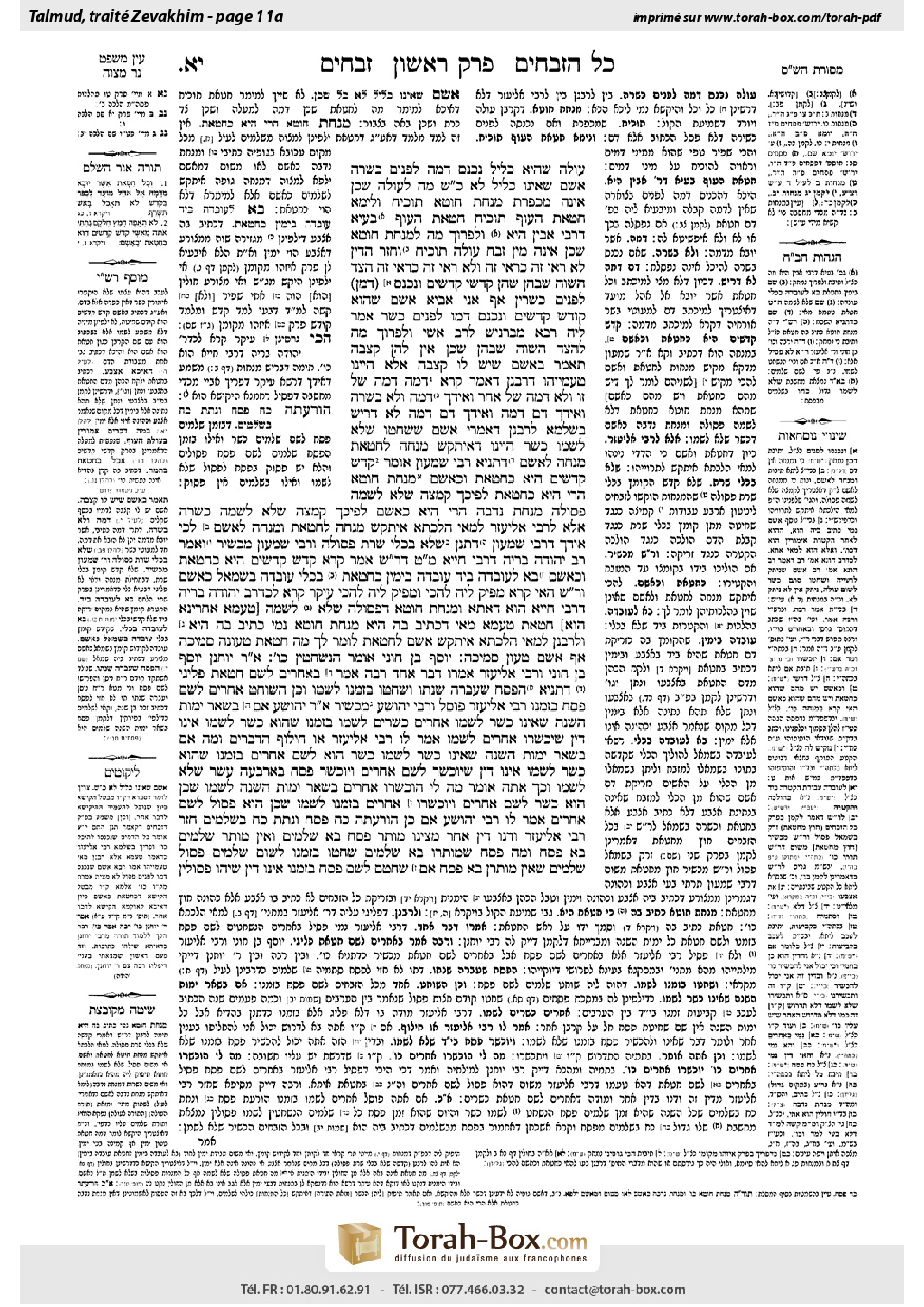
Zevachim 11a: Talmud study for Daf Yomi
Daf Yomi is the daily study of one Talmud folio. Explore 37 tractates with scans, Hebrew text, Sefaria English and AI-generated French translations where annotated.
Passage selection and English or AI-generated French translation are available where the scan has annotations. Daf Study is independent of Torah-Box and Sefaria.
Browse Zevachim · זבחים · All tractatesZevachim 11a text and translations
This page of Zevachim includes the Aramaic text, an English translation and an AI-generated French translation, alongside the scan above.
זבחים י״א א · Aramaic and Hebrew text
עוֹלָה שֶׁהִיא כָּלִיל, נִכְנַס דָּמָהּ לִפְנִים כְּשֵׁרָה; אָשָׁם שֶׁאֵינוֹ כָּלִיל, לֹא כׇּל שֶׁכֵּן?!
מָה לְעוֹלָה, שֶׁכֵּן אֵינָהּ מְכַפֶּרֶת!
מִנְחַת חוֹטֵא תּוֹכִיחַ.
וְלֵימָא: חַטַּאת הָעוֹף תּוֹכִיחַ! חַטַּאת הָעוֹף – בַּעְיָא דְּרַבִּי אָבִין הִיא.
וְלִפְרוֹךְ: מָה לְמִנְחַת חוֹטֵא, שֶׁכֵּן אֵינָהּ מִין זֶבַח!
עוֹלָה תּוֹכִיחַ. וְחָזַר הַדִּין; לֹא רְאִי זֶה כִרְאִי זֶה, וְלֹא רְאִי זֶה כִּרְאִי זֶה; הַצַּד הַשָּׁוֶה שֶׁבָּהֶן: שֶׁהֵן קׇדְשֵׁי קָדָשִׁים, וְנִכְנַס (דָּמָן) לִפְנִים – כְּשֵׁרִין; אַף אֲנִי אָבִיא אָשָׁם – שֶׁהוּא קוֹדֶשׁ קֳדָשִׁים, וְנִכְנַס דָּמוֹ לִפְנִים – כָּשֵׁר.
אֲמַר לֵיהּ רָבָא מִבַּרְנִישׁ לְרַב אָשֵׁי: וְלִפְרוֹךְ, מָה לְהַצַּד הַשָּׁוֶה שֶׁבָּהֶן – שֶׁכֵּן אֵין לָהֶן קִצְבָה; תֹּאמַר בְּאָשָׁם – שֶׁיֵּשׁ לוֹ קִצְבָה?!
אֶלָּא הַיְינוּ טַעְמַיְיהוּ דְּרַבָּנַן, דְּאָמַר קְרָא: ״דָּמָהּ״ – דָּמָהּ שֶׁל זוֹ, וְלָא דָּמָהּ שֶׁל אַחֵר.
וְאִידַּךְ – ״דָּמָהּ״ וְלֹא בְּשָׂרָהּ.
וְאִידָּךְ – ״דָּם״–״דָּמָהּ״.
וְאִידַּךְ – ״דָּם״–״דָּמָהּ״ לָא דָּרֵישׁ.
בִּשְׁלָמָא לְרַבָּנַן, דְּאָמְרִי: אָשָׁם שֶׁשְּׁחָטוֹ שֶׁלֹּא לִשְׁמוֹ – כָּשֵׁר; הַיְינוּ דְּאִיתַּקַּשׁ מִנְחָה לְחַטָּאת, מִנְחָה לְאָשָׁם.
דְּתַנְיָא, רַבִּי שִׁמְעוֹן אוֹמֵר: ״קֹדֶשׁ קָדָשִׁים הִוא כַּחַטָּאת וְכָאָשָׁם״ – מִנְחַת חוֹטֵא הֲרֵי הִיא כְּחַטָּאת, לְפִיכָךְ קְמָצָהּ שֶׁלֹּא לִשְׁמָהּ, פְּסוּלָה; מִנְחַת נְדָבָה הֲרֵי הִיא כְּאָשָׁם, לְפִיכָךְ קְמָצָהּ שֶׁלֹּא לִשְׁמָהּ, כְּשֵׁרָה.
אֶלָּא לְרַבִּי אֱלִיעֶזֶר – לְמַאי הִלְכְתָא אִיתַּקַּשׁ מִנְחָה לְחַטָּאת וּמִנְחָה לְאָשָׁם?
לְכִי אִידַּךְ דְּרַבִּי שִׁמְעוֹן, דִּתְנַן: שֶׁלֹּא בִּכְלֵי שָׁרֵת – פְּסוּלָה. וְרַבִּי שִׁמְעוֹן מַכְשִׁיר.
וְאָמַר רַב יְהוּדָה בְּרֵיהּ דְּרַבִּי חִיָּיא: מַאי טַעְמָא דְּרַבִּי שִׁמְעוֹן? אָמַר קְרָא: ״קֹדֶשׁ קֳדָשִׁים הִוא כַּחַטָּאת וּכְאָשָׁם״ – בָּא לְעוֹבְדָהּ בַּיָּד, עוֹבְדָהּ בַּיָּמִין כַּחַטָּאת; בִּכְלִי, עוֹבְדָהּ בִּשְׂמֹאל כָּאָשָׁם.
וְרַבִּי שִׁמְעוֹן – הַאי קְרָא מַפֵּיק לֵיהּ לְהָכִי וּמַפֵּיק לֵיהּ לְהָכִי?!
עִיקָּר קְרָא – לְכִדְרַב יְהוּדָה בְּרֵיהּ דְּרַבִּי חִיָּיא הוּא דַּאֲתָא; וּמִנְחַת חוֹטֵא דִּפְסוּלָה שֶׁלֹּא לִשְׁמָהּ [– טַעְמָא אַחֲרִינָא הוּא]: חַטָּאת טַעְמָא מַאי – דִּכְתִיב בַּהּ ״הִיא״; מִנְחַת חוֹטֵא נָמֵי כְּתִיב בַּהּ ״הִיא״.
וּלְרַבָּנַן, לְמַאי הִלְכְתָא אִיתַּקַּשׁ אָשָׁם לְחַטָּאת? לוֹמַר לָךְ: מָה חַטָּאת טְעוּנָה סְמִיכָה, אַף אָשָׁם טָעוּן סְמִיכָה.
יוֹסֵף בֶּן חוֹנִי אוֹמֵר: הַנִּשְׁחָטִין כּוּ׳. אָמַר רַבִּי יוֹחָנָן: יוֹסֵף בֶּן חוֹנִי וְרַבִּי אֱלִיעֶזֶר, אָמְרוּ דָּבָר אֶחָד.
רַבָּה אָמַר: בַּאֲחֵרִים לְשֵׁם חַטָּאת פְּלִיגִי.
דְּתַנְיָא: הַפֶּסַח שֶׁעִבְּרָה שְׁנָתוֹ, וּשְׁחָטוֹ בִּזְמַנּוֹ לִשְׁמוֹ; וְכֵן הַשּׁוֹחֵט אֲחֵרִים לְשֵׁם פֶּסַח בִּזְמַנּוֹ – רַבִּי אֱלִיעֶזֶר פּוֹסֵל, וְרַבִּי יְהוֹשֻׁעַ מַכְשִׁיר.
אָמַר רַבִּי יְהוֹשֻׁעַ: אִם בִּשְׁאָר יְמוֹת הַשָּׁנָה, שֶׁאֵינוֹ כָּשֵׁר לִשְׁמוֹ – אֲחֵרִים כְּשֵׁרִים לִשְׁמוֹ; בִּזְמַנּוֹ שֶׁהוּא כָּשֵׁר לִשְׁמוֹ – אֵינוֹ דִּין שֶׁיִּכְשְׁרוּ אֲחֵרִים לִשְׁמוֹ?!
אָמַר לוֹ רַבִּי אֱלִיעֶזֶר, אוֹ חִילּוּף הַדְּבָרִים: וּמָה אִם בִּשְׁאָר יְמוֹת הַשָּׁנָה, שֶׁאֵינוֹ כָּשֵׁר לִשְׁמוֹ – כָּשֵׁר הוּא לְשֵׁם אֲחֵרִים; בִּזְמַנּוֹ, שֶׁהוּא כָּשֵׁר לִשְׁמוֹ – אֵינוֹ דִּין שֶׁיּוּכְשַׁר לְשֵׁם אֲחֵרִים?! וְיוּכְשַׁר פֶּסַח בְּאַרְבָּעָה עָשָׂר שֶׁלֹּא לִשְׁמוֹ!
וְכָךְ אַתָּה אוֹמֵר?! מָה לִי הוּכְשְׁרוּ אֲחֵרִים בִּשְׁאָר יְמוֹת הַשָּׁנָה לִשְׁמוֹ – שֶׁכֵּן הוּא כָּשֵׁר לְשֵׁם אֲחֵרִים; וְיוּכְשְׁרוּ אֲחֵרִים בִּזְמַנּוֹ לִשְׁמוֹ – שֶׁכֵּן הוּא פָּסוּל לְשֵׁם אֲחֵרִים?!
אָמַר לוֹ רַבִּי יְהוֹשֻׁעַ: אִם כֵּן, הוֹרַעְתָּה כֹּחַ פֶּסַח, וְנָתַתָּ כֹּחַ בִּשְׁלָמִים.
חָזַר רַבִּי אֱלִיעֶזֶר וְדָנוֹ דִּין אַחֵר: מָצִינוּ מוֹתַר פֶּסַח בָּא שְׁלָמִים, וְאֵין מוֹתַר שְׁלָמִים בָּא פֶּסַח.
וּמָה פֶּסַח, שֶׁמּוֹתָרוֹ בָּא שְׁלָמִים – שְׁחָטוֹ בִּזְמַנּוֹ לְשׁוּם שְׁלָמִים, פָּסוּל; שְׁלָמִים, שֶׁאֵין מוֹתָרָן בָּא פֶּסַח – אִם שְׁחָטָם לְשֵׁם פֶּסַח בִּזְמַנּוֹ, אֵינוֹ דִּין שֶׁיְּהוּ פְּסוּלִין?!
Zevachim 11a · English translation
with regard to a burnt offering, which is totally consumed by the fire on the altar, nevertheless, even if its blood enters into the Sanctuary it is fit, with regard to a guilt offering, which is not entirely consumed on the altar, all the more so is it not clear that even if its blood enters the Sanctuary it remains fit?
The Gemara refutes this inference: What is notable about a burnt offering? It is notable in that it does not atone for a sin. Perhaps this is why its blood is not disqualified if it enters the sanctuary.
The Gemara responds: The meal offering of a sinner can prove the point, as it is not disqualified by entering the Sanctuary, even though it atones for a sin.
The Gemara interjects: But let us say that a bird sin offering can prove the point, as it too atones for a sin but is not disqualified by entering the Sanctuary. This case is more similar to that of a guilt offering, as a bird has blood, unlike a meal offering. The Gemara answers: It is not certain that a bird sin offering is not disqualified by entering the Sanctuary; this is a dilemma raised by Rabbi Avin.
The Gemara asks: But let us refute the above response as follows: What is notable about a sinner’s meal offering? It is notable in that it is not a type of slaughtered offering.
The Gemara answers: If so, a burnt offering can prove the point, since it is a slaughtered offering, and still if its blood enters the Sanctuary, it is not disqualified. And the inference has reverted to its starting point. The halakha is derived from the halakhot of a burnt offering and a sinner’s meal offering: The aspect of this case is not like the aspect of that case and the aspect of that case is not like the aspect of this case. Their common element is that they are offerings of the most sacred order, and if they enter into the Sanctuary they are still fit. So too, I shall include a guilt offering and infer that since it is also an offering of the most sacred order, if its blood enters into the Sanctuary it is still fit.
Rava of Barnish said to Rav Ashi: But let us refute this inference: What is notable about their common element? It is notable in that neither a burnt offering nor a sinner’s meal offering has a fixed value. Should you say the same halakhot apply to a guilt offering, which has a fixed value?
Rather, this is the reason for the opinion of the Rabbis: As the verse states: “And any sin offering, any of whose blood is brought into the Tent of Meeting to atone in the Sanctuary, shall not be eaten” (Leviticus 6:23). The term “whose blood” teaches that the blood of this offering, i.e., a sin offering, and not the blood of another offering, is disqualified in this manner.
And how does the other tanna, Rabbi Eliezer, interpret this term? He derives from it that only its blood is disqualified by entering the Sanctuary, but not its flesh.
And from where do the other Rabbis derive that the flesh of a sin offering is not disqualified by entering the Sanctuary? They maintain that both halakhot are derived from this term, as the verse could have simply stated: Blood, but stated: “Whose blood.” The redundancy excludes not only the flesh, but also other offerings.
And the other tanna, Rabbi Eliezer, does not interpret the redundancy indicated by the change from: Blood, to: “Whose blood,” to be significant. Once the word blood is mentioned, it is grammatically necessary for the verse to state “whose blood.”
§ The Gemara resumes its discussion of the dispute in the mishna between Rabbi Eliezer and the Rabbis. Granted, according to the Rabbis, who say that a guilt offering that one slaughtered not for its sake is fit, that is why a meal offering is juxtaposed with a sin offering, and a meal offering is also juxtaposed with a guilt offering.
This is as it is taught in a baraita: Rabbi Shimon says: The verse states with regard to a meal offering: “It is most sacred, as the sin offering, and as the guilt offering” (Leviticus 6:10), teaching that a meal offering of a sinner is like a sin offering. Therefore, if one removed its handful not for its sake, it is disqualified. And the verse also teaches that a voluntary meal offering is like a guilt offering. Therefore, if one removed its handful not for its sake, it is still fit. This accords with the opinion of the Rabbis, that a guilt offering slaughtered not for its sake is fit.
But according to Rabbi Eliezer, for what halakha is a meal offering juxtaposed with a sin offering, and a meal offering juxtaposed with a guilt offering?
The Gemara answers: They are juxtaposed to teach the other halakha derived by Rabbi Shimon from this verse; as we learned in a mishna (Menaḥot 26a): If the handful of a meal offering is conveyed to the altar not in a service vessel, the offering is unfit. And Rabbi Shimon deems it fit.
And Rav Yehuda, son of Rabbi Ḥiyya, says: What is the reasoning of Rabbi Shimon? The verse states with regard to a meal offering: “It is most sacred, as the sin offering, and as the guilt offering,” teaching that if a priest comes to perform its sacrificial rites by hand, he must perform them with his right hand, like one performs the rites of a sin offering. And if he performs them with a vessel, he may perform them with his left hand, like one performs the rites of a guilt offering, since Rabbi Shimon maintains this is permitted in the case of a guilt offering.
The Gemara asks: And as for Rabbi Shimon himself, does he expound this verse for this purpose, concerning one who if one removes its handful not for its sake, and expound it for that purpose, concerning conveying the handful with one’s hand?
The Gemara answers: The verse comes mainly to teach that which Rav Yehuda, son of Rabbi Ḥiyya, explained. And the halakha that a meal offering of a sinner whose handful was removed not for its sake is unfit is due to another reason: What is the reason a sin offering sacrificed not for its sake is disqualified? The reason is that the word “it” is written with regard to it in the verse: “It is a sin offering” (Leviticus 4:24). Since the word “it” is also written with regard to the meal offering of a sinner, in the verse: “For it is a sin offering” (Leviticus 5:11), the same applies in that case.
In the mishna, Rabbi Eliezer cites the verse: “As is the sin offering, so is the guilt offering” (Leviticus 7:7), as a source for his opinion. The Gemara asks: And according to the Rabbis, for what halakha is a guilt offering juxtaposed with a sin offering? The Gemara answers: They are juxtaposed to tell you that just as a sin offering requires placing hands on the head of the offering, so too, a guilt offering requires placing hands on the head of the offering.
§ The mishna teaches: Yosef ben Ḥoni says: Other offerings that are slaughtered for the sake of a Paschal offering or a sin offering are unfit. Rabbi Yoḥanan says: Yosef ben Ḥoni and Rabbi Eliezer said the same thing, i.e., Rabbi Eliezer agrees with Yosef ben Ḥoni.
Rabba says: Although they agree that other offerings slaughtered for the sake of a Paschal offering are unfit, they disagree with regard to other offerings slaughtered for the sake of a sin offering. Whereas Yosef ben Ḥoni holds that they are unfit, Rabbi Eliezer maintains that they are fit.
This is as it is taught in a baraita: In the case of a Paschal offering whose first year has passed, and it must therefore be sacrificed as a peace offering, and one slaughtered it at its designated time on Passover eve for its own sake as a Paschal offering, and likewise, if one slaughtered other offerings for the sake of a Paschal offering at its designated time, the tanna’im disagree as to the status of the offering. Rabbi Eliezer deems it unfit, and Rabbi Yehoshua deems it fit.
Rabbi Yehoshua said: If, during the rest of the days of the year, when a Paschal offering is not fit if it is slaughtered for its own sake, nevertheless, other offerings that are slaughtered for its sake are fit, then at its designated time, when a Paschal offering is fit if it is slaughtered for its own sake, isn’t it logical that other offerings slaughtered for its sake should be fit?
Rabbi Eliezer said to him: Or conversely, just as during the rest of the days of the year, when a Paschal offering is not fit if it is slaughtered for its own sake, it is fit if slaughtered for the sake of other offerings, so too, at its designated time, when it is fit if slaughtered for its own sake, isn’t it logical that it should be fit if slaughtered for the sake of other offerings? And accordingly, a Paschal offering slaughtered not for its own sake on the fourteenth of Nisan should be deemed fit, which contradicts the halakha. Clearly, this line of reasoning leads to incorrect conclusions.
Furthermore, Rabbi Eliezer refuted Rabbi Yehoshua’s logic as follows: And do you say this derivation? What does it matter to me that other offerings slaughtered during the rest of the days of the year for the sake of a Paschal offering are deemed fit? After all, a Paschal offering slaughtered for the sake of other offerings is also fit. But must you say that other offerings slaughtered at its designated time for its sake should be deemed fit? After all, at its designated time, a Paschal offering slaughtered for the sake of other offerings is unfit.
Rabbi Yehoshua said to him: If, as you maintain, other offerings slaughtered on Passover eve for the sake of a Paschal offering are disqualified, you have diminished the force of the requirement that a Paschal offering be sacrificed for its own sake, and you have given more force to the requirement that a peace offering be sacrificed for its own sake. A Paschal offering sacrificed at the proper time, i.e., during the rest of the year, for the sake of a peace offering, is fit, whereas a peace offering sacrificed on Passover eve for the sake of a Paschal offering is unfit.
The baraita continues: Rabbi Eliezer then presented a different logical inference: We find that a leftover Paschal offering, an animal consecrated as a Paschal offering but ultimately not sacrificed on Passover eve, is brought as a peace offering; but a leftover peace offering, one bought with money left over from funds dedicated toward the acquisition of a peace offering, is not brought as a Paschal offering. A Paschal offering is a potential peace offering, but a peace offering is not a potential Paschal offering.
And if so, one may infer a fortiori: Just as with regard to a Paschal offering, whose leftover offering is brought as a peace offering, and nevertheless, if one slaughtered it at its designated time for the sake of a peace offering it is unfit, so too, with regard to a peace offering, whose leftover offering is not brought as a Paschal offering, if one slaughtered it for the sake of a Paschal offering at its designated time, isn’t it logical that it should be unfit?
Zevachim 11a · Traduction française (IA)
S’agissant d’un holocauste, qui est entièrement consumé par le feu sur l’autel, il reste pourtant valide même si son sang pénètre dans le Sanctuaire. À plus forte raison, s’agissant d’un sacrifice de culpabilité, qui n’est pas entièrement consumé sur l’autel, n’est-il pas évident qu’il reste valide même si son sang pénètre dans le Sanctuaire ?
La Guemara réfute cette déduction : Qu’y a-t-il de particulier à l’holocauste ? C’est qu’il n’expie aucune faute. Peut-être est-ce pour cette raison que son sang n’est pas invalidé s’il pénètre dans le Sanctuaire.
La Guemara répond : L’oblation du pécheur peut le démontrer, car elle n’est pas invalidée lorsqu’elle pénètre dans le Sanctuaire, bien qu’elle expie une faute.
La Guemara objecte : Mais le sacrifice expiatoire d’un oiseau ne pourrait-il pas le démontrer ? Il expie lui aussi une faute, mais n’est pas invalidé lorsqu’il pénètre dans le Sanctuaire. Ce cas ressemble davantage à celui du sacrifice de culpabilité, puisqu’un oiseau a du sang, contrairement à une oblation. La Guemara répond : On ne peut affirmer avec certitude qu’un sacrifice expiatoire d’oiseau n’est pas invalidé lorsqu’il pénètre dans le Sanctuaire ; c’est une question soulevée par Rabbi Avin.
La Guemara demande : Mais ne peut-on pas réfuter la réponse précédente ainsi : Qu’y a-t-il de particulier à l’oblation du pécheur ? C’est qu’elle n’est pas un sacrifice abattu.
La Guemara répond : Dans ce cas, l’holocauste peut le démontrer, puisqu’il s’agit d’un sacrifice abattu et que, pourtant, son sang n’est pas invalidé s’il pénètre dans le Sanctuaire. La déduction revient donc à son point de départ. La halakha se déduit des règles de l’holocauste et de l’oblation du pécheur : le cas de l’un diffère de celui de l’autre, et celui de l’autre diffère de celui de l’un. Leur point commun est qu’ils sont des sacrifices du plus haut degré de sainteté et que, s’ils pénètrent dans le Sanctuaire, ils restent valides. De même, j’inclurai le sacrifice de culpabilité et déduirai que, puisqu’il est lui aussi un sacrifice du plus haut degré de sainteté, il reste valide si son sang pénètre dans le Sanctuaire.
Rava de Barnish dit à Rav Ashi : Mais ne peut-on pas réfuter cette déduction ? Qu’y a-t-il de particulier à leur point commun ? C’est qu’aucun des deux — ni l’holocauste ni l’oblation du pécheur — n’a de valeur fixe. Dirais-tu que les mêmes règles s’appliquent au sacrifice de culpabilité, dont la valeur est fixe ?
La raison de l’opinion des Rabbins est plutôt la suivante : le verset dit : « Tout sacrifice expiatoire dont le sang est apporté dans la Tente d’assignation pour faire expiation dans le Sanctuaire ne sera pas mangé » (Lévitique 6:23). L’expression « dont le sang » enseigne que le sang de ce sacrifice, c’est-à-dire du sacrifice expiatoire, et non celui d’un autre sacrifice, est invalidé de cette manière.
Et comment l’autre tanna, Rabbi Eliezer, interprète-t-il cette expression ? Il en déduit que seul son sang est invalidé lorsqu’il pénètre dans le Sanctuaire, mais pas sa chair.
Et d’où les autres Rabbins déduisent-ils que la chair d’un sacrifice expiatoire n’est pas invalidée lorsqu’elle pénètre dans le Sanctuaire ? Ils considèrent que les deux halakhot se déduisent de cette expression, car le verset aurait pu dire simplement « le sang », mais dit « dont le sang ». Cette redondance exclut non seulement la chair, mais aussi les autres sacrifices.
Quant à l’autre tanna, Rabbi Eliezer, il ne considère pas comme significative la redondance résultant du remplacement de « le sang » par « dont le sang ». Dès lors que le mot « sang » est mentionné, il est grammaticalement nécessaire que le verset dise « dont le sang ».
§ La Guemara reprend l’analyse du désaccord entre Rabbi Eliezer et les Rabbins dans la Michna. Il est compréhensible que, selon les Rabbins, qui affirment qu’un sacrifice de culpabilité abattu sans intention conforme à son statut reste valide, une oblation soit rapprochée d’un sacrifice expiatoire et aussi d’un sacrifice de culpabilité.
C’est ce qu’enseigne une baraïta : Rabbi Shimon dit : Le verset dit au sujet d’une oblation : « Elle est très sainte, comme le sacrifice expiatoire et comme le sacrifice de culpabilité » (Lévitique 6:10), ce qui enseigne que l’oblation du pécheur est comme un sacrifice expiatoire. Par conséquent, si l’on en a retiré la poignée sans intention conforme à son statut, elle est invalidée. Le verset enseigne aussi qu’une oblation volontaire est comme un sacrifice de culpabilité. Par conséquent, si l’on en a retiré la poignée sans intention conforme à son statut, elle reste valide. Cela correspond à l’opinion des Rabbins, selon laquelle un sacrifice de culpabilité abattu sans intention conforme à son statut reste valide.
Mais selon Rabbi Eliezer, quelle halakha enseigne le rapprochement d’une oblation avec un sacrifice expiatoire et avec un sacrifice de culpabilité ?
La Guemara répond : Ces rapprochements enseignent l’autre halakha que Rabbi Shimon déduit de ce verset, comme nous l’avons appris dans une Michna (Menaḥot 26a) : si la poignée d’une oblation est transportée vers l’autel autrement que dans un récipient de service, l’offrande est invalide. Rabbi Shimon, lui, la déclare valide.
Et Rav Yehuda, fils de Rabbi Ḥiyya, dit : Quel est le raisonnement de Rabbi Shimon ? Le verset dit au sujet d’une oblation : « Elle est très sainte, comme le sacrifice expiatoire et comme le sacrifice de culpabilité », ce qui enseigne que si un prêtre accomplit à la main les rites sacrificiels de l’oblation, il doit les accomplir de la main droite, comme pour les rites d’un sacrifice expiatoire. Et s’il les accomplit à l’aide d’un récipient, il peut le faire de la main gauche, comme pour les rites d’un sacrifice de culpabilité, puisque Rabbi Shimon estime que cela est permis dans le cas d’un sacrifice de culpabilité.
La Guemara demande : Rabbi Shimon lui-même interprète-t-il ce verset à cette fin, à propos de celui qui retire la poignée sans intention conforme à son statut, et aussi à cette autre fin, à propos du transport de la poignée à la main ?
La Guemara répond : Le verset vient principalement enseigner ce qu’a expliqué Rav Yehuda, fils de Rabbi Ḥiyya. Quant à la halakha selon laquelle l’oblation du pécheur dont la poignée a été retirée sans intention conforme à son statut est invalide, elle s’explique par une autre raison : pourquoi un sacrifice expiatoire offert sans intention conforme à son statut est-il invalidé ? Parce que le mot « elle » est écrit à son sujet dans le verset : « C’est un sacrifice expiatoire » (Lévitique 4:24). Puisque le mot « elle » est aussi écrit au sujet de l’oblation du pécheur, dans le verset : « Car c’est un sacrifice expiatoire » (Lévitique 5:11), la même règle s’applique à ce cas.
Dans la Michna, Rabbi Eliezer cite le verset : « Comme le sacrifice expiatoire, ainsi le sacrifice de culpabilité » (Lévitique 7:7), comme source de son opinion. La Guemara demande : Et selon les Rabbins, quelle halakha enseigne le rapprochement du sacrifice de culpabilité avec le sacrifice expiatoire ? La Guemara répond : Ils sont rapprochés pour t’enseigner que, de même qu’il faut poser les mains sur la tête de l’animal offert en sacrifice expiatoire, il faut aussi poser les mains sur la tête de l’animal offert en sacrifice de culpabilité.
§ La Michna enseigne : Yosef ben Ḥoni dit que les autres sacrifices abattus avec l’intention d’être un sacrifice de Pessaḥ ou un sacrifice expiatoire sont invalides. Rabbi Yoḥanan dit : Yosef ben Ḥoni et Rabbi Eliezer ont exprimé la même opinion, c’est-à-dire que Rabbi Eliezer est d’accord avec Yosef ben Ḥoni.
Rabba dit : Bien qu’ils conviennent que les autres sacrifices abattus avec l’intention d’être un sacrifice de Pessaḥ sont invalides, ils sont en désaccord au sujet des autres sacrifices abattus avec l’intention d’être un sacrifice expiatoire. Yosef ben Ḥoni estime qu’ils sont invalides, tandis que Rabbi Eliezer considère qu’ils sont valides.
C’est ce qu’enseigne une baraïta : dans le cas d’un sacrifice de Pessaḥ qui a dépassé sa première année et qui doit donc être offert comme sacrifice de paix, si on l’abat au moment prévu, à la veille de Pessaḥ, avec l’intention de l’offrir comme sacrifice de Pessaḥ, et de même, si l’on abat d’autres sacrifices avec l’intention de les offrir comme sacrifices de Pessaḥ au moment prévu, les tannaïm sont en désaccord sur le statut de l’offrande. Rabbi Eliezer la déclare invalide, et Rabbi Yehoshua la déclare valide.
Rabbi Yehoshua dit : Si, pendant le reste de l’année, alors qu’un sacrifice de Pessaḥ n’est pas valide lorsqu’il est abattu avec l’intention conforme à son statut, les autres sacrifices abattus avec l’intention d’être un sacrifice de Pessaḥ restent néanmoins valides, alors, au moment prévu, lorsqu’un sacrifice de Pessaḥ est valide s’il est abattu avec l’intention conforme à son statut, n’est-il pas logique que les autres sacrifices abattus avec l’intention d’être un sacrifice de Pessaḥ restent valides ?
Rabbi Eliezer lui dit : Ou, à l’inverse, de même que pendant le reste de l’année, lorsqu’un sacrifice de Pessaḥ n’est pas valide s’il est abattu avec l’intention conforme à son statut, il est valide s’il est abattu avec l’intention d’être un autre sacrifice, de même, au moment prévu, lorsqu’il est valide s’il est abattu avec l’intention conforme à son statut, n’est-il pas logique qu’il soit valide s’il est abattu avec l’intention d’être un autre sacrifice ? Selon ce raisonnement, un sacrifice de Pessaḥ abattu sans intention conforme à son statut le quatorze nissan devrait être déclaré valide, ce qui contredit la halakha. Il est donc clair que cette ligne de raisonnement conduit à des conclusions erronées.
En outre, Rabbi Eliezer réfuta ainsi le raisonnement de Rabbi Yehoshua : Comment peux-tu tirer cette déduction ? En quoi importe-t-il que les autres sacrifices abattus pendant le reste de l’année avec l’intention d’être un sacrifice de Pessaḥ soient déclarés valides ? Après tout, un sacrifice de Pessaḥ abattu avec l’intention d’être un autre sacrifice est lui aussi valide. Mais peux-tu pour autant conclure que les autres sacrifices abattus au moment prévu avec l’intention d’être un sacrifice de Pessaḥ doivent être déclarés valides ? Après tout, au moment prévu, un sacrifice de Pessaḥ abattu avec l’intention d’être un autre sacrifice est invalide.
Rabbi Yehoshua lui dit : Si, comme tu le soutiens, les autres sacrifices abattus la veille de Pessaḥ avec l’intention d’être un sacrifice de Pessaḥ sont invalidés, tu diminues la portée de l’exigence qu’un sacrifice de Pessaḥ soit offert avec l’intention conforme à son statut et tu renforces celle qu’un sacrifice de paix soit offert avec l’intention conforme à son statut. Un sacrifice de Pessaḥ offert au moment approprié, c’est-à-dire pendant le reste de l’année, avec l’intention d’être un sacrifice de paix, est valide, tandis qu’un sacrifice de paix offert la veille de Pessaḥ avec l’intention d’être un sacrifice de Pessaḥ est invalide.
La baraïta poursuit : Rabbi Eliezer présenta alors une autre déduction logique : nous constatons qu’un sacrifice de Pessaḥ restant — un animal consacré comme sacrifice de Pessaḥ mais qui, finalement, n’a pas été offert la veille de Pessaḥ — est offert comme sacrifice de paix ; mais un sacrifice de paix restant, acheté avec l’argent qui subsiste des fonds consacrés à l’acquisition d’un sacrifice de paix, n’est pas offert comme sacrifice de Pessaḥ. Un sacrifice de Pessaḥ peut donc devenir un sacrifice de paix, mais un sacrifice de paix ne peut pas devenir un sacrifice de Pessaḥ.
Dès lors, on peut déduire a fortiori : de même que, s’agissant d’un sacrifice de Pessaḥ dont le reste est offert comme sacrifice de paix, il est pourtant invalide si on l’abat au moment prévu avec l’intention d’être un sacrifice de paix, de même, s’agissant d’un sacrifice de paix dont le reste n’est pas offert comme sacrifice de Pessaḥ, s’il est abattu au moment prévu avec l’intention d’être un sacrifice de Pessaḥ, n’est-il pas logique qu’il soit invalide ?
Traduction française générée par IA à partir de l’édition anglaise de Sefaria. Vérifie toujours un passage avec le texte source.
Text from Sefaria: William Davidson Edition - Vocalized Aramaic (CC BY NC); William Davidson Edition - English (CC BY NC).