Zevachim 11b: Talmud study for Daf Yomi
Daf Yomi is the daily study of one Talmud folio. Explore 37 tractates with scans, Hebrew text, Sefaria English and AI-generated French translations where annotated.
Passage selection and English or AI-generated French translation are available where the scan has annotations. Daf Study is independent of Torah-Box and Sefaria.
Browse Zevachim · זבחים · All tractatesZevachim 11b text and translations
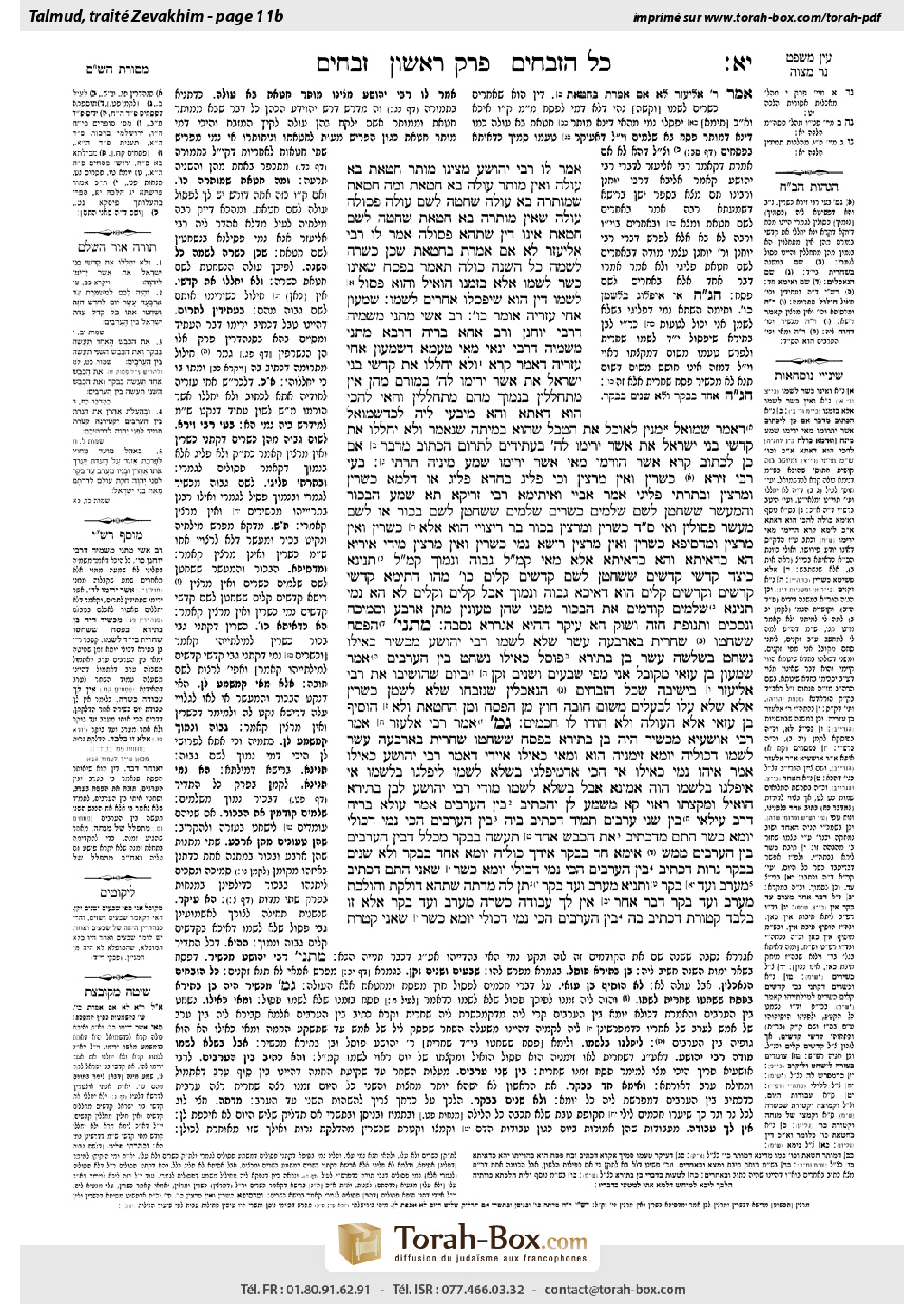
This page of Zevachim includes the Aramaic text, an English translation and an AI-generated French translation, alongside the scan above.
זבחים י״א ב · Aramaic and Hebrew text
אָמַר לוֹ רַבִּי יְהוֹשֻׁעַ: מָצִינוּ מוֹתַר חַטָּאת בָּא עוֹלָה, וְאֵין מוֹתַר עוֹלָה בָּא חַטָּאת;
וּמָה חַטָּאת, שֶׁמּוֹתָרָהּ בָּא עוֹלָה – שְׁחָטָהּ לְשֵׁם עוֹלָה, פְּסוּלָה; עוֹלָה, שֶׁאֵין מוֹתָרָהּ בָּא חַטָּאת – שְׁחָטָהּ לְשֵׁם חַטָּאת, אֵינוֹ דִּין שֶׁתְּהֵא פְּסוּלָה?!
אָמַר לוֹ רַבִּי אֱלִיעֶזֶר: לֹא; אִם אָמַרְתָּ בְּחַטָּאת – שֶׁכֵּן כְּשֵׁרָה לִשְׁמָהּ כׇּל הַשָּׁנָה כּוּלָּהּ, תֹּאמַר בַּפֶּסַח – שֶׁאֵינוֹ כָּשֵׁר לִשְׁמוֹ אֶלָּא בִּזְמַנּוֹ?! הוֹאִיל וְהוּא פָּסוּל לִשְׁמוֹ, דִּין הוּא שֶׁיִּפָּסְלוּ אֲחֵרִים לִשְׁמוֹ.
שִׁמְעוֹן אֲחִי עֲזַרְיָה אוֹמֵר כּוּ׳.
רַב אָשֵׁי מַתְנֵי מִשְּׁמֵיהּ דְּרַבִּי יוֹחָנָן, וְרַב אַחָא בְּרֵיהּ דְּרָבָא מַתְנֵי מִשְּׁמֵיהּ דְּרַבִּי יַנַּאי: מַאי טַעְמָא דְּשִׁמְעוֹן אֲחִי עֲזַרְיָה? דְּאָמַר קְרָא: ״וְלֹא יְחַלְּלוּ אֶת קׇדְשֵׁי בְּנֵי יִשְׂרָאֵל אֵת אֲשֶׁר יָרִימוּ לַה׳״ – בְּמוּרָם מֵהֶן אֵין מִתְחַלְּלִין, בְּנָמוּךְ מֵהֶם מִתְחַלְּלִין.
וְהַאי לְהָכִי הוּא דַּאֲתָא?! וְהָא מִיבְּעֵי לֵיהּ לִכְדִשְׁמוּאֵל – דְּאָמַר שְׁמוּאֵל: מִנַּיִן לָאוֹכֵל אֶת הַטֶּבֶל שֶׁהוּא בְּמִיתָה? שֶׁנֶּאֱמַר: ״וְלֹא יְחַלְּלוּ אֶת קׇדְשֵׁי בְּנֵי יִשְׂרָאֵל אֵת אֲשֶׁר יָרִימוּ לַה׳״ – בַּעֲתִידִים לִתְרוֹם הַכָּתוּב מְדַבֵּר.
אִם כֵּן, לִכְתּוֹב קְרָא ״אֲשֶׁר הוּרְמוּ״; מַאי ״אֲשֶׁר יָרִימוּ״? שְׁמַע מִינַּיהּ תַּרְתֵּי.
בָּעֵי רַבִּי זֵירָא: כְּשֵׁרִין וְאֵין מְרַצִּין – וְכִי פְּלִיג בַּחֲדָא פְּלִיג, אוֹ דִלְמָא כְּשֵׁרִין וּמְרַצִּין – וּבְתַרְתֵּי פְּלִיגִי?
אָמַר אַבָּיֵי, וְאִיתֵּימָא רַבִּי זְרִיקָא, תָּא שְׁמַע: הַבְּכוֹר וְהַמַּעֲשֵׂר שֶׁשְּׁחָטָן לְשֵׁם שְׁלָמִים – כְּשֵׁרִים. שְׁלָמִים שֶׁשְּׁחָטָן לְשֵׁם בְּכוֹר אוֹ לְשֵׁם מַעֲשֵׂר – פְּסוּלִין.
וְאִי סָלְקָא דַעְתָּךְ כְּשֵׁרִין וּמְרַצִּין, בְּכוֹר בַּר רַיצּוֹיֵי הוּא?! אֶלָּא כְּשֵׁרִין וְאֵין מְרַצִּין! וּמִדְּסֵיפָא כְּשֵׁרִין וְאֵין מְרַצִּין, רֵישָׁא נָמֵי כְּשֵׁרִין וְאֵין מְרַצִּין!
מִידֵּי אִירְיָא?! הָא כִּדְאִיתַהּ, וְהָא כִּדְאִיתַהּ.
אֶלָּא מַאי קָא מַשְׁמַע לַן? גָּבוֹהַּ וְנָמוּךְ קָא מַשְׁמַע לַן?! תְּנֵינָא: כֵּיצַד? קׇדְשֵׁי קָדָשִׁים שֶׁשְּׁחָטָן לְשֵׁם קֳדָשִׁים קַלִּים כּוּ׳!
מַהוּ דְּתֵימָא: קׇדְשֵׁי קָדָשִׁים וְקָדָשִׁים קַלִּים הוּא דְּאִיכָּא גָּבוֹהַּ וְנָמוּךְ, אֲבָל קַלִּים וְקַלִּים – לָא.
הָא נָמֵי תְּנֵינָא: שְׁלָמִים קוֹדְמִים אֶת הַבְּכוֹר, מִפְּנֵי שֶׁהֵן טְעוּנִין מַתַּן אַרְבַּע, וּסְמִיכָה, וּנְסָכִים, וּתְנוּפַת חָזֶה וָשׁוֹק!
הָא עִיקָּר, הָהִיא אַגְּרָרָא נַסְבַהּ.
מַתְנִי׳ הַפֶּסַח שֶׁשְּׁחָטוֹ שַׁחֲרִית בְּאַרְבָּעָה עָשָׂר שֶׁלֹּא לִשְׁמוֹ – רַבִּי יְהוֹשֻׁעַ מַכְשִׁיר, כְּאִילּוּ נִשְׁחַט בִּשְׁלֹשָׁה עָשָׂר. בֶּן בְּתִירָא פּוֹסֵל, כְּאִילּוּ נִשְׁחַט בֵּין הָעַרְבַּיִם.
אָמַר שִׁמְעוֹן בֶּן עַזַּאי: מְקוּבָּל אֲנִי מִפִּי שִׁבְעִים וּשְׁנַיִם זָקֵן בַּיּוֹם שֶׁהוֹשִׁיבוּ אֶת רַבִּי אֱלִיעֶזֶר בִּישִׁיבָה, שֶׁכׇּל הַזְּבָחִים הַנֶּאֱכָלִין שֶׁנִּזְבְּחוּ שֶׁלֹּא לִשְׁמָן – כְּשֵׁרִין, אֶלָּא שֶׁלֹּא עָלוּ לַבְּעָלִים מִשּׁוּם חוֹבָה; חוּץ מִן הַפֶּסַח וּמִן הַחַטָּאת. וְלֹא הוֹסִיף בֶּן עַזַּאי אֶלָּא הָעוֹלָה, וְלֹא הוֹדוּ לוֹ חֲכָמִים.
גְּמָ׳ אָמַר רַבִּי אֶלְעָזָר אָמַר רַבִּי אוֹשַׁעְיָא: מַכְשִׁיר הָיָה בֶּן בְּתִירָא בְּפֶסַח שֶׁשְּׁחָטוֹ שַׁחֲרִית בְּאַרְבָּעָה עָשָׂר לִשְׁמוֹ, דְּכוּלֵּיהּ יוֹמָא זִימְנֵיהּ הוּא.
וּמַאי ״כְּאִילּוּ״?
אַיְּידֵי דְּאָמַר רַבִּי יְהוֹשֻׁעַ ״כְּאִילּוּ״, אָמַר אִיהוּ נָמֵי ״כְּאִילּוּ״.
אִי הָכִי, אַדְּמִיפַּלְגִי בְּשֶׁלֹּא לִשְׁמוֹ – לִיפַּלְגוּ בְּלִשְׁמוֹ!
אִי אִיפְּלִגוּ בְּלִשְׁמוֹ, הֲוָה אָמֵינָא: אֲבָל בְּשֶׁלֹּא לִשְׁמוֹ – מוֹדֵי רַבִּי יְהוֹשֻׁעַ לְבֶן בְּתִירָא, הוֹאִיל וּמִקְצָתוֹ רָאוּי; קָא מַשְׁמַע לַן.
וְהָכְתִיב: ״בֵּין הָעַרְבָּיִם״!
אָמַר עוּלָּא בְּרֵיהּ דְּרַב עִילַּאי: בֵּין שְׁנֵי עֲרָבִים.
תָּמִיד, דִּכְתִיב בֵּיהּ: ״בֵּין הָעַרְבָּיִם״ – הָכִי נָמֵי דְּכוּלֵּי יוֹמָא כָּשֵׁר?!
הָתָם, מִדִּכְתִיב: ״אֶת הַכֶּבֶשׂ אֶחָד תַּעֲשֶׂה בַבֹּקֶר״, מִכְּלָל דְּ״בֵין הָעַרְבָּיִם״ – בֵּין הָעַרְבַּיִם מַמָּשׁ.
אֵימָא חַד בַּבֹּקֶר, אִידַּךְ כּוּלֵּיהּ יוֹמָא!
״אֶחָד... בַּבֹּקֶר״ – וְלֹא שְׁנַיִם בַּבֹּקֶר.
נֵרוֹת, דִּכְתִיב ״בֵּין הָעַרְבַּיִם״ – הָכִי נָמֵי דְּכוּלֵּי יוֹמָא כָּשֵׁר?!
שָׁאנֵי הָתָם, דִּכְתִיב: ״מֵעֶרֶב וְעַד בֹּקֶר״, וְתַנְיָא: ״מֵעֶרֶב וְעַד בֹּקֶר״ – תֵּן לָהּ מִדָּתָהּ שֶׁתְּהֵא דּוֹלֶקֶת וְהוֹלֶכֶת מֵעֶרֶב וְעַד בֹּקֶר. דָּבָר אַחֵר: אֵין לְךָ עֲבוֹדָה כְּשֵׁרָה מֵעֶרֶב וְעַד בֹּקֶר, אֶלָּא זוֹ בִּלְבַד.
קְטוֹרֶת, דִּכְתִיב בָּהּ: ״בֵּין הָעַרְבָּיִם״ – הָכִי נָמֵי דְּכוּלֵּי יוֹמָא כָּשֵׁר?!
שָׁאנֵי קְטֹרֶת,
Zevachim 11b · English translation
Rabbi Yehoshua said to him: This inference is not valid, as we find that a leftover sin offering, e.g., one bought with money left over from funds dedicated to the acquisition of a sin offering, is brought as a burnt offering, whereas a leftover burnt offering is not brought as a sin offering.
And according to Rabbi Eliezer’s logic, one should derive a fortiori: Just as with regard to a sin offering, whose leftover is brought as a burnt offering, nevertheless, if one slaughtered it for the sake of a burnt offering it is unfit, so too, with regard to a burnt offering, whose leftover is not brought as a sin offering, if one slaughtered it for the sake of a sin offering, isn’t it logical that it should be unfit? Yet, the halakha is that a burnt offering slaughtered for the sake of a sin offering is fit.
Rabbi Eliezer said to him: No, if you said that this is the halakha with regard to a sin offering, that another offering sacrificed for its sake is fit, this is only because a sin offering is fit when sacrificed for its sake all year long. Shall you also say that this is the halakha with regard to a Paschal offering, which is fit when sacrificed for its sake only at its designated time? Since a Paschal offering is unfit when sacrificed for its sake during the rest of the year, it is logical that other offerings should be disqualified when sacrificed for its sake at its designated time.
§ The mishna teaches: Shimon, brother of Azarya, says that this is the distinction: With regard to all offerings, if one slaughtered them for the sake of an offering whose sanctity is greater than theirs, they are fit; if one slaughtered them for the sake of an offering whose sanctity is less than theirs, they are unfit.
Rav Ashi teaches in the name of Rabbi Yoḥanan, and Rav Aḥa, son of Rava, teaches the same statement in the name of Rabbi Yannai: What is the reason for the opinion of Shimon, brother of Azarya? It is derived from that which the verse states: “And they shall not profane the holy things of the children of Israel, which they will set apart [yarimu] unto the Lord” (Leviticus 22:15). The verse is interpreted not as a prohibition but as a halakhic axiom, teaching that offerings are not profaned, i.e., disqualified, by sacrifice for the sake of offerings whose sanctity is more elevated [muram] than theirs; they are profaned only by sacrifice for the sake of offerings whose sanctity is less than theirs.
The Gemara asks: And does that verse come to teach this halakha? But isn’t it necessary for Shmuel’s derivation? As Shmuel says: From where is it derived that one who eats untithed produce is liable to be punished with death at the hand of Heaven? As it is stated: “And they shall not profane the holy things of the children of Israel, which they will set apart unto the Lord.” The term: “Will set apart,” indicates that the verse is speaking of holy items that are to be set apart in the future, i.e., untithed produce, which includes the portion designated for the priest [teruma].
The Gemara answers: If so, if the verse taught only one halakha, the halakha of Shimon, brother of Azarya, it should have written: Which they have set apart. What is the reason the verse states: “Which they will set apart,” in the future tense? Conclude from it that the verse teaches two halakhot: An offering sacrificed for the sake of an offering of greater sanctity is fit, and consumption of untithed produce is punishable by death at the hand of Heaven.
Rabbi Zeira raises a dilemma: According to Shimon, brother of Azaria, who says that less sacred offerings sacrificed for the sake of more sacred offerings are fit, perhaps they are fit but do not propitiate God, i.e., they do not fulfill the owner’s obligation, as the Rabbis hold. If so, when Shimon, brother of Azaria, disagrees with the first tanna in the mishna, he disagrees only with regard to one matter, i.e., that more sacred offerings sacrificed for the sake of less sacred ones are disqualified altogether. Alternatively, perhaps Shimon, brother of Azaria, holds that if less sacred offerings are sacrificed for the sake of more sacred offerings they are both fit and propitiate God, and they disagree with the Rabbis about two matters.
Abaye, and some say Rabbi Zerika, said: Come and hear proof that they do not satisfy the owners’ obligation: Shimon, brother of Azarya, elaborated on his opinion in the mishna: A firstborn animal and the animal tithe that one slaughtered for the sake of peace offerings are fit, as the sanctity of peace offerings is greater. Peace offerings that one slaughtered for the sake of a firstborn animal or for the sake of the animal tithe are unfit.
And if it enters your mind that offerings sacrificed for the sake of offerings of greater sanctity are both fit and propitiate God, is a firstborn an offering that propitiates? Sacrificing a firstborn does not serve to propitiate God; rather, conclude that such offerings are fit but do not propitiate. And one can infer that since in the latter clause they are fit but do not propitiate, in the former clause as well, concerning all offerings of lesser sanctity slaughtered for the sake of offerings of the most sacred order, they are fit but do not propitiate.
The Gemara responds: Are the cases comparable? This case is as it is, and that case is as it is. Perhaps Shimon, brother of Azarya, holds that offerings of lesser sanctity slaughtered for the sake of offerings of the most sacred order propitiate God, but a firstborn animal and animal tithe slaughtered for the sake of peace offerings do not propitiate God.
The Gemara asks: Rather, what is the latter clause concerning a firstborn and animal tithe teaching us, if not that no offerings of lesser sanctity propitiate God when sacrificed for the sake of offerings of greater sanctity? How is the clause not redundant? Does it teach us an example of offerings of higher sanctity and offerings of lower sanctity? We already learn such an example in the former clause, which teaches: How so? Offerings of the most sacred order that one slaughtered for the sake of offerings of lesser sanctity are unfit; offerings of lesser sanctity slaughtered for the sake of offerings of the most sacred order are fit.
The Gemara answers: It is stated lest you say that the halakha of offerings of higher sanctity and offerings of lower sanctity applies only when the difference is between offerings of the most sacred order and offerings of lesser sanctity, but with regard to offerings of lesser sanctity and other offerings of lesser sanctity this halakha does not apply, as they are all considered to possess the same level of sanctity. Therefore the mishna adds the example of a firstborn animal and animal tithe slaughtered for the sake of peace offerings, to clarify that one can distinguish between different offerings of lesser sanctity as well.
The Gemara raises an objection to this answer: We already learn this as well, in another mishna (89a): The peace offering precedes sacrifice of the firstborn because the peace offering requires placement of its blood twice so as to be visible on four sides of the altar, placing hands on the head of the offering, libations, and waving of the breast and thigh by the priest and the owner, none of which is required for the firstborn.
The Gemara answers: The primary mention of the distinction is in this mishna; that mishna cites it incidentally, in discussing the order of precedence of offerings.
MISHNA: With regard to the Paschal offering that one slaughtered on the morning of the fourteenth of Nisan, the day when the Paschal offering should be slaughtered in the afternoon, if he did so not for its sake, Rabbi Yehoshua deems it fit as though it were slaughtered on the thirteenth of Nisan. An animal consecrated as a Paschal offering that was slaughtered not at its designated time for the sake of a different offering is fit for sacrifice as a peace offering. Ben Beteira deems it unfit as though it were slaughtered in the afternoon of the fourteenth.
Shimon ben Azzai said: I received a tradition from seventy-two elders, as the Sanhedrin deliberated and decided on the day that they installed Rabbi Elazar ben Azarya at the head of the yeshiva and ruled that all the slaughtered offerings that are eaten that were slaughtered not for their sake are fit, but these offerings did not satisfy the obligation of the owner, except for the Paschal offering and the sin offering. Based on that version, ben Azzai added to the halakha cited in the first mishna only the burnt offering, which is not eaten, and the Rabbis disagreed and did not concede to him.
GEMARA: Rabbi Elazar says that Rabbi Oshaya says: With regard to a Paschal offering that one slaughtered on the morning of the fourteenth of Nisan for its sake, ben Beteira would deem it fit, as he held that the entire day, not only the afternoon, is its designated time.
The Gemara asks: And what is the reason the mishna states that according to ben Beteira, a Paschal offering slaughtered on the morning of the fourteenth is considered as though it were slaughtered in the afternoon? This language seems to indicate that it does not have the same status as a Paschal offering actually slaughtered in the afternoon.
The Gemara responds: Since Rabbi Yehoshua says the term: As though it were slaughtered on the thirteenth, ben Beteira also says the term: As though it were slaughtered in the afternoon. But in fact he maintains that there is no difference between a Paschal offering slaughtered on the morning of the fourteenth and one slaughtered in the afternoon.
The Gemara asks: If so, rather than disagreeing in the mishna with regard to a Paschal offering that was slaughtered on the morning of the fourteenth not for its sake, let them disagree with regard to one slaughtered for its sake; ben Beteira holds that it is fit, and Rabbi Yehoshua holds that it is unfit.
The Gemara answers: If the mishna were to write only that they disagree with regard to a Paschal offering slaughtered for its sake, I would say: But in a case where it was slaughtered not for its sake, Rabbi Yehoshua concedes to ben Beteira that it is disqualified, even though it was slaughtered in the morning, since at least part of the day, the afternoon, is fit for its sacrifice as a Paschal offering. Therefore, the mishna teaches us that they disagree with regard to this case as well.
The Gemara asks: How can ben Beteira claim that a Paschal offering may be slaughtered in the morning? But isn’t it written: “And the whole assembly of the congregation of Israel shall slaughter it in the afternoon [bein ha’arbayim]” (Exodus 12:6)?
Ulla, son of Rav Ilai, says: Ben Beteira interprets the phrase bein ha’arbayim literally: Between two evenings, i.e., between the eve of the fourteenth and the night after the fourteenth. Accordingly, the Paschal offering may be sacrificed all day long.
The Gemara asks: If so, with regard to the daily offering, concerning which it is written: “The one lamb you shall offer in the morning, and the other lamb you shall offer bein ha’arbayim” (Numbers 28:4), is the entire day fit for sacrifice also?
The Gemara answers: There, since it is written: “The one lamb you shall offer in the morning,” by inference, the term bein ha’arbayim is referring to the actual afternoon.
The Gemara counters: Say that one of the lambs should be sacrificed in the morning, and the other one can be sacrificed all day. Why is it evident from the requirement that one be sacrificed in the morning that the other must sacrificed in the afternoon?
The Gemara answers: The clause “One lamb you shall offer in the morning” indicates that two lambs are not sacrificed in the morning; the other must perforce be sacrificed in the afternoon.
The Gemara asks: With regard to the lamps of the Candelabrum, one should say the same, as it is written: “And when Aaron lights the lamps bein ha’arbayim” (Exodus 30:8). Is the entire day fit for lighting also, according to the opinion of ben Beteira?
The Gemara answers: There it is different, as it is written: “To burn from evening to morning” (Exodus 27:21). And it is taught in a baraita: The phrase “from evening to morning” indicates that you must allocate the Candelabrum its measure of oil so that it will burn from evening until morning. Alternatively, the same verse can be interpreted as follows: Only this rite is valid from evening until morning, since all other rites must be performed during the day. Therefore, the Candelabrum is lit only at the end of the day.
The Gemara asks: With regard to the incense, one should say likewise, as it is written with regard to it: “Bein ha’arbayim he shall burn it” (Exodus 30:8). Is the entire day also fit for burning the incense according to the opinion of ben Beteira?
The Gemara answers: The incense is different,
Zevachim 11b · Traduction française (IA)
Rabbi Yehoshua lui dit : Cette déduction n’est pas valable, car nous constatons qu’un sacrifice expiatoire dont il reste de l’argent — par exemple, lorsqu’il a été acheté avec le reliquat de fonds consacrés à l’achat d’un sacrifice expiatoire — est apporté comme holocauste, tandis qu’un holocauste dont il reste de l’argent n’est pas apporté comme sacrifice expiatoire.
Et selon le raisonnement de Rabbi Eliezer, on devrait déduire a fortiori : de même qu’un sacrifice expiatoire, dont le reliquat est apporté comme holocauste, est néanmoins invalide si on l’a égorgé avec l’intention d’en faire un holocauste, de même, un holocauste, dont le reliquat n’est pas apporté comme sacrifice expiatoire, ne devrait-il pas, à plus forte raison, être invalide si on l’a égorgé avec l’intention d’en faire un sacrifice expiatoire ? Pourtant, la halakha est qu’un holocauste égorgé avec l’intention d’en faire un sacrifice expiatoire est valide.
Rabbi Eliezer lui dit : Non. Si tu as dit que telle est la halakha concernant un sacrifice expiatoire — à savoir qu’une autre offrande égorgée avec l’intention d’être un sacrifice expiatoire est valide — c’est uniquement parce qu’un sacrifice expiatoire est valide lorsqu’il est égorgé avec cette intention tout au long de l’année. Dirais-tu également que telle est la halakha concernant une offrande pascale, qui n’est valide lorsqu’elle est égorgée avec l’intention d’être une offrande pascale qu’au moment qui lui est assigné ? Puisqu’une offrande pascale est invalide lorsqu’elle est égorgée avec cette intention pendant le reste de l’année, il est logique que les autres offrandes soient invalidées lorsqu’elles sont égorgées avec l’intention d’être une offrande pascale au moment qui lui est assigné.
§ La Michna enseigne : Shimon, frère d’Azarya, dit que la distinction est la suivante : pour toutes les offrandes, si on les a égorgées avec l’intention d’en faire une offrande dont la sainteté est supérieure à la leur, elles sont valides ; si on les a égorgées avec l’intention d’en faire une offrande dont la sainteté est inférieure à la leur, elles sont invalides.
Rav Ashi enseigne au nom de Rabbi Yoḥanan, et Rav Aḥa, fils de Rava, enseigne la même déclaration au nom de Rabbi Yannai : Quelle est la raison de l’opinion de Shimon, frère d’Azarya ? Elle se déduit de ce que dit le verset : « Ils ne profaneront pas les choses saintes des enfants d’Israël, qu’ils prélèveront [yarimu] pour le Seigneur » (Lévitique 22:15). Le verset est interprété non comme une interdiction, mais comme un principe halakhique : les offrandes ne sont pas profanées, c’est-à-dire invalidées, lorsqu’elles sont égorgées avec l’intention d’en faire des offrandes dont la sainteté est plus élevée [muram] que la leur ; elles ne sont profanées que lorsqu’elles sont égorgées avec l’intention d’en faire des offrandes dont la sainteté est inférieure à la leur.
La Guemara demande : Ce verset vient-il enseigner cette halakha ? Mais n’est-il pas nécessaire pour la déduction de Shmuel ? Car Shmuel dit : D’où apprend-on que celui qui consomme des produits non soumis à la dîme est passible de mort par la main du Ciel ? Car il est dit : « Ils ne profaneront pas les choses saintes des enfants d’Israël, qu’ils prélèveront pour le Seigneur. » L’expression « qu’ils prélèveront » indique que le verset parle de choses saintes qui devront être prélevées à l’avenir, c’est-à-dire de produits non soumis à la dîme, parmi lesquels figure la part destinée au prêtre [terouma].
La Guemara répond : Si le verset n’enseignait qu’une seule halakha, celle de Shimon, frère d’Azarya, il aurait dû écrire : « qu’ils ont prélevées ». Pourquoi le verset dit-il : « qu’ils prélèveront », au futur ? Déduis-en que le verset enseigne deux halakhot : une offrande égorgée avec l’intention d’en faire une offrande de plus grande sainteté est valide, et la consommation de produits non soumis à la dîme est passible de mort par la main du Ciel.
Rabbi Zeira soulève une question : selon Shimon, frère d’Azarya, qui dit que les offrandes de moindre sainteté égorgées avec l’intention d’en faire des offrandes de plus grande sainteté sont valides, peut-être sont-elles valides sans toutefois obtenir l’agrément divin, c’est-à-dire sans acquitter le propriétaire de son obligation, comme le soutiennent les Sages. Si tel est le cas, lorsque Shimon, frère d’Azarya, contredit le premier tanna de la Michna, il ne diverge que sur un seul point : les offrandes de plus grande sainteté égorgées avec l’intention d’en faire des offrandes de moindre sainteté sont totalement invalides. Ou bien Shimon, frère d’Azarya, estime peut-être que les offrandes de moindre sainteté égorgées avec l’intention d’en faire des offrandes de plus grande sainteté sont à la fois valides et obtiennent l’agrément divin ; il diverge alors des Sages sur deux points.
Abaye — et certains disent Rabbi Zerika — dit : Viens entendre une preuve qu’elles n’acquittent pas les propriétaires de leur obligation. Shimon, frère d’Azarya, développe son opinion dans la Michna : un animal premier-né et l’animal de la dîme égorgés avec l’intention d’en faire des offrandes de paix sont valides, car les offrandes de paix ont une sainteté supérieure. Les offrandes de paix égorgées avec l’intention d’en faire un animal premier-né ou un animal de la dîme sont invalides.
Et si tu penses que les offrandes égorgées avec l’intention d’en faire des offrandes de plus grande sainteté sont à la fois valides et obtiennent l’agrément divin, un animal premier-né est-il une offrande qui obtient cet agrément ? Le sacrifice d’un premier-né ne sert pas à obtenir l’agrément divin. Déduis plutôt que de telles offrandes sont valides, mais n’obtiennent pas cet agrément. On peut en déduire que, puisqu’elles sont valides sans obtenir l’agrément divin dans la dernière partie, il en va de même dans la première partie : toutes les offrandes de moindre sainteté égorgées avec l’intention d’en faire des offrandes de la catégorie de sainteté la plus élevée sont valides, mais n’obtiennent pas l’agrément divin.
La Guemara répond : Ces cas sont-ils comparables ? Chaque cas est différent. Peut-être Shimon, frère d’Azarya, estime-t-il que les offrandes de moindre sainteté égorgées avec l’intention d’en faire des offrandes de la catégorie de sainteté la plus élevée obtiennent l’agrément divin, mais qu’un animal premier-né et un animal de la dîme égorgés avec l’intention d’en faire des offrandes de paix ne l’obtiennent pas.
La Guemara demande : Alors, que nous enseigne la dernière partie, concernant l’animal premier-né et l’animal de la dîme, sinon qu’aucune offrande de moindre sainteté n’obtient l’agrément divin lorsqu’elle est égorgée avec l’intention d’en faire une offrande de plus grande sainteté ? En quoi cette partie n’est-elle pas redondante ? Nous enseigne-t-elle un exemple d’offrandes de plus grande et de moindre sainteté ? Nous en apprenons déjà un exemple dans la première partie, qui enseigne : Comment cela ? Les offrandes de la catégorie de sainteté la plus élevée égorgées avec l’intention d’en faire des offrandes de moindre sainteté sont invalides ; les offrandes de moindre sainteté égorgées avec l’intention d’en faire des offrandes de la catégorie de sainteté la plus élevée sont valides.
La Guemara répond : Cela est enseigné de peur que tu ne dises que la halakha concernant les offrandes de plus grande et de moindre sainteté ne s’applique que lorsque la différence oppose des offrandes de la catégorie de sainteté la plus élevée à des offrandes de moindre sainteté, mais qu’elle ne s’applique pas entre offrandes de moindre sainteté, puisqu’elles sont toutes considérées comme ayant le même degré de sainteté. La Michna ajoute donc l’exemple d’un animal premier-né et de l’animal de la dîme égorgés avec l’intention d’en faire des offrandes de paix, afin de préciser que l’on peut également distinguer entre différentes offrandes de moindre sainteté.
La Guemara soulève une objection à cette réponse : nous apprenons déjà cela aussi dans une autre Michna (89a) : l’offrande de paix précède le sacrifice d’un animal premier-né, car elle exige que son sang soit appliqué deux fois, de manière à être visible sur les quatre côtés de l’autel, l’imposition des mains sur la tête de l’offrande, des libations et le balancement de la poitrine et de la cuisse par le prêtre et le propriétaire, alors qu’aucun de ces rites n’est requis pour l’animal premier-né.
La Guemara répond : La distinction est principalement mentionnée dans cette Michna ; l’autre Michna la cite incidemment, en traitant de l’ordre de préséance des offrandes.
MICHNA : Pour l’offrande pascale que l’on a égorgée le matin du quatorze Nissan, alors qu’elle doit être égorgée l’après-midi, si on l’a égorgée sans l’intention d’en faire une offrande pascale, Rabbi Yehoshua la déclare valide, comme si elle avait été égorgée le treize Nissan. Un animal consacré comme offrande pascale, égorgé hors du moment qui lui est assigné avec l’intention d’en faire une autre offrande, est valide et peut être offert comme offrande de paix. Ben Beteira le déclare invalide, comme s’il avait été égorgé l’après-midi du quatorze.
Shimon ben Azzai dit : J’ai reçu une tradition de soixante-douze anciens, alors que le Sanhédrin délibérait et décidait, le jour où ils installèrent Rabbi Elazar ben Azarya à la tête de la yeshiva, que toutes les offrandes égorgées qui sont consommées et qui ont été égorgées sans l’intention requise sont valides, mais n’acquittent pas le propriétaire de son obligation, à l’exception de l’offrande pascale et du sacrifice expiatoire. Selon cette version, ben Azzai ajouta à la halakha citée dans la première Michna uniquement l’holocauste, qui n’est pas consommé ; les Sages s’opposèrent à lui et ne lui donnèrent pas leur accord.
GUEMARA : Rabbi Elazar dit au nom de Rabbi Oshaya : une offrande pascale égorgée le matin du quatorze Nissan avec l’intention d’en faire une offrande pascale serait, selon ben Beteira, valide, car il estimait que toute la journée, et pas seulement l’après-midi, constitue le moment qui lui est assigné.
La Guemara demande : Pourquoi la Michna dit-elle que, selon ben Beteira, une offrande pascale égorgée le matin du quatorze est considérée comme si elle avait été égorgée l’après-midi ? Cette formulation semble indiquer qu’elle n’a pas le même statut qu’une offrande pascale effectivement égorgée l’après-midi.
La Guemara répond : Puisque Rabbi Yehoshua emploie l’expression « comme si elle avait été égorgée le treize », ben Beteira emploie lui aussi l’expression « comme si elle avait été égorgée l’après-midi ». En réalité, il soutient qu’il n’y a aucune différence entre une offrande pascale égorgée le matin du quatorze et une égorgée l’après-midi.
La Guemara demande : Dans ce cas, au lieu de diverger dans la Michna au sujet d’une offrande pascale égorgée le matin du quatorze sans l’intention d’en faire une offrande pascale, qu’ils divergent au sujet d’une offrande égorgée avec l’intention d’en faire une offrande pascale : ben Beteira estime qu’elle est valide, et Rabbi Yehoshua qu’elle est invalide.
La Guemara répond : Si la Michna disait seulement qu’ils divergent au sujet d’une offrande pascale égorgée avec l’intention d’en faire une offrande pascale, je dirais que, lorsqu’elle a été égorgée sans cette intention, Rabbi Yehoshua concède à ben Beteira qu’elle est invalide, même si elle a été égorgée le matin, puisque l’après-midi, au moins, convient à son sacrifice comme offrande pascale. La Michna nous enseigne donc qu’ils divergent également sur ce cas.
La Guemara demande : Comment ben Beteira peut-il soutenir qu’une offrande pascale peut être égorgée le matin ? N’est-il pas écrit : « Toute l’assemblée de la communauté d’Israël l’égorgera entre les deux soirs [bein ha’arbayim] » (Exode 12:6) ?
Ulla, fils de Rav Ilai, dit : Ben Beteira interprète littéralement l’expression bein ha’arbayim, « entre les deux soirs », c’est-à-dire entre la veille du quatorze et la nuit qui suit le quatorze. Par conséquent, l’offrande pascale peut être égorgée tout au long de la journée.
La Guemara demande : Dans ce cas, pour l’offrande quotidienne, au sujet de laquelle il est écrit : « Tu offriras un agneau le matin, et l’autre agneau, tu l’offriras entre les deux soirs [bein ha’arbayim] » (Nombres 28:4), toute la journée conviendrait-elle également pour le sacrifice de l’offrande du soir ?
La Guemara répond : Dans ce cas, puisqu’il est écrit : « Tu offriras un agneau le matin », on en déduit que l’expression bein ha’arbayim désigne l’après-midi proprement dit.
La Guemara objecte : On pourrait dire qu’un des agneaux doit être sacrifié le matin, et que l’autre peut l’être à n’importe quel moment de la journée. Pourquoi est-il évident, du fait qu’un agneau doit être sacrifié le matin, que l’autre doit l’être l’après-midi ?
La Guemara répond : La formule « Tu offriras un agneau le matin » indique que les deux agneaux ne sont pas sacrifiés le matin ; l’autre doit donc nécessairement être sacrifié l’après-midi.
La Guemara demande : Pour les lampes du Candélabre, ne devrait-on pas dire la même chose, puisqu’il est écrit : « Quand Aaron allumera les lampes entre les deux soirs [bein ha’arbayim] » (Exode 30:8) ? Selon l’opinion de ben Beteira, toute la journée conviendrait-elle également pour les allumer ?
La Guemara répond : Là, c’est différent, car il est écrit : « Pour brûler du soir au matin » (Exode 27:21). Et une baraïta enseigne : L’expression « du soir au matin » indique qu’il faut fournir au Candélabre une quantité d’huile suffisante pour qu’il brûle du soir au matin. On peut aussi interpréter le même verset ainsi : seul ce rite est valide du soir au matin, puisque tous les autres rites doivent être accomplis pendant la journée. Par conséquent, le Candélabre est allumé seulement à la fin de la journée.
La Guemara demande : Pour l’encens, ne devrait-on pas dire la même chose, puisqu’il est écrit à son sujet : « Entre les deux soirs [bein ha’arbayim], il le fera brûler » (Exode 30:8) ? Selon l’opinion de ben Beteira, toute la journée conviendrait-elle également pour brûler l’encens ?
La Guemara répond : L’encens constitue un cas différent,
Traduction française générée par IA à partir de l’édition anglaise de Sefaria. Vérifie toujours un passage avec le texte source.
Text from Sefaria: William Davidson Edition - Vocalized Aramaic (CC BY NC); William Davidson Edition - English (CC BY NC).