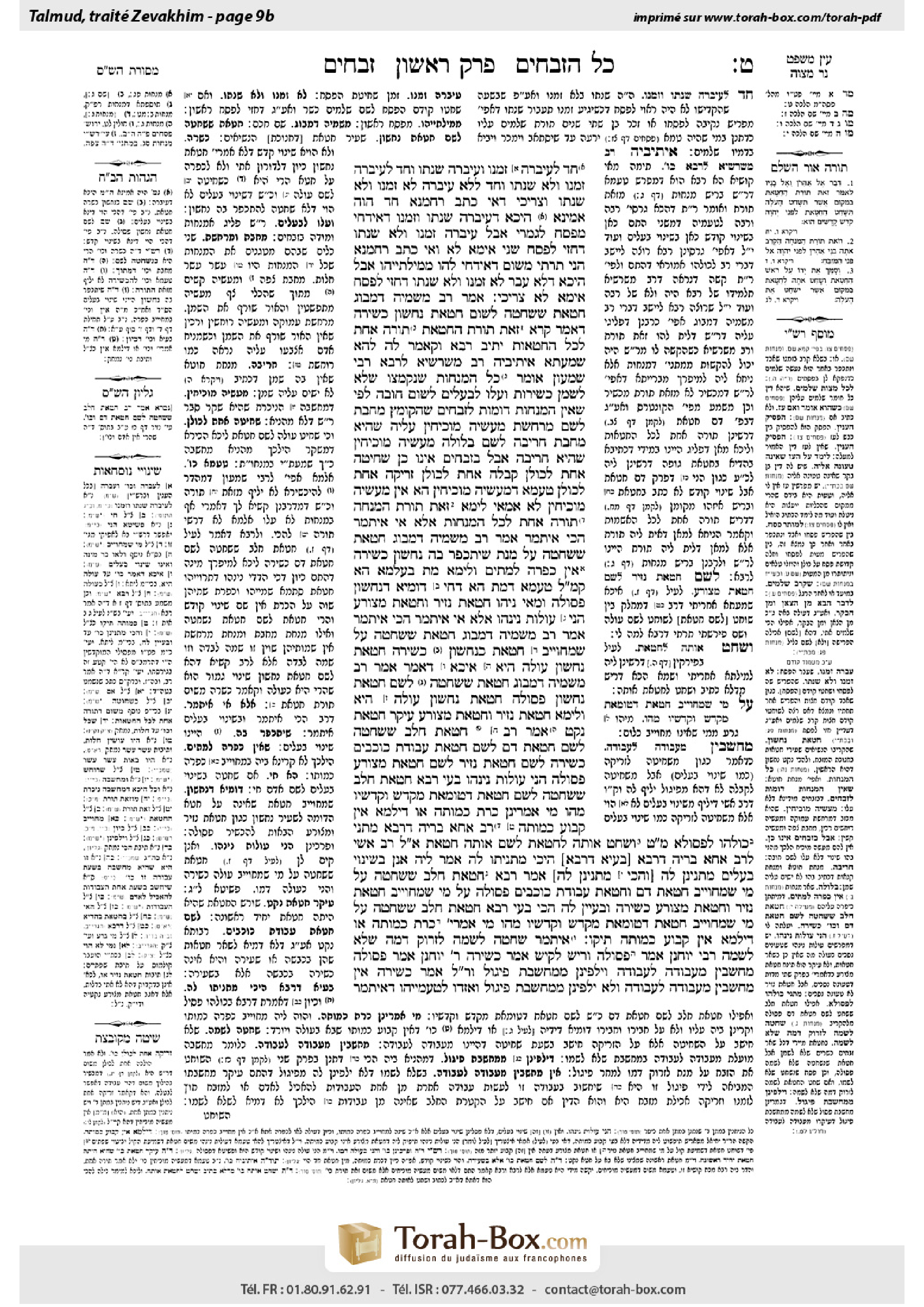
Zevachim 9b: Talmud study for Daf Yomi
Daf Yomi is the daily study of one Talmud folio. Explore 37 tractates with scans, Hebrew text, Sefaria English and AI-generated French translations where annotated.
Passage selection and English or AI-generated French translation are available where the scan has annotations. Daf Study is independent of Torah-Box and Sefaria.
Browse Zevachim · זבחים · All tractatesZevachim 9b text and translations
This page of Zevachim includes the Aramaic text, an English translation and an AI-generated French translation, alongside the scan above.
זבחים ט׳ ב · Aramaic and Hebrew text
חַד לְעִיבְּרָה זְמַנּוֹ וְעִיבְּרָה שְׁנָתוֹ, וְחַד לְעִיבְּרָה זְמַנּוֹ וְלֹא שְׁנָתוֹ, וְחַד לְלֹא עִיבְּרָה לֹא זְמַנּוֹ וְלֹא שְׁנָתוֹ.
וּצְרִיכִי; דְּאִי כְּתַב רַחֲמָנָא חַד, הֲוָה אָמֵינָא: הֵיכָא דְּעִיבְּרָה שְׁנָתוֹ וּזְמַנּוֹ – דְּאִידְּחִי מִפֶּסַח לִגְמָרֵי; אֲבָל עִיבְּרָה זְמַנּוֹ וְלֹא שְׁנָתוֹ, דַּחֲזֵי לְפֶסַח שֵׁנִי – אֵימָא לָא.
וְאִי כְּתַב רַחֲמָנָא הָנֵי תַּרְתֵּי – מִשּׁוּם דְּאִידְּחִי לְהוּ מִמִּילְּתַיְיהוּ; אֲבָל הֵיכָא דְּלָא עִבֵּר לֹא זְמַנּוֹ וְלֹא שְׁנָתוֹ, דַּחֲזֵי לְפֶסַח – אֵימָא לָא; צְרִיכִי.
אָמַר רַב מִשְּׁמֵיהּ דְּמָבוֹג: חַטָּאת שֶׁשְּׁחָטָהּ לְשׁוּם חַטַּאת נַחְשׁוֹן – כְּשֵׁירָה; דְּאָמַר קְרָא: ״זֹאת תּוֹרַת הַחַטָּאת״ – תּוֹרָה אַחַת לְכׇל הַחַטָּאוֹת.
יָתֵיב רָבָא וְקָאָמַר לַהּ לְהָא שְׁמַעְתָּא; אֵיתִיבֵיהּ רַב מְשַׁרְשְׁיָא לְרָבָא, רַבִּי שִׁמְעוֹן אוֹמֵר: כׇּל הַמְּנָחוֹת שֶׁנִּקְמְצוּ שֶׁלֹּא לִשְׁמָן – כְּשֵׁירוֹת, וְעָלוּ לַבְּעָלִים לְשׁוּם חוֹבָה;
לְפִי שֶׁאֵין הַמְּנָחוֹת דּוֹמוֹת לִזְבָחִים. שֶׁהַקּוֹמֵץ מַחֲבַת לְשֵׁם מַרְחֶשֶׁת – מַעֲשֶׂיהָ מוֹכִיחִין עָלֶיהָ שֶׁהִיא מַחֲבַת, חֲרֵיבָה לְשֵׁם בְּלוּלָה – מַעֲשֶׂיהָ מוֹכִיחִין שֶׁהִיא חֲרֵיבָה;
אֲבָל בִּזְבָחִים אֵינוֹ כֵּן – שְׁחִיטָה אַחַת לְכוּלָּן, קַבָּלָה אַחַת לְכוּלָּן, זְרִיקָה אַחַת לְכוּלָּן.
טַעְמָא דְּמַעֲשֶׂיהָ מוֹכִיחִין, הָא אֵין מַעֲשֶׂיהָ מוֹכִיחִין – לָא; אַמַּאי? לֵימָא: ״זֹאת תּוֹרַת הַמִּנְחָה״ – תּוֹרָה אַחַת לְכׇל הַמְּנָחוֹת!
אֶלָּא אִי אִיתְּמַר, הָכִי אִיתְּמַר: אָמַר רַב מִשְּׁמֵיהּ דְּמָבוֹג: חַטָּאת שֶׁשְּׁחָטָהּ עַל מְנָת שֶׁיִּתְכַּפֵּר בָּהּ נַחְשׁוֹן – כְּשֵׁירָה; אֵין כַּפָּרָה לְמֵתִים.
וְלֵימָא מֵת בְּעָלְמָא!
הָא קָא מַשְׁמַע לַן: טַעְמָא דְּמֵת; הָא דְּחַי דּוּמְיָא דְּנַחְשׁוֹן – פְּסוּלָה. וּמַאי נִיהוּ? חַטַּאת נָזִיר וְחַטַּאת מְצוֹרָע.
הָנֵי עוֹלוֹת נִינְהוּ!
אֶלָּא אִי אִיתְּמַר הָכִי אִיתְּמַר, אָמַר רַב מִשְּׁמֵיהּ דְּמָבוֹג: חַטָּאת שֶׁשְּׁחָטָהּ עַל שֶׁמְּחוּיָּיב חַטָּאת כְּנַחְשׁוֹן – כְּשֵׁירָה; חַטַּאת נַחְשׁוֹן – עוֹלָה הִיא.
אִיכָּא דְּאָמַר, אָמַר רַב מִשְּׁמֵיהּ דְּמָבוֹג: חַטָּאת שֶׁשְּׁחָטָהּ לְשֵׁם חַטַּאת נַחְשׁוֹן – פְּסוּלָה; חַטַּאת נַחְשׁוֹן – עוֹלָה הִיא.
וְלֵימָא: חַטַּאת נָזִיר וְחַטַּאת מְצוֹרָע! עִיקַּר חַטָּאת נָקֵט.
אָמַר רַב: חַטַּאת חֵלֶב שֶׁשְּׁחָטָהּ לְשֵׁם חַטַּאת דָּם, לְשֵׁם חַטַּאת עֲבוֹדָה זָרָה – כְּשֵׁירָה.
לְשֵׁם חַטַּאת נָזִיר, לְשֵׁם חַטַּאת מְצוֹרָע – פְּסוּלָה; הָנֵי עוֹלוֹת נִינְהוּ.
בָּעֵי רָבָא: חַטַּאת חֵלֶב שֶׁשְּׁחָטָהּ לְשֵׁם חַטָּאת דְּטוּמְאַת מִקְדָּשׁ וְקָדָשָׁיו, מַהוּ? מִי אָמְרִינַן: כָּרֵת כְּמוֹתָהּ;
אוֹ דִילְמָא, אֵין קָבוּעַ כְּמוֹתָהּ?
רַב אַחָא בְּרֵיהּ דְּרָבָא מַתְנֵי כּוּלְּהוּ לִפְסוּלָא, מַאי טַעְמָא? ״וְשָׁחַט אוֹתָהּ לְחַטָּאת״ – לְשֵׁם אוֹתָהּ חַטָּאת.
אֲמַר לֵיהּ רַב אָשֵׁי לְרַב אַחָא בְּרֵיהּ דְּרָבָא: בַּעְיָא דְּרָבָא הֵיכִי מַתְנִיתוּ לַהּ?
אֲמַר לֵיהּ: אֲנַן בְּשִׁינּוּי בְּעָלִים מַתְנֵינַן לַהּ [וְהָכִי מַתְנֵינַן לָהּ], אָמַר רָבָא: חַטַּאת חֵלֶב שֶׁשְּׁחָטָהּ עַל מִי שֶׁמְּחוּיָּיב חַטַּאת דָּם וְחַטַּאת עֲבוֹדָה זָרָה – פְּסוּלָה. עַל מִי שֶׁמְּחוּיָּיב חַטַּאת נָזִיר וְחַטַּאת מְצוֹרָע – כְּשֵׁירָה.
וּבָעֲיִין לַהּ הָכִי – בָּעֵי רָבָא: חַטַּאת חֵלֶב שֶׁשְּׁחָטָהּ עַל מִי שֶׁמְּחוּיָּיב חַטָּאת דְּטוּמְאַת מִקְדָּשׁ וְקָדָשָׁיו, מַהוּ? מִי אָמְרִינַן: כָּרֵת כְּמוֹתָהּ; אוֹ דִילְמָא, אֵין קָבוּעַ כְּמוֹתָהּ?
תֵּיקוּ.
אִיתְּמַר: שְׁחָטָהּ לִשְׁמָהּ, לִזְרוֹק דָּמָהּ שֶׁלֹּא לִשְׁמָהּ – רַבִּי יוֹחָנָן אָמַר: פְּסוּלָה, וְרֵישׁ לָקִישׁ אָמַר: כְּשֵׁירָה.
רַבִּי יוֹחָנָן אָמַר פְּסוּלָה – מְחַשְּׁבִין מֵעֲבוֹדָה לַעֲבוֹדָה, וְיָלְפִינַן מִמַּחְשֶׁבֶת פִּיגּוּל.
וְרֵישׁ לָקִישׁ אָמַר כְּשֵׁירָה – אֵין מְחַשְּׁבִין מֵעֲבוֹדָה לַעֲבוֹדָה, וְלָא יָלְפִינַן מִמַּחְשֶׁבֶת פִּיגּוּל.
וְאָזְדוּ לְטַעְמַיְיהוּ – דְּאִיתְּמַר:
Zevachim 9b · English translation
One verse teaches this halakha in a case where its time of sacrifice, Passover eve, has passed, and its first year has also passed, disqualifying it for sacrifice as a Paschal offering. And one verse teaches the halakha in a case where its time of sacrifice has passed, but not its first year. And the third one teaches a case where neither its time of sacrifice nor its first year has passed, but it was sacrificed before Passover eve.
And all these verses are necessary. As, had the Merciful One written only one of the verses, I would say that it is referring to a case where both its first year and its time of sacrifice have passed. Only such a Paschal offering should be sacrificed as a peace offering, as it was completely rejected from its status as a Paschal offering. But in a case where its time of sacrifice has passed, but its first year has not passed, in which case it is still fit to be sacrificed as a Paschal offering on the second Pesaḥ, I would say that it is not sacrificed as a peace offering.
And had the Merciful One written only these two verses, one might assume that only these Paschal offerings are sacrificed as peace offerings, as they were both rejected from their status as Paschal offerings. But in a case where neither its time of sacrifice nor its first year have passed, in which case it is still fit to be sacrificed as a Paschal offering on Passover eve, I would say that it is not sacrificed as a peace offering. Therefore, all three verses are necessary.
§ Rav says in the name of Mavog: A sin offering that one slaughtered for the sake of a sin offering of Nahshon, i.e., a sin offering similar to those brought by the princes during the dedication of the Tabernacle (see Numbers, chapter 7), not to atone for a sin but as a gift, is fit and satisfies its owner’s obligation; as the verse states: “This is the law of the sin offering” (Leviticus 6:18), indicating that there is one law for all the sin offerings.
Rava sat and stated this halakha of Mavog. Rav Mesharshiyya raised an objection to Rava from a baraita: Rabbi Shimon says: All meal offerings from which a handful was removed not for their sake but for the sake of another type of meal offering are fit, and satisfied the obligation of the owner, in contrast to animal offerings, which if slaughtered not for their sake do not satisfy their owners’ obligations.
This is because meal offerings are not similar to slaughtered offerings. As, if one removes a handful from a meal offering prepared in a shallow pan for the sake of a meal offering prepared in a deep pan, his intention is demonstrably incorrect, as its mode of preparation proves that it is a meal offering prepared in a shallow pan. Likewise, if one removes a handful from a dry meal offering for the sake of a meal offering mixed with oil, his intention is demonstrably incorrect, as its mode of preparation proves that it is a dry meal offering. The demonstrably incorrect nature of the intention prevents it from affecting the status of the meal offering in any way.
But with regard to slaughtered offerings this is not so. There is one mode of slaughter for all of the offerings, one mode of collection of the blood for all of them, and one mode of sprinkling for all of them. Therefore, improper intention affects the status of the offering; if a rite is performed for the sake of the wrong type of offering, the offering does not satisfy its owner’s obligation.
Rav Mesharshiyya inferred from the baraita: The reason a meal offering satisfies its owner’s obligation even when one removed a handful for the sake of another type of meal offering is that its mode of preparation proves its true nature. But if its mode of preparation does not prove its nature, it does not satisfy its owner’s obligation. Why not? If Mavog’s derivation is correct, let us say likewise that the verse: “This is the law of the meal offering” (Leviticus 6:7), indicates that there is one law for all of the meal offerings, regardless of their mode of preparation.
Rather, if Mavog’s statement was stated, it was stated like this: Rav says in the name of Mavog: A sin offering that one slaughtered on the condition that Nahshon, the prince of Judah, be atoned for by it is fit; this is not considered a change of owner, as there is no atonement for the dead.
The Gemara challenges: But if this was Mavog’s statement, why did he mention Nahshon? Let him state this halakha in reference to a dead person in general.
The Gemara answers: This statement of Mavog teaches us that the reason for the fitness of a sin offering slaughtered for the atonement of Nahshon is that he is dead. Consequently, if it was slaughtered for the sake of a living person obligated to bring a sin offering similar to that of Nahshon, it is unfit. And what is that? It is a nazirite’s sin offering or a leper’s sin offering, which are brought not to atone for a sin but to become ritually pure. Consequently, if one sacrifices a standard sin offering for the sake of one obligated to bring the sin offering of a nazirite or a leper, it is considered a change of owner, and the offering is unfit.
The Gemara counters: Why is the offering disqualified? These sin offerings of a nazirite and a leper are equivalent to burnt offerings, since they are not brought for atonement. Sacrificing a sin offering for the sake of one obligated to bring a burnt offering is not considered deviation with regard to the owner and does not disqualify it (see 3b).
The Gemara answers: Rather, if Mavog’s statement was stated, it was stated like this: Rav says in the name of Mavog: A sin offering that one slaughtered for one who is obligated to bring a sin offering similar to that of Nahshon is fit; Nahshon’s sin offering is equivalent to a burnt offering.
There is one who says that Rav says in the name of Mavog: A sin offering that one slaughtered for the sake of a sin offering of Nahshon is unfit. This is because a sin offering of Nahshon is equivalent to a burnt offering, and he is therefore considered to have deviated from the type of offering.
The Gemara challenges: But why did Mavog mention a sin offering of Nahshon, which one cannot bring at all? Let him say this halakha with regard to a nazirite’s sin offering and a leper’s sin offering, which are also equivalent to burnt offerings. The Gemara explains: Mavog cited the primary sin offering, the first case of an individual sin offering recorded in the Bible.
§ Rav says: A sin offering brought for consuming forbidden fat that one slaughtered for the sake of a sin offering brought for consuming blood, or for the sake of a sin offering brought for engaging in idol worship, is fit; it is not considered deviation from the type of offering.
But if it was slaughtered for the sake of a nazirite’s sin offering, or for the sake of a leper’s sin offering, it is unfit; these sin offerings are equivalent to burnt offerings, as they are not brought for atonement.
Rava raises a dilemma: In the case of a sin offering brought for consuming forbidden fat that one slaughtered for the sake of a sin offering brought for the defiling of the Temple or its sacrificial foods, what is the halakha? Do we say that the offering is fit, as the latter type of sin offering atones for a transgression punishable by karet when committed intentionally, similar to the transgression of consuming forbidden fat?
Or perhaps is it unfit, as a sin offering brought for defiling the Temple is a sliding-scale sin offering, the contents of which vary with the financial situation of the transgressor (see Leviticus 5:3–13), and not a set sin offering, which is always an animal, like a sin offering brought for consuming forbidden fat?
Rav Aḥa, son of Rava, teaches a version of Rav’s statement according to which in all of the cases he mentioned, including one where the sin offering was slaughtered for the sake of a sin offering brought for consuming blood or for engaging in idol worship, the offering is unfit. What is the reason? It is derived from the verse: “And slaughter it [otah] for a sin offering” (Leviticus 4:33), that a sin offering must be slaughtered for the sake of that [otah] sin offering, and no other.
Rav Ashi said to Rav Aḥa, son of Rava: How do you teach Rava’s dilemma? Rava appears to assume that if one slaughters a sin offering for the sake of some other types of sin offering it remains fit. How is this compatible with your version of Rav’s statement, according to which slaughter for the sake of any other type of sin offering disqualifies it?
Rav Aḥa said to him: We teach Rava’s dilemma with regard to deviation with regard to the owner rather than from the type of offering. And this is how we teach it: First, Rava says: A sin offering brought for consuming forbidden fat that one slaughtered for the sake of one who is obligated to bring a sin offering for consuming blood, or for the sake of one who is obligated to bring a sin offering for engaging in idol worship, is unfit. Since the other person is also obligated to bring a sin offering, this is considered deviation with regard to the owner. But if it was slaughtered for one who is obligated to bring a nazirite’s sin offering or a leper’s sin offering, it is fit, as these sin offerings are not brought for atonement. Deviation with regard to the owner disqualifies an offering only if the other owner is obligated to bring a similar offering.
And then we pose the dilemma like this: Rava raises a dilemma: In the case of a sin offering brought for consuming forbidden fat that one slaughtered for the sake of one who is obligated to bring a sin offering for the defiling of the Temple or its sacrificial foods, what is the halakha? Do we say that the offering is unfit, as the one who defiled the Temple or its sacrificial foods is obligated to bring a sin offering for a transgression punishable by karet, similar to the transgression of the owner? Or perhaps it remains fit, as a sin offering brought for defiling the Temple is not a set sin offering like a sin offering brought for consuming forbidden fat?
The Gemara concludes: The dilemma shall stand unresolved.
§ It was stated: If one slaughtered a sin offering for its sake with intent to sprinkle its blood not for its sake but for the sake of another type of offering, Rabbi Yoḥanan says that the offering is unfit, and Reish Lakish says it is fit.
Rabbi Yoḥanan says it is unfit, as in his opinion one can have intention from one rite to affect another rite, i.e., one can disqualify an offering by performing one rite with improper intent about a subsequent rite that he has not yet performed. And we derive this halakha from intent of piggul, i.e., intent while performing one of the main rites to consume the offering after the appointed time, which disqualifies the offering.
And Reish Lakish says that it is fit, as in his opinion one cannot have intention from one rite to affect another rite, and we do not derive halakhot with regard to deviation from the type of offering from intent of piggul.
And Rabbi Yoḥanan and Reish Lakish each follow [ve’azdu] their general line of reasoning in this matter; as it was stated:
Zevachim 9b · Traduction française (IA)
Un verset enseigne cette halakha dans le cas où le moment prévu pour le sacrifice, la veille de Pessaḥ, est passé et où sa première année est également écoulée, ce qui le disqualifie comme sacrifice pascal. Un autre verset enseigne la halakha dans le cas où le moment prévu pour le sacrifice est passé, mais pas sa première année. Le troisième enseigne le cas où ni le moment prévu pour le sacrifice ni sa première année ne sont passés, mais où il a été sacrifié avant la veille de Pessaḥ.
Tous ces versets sont nécessaires. En effet, si le Miséricordieux n’avait écrit qu’un seul de ces versets, j’aurais dit qu’il s’agit d’un cas où sa première année et le moment prévu pour son sacrifice sont tous deux passés. Seul un tel sacrifice pascal devrait être offert comme sacrifice de paix, puisqu’il a été complètement écarté de son statut de sacrifice pascal. Mais dans le cas où le moment prévu pour son sacrifice est passé, sans que sa première année le soit, et où il peut encore être offert comme sacrifice pascal lors du second Pessaḥ, j’aurais dit qu’il ne doit pas être offert comme sacrifice de paix.
Et si le Miséricordieux n’avait écrit que ces deux versets, on aurait pu supposer que seuls ces sacrifices pascals sont offerts comme sacrifices de paix, puisqu’ils ont tous deux été écartés de leur statut de sacrifices pascals. Mais dans le cas où ni le moment prévu pour le sacrifice ni sa première année ne sont passés, et où il peut encore être offert comme sacrifice pascal la veille de Pessaḥ, j’aurais dit qu’il ne doit pas être offert comme sacrifice de paix. Les trois versets sont donc nécessaires.
§ Rav dit au nom de Mavog : Un sacrifice expiatoire abattu en vue du sacrifice expiatoire de Nahshon, c’est-à-dire un sacrifice expiatoire semblable à ceux qu’ont apportés les princes lors de l’inauguration du Tabernacle (voir Nombres, chapitre 7), non pour expier une faute, mais comme offrande, est valide et acquitte son propriétaire de son obligation. En effet, le verset dit : « Telle est la loi du sacrifice expiatoire » (Lévitique 6:18), ce qui indique qu’il existe une seule loi pour tous les sacrifices expiatoires.
Rava était assis et enseignait cette halakha de Mavog. Rav Mesharshiyya lui opposa une baraïta : Rabbi Shimon dit : Toutes les offrandes végétales dont on a prélevé une poignée non pour elles-mêmes, mais en vue d’un autre type d’offrande végétale, sont valides et acquittent leur propriétaire de son obligation, contrairement aux sacrifices animaux qui, s’ils sont abattus sans l’intention requise, n’acquittent pas leur propriétaire de son obligation.
En effet, les offrandes végétales ne sont pas comparables aux sacrifices abattus. Si l’on prélève une poignée d’une offrande végétale cuite à la poêle plate en vue d’une offrande végétale cuite à la poêle profonde, l’intention est manifestement erronée, puisque son mode de préparation montre qu’il s’agit d’une offrande végétale cuite à la poêle plate. De même, si l’on prélève une poignée d’une offrande végétale sèche en vue d’une offrande végétale mélangée à de l’huile, l’intention est manifestement erronée, puisque son mode de préparation montre qu’il s’agit d’une offrande végétale sèche. Le caractère manifestement erroné de l’intention l’empêche d’affecter de quelque manière que ce soit le statut de l’offrande végétale.
Mais il n’en va pas ainsi des sacrifices abattus. Il existe une seule façon d’abattre tous les sacrifices, une seule façon de recueillir leur sang et une seule façon de l’asperger. Par conséquent, une intention inadéquate affecte le statut du sacrifice : si un rite est accompli en vue du mauvais type de sacrifice, celui-ci n’acquitte pas son propriétaire de son obligation.
Rav Mesharshiyya déduisit de la baraïta qu’une offrande végétale acquitte son propriétaire de son obligation même si l’on en a prélevé une poignée en vue d’un autre type d’offrande végétale, parce que son mode de préparation révèle sa véritable nature. Mais si son mode de préparation ne révèle pas sa nature, elle n’acquitte pas son propriétaire de son obligation. Pourquoi ? Si la déduction de Mavog est juste, disons de même que le verset « Telle est la loi de l’offrande végétale » (Lévitique 6:7) indique qu’il existe une seule loi pour toutes les offrandes végétales, quel que soit leur mode de préparation.
Mais si la déclaration de Mavog a été formulée, elle l’a été ainsi : Rav dit au nom de Mavog : Un sacrifice expiatoire abattu à condition qu’il expie Nahshon, le prince de Juda, est valide ; cela n’est pas considéré comme un changement de propriétaire, car on n’expie pas les morts.
La Guemara objecte : Mais si telle était la déclaration de Mavog, pourquoi a-t-il mentionné Nahshon ? Qu’il énonce cette halakha au sujet d’un mort en général.
La Guemara répond : Cette déclaration de Mavog nous enseigne que si un sacrifice expiatoire abattu en vue d’expier Nahshon est valide, c’est parce qu’il est mort. Par conséquent, si le sacrifice est abattu en vue d’une personne vivante tenue d’apporter un sacrifice expiatoire semblable à celui de Nahshon, il est invalide. De quel sacrifice s’agit-il ? Du sacrifice expiatoire d’un nazir ou de celui d’un lépreux, qui sont apportés non pour expier une faute, mais pour obtenir la pureté rituelle. Par conséquent, si l’on sacrifie un sacrifice expiatoire ordinaire en vue d’une personne tenue d’apporter le sacrifice expiatoire d’un nazir ou d’un lépreux, cela est considéré comme un changement de propriétaire et le sacrifice est invalide.
La Guemara réplique : Pourquoi le sacrifice est-il disqualifié ? Les sacrifices expiatoires d’un nazir et d’un lépreux équivalent à des holocaustes, puisqu’ils ne sont pas apportés pour expier. Sacrifier un sacrifice expiatoire en vue d’une personne tenue d’apporter un holocauste n’est pas considéré comme une déviation concernant le propriétaire et ne le disqualifie pas (voir 3b).
La Guemara répond : Mais si la déclaration de Mavog a été formulée, elle l’a été ainsi : Rav dit au nom de Mavog : Un sacrifice expiatoire abattu en vue d’une personne tenue d’apporter un sacrifice expiatoire semblable à celui de Nahshon est valide ; le sacrifice expiatoire de Nahshon équivaut à un holocauste.
Selon une autre version, Rav dit au nom de Mavog : Un sacrifice expiatoire abattu en vue du sacrifice expiatoire de Nahshon est invalide. En effet, le sacrifice expiatoire de Nahshon équivaut à un holocauste ; on considère donc que le type de sacrifice a été modifié.
La Guemara objecte : Mais pourquoi Mavog a-t-il mentionné le sacrifice expiatoire de Nahshon, qu’on ne peut pas apporter ? Qu’il énonce cette halakha au sujet du sacrifice expiatoire d’un nazir ou d’un lépreux, qui équivaut également à un holocauste. La Guemara explique : Mavog a cité le sacrifice expiatoire par excellence, le premier cas de sacrifice expiatoire individuel mentionné dans la Bible.
§ Rav dit : Un sacrifice expiatoire apporté pour avoir consommé de la graisse interdite, abattu en vue d’un sacrifice expiatoire apporté pour avoir consommé du sang ou d’un sacrifice expiatoire apporté pour avoir pratiqué le culte idolâtre, est valide ; cela n’est pas considéré comme une déviation du type de sacrifice.
Mais s’il a été abattu en vue du sacrifice expiatoire d’un nazir ou de celui d’un lépreux, il est invalide ; ces sacrifices expiatoires équivalent à des holocaustes, car ils ne sont pas apportés pour expier.
Rava soulève un dilemme : dans le cas d’un sacrifice expiatoire apporté pour avoir consommé de la graisse interdite, abattu en vue d’un sacrifice expiatoire apporté pour avoir rendu impur le Temple ou ses aliments consacrés, quelle est la halakha ? Le sacrifice est-il valide, puisque ce dernier type de sacrifice expiatoire expie une transgression passible de karet lorsqu’elle est commise intentionnellement, comme la transgression consistant à consommer de la graisse interdite ?
Ou peut-être est-il invalide, car le sacrifice expiatoire apporté pour avoir rendu impur le Temple est un sacrifice expiatoire à échelle variable, dont la nature dépend de la situation financière du transgresseur (voir Lévitique 5:3–13), et non un sacrifice expiatoire fixe, qui est toujours un animal, comme le sacrifice expiatoire apporté pour avoir consommé de la graisse interdite ?
Rav Aḥa, fils de Rava, enseigne une version de la déclaration de Rav selon laquelle, dans tous les cas qu’il a mentionnés, y compris celui où le sacrifice expiatoire a été abattu en vue d’un sacrifice expiatoire apporté pour avoir consommé du sang ou pratiqué le culte idolâtre, le sacrifice est invalide. Pour quelle raison ? Cela se déduit du verset : « Et il l’abattra [otah] en sacrifice expiatoire » (Lévitique 4:33) : un sacrifice expiatoire doit être abattu en vue de ce sacrifice expiatoire-là [otah], et d’aucun autre.
Rav Ashi dit à Rav Aḥa, fils de Rava : Comment enseignez-vous le dilemme de Rava ? Rava semble supposer que si l’on abat un sacrifice expiatoire en vue de certains autres types de sacrifices expiatoires, il reste valide. Comment cela s’accorde-t-il avec votre version de la déclaration de Rav, selon laquelle l’abattage en vue de tout autre type de sacrifice expiatoire le disqualifie ?
Rav Aḥa lui dit : Nous enseignons le dilemme de Rava à propos d’une déviation concernant le propriétaire, et non d’une déviation du type de sacrifice. Nous l’enseignons ainsi : Tout d’abord, Rava dit : Un sacrifice expiatoire apporté pour avoir consommé de la graisse interdite, abattu en vue d’une personne tenue d’apporter un sacrifice expiatoire pour avoir consommé du sang ou en vue d’une personne tenue d’apporter un sacrifice expiatoire pour avoir pratiqué le culte idolâtre, est invalide. Puisque l’autre personne est elle aussi tenue d’apporter un sacrifice expiatoire, cela est considéré comme une déviation concernant le propriétaire. Mais si le sacrifice est abattu en vue d’une personne tenue d’apporter le sacrifice expiatoire d’un nazir ou d’un lépreux, il est valide, car ces sacrifices expiatoires ne sont pas apportés pour expier. Une déviation concernant le propriétaire ne disqualifie un sacrifice que si l’autre propriétaire est tenu d’apporter un sacrifice semblable.
Puis nous formulons le dilemme ainsi : Rava soulève un dilemme : dans le cas d’un sacrifice expiatoire apporté pour avoir consommé de la graisse interdite, abattu en vue d’une personne tenue d’apporter un sacrifice expiatoire pour avoir rendu impur le Temple ou ses aliments consacrés, quelle est la halakha ? Le sacrifice est-il invalide, puisque la personne qui a rendu impur le Temple ou ses aliments consacrés est tenue d’apporter un sacrifice expiatoire pour une transgression passible de karet, comme celle commise par le propriétaire ? Ou peut-être reste-t-il valide, car le sacrifice expiatoire apporté pour avoir rendu impur le Temple n’est pas un sacrifice expiatoire fixe, contrairement à celui apporté pour avoir consommé de la graisse interdite ?
La Guemara conclut : Le dilemme reste sans réponse.
§ Il a été enseigné : Si l’on a abattu un sacrifice expiatoire en vue de lui-même, avec l’intention d’asperger son sang non en vue de lui-même, mais en vue d’un autre type de sacrifice, Rabbi Yoḥanan dit que le sacrifice est invalide, et Reish Lakish dit qu’il est valide.
Rabbi Yoḥanan dit qu’il est invalide, car, selon lui, une intention portant sur un rite peut avoir un effet sur un autre rite : on peut disqualifier un sacrifice en accomplissant un rite avec une intention inadéquate concernant un rite ultérieur qui n’a pas encore été accompli. Nous déduisons cette halakha de l’intention de piggul, c’est-à-dire l’intention, lors de l’accomplissement de l’un des rites principaux, de consommer le sacrifice après le délai prescrit, ce qui disqualifie le sacrifice.
Reish Lakish dit qu’il est valide, car, selon lui, une intention portant sur un rite ne peut pas avoir d’effet sur un autre rite, et nous ne déduisons pas les halakhot relatives à la déviation du type de sacrifice de l’intention de piggul.
Rabbi Yoḥanan et Reish Lakish suivent chacun [ve’azdu] leur ligne générale de raisonnement sur cette question ; car il a été enseigné :
Traduction française générée par IA à partir de l’édition anglaise de Sefaria. Vérifie toujours un passage avec le texte source.
Text from Sefaria: William Davidson Edition - Vocalized Aramaic (CC BY NC); William Davidson Edition - English (CC BY NC).