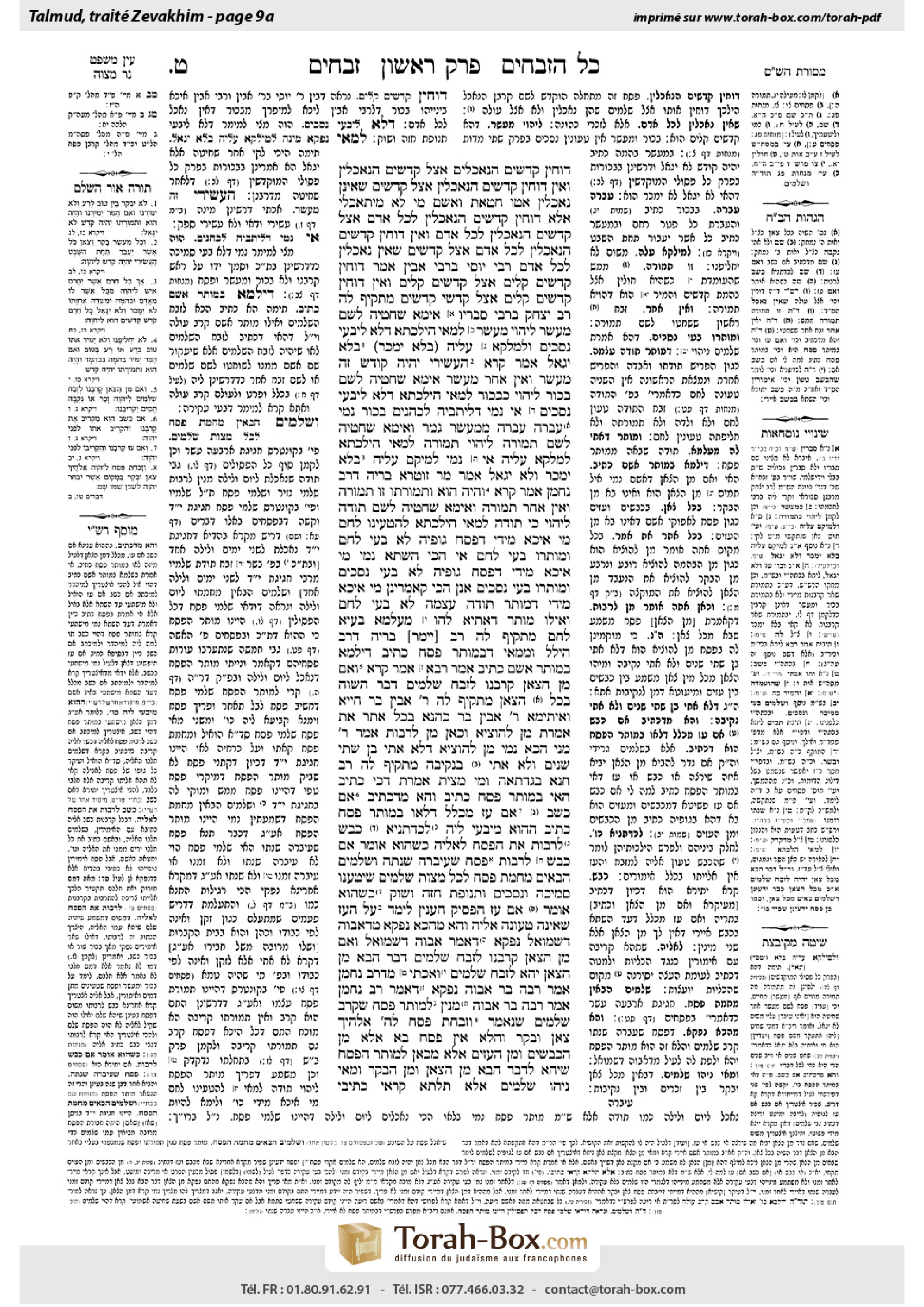
Zevachim 9a: Talmud study for Daf Yomi
Daf Yomi is the daily study of one Talmud folio. Explore 37 tractates with scans, Hebrew text, Sefaria English and AI-generated French translations where annotated.
Passage selection and English or AI-generated French translation are available where the scan has annotations. Daf Study is independent of Torah-Box and Sefaria.
Browse Zevachim · זבחים · All tractatesZevachim 9a text and translations
This page of Zevachim includes the Aramaic text, an English translation and an AI-generated French translation, alongside the scan above.
זבחים ט׳ א · Aramaic and Hebrew text
דּוֹחִין קָדָשִׁים הַנֶּאֱכָלִים אֵצֶל קָדָשִׁים הַנֶּאֱכָלִין, וְאֵין דּוֹחִין קָדָשִׁים הַנֶּאֱכָלִין אֵצֶל קָדָשִׁים שֶׁאֵינָן נֶאֱכָלִין.
אַטּוּ חַטָּאת וְאָשָׁם מִי לָא מִיתְאַכְלִי?!
אֶלָּא דּוֹחִין קָדָשִׁים הַנֶּאֱכָלִין לְכׇל אָדָם אֵצֶל קָדָשִׁים הַנֶּאֱכָלִין לְכׇל אָדָם, וְאֵין דּוֹחִין קָדָשִׁים הַנֶּאֱכָלִין לְכׇל אָדָם אֵצֶל קָדָשִׁים שֶׁאֵין נֶאֱכָלִין לְכׇל אָדָם.
רַבִּי יוֹסֵי בְּרַבִּי אָבִין אָמַר: דּוֹחִין קָדָשִׁים קַלִּים אֵצֶל קָדָשִׁים קַלִּים, וְאֵין דּוֹחִין קָדָשִׁים קַלִּים אֵצֶל קׇדְשֵׁי קָדָשִׁים.
מַתְקֵיף לַהּ רַב יִצְחָק בְּרַבִּי (סַבְרִיוּ) [סַבְרִין], אֵימָא: שַׁחְטֵיהּ לְשֵׁם מַעֲשֵׂר – לֶיהֱוֵי מַעֲשֵׂר! לְמַאי הִילְכְתָא? דְּלָא לִיבְעֵי נְסָכִים, וּלְמִלְקֵא עֲלֵיהּ (בְּלֹא יִמָּכֵר) בְּ״לֹא יִגָּאֵל״.
אָמַר קְרָא: ״הָעֲשִׂירִי יִהְיֶה קֹדֶשׁ״ – זֶה מַעֲשֵׂר, וְאֵין אַחֵר מַעֲשֵׂר.
אֵימָא: שַׁחְטֵיהּ לְשֵׁם בְּכוֹר – לֶיהֱוֵי כִּבְכוֹר! לְמַאי הִילְכְתָא? דְּלָא לִיבְעֵי נְסָכִים, אִי נָמֵי דְּלִיתְּבֵיהּ לְכֹהֲנִים.
בְּכוֹר נָמֵי, ״עֲבָרָה״–״עֲבָרָה״ מִמַּעֲשֵׂר גָּמַר.
וְאֵימָא: שַׁחְטֵיהּ לְשֵׁם תְּמוּרָה – לֶיהֱוֵי תְּמוּרָה! לְמַאי הִילְכְתָא? לְמִלְקֵא עֲלֵיהּ, אִי נָמֵי לְמֵיקַם עֲלֵיהּ בְּ״לֹא יִמָּכֵר וְלֹא יִגָּאֵל״.
אָמַר מָר זוּטְרָא בְּרֵיהּ דְּרַב נַחְמָן, אָמַר קְרָא: ״וְהָיָה הוּא וּתְמוּרָתוֹ״ – זוֹ תְּמוּרָה, וְאֵין אַחֵר תְּמוּרָה.
וְאֵימָא: שַׁחְטֵיהּ לְשֵׁם תּוֹדָה – לֶיהֱוֵי כִּי תוֹדָה! לְמַאי הִילְכְתָא? לְהַטְעִינוֹ לֶחֶם.
מִי אִיכָּא מִידֵּי דְּפֶסַח גּוּפֵיהּ לָא בָּעֵי לֶחֶם, וּמוֹתָרוֹ בָּעֵי לֶחֶם?!
אִי הָכִי, הַשְׁתָּא נָמֵי – מִי אִיכָּא מִידֵּי דְּפֶסַח גּוּפֵיהּ לָא בָּעֵי נְסָכִים, וּמוֹתָרוֹ בָּעֵי נְסָכִים?!
אֲנַן הָכִי קָאָמְרִינַן: מִי אִיכָּא מִידֵּי דְּמוֹתַר תּוֹדָה עַצְמָהּ – לָא בָּעֵי לֶחֶם, וְאִילּוּ מוֹתָר דְּאָתְיָא לְהוּ מֵעָלְמָא – בָּעֲיָא לֶחֶם?!
מַתְקֵיף לַהּ רַב [יֵימַר] בְּרֵיהּ דְּרַב הִילֵּל: וּמִמַּאי דִּבְמוֹתַר פֶּסַח כְּתִיב? דִּילְמָא בְּמוֹתַר אָשָׁם כְּתִיב!
אָמַר רָבָא, אָמַר קְרָא: ״וְאִם מִן הַצֹּאן קׇרְבָּנוֹ לְזֶבַח שְׁלָמִים״ – דָּבָר הַשָּׁוֶה בְּכׇל הַצֹּאן.
מַתְקֵיף לַהּ רַבִּי אָבִין בַּר חִיָּיא, וְאִיתֵּימָא רַבִּי אָבִין בַּר כָּהֲנָא: בְּכֹל אֲתַר אַתְּ אָמְרַתְּ ״מִן״ – לְהוֹצִיא, וְכָאן ״מִן״ – לְרַבּוֹת!
אָמַר רַבִּי מָנִי: הָכָא נָמֵי ״מִן״ לְהוֹצִיא – דְּלָא אָתֵי בֶּן שְׁתֵּי שָׁנִים, וְלָא אָתֵי בִּנְקֵיבָה.
מַתְקֵיף לַהּ רַב חָנָא בַּגְדָּתָאָה: וּמִי מָצֵית אָמְרַתְּ דְּכִי כְּתִיב הַאי – בְּמוֹתַר פֶּסַח כְּתִיב?! וְהָא מִדִּכְתִיב ״אִם כֶּשֶׂב״, ״אִם עֵז״ – מִכְּלָל דְּלָאו בְּמוֹתַר פֶּסַח כְּתִיב!
הָהוּא מִיבְּעֵי לֵיהּ לְכִדְתַנְיָא: ״כֶּבֶשׂ״ – לְרַבּוֹת אֶת הַפֶּסַח לְאַלְיָה.
כְּשֶׁהוּא אוֹמֵר: ״אִם כֶּבֶשׂ״ – לְרַבּוֹת פֶּסַח שֶׁעִיבְּרָה שְׁנָתָהּ; וּשְׁלָמִים הַבָּאִים מֵחֲמַת פֶּסַח – לְכׇל מִצְוַת שְׁלָמִים, שֶׁיִּטָּעֲנוּ סְמִיכָה וּנְסָכִים וּתְנוּפַת חָזֶה וְשׁוֹק. כְּשֶׁהוּא אוֹמֵר: ״אִם עֵז״ – הִפְסִיק הָעִנְיָן, לִימֵּד עַל הָעֵז שֶׁאֵינָהּ טְעוּנָה אַלְיָה.
וְהָא – מֵהָכָא נָפְקָא?! מִדַּאֲבוּהּ דִּשְׁמוּאֵל נָפְקָא, דְּאָמַר אֲבוּהּ דִּשְׁמוּאֵל: ״וְאִם מִן הַצֹּאן קׇרְבָּנוֹ לְזֶבַח שְׁלָמִים״ – דָּבָר הַבָּא מִן הַצֹּאן יְהֵא לְזֶבַח שְׁלָמִים!
וְאַכַּתִּי מִדְּרַב נַחְמָן אָמַר רַבָּה בַּר אֲבוּהּ נָפְקָא! דְּאָמַר רַב נַחְמָן אָמַר רַבָּה בַּר אֲבוּהּ: מִנַּיִן לְמוֹתַר פֶּסַח שֶׁקָּרֵב שְׁלָמִים? שֶׁנֶּאֱמַר: ״וְזָבַחְתָּ פֶּסַח לַה׳ אֱלֹהֶיךָ צֹאן וּבָקָר״. וַהֲלֹא אֵין פֶּסַח בָּא אֶלָּא מִן הַכְּבָשִׂים וּמִן הָעִזִּים! אֶלָּא מִכָּאן לְמוֹתַר הַפֶּסַח שֶׁיְּהֵא לְדָבָר הַבָּא מִן הַצֹּאן וּמִן הַבָּקָר; וּמַאי נִיהוּ – שְׁלָמִים.
אֶלָּא תְּלָתָא קְרָאֵי כְּתִיבִי,
Zevachim 9a · English translation
Offerings that are eaten, in this case the Paschal offering, are diverted when slaughtered not for their sake to serve as other types of offerings that are eaten, such as peace offerings. But offerings that are eaten are not diverted to serve as offerings that are not eaten, such as burnt offerings.
The Gemara asks: Is that to say that a sin offering and a guilt offering are not eaten? Why does a Paschal offering receive the status of a peace offering and not that of a sin offering or a guilt offering, which are eaten by the priests?
Rather, the answer should be emended: Offerings that are eaten by every Jewish person are diverted to serve as offerings eaten by every Jewish person, i.e., peace offerings. But offerings eaten by every Jewish person are not diverted to serve as offerings not eaten by every Jewish person, i.e., sin offerings and guilt offerings, which are eaten only by priests.
Rabbi Yosei, son of Rabbi Avin, says that there is a different answer: Offerings of lesser sanctity are diverted to serve as offerings of lesser sanctity, i.e., peace offerings. But offerings of lesser sanctity are not diverted to serve as offerings of the most sacred order, i.e., burnt offerings, sin offerings, or guilt offerings.
Rav Yitzḥak, son of Rabbi Savriyu, objects to this answer: If so, say that if one slaughtered a Paschal offering for the sake of the animal tithe, let it be rendered animal tithe, which, like a Paschal offering, is an offering of lesser sanctity. The Gemara adds: For what halakha does it matter, practically speaking, that a Paschal offering has been rendered an animal tithe rather than a peace offering? It matters because if it is rendered an animal tithe, it should not require libations. And furthermore, if one sells it, he should be flogged for transgressing the prohibition: “It shall not be redeemed” (Leviticus 27:33), which applies to the animal tithe even after its slaughter.
The Gemara responds: The verse states with regard to the animal tithe: “The tenth shall be sacred” (Leviticus 27:32). The definite article indicates that this, the tenth animal, is the tithe, but another animal slaughtered for its sake is not a tithe.
The Gemara challenges: Still, say that if one slaughtered a Paschal offering for the sake of a firstborn animal, let it be rendered like a firstborn. The Gemara adds: For what halakha does it matter, practically speaking, that it has been rendered a firstborn rather than a peace offering? It matters because if it is rendered a firstborn, it should not require libations. Also, this means that one should give it to the priests.
The Gemara answers: With regard to a firstborn too, the verse states: “That you shall set apart [veha’avarta] unto the Lord all that opens the womb” (Exodus 13:12). Since with regard to the animal tithe it is stated: “Whatever passes [ya’avor] under the rod, the tenth shall be holy” (Leviticus 27:32), it is derived by verbal analogy between the passing [avara] stated with regard to a firstborn and the passing [avara] stated with regard to the animal tithe that a Paschal offering cannot become a firstborn either.
The Gemara challenges: But say that if one slaughtered a Paschal offering for the sake of a substitute, let it be rendered a substitute. The Gemara adds: For what halakha does it matter, practically speaking, that it has been rendered a substitute rather than a peace offering? The one who slaughtered it should be flogged for transgressing the prohibition of effecting substitution. Also, its sale should be determined to violate the prohibition: “It shall not be sold or redeemed” (Leviticus 27:28).
Mar Zutra, son of Rav Naḥman, says: It is derived from that which the verse states with regard to substitution: “Then both it and that for which it is changed shall be sacred” (Leviticus 27:33). The verse teaches that only it, the animal substituted, is a substitute, but another animal is not a substitute.
The Gemara challenges: But say that if one slaughtered a Paschal offering for the sake of a thanks offering, let it be rendered like a thanks offering. The Gemara adds: For what halakha does it practically matter that it has been rendered a thanks offering rather than a peace offering? If so, it should require a meal offering of forty loaves of bread.
The Gemara answers: Is there anything, i.e., any situation, comparable to this suggestion that a Paschal offering itself does not require bread, but its leftover, an animal consecrated as a Paschal offering but ultimately not sacrificed on Passover eve, requires bread when slaughtered not for its sake? Such a suggestion is implausible.
The Gemara asks: If so, now that a leftover Paschal offering slaughtered for the sake of a peace offering becomes a peace offering, this objection can also be raised: Is there anything comparable to the suggestion that a Paschal offering itself does not require libations, but its leftover requires libations as a peace offering?
The Gemara explains its answer: This is what we are saying: Is there anything comparable to the suggestion that the leftover of a thanks offering itself does not require bread, but the leftover of an offering from some other category requires bread?
§ It was taught that the verse: “And if his offering for a sacrifice of peace offerings unto the Lord is of the flock” (Leviticus 3:6), teaches that a Paschal offering sacrificed not on Passover eve is rendered a peace offering if sacrificed not for its sake. Rav Yeimar, son of Rav Hillel, objects to this: But from where is it derived that this verse is written with regard to a leftover Paschal offering? Perhaps it is written with regard to a leftover guilt offering; a guilt offering is also brought only from the flock.
Rava says: The verse states: “And if his offering for a sacrifice of peace offerings unto the Lord is of [min] the flock,” where the term “min” indicates that is brought equally from all species of the flock, i.e., from both sheep and goats. A guilt offering, by contrast, is brought only from rams, i.e., male sheep.
Rabbi Avin bar Ḥiyya, and some say Rabbi Avin bar Kahana, objects to this: You say everywhere that the word “min” is stated to exclude items, but here you claim that the word “min” is stated to include all species of the flock? You should say the opposite: The verse indicates an offering that is brought only from some species of the flock, i.e., a guilt offering.
Rabbi Mani says: Here too, the word “min” is stated to exclude certain categories of the flock, as a Paschal offering is not brought from an animal that is in its second year, and is not brought from the female animals of the flock.
The Gemara cites another objection. Rav Ḥana of Baghdad objects to this: How can you say that when this verse is written, it is written with regard to a leftover Paschal offering? But from that which is written in the subsequent verses: “If he brings a lamb” (Leviticus 3:7), and “if his offering is a goat” (Leviticus 3:12), one learns by inference that the passage is not written with regard to a leftover Paschal offering; the Torah states elsewhere, in Exodus 12:5, that a Paschal offering is brought from both lambs and goats, and it is unnecessary to teach this again in Leviticus.
The Gemara answers: Those verses are necessary for that which is taught in a baraita: The word “lamb” is written to include the Paschal offering in the requirement that the tail be offered on the altar, which is written subsequently with regard to a peace offering (Leviticus 3:9), since this halakha is not mentioned in the verses concerning the Paschal offering.
The baraita continues: When the verse states: “If he brings a lamb,” it is to include in all the mitzvot of peace offerings a Paschal offering whose first year has passed and is therefore too old to be sacrificed as a Paschal offering, and peace offerings brought due to a Paschal offering. Specifically, this indicates that they require placing hands on the head of the offering, libations, and the waving of the breast and thigh. And when the verse states: “And if his offering is a goat,” it interrupted the previous matter and taught that the sacrificing of a goat does not require that the tail be burned on the altar.
The Gemara asks: But is it derived from here that a Paschal offering that is too old to be sacrificed as a Paschal offering is sacrificed as a peace offering? It is derived from the verse that Shmuel’s father cites, as Shmuel’s father says: The verse: “And if his offering for a sacrifice of peace offerings unto the Lord is of the flock” (Leviticus 3:6), teaches that an offering that is brought only from the flock, i.e., the Paschal offering, will be a sacrifice of peace offerings.
The Gemara responds: But even without the baraita, Shmuel’s father’s statement is still superfluous, as that halakha is derived from that which Rav Naḥman says that Rabba bar Avuh says. As Rav Naḥman says that Rabba bar Avuh says: From where is it derived that a leftover Paschal offering is sacrificed as a peace offering? As it is stated: “And you shall sacrifice the Passover offering unto the Lord, your God, of the flock and the herd” (Deuteronomy 16:2). Why is the herd mentioned? But isn’t a Paschal offering brought only from the lambs and from the goats? Rather, it is derived from here that a leftover Paschal offering should be sacrificed as an offering brought both from the flock and from the herd. And what is that? It is a peace offering.
Rather, none of these derivations are superfluous, as three verses are written that teach the halakha that a Paschal offering that is sacrificed not on Passover eve is sacrificed as a peace offering.
Zevachim 9a · Traduction française (IA)
Les offrandes que l’on consomme — en l’occurrence, l’offrande pascale — sont détournées de leur destination lorsqu’elles sont abattues sans être destinées à elles-mêmes, et prennent le statut d’autres offrandes que l’on consomme, comme les offrandes de paix. Mais elles ne prennent pas le statut d’offrandes que l’on ne consomme pas, comme les holocaustes.
La Guemara demande : Faut-il en conclure qu’on ne consomme ni le sacrifice expiatoire ni le sacrifice de culpabilité ? Pourquoi l’offrande pascale prend-elle le statut d’une offrande de paix plutôt que celui d’un sacrifice expiatoire ou d’un sacrifice de culpabilité, que les prêtres consomment ?
Il faut plutôt corriger la réponse ainsi : les offrandes que tout Juif peut consommer sont détournées de leur destination pour prendre le statut d’autres offrandes que tout Juif peut consommer, c’est-à-dire les offrandes de paix. Mais elles ne prennent pas le statut d’offrandes que tout Juif ne peut pas consommer, c’est-à-dire les sacrifices expiatoires et les sacrifices de culpabilité, que seuls les prêtres consomment.
Rabbi Yosei, fils de Rabbi Avin, donne une autre réponse : les offrandes de moindre sainteté sont détournées de leur destination pour prendre le statut d’offrandes de moindre sainteté, c’est-à-dire d’offrandes de paix. Mais elles ne prennent pas le statut d’offrandes de sainteté suprême, c’est-à-dire d’holocaustes, de sacrifices expiatoires ou de sacrifices de culpabilité.
Rav Yitzḥak, fils de Rabbi Savriyu, objecte à cette réponse : Si tel est le cas, disons que lorsqu’on abat une offrande pascale en vue de la dîme du bétail, elle prend le statut de dîme du bétail, qui, comme l’offrande pascale, est une offrande de moindre sainteté. La Guemara ajoute : En pratique, quelle halakha découle du fait qu’elle prend le statut de dîme du bétail plutôt que celui d’une offrande de paix ? Cela importe parce que, si elle prend le statut de dîme du bétail, elle ne devrait pas nécessiter de libations. En outre, si on la vend, on devrait être flagellé pour avoir transgressé l’interdiction : « Elle ne sera pas rachetée » (Lévitique 27:33), qui s’applique à la dîme du bétail même après son abattage.
La Guemara répond : Au sujet de la dîme du bétail, le verset dit : « Le dixième sera consacré » (Lévitique 27:32). L’article défini indique que c’est celui-ci, le dixième animal, qui constitue la dîme, et qu’un autre animal abattu en vue de celle-ci ne devient pas une dîme.
La Guemara objecte : Pourtant, disons que lorsqu’on abat une offrande pascale en vue d’un animal premier-né, elle prend le statut de premier-né. La Guemara ajoute : En pratique, quelle halakha découle du fait qu’elle prend le statut de premier-né plutôt que celui d’une offrande de paix ? Cela importe parce que, si elle prend le statut de premier-né, elle ne devrait pas nécessiter de libations. De plus, cela signifie qu’on devrait la donner aux prêtres.
La Guemara répond : À propos du premier-né également, le verset dit : « Tu mettras à part [veha’avarta] pour le Seigneur tout premier-né du sein maternel » (Exode 13:12). Puisque, à propos de la dîme du bétail, il est dit : « Tout ce qui passe [ya’avor] sous le bâton, le dixième sera consacré » (Lévitique 27:32), on déduit, par analogie verbale entre le passage [avara] mentionné à propos du premier-né et le passage [avara] mentionné à propos de la dîme du bétail, qu’une offrande pascale ne peut pas non plus devenir un premier-né.
La Guemara objecte : Mais disons que lorsqu’on abat une offrande pascale en vue d’un animal de substitution, elle prend le statut d’animal de substitution. La Guemara ajoute : En pratique, quelle halakha découle du fait qu’elle prend le statut d’animal de substitution plutôt que celui d’une offrande de paix ? Celui qui l’a abattue devrait être flagellé pour avoir transgressé l’interdiction d’effectuer une substitution. De plus, sa vente devrait être considérée comme une transgression de l’interdiction : « Elle ne sera ni vendue ni rachetée » (Lévitique 27:28).
Mar Zutra, fils de Rav Naḥman, dit : On le déduit de ce que le verset dit au sujet de la substitution : « Alors, elle et celle qui lui est substituée seront consacrées » (Lévitique 27:33). Le verset enseigne que seule celle-ci, l’animal substitué, est une substitution, et qu’un autre animal n’est pas une substitution.
La Guemara objecte : Mais disons que lorsqu’on abat une offrande pascale en vue d’une offrande de remerciement, elle prend le statut d’une offrande de remerciement. La Guemara ajoute : En pratique, quelle halakha découle du fait qu’elle prend le statut d’une offrande de remerciement plutôt que celui d’une offrande de paix ? Dans ce cas, elle devrait nécessiter une offrande de farine accompagnée de quarante pains.
La Guemara répond : Existe-t-il une situation comparable à cette suggestion, selon laquelle l’offrande pascale elle-même ne nécessite pas de pain, mais le reste de cette offrande — un animal consacré comme offrande pascale, mais qui n’a finalement pas été sacrifié la veille de Pessaḥ — en nécessite lorsqu’on l’abat sans le destiner à lui-même ? Une telle suggestion est invraisemblable.
La Guemara demande : Si tel est le cas, maintenant qu’une offrande pascale restante, abattue en vue d’une offrande de paix, prend le statut d’une offrande de paix, on peut également soulever cette objection : existe-t-il une situation comparable à l’idée selon laquelle l’offrande pascale elle-même ne nécessite pas de libations, mais que ce qui en reste en nécessite en tant qu’offrande de paix ?
La Guemara explique sa réponse : Voici ce que nous voulons dire : existe-t-il une situation comparable à l’idée selon laquelle le reste d’une offrande de remerciement elle-même ne nécessite pas de pain, mais que le reste d’une offrande d’une autre catégorie en nécessite ?
§ Il a été enseigné que le verset : « Et si son offrande pour un sacrifice de paix à l’Éternel est prise dans le petit bétail » (Lévitique 3:6), enseigne qu’une offrande pascale sacrifiée à une date autre que la veille de Pessaḥ prend le statut d’une offrande de paix si elle est sacrifiée sans être destinée à elle-même. Rav Yeimar, fils de Rav Hillel, objecte : Mais d’où déduit-on que ce verset parle d’une offrande pascale restante ? Peut-être parle-t-il d’un sacrifice de culpabilité restant ; un sacrifice de culpabilité est lui aussi apporté uniquement du petit bétail.
Rava dit : Le verset dit : « Et si son offrande pour un sacrifice de paix à l’Éternel est prise parmi [min] le petit bétail », le terme « min » indiquant qu’elle est apportée de toutes les espèces du petit bétail, c’est-à-dire des moutons comme des chèvres. En revanche, un sacrifice de culpabilité n’est apporté que sous la forme d’un bélier, c’est-à-dire d’un mouton mâle.
Rabbi Avin bar Ḥiyya — et certains disent Rabbi Avin bar Kahana — objecte : Vous dites partout que le mot « min » est employé pour exclure des éléments, mais ici vous affirmez qu’il est employé pour inclure toutes les espèces du petit bétail ? Il faudrait dire le contraire : le verset indique une offrande qui n’est apportée que de certaines espèces du petit bétail, c’est-à-dire un sacrifice de culpabilité.
Rabbi Mani dit : Ici aussi, le mot « min » est employé pour exclure certaines catégories du petit bétail, car une offrande pascale n’est pas apportée à partir d’un animal dans sa deuxième année, ni à partir des femelles du petit bétail.
La Guemara cite une autre objection. Rav Ḥana de Bagdad objecte : Comment pouvez-vous dire que ce verset, tel qu’il est énoncé, parle d’une offrande pascale restante ? Or, on déduit des versets suivants — « S’il apporte un agneau » (Lévitique 3:7) et « si son offrande est une chèvre » (Lévitique 3:12) — que le passage ne parle pas d’une offrande pascale restante. La Torah précise ailleurs, en Exode 12:5, qu’une offrande pascale peut provenir aussi bien des agneaux que des chèvres ; il n’est donc pas nécessaire de l’enseigner à nouveau dans le Lévitique.
La Guemara répond : Ces versets sont nécessaires pour enseigner ce qui figure dans une baraïta : le mot « agneau » inclut l’offrande pascale dans l’obligation d’offrir la queue sur l’autel, obligation mentionnée ensuite à propos d’une offrande de paix (Lévitique 3:9), puisque cette halakha n’est pas mentionnée dans les versets concernant l’offrande pascale.
La baraïta poursuit : Lorsque le verset dit : « S’il apporte un agneau », il inclut dans toutes les mitsvot relatives aux offrandes de paix une offrande pascale dont la première année est révolue et qui est donc trop âgée pour être sacrifiée comme offrande pascale, ainsi que les offrandes de paix apportées en raison d’une offrande pascale. Plus précisément, cela indique qu’elles exigent l’imposition des mains sur la tête de l’offrande, des libations et le balancement de la poitrine et de la cuisse. Et lorsque le verset dit : « Et si son offrande est une chèvre », il interrompt le sujet précédent et enseigne que le sacrifice d’une chèvre n’exige pas que la queue soit brûlée sur l’autel.
La Guemara demande : Mais est-ce de là que l’on déduit qu’une offrande pascale trop âgée pour être sacrifiée comme offrande pascale est sacrifiée comme offrande de paix ? On le déduit du verset cité par le père de Shmuel, qui dit : Le verset « Et si son offrande pour un sacrifice de paix à l’Éternel est prise dans le petit bétail » (Lévitique 3:6) enseigne qu’une offrande qui provient uniquement du petit bétail, c’est-à-dire l’offrande pascale, devient une offrande de paix.
La Guemara répond : Mais même sans la baraïta, la déclaration du père de Shmuel reste superflue, puisque cette halakha se déduit de ce que Rav Naḥman dit au nom de Rabba bar Avuh. Rav Naḥman dit au nom de Rabba bar Avuh : D’où déduit-on qu’une offrande pascale restante est sacrifiée comme offrande de paix ? Du verset : « Tu sacrifieras l’offrande de Pessaḥ à l’Éternel, ton Dieu, du petit et du gros bétail » (Deutéronome 16:2). Pourquoi le gros bétail est-il mentionné ? Une offrande pascale n’est-elle pas apportée uniquement à partir des agneaux et des chèvres ? On en déduit plutôt qu’une offrande pascale restante doit être sacrifiée comme une offrande provenant à la fois du petit et du gros bétail. Et quelle est cette offrande ? Une offrande de paix.
En réalité, aucune de ces déductions n’est superflue, car trois versets enseignent la halakha selon laquelle une offrande pascale sacrifiée à une date autre que la veille de Pessaḥ est sacrifiée comme offrande de paix.
Traduction française générée par IA à partir de l’édition anglaise de Sefaria. Vérifie toujours un passage avec le texte source.
Text from Sefaria: William Davidson Edition - Vocalized Aramaic (CC BY NC); William Davidson Edition - English (CC BY NC).