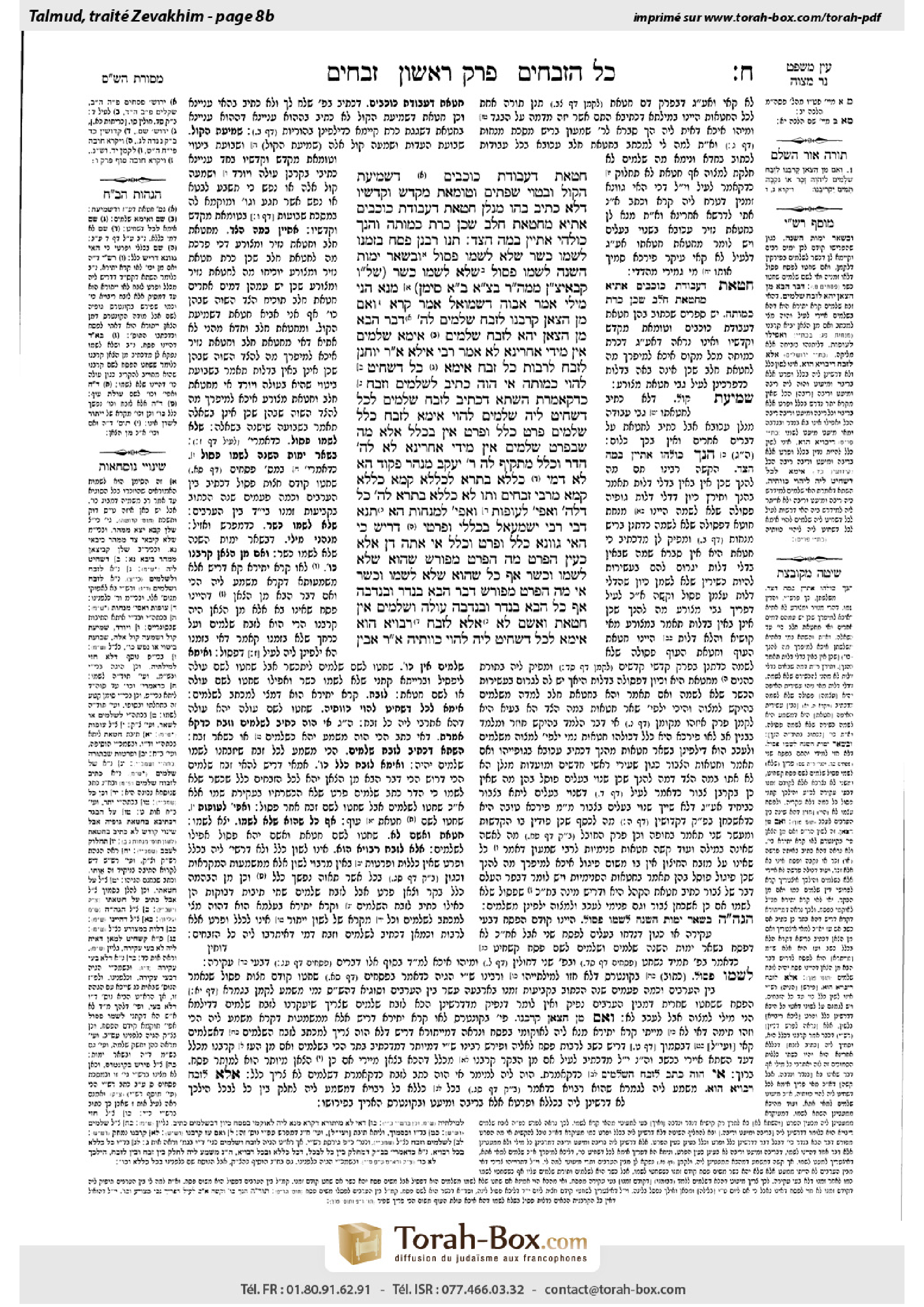
Zevachim 8b: Talmud study for Daf Yomi
Daf Yomi is the daily study of one Talmud folio. Explore 37 tractates with scans, Hebrew text, Sefaria English and AI-generated French translations where annotated.
Passage selection and English or AI-generated French translation are available where the scan has annotations. Daf Study is independent of Torah-Box and Sefaria.
Browse Zevachim · זבחים · All tractatesZevachim 8b text and translations
This page of Zevachim includes the Aramaic text, an English translation and an AI-generated French translation, alongside the scan above.
זבחים ח׳ ב · Aramaic and Hebrew text
חַטָּאת דַּעֲבוֹדָה זָרָה, דִּשְׁמִיעַת הַקּוֹל, וּבִטּוּי שְׂפָתַיִם, וְטוּמְאַת מִקְדָּשׁ וְקָדָשָׁיו – דְּלָא כְּתִיב בְּהוּ; מְנָלַן?
חַטָּאת דַּעֲבוֹדָה זָרָה – אָתְיָא מֵחַטַּאת חֵלֶב, שֶׁכֵּן כָּרֵת כְּמוֹתָהּ; וְהָנָךְ כּוּלְּהִי – אָתְיָין בְּמָה הַצַּד.
תָּנוּ רַבָּנַן: פֶּסַח בִּזְמַנּוֹ – לִשְׁמוֹ כָּשֵׁר, שֶׁלֹּא לִשְׁמוֹ פָּסוּל; וּבִשְׁאָר יְמוֹת הַשָּׁנָה – לִשְׁמוֹ פָּסוּל, שֶׁלֹּא לִשְׁמוֹ כָּשֵׁר.
(של״ו קבאיצ״ן ממה״ר בצ״א ב״א סִימָן)
מְנָא הָנֵי מִילֵּי? אָמַר אֲבוּהּ דִּשְׁמוּאֵל, אָמַר קְרָא: ״וְאִם מִן הַצֹּאן קׇרְבָּנוֹ לְזֶבַח שְׁלָמִים לַה׳״ – דָּבָר הַבָּא מִן הַצֹּאן יְהֵא לְזֶבַח שְׁלָמִים.
אֵימָא שְׁלָמִים אִין, מִידֵּי אַחֲרִינָא לָא! אָמַר רַבִּי אִילָא אָמַר רַבִּי יוֹחָנָן: ״לְזֶבַח״ – לְרַבּוֹת כׇּל זֶבַח.
אֵימָא כֹּל דְּשָׁחֵיט – לֶהֱוֵי כְּמוֹתָהּ!
אִי הֲוָה כְּתִיב ״לִשְׁלָמִים וְזֶבַח״ – כִּדְקָאָמְרַתְּ; הַשְׁתָּא דִּכְתִיב ״לְזֶבַח שְׁלָמִים״ – לְכֹל דְּשָׁחֵיט לֵיהּ, שְׁלָמִים לֶהֱוֵי.
אֵימָא: ״לְזֶבַח״ – כָּלַל, ״שְׁלָמִים״ – פָּרַט; כְּלָל וּפְרָט – אֵין בַּכְּלָל אֶלָּא מַה שֶׁבַּפְּרָט; שְׁלָמִים אִין, מִידֵּי אַחֲרִינָא לָא!
״לַה׳״ – הָדַר וְכָלַל.
מַתְקֵיף לַהּ רַב יַעֲקֹב מִנְּהַר פְּקוֹד: הָא לָא דָּמֵי כְּלָלָא בָּתְרָא לִכְלָלָא קַמָּא; כְּלָלָא קַמָּא – מְרַבֵּי זְבָחִים וְתוּ לָא; כְּלָלָא בָּתְרָא – ״לַה׳״ כֹּל דְּלַה׳, וַאֲפִילּוּ לְעוֹפוֹת וַאֲפִילּוּ לִמְנָחוֹת!
הָא תַּנָּא דְּבֵי רַבִּי יִשְׁמָעֵאל, בִּכְלָלֵי וּפְרָטֵי דָּרֵישׁ כִּי הַאי גַוְונָא:
כְּלָל וּפְרָט וּכְלָל – אִי אַתָּה דָן אֶלָּא כְּעֵין הַפְּרָט; מָה הַפְּרָט מְפוֹרָשׁ – שֶׁהוּא שֶׁלֹּא לִשְׁמוֹ, וְכָשֵׁר; אַף כֹּל – שֶׁהוּא שֶׁלֹּא לִשְׁמוֹ, וְכָשֵׁר.
אִי – מָה הַפְּרָט מְפוֹרָשׁ, דָּבָר הַבָּא בְּנֶדֶר וּבִנְדָבָה; אַף כׇּל הַבָּא בְּנֶדֶר וּבִנְדָבָה – עוֹלָה וּשְׁלָמִים אִין, חַטָּאת וְאָשָׁם לֹא!
אֶלָּא ״לְזֶבַח״ – רִבּוּיָא הוּא.
אֵימָא לְכֹל דְּשָׁחֵיט לֵיהּ – לֶהֱוֵי כְּוָותֵיהּ!
אָמַר רַבִּי אָבִין:
Zevachim 8b · English translation
From where do we derive these halakhot with regard to a sin offering brought for idol worship, which has unique halakhot, as detailed in Numbers 15:27–31, and with regard to which the term: For a sin offering, is not written? Likewise, from where do we derive them with regard to the sin offerings that are brought for the hearing of the voice, and for an utterance of the lips, and for the defiling of the Temple or its sacrificial foods, which also have unique halakhot (Leviticus 5:1–13), and with regard to which the term: For a sin offering, is not written either?
The Gemara answers: With regard to a sin offering brought for idol worship, these halakhot are derived from the halakhot of a sin offering brought for eating forbidden fat, as idol worship is also punishable by karet, similar to consumption of forbidden fat. And with regard to all these other sin offerings, which are brought for transgressions not punishable by karet, these halakhot are derived by analogy from the common element of the aforementioned three sources, namely, a standard sin offering, the sin offering of a nazirite, and the sin offering of a leper.
§ The Sages taught: When a Paschal offering is sacrificed at its appointed time, on Passover eve after noon, if it is sacrificed for its sake, it is fit; if it is sacrificed not for its sake, it is unfit, as stated in the mishna. And when an offering consecrated as a Paschal offering is sacrificed during the rest of the days of the year, if it is sacrificed for its sake, it is unfit; if it is sacrificed not for its sake, it is fit.
The Gemara presents a mnemonic for the names of the amora’im mentioned in this discussion: Shin, lamed, vav; kuf, beit, alef, yod, tzadi, nun; mem, mem, heh, reish; beit, tzadi, alef; beit, alef.
The Gemara asks: From where are these matters derived, i.e., that if a Paschal offering is sacrificed during the rest of the year it is fit if sacrificed not for its sake? Shmuel’s father says: The verse states: “And if his offering for a sacrifice of peace offerings unto the Lord is of the flock” (Leviticus 3:6), indicating that an offering that is brought only from the flock will be a sacrifice of peace offerings. The Paschal offering fulfills this criterion.
The Gemara challenges: Say that if it is sacrificed for the sake of a peace offering, yes, it is fit, but if it is sacrificed for the sake of some other offering, it is not fit. Rabbi Ila says that Rabbi Yoḥanan says: The redundant expression “for a sacrifice” in Leviticus 3:6 is stated to include any type of sacrifice.
The Gemara asks: If so, say that a Paschal offering should be rendered as any offering for which one slaughters it; for example, if it is slaughtered for the sake of a burnt offering, it should be rendered a burnt offering.
The Gemara answers: If the phrase: For peace offerings and a sacrifice, was written in the verse, it would be as you say. Now that it is written: “For a sacrifice of peace offerings,” it indicates that for whatever type of offering one slaughters it, it will be a peace offering.
The Gemara challenges: Say that: “For a sacrifice,” is a generalization and: “Of peace offerings,” is a detail, and according to the principles of biblical hermeneutics, wherever there is a generalization and a detail, the generalization includes only that which is specified in the detail. Accordingly, if the offering is sacrificed for the sake of a peace offering, yes, it is fit; but if it is sacrificed for the sake of another offering, it is not fit.
The Gemara answers: With the term: “Unto the Lord,” the verse then generalized again. Therefore, the verse is formulated as a generalization, a detail, and a generalization, as the Gemara will explain.
Rav Ya’akov of Nehar Pekod objects to this suggestion: But the latter generalization is dissimilar to the former generalization. The former generalization: “For a sacrifice,” includes only slaughtered offerings and nothing more, whereas the latter generalization: “Unto the Lord,” includes any offering unto the Lord. And accordingly, even if the Paschal offering was sacrificed for the sake of bird offerings, or even for the sake of meal offerings, it should be fit, as these are brought “unto the Lord.”
The Gemara responds to this objection: The school of Rabbi Yishmael taught generalizations and details even in examples like this case.
The Gemara explains: Since “unto the Lord” is a second generalization, the verse is formulated as a generalization, and a detail, and a generalization, and you may deduce that the verse is referring only to items similar to the detail. Just as the items mentioned in the detail are clearly defined as a case where a Paschal offering was sacrificed not for its own sake, and nevertheless it is fit, so too, in any case where it was sacrificed not for its sake but for the sake of another offering, it is fit.
The Gemara asks: If the verse is referring only to actions similar to the detail, then just as the items mentioned in the detail are clearly defined as a peace offering, which is a matter that is brought as a vow offering or as a gift offering, so too, a Paschal offering should be fit only if it was sacrificed for the sake of any offering that is brought as a vow offering or as a gift offering. Accordingly, if it was sacrificed for the sake of a burnt offering or a peace offering, yes, it is fit, as these are brought as a vow offering or as a gift offering; but if it was sacrificed for the sake of a sin offering or a guilt offering, it is not fit, as these are not brought as a vow offering or as a gift offering.
The Gemara therefore rejects the exegetical method of generalizations and details in favor of that of amplifications and restrictions: Rather, the term: “For a sacrifice,” is not a generalization, but an amplification, which includes any type of offering. Therefore, if a Paschal offering is sacrificed for the sake of any type of offering during the rest of the year, it is fit.
The Gemara challenges: If so, say that it adds that a Paschal offering should be rendered as any offering for which one slaughters it. Why does Shmuel’s father interpret that it is rendered a peace offering specifically?
Rabbi Avin says:
Zevachim 8b · Traduction française (IA)
D’où déduisons-nous ces halakhot concernant le sacrifice expiatoire apporté pour l’idolâtrie, qui est régi par des halakhot particulières, comme il est détaillé en Nombres 15:27–31, et à propos duquel l’expression « pour un sacrifice expiatoire » n’est pas écrite ? De même, d’où les déduisons-nous concernant les sacrifices expiatoires apportés pour avoir entendu une voix, pour avoir prononcé une parole ou pour avoir rendu impur le Temple ou ses aliments consacrés, qui sont eux aussi régis par des halakhot particulières (Lévitique 5:1–13), et à propos desquels l’expression « pour un sacrifice expiatoire » n’est pas non plus écrite ?
La Guemara répond : Pour le sacrifice expiatoire apporté pour l’idolâtrie, ces halakhot sont déduites des halakhot du sacrifice expiatoire apporté pour la consommation de graisse interdite, car l’idolâtrie est elle aussi passible de karet, comme la consommation de graisse interdite. Quant à tous ces autres sacrifices expiatoires, qui sont apportés pour des transgressions non passibles de karet, ces halakhot sont déduites par analogie de l’élément commun aux trois sources mentionnées précédemment, à savoir le sacrifice expiatoire ordinaire, le sacrifice expiatoire du nazir et le sacrifice expiatoire du lépreux.
§ Les Sages ont enseigné : Lorsqu’un sacrifice pascal est offert à son moment fixé, la veille de Pessa’h après midi, s’il est offert pour lui-même, il est valide ; s’il est offert avec une autre intention, il est invalide, comme l’enseigne la Michna. En revanche, lorsqu’une offrande consacrée comme sacrifice pascal est offerte pendant le reste de l’année, si elle est offerte pour elle-même, elle est invalide ; si elle est offerte avec une autre intention, elle est valide.
La Guemara présente un moyen mnémotechnique formé des noms des amoraïm mentionnés dans cette discussion : shin, lamed, vav ; qof, beit, alef, yod, tsadi, noun ; mem, mem, hé, reish ; beit, tsadi, alef ; beit, alef.
La Guemara demande : D’où déduit-on ces règles, à savoir qu’un sacrifice pascal offert pendant le reste de l’année est valide lorsqu’il est offert avec une autre intention ? Le père de Shmuel dit : Le verset énonce : « Et si son offrande pour un sacrifice de paix est du petit bétail » (Lévitique 3:6), ce qui indique qu’une offrande provenant uniquement du petit bétail sera un sacrifice de paix. Le sacrifice pascal répond à ce critère.
La Guemara objecte : Dis plutôt que s’il est offert avec l’intention d’un sacrifice de paix, il est valide, mais que s’il est offert avec l’intention d’un autre type de sacrifice, il n’est pas valide. Rabbi Ila dit que Rabbi Yoḥanan dit : L’expression redondante « pour un sacrifice », en Lévitique 3:6, est écrite pour inclure tout type de sacrifice.
La Guemara demande : Dans ce cas, dis plutôt qu’un sacrifice pascal doit devenir le type d’offrande pour lequel on l’abat ; par exemple, s’il est abattu avec l’intention d’un holocauste, il doit devenir un holocauste.
La Guemara répond : Si le verset disait « pour des sacrifices de paix et un sacrifice », tu aurais raison. Mais puisqu’il est écrit « pour un sacrifice de paix », cela indique que, quel que soit le type d’offrande avec l’intention duquel on l’abat, il devient un sacrifice de paix.
La Guemara objecte : Dis plutôt que « pour un sacrifice » est une expression générale et que « de paix » est une précision ; or, selon les principes de l’herméneutique biblique, lorsqu’une expression générale est suivie d’une précision, l’expression générale ne comprend que ce qui est spécifié dans la précision. Par conséquent, si l’offrande est offerte avec l’intention d’un sacrifice de paix, elle est valide ; mais si elle est offerte avec l’intention d’un autre sacrifice, elle n’est pas valide.
La Guemara répond : Avec l’expression « pour le Seigneur », le verset généralise ensuite à nouveau. Le verset est donc formulé selon le principe d’une expression générale, d’une précision, puis d’une expression générale, comme la Guemara l’expliquera.
Rav Ya’akov de Nehar Pekod s’oppose à cette proposition : Mais la dernière expression générale est différente de la première. La première, « pour un sacrifice », ne comprend que les sacrifices abattus, et rien de plus, tandis que la dernière, « pour le Seigneur », comprend toute offrande destinée au Seigneur. Par conséquent, même si le sacrifice pascal était offert avec l’intention d’offrandes d’oiseaux, voire d’offrandes de farine, il devrait être valide, car celles-ci sont apportées « pour le Seigneur ».
La Guemara répond à cette objection : L’école de Rabbi Yishmael enseignait les règles des expressions générales et des précisions même dans des cas semblables à celui-ci.
La Guemara explique : Puisque « pour le Seigneur » constitue une seconde expression générale, le verset est formulé selon le principe d’une expression générale, d’une précision, puis d’une expression générale ; on peut en déduire qu’il ne se rapporte qu’à des éléments semblables à ceux de la précision. De même que les éléments mentionnés dans la précision correspondent clairement au cas où un sacrifice pascal est offert avec une autre intention et demeure néanmoins valide, de même, dans tout cas où il est offert non pour lui-même, mais avec l’intention d’une autre offrande, il est valide.
La Guemara demande : Si le verset ne se rapporte qu’à des cas semblables à celui de la précision, alors, de même que les éléments mentionnés dans la précision correspondent clairement à un sacrifice de paix, c’est-à-dire à une offrande apportée à titre de vœu ou de don, de même, un sacrifice pascal ne devrait être valide que s’il est offert avec l’intention d’une offrande apportée à titre de vœu ou de don. Par conséquent, s’il est offert avec l’intention d’un holocauste ou d’un sacrifice de paix, il est valide, car ces offrandes sont apportées à titre de vœu ou de don ; mais s’il est offert avec l’intention d’un sacrifice expiatoire ou d’un sacrifice de culpabilité, il n’est pas valide, car ces offrandes ne sont pas apportées à titre de vœu ou de don.
La Guemara rejette donc la méthode exégétique des expressions générales et des précisions au profit de celle des amplifications et des restrictions : l’expression « pour un sacrifice » n’est pas une expression générale, mais une amplification qui inclut tout type d’offrande. Par conséquent, si un sacrifice pascal est offert avec l’intention de n’importe quel type d’offrande pendant le reste de l’année, il est valide.
La Guemara objecte : Dans ce cas, dis plutôt que cela ajoute qu’un sacrifice pascal doit devenir n’importe quel type d’offrande pour lequel on l’abat. Pourquoi le père de Shmuel interprète-t-il qu’il devient précisément un sacrifice de paix ?
Rabbi Avin dit :
Traduction française générée par IA à partir de l’édition anglaise de Sefaria. Vérifie toujours un passage avec le texte source.
Text from Sefaria: William Davidson Edition - Vocalized Aramaic (CC BY NC); William Davidson Edition - English (CC BY NC).