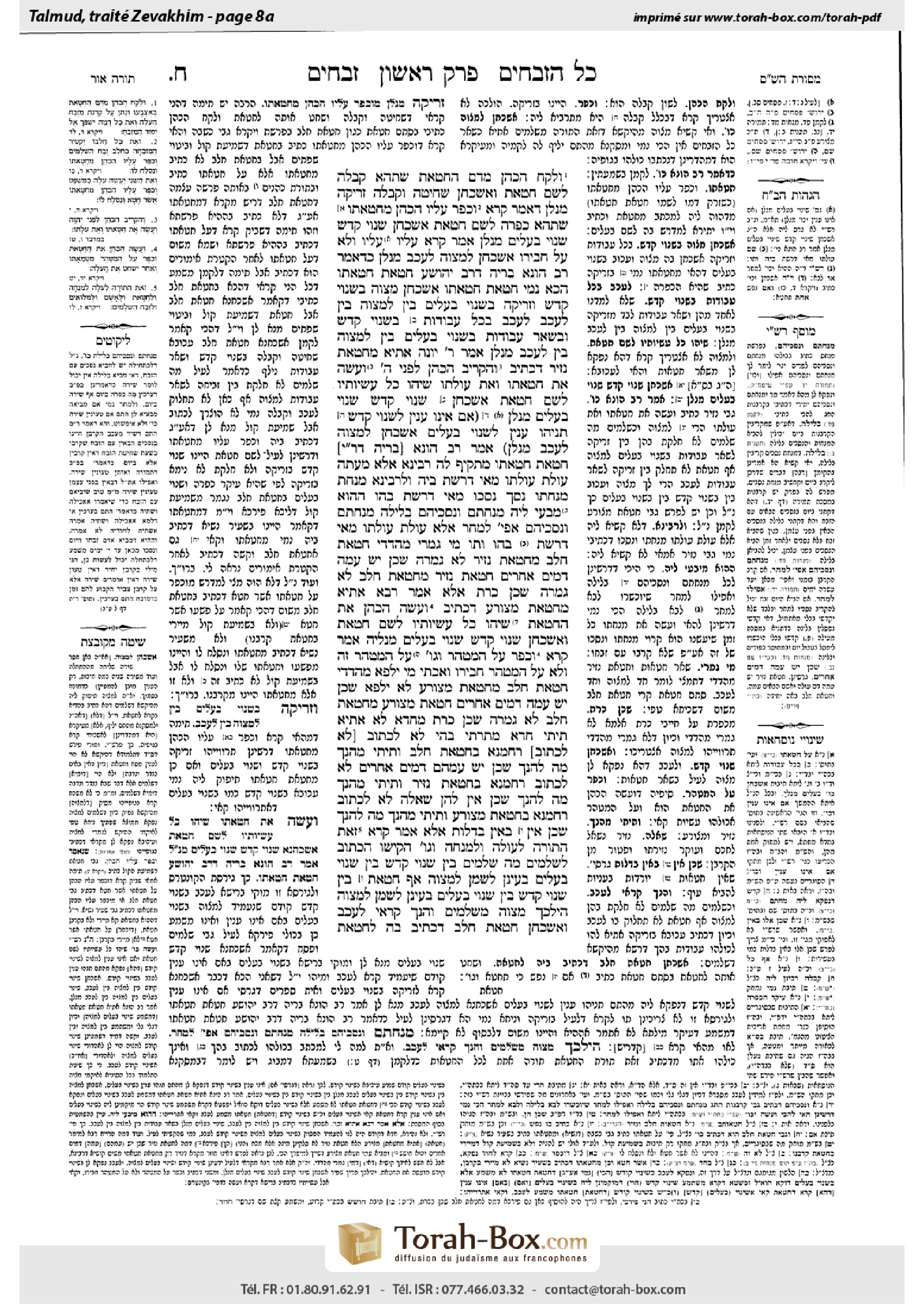
Zevachim 8a: Talmud study for Daf Yomi
Daf Yomi is the daily study of one Talmud folio. Explore 37 tractates with scans, Hebrew text, Sefaria English and AI-generated French translations where annotated.
Passage selection and English or AI-generated French translation are available where the scan has annotations. Daf Study is independent of Torah-Box and Sefaria.
Browse Zevachim · זבחים · All tractatesZevachim 8a text and translations
This page of Zevachim includes the Aramaic text, an English translation and an AI-generated French translation, alongside the scan above.
זבחים ח׳ א · Aramaic and Hebrew text
״וְלָקַח הַכֹּהֵן מִדַּם הַחַטָּאת״ – שֶׁתְּהֵא קַבָּלָה לְשֵׁם חַטָּאת.
וְאַשְׁכְּחַן שְׁחִיטָה וְקַבָּלָה, זְרִיקָה מְנָלַן? דְּאָמַר קְרָא: ״וְכִפֶּר עָלָיו הַכֹּהֵן מֵחַטָּאתוֹ״ – שֶׁתְּהֵא כַּפָּרָה לְשֵׁם חַטָּאת.
אַשְׁכְּחַן שִׁנּוּי קֹדֶשׁ, שִׁנּוּי בְּעָלִים מְנָלַן? אָמַר קְרָא: ״עָלָיו״ – עָלָיו וְלֹא עַל חֲבֵירוֹ.
אַשְׁכְּחַן לְמִצְוָה, לְעַכֵּב מְנָלַן? כִּדְאָמַר רַב הוּנָא בְּרֵיהּ דְּרַב יְהוֹשֻׁעַ: ״חַטָּאת״–״חַטָּאתוֹ״; הָכָא נָמֵי: ״חַטָּאת״–״חַטָּאתוֹ״.
אַשְׁכְּחַן מִצְוָה – בְּשִׁנּוּי קֹדֶשׁ, וּזְרִיקָה בְּשִׁנּוּי בְּעָלִים – בֵּין לְמִצְוָה בֵּין לְעַכֵּב. לְעַכֵּב – בְּכׇל עֲבוֹדוֹת בְּשִׁנּוּי קֹדֶשׁ, וּבִשְׁאָר עֲבוֹדוֹת בְּשִׁנּוּי בְּעָלִים – בֵּין לְמִצְוָה בֵּין לְעַכֵּב, מְנָלַן?
אָמַר רַבִּי יוֹנָה: אָתְיָא מֵחַטַּאת נָזִיר, דִּכְתִיב: ״וְהִקְרִיב הַכֹּהֵן לִפְנֵי ה׳ וְעָשָׂה אֶת חַטָּאתוֹ וְאֶת עֹלָתוֹ״ – שֶׁיְּהוּ כׇּל עֲשִׂיּוֹתָיו לְשֵׁם חַטָּאת.
אַשְׁכְּחַן שִׁנּוּי קֹדֶשׁ, שִׁנּוּי בְּעָלִים מְנָלַן? (אִם אֵינוֹ עִנְיָן לְשִׁנּוּי קֹדֶשׁ, תְּנֵיהוּ עִנְיָן לְשִׁנּוּי בְּעָלִים. אַשְׁכְּחַן לְמִצְוָה, לְעַכֵּב מְנָלַן?)
אָמַר רַב הוּנָא בְּרֵיהּ דְּרַב יְהוֹשֻׁעַ: ״חַטָּאת״–״חַטָּאתוֹ״.
מַתְקֵיף לַהּ רָבִינָא: אֶלָּא מֵעַתָּה, ״עוֹלַת״–״עוֹלָתוֹ״ מַאי דָּרְשַׁתְּ בֵּיהּ?
וּלְרָבִינָא, ״מִנְחָת״–״מִנְחָתוֹ״, ״נֶסֶךְ״–״נִסְכּוֹ״, מַאי דָּרְשַׁתְּ בְּהוּ?
הָהוּא מִבְּעֵי לֵיהּ: ״מִנְחָתָם וְנִסְכֵּיהֶם״ – בַּלַּיְלָה, ״מִנְחָתָם וְנִסְכֵּיהֶם״ – אֲפִילּוּ לְמָחָר. אֶלָּא ״עוֹלַת״–״עוֹלָתוֹ״, מַאי דָּרְשַׁתְּ בְּהוּ?
וְתוּ, מִי גָּמְרִי מֵהֲדָדֵי?! חַטַּאת חֵלֶב מֵחַטַּאת נָזִיר לָא גָּמְרָה – שֶׁכֵּן יֵשׁ עִמָּהּ דָּמִים אֲחֵרִים; חַטַּאת נָזִיר מֵחַטַּאת חֵלֶב לָא גָּמְרָה – שֶׁכֵּן כָּרֵת!
אֶלָּא אָמַר רָבָא: אָתְיָא מֵחַטַּאת מְצוֹרָע, דִּכְתִיב: ״וְעָשָׂה הַכֹּהֵן אֶת הַחַטָּאת״ – שֶׁיְּהוּ כׇּל עֲשִׂיּוֹתָיו לְשֵׁם חַטָּאת.
וְאַשְׁכְּחַן שִׁנּוּי קֹדֶשׁ, שִׁנּוּי בְּעָלִים מְנָלֵיהּ? אָמַר קְרָא: ״וְכִפֶּר עַל הַמִּטַּהֵר וְגוֹ׳״ – עַל הַמִּטַּהֵר זֶה, וְלֹא עַל הַמִּטַּהֵר חֲבֵירוֹ.
וְאַכַּתִּי, מִי יָלְפָא מֵהֲדָדֵי?! חַטַּאת חֵלֶב מֵחַטַּאת מְצוֹרָע לָא יָלְפָא – שֶׁכֵּן יֵשׁ עִמָּהּ דָּמִים אֲחֵרִים; חַטָּאת מְצוֹרָע מֵחַטַּאת חֵלֶב לָא גָּמְרָה – שֶׁכֵּן כָּרֵת!
מֵחֲדָא לָא אָתְיָא, תֵּיתֵי חֲדָא מִתַּרְתֵּי.
בְּהֵי לָא לִכְתּוֹב? [לָא לִכְתּוֹב] רַחֲמָנָא בְּחַטַּאת חֵלֶב, וְתֵיתֵי מֵהָנָךְ?! מָה לְהָנָךְ, שֶׁכֵּן יֵשׁ עִמָּהֶם דָּמִים אֲחֵרִים!
לָא לִכְתּוֹב רַחֲמָנָא בְּחַטַּאת נָזִיר, וְתֵיתֵי מֵהָנָךְ?! מָה לְהָנָךְ, שֶׁכֵּן אֵין לָהֶן שְׁאֵלָה!
לָא לִכְתּוֹב רַחֲמָנָא בְּחַטַּאת מְצוֹרָע, וְתֵיתֵי מֵהָנָךְ?! מָה לְהָנָךְ, שֶׁכֵּן אֵין בָּאִין בְּדַלּוּת!
אֶלָּא אָמַר קְרָא: ״זֹאת הַתּוֹרָה לָעֹלָה וְלַמִּנְחָה וְגוֹ׳״ – הִקִּישׁוֹ הַכָּתוּב לִשְׁלָמִים; מָה שְׁלָמִים – בֵּין שִׁנּוּי קֹדֶשׁ בֵּין שִׁנּוּי בְּעָלִים, בָּעֵינַן לִשְׁמָן לְמִצְוָה; אַף חַטָּאת – בֵּין שִׁנּוּי קֹדֶשׁ בֵּין שִׁנּוּי בְּעָלִים, בָּעֵינַן לִשְׁמָן לְמִצְוָה.
הִילְכָּךְ, מִצְוָה – מִשְּׁלָמִים, וְהָנָךְ קְרָאֵי – לְעַכֵּב.
וְאַשְׁכְּחַן חַטַּאת חֵלֶב, דִּכְתִיב בָּהּ ״לַחַטָּאת״;
Zevachim 8a · English translation
“And the priest shall take of the blood of the sin offering” (Leviticus 4:25), teaching that the collection of the blood must be performed for the sake of a sin offering.
The Gemara asks: And we found a source for the halakha that the slaughter and collection must be performed for the sake of a sin offering. From where do we derive this halakha with regard to the sprinkling of the blood? The Gemara answers: It is derived from a verse, as the verse states: “And the priest shall make atonement for him concerning his sin” (Leviticus 4:26), teaching that the atonement must be effected for the sake of a sin offering, as atonement is effected by the sprinkling of the blood.
The Gemara asks: We found a source for the prohibition against deviation from the type of offering. From where do we derive the prohibition against deviation with regard to the owner? The Gemara answers: The aforementioned verse states: “And the priest shall make atonement for him,” indicating that the intent must be for him, and not for another.
The Gemara asks: We found a source for the mitzva to sprinkle the blood for the sake of the owner ab initio. From where do we derive that this is indispensable and disqualifies the offering if not fulfilled? The Gemara answers: It is as Rav Huna, son of Rav Yehoshua, says with regard to the sin offering of a nazirite: Since the verse could have simply stated: Sin offering, but instead stated: “His sin offering” (Numbers 6:16), it is inferred that the offering must be sacrificed for his, the owner’s, sake. Here too, since the verse could have simply stated “sin,” but states “his sin,” one infers that if the blood of the sin offering is not sprinkled for the sake of its owner, it is disqualified.
The Gemara asks: We found a source for the mitzva of sacrificing a sin offering without deviation from the type of offering ab initio, and with regard to sprinkling its blood without deviation with regard to the owner concerning both its mitzva ab initio and its indispensability. From where do we derive that performing all sacrificial rites without deviation from the type of offering is an indispensable requirement, and that performing all other rites, besides sprinkling the blood, without deviation with regard to the owner is both a mitzva ab initio and indispensable?
Rabbi Yona says: It is derived from the halakha concerning the sin offering of a nazirite; as it is written concerning a nazirite: “And the priest shall bring them before the Lord, and shall offer [ve’asa] his sin offering, and his burnt offering” (Numbers 6:16). The verse teaches that all of its sacrificial actions [asiyyotav] must be performed for the sake of a sin offering.
The Gemara asks: We found a source for the halakha that a sin offering must be sacrificed without deviation from the type of offering, and that this requirement is indispensable. From where do we derive that sacrificing it without deviation with regard to the owner is also indispensable, even in rites other than the sprinkling of the blood?
Rav Huna, son of Rav Yehoshua, says: Since the verse concerning a nazirite could have simply stated: Sin offering, but instead states: “His sin offering,” one infers that the offering must be sacrificed for the owner’s sake.
Ravina objects to this: If that is so, what do you interpret from the fact that the same verse could have stated: Burnt offering, but instead states: “His burnt offering”?
The Gemara asks: And according to Ravina, what do you interpret from the subsequent verse: “The priest shall offer also his meal offering and his libation” (Numbers 6:17)? Why does Ravina not mention that this verse could have stated: Meal offering, but instead states: “His meal offering,” and that it could have stated: Libation, but instead states: “His libation”?
The Gemara answers: That language is necessary; it is just like the phrase: “Their meal offering and their libations,” which is mentioned many times in the portion of the Festival offerings (e.g., Numbers 29:37). It teaches that the meal offerings and libations that are brought with the additional animal offerings of the Festivals can be sacrificed even at night after the offering is brought. The phrase: “Their meal offering and their libations,” also teaches that they may be brought even on the following day. Likewise here, when stated with regard to a nazirite, the phrase teaches that they may be brought at night or the day after the offering is sacrificed. But there remains a difficulty: What do you interpret from the fact that the verse could have stated: Burnt offering, but instead states: “His burnt offering”?
The Gemara raises an additional objection to the derivation from a nazirite’s sin offering: And furthermore, can the halakhot of a standard sin offering and of a nazirite’s sin offering be derived from one another? The halakhot of a sin offering brought for a transgression, e.g., eating forbidden fat, cannot be derived from the halakhot of a nazirite’s sin offering, due to the unique element of stringency of the latter, since there is other blood, i.e., other offerings are brought, with it. Likewise, the halakhot of a nazirite’s sin offering cannot be derived from the halakhot of a sin offering brought for eating forbidden fat, due to the unique element of stringency of the latter, since it atones for a transgression punishable by excision from the World-to-Come [karet].
Rather, Rava says: These halakhot are derived from the halakha of the sin offering of a leper; as it is written: “And the priest shall offer [ve’asa] the sin offering” (Leviticus 14:19), teaching that all sacrificial actions of [asiyyotav] a sin offering must be performed for the sake of a sin offering.
And we found a source for the halakha that a sin offering must be sacrificed without deviation from the type of offering, and that this is indispensable. From where do we derive that sacrificing a sin offering without deviation with regard to the owner is also indispensable? The verse states: “And make atonement for the one that is to be purified of his impurity” (Leviticus 14:19), indicating that the sin offering must be sacrificed for the sake of this person who is being purified, and not for another person who is to be purified.
The Gemara asks: But still, can the halakhot of a standard sin offering and a leper’s sin offering be derived from one another? This comparison is also problematic. The halakhot of a sin offering brought for eating forbidden fat cannot be derived from the halakhot of a leper’s sin offering, since there is other blood that is brought with the latter, i.e., a burnt offering and a guilt offering; and the halakhot of a leper’s sin offering cannot be derived from the halakhot of a sin offering brought for eating forbidden fat, since the latter atones for a transgression punishable by karet.
The Gemara answers: Indeed, the halakhot of a sin offering cannot be derived from the halakhot of one other type of sin offering alone. But one can derive the halakhot of one type of sin offering from the halakhot of the other two. The verses concerning a standard sin offering, that of a leper, and that of a nazirite all contain elements that indicate that the offering must be sacrificed for its own sake. Two of them together are sufficient to teach that this halakha applies to the third case. The third case is therefore apparently extraneous, and it is understood to teach that proper intent in this regard is indispensable for all the offering’s rites.
The Gemara asks: With regard to which type of sin offering should the Torah not have written this halakha, i.e., which of the three cases should be regarded as the extraneous case? If you say: Let the Merciful One not write it with regard to a sin offering brought for eating forbidden fat, and one can derive it from these other sin offerings, i.e., those of a nazirite and a leper, this can be refuted: What is notable about these other sin offerings? They are notable in that there is other blood brought with them. Therefore, the halakha should apply only to similar sin offerings.
If you say: Let the Merciful One not write it with regard to a nazirite’s sin offering, and one can derive it from these other sin offerings, those of a leper and a sinner, this can also be refuted: What is notable about these other sin offerings? They are notable in that one does not have the option of obtaining an exemption through a request to a halakhic authority. A nazirite, by contrast, can request of a halakhic authority to dissolve his vow of naziriteship, thereby nullifying his obligation.
If you say: Let the Merciful One not write it with regard to a leper’s sin offering, and one can derive it from these other sin offerings, those of a nazirite and a sinner, this can also be refuted: What is notable about these other sin offerings? They are notable in that they cannot be brought from doves instead of sheep if the owner is poor, unlike a leper’s sin offering (see Leviticus 14:21). Therefore, the halakhot of these different sin offerings cannot be derived from one another.
Rather, the halakha is derived from that which the verse states: “This is the law of the burnt offering, and of the meal offering, and of the sin offering, and of the guilt offering, and of the consecration offering, and of the sacrifice of peace offerings” (Leviticus 7:37). The verse juxtaposes a sin offering with a peace offering, indicating that just as for a peace offering we require intent for its sake, as a mitzva ab initio, both concerning the deviation from the type of offering and concerning deviation with regard to the owner, so too, for a sin offering we require intent for its sake as a mitzva, both concerning deviation from the type of offering and concerning deviation with regard to the owner.
Therefore, the mitzva ab initio is derived from the halakha of a peace offering; and those verses mentioned earlier, from which this requirement is derived with regard to each type of sin offering separately, repeat the halakha to teach that it is indispensable.
The Gemara asks: And we found a source for these halakhot with regard to a sin offering brought for eating forbidden fat, as it is written with regard to it: “And slaughter it for a sin offering” (Leviticus 4:33), indicating that it must be slaughtered for the sake of a sin offering. Likewise, sources for this halakha with regard to the sin offerings of a nazirite and a leper have also been cited.
Zevachim 8a · Traduction française (IA)
« Le prêtre prendra du sang du sacrifice expiatoire » (Lévitique 4:25) : cela enseigne que le prélèvement du sang doit être effectué pour un sacrifice expiatoire.
La Guemara demande : Nous avons trouvé une source pour la halakha selon laquelle l’abattage et le prélèvement doivent être effectués pour un sacrifice expiatoire. D’où déduisons-nous cette halakha concernant l’aspersion du sang ? La Guemara répond : Elle se déduit d’un verset, car il est dit : « Le prêtre fera expiation pour lui au sujet de son péché » (Lévitique 4:26). Cela enseigne que l’expiation doit être accomplie pour un sacrifice expiatoire, puisque l’expiation s’accomplit par l’aspersion du sang.
La Guemara demande : Nous avons trouvé une source pour l’interdiction de s’écarter du type de sacrifice. D’où déduisons-nous l’interdiction de s’écarter concernant le propriétaire ? La Guemara répond : Le verset précité dit : « Le prêtre fera expiation pour lui », indiquant que l’intention doit être dirigée vers lui, et non vers un autre.
La Guemara demande : Nous avons trouvé une source pour la mitsva d’asperger le sang en ayant, a priori, l’intention de le faire pour le propriétaire. D’où déduisons-nous que cette condition est indispensable et que son non-respect invalide le sacrifice ? La Guemara répond que cela découle de ce que dit Rav Huna, fils de Rav Yehoshua, au sujet du sacrifice expiatoire d’un nazir : puisque le verset aurait pu simplement dire « sacrifice expiatoire », mais dit plutôt « son sacrifice expiatoire » (Nombres 6:16), on en déduit que le sacrifice doit être offert pour lui, c’est-à-dire pour le propriétaire. Ici aussi, puisque le verset aurait pu simplement dire « péché », mais dit « son péché », on en déduit que si le sang du sacrifice expiatoire n’est pas aspergé pour le propriétaire, le sacrifice est disqualifié.
La Guemara demande : Nous avons trouvé une source pour la mitsva d’offrir, a priori, un sacrifice expiatoire sans s’écarter du type de sacrifice, ainsi que pour l’aspersion de son sang sans s’écarter concernant le propriétaire, tant au titre de la mitsva à accomplir a priori que de son caractère indispensable. D’où déduisons-nous que l’exécution de tous les rites sacrificiels sans s’écarter du type de sacrifice est une condition indispensable, et que l’exécution de tous les autres rites, hormis l’aspersion du sang, sans s’écarter concernant le propriétaire constitue à la fois une mitsva à accomplir a priori et une condition indispensable ?
Rabbi Yona dit : Cela se déduit de la halakha relative au sacrifice expiatoire d’un nazir, car il est écrit au sujet d’un nazir : « Le prêtre les présentera devant l’Éternel et offrira [ve’asa] son sacrifice expiatoire et son holocauste » (Nombres 6:16). Le verset enseigne que tous ses actes sacrificiels [asiyyotav] doivent être accomplis pour un sacrifice expiatoire.
La Guemara demande : Nous avons trouvé une source pour la halakha selon laquelle un sacrifice expiatoire doit être offert sans s’écarter du type de sacrifice et que cette condition est indispensable. D’où déduisons-nous que l’offrir sans s’écarter concernant le propriétaire est également indispensable, même pour les rites autres que l’aspersion du sang ?
Rav Huna, fils de Rav Yehoshua, dit : Puisque le verset au sujet d’un nazir aurait pu simplement dire « sacrifice expiatoire », mais dit plutôt « son sacrifice expiatoire », on en déduit que le sacrifice doit être offert pour le propriétaire.
Ravina objecte : Si tel est le cas, comment interprètes-tu le fait que le même verset aurait pu dire « holocauste », mais dit plutôt « son holocauste » ?
La Guemara demande : Et selon Ravina, comment interprètes-tu le verset suivant : « Le prêtre offrira aussi son offrande végétale et sa libation » (Nombres 6:17) ? Pourquoi Ravina ne souligne-t-il pas que le verset aurait pu dire « offrande végétale », mais dit « son offrande végétale », et qu’il aurait pu dire « libation », mais dit « sa libation » ?
La Guemara répond : Cette formulation est nécessaire ; elle est analogue à l’expression « leur offrande végétale et leurs libations », qui apparaît à maintes reprises dans le passage consacré aux sacrifices des fêtes (par exemple, Nombres 29:37). Elle enseigne que les offrandes végétales et les libations apportées avec les sacrifices animaux supplémentaires des fêtes peuvent être offertes la nuit, après que le sacrifice a été apporté. L’expression « leur offrande végétale et leurs libations » enseigne également qu’elles peuvent être apportées le lendemain. De même, ici, à propos d’un nazir, cette expression enseigne qu’elles peuvent être apportées la nuit ou le lendemain de l’offrande du sacrifice. Mais une difficulté subsiste : comment interprètes-tu le fait que le verset aurait pu dire « holocauste », mais dit plutôt « son holocauste » ?
La Guemara soulève une objection supplémentaire à la déduction tirée du sacrifice expiatoire d’un nazir : de plus, peut-on déduire les halakhot d’un sacrifice expiatoire ordinaire de celles du sacrifice expiatoire d’un nazir, et inversement ? On ne peut pas déduire les halakhot d’un sacrifice expiatoire apporté pour une transgression, par exemple la consommation de graisse interdite, de celles du sacrifice expiatoire d’un nazir, en raison de la sévérité particulière de ce dernier : d’autres sacrifices, c’est-à-dire d’autres offrandes, sont apportés avec lui. De même, on ne peut pas déduire les halakhot du sacrifice expiatoire d’un nazir de celles d’un sacrifice expiatoire apporté pour la consommation de graisse interdite, en raison de la sévérité particulière de ce dernier : il expie une transgression passible de retranchement du monde à venir [karet].
Rava dit plutôt : Ces halakhot se déduisent de la halakha concernant le sacrifice expiatoire d’un lépreux, car il est écrit : « Le prêtre offrira [ve’asa] le sacrifice expiatoire » (Lévitique 14:19), ce qui enseigne que tous les actes sacrificiels [asiyyotav] d’un sacrifice expiatoire doivent être accomplis pour un sacrifice expiatoire.
Nous avons trouvé une source pour la halakha selon laquelle un sacrifice expiatoire doit être offert sans s’écarter du type de sacrifice et que cela est indispensable. D’où déduisons-nous qu’offrir un sacrifice expiatoire sans s’écarter concernant le propriétaire est également indispensable ? Le verset dit : « Et il fera expiation pour celui qui doit être purifié de son impureté » (Lévitique 14:19), indiquant que le sacrifice expiatoire doit être offert pour cette personne en cours de purification, et non pour une autre personne à purifier.
La Guemara demande : Mais peut-on malgré tout déduire les halakhot d’un sacrifice expiatoire ordinaire de celles du sacrifice expiatoire d’un lépreux, et inversement ? Cette comparaison pose également problème. On ne peut pas déduire les halakhot d’un sacrifice expiatoire apporté pour la consommation de graisse interdite de celles du sacrifice expiatoire d’un lépreux, puisque ce dernier est accompagné d’autres sacrifices, c’est-à-dire d’un holocauste et d’un sacrifice de culpabilité ; et on ne peut pas déduire les halakhot du sacrifice expiatoire d’un lépreux de celles d’un sacrifice expiatoire apporté pour la consommation de graisse interdite, car ce dernier expie une transgression passible de karet.
La Guemara répond : En effet, on ne peut pas déduire les halakhot d’un sacrifice expiatoire de celles d’un seul autre type de sacrifice expiatoire. Mais on peut déduire les halakhot d’un type de sacrifice expiatoire de celles des deux autres. Les versets concernant le sacrifice expiatoire ordinaire, celui d’un lépreux et celui d’un nazir contiennent tous des éléments indiquant que le sacrifice doit être offert pour lui-même. Deux d’entre eux suffisent ensemble à enseigner que cette halakha s’applique au troisième cas. Ce troisième cas semble donc superflu ; on comprend alors qu’il enseigne que l’intention adéquate à cet égard est indispensable pour tous les rites du sacrifice.
La Guemara demande : Pour quel type de sacrifice expiatoire la Torah aurait-elle dû ne pas écrire cette halakha, c’est-à-dire lequel des trois cas faut-il considérer comme superflu ? Si tu dis que le Miséricordieux aurait pu ne pas l’écrire au sujet d’un sacrifice expiatoire apporté pour la consommation de graisse interdite, et qu’on aurait pu le déduire de ces autres sacrifices expiatoires, ceux d’un nazir et d’un lépreux, cela peut être réfuté : qu’ont de particulier ces autres sacrifices expiatoires ? Ils se distinguent par le fait que d’autres sacrifices sont apportés avec eux. La halakha ne devrait donc s’appliquer qu’à des sacrifices expiatoires semblables.
Si tu dis que le Miséricordieux aurait pu ne pas l’écrire au sujet du sacrifice expiatoire d’un nazir et qu’on aurait pu le déduire de ces autres sacrifices expiatoires, ceux d’un lépreux et d’un pécheur, cela peut également être réfuté : qu’ont de particulier ces autres sacrifices expiatoires ? Ils se distinguent par le fait qu’on ne peut pas obtenir une dispense en adressant une requête à une autorité halakhique. Un nazir, en revanche, peut demander à une autorité halakhique de délier son vœu de naziréat, annulant ainsi son obligation.
Si tu dis que le Miséricordieux aurait pu ne pas l’écrire au sujet du sacrifice expiatoire d’un lépreux et qu’on aurait pu le déduire de ces autres sacrifices expiatoires, ceux d’un nazir et d’un pécheur, cela peut également être réfuté : qu’ont de particulier ces autres sacrifices expiatoires ? Ils se distinguent par le fait qu’un propriétaire pauvre ne peut pas les apporter avec des colombes à la place de moutons, contrairement au sacrifice expiatoire d’un lépreux (voir Lévitique 14:21). Les halakhot de ces différents sacrifices expiatoires ne peuvent donc pas être déduites les unes des autres.
La halakha se déduit plutôt de ce que dit le verset : « Telle est la loi de l’holocauste, de l’offrande végétale, du sacrifice expiatoire, du sacrifice de culpabilité, du sacrifice d’investiture et du sacrifice de paix » (Lévitique 7:37). Le verset rapproche le sacrifice expiatoire du sacrifice de paix, indiquant que, de même que pour un sacrifice de paix, nous exigeons qu’il soit offert avec l’intention adéquate à son égard, au titre d’une mitsva à accomplir a priori, tant pour éviter de s’écarter du type de sacrifice que pour éviter de s’écarter concernant le propriétaire, de même, pour un sacrifice expiatoire, nous exigeons qu’il soit offert avec l’intention adéquate à son égard, au titre d’une mitsva, tant pour éviter de s’écarter du type de sacrifice que pour éviter de s’écarter concernant le propriétaire.
La mitsva à accomplir a priori se déduit donc de la halakha du sacrifice de paix ; et les versets mentionnés précédemment, qui établissent cette exigence séparément pour chaque type de sacrifice expiatoire, répètent la halakha pour enseigner qu’elle est indispensable.
La Guemara demande : Nous avons trouvé une source pour ces halakhot concernant le sacrifice expiatoire apporté pour la consommation de graisse interdite, car il est écrit à son sujet : « Tu l’abattras comme sacrifice expiatoire » (Lévitique 4:33), indiquant qu’il doit être abattu pour un sacrifice expiatoire. Des sources pour cette halakha concernant les sacrifices expiatoires d’un nazir et d’un lépreux ont également été citées.
Traduction française générée par IA à partir de l’édition anglaise de Sefaria. Vérifie toujours un passage avec le texte source.
Text from Sefaria: William Davidson Edition - Vocalized Aramaic (CC BY NC); William Davidson Edition - English (CC BY NC).