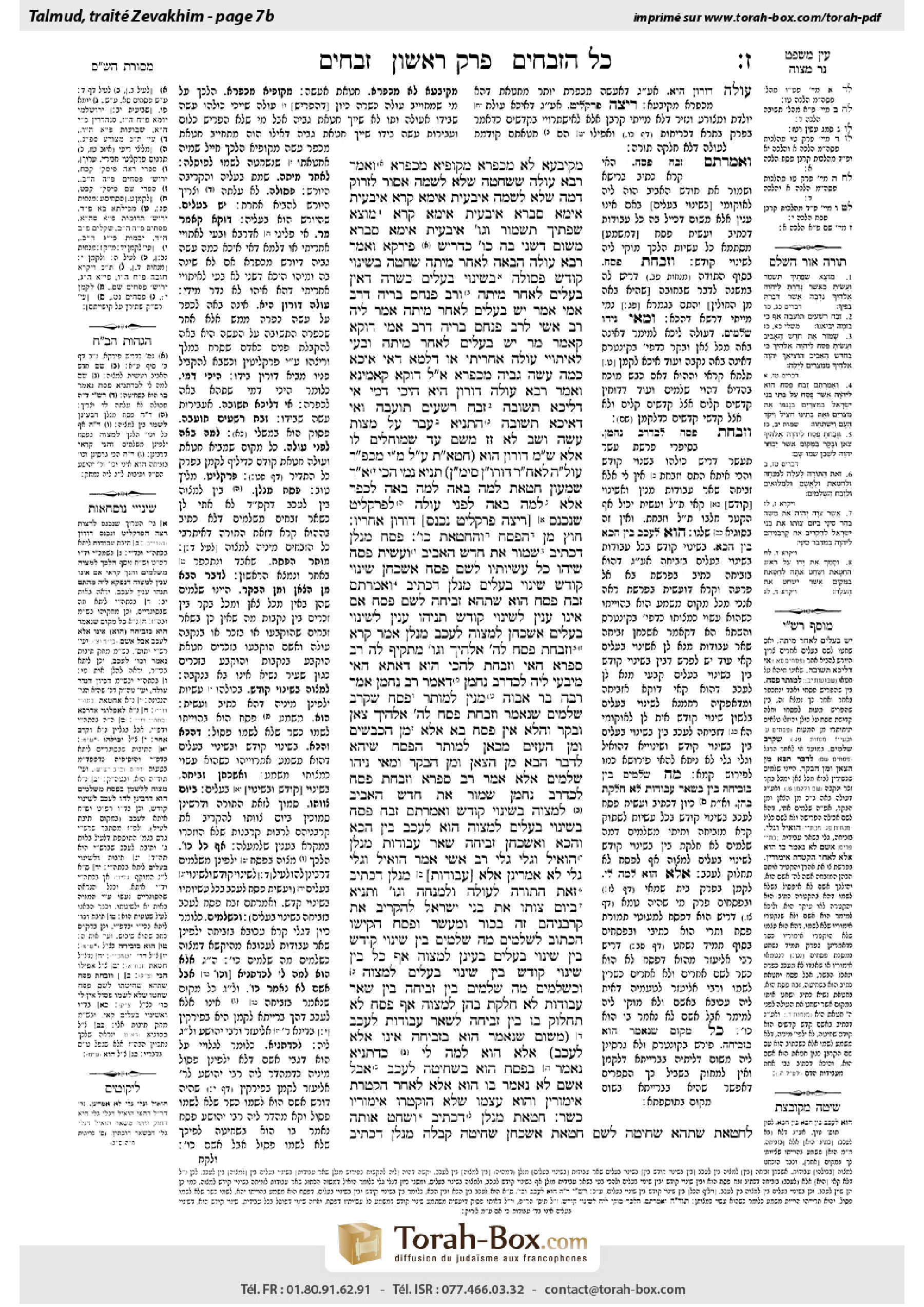
Zevachim 7b: Talmud study for Daf Yomi
Daf Yomi is the daily study of one Talmud folio. Explore 37 tractates with scans, Hebrew text, Sefaria English and AI-generated French translations where annotated.
Passage selection and English or AI-generated French translation are available where the scan has annotations. Daf Study is independent of Torah-Box and Sefaria.
Browse Zevachim · זבחים · All tractatesZevachim 7b text and translations
This page of Zevachim includes the Aramaic text, an English translation and an AI-generated French translation, alongside the scan above.
זבחים ז׳ ב · Aramaic and Hebrew text
מִקִּיבְעָא לָא מְכַפְּרָא, מִקּוּפְיָא מְכַפְּרָא.
וְאָמַר רָבָא: עוֹלָה שֶׁשְּׁחָטָהּ שֶׁלֹּא לִשְׁמָהּ – אָסוּר לִזְרוֹק דָּמָהּ שֶׁלֹּא לִשְׁמָהּ.
אִיבָּעֵית אֵימָא קְרָא, אִיבָּעֵית אֵימָא סְבָרָא. אִיבָּעֵית אֵימָא קְרָא: ״מוֹצָא שְׂפָתֶיךָ תִּשְׁמֹר וְגוֹ׳״. אִיבָּעֵית אֵימָא סְבָרָא: מִשּׁוּם דְּשַׁנִּי בַּהּ כּוּ׳, כִּדְרֵישׁ פִּירְקָא.
וְאָמַר רָבָא: עוֹלָה הַבָּאָה לְאַחַר מִיתָה; שְׁחָטָהּ בְּשִׁינּוּי קוֹדֶשׁ – פְּסוּלָה, בְּשִׁינּוּי בְּעָלִים – כְּשֵׁרָה, דְּאֵין בְּעָלִים לְאַחַר מִיתָה.
וְרַב פִּנְחָס בְּרֵיהּ דְּרַב אַמֵּי אָמַר: יֵשׁ בְּעָלִים לְאַחַר מִיתָה. אֲמַר לֵיהּ רַב אָשֵׁי לְרַב פִּנְחָס בְּרֵיהּ דְּרַב אַמֵּי: דַּוְקָא קָאָמַר מָר יֵשׁ בְּעָלִים לְאַחַר מִיתָה – וּבָעֵי לְאֵיתוֹיֵי עוֹלָה אַחֲרִיתִי; אוֹ דִּלְמָא, דְּאִי אִיכָּא כַּמָּה עֲשֵׂה גַּבֵּיהּ מְכַפְּרָא?
אֲמַר לֵיהּ: דַּוְקָא קָאָמֵינָא.
וְאָמַר רָבָא: עוֹלָה – דּוֹרוֹן הִיא. הֵיכִי דָמֵי? אִי דְּלֵיכָּא תְּשׁוּבָה – ״זֶבַח רְשָׁעִים תּוֹעֵבָה״! וְאִי דְּאִיכָּא תְּשׁוּבָה – הָתַנְיָא: עָבַר עַל מִצְוַת עֲשֵׂה וְשָׁב, לֹא זָז מִשָּׁם עַד שֶׁמּוֹחֲלִים לוֹ! אֶלָּא שְׁמַע מִינַּהּ דּוֹרוֹן הוּא.
חַטָּאת עַל מִי מְכַפֵּר, עוֹלָה לְאַחַר דּוֹרוֹן – סִימָן.
תַּנְיָא נָמֵי הָכִי, אָמַר רַבִּי שִׁמְעוֹן: חַטָּאת לָמָּה בָּאָה? לָמָּה בָּאָה?! לְכַפֵּר! אֶלָּא לָמָּה בָּאָה לִפְנֵי עוֹלָה? לִפְרַקְלִיט שֶׁנִּכְנָס, [רִיצָּה פְּרַקְלִיט – נִכְנָס] דּוֹרוֹן אַחֲרָיו.
חוּץ מִן הַפֶּסַח וְהַחַטָּאת כּוּ׳. פֶּסַח מְנָלַן?
דִּכְתִיב: ״שָׁמוֹר אֶת חֹדֶשׁ הָאָבִיב וְעָשִׂיתָ פֶּסַח״ – שֶׁיְּהוּ כׇּל עֲשִׂיּוֹתָיו לְשֵׁם פֶּסַח.
אַשְׁכְּחַן שִׁינּוּי קוֹדֶשׁ, שִׁינּוּי בְּעָלִים מְנָלַן?
דִּכְתִיב: ״וַאֲמַרְתֶּם זֶבַח פֶּסַח הוּא״ – שֶׁתְּהֵא זְבִיחָה לְשֵׁם פֶּסַח; אִם אֵינוֹ עִנְיָן לְשִׁינּוּי קוֹדֶשׁ, תְּנֵיהוּ עִנְיָן לְשִׁינּוּי בְעָלִים.
אַשְׁכְּחַן לְמִצְוָה, לְעַכֵּב מְנָלַן?
אָמַר קְרָא: ״וְזָבַחְתָּ פֶּסַח לַה׳ אֱלֹהֶיךָ וְגוֹ׳״.
מַתְקֵיף לַהּ רַב סָפְרָא: הַאי ״וְזָבַחְתָּ״ לְהָכִי הוּא דַּאֲתָא?! הַאי מִיבְּעֵי לֵיהּ לְכִדְרַב נַחְמָן – דְּאָמַר רַב נַחְמָן אָמַר רַבָּה בַּר אֲבוּהּ: מִנַּיִן לְמוֹתַר פֶּסַח שֶׁקָּרֵב שְׁלָמִים? שֶׁנֶּאֱמַר: ״וְזָבַחְתָּ פֶּסַח לַה׳ אֱלֹהֶיךָ צֹאן וּבָקָר״ – וַהֲלֹא אֵין פֶּסַח בָּא אֶלָּא מִן הַכְּבָשִׂים וּמִן הָעִזִּים! מִכָּאן לְמוֹתַר הַפֶּסַח שֶׁיְּהֵא לְדָבָר הַבָּא מִן הַצֹּאן וּמִן הַבָּקָר, וּמַאי נִיהוּ – שְׁלָמִים.
אֶלָּא אָמַר רַב סָפְרָא: ״וְזָבַחְתָּ פֶּסַח״ – לְכִדְרַב נַחְמָן; ״שָׁמוֹר אֶת חֹדֶשׁ הָאָבִיב״ – לְמִצְוָה בְּשִׁינּוּי קוֹדֶשׁ; ״וַאֲמַרְתֶּם זֶבַח פֶּסַח״ – בְּשִׁינּוּי בְּעָלִים לְמִצְוָה; ״הוּא״ – לְעַכֵּב בֵּין הָכָא וְהָכָא.
וְאַשְׁכְּחַן זְבִיחָה, שְׁאָר עֲבוֹדוֹת מְנָלַן? הוֹאִיל וְגַלִּי – גַּלִּי.
רַב אָשֵׁי אָמַר: הוֹאִיל וְגַלִּי גַּלִּי לָא אָמְרִינַן. אֶלָּא [עֲבוֹדוֹת] מְנָלַן? דִּכְתִיב: ״זֹאת הַתּוֹרָה לָעוֹלָה וְלַמִּנְחָה וְגוֹ׳״;
וְתַנְיָא: ״בְּיוֹם צַוֹּתוֹ אֶת בְּנֵי יִשְׂרָאֵל לְהַקְרִיב אֶת קׇרְבְּנֵיהֶם״ – זֶה בְּכוֹר וּמַעֲשֵׂר וָפֶסַח;
הִקִּישׁוֹ הַכָּתוּב לִשְׁלָמִים. מָה שְׁלָמִים – בֵּין שִׁינּוּי קוֹדֶשׁ בֵּין שִׁינּוּי בְעָלִים, בָּעֵינַן לְמִצְוָה; אַף כׇּל – בֵּין שִׁינּוּי קוֹדֶשׁ בֵּין שִׁינּוּי בְעָלִים, לְמִצְוָה.
וְכִשְׁלָמִים; מָה שְׁלָמִים – בֵּין זְבִיחָה בֵּין שְׁאָר עֲבוֹדוֹת, לֹא חָלַקְתָּ בָּהֶן, לְמִצְוָה; אַף פֶּסַח – לֹא תַּחְלוֹק בּוֹ בֵּין זְבִיחָה לִשְׁאָר עֲבוֹדוֹת, לְעַכֵּב. (מִשּׁוּם שֶׁנֶּאֱמַר ״הוּא״ בִּזְבִיחָה – אֵינוֹ אֶלָּא לְעַכֵּב.)
אֶלָּא, ״הוּא״ לְמָה לִי?
כִּדְתַנְיָא: נֶאֱמַר בְּפֶסַח ״הוּא״ בִּשְׁחִיטָה – לְעַכֵּב; אֲבָל אָשָׁם לֹא נֶאֱמַר בּוֹ ״הוּא״ אֶלָּא לְאַחַר הַקְטָרַת אֵימוּרִין, וְהוּא עַצְמוֹ שֶׁלֹּא הוּקְטְרוּ אֵימוּרָיו – כָּשֵׁר.
חַטָּאת מְנָלַן? דִּכְתִיב: ״וְשָׁחַט אֹתָהּ לְחַטָּאת״ – שֶׁתְּהֵא שְׁחִיטָה לְשֵׁם חַטָּאת.
אַשְׁכְּחַן שְׁחִיטָה, קַבָּלָה מְנָלַן? דִּכְתִיב:
Zevachim 7b · English translation
The Gemara answers: A sin offering does not atone for violating a positive mitzva by its essence, since prohibitions and positive mitzvot are not of the same type, but it atones for it incidentally.
And Rava says: As for a burnt offering that one slaughtered not for its sake, it is still prohibited to sprinkle its blood not for its sake.
Why is this so? If you wish, cite a verse; and if you wish, propose a logical argument. The Gemara elaborates: If you wish, cite a verse: “That which has gone out of your lips you shall observe and do; according to what you have vowed freely to the Lord your God, even that which you have promised with your mouth” (Deuteronomy 23:24). The derivation from this verse was explained in 2a. If you wish, propose a logical argument: Just because one deviated from protocol in its slaughter, shall he continue to deviate from protocol in the rest of the sacrificial process? This is as it was stated at the beginning of the chapter (2a).
And Rava says: With regard to a burnt offering that is brought by its owner’s heirs after his death, if one slaughtered it with a deviation from the type of offering, i.e., for the sake of another type of offering, it is unfit, i.e., it does not satisfy the owner’s obligation, and the heirs must therefore bring another offering. But if it was slaughtered with a deviation with regard to the owner, i.e., for the sake of another person, it is fit, as the offering has no legal owner after the owner’s death.
And Rav Pineḥas, son of Rav Ami, says that an offering has an owner after its owner’s death, specifically, the heir. Rav Ashi said to Rav Pineḥas, son of Rav Ami: Is the Master saying that an offering actually has an owner after its owner’s death, and that if it was slaughtered for the sake of the wrong owner, the heir must bring another burnt offering, contrary to the opinion of Rava? Or perhaps the Master is merely saying that if the heir has several violations of positive mitzvot, the offering atones for them, but still if it was slaughtered for the sake of the wrong owner, the heir is not required to bring another offering.
Rav Pineḥas said to him: I am saying that the heir is actually the owner, and if the offering was slaughtered for someone else, he must bring another offering.
And Rava says: A burnt offering is a gift [doron] to God; its essential purpose is not atonement. Rava supports his assertion: What are the circumstances under which a burnt offering atones for violating a positive mitzva? If one brings a burnt offering without repentance for his transgression, he may not sacrifice it at all, as “the sacrifice of the wicked is an abomination” (Proverbs 21:27). And if there is repentance, isn’t it taught in a baraita that if one violates a positive mitzva and repents, God forgives him before he even moves from his place? If so, why is he required to bring an offering? Rather, conclude from it that a burnt offering is a gift that one brings in order to appease God even after he is forgiven.
The Gemara states a mnemonic for this series of statements by Rava: A sin offering atones for who, a burnt offering after a gift.
This last statement of Rava is also taught in a baraita: Rabbi Shimon said: For what purpose is a sin offering brought? The Gemara interrupts: For what purpose is it brought? Is it not brought to atone for a transgression? Rather, Rabbi Shimon clearly meant: For what reason is it brought before a burnt offering in all circumstances where both are brought? Rabbi Shimon answered: It is comparable to an advocate [lifraklit] who enters before the king to convince him to pardon the defendant. Once the advocate has appeased the king, the gift is brought in after him.
§ The mishna teaches that all offerings are fit even if slaughtered not for their sake, except for the Paschal offering and the sin offering. The Gemara asks: From where do we derive that a Paschal offering is required to be slaughtered for its sake?
The Gemara answers: It is derived from a verse, as it is written: “Observe the month of the spring and offer [ve’asita] the Paschal offering” (Deuteronomy 16:1), teaching that all of the actions [asiyyotav] of the Paschal offering, all of its sacrificial rites, must be performed for the sake of the Paschal offering.
The Gemara asks: We found a source for the halakha that deviation from the type of offering is prohibited. From where do we derive that deviation with regard to the owner is also prohibited?
The Gemara answers that this is derived from a verse, as it is written: “And you shall say: It is the sacrifice [zevaḥ] of the Lord’s Passover” (Exodus 12:27), which indicates that the slaughter [zeviḥa] must be performed for the sake of the Paschal offering. If the verse is not necessary in order to derive the matter of deviation from the type of offering, as that halakha is derived from Deuteronomy 16:1, apply it to the matter of deviation with regard to the owner.
The Gemara asks: We found a source for the mitzva to sacrifice the Paschal offering for its sake and for the sake of its owner. From where do we derive that these intentions are indispensable and, if lacking, disqualify the offering?
The Gemara answers: The verse states: “And you shall sacrifice [vezavaḥta] the Paschal offering unto the Lord, your God, of the flock and the herd” (Deuteronomy 16:2). By repeating the mitzva to sacrifice the Paschal offering for its sake and for the sake of its owner, the Torah indicates that these two intentions are both indispensable to the sacrificial process.
Rav Safra objects to this: Does this verse: “And you shall sacrifice,” come to teach this halakha? It is necessary for the statement of Rav Naḥman, as Rav Naḥman says that Rabba bar Avuh says: From where is it derived that a leftover Paschal offering, an animal consecrated but not ultimately sacrificed on Passover eve, is sacrificed as a peace offering afterward? It is derived from that which is stated: “And you shall sacrifice the Passover offering unto the Lord, your God, of the flock and the herd.” The verse is difficult: But isn’t a Paschal offering brought only from the lambs and from the goats? From here it is derived that a leftover Paschal offering should be sacrificed as an offering brought both from the flock and from the herd. And what is that? It is a peace offering.
Rather, Rav Safra says that the verses should be expounded as follows: The verse “And you shall sacrifice the Paschal offering” teaches the statement of Rav Naḥman, that a leftover Paschal offering is sacrificed as a peace offering. The verse: “Observe the month of the spring and offer the Paschal offering” (Deuteronomy 16:1), teaches that there is a mitzva to sacrifice the Paschal offering without deviation from the type of offering. The verse: “And you shall say: It is the sacrifice of the Lord’s Passover” (Exodus 12:27), teaches that there is a mitzva to slaughter it without deviation with regard to the owner. The term “it is” in the latter verse teaches that both here and there, i.e., with regard to both the offering and the owner, proper intent is indispensable.
Rav Safra continues: And we found a source for slaughter. From where do we derive that other sacrificial rites must also be performed for the sake of the owner or the offering is disqualified? Since the Torah revealed that this intention is indispensable to the proper slaughter of the Paschal offering, it thereby revealed that it is critical to proper performance of the other rites as well.
Rav Ashi says: We do not say that since the Torah revealed that this halakha is indispensable to slaughter, it thereby revealed that it is indispensable to the other rites as well. Rather, from where do we derive that it is indispensable to the other sacrificial rites? It is derived from a verse, as it is written: “This is the law of the burnt offering, and of the meal offering, and of the sin offering, and of the guilt offering, and of the consecration offering, and of the sacrifice of peace offerings” (Leviticus 7:37), indicating that all offerings must, like a peace offering, be sacrificed for their own sake.
And it is taught in a baraita: In the verse: “In the day that he commanded the children of Israel to present their offerings” (Leviticus 7:38), this word, i.e., “offerings,” is referring to the firstborn animal, the animal tithe, and the Paschal offering, which are not mentioned in the previous verse.
The text juxtaposes all types of offerings mentioned in both verses with a peace offering, indicating that just as one who sacrifices a peace offering is required to do so with the proper intent, both concerning deviation from the offering and concerning deviation with regard to the owner, and in addition, the halakha of proper intent is only as a mitzva, not as an indispensable requirement, so too, in the case of any type of offering that must have proper intent, both concerning deviation from the offering and concerning deviation with regard to the owner, the halakha of proper intent is only as a mitzva. Therefore, the mitzva ab initio is derived from the halakha of a peace offering; and those verses mentioned earlier repeat the halakha to teach that it is indispensable with regard to slaughter.
And the juxtaposition of the peace offering with the Paschal offering indicates that a Paschal offering is similar to a peace offering in another respect: Just as with regard to a peace offering, you did not distinguish between slaughter and the other rites with regard to the mitzva ab initio of proper intent, so too, with regard to the Paschal offering, do not distinguish between slaughter and the other sacrificial rites with regard to the halakha that proper intent is indispensable.
The Gemara asks: Rather, since the indispensability of proper intent with regard to the Paschal offering is derived from its juxtaposition with the peace offering, why do I need the term “it is” to be written in Exodus 12:27? What is derived from there?
The Gemara answers: This is written to teach that this requirement is indispensable only in the case of a Paschal offering, and not in the case of a guilt offering. As it is taught in a baraita: Concerning the Paschal offering, the term “it is” is stated with regard to slaughter in Exodus 12:27 to teach that intent for the owner is indispensable. But concerning a guilt offering, the term “it is” is stated only after the verse mentions the burning of the sacrificial portions, and since a guilt offering itself is fit even when its portions were not burned on the altar at all, intent for the sake of the owner at this point is certainly not indispensable.
§ The Gemara asks: From where do we derive that if a sin offering is sacrificed for the sake of the wrong type of offering or one other than its owner, it is disqualified? The Gemara answers: It is derived from this verse, as it is written: “And slaughter it for a sin offering” (Leviticus 4:33), teaching that the slaughter must be performed for the sake of a sin offering.
The Gemara asks: We found a source with regard to slaughter. From where do we derive this with regard to collection of the blood? The Gemara answers: It is derived from this verse, as it is written:
Zevachim 7b · Traduction française (IA)
La Guemara répond : Le sacrifice expiatoire n’expie pas par nature la transgression d’une mitsva positive, car les interdits et les mitsvot positives ne sont pas du même ordre ; il l’expie toutefois de manière incidente.
Et Rava dit : Quant à l’holocauste qu’on a égorgé sans l’égorger pour son propre compte, il est néanmoins interdit d’en asperger le sang sans le faire pour son propre compte.
Pourquoi en est-il ainsi ? Si tu le souhaites, cite un verset ; si tu le souhaites, avance un raisonnement logique. La Guemara précise : si tu le souhaites, cite un verset : « Tu observeras et tu accompliras ce qui est sorti de tes lèvres, selon le vœu que tu as fait spontanément à l’Éternel ton Dieu, et que ta bouche a prononcé » (Deutéronome 23:24). La déduction tirée de ce verset a été expliquée en 2a. Si tu le souhaites, avance un raisonnement logique : sous prétexte qu’on a dérogé à la procédure lors de l’égorgement, faudrait-il continuer à y déroger pour le reste du processus sacrificiel ? C’est ce qui a été dit au début du chapitre (2a).
Et Rava dit : Quant à l’holocauste que les héritiers de son propriétaire apportent après la mort de celui-ci, s’il a été égorgé en dérogeant au type de sacrifice, c’est-à-dire pour un autre type de sacrifice, il est invalide, autrement dit, il ne satisfait pas à l’obligation du propriétaire, et les héritiers doivent donc apporter un autre sacrifice. Mais s’il a été égorgé en dérogeant à l’identité du propriétaire, c’est-à-dire pour le compte d’une autre personne, il est valide, puisque le sacrifice n’a plus de propriétaire au sens juridique après la mort de celui-ci.
Et Rav Pineḥas, fils de Rav Ami, dit qu’un sacrifice a un propriétaire après la mort de celui-ci : il s’agit précisément de l’héritier. Rav Ashi dit à Rav Pineḥas, fils de Rav Ami : Le maître veut-il dire qu’un sacrifice a effectivement un propriétaire après la mort de celui-ci, et que, s’il a été égorgé pour le mauvais propriétaire, l’héritier doit apporter un autre holocauste, contrairement à l’opinion de Rava ? Ou peut-être le maître veut-il seulement dire que si l’héritier a commis plusieurs transgressions de mitsvot positives, le sacrifice les expie, mais que, malgré tout, s’il a été égorgé pour le mauvais propriétaire, l’héritier n’est pas tenu d’apporter un autre sacrifice ?
Rav Pineḥas lui dit : Je dis que l’héritier est effectivement le propriétaire et que, si le sacrifice a été égorgé pour quelqu’un d’autre, il doit en apporter un autre.
Et Rava dit : L’holocauste est un don [doron] à Dieu ; son but essentiel n’est pas l’expiation. Rava étaye son affirmation : Dans quelles circonstances l’holocauste expie-t-il la transgression d’une mitsva positive ? Si quelqu’un apporte un holocauste sans s’être repenti de sa transgression, il ne peut pas du tout le sacrifier, car « le sacrifice des méchants est une abomination » (Proverbes 21:27). Et s’il s’est repenti, n’est-il pas enseigné dans une baraïta que si quelqu’un transgresse une mitsva positive puis se repent, Dieu lui pardonne avant même qu’il ne bouge de sa place ? Dans ce cas, pourquoi doit-il apporter un sacrifice ? Il faut plutôt en conclure que l’holocauste est un don qu’on apporte pour apaiser Dieu, même après avoir été pardonné.
La Guemara donne un moyen mnémotechnique pour cette série de déclarations de Rava : le sacrifice expiatoire expie pour qui, l’holocauste après un don.
Cette dernière déclaration de Rava est également enseignée dans une baraïta : Rabbi Shimon a dit : Dans quel but apporte-t-on un sacrifice expiatoire ? La Guemara interrompt : Dans quel but l’apporte-t-on ? N’est-ce pas pour expier une transgression ? Rabbi Shimon voulait clairement dire : Pour quelle raison l’apporte-t-on avant un holocauste chaque fois que les deux sont apportés ? Rabbi Shimon répondit : Il est comparable à un avocat [lifraklit] qui entre auprès du roi pour le convaincre de gracier l’accusé. Une fois que l’avocat a apaisé le roi, on apporte ensuite le don.
§ La Michna enseigne que tous les sacrifices sont valides même s’ils ont été égorgés sans l’être pour leur propre compte, à l’exception du sacrifice pascal et du sacrifice expiatoire. La Guemara demande : D’où déduisons-nous que le sacrifice pascal doit être égorgé pour son propre compte ?
La Guemara répond : Cela se déduit d’un verset, ainsi qu’il est écrit : « Observe le mois du printemps et offre [ve’asita] le sacrifice pascal » (Deutéronome 16:1), ce qui enseigne que tous les actes [asiyyotav] du sacrifice pascal, c’est-à-dire tous ses rites sacrificiels, doivent être accomplis pour le sacrifice pascal.
La Guemara demande : Nous avons trouvé une source pour la halakha selon laquelle il est interdit de déroger au type de sacrifice. D’où déduisons-nous qu’il est également interdit de déroger à l’identité du propriétaire ?
La Guemara répond que cela se déduit d’un verset, ainsi qu’il est écrit : « Et vous direz : C’est le sacrifice [zevaḥ] de la Pâque de l’Éternel » (Exode 12:27), ce qui indique que l’égorgement [zeviḥa] doit être effectué pour le sacrifice pascal. Si le verset n’est pas nécessaire pour déduire la règle concernant la dérogation au type de sacrifice, puisque cette halakha se déduit de Deutéronome 16:1, appliquons-le à la dérogation concernant l’identité du propriétaire.
La Guemara demande : Nous avons trouvé une source pour la mitsva de sacrifier le sacrifice pascal pour lui-même et pour son propriétaire. D’où déduisons-nous que ces intentions sont indispensables et que, si elles font défaut, le sacrifice est invalide ?
La Guemara répond : Le verset dit : « Et tu sacrifieras [vezavaḥta] le sacrifice pascal à l’Éternel ton Dieu, du petit et du gros bétail » (Deutéronome 16:2). En répétant la mitsva de sacrifier le sacrifice pascal pour lui-même et pour son propriétaire, la Torah indique que ces deux intentions sont toutes deux indispensables au processus sacrificiel.
Rav Safra objecte : Ce verset, « Et tu sacrifieras », vient-il enseigner cette halakha ? Il est nécessaire pour l’enseignement de Rav Naḥman, car Rav Naḥman dit au nom de Rabba bar Avuh : D’où déduit-on qu’un sacrifice pascal resté en réserve, c’est-à-dire un animal consacré mais qui n’a finalement pas été sacrifié la veille de Pessaḥ, est ensuite sacrifié comme offrande de paix ? On le déduit de ce qui est dit : « Et tu sacrifieras le sacrifice pascal à l’Éternel ton Dieu, du petit et du gros bétail. » Ce verset pose une difficulté : un sacrifice pascal n’est-il pas apporté uniquement parmi les agneaux et les boucs ? On en déduit qu’un sacrifice pascal resté en réserve doit être sacrifié comme une offrande provenant à la fois du petit et du gros bétail. Et de quelle offrande s’agit-il ? D’une offrande de paix.
Rav Safra dit plutôt qu’il faut interpréter les versets comme suit : le verset « Et tu sacrifieras le sacrifice pascal » enseigne ce qu’a dit Rav Naḥman, à savoir qu’un sacrifice pascal resté en réserve est sacrifié comme une offrande de paix. Le verset « Observe le mois du printemps et offre le sacrifice pascal » (Deutéronome 16:1) enseigne qu’il y a une mitsva de sacrifier le sacrifice pascal sans déroger au type de sacrifice. Le verset « Et vous direz : C’est le sacrifice de la Pâque de l’Éternel » (Exode 12:27) enseigne qu’il y a une mitsva de l’égorger sans déroger à l’identité du propriétaire. L’expression « c’est » dans ce dernier verset enseigne que, dans les deux cas, c’est-à-dire tant pour le type de sacrifice que pour l’identité du propriétaire, l’intention requise est indispensable.
Rav Safra poursuit : Nous avons trouvé une source pour l’égorgement. D’où déduisons-nous que les autres rites sacrificiels doivent eux aussi être accomplis pour le propriétaire ou pour le sacrifice, faute de quoi celui-ci est invalidé ? Puisque la Torah a révélé que cette intention est indispensable pour l’égorgement correct du sacrifice pascal, elle a ainsi révélé qu’elle est également essentielle à l’accomplissement correct des autres rites.
Rav Ashi dit : Nous ne disons pas que, puisque la Torah a révélé que cette halakha est indispensable pour l’égorgement, elle a ainsi révélé qu’elle l’est également pour les autres rites. D’où déduisons-nous alors qu’elle est indispensable pour les autres rites sacrificiels ? Cela se déduit d’un verset, ainsi qu’il est écrit : « Telle est la loi de l’holocauste, de l’offrande végétale, du sacrifice expiatoire, du sacrifice de culpabilité, du sacrifice d’investiture et des sacrifices d’offrandes de paix » (Lévitique 7:37), ce qui indique que tous les sacrifices doivent, comme l’offrande de paix, être sacrifiés pour eux-mêmes.
Et il est enseigné dans une baraïta : Dans le verset « le jour où il ordonna aux enfants d’Israël de présenter leurs sacrifices » (Lévitique 7:38), le terme « sacrifices » désigne le premier-né, la dîme du bétail et le sacrifice pascal, qui ne sont pas mentionnés dans le verset précédent.
Le texte met en parallèle tous les types de sacrifices mentionnés dans les deux versets avec l’offrande de paix. Cela indique que, de même que celui qui sacrifie une offrande de paix doit le faire avec l’intention correcte, tant en ce qui concerne le type de sacrifice qu’en ce qui concerne l’identité du propriétaire, et que la règle de l’intention correcte n’est qu’une mitsva et non une condition indispensable, de même, pour tout type de sacrifice qui doit être accompli avec l’intention correcte, tant en ce qui concerne le type de sacrifice qu’en ce qui concerne l’identité du propriétaire, la règle de l’intention correcte n’est qu’une mitsva. Par conséquent, le caractère de mitsva de cette exigence se déduit de la règle relative à l’offrande de paix ; et les versets mentionnés précédemment répètent cette règle pour enseigner que l’intention correcte est indispensable lors de l’égorgement.
Et la mise en parallèle de l’offrande de paix avec le sacrifice pascal indique que celui-ci ressemble à l’offrande de paix sous un autre rapport : de même que, pour l’offrande de paix, on n’a pas distingué l’égorgement des autres rites en ce qui concerne la mitsva de procéder d’emblée avec l’intention correcte, de même, pour le sacrifice pascal, ne distingue-t-on pas l’égorgement des autres rites sacrificiels en ce qui concerne la règle selon laquelle l’intention correcte est indispensable.
La Guemara demande : Dès lors, puisque le caractère indispensable de l’intention correcte pour le sacrifice pascal se déduit de sa mise en parallèle avec l’offrande de paix, pourquoi fallait-il écrire l’expression « c’est » en Exode 12:27 ? Qu’en déduit-on ?
La Guemara répond : Cette expression est écrite pour enseigner que cette exigence n’est indispensable que dans le cas du sacrifice pascal, et non dans celui d’un sacrifice de culpabilité. Car il est enseigné dans une baraïta : Pour le sacrifice pascal, l’expression « c’est » est employée à propos de l’égorgement en Exode 12:27 afin d’enseigner que l’intention concernant le propriétaire est indispensable. Mais pour un sacrifice de culpabilité, l’expression « c’est » n’apparaît qu’après que le verset a mentionné la combustion des parties sacrificielles ; et puisque le sacrifice de culpabilité lui-même reste valide même si ses parties n’ont pas du tout été brûlées sur l’autel, l’intention concernant le propriétaire à ce stade n’est certainement pas indispensable.
§ La Guemara demande : D’où déduisons-nous qu’un sacrifice expiatoire offert pour un type de sacrifice erroné ou pour quelqu’un d’autre que son propriétaire est invalidé ? La Guemara répond : Cela se déduit de ce verset, ainsi qu’il est écrit : « Et tu l’égorgeras comme sacrifice expiatoire » (Lévitique 4:33), ce qui enseigne que l’égorgement doit être effectué en tant que sacrifice expiatoire.
La Guemara demande : Nous avons trouvé une source concernant l’égorgement. D’où déduisons-nous la même règle concernant le recueil du sang ? La Guemara répond : Cela se déduit de ce verset, ainsi qu’il est écrit :
Traduction française générée par IA à partir de l’édition anglaise de Sefaria. Vérifie toujours un passage avec le texte source.
Text from Sefaria: William Davidson Edition - Vocalized Aramaic (CC BY NC); William Davidson Edition - English (CC BY NC).