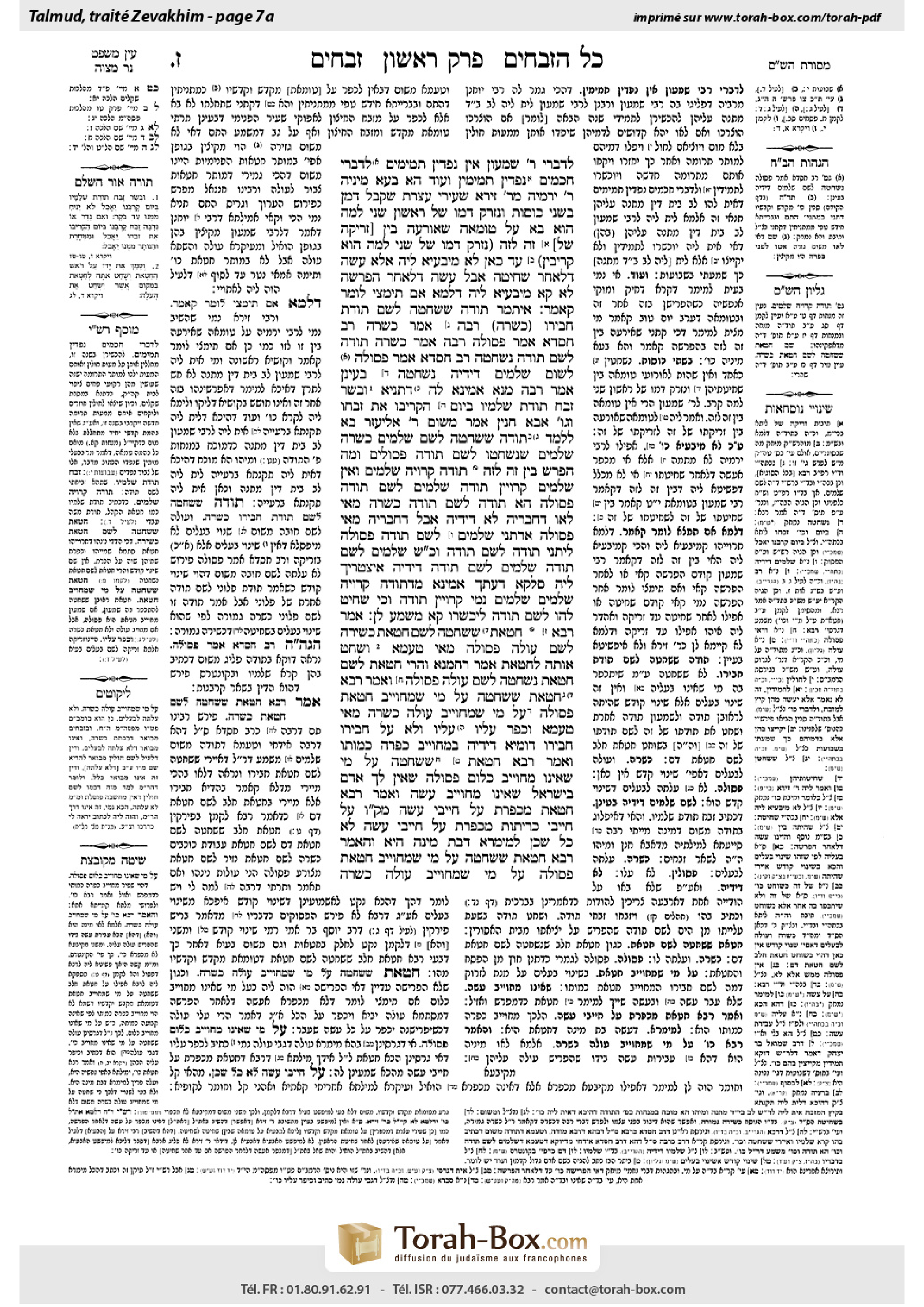
Zevachim 7a: Talmud study for Daf Yomi
Daf Yomi is the daily study of one Talmud folio. Explore 37 tractates with scans, Hebrew text, Sefaria English and AI-generated French translations where annotated.
Passage selection and English or AI-generated French translation are available where the scan has annotations. Daf Study is independent of Torah-Box and Sefaria.
Browse Zevachim · זבחים · All tractatesZevachim 7a text and translations
This page of Zevachim includes the Aramaic text, an English translation and an AI-generated French translation, alongside the scan above.
זבחים ז׳ א · Aramaic and Hebrew text
לְדִבְרֵי רַבִּי שִׁמְעוֹן אֵין נִפְדִּין תְּמִימִים, לְדִבְרֵי חֲכָמִים נִפְדִּין תְּמִימִין!
וְעוֹד, הָא בְּעָא מִינֵּיהּ רַבִּי יִרְמְיָה מֵרַבִּי זֵירָא: שְׂעִירֵי עֲצֶרֶת שֶׁקִּבֵּל דָּמָן בִּשְׁנֵי כּוֹסוֹת, וְנִזְרַק דָּמוֹ שֶׁל רִאשׁוֹן; שֵׁנִי לָמָה הוּא בָּא? עַל טוּמְאָה שֶׁאוֹרְעָה בֵּין [זְרִיקָה שֶׁל] זֶה לָזֶה. (נִזְרַק דָּמוֹ שֶׁל שֵׁנִי לָמָה הוּא קְרֵיבִין)
עַד כָּאן לָא מִיבַּעְיָא לֵיהּ – אֶלָּא עֲשֵׂה דִּלְאַחַר שְׁחִיטָה, אֲבָל עָשָׂה דִּלְאַחַר הַפְרָשָׁה – לָא קָא מִיבַּעְיָא לֵיהּ!
דִּלְמָא ״אִם תִּימְצֵי לוֹמַר״ קָאָמַר.
אִיתְּמַר: תּוֹדָה שֶׁשְּׁחָטָהּ לְשֵׁם תּוֹדַת חֲבֵירוֹ (כְּשֵׁרָה) – רַבָּה אָמַר: כְּשֵׁרָה, רַב חִסְדָּא אָמַר: פְּסוּלָה.
רַבָּה אָמַר כְּשֵׁרָה – תּוֹדָה לְשֵׁם תּוֹדָה נִשְׁחֲטָה. רַב חִסְדָּא אָמַר פְּסוּלָה – לְשׁוּם שְׁלָמִים דִּידֵיהּ נִשְׁחֲטָה בָּעֵינַן.
אָמַר רַבָּה: מְנָא אָמֵינָא לַהּ? דְּתַנְיָא: ״וּבְשַׂר זֶבַח תּוֹדַת שְׁלָמָיו בְּיוֹם הַקְרִיבוֹ אֶת זִבְחוֹ וְגוֹ׳״ – אַבָּא חָנִין אָמַר מִשּׁוּם רַבִּי אֱלִיעֶזֶר, בָּא לְלַמֵּד: תּוֹדָה שֶׁשְּׁחָטָהּ לְשֵׁם שְׁלָמִים – כְּשֵׁרָה, שְׁלָמִים שֶׁנִּשְׁחֲטוּ לְשֵׁם תּוֹדָה – פְּסוּלִים. וּמָה הֶפְרֵשׁ בֵּין זֶה לָזֶה? תּוֹדָה קְרוּיָה שְׁלָמִים, וְאֵין שְׁלָמִים קְרוּיִין תּוֹדָה.
שְׁלָמִים לְשֵׁם תּוֹדָה – פְּסוּלָה, הָא תּוֹדָה לְשֵׁם תּוֹדָה – כְּשֵׁרָה; מַאי, לָאו דְּחַבְרֵיהּ?
לָא, דִּידֵיהּ.
אֲבָל דְּחַבְרֵיהּ מַאי – פְּסוּלָה? אַדְּתָנֵי ״שְׁלָמִים לְשֵׁם תּוֹדָה פְּסוּלָה״, לִיתְנֵי ״תּוֹדָה לְשֵׁם תּוֹדָה״ – וְכׇל שֶׁכֵּן שְׁלָמִים לְשֵׁם תּוֹדָה!
שְׁלָמִים לְשֵׁם תּוֹדָה דִּידֵיהּ אִיצְטְרִיךְ לֵיהּ; סָלְקָא דַּעְתָּךְ אָמֵינָא: מִדְּתוֹדָה קְרוּיָה ״שְׁלָמִים״, שְׁלָמִים נָמֵי קְרוּיִין ״תּוֹדָה״ – וְכִי שָׁחֵיט לְהוּ לְשֵׁם תּוֹדָה לִיכַּשְּׁרוּ; קָא מַשְׁמַע לַן.
אָמַר רָבָא: חַטָּאת שֶׁשְּׁחָטָהּ לְשֵׁם חַטָּאת – כְּשֵׁירָה, לְשֵׁם עוֹלָה – פְּסוּלָה.
מַאי טַעְמָא? ״וְשָׁחַט אוֹתָהּ לְחַטָּאת״ אָמַר רַחֲמָנָא, וַהֲרֵי חַטָּאת לְשֵׁם חַטָּאת נִשְׁחֲטָה. לְשֵׁם עוֹלָה – פְּסוּלָה.
וְאָמַר רָבָא: חַטָּאת שֶׁשְּׁחָטָהּ עַל מִי שֶׁמְּחוּיָּיב חַטָּאת – פְּסוּלָה. עַל מִי שֶׁמְּחוּיָּיב עוֹלָה – כְּשֵׁרָה.
מַאי טַעְמָא? ״וְכִפֶּר עָלָיו״ – עָלָיו וְלֹא עַל חֲבֵירוֹ; חֲבֵירוֹ דּוּמְיָא דִידֵיהּ, בִּמְחוּיָּיב כַּפָּרָה כְּמוֹתוֹ.
וְאָמַר רָבָא: חַטָּאת שֶׁשְּׁחָטָהּ עַל מִי שֶׁאֵינוֹ מְחוּיָּיב כְּלוּם – פְּסוּלָה, שֶׁאֵין לְךָ אָדָם בְּיִשְׂרָאֵל שֶׁאֵינוֹ מְחוּיָּיב עֲשֵׂה.
וְאָמַר רָבָא: חַטָּאת מְכַפֶּרֶת עַל חַיָּיבֵי עֲשֵׂה מִקַּל וְחוֹמֶר – עַל חַיָּיבֵי כָרֵיתוֹת מְכַפֶּרֶת, עַל חַיָּיבֵי עֲשֵׂה לֹא כׇּל שֶׁכֵּן?!
לְמֵימְרָא דְּבַת מִינַהּ הִיא?! וְהָאָמַר רָבָא: חַטָּאת שֶׁשְּׁחָטָהּ עַל מִי שֶׁמְּחוּיָּיב חַטָּאת – פְּסוּלָה, עַל מִי שֶׁמְּחוּיָּיב עוֹלָה – כְּשֵׁרָה!
Zevachim 7a · English translation
according to the statement of Rabbi Shimon, they may not be redeemed as long as they are unblemished, since they retain the status of offerings. But according to the statement of the Rabbis, they may be redeemed even when they are unblemished, as the court initially stipulates that if they are not needed they will not assume the status of an offering. Apparently Rabbi Shimon does not accept the notion that the court can stipulate that there be a delay in the consecration of communal offerings, and the baraita can be adduced as evidence that offerings atone for transgressions committed after their designation as offerings.
And furthermore, continued Rav Yosef, son of Rav Shmuel, one can otherwise infer from the goats sacrificed on Shavuot that an offering can atone for transgressions committed after designation; as Rabbi Yirmeya asked Rabbi Zeira: If the goats sacrificed on Shavuot were slaughtered simultaneously and their blood was collected in two cups, and the blood of the first goat was sprinkled, for what sin is the second goat brought? There was no time in the interim for other transgressions to occur. Rabbi Zeira answered: It atones for any incident involving impurity that occurred between the sprinkling of the blood of that first goat and the sprinkling of the blood of this second goat.
One can infer: Rabbi Yirmeya raised the dilemma only about whether or not an offering atones for the violation of a positive mitzva committed after its slaughter and before the sprinkling of the blood. But with regard to the violation of a positive mitzva that one committed after the designation of the offering, before its slaughter, he did not raise the dilemma. Apparently, it was obvious to him that the offering atones for such a violation.
The Gemara rejects this proof: Perhaps Rabbi Yirmeya’s dilemma was also with regard to the violations committed after designation. He phrased his question to apply to violations committed after slaughter because he was saying: Even if you say that an offering atones for violations committed after designation, does it atone for those violations committed after slaughter? It may be that neither issue was clear to him.
§ It was stated with regard to a thanks offering that one slaughtered for the sake of another’s thanks offering: Rabba says that it is fit and satisfies its owner’s obligation, and Rav Ḥisda says it is unfit in this regard.
Rabba says it is fit because the thanks offering was slaughtered for the sake of a thanks offering. Rav Ḥisda says it is unfit because it must be slaughtered for the sake of his own peace offering.
Rabba said: From where do I say that it is fit? It is as it is taught in a baraita: The verse states: “And the meat of the sacrifice of his thanksgiving peace offering…on the day that he presents his offering it shall be eaten” (Leviticus 7:15–16). Abba Ḥanin said in the name of Rabbi Eliezer: The verse comes to teach that a thanks offering that one slaughtered for the sake of a peace offering is fit, whereas a peace offering that was slaughtered for the sake of a thanks offering is unfit. And what is the difference between this offering and that offering? A thanks offering is called a peace offering in the verse, but a peace offering is not called a thanks offering.
Rabba explains: The baraita indicates that a peace offering that was slaughtered for the sake of a thanks offering is unfit, but a thanks offering that was slaughtered for the sake of some other thanks offering is fit. What, is it not referring to the thanks offering of another, teaching that it satisfies its owner’s obligation?
The Gemara responds: No, it is referring to another thanks offering of his own, which he designated to give thanks for another incident of deliverance.
The Gemara asks: But if one slaughtered his thanks offering for the sake of another’s thanks offering, what is the halakha? Is it unfit, i.e., does it not satisfy the owner’s obligation? If so, rather than teaching that a peace offering slaughtered for the sake of a thanks offering is unfit, let the baraita teach that a thanks offering that was slaughtered for the sake of another’s thanks offering is unfit, and one could infer that all the more so a peace offering slaughtered for the sake of a thanks offering is unfit.
The Gemara answers: It was necessary for the baraita to specify a case where a peace offering was slaughtered for the sake of his own thanks offering. Otherwise, it might enter your mind to say that since a thanks offering is called a peace offering, a peace offering is called a thanks offering as well, and therefore when one slaughters a peace offering for the sake of a thanks offering it should be fit. Therefore the baraita teaches us that this is not the case.
§ Rava says: A sin offering that one slaughtered for the sake of another sin offering he was obligated to bring is fit; but if one slaughtered it for the sake of a burnt offering it is unfit.
What is the reason for this distinction? The Merciful One states in the Torah: “And slaughter it for a sin offering” (Leviticus 4:33), and therefore, as long as the sin offering was slaughtered for the sake of a sin offering, even another sin offering, it is fit. But if it was slaughtered for the sake of a burnt offering it is unfit.
And Rava says: A sin offering that one slaughtered for a person other than its owner, but who nevertheless was obligated to bring a sin offering, is unfit. But if one slaughtered it for one who was obligated to bring a burnt offering, it is fit.
What is the reason for this distinction? The Torah states: “And he shall be forgiven” (Leviticus 4:26), indicating that it must be specifically he, the owner, who shall be forgiven, and not another person. The other person to whom this is referring, with regard to whom the offering is disqualified, is presumably similar to the owner in that he is also obligated to achieve atonement similar to the owner’s by bringing a sin offering. Whereas if the other person is obligated to bring a burnt offering, and not a sin offering, this disqualification does not apply.
And Rava says: A sin offering that one slaughtered for a person who is not obligated to bring anything is unfit, as there is no person among the Jewish people who is not obligated to bring an offering for violating a positive mitzva. Therefore, the one for whom he slaughtered the offering is considered one who was obligated to bring a sin offering.
And Rava says that a sin offering atones for those obligated to bring a burnt offering for violating a positive mitzva, due to an a fortiori inference: If a sin offering atones for those who are liable for transgressions for which one receives excision from the World-to-Come if he performs them intentionally, all the more so is it not clear that it atones for those liable for failing to fulfill a positive mitzva?
The Gemara asks: Is this to say that the violation of a positive mitzva is of the same type as the sins atoned for by a sin offering? But doesn’t Rava say that a sin offering that one slaughtered for a person other than its owner but who was obligated to bring a sin offering is unfit, but if it was slaughtered for a person who is obligated to bring a burnt offering, it is fit, as he is not obligated to provide a similar atonement? Given that burnt offerings atone for violations of positive mitzvot, apparently such atonement is of a different type than atonement for the transgression of prohibitions.
Zevachim 7a · Traduction française (IA)
Selon l’enseignement de Rabbi Chimon, ils ne peuvent pas être rachetés tant qu’ils sont sans défaut, puisqu’ils conservent le statut d’offrandes. Mais selon l’enseignement des Sages, ils peuvent être rachetés même lorsqu’ils sont sans défaut, car le tribunal stipule d’emblée que, s’ils ne sont pas nécessaires, ils ne prendront pas le statut d’offrandes. Il apparaît donc que Rabbi Chimon n’admet pas que le tribunal puisse stipuler un délai dans la consécration des offrandes communautaires, et l’on peut invoquer la baraïta comme preuve que les offrandes expient des transgressions commises après qu’elles ont été désignées comme offrandes.
Et de plus, poursuivit Rav Yossef, fils de Rav Chmouel, on peut déduire autrement des boucs sacrifiés à Chavouot qu’une offrande peut expier des transgressions commises après sa désignation. En effet, Rabbi Yirmeya demanda à Rabbi Zeïra : Si les boucs sacrifiés à Chavouot ont été égorgés simultanément et que leur sang a été recueilli dans deux coupes, puis que le sang du premier bouc a été aspergé, pour quelle faute le second bouc est-il offert ? Il n’y avait pas eu assez de temps entre les deux pour que d’autres transgressions soient commises. Rabbi Zeïra répondit : Il expie tout cas d’impureté survenu entre l’aspersion du sang de ce premier bouc et celle du sang de ce second bouc.
On peut en déduire que Rabbi Yirmeya ne souleva la question que pour savoir si une offrande expie ou non la transgression d’une mitsva positive commise après son égorgement et avant l’aspersion du sang. Mais au sujet de la transgression d’une mitsva positive commise après la désignation de l’offrande et avant son égorgement, il ne souleva pas la question. Il lui semblait donc évident que l’offrande expiait une telle transgression.
La Guemara rejette cette preuve : peut-être la question de Rabbi Yirmeya portait-elle aussi sur les transgressions commises après la désignation. Il formula sa question au sujet des transgressions commises après l’égorgement parce qu’il disait : même si tu affirmes qu’une offrande expie les transgressions commises après sa désignation, expie-t-elle celles qui sont commises après l’égorgement ? Il se peut qu’aucune des deux questions ne lui ait paru évidente.
§ À propos d’un sacrifice de reconnaissance égorgé en vue du sacrifice de reconnaissance d’un autre, il a été dit : Rabba affirme qu’il est valide et acquitte son propriétaire de son obligation, tandis que Rav Ḥisda affirme qu’à cet égard, il est invalide.
Rabba affirme qu’il est valide parce que le sacrifice de reconnaissance a été égorgé en vue d’un sacrifice de reconnaissance. Rav Ḥisda affirme qu’il est invalide parce qu’il doit être égorgé en vue de son propre sacrifice de paix.
Rabba dit : D’où sais-je qu’il est valide ? De ce qui est enseigné dans une baraïta : le verset dit : « Et la chair du sacrifice de reconnaissance de son sacrifice de paix… le jour où il présente son offrande, elle sera mangée » (Lévitique 7, 15-16). Abba Ḥanin a dit au nom de Rabbi Eliézer : Le verset vient enseigner qu’un sacrifice de reconnaissance égorgé en vue d’un sacrifice de paix est valide, tandis qu’un sacrifice de paix égorgé en vue d’un sacrifice de reconnaissance est invalide. Et quelle est la différence entre cette offrande et celle-là ? Le sacrifice de reconnaissance est appelé sacrifice de paix dans le verset, mais le sacrifice de paix n’est pas appelé sacrifice de reconnaissance.
Rabba explique : La baraïta indique qu’un sacrifice de paix égorgé en vue d’un sacrifice de reconnaissance est invalide, mais qu’un sacrifice de reconnaissance égorgé en vue d’un autre sacrifice de reconnaissance est valide. Ne s’agit-il pas du sacrifice de reconnaissance d’un autre, ce qui enseignerait qu’il acquitte son propriétaire de son obligation ?
La Guemara répond : Non, il s’agit d’un autre sacrifice de reconnaissance qui lui appartient, qu’il a désigné pour remercier d’un autre événement dont il a été sauvé.
La Guemara demande : Mais si l’on égorge son sacrifice de reconnaissance en vue du sacrifice de reconnaissance d’un autre, quelle est la halakha ? Est-il invalide, c’est-à-dire n’acquitte-t-il pas son propriétaire de son obligation ? Si tel est le cas, au lieu d’enseigner qu’un sacrifice de paix égorgé en vue d’un sacrifice de reconnaissance est invalide, que la baraïta enseigne qu’un sacrifice de reconnaissance égorgé en vue du sacrifice de reconnaissance d’un autre est invalide ; on pourrait alors en déduire qu’à plus forte raison, un sacrifice de paix égorgé en vue d’un sacrifice de reconnaissance est invalide.
La Guemara répond : Il était nécessaire que la baraïta précise le cas d’un sacrifice de paix égorgé en vue de son propre sacrifice de reconnaissance. Sinon, on aurait pu penser que, puisque le sacrifice de reconnaissance est appelé sacrifice de paix, le sacrifice de paix est lui aussi appelé sacrifice de reconnaissance et que, par conséquent, lorsqu’on égorge un sacrifice de paix en vue d’un sacrifice de reconnaissance, il devrait être valide. La baraïta nous enseigne donc qu’il n’en est pas ainsi.
§ Rava dit : Un sacrifice expiatoire égorgé en vue d’un autre sacrifice expiatoire que l’on était tenu d’apporter est valide ; mais s’il est égorgé en vue d’un holocauste, il est invalide.
Quelle est la raison de cette distinction ? Le Miséricordieux dit dans la Torah : « Et tu l’égorgeras en sacrifice expiatoire » (Lévitique 4, 33) ; par conséquent, dès lors que le sacrifice expiatoire a été égorgé en vue d’un sacrifice expiatoire, même d’un autre sacrifice expiatoire, il est valide. Mais s’il a été égorgé en vue d’un holocauste, il est invalide.
Et Rava dit : Un sacrifice expiatoire égorgé pour une personne autre que son propriétaire, mais qui était néanmoins tenue d’apporter un sacrifice expiatoire, est invalide. Mais s’il est égorgé pour une personne tenue d’apporter un holocauste, il est valide.
Quelle est la raison de cette distinction ? La Torah dit : « Et il lui sera pardonné » (Lévitique 4, 26), ce qui indique que c’est précisément lui, le propriétaire, qui doit être pardonné, et non une autre personne. L’autre personne dont il est ici question, celle pour laquelle l’offrande est invalidée, est vraisemblablement semblable au propriétaire en ce qu’elle est elle aussi tenue d’obtenir une expiation comparable à celle du propriétaire en apportant un sacrifice expiatoire. En revanche, si l’autre personne est tenue d’apporter un holocauste, et non un sacrifice expiatoire, cette invalidité ne s’applique pas.
Et Rava dit : Un sacrifice expiatoire égorgé pour une personne qui n’est tenue d’apporter aucune offrande est invalide, car il n’existe personne parmi le peuple juif qui ne soit tenu d’apporter une offrande pour avoir transgressé une mitsva positive. Par conséquent, la personne pour laquelle on a égorgé l’offrande est considérée comme quelqu’un qui était tenu d’apporter un sacrifice expiatoire.
Et Rava dit qu’un sacrifice expiatoire expie pour ceux qui sont tenus d’apporter un holocauste à la suite de la transgression d’une mitsva positive, au moyen d’un raisonnement a fortiori : si un sacrifice expiatoire expie pour ceux qui sont passibles du retranchement du monde à venir lorsqu’ils commettent intentionnellement des transgressions, à plus forte raison n’est-il pas évident qu’il expie pour ceux qui sont passibles de ne pas avoir accompli une mitsva positive ?
La Guemara demande : Cela signifie-t-il que la transgression d’une mitsva positive est du même type que les péchés qu’expie un sacrifice expiatoire ? Pourtant, Rava ne dit-il pas qu’un sacrifice expiatoire égorgé pour une personne autre que son propriétaire, mais tenue d’apporter un sacrifice expiatoire, est invalide, tandis que s’il est égorgé pour une personne tenue d’apporter un holocauste, il est valide, car celle-ci n’est pas tenue d’obtenir une expiation du même type ? Puisque les holocaustes expient les transgressions de mitsvot positives, il apparaît que cette expiation est d’un type différent de celle qui porte sur la transgression d’interdictions.
Traduction française générée par IA à partir de l’édition anglaise de Sefaria. Vérifie toujours un passage avec le texte source.
Text from Sefaria: William Davidson Edition - Vocalized Aramaic (CC BY NC); William Davidson Edition - English (CC BY NC).