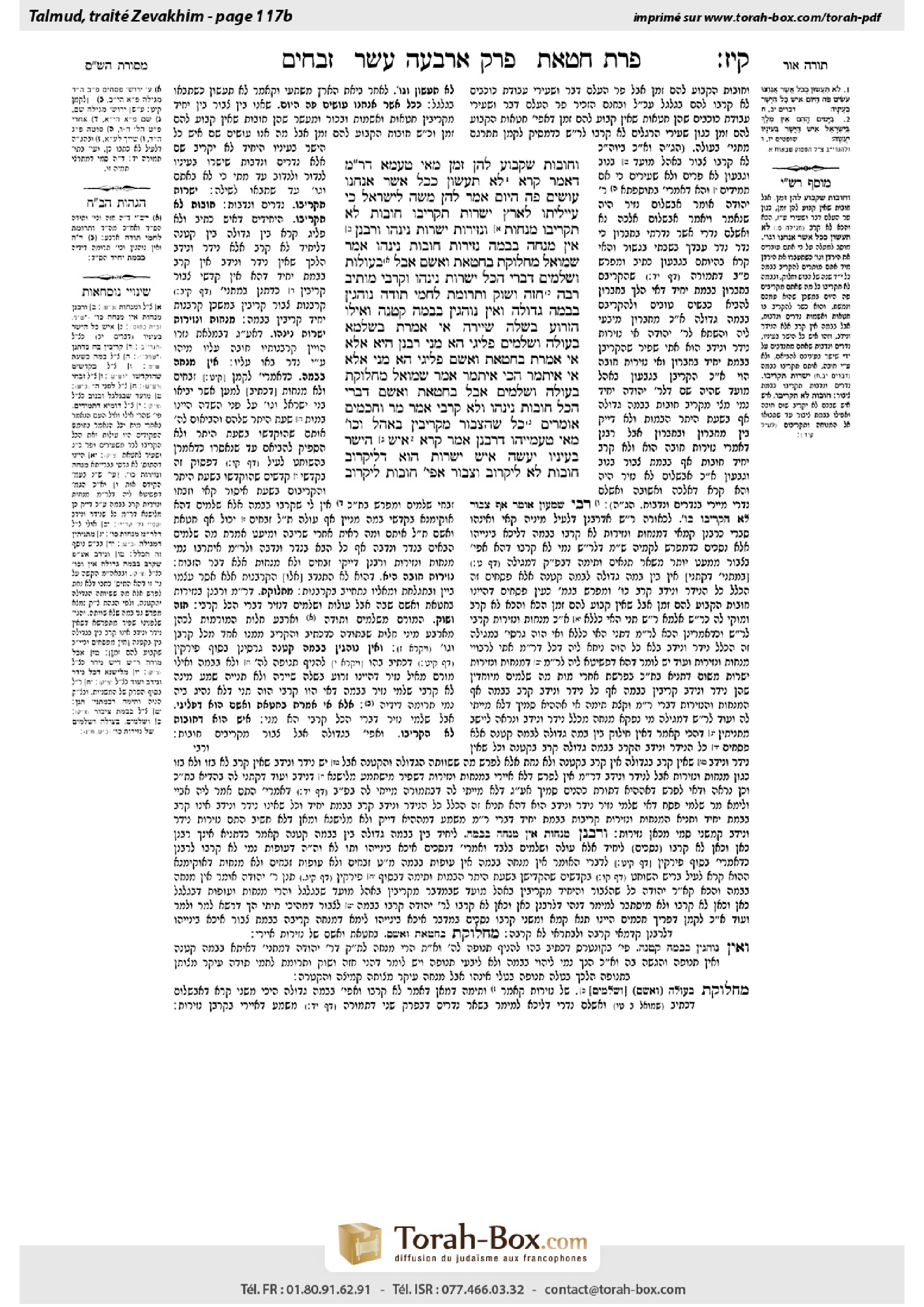
Zevachim 117b: Talmud study for Daf Yomi
Daf Yomi is the daily study of one Talmud folio. Explore 37 tractates with scans, Hebrew text, Sefaria English and AI-generated French translations where annotated.
Passage selection and English or AI-generated French translation are available where the scan has annotations. Daf Study is independent of Torah-Box and Sefaria.
Browse Zevachim · זבחים · All tractatesZevachim 117b text and translations
This page of Zevachim includes the Aramaic text, an English translation and an AI-generated French translation, alongside the scan above.
זבחים קי״ז ב · Aramaic and Hebrew text
וְחוֹבוֹת שֶׁקָּבוּעַ לָהֶן זְמַן.
מַאי טַעְמָא דְּרַבִּי מֵאִיר? דְּאָמַר קְרָא: ״לֹא תַעֲשׂוּן כְּכֹל אֲשֶׁר אֲנַחְנוּ עֹשִׂים פֹּה הַיּוֹם״ –
אָמַר לָהֶן מֹשֶׁה לְיִשְׂרָאֵל: כִּי עָיְילִיתוּ לָאָרֶץ ישראל – יְשָׁרוֹת תַּקְרִיבוּ, חוֹבוֹת לֹא תַּקְרִיבוּ. מְנָחוֹת וּנְזִירוֹת – יְשָׁרוֹת נִינְהוּ.
וְרַבָּנַן – אֵין מִנְחָה בְּבָמָה; נְזִירוֹת חוֹבוֹת נִינְהוּ.
אָמַר שְׁמוּאֵל: מַחְלוֹקֶת בְּחַטָּאת וְאָשָׁם, אֲבָל בְּעוֹלוֹת וּשְׁלָמִים – דִּבְרֵי הַכֹּל יְשָׁרוֹת נִינְהוּ, וְקָרְבִי.
מוֹתֵיב רַבָּה: חָזֶה וָשׁוֹק וּתְרוּמַת לַחְמֵי תוֹדָה – נוֹהֲגִין בְּבָמָה גְּדוֹלָה, וְאֵין נוֹהֲגִין בְּבָמָה קְטַנָּה. וְאִילּוּ הַזְּרוֹעַ בְּשֵׁלָה – שַׁיְּירַהּ;
אִי אָמְרַתְּ בִּשְׁלָמָא בְּעוֹלָה וּשְׁלָמִים פְּלִיגִי, הָא מַנִּי – רַבָּנַן הִיא. אֶלָּא אִי אָמְרַתְּ בְּחַטָּאת וְאָשָׁם פְּלִיגִי, הָא מַנִּי?
אֶלָּא אִי אִיתְּמַר, הָכִי אִיתְּמַר – אָמַר שְׁמוּאֵל: מַחְלוֹקֶת בְּעוֹלָה וּשְׁלָמִים, אֲבָל בְּחַטָּאת וְאָשָׁם – דִּבְרֵי הַכֹּל חוֹבוֹת נִינְהוּ, וְלָא קָרְבִי.
אָמַר מָר, וַחֲכָמִים אוֹמְרִים: כֹּל שֶׁהַצִּבּוּר מַקְרִיבִין בְּאֹהֶל וְכוּ׳.
מַאי טַעְמַיְיהוּ דְּרַבָּנַן? אָמַר קְרָא: ״אִישׁ הַיָּשָׁר בְּעֵינָיו יַעֲשֶׂה״; אִישׁ – יְשָׁרוֹת הוּא דְּלִיקְרוּב, חוֹבוֹת לָא לִיקְרוּב; וְצִבּוּר – אֲפִילּוּ חוֹבוֹת לִיקְרוּב.
Zevachim 117b · English translation
and compulsory public offerings that have a set time to be sacrificed, e.g., daily offerings and additional offerings. Public offerings that do not have a set time were not sacrificed upon the great public altar in Gilgal.
§ The Gemara explains the various opinions cited in the baraita: What is the reason for the opinion of Rabbi Meir that only vow offerings and gift offerings, such as nazirite offerings and meal offerings, were sacrificed upon a private altar during the period of Gilgal? It is as the verse states: “You shall not do all that we do here this day, every man whatsoever is fitting in his own eyes. For you have not as yet come to the rest and to the inheritance” (Deuteronomy 12:8–9).
Moses said the following to the Jewish people: When you enter Eretz Yisrael but have not yet arrived at Shiloh or Jerusalem and are therefore permitted to sacrifice upon private altars, you may not sacrifice whatever has been sacrificed in the wilderness, i.e., both obligatory offerings and gift offerings. Rather, the phrase “every man whatsoever is fitting [hayashar] in his own eyes,” means that fitting offerings [yesharot], i.e., offerings that are fitting in one’s eyes and are brought due to one’s own benevolence, you may sacrifice, but you may not sacrifice obligatory offerings. Meal offerings and offerings of a nazirite are included in the category of fitting offerings: Meal offerings are sacrificed as vow offerings or gift offerings while offerings of a nazirite are considered a vow offering, as becoming a nazirite is not compulsory.
And what is the reason that the Rabbis disagree with Rabbi Meir and state that meal offerings and offerings of a nazirite were not sacrificed on a private altar? They hold that a meal offering is not ever sacrificed upon a private altar and that offerings of a nazirite are considered compulsory. While one assumes the status of a nazirite voluntarily, once he has become a nazirite he is required to bring the offering.
With regard to this, Shmuel says that the disagreement between Rabbi Meir and the Rabbis pertains only to the sin offering and the guilt offering brought by the nazirite. But with regard to the burnt offering and the peace offering that the nazirite brings, all agree that they are considered offerings that one deems fitting to sacrifice and are therefore sacrificed on a private altar.
Rabba raises an objection from a baraita: The halakha of the breast and thigh portions of peace offerings, which are given to the priests (see Leviticus 7:34), and the halakha of the teruma of the loaves of the thanks offering, i.e., the bread that was given to the priests from each of the four types of loaves that were brought with the thanks offering (see Leviticus 7:14), apply only with regard to a great public altar, and do not apply with regard to a small private altar. Rabba comments: By contrast, another of the priestly gifts, the cooked foreleg of the nazirite’s ram (see Numbers 6:19–20) was omitted by the tanna.
Rabba notes: Granted, if you say that Rabbi Meir and the Rabbis disagree even with regard to whether a burnt offering and peace offering of a nazirite may be sacrificed upon a private altar, then in accordance with whose opinion is this baraita that omits the nazirite’s ram? It is in accordance with the opinion of the Rabbis, who hold that the peace offering of the nazirite was not sacrificed upon a private altar. But if you say that they disagree only with regard to a sin offering and guilt offering, while the Rabbis agree that the peace offering and burnt offering of a nazirite were sacrificed on a private altar, then in accordance with whose opinion is this baraita?
Rather, if this was stated, it was stated like this: Shmuel said that the disagreement between Rabbi Meir and the Rabbis pertains only to the burnt offering and peace offering that were brought by the nazirite. But with regard to the sin offering and guilt offering, all agree that they are compulsory, and even according to the opinion of Rabbi Meir they are not sacrificed upon a private altar.
§ The Gemara continues to clarify the opinions in the baraita: The Master, i.e., Rabbi Yehuda, said that any offering that the public or an individual could sacrifice in the Tent of Meeting in the wilderness, including vow offerings, gift offerings, and compulsory offerings, could also be sacrificed in the Tent of Meeting in Gilgal. It was only on a private altar that the individual was limited to sacrificing burnt offerings and peace offerings. And the Rabbis say: Any offering that the public could sacrifice in the Tent of Meeting in the wilderness could also be sacrificed in the Tent of Meeting in Gilgal. An individual could sacrifice only burnt offerings and peace offerings, whether on a great public altar or on a private altar.
The Gemara clarifies the two opinions: What is the reason for the opinion of the Rabbis that only the public could sacrifice compulsory offerings on a great public altar? The verse states with regard to the period in which private altars were permitted: “You shall not do all that we do here this day, every man whatsoever is fitting in his own eyes” (Deuteronomy 12:8). This indicates that it is “a man,” i.e., an individual, who may sacrifice only offerings that he deems “fitting,” i.e., voluntary offerings, but may not sacrifice compulsory offerings. But the public may sacrifice even compulsory offerings.
Zevachim 117b · Traduction française (IA)
et les sacrifices publics obligatoires dont le moment de l’offrande est fixé, par exemple les sacrifices quotidiens et les sacrifices supplémentaires. Les sacrifices publics qui n’avaient pas de moment fixé n’étaient pas offerts sur le grand autel public de Guilgal.
§ La Guemara explique les diverses opinions citées dans la baraïta : quelle est la raison de l’opinion de Rabbi Meïr, selon laquelle seuls les sacrifices votifs et les offrandes volontaires, comme les sacrifices du nazir et les oblations, étaient offerts sur un autel privé pendant la période de Guilgal ? C’est ce qu’indique le verset : « Vous ne ferez pas comme nous faisons ici aujourd’hui, chacun ce qui lui semble juste à ses yeux. Car vous n’êtes pas encore arrivés au repos et à l’héritage » (Deutéronome 12, 8-9).
Moïse dit ceci au peuple juif : lorsque vous entrerez en Eretz Israël, mais que vous ne serez pas encore arrivés à Silo ou à Jérusalem et que vous serez donc autorisés à offrir des sacrifices sur des autels privés, vous ne pourrez pas offrir tout ce qui était offert dans le désert, c’est-à-dire aussi bien les sacrifices obligatoires que les offrandes volontaires. L’expression « chacun ce qui lui semble juste [hayashar] à ses yeux » signifie plutôt que vous pourrez offrir les sacrifices appropriés [yesharot], c’est-à-dire ceux qui vous semblent appropriés et que vous apportez de votre propre gré, mais pas les sacrifices obligatoires. Les oblations et les sacrifices du nazir entrent dans la catégorie des sacrifices appropriés : les oblations sont offertes comme sacrifices votifs ou offrandes volontaires, tandis que les sacrifices du nazir sont considérés comme des sacrifices votifs, car on n’est pas obligé de devenir nazir.
Et pourquoi les Sages sont-ils en désaccord avec Rabbi Meïr et affirment-ils que les oblations et les sacrifices du nazir n’étaient pas offerts sur un autel privé ? Ils considèrent qu’une oblation n’est jamais offerte sur un autel privé et que les sacrifices du nazir sont considérés comme obligatoires. Bien que l’on devienne nazir de son plein gré, une fois devenu nazir, on est tenu d’apporter le sacrifice.
À ce sujet, Chmouel dit que le désaccord entre Rabbi Meïr et les Sages ne porte que sur le sacrifice expiatoire et le sacrifice de culpabilité apportés par le nazir. En revanche, concernant l’holocauste et le sacrifice de paix apportés par le nazir, tous s’accordent à dire qu’ils sont considérés comme des sacrifices que l’on juge appropriés à offrir et qu’ils étaient donc offerts sur un autel privé.
Rabba soulève une objection à partir d’une baraïta : la règle relative à la poitrine et à la cuisse des sacrifices de paix, qui sont données aux prêtres (voir Lévitique 7, 34), ainsi que celle relative à la terouma des pains du sacrifice de reconnaissance, c’est-à-dire le pain remis aux prêtres parmi chacun des quatre types de pains apportés avec le sacrifice de reconnaissance (voir Lévitique 7, 14), ne s’appliquent qu’au grand autel public et non au petit autel privé. Rabba remarque : en revanche, le tanna a omis un autre don sacerdotal, la patte antérieure cuite du bélier du nazir (voir Nombres 6, 19-20).
Rabba remarque : certes, si tu dis que Rabbi Meïr et les Sages sont également en désaccord sur la question de savoir si l’holocauste et le sacrifice de paix du nazir peuvent être offerts sur un autel privé, alors de quelle opinion cette baraïta qui omet le bélier du nazir relève-t-elle ? Elle relève de l’opinion des Sages, qui considèrent que le sacrifice de paix du nazir n’était pas offert sur un autel privé. Mais si tu dis qu’ils ne sont en désaccord qu’au sujet du sacrifice expiatoire et du sacrifice de culpabilité, tandis que les Sages conviennent que le sacrifice de paix et l’holocauste du nazir étaient offerts sur un autel privé, alors de quelle opinion cette baraïta relève-t-elle ?
Mais, si cette déclaration a été formulée, elle l’a été ainsi : Chmouel a dit que le désaccord entre Rabbi Meïr et les Sages porte uniquement sur l’holocauste et le sacrifice de paix apportés par le nazir. En revanche, concernant le sacrifice expiatoire et le sacrifice de culpabilité, tous s’accordent à dire qu’ils sont obligatoires et que, même selon l’opinion de Rabbi Meïr, ils ne sont pas offerts sur un autel privé.
§ La Guemara poursuit en clarifiant les opinions de la baraïta : le Maître, c’est-à-dire Rabbi Yehouda, a dit que tout sacrifice que le public ou un particulier pouvait offrir dans la Tente d’assignation, dans le désert — y compris les sacrifices votifs, les offrandes volontaires et les sacrifices obligatoires — pouvait également être offert dans la Tente d’assignation de Guilgal. C’est uniquement sur un autel privé que le particulier était limité à l’offrande d’holocaustes et de sacrifices de paix. Et les Sages disent : tout sacrifice que le public pouvait offrir dans la Tente d’assignation, dans le désert, pouvait également être offert dans la Tente d’assignation de Guilgal. Un particulier ne pouvait offrir que des holocaustes et des sacrifices de paix, que ce soit sur un grand autel public ou sur un autel privé.
La Guemara clarifie les deux opinions : quelle est la raison de l’opinion des Sages, selon laquelle seul le public pouvait offrir des sacrifices obligatoires sur un grand autel public ? Le verset relatif à la période où les autels privés étaient autorisés dit : « Vous ne ferez pas comme nous faisons ici aujourd’hui, chacun ce qui lui semble juste à ses yeux » (Deutéronome 12, 8). Cela indique que c’est « un homme », c’est-à-dire un particulier, qui ne peut offrir que les sacrifices qu’il juge « appropriés », c’est-à-dire des offrandes volontaires, mais pas des sacrifices obligatoires. Le public, en revanche, peut offrir même des sacrifices obligatoires.
Traduction française générée par IA à partir de l’édition anglaise de Sefaria. Vérifie toujours un passage avec le texte source.
Text from Sefaria: William Davidson Edition - Vocalized Aramaic (CC BY NC); William Davidson Edition - English (CC BY NC).