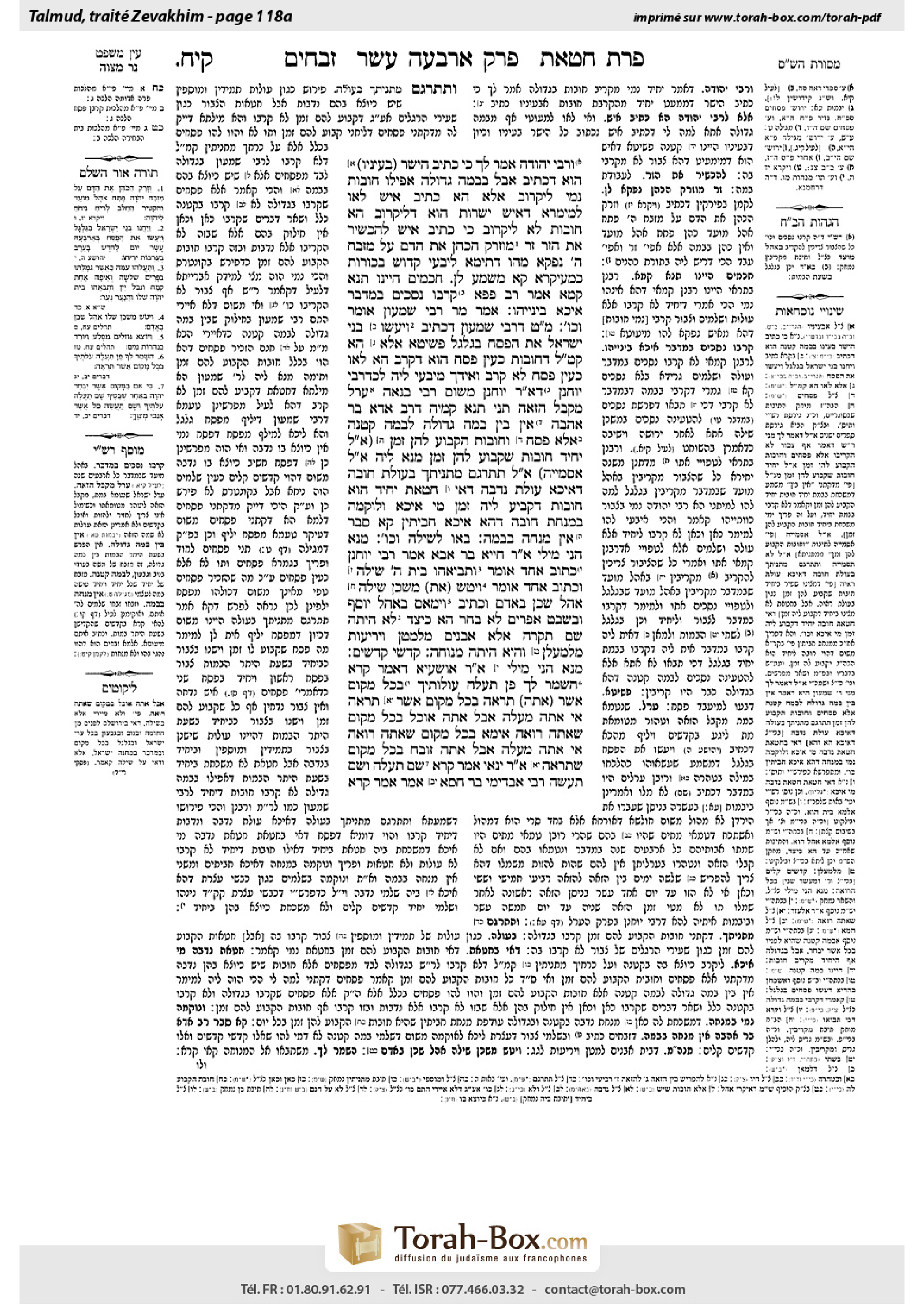
Zevachim 118a: Talmud study for Daf Yomi
Daf Yomi is the daily study of one Talmud folio. Explore 37 tractates with scans, Hebrew text, Sefaria English and AI-generated French translations where annotated.
Passage selection and English or AI-generated French translation are available where the scan has annotations. Daf Study is independent of Torah-Box and Sefaria.
Browse Zevachim · זבחים · All tractatesZevachim 118a text and translations
This page of Zevachim includes the Aramaic text, an English translation and an AI-generated French translation, alongside the scan above.
זבחים קי״ח א · Aramaic and Hebrew text
וְרַבִּי יְהוּדָה אָמַר לָךְ: כִּי כְּתִיב – ״הַיָּשָׁר בְּעֵינָיו״ הוּא דִּכְתִיב; אֲבָל בְּבָמָה גְּדוֹלָה – אֲפִילּוּ חוֹבוֹת נָמֵי לִיקְרוּב.
אֶלָּא הָא כְּתִיב ״אִישׁ״ – לָאו לְמֵימְרָא דְּאִישׁ יְשָׁרוֹת הוּא דְּלִיקְרוּב, הָא חוֹבוֹת לָא לִיקְרוּב? כִּי כְּתִיב ״אִישׁ״ – לְהַכְשִׁיר אֶת הַזָּר.
זָר – מִ״וְּזָרַק הַכֹּהֵן אֶת הַדָּם עַל מִזְבַּח ה׳״ נָפְקָא!
מַהוּ דְּתֵימָא לִיבְעֵי קִדּוּשׁ בְּכוֹרוֹת כְּמֵעִיקָּרָא; קָא מַשְׁמַע לַן.
חֲכָמִים הַיְינוּ תַּנָּא קַמָּא!
אָמַר רַב פָּפָּא: קָרְבוּ נְסָכִים בְּמִדְבָּר אִיכָּא בֵּינַיְיהוּ.
אָמַר מָר: רַבִּי שִׁמְעוֹן אוֹמֵר וְכוּ׳. מַאי טַעְמֵיהּ דְּרַבִּי שִׁמְעוֹן? דִּכְתִיב: ״וַיַּעֲשׂוּ בְנֵי יִשְׂרָאֵל אֶת הַפֶּסַח בַּגִּלְגָּל״.
פְּשִׁיטָא! אֶלָּא הָא קָא מַשְׁמַע לַן – דְּחוֹבוֹת כְּעֵין פֶּסַח הוּא דְּקָרֵב, הָא לָאו כְּעֵין פֶּסַח לָא קָרֵב. וְאִידַּךְ –
מִיבְּעֵי לֵיהּ לְכִדְרַבִּי יוֹחָנָן, דְּאָמַר רַבִּי יוֹחָנָן מִשּׁוּם רַבִּי בַּנָּאָה: עָרֵל – מְקַבֵּל הַזָּאָה.
תָּנֵי תַּנָּא קַמֵּיהּ דְּרַב אַדָּא בַּר אַהֲבָה: אֵין בֵּין בָּמָה גְּדוֹלָה לְבָמָה קְטַנָּה, אֶלָּא פֶּסַח וְחוֹבוֹת הַקָּבוּעַ לָהֶן זְמַן. אֲמַר לֵיהּ: יָחִיד – חוֹבוֹת שֶׁקָּבוּעַ לָהֶן זְמַן מְנָא לֵיהּ?
אֲמַר לֵיהּ: אֶסְמְיַיהּ? אֲמַר לֵיהּ: תִּתַּרְגַּם מַתְנִיתָךְ בְּעוֹלַת חוֹבָה, דְּאִיכָּא עוֹלַת נְדָבָה. דְּאִי חַטַּאת יָחִיד הוּא – חוֹבוֹת דִּקְבִיעַ לֵיהּ זְמַן מִי אִיכָּא?!
וְלוֹקְמַהּ בְּמִנְחַת חוֹבָה – דְּהָא אִיכָּא חֲבִיתִּין! קָא סָבַר: אֵין מִנְחָה בְּבָמָה.
בָּאוּ לְשִׁילֹה וְכוּ׳. מְנָא הָנֵי מִילֵּי? אָמַר רַבִּי חִיָּיא בַּר אַבָּא אָמַר רַבִּי יוֹחָנָן: כָּתוּב אֶחָד אוֹמֵר: ״וַתְּבִאֵהוּ בֵּית ה׳ שִׁילֹה״, וְכָתוּב אֶחָד אוֹמֵר: ״וַיִּטֹּשׁ (אֶת) מִשְׁכַּן שִׁילֹה אֹהֶל שִׁכֵּן בָּאָדָם״, וּכְתִיב ״וַיִּמְאַס בְּאֹהֶל יוֹסֵף וּבְשֵׁבֶט אֶפְרַיִם לֹא בָחָר״.
הָא כֵּיצַד? לֹא הָיְתָה שָׁם תִּקְרָה, אֶלָּא אֲבָנִים מִלְּמַטָּן וִירִיעוֹת מִלְּמַעְלָן, וְהִיא הָיְתָה ״מְנוּחָה״.
קׇדְשֵׁי קֳדָשִׁים. מְנָא הָנֵי מִילֵּי? אָמַר רַבִּי אוֹשַׁעְיָא, דְּאָמַר קְרָא: ״הִשָּׁמֶר לְךָ פֶּן תַּעֲלֶה עֹלֹתֶיךָ בְּכׇל מָקוֹם אֲשֶׁר (אַתָּה) תִּרְאֶה״ – בְּכׇל מָקוֹם אֲשֶׁר תִּרְאֶה אִי אַתָּה מַעֲלֶה, אֲבָל אַתָּה אוֹכֵל בְּכׇל מָקוֹם שֶׁאַתָּה רוֹאֶה.
אֵימָא: בְּכׇל מָקוֹם שֶׁאַתָּה רוֹאֶה אִי אַתָּה מַעֲלֶה, אֲבָל אַתָּה זוֹבֵחַ בְּכׇל מָקוֹם שֶׁתִּרְאֶה!
אָמַר רַבִּי יַנַּאי, אָמַר קְרָא: ״שָׁם תַּעֲלֶה... וְשָׁם תַּעֲשֶׂה״.
רַבִּי אַבְדִּימִי בַּר חַסָּא אָמַר, אָמַר קְרָא:
Zevachim 118a · English translation
And Rabbi Yehuda, who holds that an individual may also sacrifice compulsory offerings on a great public altar, could have said to you that when the phrase “whatsoever is fitting” is written, indicating that individuals may sacrifice only vow offerings and gift offerings, it is with regard to “in his own eyes” that it is written. In other words, it is referring to a location that is fitting in his eyes for sacrifice, i.e., a private altar. But on a great public altar, even compulsory offerings may be sacrificed.
The Gemara asks: But even if that derivation is correct, isn’t “man” written in that verse? Isn’t that to say that with regard to “a man,” i.e., an individual, only offerings that one deems fitting to sacrifice may be sacrificed, but compulsory offerings may not be sacrificed? The Gemara replies: When “man” is written in this verse, it is to qualify a non-priest to perform the sacrificial service on a private altar.
The Gemara challenges: But the fact that a non-priest is qualified to perform the sacrificial service on a private altar is derived from the verse: “And the priest shall dash the blood against the altar of the Lord at the entrance of the Tent of Meeting” (Leviticus 17:6). The verse indicates that service at a great public altar may be performed only by a priest, from which it is inferred that the service on a private altar may be performed by a non-priest as well.
The Gemara replies: Lest you say that whereas that verse indicates it is not required that the service on a private altar be performed by a priest, nevertheless consecration of the firstborn is required for this purpose, as was the case initially, i.e., before the Tabernacle was constructed. Perhaps the only non-priests who may perform the service on private altars are the firstborn sons. Therefore, the verse states: “Every man whatsoever is fitting in his own eyes,” which teaches us that with regard to private altars, each person may sacrifice his own offerings.
§ The Gemara clarifies the opinion of the Rabbis, who disagree with Rabbi Yehuda, by questioning: But the statement of the Rabbis is identical to the statement of the first tanna, i.e., the Rabbis cited at the beginning of the baraita, who say that on a private altar an individual sacrificed only burnt offerings and peace offerings. What is the difference between the first tanna and the Rabbis?
Rav Pappa said: The difference between them is whether libations were offered in the wilderness along with burnt offerings and peace offerings. According to the opinion of the first tanna, libations were not offered in the wilderness, nor were they offered in Eretz Yisrael during the period of Gilgal. According to the Rabbis in the latter section of the baraita, libations were offered in the wilderness and in Gilgal.
§ The Master said in the baraita: Rabbi Shimon says that even the public did not sacrifice all offerings in the Tent of Meeting in Gilgal; they sacrificed only Paschal offerings and compulsory public offerings that have a set time. The Gemara asks: What is the reason for the opinion of Rabbi Shimon? As it is written: “And the children of Israel encamped in Gilgal; and they kept the Passover on the fourteenth day of the month at evening in the plains of Jericho” (Joshua 5:10).
The Gemara asks: Isn’t it obvious that they brought the Paschal offering? The Paschal offering is compulsory. Rather, this verse teaches us that in Gilgal, only compulsory offerings similar to the Paschal offering, i.e., that have a set time, were sacrificed, but offerings that are not similar to the Paschal offering were not sacrificed. The Gemara asks: And how does the other tanna, i.e., the Rabbis who disagree with Rabbi Shimon and hold that during the period of Gilgal other offerings were sacrificed by the public, interpret the verse?
The Gemara responds: It is necessary for the halakha that was taught by Rabbi Yoḥanan. As Rabbi Yoḥanan says in the name of Rabbi Bena’a: If an uncircumcised Jew contracted ritual impurity from a corpse, he may receive sprinkling of the water containing the ashes of the red heifer on the third and seventh days of his purification, despite the fact that he is uncircumcised. In the time of Joshua, the Jewish people became circumcised after they were purified from impurity imparted by a corpse.
§ With regard to the Paschal offering and compulsory public offerings that have a set time mentioned by Rabbi Shimon, the Gemara relates that a tanna taught a baraita in the presence of Rav Adda bar Ahava: The difference between a great public altar, e.g., the altar in Gilgal, and a small private altar is only that the Paschal offering and compulsory offerings that have a set time may be sacrificed upon a great public altar, but not upon a private altar. Rav Adda bar Ahava said to him: From where would an individual sacrifice compulsory offerings that have a set time? There is no such offering brought by an individual. It was therefore unnecessary for the tanna to state that this type of offering is not sacrificed on a private altar.
The tanna said to him: If so, shall I remove it from the text of the mishna, and teach only: Paschal offerings? Rav Adda bar Ahava said to him: That is not necessary; interpret your mishna as referring to a compulsory burnt offering, i.e., the burnt offering of appearance brought on the pilgrimage Festivals by every individual, which is not sacrificed on a private altar, as there is, conversely, a voluntary burnt offering that may be sacrificed on a private altar. This baraita must be discussing a burnt offering brought by an individual, as if it is referring to a sin offering brought by an individual, are there compulsory sin offerings that have a set time?
The Gemara asks: And let him establish the baraita as referring to the compulsory meal offering of an individual, which has a set time, as there is the griddle-cake offering that the High Priest was obligated to sacrifice every day and that may be sacrificed only upon a great public altar, not upon a private altar. The Gemara replies: Rav Adda bar Ahava holds that there is no meal offering sacrificed upon an altar outside the Temple, even a great public altar.
§ The mishna teaches that when they arrived at Shiloh, private altars were prohibited. There was no roof of wood or stone in the Tabernacle in Shiloh; there was only a building of stone below, and the curtains of the roof of the Tabernacle were spread above it. The Gemara asks: From where are these matters derived? Rabbi Ḥiyya bar Abba says that Rabbi Yoḥanan says: One verse states, with regard to Hannah bringing Samuel to the Tabernacle: “And she brought him to the house of the Lord in Shiloh” (I Samuel 1:24), and one verse states: “And He forsook the Tabernacle of Shiloh, the tent that He had made to dwell among men” (Psalms 78:60). And in addition, it is written: “Moreover he abhorred the tent of Joseph and chose not the tribe of Ephraim” (Psalms 78:67).
One verse describes the Tabernacle in Shiloh as a house, while the other describes it as a tent. How can these texts be reconciled? As the mishna states: There was no roof of wood or stone there; rather, there was stone below, and it was therefore described as a house, and the curtains of the Tabernacle were spread above it, and it was therefore described as a tent. And the period that the Tabernacle was in Shiloh was characterized in the Torah as “rest” in the verse: “For you have not as yet come to the rest and to the inheritance, which the Lord your God has given you” (Deuteronomy 12:9).
§ The mishna teaches that during the period of Shiloh, offerings of the most sacred order were eaten within the curtains, and offerings of lesser sanctity and second tithe were eaten in any place that overlooks Shiloh. The Gemara asks: From where are these matters derived? Rabbi Oshaya said: As in the context of the prohibition against sacrificing outside the Tabernacle, the verse states: “Take heed to yourself that you do not offer your burnt offerings in every place that you see” (Deuteronomy 12:13), from which it may be inferred: You may not offer up in every place that you see, but you may eat the offerings in every place that you see.
The Gemara challenges: Say instead the following inference: You may not offer up offerings upon an altar in every place that you see, but you may slaughter offerings in every place that you see. It would therefore be permitted to slaughter offerings in any place that overlooks Shiloh.
Rabbi Yannai said that the subsequent verse states: “But in the place that the Lord shall choose in one of your tribes, there you shall offer your burnt offerings, and there you shall do all that I command you” (Deuteronomy 12:14). This verse teaches that all of the sacrificial service is performed in the place that the offering is burned, and only the consumption of offerings of lesser sanctity is permitted in any place that overlooks Shiloh.
Rabbi Avdimi bar Ḥasa said that when describing the boundaries of the portions of Eretz Yisrael of the children of Joseph, wherein Shiloh was located, the verse states:
Zevachim 118a · Traduction française (IA)
Et Rabbi Yehouda, qui estime qu’un particulier peut lui aussi offrir des sacrifices obligatoires sur un grand autel public, aurait pu te répondre que lorsque l’expression « tout ce qui convient » est écrite, indiquant que les particuliers ne peuvent offrir que des sacrifices de vœu et des offrandes volontaires, elle se rapporte aux mots « à ses propres yeux ». Autrement dit, elle désigne un lieu qui, à ses yeux, convient pour offrir un sacrifice, c’est-à-dire un autel privé. Mais sur un grand autel public, même des sacrifices obligatoires peuvent être offerts.
La Guemara demande : Mais même si cette déduction est correcte, le mot « homme » n’est-il pas écrit dans ce verset ? Cela ne signifie-t-il pas que, pour « un homme », c’est-à-dire un particulier, seuls peuvent être offerts les sacrifices qu’il juge appropriés, mais pas les sacrifices obligatoires ? La Guemara répond : Le mot « homme » est écrit dans ce verset pour permettre à un non-cohen d’accomplir le service sacrificiel sur un autel privé.
La Guemara objecte : Mais le fait qu’un non-cohen soit autorisé à accomplir le service sacrificiel sur un autel privé est déduit du verset : « Le cohen jettera le sang contre l’autel de l’Éternel, à l’entrée de la Tente d’assignation » (Lévitique 17:6). Le verset indique que le service sur un grand autel public ne peut être accompli que par un cohen ; on en déduit que le service sur un autel privé peut également être accompli par un non-cohen.
La Guemara répond : De crainte que tu ne dises que ce verset indique certes qu’il n’est pas nécessaire qu’un cohen accomplisse le service sur un autel privé, mais qu’il faut néanmoins être un premier-né consacré à cette fin, comme c’était le cas au début, c’est-à-dire avant la construction du Tabernacle. Peut-être seuls les fils premiers-nés non-cohanim peuvent-ils accomplir le service sur les autels privés. Le verset dit donc : « Tout homme, selon ce qui convient à ses propres yeux », ce qui nous enseigne que, sur les autels privés, chacun peut offrir ses propres sacrifices.
§ La Guemara précise l’opinion des Rabbins, qui sont en désaccord avec Rabbi Yehouda, en demandant : Mais la déclaration des Rabbins est identique à celle du premier tanna, c’est-à-dire les Rabbins cités au début de la baraïta, qui disent que, sur un autel privé, un particulier n’offrait que des holocaustes et des sacrifices de paix. Quelle est la différence entre le premier tanna et les Rabbins ?
Rav Pappa dit : La différence entre eux porte sur la question de savoir si des libations étaient offertes dans le désert avec les holocaustes et les sacrifices de paix. Selon le premier tanna, aucune libation n’était offerte dans le désert, ni en Eretz Israël durant la période de Guilgal. Selon les Rabbins dans la dernière partie de la baraïta, des libations étaient offertes dans le désert et à Guilgal.
§ Le Maître a dit dans la baraïta : Rabbi Shimon dit que même le public n’offrait pas tous les sacrifices dans la Tente d’assignation à Guilgal ; il n’offrait que les sacrifices pascals et les sacrifices publics obligatoires à date fixe. La Guemara demande : Quelle est la raison de l’opinion de Rabbi Shimon ? Car il est écrit : « Les enfants d’Israël campèrent à Guilgal et célébrèrent la Pâque le quatorzième jour du mois, au soir, dans les plaines de Jéricho » (Josué 5:10).
La Guemara demande : N’est-il pas évident qu’ils ont offert le sacrifice pascal ? Celui-ci est obligatoire. Ce verset nous enseigne plutôt qu’à Guilgal, seuls étaient offerts les sacrifices obligatoires semblables au sacrifice pascal, c’est-à-dire ceux dont la date est fixe ; les sacrifices qui ne sont pas semblables au sacrifice pascal n’étaient pas offerts. La Guemara demande : Et comment l’autre tanna, c’est-à-dire les Rabbins qui sont en désaccord avec Rabbi Shimon et estiment que, durant la période de Guilgal, le public offrait d’autres sacrifices, interprète-t-il le verset ?
La Guemara répond : Ce verset est nécessaire pour enseigner la halakha rapportée par Rabbi Yoḥanan. En effet, Rabbi Yoḥanan dit au nom de Rabbi Bena’a : Si un Juif incirconcis a contracté une impureté rituelle au contact d’un mort, il peut recevoir, le troisième et le septième jour de sa purification, l’aspersion de l’eau contenant les cendres de la vache rousse, bien qu’il soit incirconcis. À l’époque de Josué, le peuple juif fut circoncis après s’être purifié de l’impureté transmise par un mort.
§ À propos du sacrifice pascal et des sacrifices publics obligatoires à date fixe mentionnés par Rabbi Shimon, on rapporte qu’un tanna enseigna une baraïta en présence de Rav Adda bar Ahava : La seule différence entre un grand autel public, par exemple l’autel de Guilgal, et un petit autel privé est que le sacrifice pascal et les sacrifices obligatoires à date fixe peuvent être offerts sur un grand autel public, mais pas sur un autel privé. Rav Adda bar Ahava lui dit : Où un particulier pourrait-il offrir des sacrifices obligatoires à date fixe ? Aucun sacrifice de ce type n’est offert par un particulier. Il était donc inutile que le tanna précise que ce type de sacrifice n’est pas offert sur un autel privé.
Le tanna lui dit : Dans ce cas, dois-je le retirer du texte de la Michna et n’enseigner que : « Les sacrifices pascals » ? Rav Adda bar Ahava lui dit : Ce n’est pas nécessaire ; interprète ta Michna comme faisant référence à un holocauste obligatoire, c’est-à-dire l’holocauste de présentation apporté par chaque particulier lors des fêtes de pèlerinage, qui n’est pas offert sur un autel privé, alors qu’il existe, à l’inverse, un holocauste volontaire qui peut y être offert. Cette baraïta doit parler d’un holocauste apporté par un particulier, car si elle faisait référence à un sacrifice expiatoire apporté par un particulier, existe-t-il des sacrifices expiatoires obligatoires à date fixe ?
La Guemara demande : Et pourquoi ne pas établir que la baraïta parle de l’offrande de farine obligatoire d’un particulier, qui a une date fixe, puisqu’il existe l’offrande de galettes cuites à la poêle que le Grand Prêtre devait offrir chaque jour et qui ne peut être offerte que sur un grand autel public, et non sur un autel privé ? La Guemara répond : Rav Adda bar Ahava estime qu’aucune offrande de farine n’est offerte sur un autel situé hors du Temple, même s’il s’agit d’un grand autel public.
§ La Michna enseigne qu’à leur arrivée à Silo, les autels privés furent interdits. Le Tabernacle de Silo n’avait pas de toit en bois ou en pierre ; il n’y avait qu’une construction en pierre en contrebas, au-dessus de laquelle étaient tendues les tentures du toit du Tabernacle. La Guemara demande : D’où ces faits sont-ils déduits ? Rabbi Ḥiyya bar Abba dit au nom de Rabbi Yoḥanan : Un verset dit, à propos de Hanna qui amena Samuel au Tabernacle : « Elle l’amena à la maison de l’Éternel, à Silo » (I Samuel 1:24), et un autre verset dit : « Il abandonna le Tabernacle de Silo, la tente qu’il avait dressée parmi les hommes » (Psaumes 78:60). De plus, il est écrit : « Il rejeta aussi la tente de Joseph et ne choisit pas la tribu d’Éphraïm » (Psaumes 78:67).
Un verset décrit le Tabernacle de Silo comme une maison, tandis qu’un autre le décrit comme une tente. Comment concilier ces textes ? Comme l’enseigne la Michna, il n’y avait là aucun toit en bois ou en pierre ; il y avait plutôt de la pierre en contrebas, raison pour laquelle le lieu était décrit comme une maison, et les tentures du Tabernacle étaient tendues au-dessus, raison pour laquelle il était décrit comme une tente. Dans la Torah écrite, la période où le Tabernacle se trouvait à Silo est qualifiée de « repos », dans le verset : « Car vous n’êtes pas encore arrivés au repos et à l’héritage que l’Éternel, votre Dieu, vous donne » (Deutéronome 12:9).
§ La Michna enseigne que, durant la période de Silo, les sacrifices de sainteté supérieure étaient consommés à l’intérieur des tentures, tandis que les sacrifices de moindre sainteté et la seconde dîme étaient consommés en tout lieu d’où l’on pouvait voir Silo. La Guemara demande : D’où ces faits sont-ils déduits ? Rabbi Oshaya dit : Dans le contexte de l’interdiction d’offrir des sacrifices hors du Tabernacle, le verset dit : « Garde-toi de ne pas offrir tes holocaustes en tout lieu que tu verras » (Deutéronome 12:13). On peut en déduire : Tu ne peux pas offrir de sacrifices en tout lieu que tu verras, mais tu peux les consommer en tout lieu que tu verras.
La Guemara objecte : Il faudrait plutôt déduire ceci : Tu ne peux pas offrir de sacrifices sur un autel en tout lieu que tu verras, mais tu peux abattre des sacrifices en tout lieu que tu verras. Il serait donc permis d’abattre des sacrifices en tout lieu d’où l’on pouvait voir Silo.
Rabbi Yannai dit que le verset suivant précise : « Mais au lieu que l’Éternel choisira dans l’une de tes tribus, c’est là que tu offriras tes holocaustes et que tu feras tout ce que je t’ordonne » (Deutéronome 12:14). Ce verset enseigne que l’ensemble du service sacrificiel s’accomplit au lieu où le sacrifice est brûlé ; seule la consommation des sacrifices de moindre sainteté est permise en tout lieu d’où l’on peut voir Silo.
Rabbi Avdimi bar Ḥasa dit que, lorsqu’il décrit les limites des territoires d’Eretz Israël attribués aux enfants de Joseph, où se trouvait Silo, le verset dit :
Traduction française générée par IA à partir de l’édition anglaise de Sefaria. Vérifie toujours un passage avec le texte source.
Text from Sefaria: William Davidson Edition - Vocalized Aramaic (CC BY NC); William Davidson Edition - English (CC BY NC).