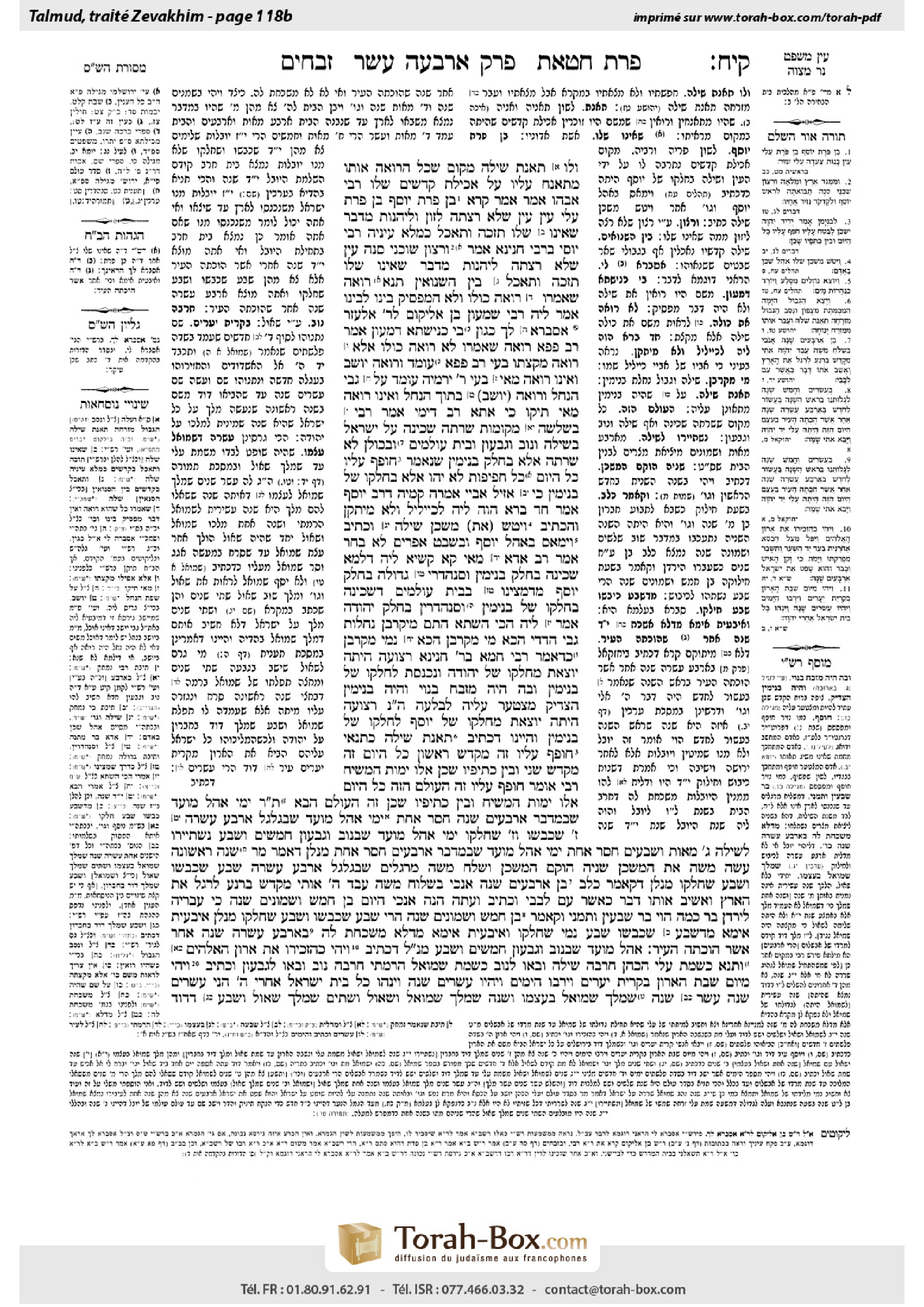
Zevachim 118b: Talmud study for Daf Yomi
Daf Yomi is the daily study of one Talmud folio. Explore 37 tractates with scans, Hebrew text, Sefaria English and AI-generated French translations where annotated.
Passage selection and English or AI-generated French translation are available where the scan has annotations. Daf Study is independent of Torah-Box and Sefaria.
Browse Zevachim · זבחים · All tractatesZevachim 118b text and translations
This page of Zevachim includes the Aramaic text, an English translation and an AI-generated French translation, alongside the scan above.
זבחים קי״ח ב · Aramaic and Hebrew text
״וְלוֹ תַּאֲנַת שִׁילֹה״ – מָקוֹם שֶׁכׇּל הָרוֹאֶה אוֹתוֹ מִתְאַנֵּחַ עָלָיו עַל אֲכִילַת קָדָשִׁים שֶׁלּוֹ.
רַבִּי אֲבָהוּ אָמַר, אָמַר קְרָא: ״בֵּן פֹּרָת יוֹסֵף בֵּן פֹּרָת עֲלֵי עָיִן״ – עַיִן שֶׁלֹּא רָצְתָה לִזּוֹן וְלֵיהָנוֹת מִדָּבָר שֶׁאֵינוֹ שֶׁלּוֹ, תִּזְכֶּה וְתֹאכַל כִּמְלֹא עֵינֶיהָ.
רַבִּי יוֹסֵי בְּרַבִּי חֲנִינָא אָמַר: ״וּרְצוֹן שֹׁכְנִי סְנֶה״ – עַיִן שֶׁלֹּא רָצְתָה לֵיהָנוֹת מִדָּבָר שֶׁאֵינוֹ שֶׁלּוֹ, תִּזְכֶּה וְתֹאכַל בֵּין הַשְּׂנוּאִין.
תָּנָא: רוֹאֶה שֶׁאָמְרוּ – רוֹאֶה כּוּלּוֹ, וְלֹא הַמַּפְסִיק בֵּינוֹ לְבֵינוֹ. אֲמַר לֵיהּ רַבִּי שִׁמְעוֹן בֶּן אֶלְיָקִים לְרַבִּי אֶלְעָזָר, אַסְבְּרָא לָךְ: כְּגוֹן בֵּי כְנִישְׁתָּא דְּמָעוֹן. אָמַר רַב פָּפָּא: רוֹאֶה שֶׁאָמְרוּ – לֹא רוֹאֶה כּוּלּוֹ, אֶלָּא רוֹאֶה מִקְצָתוֹ.
בָּעֵי רַב פָּפָּא: עוֹמֵד וְרוֹאֶה, יוֹשֵׁב וְאֵינוֹ רוֹאֶה – מַאי? בָּעֵי רַבִּי יִרְמְיָה: עוֹמֵד עַל גַּבֵּי הַנַּחַל וְרוֹאֶה, (יוֹשֵׁב) בְּתוֹךְ הַנַּחַל וְאֵינוֹ רוֹאֶה – מַאי? תֵּיקוּ.
כִּי אֲתָא רַב דִּימִי, אָמַר רַבִּי: בִּשְׁלֹשָׁה מְקוֹמוֹת שָׁרְתָה שְׁכִינָה עַל יִשְׂרָאֵל – בְּשִׁילֹה, וְנוֹב וְגִבְעוֹן, וּבֵית עוֹלָמִים; וּבְכוּלָּן לֹא שָׁרְתָה אֶלָּא בְּחֵלֶק בִּנְיָמִין. שֶׁנֶּאֱמַר: ״חֹפֵף עָלָיו כׇּל הַיּוֹם״ – כׇּל חֲפִיפוֹת לֹא יְהוּ אֶלָּא בְּחֶלְקוֹ שֶׁל בִּנְיָמִין.
כִּי אָזֵיל אַבָּיֵי, אַמְרַהּ קַמֵּיהּ דְּרַב יוֹסֵף. אָמַר: חַד בְּרָא הֲוָה לֵיהּ לְכַיְילִיל, וְלָא מִיתְּקַן. וְהָכְתִיב: ״וַיִּטֹּשׁ אֶת מִשְׁכָּן שִׁילוֹ״, וּכְתִיב: ״וַיִּמְאַס בְּאֹהֶל יוֹסֵף וּבְשֵׁבֶט אֶפְרַיִם לֹא בָחָר״!
אָמַר רַב אַדָּא: מַאי קָא קַשְׁיָא לֵיהּ? דִּלְמָא שְׁכִינָה בְּחֵלֶק בִּנְיָמִין, וְסַנְהֶדְרִי גְּדוֹלָה בְּחֵלֶק יוֹסֵף; מִדְּמָצִינוּ בְּבֵית עוֹלָמִים דִּשְׁכִינָה בְּחֶלְקוֹ שֶׁל בִּנְיָמִין, וְסַנְהֶדְרִין בְּחֵלֶק יְהוּדָה!
אֲמַר לֵיהּ: הָכִי הַשְׁתָּא?! הָתָם – מִיקָרְבָן נַחֲלוֹת גַּבֵּי הֲדָדֵי; הָכָא – מִי מְקָרְבָן?! הָכָא נָמֵי מְקָרְבָן. כִּדְאָמַר רַבִּי חָמָא בְּרַבִּי חֲנִינָא: רְצוּעָה הָיְתָה יוֹצֵאת מֵחֶלְקוֹ שֶׁל יְהוּדָה וְנִכְנֶסֶת לְחֶלְקוֹ שֶׁל בִּנְיָמִין, וּבָהּ הָיָה מִזְבֵּחַ בָּנוּי, וְהָיָה בִּנְיָמִין הַצַּדִּיק מִצְטַעֵר עָלֶיהָ לְבׇלְעָהּ.
הָכָא נָמֵי – רְצוּעָה הָיְתָה יוֹצֵאת מֵחֶלְקוֹ שֶׁל יוֹסֵף, לְחֶלְקוֹ שֶׁל בִּנְיָמִין. וְהַיְינוּ דִּכְתִיב: ״תַּאֲנַת שִׁילֹה״.
כְּתַנָּאֵי: ״חֹפֵף עָלָיו״ – זֶה מִקְדָּשׁ רִאשׁוֹן, ״כׇּל הַיּוֹם״ – זֶה מִקְדָּשׁ שֵׁנִי, ״וּבֵין כְּתֵפָיו שָׁכֵן״ – אֵלּוּ יְמוֹת הַמָּשִׁיחַ.
רַבִּי אוֹמֵר: ״חוֹפֵף עָלָיו״ – זֶה הָעוֹלָם הַזֶּה, ״כׇּל הַיּוֹם״ – אֵלּוּ יְמוֹת הַמָּשִׁיחַ, ״וּבֵין כְּתֵפָיו שָׁכֵן״ – זֶה הָעוֹלָם הַבָּא.
תָּנוּ רַבָּנַן: יְמֵי אֹהֶל מוֹעֵד שֶׁבַּמִּדְבָּר – אַרְבָּעִים שָׁנָה חָסֵר אַחַת. יְמֵי אֹהֶל מוֹעֵד שֶׁבַּגִּלְגָּל – אַרְבַּע עֶשְׂרֵה; שֶׁבַע שֶׁכִּבְּשׁוּ, וְשֶׁבַע שֶׁחִלְּקוּ. יְמֵי אֹהֶל מוֹעֵד שֶׁבְּנוֹב וְגִבְעוֹן – חֲמִשִּׁים וָשֶׁבַע. נִשְׁתַּיְּירוּ לְשִׁילֹה שְׁלֹשׁ מֵאוֹת וְשִׁבְעִים חָסֵר אַחַת.
יְמֵי אֹהֶל מוֹעֵד שֶׁבַּמִּדְבָּר – אַרְבָּעִים חָסֵר אַחַת. מְנָלַן? דְּאָמַר מָר: שָׁנָה רִאשׁוֹנָה – עָשָׂה מֹשֶׁה אֶת הַמִּשְׁכָּן, שְׁנִיָּה – הוּקַם הַמִּשְׁכָּן וְשָׁלַח מֹשֶׁה מְרַגְּלִים.
שֶׁבַּגִּלְגָּל אַרְבַּע עֶשְׂרֵה – שֶׁבַע שֶׁכִּבְּשׁוּ וְשֶׁבַע שֶׁחִלְּקוּ. מְנָלַן? דְּקָאָמַר כָּלֵב: ״בֶּן אַרְבָּעִים שָׁנָה אָנֹכִי בִּשְׁלֹחַ מֹשֶׁה עֶבֶד ה׳ אוֹתִי מִקָּדֵשׁ בַּרְנֵעַ לְרַגֵּל אֶת הָאָרֶץ, וָאָשֵׁב אוֹתוֹ דָּבָר כַּאֲשֶׁר עִם לְבָבִי״; וּכְתִיב: ״וְעַתָּה הִנֵּה אָנֹכִי הַיּוֹם בֶּן חָמֵשׁ וּשְׁמֹנִים שָׁנָה״.
כִּי עַבְרֵיהּ לְיַרְדֵּן בַּר כַּמָּה הָוֵי – בַּר שִׁבְעִין וְתַמְנֵי, וְקָאָמַר: ״בֶּן חָמֵשׁ וּשְׁמוֹנִים שָׁנָה״; הֲרֵי שֶׁבַע שֶׁכִּבְּשׁוּ.
וְשֶׁבַע שֶׁחִלְּקוּ מְנָלַן? אִיבָּעֵית אֵימָא: מִדְּשֶׁבַע שֶׁכִּבְּשׁוּ, שֶׁבַע נָמֵי שֶׁחִלְּקוּ;
וְאִיבָּעֵית אֵימָא: מִדְּלָא מַשְׁכַּחַתְּ לַהּ בְּאַרְבַּע עֶשְׂרֵה שָׁנָה ״אַחַר אֲשֶׁר הֻכְּתָה הָעִיר״.
אֹהֶל מוֹעֵד שֶׁבְּנוֹב וְגִבְעוֹן – חֲמִשִּׁים וָשֶׁבַע. מְנָא לַן? דִּכְתִיב: ״וַיְהִי כְּהַזְכִּירוֹ אֶת אֲרוֹן הָאֱלֹהִים״;
וְתָנָא: כְּשֶׁמֵּת עֵלִי הַכֹּהֵן – חָרְבָה שִׁילֹה, וּבָאוּ לְנוֹב; כְּשֶׁמֵּת שְׁמוּאֵל הָרָמָתִי – חָרְבָה נוֹב, וּבָאוּ לְגִבְעוֹן.
וּכְתִיב: ״וַיְהִי מִיּוֹם שֶׁבֶת הָאָרוֹן בְּקִרְיַת יְעָרִים, וַיִּרְבּוּ הַיָּמִים וַיִּהְיוּ עֶשְׂרִים שָׁנָה, וַיִּנָּהוּ כׇּל בֵּית יִשְׂרָאֵל אַחֲרֵי ה׳״;
הָנֵי עֶשְׂרִים שָׁנָה – עֶשֶׂר שָׁנָה שֶׁמָּלַךְ שְׁמוּאֵל בְּעַצְמוֹ, וְשָׁנָה שֶׁמָּלַךְ שְׁמוּאֵל וְשָׁאוּל, וּשְׁתַּיִם שֶׁמָּלַךְ שָׁאוּל, וְשֶׁבַע דְּדָוִד –
Zevachim 118b · English translation
“And the border turned about eastward to Taanath Shiloh” (Joshua 16:6), a place adjacent to Shiloh. Why did it bear the name of Taanath Shiloh? It is because it was the place from which whoever saw the Tabernacle in Shiloh after its destruction would moan [mitane’aḥ] for it with regard to the consumption of sacrificial animals from offerings of lesser sanctity that had been previously permitted there, but was now no longer permitted.
Rabbi Abbahu says that a different biblical allusion may be found in what the verse states in the context of Jacob’s blessing to Joseph: “Joseph is a fruitful vine, a fruitful vine by a fountain [ayin]” (Genesis 49:22). The Gemara interprets the word fountain homiletically: An eye [ayin] that did not wish to partake or derive benefit from something that was not his, i.e., the wife of Potiphar, shall merit to have offerings of lesser sanctity consumed in Shiloh, in Joseph’s portion of Eretz Yisrael, to the fullest extent of its eyes, i.e., from wherever Shiloh can be seen.
Rabbi Yosei, son of Rabbi Ḥanina, says that another allusion may be found in the context of Moses’ blessing to Joseph: “And the good will of Him Who dwelt in the bush [seneh]” (Deuteronomy 33:16). The Gemara interprets the word “seneh” homiletically: An eye that did not wish to derive benefit from something that was not his shall merit to have offerings of lesser sanctity consumed among the haters [senu’in]. In other words, offerings of lesser sanctity may be consumed in any place that overlooks Shiloh, even in the portions of the other tribes, who are described by the Torah as hating Joseph (see Genesis, chapter 37).
§ With regard to the halakha that during the period of Shiloh offerings of lesser sanctity could be eaten in any place that overlooks Shiloh, it was taught: The term: Overlooks, that was stated in the mishna, means that one sees it in its entirety, and there is nothing that obstructs between the seer and the surrounding area. Rabbi Shimon ben Elyakum said to Rabbi Elazar: I shall explain this type of seeing to you: For example, the synagogue of Maon, which was adjacent to the city of Tiberias, and from where Tiberias could be seen. Rav Pappa said that the term: Overlooks, that was stated does not mean that one must see the Tabernacle in Shiloh in its entirety, but rather even if one sees it partially, offerings of lesser sanctity may be consumed there.
With regard to the definition of overlooking, Rav Pappa raises a dilemma: If one is in a place where he stands and sees Shiloh, but if he sits he does not see Shiloh, what is the halakha? Is this considered overlooking? Likewise, Rabbi Yirmeya raises a dilemma: If one is in a place where he can stand upon the bank of the stream and see Shiloh, but if he is in the stream he does not see Shiloh, what is the halakha? No resolution is found for either of these questions, and the Gemara concludes: These dilemmas shall stand unresolved.
§ When Rav Dimi came from Eretz Yisrael to Babylonia, he said that Rabbi Yehuda HaNasi said: The Divine Presence rested upon the Jewish people in three places: In Shiloh, and Nov and Gibeon, and the Eternal House, and in all of those the Divine Presence rested only in the portion of the tribe of Benjamin, as it is stated in Moses’ blessing to Benjamin: “The beloved of the Lord shall dwell in safety by Him; He covers him all the day and He dwells between his shoulders” (Deuteronomy 33:12), meaning: All coverings, i.e., times of resting of the Divine Presence upon the Jewish people, shall be only in the portion of Benjamin.
The Gemara relates that when Abaye went to study Torah with Rav Yosef, he said the statement of Rav Dimi before Rav Yosef. Rav Yosef said in response: Kaylil, Abaye’s father, had one son, and he is not proper. But isn’t it written with regard to the Tabernacle in Shiloh: “And He forsook the Tabernacle of Shiloh” (Psalms 78:60); and it is written: “Moreover He abhorred the tent of Joseph, and chose not the tribe of Ephraim” (Psalms 78:67)? These verses indicate that the Tabernacle in Shiloh was in the portion of Joseph, not of Benjamin.
Rav Adda said: What is Rav Yosef’s difficulty from that verse? Perhaps the Tabernacle was in both the portion of Benjamin and that of Joseph. The Divine Presence was in the portion of Benjamin, and the Great Sanhedrin, which sits adjacent to the location of the Divine Presence, was in the portion of Joseph. This is similar to what we found in the case of the Eternal House, where the Divine Presence was in the portion of Benjamin and the Sanhedrin was in the portion of Judah.
Rav Yosef said to him in response: How can these cases be compared? There, in the Temple in Jerusalem, the portions of Benjamin and Judah were close to each other, and a division in which the Temple was located in the portion of one tribe while the Sanhedrin was located in the portion of another was possible. Here, with regard to Shiloh, are Shiloh and the portion of Benjamin close to each other? The Gemara replies: Here too they are close, as Rabbi Ḥama, son of Rabbi Ḥanina, says: A strip of land protruded from the portion of Judah and entered into the portion of Benjamin, and the altar in the Temple was built on that strip. And the tribe of Benjamin the righteous would agonize over it, desiring to take it into its portion, due to its unique sanctity.
Here too, with regard to the Tabernacle in Shiloh, a strip of land protruded from the portion of Joseph and entered into the portion of Benjamin, which connected Shiloh to the portion of Benjamin, and it was upon that strip, which had the status of Benjamin’s portion, that the Tabernacle stood. And that is what it means concerning that which is written with regard to the boundary of Joseph: “And the border turned about eastward to Taanath Shiloh” (Joshua 16:6), which in this context, is interpreted as meaning that the tribe of Benjamin would bemoan the fact that the Tabernacle in Shiloh was not located entirely in its portion.
The Gemara notes that the dispute between the amora’im with regard to the tribe in which the Tabernacle in Shiloh was located is like a dispute between tanna’im, as it is taught with regard to Moses’ blessing to Benjamin: “He covers him”; this is a reference to the First Temple. “All the day”; this is a reference to the Second Temple. “And He dwells between his shoulders”; this is a reference to the messianic era.
Rabbi Yehuda HaNasi says: “He covers him”; this is a reference to this world. “All the day”; this is a reference to the messianic era. “And He dwells between his shoulders”; this is a reference to the World-to-Come. According to the opinion of the Rabbis, the Divine Presence dwelled in the portion of Benjamin from the first Temple period and onward, but not during the period of the Tabernacle in Shiloh, when it was in the portion of Joseph. However, according to the opinion of Rabbi Yehuda HaNasi, the entire period that the Divine Presence dwelled in this world, including the period of Shiloh, it did so in the portion of Benjamin.
§ With regard to the duration of the different periods mentioned in the mishna, the Sages taught: The days of the Tent of Meeting in the wilderness were forty years, less one year. The days of the Tent of Meeting that were in Gilgal were fourteen years: Seven years during which the Jews conquered the land and seven years during which they divided the land among the tribes. The days of the Tent of Meeting that were in Nov and Gibeon were fifty-seven years, until the Temple in Jerusalem was constructed. Since the Temple was constructed 480 years after the Exodus from Egypt (see I Kings 6:1), it follows that there remain for the period of the Tabernacle in Shiloh 370 years less one.
The Gemara asks: From where do we derive that the days of the Tent of Meeting that were in the wilderness were forty years less one? As the Master said in a baraita: In the first year after the Exodus from Egypt, Moses constructed the Tabernacle; in the second year the Tabernacle was erected, and Moses sent spies. Because of the sin of the spies, the Jewish people remained in the wilderness for forty years. It follows that the Tabernacle in the wilderness stood for thirty-nine years.
From where do we derive that the Tabernacle remained in Gilgal for fourteen years, seven years during which the Jews conquered the land and seven years during which they divided it? As Caleb, son of Jephunneh, said to Joshua at the conclusion of the period of conquest before the land was divided: “Forty years old was I when Moses, the servant of the Lord, sent me from Kadesh Barnea to spy out the land; and I brought him back word as it was in my heart” (Joshua 14:7), and it is written: “And now, I am this day eighty and five years old” (Joshua 14:10).
When the Jewish people crossed the Jordan, how old was Caleb? He was seventy-eight years old: The spies were sent by Moses in the second year after the Exodus from Egypt, and in the fortieth year they crossed the Jordan. And at the time of the division of the Land, he said that he was eighty-five years old. This indicates that it was seven years during which the Jews conquered the land.
The Gemara asks: And from where do we derive that there were seven years during which they divided the land? If you wish, say: Since it was a period of seven years in which they conquered the land, it was presumably also a period of seven years in which they divided the land.
And if you wish, say instead: Because otherwise, you do not find any plausible explanation for the date mentioned by the prophet Ezekiel in the verse: “In the beginning of the year, on the tenth day of the month, in the fourteenth year after that the city was smitten” (Ezekiel 40:1). This indicates that it was a Jubilee Year, unless capturing and dividing the land took a total of fourteen years, after which point they began to calculate Sabbatical and Jubilee Years.
§ The baraita stated that the period of the Tent of Meeting that was in Nov and Gibeon was fifty-seven years. The Gemara asks: From where do we derive this? As it is written in the description of the death of Eli the High Priest, upon being informed that the Ark was captured by the Philistines: “And it came to pass, when he made mention of the Ark of God, that he fell from off his seat backward by the side of the gate, and his neck broke, and he died” (I Samuel 4:18).
And a tanna taught: When Eli the priest died, Shiloh was destroyed and the Jews arrived at Nov, where they erected the Tabernacle. At that time, Samuel began to lead the people. When Samuel from Rama died, Nov was destroyed by Saul (see I Samuel 22:19) and they arrived at Gibeon, where the Tabernacle remained (see I Chronicles 16:39).
The Gemara determines the number of years from when the Ark was captured by the Philistines and Shiloh was destroyed: And it is written: “And it came to pass, from the day that the Ark abode in Kiriath Jearim that the time was long; for it was twenty years; and all the house of Israel yearned after the Lord” (I Samuel 7:2). The Ark was returned by the Philistines to Kiriath Jearim seven months after it was captured, and it remained there for twenty years, until David brought it to Jerusalem.
The Gemara explains that these twenty years are calculated as follows: Ten years that Samuel reigned alone, from the death of Eli until the coronation of Saul, and one year that Samuel and Saul reigned, i.e., Saul reigned for one year during the lifetime of Samuel, and two years that Saul reigned alone after the death of Samuel. And in addition to these thirteen years, there were the seven years of David’s reign in Hebron, before the years of his reign in Jerusalem.
Zevachim 118b · Traduction française (IA)
« Et la frontière tournait vers l’est, jusqu’à Taanath-Shilo » (Josué 16,6), un lieu adjacent à Shilo. Pourquoi portait-il le nom de Taanath-Shilo ? Parce que c’était l’endroit d’où quiconque voyait le Tabernacle de Shilo après sa destruction se lamentait [mitane’aḥ] sur lui, car la consommation des animaux des sacrifices de moindre sainteté, qui y était auparavant permise, ne l’était désormais plus.
Rabbi Abbahou dit qu’une autre allusion biblique se trouve dans les paroles du verset, dans le contexte de la bénédiction de Jacob à Joseph : « Joseph est un cep fécond, un cep fécond près d’une source [ayin] » (Genèse 49,22). La Guemara interprète le mot « source » de manière homilétique : un œil [ayin] qui n’a pas voulu prendre ni tirer profit de ce qui ne lui appartenait pas, c’est-à-dire de la femme de Potiphar, méritera que des offrandes de moindre sainteté soient consommées à Shilo, dans la part de Joseph en Eretz Israël, aussi loin que porte le regard, c’est-à-dire partout où Shilo est visible.
Rabbi Yossei, fils de Rabbi Ḥanina, dit qu’une autre allusion se trouve dans le contexte de la bénédiction de Moïse à Joseph : « Et la bienveillance de Celui qui résidait dans le buisson [seneh] » (Deutéronome 33,16). La Guemara interprète le mot « seneh » de manière homilétique : un œil qui n’a pas voulu tirer profit de ce qui ne lui appartenait pas méritera que des offrandes de moindre sainteté soient consommées parmi les haineux [senu’in]. Autrement dit, ces offrandes peuvent être consommées partout où Shilo est visible, même dans les parts des autres tribus, que la Torah décrit comme haïssant Joseph (voir Genèse, chapitre 37).
§ À propos de la halakha selon laquelle, à l’époque de Shilo, les offrandes de moindre sainteté pouvaient être consommées partout où Shilo était visible, il a été enseigné : le terme « visible », employé dans la Michna, signifie que l’on voit Shilo dans son intégralité et que rien ne fait obstacle entre l’observateur et les environs. Rabbi Shimon ben Elyakum dit à Rabbi Elazar : Je vais t’expliquer ce que signifie voir ainsi : c’est, par exemple, le cas de la synagogue de Maon, située près de la ville de Tibériade, d’où l’on pouvait voir Tibériade. Rav Pappa dit que le terme « visible » ne signifie pas qu’il faut voir le Tabernacle de Shilo dans son intégralité ; même si l’on n’en voit qu’une partie, les offrandes de moindre sainteté peuvent y être consommées.
À propos de la définition d’un lieu d’où Shilo est visible, Rav Pappa soulève un dilemme : si quelqu’un se trouve à un endroit d’où il voit Shilo lorsqu’il est debout, mais ne la voit pas lorsqu’il est assis, quelle est la halakha ? Cela est-il considéré comme un lieu d’où Shilo est visible ? De même, Rabbi Yirmeya soulève un dilemme : si quelqu’un se trouve à un endroit d’où il peut voir Shilo en se tenant sur la rive du cours d’eau, mais ne la voit pas lorsqu’il se trouve dans le cours d’eau, quelle est la halakha ? Aucune solution n’est apportée à ces deux questions, et la Guemara conclut : ces dilemmes restent sans solution.
§ Lorsque Rav Dimi vint d’Eretz Israël en Babylonie, il rapporta que Rabbi Yehouda HaNassi avait dit : la Présence divine reposa sur le peuple juif en trois lieux : à Shilo, à Nov et à Gibeon, ainsi que dans la Maison éternelle. Dans tous ces lieux, la Présence divine ne reposa que dans la part de la tribu de Benjamin, comme il est dit dans la bénédiction de Moïse à Benjamin : « Le bien-aimé de l’Éternel demeurera en sécurité auprès de Lui ; Il le protège tout le jour et Il réside entre ses épaules » (Deutéronome 33,12). Cela signifie que tous les lieux où la Présence divine reposa sur le peuple juif se trouvaient dans la part de Benjamin.
La Guemara rapporte que, lorsqu’Abaye alla étudier la Torah auprès de Rav Yossef, il lui répéta la déclaration de Rav Dimi. Rav Yossef répondit : Kaylil, le père d’Abaye, n’avait qu’un fils, et il n’est pas à la hauteur. Mais n’est-il pas écrit au sujet du Tabernacle de Shilo : « Il abandonna le Tabernacle de Shilo » (Psaumes 78,60) ? Et il est écrit : « De plus, Il rejeta la tente de Joseph et ne choisit pas la tribu d’Éphraïm » (Psaumes 78,67). Ces versets indiquent que le Tabernacle de Shilo se trouvait dans la part de Joseph, et non dans celle de Benjamin.
Rav Adda dit : quelle difficulté Rav Yossef tire-t-il de ce verset ? Le Tabernacle se trouvait peut-être à la fois dans la part de Benjamin et dans celle de Joseph. La Présence divine se trouvait dans la part de Benjamin, et le Grand Sanhédrin, qui siégeait à proximité du lieu où résidait la Présence divine, dans la part de Joseph. Cela ressemble à ce que nous avons constaté dans le cas de la Maison éternelle, où la Présence divine se trouvait dans la part de Benjamin et le Sanhédrin dans celle de Juda.
Rav Yossef lui répondit : comment peut-on comparer ces cas ? Là-bas, dans le Temple de Jérusalem, les parts de Benjamin et de Juda étaient proches l’une de l’autre ; il était donc possible que le Temple se trouve dans la part d’une tribu et le Sanhédrin dans celle d’une autre. Ici, à propos de Shilo, Shilo et la part de Benjamin sont-ils proches l’un de l’autre ? La Guemara répond : ici aussi, ils sont proches, car Rabbi Ḥama, fils de Rabbi Ḥanina, dit qu’une bande de terre s’étendait depuis la part de Juda jusque dans celle de Benjamin, et que l’autel du Temple avait été construit sur cette bande. La tribu de Benjamin le juste en était tourmentée et désirait l’intégrer à sa part, en raison de sa sainteté particulière.
De même, à propos du Tabernacle de Shilo, une bande de terre s’étendait depuis la part de Joseph jusque dans celle de Benjamin, reliant Shilo à la part de Benjamin ; le Tabernacle se dressait sur cette bande, qui avait le statut de la part de Benjamin. C’est le sens de ce qui est écrit au sujet de la frontière de Joseph : « Et la frontière tournait vers l’est, jusqu’à Taanath-Shilo » (Josué 16,6). Dans ce contexte, cela signifie que la tribu de Benjamin déplorait que le Tabernacle de Shilo ne se trouve pas entièrement dans sa part.
La Guemara note que le désaccord entre les amoraïm concernant la tribu dans la part de laquelle se trouvait le Tabernacle de Shilo correspond à un désaccord entre tannaïm, car il est enseigné au sujet de la bénédiction de Moïse à Benjamin : « Il le protège » fait référence au Premier Temple ; « tout le jour » fait référence au Second Temple ; et « Il réside entre ses épaules » fait référence à l’ère messianique.
Rabbi Yehouda HaNassi dit : « Il le protège » fait référence à ce monde ; « tout le jour » fait référence à l’ère messianique ; et « Il réside entre ses épaules » fait référence au Monde futur. Selon l’opinion des Rabbins, la Présence divine résida dans la part de Benjamin à partir de l’époque du Premier Temple, mais pas à l’époque du Tabernacle de Shilo, qui se trouvait dans la part de Joseph. En revanche, selon l’opinion de Rabbi Yehouda HaNassi, pendant toute la période où la Présence divine résida dans ce monde, y compris à l’époque de Shilo, elle se trouvait dans la part de Benjamin.
§ À propos de la durée des différentes périodes mentionnées dans la Michna, les Sages ont enseigné : la Tente d’assignation dans le désert dura trente-neuf ans. La Tente d’assignation à Guilgal dura quatorze ans : sept ans pendant lesquels les Juifs conquirent le pays, et sept ans pendant lesquels ils le répartirent entre les tribus. La Tente d’assignation à Nov et à Gibeon dura cinquante-sept ans, jusqu’à la construction du Temple de Jérusalem. Puisque le Temple fut construit 480 ans après la sortie d’Égypte (voir I Rois 6,1), il s’ensuit que la période du Tabernacle de Shilo dura 370 ans moins un an.
La Guemara demande : d’où déduisons-nous que la Tente d’assignation dans le désert dura quarante ans moins un an ? Car le Maître a enseigné dans une baraïta : la première année après la sortie d’Égypte, Moïse construisit le Tabernacle ; la deuxième année, le Tabernacle fut dressé et Moïse envoya les explorateurs. En raison de la faute des explorateurs, le peuple juif resta dans le désert pendant quarante ans. Il s’ensuit que le Tabernacle dans le désert demeura pendant trente-neuf ans.
D’où déduisons-nous que le Tabernacle demeura à Guilgal pendant quatorze ans, soit sept ans durant lesquels les Juifs conquirent le pays et sept ans durant lesquels ils le répartirent ? À la fin de la période de conquête, avant le partage du pays, Caleb, fils de Jephunné, dit à Josué : « J’avais quarante ans lorsque Moïse, serviteur de l’Éternel, m’envoya de Qadesh-Barnéa pour espionner le pays, et je lui en rapportai des nouvelles selon mon cœur » (Josué 14,7). Et il est écrit : « Et maintenant, voici que j’ai quatre-vingt-cinq ans » (Josué 14,10).
Quel âge avait Caleb lorsque le peuple juif traversa le Jourdain ? Il avait soixante-dix-huit ans : les explorateurs furent envoyés par Moïse la deuxième année après la sortie d’Égypte, et le peuple traversa le Jourdain la quarantième année. Au moment du partage du pays, Caleb dit qu’il avait quatre-vingt-cinq ans. Cela indique que les Juifs mirent sept ans à conquérir le pays.
La Guemara demande : et d’où déduisons-nous qu’ils répartirent le pays pendant sept ans ? Si tu le souhaites, dis : puisqu’ils mirent sept ans à conquérir le pays, ils en mirent vraisemblablement aussi sept à le répartir.
Et si tu le souhaites, dis plutôt : autrement, on ne trouve aucune explication plausible à la date mentionnée par le prophète Ézéchiel dans le verset : « Au début de l’année, le dixième jour du mois, la quatorzième année après que la ville eut été frappée » (Ézéchiel 40,1). Cela indique qu’il s’agissait d’une année de Jubilé, à moins que la conquête et le partage du pays n’aient duré au total quatorze ans, après quoi ils commencèrent à compter les années sabbatiques et les années de Jubilé.
§ La baraïta a déclaré que la période de la Tente d’assignation à Nov et à Gibeon dura cinquante-sept ans. La Guemara demande : d’où déduisons-nous cela ? Car il est écrit, dans le récit de la mort du grand prêtre Éli, lorsqu’on lui annonça que l’Arche avait été capturée par les Philistins : « Et il arriva, lorsqu’on lui annonça l’Arche de Dieu, qu’il tomba à la renverse de son siège, près de la porte ; son cou se brisa et il mourut » (I Samuel 4,18).
Et un tanna a enseigné : à la mort du prêtre Éli, Shilo fut détruite et les Juifs arrivèrent à Nov, où ils dressèrent le Tabernacle. À cette époque, Samuel commença à diriger le peuple. À la mort de Samuel, qui venait de Rama, Nov fut détruite par Saül (voir I Samuel 22,19), et les Juifs arrivèrent à Gibeon, où le Tabernacle demeura (voir I Chroniques 16,39).
La Guemara établit le nombre d’années écoulées depuis la capture de l’Arche par les Philistins et la destruction de Shilo : il est écrit : « Depuis le jour où l’Arche demeura à Qiryath-Yearim, le temps passa ; vingt ans, et toute la maison d’Israël aspira à l’Éternel » (I Samuel 7,2). Les Philistins rendirent l’Arche à Qiryath-Yearim sept mois après l’avoir capturée, et elle y demeura vingt ans, jusqu’à ce que David l’amène à Jérusalem.
La Guemara explique que ces vingt années se calculent ainsi : dix années durant lesquelles Samuel régna seul, de la mort d’Éli jusqu’au couronnement de Saül ; une année durant laquelle Samuel et Saül régnèrent, c’est-à-dire que Saül régna une année du vivant de Samuel ; et deux années durant lesquelles Saül régna seul après la mort de Samuel. À ces treize années s’ajoutèrent les sept années du règne de David à Hébron, avant les années de son règne à Jérusalem.
Traduction française générée par IA à partir de l’édition anglaise de Sefaria. Vérifie toujours un passage avec le texte source.
Text from Sefaria: William Davidson Edition - Vocalized Aramaic (CC BY NC); William Davidson Edition - English (CC BY NC).