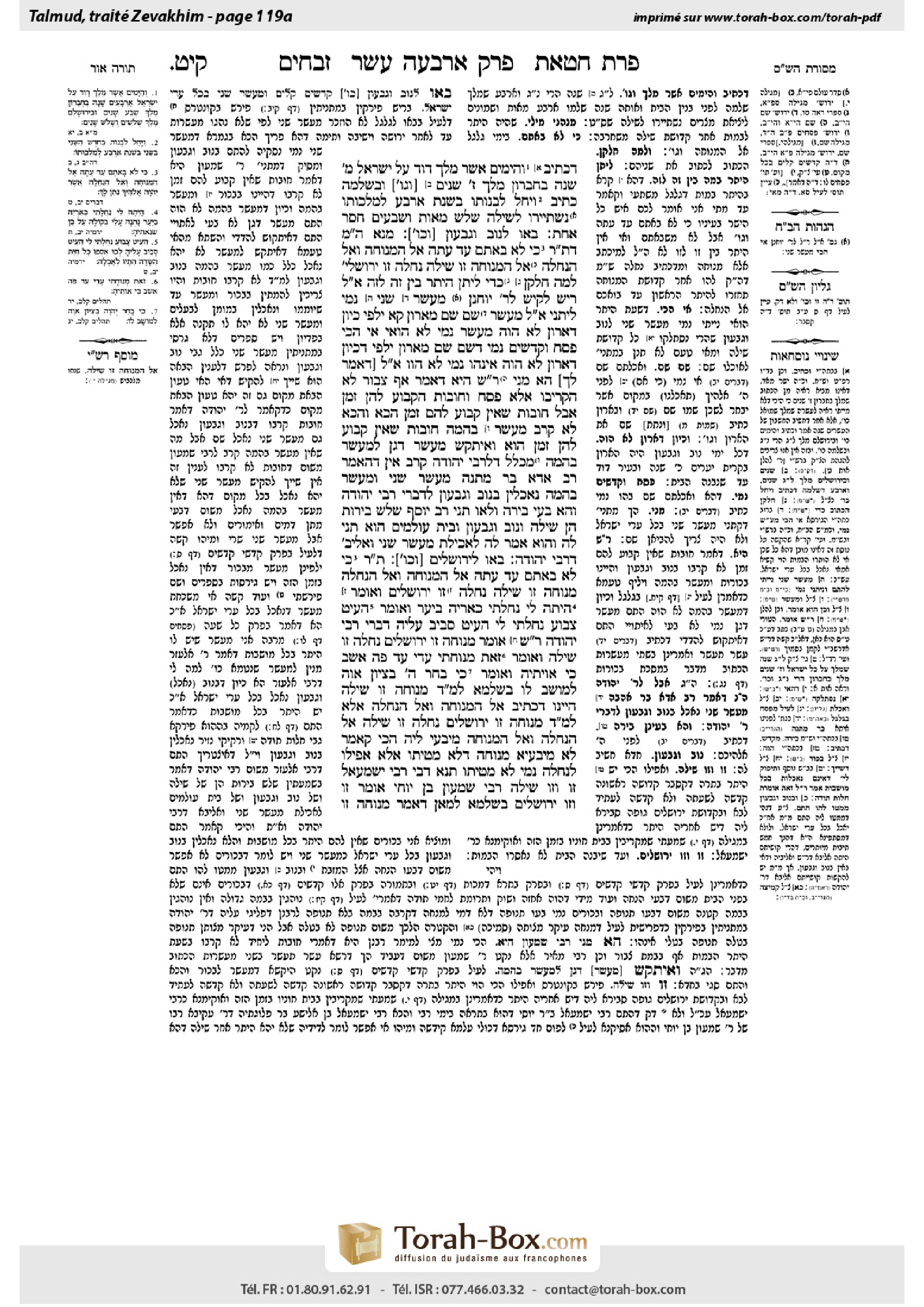
Zevachim 119a: Talmud study for Daf Yomi
Daf Yomi is the daily study of one Talmud folio. Explore 37 tractates with scans, Hebrew text, Sefaria English and AI-generated French translations where annotated.
Passage selection and English or AI-generated French translation are available where the scan has annotations. Daf Study is independent of Torah-Box and Sefaria.
Browse Zevachim · זבחים · All tractatesZevachim 119a text and translations
This page of Zevachim includes the Aramaic text, an English translation and an AI-generated French translation, alongside the scan above.
זבחים קי״ט א · Aramaic and Hebrew text
דִּכְתִיב: ״וְהַיָּמִים אֲשֶׁר מָלַךְ דָּוִד עַל יִשְׂרָאֵל – אַרְבָּעִים שָׁנָה; בְּחֶבְרוֹן מָלַךְ שֶׁבַע שָׁנִים [וְגוֹ׳]״.
וּבִשְׁלֹמֹה כְּתִיב: ״וַיָּחֶל לִבְנוֹתוֹ בִּשְׁנַת אַרְבַּע לְמַלְכוּתוֹ״. נִשְׁתַּיְּירוּ לְשִׁילֹה שְׁלֹשׁ מֵאוֹת וְשִׁבְעִים חָסֵר אֶחָת.
בָּאוּ לְנוֹב וְגִבְעוֹן [וְכוּ׳]. מְנָא הָנֵי מִילֵּי? דְּתָנוּ רַבָּנַן: ״כִּי לֹא בָּאתֶם עַד עָתָּה אֶל הַמְּנוּחָה וְאֶל הַנַּחֲלָה״;
״אֶל הַמְּנוּחָה״ – זוֹ שִׁילֹה, ״נַחֲלָה״ – זוֹ יְרוּשָׁלַיִם. לָמָּה חִלְּקָן? כְּדֵי לִיתֵּן הֶיתֵּר בֵּין זֶה לָזֶה.
אֲמַר לֵיהּ רֵישׁ לָקִישׁ לְרַבִּי יוֹחָנָן: מַעֲשֵׂר שֵׁנִי נָמֵי לִיתְנֵי! אֲמַר לֵיהּ: מַעֲשֵׂר – ״שָׁם״–״שָׁם״ מֵאָרוֹן קָא יָלְפִי; כֵּיוָן דְּאָרוֹן לָא הֲוָה, מַעֲשֵׂר נָמֵי לָא הֲוַאי.
אִי הָכִי, פֶּסַח וְקָדָשִׁים נָמֵי – דְּ״שָׁם״–״שָׁם״ מֵאָרוֹן יָלְפִי; דְּכֵיוָן דְּאָרוֹן לָא הֲוָה, אִינְהוּ נָמֵי לָא הֲווֹ!
אֲמַר לֵיהּ: דַּאֲמַר לָךְ הָא, מַנִּי – רַבִּי שִׁמְעוֹן הִיא, דְּאָמַר: אַף צִבּוּר לֹא הִקְרִיבוּ אֶלָּא פֶּסַח וְחוֹבוֹת הַקָּבוּעַ לָהֶן זְמַן, אֲבָל חוֹבוֹת שֶׁאֵין קָבוּעַ לָהֶם זְמַן – הָכָא וְהָכָא לָא קְרוּב. מַעְשַׂר בְּהֵמָה – חוֹבוֹת שֶׁאֵין קָבוּעַ לָהֶן זְמַן הוּא, וְאִיתַּקַּשׁ מַעְשַׂר דָּגָן לְמַעְשַׂר בְּהֵמָה.
מִכְּלָל דִּלְרַבִּי יְהוּדָה קְרוּב? אִין; דְּהָאָמַר רַב אַדָּא בַּר מַתְנָה: מַעֲשֵׂר שֵׁנִי וּמַעְשַׂר בְּהֵמָה נֶאֱכָלִין בְּנוֹב וְגִבְעוֹן לְדִבְרֵי רַבִּי יְהוּדָה. וְהָא בָּעֵי בִּירָה! וְלָאו תָּנֵי רַב יוֹסֵף: שָׁלֹשׁ בִּירוֹת הֵן – שִׁילֹה, וְנוֹב וְגִבְעוֹן, וּבֵית עוֹלָמִים? הוּא תָּנֵי לַהּ וְהוּא אָמַר לַהּ: לַאֲכִילַת מַעֲשֵׂר שֵׁנִי, וְאַלִּיבָּא דְּרַבִּי יְהוּדָה.
בָּאוּ לִירוּשָׁלַיִם [וְכוּ׳]. תָּנוּ רַבָּנַן: ״כִּי לֹא בָּאתֶם עַד עָתָּה אֶל הַמְּנוּחָה וְאֶל הַנַּחֲלָה״ – ״מְנוּחָה״ זוֹ שִׁילֹה, ״נַחֲלָה״ זוֹ יְרוּשָׁלַיִם.
וְאוֹמֵר: ״הָיְתָה לִּי נַחֲלָתִי כְּאַרְיֵה בַיָּעַר״, וְאוֹמֵר: ״הַעַיִט צָבוּעַ נַחֲלָתִי לִי הַעַיִט סָבִיב עָלֶיהָ״. דִּבְרֵי רַבִּי יְהוּדָה.
רַבִּי שִׁמְעוֹן אוֹמֵר: ״מְנוּחָה״ זוֹ יְרוּשָׁלַיִם, ״נַחֲלָה״ זוֹ שִׁילֹה. וְאוֹמֵר: ״זֹאת מְנוּחָתִי עֲדֵי עַד פֹּה אֵשֵׁב כִּי אִוִּיתִיהָ״, וְאוֹמֵר: ״כִּי בָחַר ה׳ בְּצִיּוֹן אִוָּהּ לְמוֹשָׁב לוֹ״.
בִּשְׁלָמָא לְמַאן דְּאָמַר ״מְנוּחָה״ זוֹ שִׁילֹה – הַיְינוּ דִּכְתִיב: ״אֶל הַמְּנוּחָה וְאֶל הַנַּחֲלָה״. אֶלָּא לְמַאן דְּאָמַר ״מְנוּחָה״ זוֹ יְרוּשָׁלַיִם, ״נַחֲלָה״ זוֹ שִׁילֹה – ״אֶל הַנַּחֲלָה וְאֶל הַמְּנוּחָה״ מִיבְּעֵי לֵיהּ! הָכִי קָאָמַר: לָא מִיבַּעְיָא ״מְנוּחָה״ דְּלָא מְטֵיתוּ, אֶלָּא אֲפִילּוּ לְ״נַחֲלָה״ נָמֵי לָא מְטֵיתוּ.
תָּנָא דְּבֵי רַבִּי יִשְׁמָעֵאל: זוֹ וְזוֹ שִׁילֹה. רַבִּי שִׁמְעוֹן בֶּן יוֹחַי אוֹמֵר: זוֹ וְזוֹ יְרוּשָׁלַיִם. בִּשְׁלָמָא לְמַאן דְּאָמַר ״מְנוּחָה״ זוֹ
Zevachim 119a · English translation
As it is written: “And the days that David reigned over Israel were forty years: Seven years he reigned in Hebron, and thirty-three years he reigned in Jerusalem” (I Kings 2:11). In the first year that David reigned in Jerusalem he brought the Ark there from Kiriath Jearim. The Ark was therefore in Kiriath Jearim for twenty years. When the thirty-three years of David’s reign in Jerusalem are added to these, there are a total of fifty-three years from the destruction of Shiloh. During all of these years, and at the beginning of Solomon’s reign, the Tabernacle was in Nov and Gibeon (see I Kings 3:4).
And with regard to the construction of the Temple in the time of Solomon, it is written: “And he began to build it in the second day of the second month, in the fourth year of his reign” (II Chronicles 3:2), which was the 480th year following the Exodus (see I Kings 6:1). When the forty years in the wilderness, the fourteen years that the Tabernacle stood in Gilgal, and the fifty-seven years that the Tabernacle stood in Nov and Gibeon, which totals 111 years, are subtracted from the 480, there remain for Shiloh 370 less one years in which the Tabernacle stood there.
§ The mishna teaches that when Shiloh was destroyed and they arrived at Nov and Gibeon, private altars were permitted and offerings of lesser sanctity could be eaten in any city in Eretz Yisrael. The Gemara asks: From where are these matters derived? they are derived as the Sages taught: The Jewish people were told that when they enter Eretz Yisrael they would be permitted to sacrifice on private altars, “for you have not as yet come to the rest and to the inheritance” (Deuteronomy 12:9), during which time those altars would be prohibited.
The Gemara interprets the verse: “To the rest”; this is a reference to Shiloh. “The inheritance”; this is a reference to Jerusalem. One may ask: Why does the verse divide them into two terms, i.e., “rest” and “inheritance”? It is in order to give permission to sacrifice on private altars during the period between this one and that one. Therefore, it was permitted to sacrifice on private altars during the period of Nov and Gibeon.
Reish Lakish said to Rabbi Yoḥanan: Let the tanna of the mishna teach the halakha with regard to second tithe as well. Rabbi Yoḥanan said to him: Second tithe is derived from what was written with regard to the Ark, by means of the verbal analogy between “there” and “there.” With regard to second tithe, the verse states: “And there you shall eat before the Lord your God” (Deuteronomy 12:7), while with regard to the Ark, the verse states: “There you shall place the Ark of the Testimony” (Exodus 40:3). Due to the analogy between second tithe and the Ark, one can infer that since there was no Ark in Nov and Gibeon, as at that time it was in Kiriath Jearim, there was also no second tithe eaten there.
Reish Lakish asked: If it is so that this is the source, then with regard to the Paschal offering and other sacrificial animals, which everyone agrees were consumed in Nov and Gibeon, it can also be said that they are derived from the Ark by means of the verbal analogy between “there” and “there,” and since the Ark was not in Nov and Gibeon they too were not there.
Rabbi Yoḥanan said to him: With regard to the one who said this to you, i.e., the tanna of the mishna, from which you inferred that second tithe was not eaten in Nov and Gibeon, in accordance with whose opinion is this statement of his? It is the opinion of Rabbi Shimon, who says: Even the public sacrificed upon a great public altar, e.g., in Nov and Gibeon, only Paschal offerings and compulsory public offerings that have a set time. But compulsory offerings that do not have a set time were not sacrificed here or there, i.e., on a great public altar or on a small private altar. This includes an animal tithe offering, which is a compulsory offering that has no set time, and grain tithe is juxtaposed to animal tithe. Since animal tithe offerings were not brought at that time, second tithe was not eaten there either.
The Gemara asks: Based on this, may it be concluded by inference that according to the opinion of Rabbi Yehuda that compulsory offerings for which there is no set time were sacrificed upon a great public altar, second tithe was eaten there and animal tithe offerings were sacrificed? The Gemara responds: Yes, as Rav Adda bar Mattana says: Second tithe and animal tithe offerings were consumed in Nov and Gibeon according to the statement of Rabbi Yehuda. The Gemara challenges: But these require the Temple, not a tent, to which people will come to eat tithes. The Gemara responds: But didn’t Rav Yosef teach a baraita that states: There were three temples: Shiloh, Nov and Gibeon, and the Eternal House. He teaches it and he says it: This is referring to consuming second tithe, and is in accordance with the opinion of Rabbi Yehuda.
§ The mishna teaches that when they arrived at Jerusalem, private altars were prohibited and there was no subsequent period in which they were permitted. And the Temple in Jerusalem was characterized as “inheritance.” With regard to this, the Sages taught in a baraita: The verse that discusses the permissibility of private altars states: “For you have not as yet come to the rest and to the inheritance” (Deuteronomy 12:9). The Gemara interprets: With regard to “rest,” this is a reference to Shiloh, and with regard to “inheritance,” this is a reference to Jerusalem.
And similarly, the verse that relates a prophecy with regard to Jerusalem states: “I have forsaken My house, I have cast off My inheritance…My inheritance has become to Me as a lion in the forest” (Jeremiah 12:7–8). And additionally, in that same prophecy the verse states: “Is My inheritance to Me as a speckled bird of prey? Are the birds of prey against her round about?” (Jeremiah 12:9). This is the statement of Rabbi Yehuda.
By contrast, Rabbi Shimon says: With regard to “rest,” this is a reference to Jerusalem, and with regard to “inheritance,” this is a reference to Shiloh. And this is evident from the verse that says: “This is My resting place forever; here will I dwell, for I have desired it” (Psalms 132:14). And it states in the previous verse: “For the Lord has chosen Zion; He has desired it for His habitation” (Psalms 132:13), which indicates that the verses are referring to Jerusalem.
The Gemara challenges: Granted, according to the one who says that with regard to “rest,” this is a reference to Shiloh; that is, as it is written: “To the rest and to the inheritance,” in chronological order, as the period of Shiloh preceded that of Jerusalem. But according to the one who says that with regard to “rest,” this is a reference to Jerusalem, and with regard to “inheritance,” this is a reference to Shiloh, the verse should have stated: To the inheritance and to the rest. The Gemara explains: This is what the verse is saying: When you enter Eretz Yisrael private altars will be permitted, and it is not necessary to say that you have not arrived at the “rest,” i.e., the Temple in Jerusalem, but you have not even arrived at the “inheritance,” i.e., the Tabernacle in Shiloh.
§ With regard to the words “rest” and “inheritance” in the aforementioned verse, the school of Rabbi Yishmael taught that this and that, i.e., both terms, are a reference to Shiloh. Rabbi Shimon ben Yoḥai says: This and that are a reference to Jerusalem. The Gemara asks: Granted, according to the one who says that with regard to “rest,” this is
Zevachim 119a · Traduction française (IA)
Comme il est écrit : « Les jours où David régna sur Israël furent de quarante ans : il régna sept ans à Hébron et trente-trois ans à Jérusalem » (I Rois 2,11). La première année où David régna à Jérusalem, il y fit venir l’Arche depuis Qiryat-Yearim. L’Arche se trouvait donc à Qiryat-Yearim depuis vingt ans. En ajoutant à ces vingt ans les trente-trois années du règne de David à Jérusalem, on obtient un total de cinquante-trois ans depuis la destruction de Silo. Pendant toutes ces années, ainsi qu’au début du règne de Salomon, le Tabernacle se trouvait à Nob et à Gabaon (voir I Rois 3,4).
Concernant la construction du Temple à l’époque de Salomon, il est écrit : « Il commença à le construire le deuxième jour du deuxième mois, la quatrième année de son règne » (II Chroniques 3,2), ce qui correspond à la 480e année après la sortie d’Égypte (voir I Rois 6,1). Si l’on retranche des 480 ans les quarante années dans le désert, les quatorze années pendant lesquelles le Tabernacle se tint à Guilgal et les cinquante-sept années pendant lesquelles il se tint à Nob et à Gabaon, soit un total de 111 ans, il reste pour Silo 370 ans moins un, pendant lesquels le Tabernacle s’y tint.
§ La Michna enseigne que lorsque Silo fut détruite et que le peuple arriva à Nob et à Gabaon, les autels privés furent autorisés et les offrandes de moindre sainteté purent être consommées dans n’importe quelle ville d’Eretz Israël. La Guemara demande : De quoi ces règles sont-elles déduites ? Elles le sont, comme les Sages l’ont enseigné : il fut dit au peuple juif que, lorsqu’il entrerait en Eretz Israël, il serait autorisé à offrir des sacrifices sur des autels privés, « car vous n’êtes pas encore arrivés au repos ni à l’héritage » (Deutéronome 12,9), période durant laquelle ces autels seraient interdits.
La Guemara interprète le verset : « Au repos » désigne Silo. « À l’héritage » désigne Jérusalem. On peut demander : Pourquoi le verset les distingue-t-il en deux termes, « repos » et « héritage » ? C’est afin d’autoriser les sacrifices sur des autels privés durant la période séparant l’un de l’autre. Les sacrifices sur des autels privés étaient donc autorisés à l’époque de Nob et de Gabaon.
Reish Lakish dit à Rabbi Yoḥanan : Que le tanna de la Michna enseigne également la halakha concernant la seconde dîme. Rabbi Yoḥanan lui dit : La seconde dîme se déduit de ce qui est écrit au sujet de l’Arche, au moyen de l’analogie verbale entre « là » et « là ». Au sujet de la seconde dîme, le verset dit : « Et là, vous mangerez devant le Seigneur votre Dieu » (Deutéronome 12,7), tandis qu’au sujet de l’Arche, le verset dit : « Tu y placeras l’Arche du Témoignage » (Exode 40,3). En raison de l’analogie entre la seconde dîme et l’Arche, on peut déduire que, puisqu’il n’y avait pas d’Arche à Nob et à Gabaon, car elle se trouvait alors à Qiryat-Yearim, la seconde dîme n’y était pas non plus consommée.
Reish Lakish demande : S’il en est ainsi, et que telle est la source, alors, concernant l’offrande pascale et les autres animaux offerts en sacrifice, que tous reconnaissent avoir été consommés à Nob et à Gabaon, on peut également dire qu’ils se déduisent de l’Arche au moyen de l’analogie verbale entre « là » et « là » ; et puisque l’Arche ne se trouvait pas à Nob et à Gabaon, eux non plus ne s’y trouvaient pas.
Rabbi Yoḥanan lui dit : Quant à celui qui t’a dit cela, c’est-à-dire le tanna de la Michna, dont tu as déduit que la seconde dîme n’était pas consommée à Nob et à Gabaon, de quelle opinion s’agit-il ? De celle de Rabbi Shimon, qui dit que, même lorsque le public offrait des sacrifices sur un grand autel public, par exemple à Nob et à Gabaon, il n’offrait que des offrandes pascales et des offrandes publiques obligatoires ayant un temps fixé. En revanche, les offrandes obligatoires sans temps fixé n’étaient offertes ni ici ni là, c’est-à-dire ni sur un grand autel public ni sur un petit autel privé. Cela inclut l’offrande de la dîme animale, qui est une offrande obligatoire sans temps fixé, et la dîme de céréales lui est juxtaposée. Puisque les offrandes de la dîme animale n’étaient pas apportées à cette époque, la seconde dîme n’y était pas non plus consommée.
La Guemara demande : Peut-on donc en conclure que, selon l’opinion de Rabbi Yehuda, qui dit que les offrandes obligatoires sans temps fixé étaient offertes sur un grand autel public, la seconde dîme y était consommée et les offrandes de la dîme animale y étaient offertes ? La Guemara répond : Oui, car Rav Adda bar Mattana dit que la seconde dîme et les offrandes de la dîme animale étaient consommées à Nob et à Gabaon, conformément à l’enseignement de Rabbi Yehuda. La Guemara objecte : Mais il faut un Temple, et non une tente, où les gens puissent venir consommer les dîmes. La Guemara répond : Rav Yosef n’a-t-il pas enseigné une baraïta qui dit qu’il y eut trois Temples : Silo, Nob et Gabaon, et la Maison éternelle ? Il l’enseigne en disant que cela concerne la consommation de la seconde dîme, conformément à l’opinion de Rabbi Yehuda.
§ La Michna enseigne que lorsque le peuple arriva à Jérusalem, les autels privés furent interdits et il n’y eut ensuite aucune période durant laquelle ils furent autorisés. Le Temple de Jérusalem fut désigné comme « héritage ». À ce sujet, les Sages enseignèrent dans une baraïta : Le verset qui traite de l’autorisation des autels privés dit : « Car vous n’êtes pas encore arrivés au repos ni à l’héritage » (Deutéronome 12,9). La Guemara interprète : « Repos » désigne Silo, et « héritage » désigne Jérusalem.
De même, le verset qui rapporte une prophétie concernant Jérusalem dit : « J’ai abandonné Ma maison, j’ai rejeté Mon héritage… Mon héritage est devenu pour Moi comme un lion dans la forêt » (Jérémie 12,7-8). De plus, dans cette même prophétie, le verset dit : « Mon héritage est-il pour Moi comme un oiseau de proie bigarré ? Les oiseaux de proie sont-ils autour d’elle ? » (Jérémie 12,9). Tel est l’enseignement de Rabbi Yehuda.
À l’inverse, Rabbi Shimon dit : « Repos » désigne Jérusalem, et « héritage » désigne Silo. Cela ressort du verset qui dit : « C’est ici mon lieu de repos à jamais ; j’y habiterai, car je l’ai désiré » (Psaumes 132,14). Le verset précédent dit également : « Car le Seigneur a choisi Sion, Il l’a désirée pour demeure » (Psaumes 132,13), ce qui indique que ces versets parlent de Jérusalem.
La Guemara objecte : Selon celui qui dit que « repos » désigne Silo, cela se comprend, car il est écrit « au repos et à l’héritage », dans l’ordre chronologique, puisque la période de Silo précéda celle de Jérusalem. Mais selon celui qui dit que « repos » désigne Jérusalem et « héritage » désigne Silo, le verset aurait dû dire : « À l’héritage et au repos ». La Guemara explique : Voici ce que dit le verset : Lorsque vous entrerez en Eretz Israël, les autels privés seront autorisés ; inutile de dire que vous n’êtes pas encore arrivés au « repos », c’est-à-dire au Temple de Jérusalem, car vous n’êtes même pas encore arrivés à « l’héritage », c’est-à-dire au Tabernacle de Silo.
§ À propos des termes « repos » et « héritage » dans le verset précité, l’école de Rabbi Yishmael enseigna que l’un et l’autre, c’est-à-dire les deux termes, désignent Silo. Rabbi Shimon ben Yoḥai dit : L’un et l’autre désignent Jérusalem. La Guemara demande : Selon celui qui dit que « repos » désigne
Traduction française générée par IA à partir de l’édition anglaise de Sefaria. Vérifie toujours un passage avec le texte source.
Text from Sefaria: William Davidson Edition - Vocalized Aramaic (CC BY NC); William Davidson Edition - English (CC BY NC).