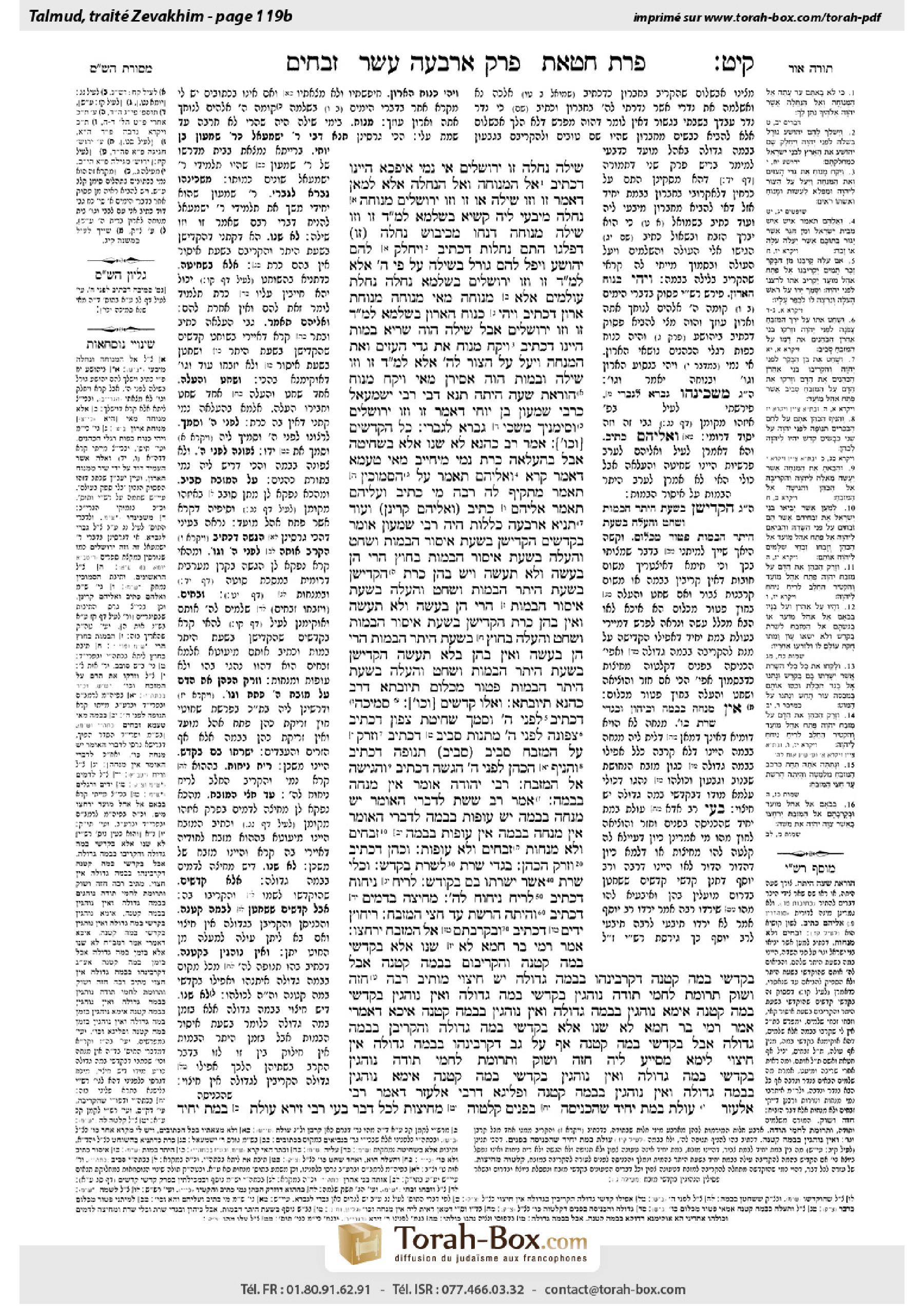
Zevachim 119b: Talmud study for Daf Yomi
Daf Yomi is the daily study of one Talmud folio. Explore 37 tractates with scans, Hebrew text, Sefaria English and AI-generated French translations where annotated.
Passage selection and English or AI-generated French translation are available where the scan has annotations. Daf Study is independent of Torah-Box and Sefaria.
Browse Zevachim · זבחים · All tractatesZevachim 119b text and translations
This page of Zevachim includes the Aramaic text, an English translation and an AI-generated French translation, alongside the scan above.
זבחים קי״ט ב · Aramaic and Hebrew text
שִׁילֹה ״נַחֲלָה״ זוֹ יְרוּשָׁלַיִם, אִי נָמֵי אִיפְּכָא – הַיְינוּ דִּכְתִיב: ״אֶל הַמְּנוּחָה וְאֶל הַנַּחֲלָה״. אֶלָּא לְמַאן דְּאָמַר זוֹ וָזוֹ שִׁילֹה, אוֹ זוֹ וָזוֹ יְרוּשָׁלַיִם – ״מְנוּחָה נַחֲלָה״ מִיבְּעֵי לֵיהּ! קַשְׁיָא.
בִּשְׁלָמָא לְמַאן דְּאָמַר זוֹ וָזוֹ שִׁילֹה; ״מְנוּחָה״ – דְּנָחוּ מִכִּיבּוּשׁ, ״נַחֲלָה (זוֹ)״ – דִּפְלַגוּ הָתָם נַחֲלוֹת, דִּכְתִיב: ״וַיְחַלֵּק לָהֶם יְהוֹשֻׁעַ וַיַּפֵּל לָהֶם גּוֹרָל בְּשִׁילֹה עַל פִּי ה׳״.
אֶלָּא לְמַאן דְּאָמַר זוֹ וָזוֹ יְרוּשָׁלַיִם; בִּשְׁלָמָא ״נַחֲלָה״ – נַחֲלַת עוֹלָמִים. אֶלָּא ״מְנוּחָה״ – מַאי מְנוּחָה? מְנוּחַת אָרוֹן, דִּכְתִיב: ״וַיְהִי כְּנוֹחַ הָאָרוֹן״.
בִּשְׁלָמָא לְמַאן דְּאָמַר זוֹ וָזוֹ יְרוּשָׁלַיִם, אֲבָל שִׁילֹה הֲווֹ (שריא) [שַׁרְיָאן] בָּמוֹת – הַיְינוּ דִּכְתִיב: ״וַיִּקַּח מָנוֹחַ אֶת גְּדִי הָעִזִּים וְאֶת הַמִּנְחָה וַיַּעַל עַל הַצּוּר לַה׳״.
אֶלָּא לְמַאן דְּאָמַר זוֹ וָזוֹ שִׁילֹה, וּבָמוֹת הֲווֹ אֲסִירָן – מַאי ״וַיִּקַּח מָנוֹחַ״? הוֹרָאַת שָׁעָה הָיְתָה.
תָּנָא דְּבֵי רַבִּי יִשְׁמָעֵאל כְּרַבִּי שִׁמְעוֹן בֶּן יוֹחַי, דְּאָמַר: זוֹ וָזוֹ יְרוּשָׁלַיִם. וְסִימָנָיךְ: (משכי) [מַשְׁכִינְהוּ] גַּבְרָא לְגַבְרֵי.
כׇּל הַקֳּדָשִׁים [וְכוּ׳]. אָמַר רַב כָּהֲנָא: לֹא שָׁנוּ אֶלָּא בִּשְׁחִיטָה, אֲבָל בְּהַעֲלָאָה – כָּרֵת נָמֵי מִיחַיַּיב.
מַאי טַעְמָא? דְּאָמַר קְרָא: ״וַאֲלֵהֶם תֹּאמַר״ – עַל הַסְּמוּכִין תֹּאמַר.
מַתְקֵיף לַהּ רַבָּה: מִי כְּתִיב ״וַעֲלֵיהֶם תֹּאמַר״?! ״אֲלֵהֶם״ כְּתִיב, וַ״אֲלֵיהֶם״ קָרֵינַן!
וְעוֹד תַּנְיָא, אַרְבָּעָה כְּלָלוֹת הָיָה רַבִּי שִׁמְעוֹן אוֹמֵר בְּקָדָשִׁים: הִקְדִּישָׁן בִּשְׁעַת אִיסּוּר הַבָּמוֹת, וְשָׁחַט וְהֶעֱלָה בִּשְׁעַת אִיסּוּר הַבָּמוֹת בַּחוּץ – הֲרֵי הֵן בַּעֲשֵׂה וְלֹא תַעֲשֶׂה, וְיֵשׁ בָּהֶן כָּרֵת. הִקְדִּישָׁן בִּשְׁעַת הֶיתֵּר הַבָּמוֹת, וְשָׁחַט וְהֶעֱלָה בִּשְׁעַת אִיסּוּר הַבָּמוֹת – הֲרֵי הֵן בַּעֲשֵׂה וְלֹא תַעֲשֶׂה, וְאֵין בָּהֶן כָּרֵת.
הִקְדִּישָׁן בִּשְׁעַת אִיסּוּר הַבָּמוֹת, וְשָׁחַט וְהֶעֱלָה בַּחוּץ בִּשְׁעַת הֶיתֵּר הַבָּמוֹת – הֲרֵי הֵן בַּעֲשֵׂה, וְאֵין בָּהֶן בְּלֹא תַעֲשֶׂה.
הִקְדִּישָׁן בִּשְׁעַת הֶיתֵּר הַבָּמוֹת, וְשָׁחַט וְהֶעֱלָה בִּשְׁעַת הֶיתֵּר הַבָּמוֹת – פָּטוּר מִכְּלוּם. תְּיוּבְתָּא דְּרַב כָּהֲנָא! תְּיוּבְתָּא.
וְאֵלּוּ קֳדָשִׁים [וְכוּ׳]. סְמִיכָה – דִּכְתִיב: ״לִפְנֵי ה׳ וְסָמַךְ״.
שְׁחִיטַת צָפוֹן – דִּכְתִיב: ״צָפוֹנָה לִפְנֵי ה׳״. מַתָּנוֹת סָבִיב – דִּכְתִיב: ״וְזָרַק עַל הַמִּזְבֵּחַ סָבִיב (סָבִיב)״.
תְּנוּפָה – דִּכְתִיב: ״וְהֵנִיף הַכֹּהֵן לִפְנֵי ה׳״. הַגָּשָׁה – דִּכְתִיב: ״וְהִגִּישָׁהּ אֶל הַמִּזְבֵּחַ״.
רַבִּי יְהוּדָה אוֹמֵר: אֵין מִנְחָה בְּבָמָה. אָמַר רַב שֵׁשֶׁת: לְדִבְרֵי הָאוֹמֵר יֵשׁ מִנְחָה בְּבָמָה – יֵשׁ עוֹפוֹת בְּבָמָה. לְדִבְרֵי הָאוֹמֵר אֵין מִנְחָה בְּבָמָה – אֵין עוֹפוֹת בְּבָמָה.
״זְבָחִים״ – וְלֹא מְנָחוֹת, ״זְבָחִים״ – וְלֹא עוֹפוֹת.
וְכֹהֵן – דִּכְתִיב: ״וְזָרַק הַכֹּהֵן״. בִּגְדֵי שָׁרֵת – ״לְשָׁרֵת בַּקֹּדֶשׁ״.
וּכְלֵי שָׁרֵת – ״אֲשֶׁר יְשָׁרְתוּ בָם בַּקֹּדֶשׁ״. לְרֵיחַ נִיחוֹחַ – דִּכְתִיב: ״לְרֵיחַ נִיחֹחַ לַה׳״.
מְחִיצָה בְּדָמִים – דִּכְתִיב: ״וְהָיְתָה הָרֶשֶׁת עַד חֲצִי הַמִּזְבֵּחַ״. רִיחוּץ יָדַיִם – דִּכְתִיב: ״וּבְקׇרְבָתָם אֶל הַמִּזְבֵּחַ יִרְחָצוּ״.
אָמַר רָמֵי בַּר חָמָא: לֹא שָׁנוּ אֶלָּא בְּקׇדְשֵׁי בָּמָה קְטַנָּה, וְהִקְרִיבוּם בְּבָמָה קְטַנָּה; אֲבָל בְּקׇדְשֵׁי בָּמָה קְטַנָּה דְּקָרְבִינְהוּ בְּבָמָה גְּדוֹלָה – יֵשׁ חִיצּוּי.
מוֹתֵיב רַבָּה: חָזֶה וָשׁוֹק, תְּרוּמַת לַחְמֵי תוֹדָה – נוֹהֲגִין בְּקׇדְשֵׁי בָּמָה גְּדוֹלָה, וְאֵין נוֹהֲגִין בְּקׇדְשֵׁי בָּמָה קְטַנָּה. אֵימָא: נוֹהֲגִין בְּבָמָה גְּדוֹלָה, וְאֵין נוֹהֲגִין בְּבָמָה קְטַנָּה.
אִיכָּא דְּאָמְרִי, אָמַר רָמֵי בַּר חָמָא: לֹא שָׁנוּ אֶלָּא בְּקׇדְשֵׁי בָּמָה גְּדוֹלָה, וְהִקְרִיבָן בְּבָמָה גְּדוֹלָה; אֲבָל בְּקׇדְשֵׁי בָּמָה קְטַנָּה – אַף עַל גַּב דְּקָרְבִינְהוּ בְּבָמָה גְּדוֹלָה, אֵין חִיצּוּי.
לֵימָא מְסַיַּיע לֵיהּ: חָזֶה וָשׁוֹק וּתְרוּמַת לַחְמֵי תוֹדָה – נוֹהֲגִין בְּקׇדְשֵׁי בָּמָה גְּדוֹלָה, וְאֵין נוֹהֲגִין בְּקׇדְשֵׁי בָּמָה קְטַנָּה.
אֵימָא: נוֹהֲגִין בְּבָמָה גְּדוֹלָה, וְאֵין נוֹהֲגִין בְּבָמָה קְטַנָּה. וּפְלִיגָא דְּרַבִּי אֶלְעָזָר, דְּאָמַר רַבִּי אֶלְעָזָר: עוֹלַת בָּמַת יָחִיד שֶׁהִכְנִיסָהּ בִּפְנִים – קְלָטוּהָ מְחִיצוֹת לְכׇל דָּבָר.
בָּעֵי רַבִּי זֵירָא: עוֹלַת בָּמַת יָחִיד,
Zevachim 119b · English translation
a reference to Shiloh, and with regard to “inheritance,” this is a reference to Jerusalem, or the reverse, i.e., that “rest” is a reference to Jerusalem and “inheritance” is a reference to Shiloh, this is as it is written: “To the rest and to the inheritance [el hamenuḥa ve’el hanaḥala],” utilizing two different phrases. But according to the one, i.e., the school of Rabbi Yishmael, who says that this and that are both references to Shiloh, or according to the opinion of Rabbi Shimon ben Yoḥai that both this and that are references to Jerusalem, the verse should have stated: For you have not as yet come to the rest and inheritance [menuḥa naḥala]. The Gemara concedes that this is difficult.
The Gemara comments: Granted, according to the one, i.e., Rabbi Shimon ben Yoḥai, who says this and that are references to Shiloh, each of the designations may be explained: It is called “rest” because during the period of Shiloh they rested from the conquest in the time of Joshua, and it is called “inheritance” because they divided the portions of land among the tribes there, as it is written: “And Joshua divided the land for them, and he cast a lot for them in Shiloh according to the Lord” (Joshua 18:10).
But according to the one, i.e., the school of Rabbi Yishmael, who says this and that are references to Jerusalem, granted that “inheritance” is a reference to Jerusalem, since it is an eternal inheritance. But with regard to “rest,” what rest was there in the Temple in Jerusalem? The Gemara answers: The rest of the Ark, as it is written: And when the ark rested. In other words, verses occasionally refer to the Temple in Jerusalem as the resting place of the Ark.
The Gemara comments: Granted, according to the one, i.e., Rabbi Shimon ben Yoḥai, who says that this and that are references to Jerusalem, and consequently private altars were forbidden only following the establishment of the Temple in Jerusalem, but during the period of the Tabernacle in Shiloh private altars were permitted, this is as it is written: “So Manoah took the kid with the meal offering, and offered them upon the rock to the Lord” (Judges 13:19), i.e., he sacrificed them upon a private altar and not in Shiloh.
But according to the one, i.e., the school of Rabbi Yishmael, who says that this and that are references to Shiloh, and private altars were forbidden during this period, what is the meaning of: “So Manoah took,” as it was forbidden to sacrifice offerings outside the Temple? The Gemara answers: Permitting this sacrifice was a provisional edict issued in exigent circumstances.
The Gemara notes that with regard to the disagreement between the tanna’im over the interpretation of the words “rest” and “inheritance,” there is another version of that which the school of Rabbi Yishmael taught, which is in accordance with the opinion of Rabbi Shimon ben Yoḥai, who says that this and that are references to Jerusalem. And your mnemonic to remember this is: The man pulled the men, meaning: Rabbi Shimon ben Yoḥai, who is an individual, pulled, i.e., convinced, the members of the school of Rabbi Yishmael to adopt his opinion.
§ The mishna teaches that with regard to all offerings that one consecrated during a period of the permitting of private altars and sacrificed outside their designated area during a period of prohibition of private altars, one is in violation of a positive mitzva and a prohibition, but he is not liable to receive karet for sacrificing them. With regard to this, Rav Kahana says: They taught that only with regard to slaughter of these animals outside the designated area is one not liable to receive karet. But with regard to offering up, one would also be liable to receive karet.
What is the reason for this? It is that immediately following the Torah’s description of an offering that was consecrated during a period of the permitting of private altars the verse states the penalty for sacrificing outside the designated area: “And to them [va’alehem] you shall say” (Leviticus 17:8). The term “alehem,” to them, the first letter of which is the letter aleph, is phonetically similar to the term: Alehem, about them, the first letter of which is the letter ayin. Therefore, the verse can be understood to mean: About that which is written in the adjacent passage you shall say. The preceding passage discusses offerings that were slaughtered outside the Temple, so although there is no penalty of karet for their slaughter, one is liable for karet for sacrificing them upon a private altar.
Rabba objects to this: Is it written: And about them you shall say? “To them” is written, and we read it as “to them.” The verse means that the command should be relayed to Aaron, his sons, and the Jewish people, who are mentioned in the beginning of the passage.
And additionally, it is taught in a baraita: Rabbi Shimon would say four principles with regard to sacrificial animals: With regard to offerings that one consecrated during a period of prohibition of private altars, and slaughtered and offered up outside their designated area during a period of prohibition of private altars, for these one is in violation of a positive mitzva and a prohibition, and they carry the punishment of karet. With regard to one who consecrated them during a period of the permitting of private altars, and slaughtered and offered them up during a period of prohibition of private altars, for these one is in violation of a positive mitzva and a prohibition, but they do not carry the punishment of karet.
With regard to one who consecrated them during a period of prohibition of private altars, and slaughtered and offered them up outside their designated area during a period of the permitting of private altars, for these one is in violation of a positive mitzva, but one has not violated a prohibition with regard to them.
With regard to one who consecrated them during a period of the permitting of private altars, and slaughtered and offered them up during a period of the permitting of private altars, he is exempt from all violations. The baraita states explicitly that there is no distinction between slaughtering and offering up on a private altar: In both cases, one who consecrated the offering during a period of the permitting of private altars and slaughtered or offered it up during a period of prohibition of private altars is exempt from the punishment of karet. The Gemara concludes: The refutation of the opinion of Rav Kahana, who distinguished between slaughter and offering up, is a conclusive refutation.
§ The mishna teaches: And these are the consecrated items, and lists components of the sacrificial service that were performed only on a great public altar, i.e., in the Tabernacle, and not on a private altar. The Gemara clarifies the source of each ritual on the list: The source for the halakha concerning placing hands on the head of an offering is as it is written: “If his offering be a burnt offering…he shall bring it to the entrance of the Tent of Meeting, that he may be accepted before the Lord. And he shall lay his hand upon the head of the burnt offering” (Leviticus 1:3–4).
The source for the halakha concerning slaughtering offerings of the most sacred order in the north is as it is written: “And he shall slaughter it on the side of the altar northward before the Lord” (Leviticus 1:11). The source for the halakha concerning placement of the blood of a burnt offering around, i.e., on all four sides of, the altar, is as it is written: “And Aaron’s sons, the priests, shall…sprinkle the blood roundabout against the altar that is at the entrance of the Tent of Meeting” (Leviticus 1:5).
The source for the halakha concerning waving of those offerings that require waving is as it is written: “And the priest shall take one of the lambs, and offer it for a guilt offering, and the log of oil, and wave them for a wave offering before the Lord” (Leviticus 14:12). The source for the halakha concerning bringing meal offerings to the corner of the altar before the removal of the handful is as it is written: “And he shall bring it to the altar” (Leviticus 2:8). The definite article before the word “altar” indicates that this applies only to the altar in the Tabernacle, and not on a private altar.
§ With regard to the question of whether a meal offering was sacrificed upon an altar outside the Temple, the mishna teaches that Rabbi Yehuda says: There is no meal offering sacrificed on an altar outside the Temple, even a great public altar, e.g., the Tabernacle in Gilgal, Nov, and Gibeon. Rav Sheshet says: According to the statement of the one who says there is a meal offering sacrificed on an altar outside the Temple, there are also bird offerings sacrificed on an altar outside the Temple. According to the statement of the one who says there is no meal offering sacrificed on an altar outside the Temple, there are also no bird offerings sacrificed on an altar outside the Temple.
The reason for this is that the Torah is referring to offerings that were sacrificed during the period of the permitting of private altars as: Slaughtered offerings [zevaḥim], in the verse: “And sacrifice them for sacrifices of [vezaveḥu zivḥei] peace offerings” (Leviticus 17:5), from which it may be inferred: Slaughtered offerings but not meal offerings; slaughtered offerings but not bird offerings, i.e., neither meal offerings nor bird offerings were sacrificed on an altar outside the Temple, including a great public altar.
The Gemara continues detailing the distinctions between great public altars and small private altars: And a priest is required only at a public altar, as it is written: “And the priest shall sprinkle the blood against the altar of the Lord at the entrance of the Tent of Meeting” (Leviticus 17:6). Priestly service vestments are required only at a public altar, as it is written: “And they shall be upon Aaron, and upon his sons when they go into the Tent of Meeting or when they come near to the altar to minister in the sacred place” (Exodus 28:43).
And with regard to service vessels, it is written: “And they shall take all the service vessels wherewith they serve in the sacred place” (Numbers 4:12). With regard to a pleasing aroma, i.e., that limbs that had previously been roasted off the altar should not be placed upon the altar, it is required only on a public altar, as it is written: “And the priest shall sprinkle the blood against the altar of the Lord at the entrance of the Tent of Meeting, and the priest shall make the fat smoke for an aroma pleasing to the Lord” (Leviticus 17:6).
A partition for the blood, i.e., the red line that divides the altar, as the blood of some offerings, e.g., a sin offering, was sprinkled above the line, and the blood of other offerings, e.g., a burnt offering, was sprinkled below the line, was required only on a public altar, as it is written: “And the net may reach halfway up the altar” (Exodus 27:5). The definite article before the word “altar” indicates that this applied only to the altar in the Tabernacle. With regard to the requirement for washing of hands and feet before the service, it is required only on a public altar, as it is written: “When they went into the Tent of Meeting and when they came near to the altar, they shall wash” (Exodus 40:32).
§ Concerning the halakha requiring a partition for the blood, and other halakhot that did not apply to a private altar but did apply to a great public altar, Rami bar Ḥama said: The Sages taught that there is no requirement for a partition only with regard to consecrated sacrificial items to be used on a small private altar, and which one sacrificed upon a small private altar. But in the case of consecrated sacrificial items to be used on a small private altar that were sacrificed upon a great public altar, there is a partition.
Rabba raised an objection from a baraita: The halakha of waving the breast and the thigh of a peace offering and the teruma of the loaves of a thanks offering applies with regard to sacrificial items of a great public altar and does not apply with regard to sacrificial items of a small private altar, even if they were sacrificed upon a great public altar. The Gemara responds: Say that the text of the baraita should be the following: The halakha of waving the breast and thigh and the teruma of the loaves of a thanks offering applies to a great public altar, even with regard to a sacrificial item of a small private altar, but does not apply to a small private altar.
Some say that Rami bar Ḥama said: The Sages taught that there is a requirement for a partition only with regard to sacrificial items of a great public altar that were sacrificed upon a great public altar. But in the case of sacrificial items of a small private altar, even though they were sacrificed upon a great public altar, there is no partition.
The Gemara suggests: Let us say that the following baraita supports the opinion of Rami bar Ḥama: Waving of the breast and thigh of a peace offering and the teruma of the loaves of a thanks offering applies to sacrificial items of a great public altar, and does not apply to sacrificial items of a small private altar.
The Gemara responds: No proof may be brought from here, as I will say that it means the halakha of waving the breast and thigh and the teruma of the loaves of a thanks offering applies to a great public altar, even with regard to the sacrificial items of a private altar, and does not apply to a small private altar. The Gemara notes: And this latter version of Rami bar Ḥama’s statement disagrees with the opinion of Rabbi Elazar, as Rabbi Elazar says: A burnt offering of a private altar that one brought inside, i.e., into the area of a great public altar, is absorbed, i.e., sanctified, by the partitions for all matters.
With regard to the previous matter, Rabbi Zeira raises a dilemma: With regard to a burnt offering of a private altar
Zevachim 119b · Traduction française (IA)
une référence à Silo, et « héritage » fait référence à Jérusalem, ou inversement, c’est-à-dire que « repos » fait référence à Jérusalem et « héritage » à Silo, comme il est écrit : « Vers le repos et vers l’héritage [el hamenuḥa ve’el hanaḥala] », en employant deux expressions différentes. Mais selon celui — c’est-à-dire l’école de Rabbi Yishmael — qui dit que les deux expressions font référence à Silo, ou selon l’opinion de Rabbi Shimon ben Yoḥai, qui dit qu’elles font toutes deux référence à Jérusalem, le verset aurait dû dire : « Car vous n’êtes pas encore arrivés au repos et à l’héritage [menuḥa naḥala]. » La Guemara reconnaît que cette difficulté demeure.
La Guemara commente : Certes, selon celui — c’est-à-dire Rabbi Shimon ben Yoḥai — qui dit que les deux expressions font référence à Silo, chacune des désignations peut s’expliquer : l’endroit est appelé « repos » parce qu’à l’époque de Silo, ils se reposèrent de la conquête menée au temps de Josué ; et il est appelé « héritage » parce qu’ils y répartirent les portions de terre entre les tribus, comme il est écrit : « Josué leur partagea le pays et tira au sort pour eux à Silo, selon l’ordre du Seigneur » (Josué 18:10).
Mais selon celui — c’est-à-dire l’école de Rabbi Yishmael — qui dit que les deux expressions font référence à Jérusalem, on comprend que « héritage » fasse référence à Jérusalem, puisqu’il s’agit d’un héritage éternel. Mais, en ce qui concerne « repos », quel repos y avait-il dans le Temple de Jérusalem ? La Guemara répond : le repos de l’Arche, comme il est écrit : « Lorsque l’Arche se reposait. » Autrement dit, certains versets désignent parfois le Temple de Jérusalem comme le lieu de repos de l’Arche.
La Guemara commente : Certes, selon celui — c’est-à-dire Rabbi Shimon ben Yoḥai — qui dit que les deux expressions font référence à Jérusalem, et que, par conséquent, les autels privés ne furent interdits qu’après l’établissement du Temple à Jérusalem, tandis qu’à l’époque du Tabernacle de Silo les autels privés étaient permis, cela correspond à ce qui est écrit : « Manoah prit le chevreau et l’offrande végétale, et les offrit sur le rocher au Seigneur » (Juges 13:19), c’est-à-dire qu’il les offrit sur un autel privé et non à Silo.
Mais selon celui — c’est-à-dire l’école de Rabbi Yishmael — qui dit que les deux expressions font référence à Silo, et que les autels privés étaient interdits à cette époque, que signifie : « Manoah prit… », alors qu’il était interdit d’offrir des sacrifices hors du Temple ? La Guemara répond : L’autorisation de ce sacrifice fut un décret provisoire émis dans une situation d’urgence.
La Guemara relève qu’au sujet du désaccord entre les tannaïm sur l’interprétation des mots « repos » et « héritage », il existe une autre version de l’enseignement de l’école de Rabbi Yishmael, conforme à l’opinion de Rabbi Shimon ben Yoḥai, qui dit que les deux expressions font référence à Jérusalem. Voici un moyen mnémotechnique pour s’en souvenir : l’homme tira les hommes, c’est-à-dire que Rabbi Shimon ben Yoḥai, qui est un individu, tira — autrement dit, convainquit — les membres de l’école de Rabbi Yishmael d’adopter son opinion.
§ La Michna enseigne que, pour toutes les offrandes qu’on a consacrées pendant une période où les autels privés étaient permis et qu’on a sacrifiées hors de leur lieu désigné pendant une période où les autels privés étaient interdits, on transgresse un commandement positif et une interdiction, mais on n’encourt pas le retranchement pour les avoir sacrifiées. À ce sujet, Rav Kahana dit : Ils ont enseigné que l’absence de responsabilité passible de retranchement ne concerne que l’abattage de ces animaux hors du lieu désigné. En revanche, pour leur offrande sur l’autel, on serait également passible de retranchement.
Quelle en est la raison ? C’est que, immédiatement après la description par la Torah d’une offrande consacrée pendant une période où les autels privés étaient permis, le verset énonce la peine encourue pour un sacrifice offert hors du lieu désigné : « Et à eux [va’alehem], tu diras » (Lévitique 17:8). Le terme « alehem », « à eux », dont la première lettre est un aleph, ressemble phonétiquement au terme « alehem », « à leur sujet », dont la première lettre est un ayin. Le verset peut donc être compris ainsi : « Au sujet de ce qui est écrit dans le passage précédent, tu diras. » Le passage précédent traite d’offrandes abattues hors du Temple ; ainsi, bien qu’il n’y ait pas de peine de retranchement pour leur abattage, on est passible de retranchement si on les offre sur un autel privé.
Rabba objecte : Est-il écrit : « Et à leur sujet, tu diras » ? Il est écrit « à eux », et nous le lisons « à eux ». Le verset signifie que le commandement doit être transmis à Aaron, à ses fils et au peuple juif, mentionnés au début du passage.
De plus, il est enseigné dans une baraïta : Rabbi Shimon disait quatre principes au sujet des animaux destinés aux sacrifices. Pour les offrandes consacrées pendant une période où les autels privés étaient interdits, puis abattues et offertes hors de leur lieu désigné pendant une période où les autels privés étaient interdits, on transgresse un commandement positif et une interdiction, et elles entraînent la peine de retranchement. Pour celles qui ont été consacrées pendant une période où les autels privés étaient permis, puis abattues et offertes pendant une période où les autels privés étaient interdits, on transgresse un commandement positif et une interdiction, mais elles n’entraînent pas la peine de retranchement.
Pour celles qui ont été consacrées pendant une période où les autels privés étaient interdits, puis abattues et offertes hors de leur lieu désigné pendant une période où les autels privés étaient permis, on transgresse un commandement positif, mais aucune interdiction n’est transgressée à leur sujet.
Pour celles qui ont été consacrées pendant une période où les autels privés étaient permis, puis abattues et offertes pendant une période où les autels privés étaient permis, leur auteur est exempt de toute transgression. La baraïta énonce explicitement qu’il n’y a pas de distinction entre l’abattage et l’offrande sur un autel privé : dans les deux cas, celui qui a consacré l’offrande pendant une période où les autels privés étaient permis et qui l’a abattue ou offerte pendant une période où ils étaient interdits n’encourt pas la peine de retranchement. La Guemara conclut : La réfutation de l’opinion de Rav Kahana, qui distinguait l’abattage de l’offrande sur l’autel, est une réfutation décisive.
§ La Michna enseigne : « Et voici les choses consacrées », puis énumère des éléments du service sacrificiel accomplis uniquement sur un grand autel public, c’est-à-dire dans le Tabernacle, et non sur un autel privé. La Guemara précise la source de chaque rite de la liste : la source de la halakha concernant l’imposition des mains sur la tête d’une offrande est ce qui est écrit : « Si son offrande est un holocauste… il l’amènera à l’entrée de la Tente d’assignation, afin qu’il soit agréé devant le Seigneur. Il posera sa main sur la tête de l’holocauste » (Lévitique 1:3–4).
La source de la halakha concernant l’abattage des offrandes de sainteté suprême au nord est ce qui est écrit : « Il l’abattra du côté nord de l’autel, devant le Seigneur » (Lévitique 1:11). La source de la halakha concernant l’aspersion du sang d’un holocauste autour de l’autel, c’est-à-dire sur ses quatre côtés, est ce qui est écrit : « Les fils d’Aaron, les prêtres, […] aspergeront le sang tout autour contre l’autel qui se trouve à l’entrée de la Tente d’assignation » (Lévitique 1:5).
La source de la halakha concernant l’agitation des offrandes qui requièrent ce rite est ce qui est écrit : « Le prêtre prendra l’un des agneaux, l’offrira en sacrifice de culpabilité, avec le log d’huile, et les agitera en offrande d’agitation devant le Seigneur » (Lévitique 14:12). La source de la halakha concernant l’apport des offrandes végétales à l’angle de l’autel avant le prélèvement de la poignée est ce qui est écrit : « Il l’apportera à l’autel » (Lévitique 2:8). L’article défini devant le mot « autel » indique que cela ne s’applique qu’à l’autel du Tabernacle, et non à un autel privé.
§ À propos de la question de savoir si une offrande végétale était offerte sur un autel hors du Temple, la Michna enseigne que Rabbi Yehuda dit : Aucune offrande végétale n’est offerte sur un autel hors du Temple, même sur un grand autel public, par exemple dans le Tabernacle à Guilgal, à Nob et à Gabaon. Rav Sheshet dit : Selon celui qui affirme qu’une offrande végétale est offerte sur un autel hors du Temple, les offrandes d’oiseaux y sont également offertes. Selon celui qui affirme qu’aucune offrande végétale n’est offerte sur un autel hors du Temple, les offrandes d’oiseaux n’y sont pas non plus offertes.
La raison en est que la Torah désigne les offrandes offertes pendant la période où les autels privés étaient permis comme des « sacrifices [zevaḥim] », dans le verset : « Vous les sacrifierez en sacrifices [vezaveḥu zivḥei] de paix » (Lévitique 17:5). On peut en déduire : des sacrifices, mais pas des offrandes végétales ; des sacrifices, mais pas des offrandes d’oiseaux. Autrement dit, ni les offrandes végétales ni les offrandes d’oiseaux n’étaient offertes sur un autel hors du Temple, y compris sur un grand autel public.
La Guemara poursuit en détaillant les différences entre les grands autels publics et les petits autels privés : la présence d’un prêtre n’est requise que sur un autel public, comme il est écrit : « Le prêtre aspergera le sang contre l’autel du Seigneur, à l’entrée de la Tente d’assignation » (Lévitique 17:6). Les vêtements sacerdotaux ne sont requis que sur un autel public, comme il est écrit : « Ils seront sur Aaron et sur ses fils lorsqu’ils entreront dans la Tente d’assignation ou lorsqu’ils s’approcheront de l’autel pour servir dans le lieu saint » (Exode 28:43).
Et au sujet des ustensiles de service, il est écrit : « Ils prendront tous les ustensiles de service dont ils se servent dans le lieu saint » (Nombres 4:12). Quant à l’exigence d’un parfum agréable — c’est-à-dire que les membres qui ont été rôtis auparavant hors de l’autel ne doivent pas être placés sur l’autel —, elle ne s’applique que sur un autel public, comme il est écrit : « Le prêtre aspergera le sang contre l’autel du Seigneur, à l’entrée de la Tente d’assignation, et le prêtre fera fumer la graisse en parfum agréable au Seigneur » (Lévitique 17:6).
Une séparation pour le sang, c’est-à-dire la ligne rouge qui divise l’autel — le sang de certaines offrandes, par exemple un sacrifice expiatoire, étant aspergé au-dessus de la ligne, et celui d’autres offrandes, par exemple un holocauste, au-dessous — n’était requise que sur un autel public, comme il est écrit : « Le treillis atteindra la moitié de l’autel » (Exode 27:5). L’article défini devant le mot « autel » indique que cela ne s’appliquait qu’à l’autel du Tabernacle. Quant à l’obligation de se laver les mains et les pieds avant le service, elle ne s’applique que sur un autel public, comme il est écrit : « Lorsqu’ils entreront dans la Tente d’assignation et lorsqu’ils s’approcheront de l’autel, ils se laveront » (Exode 40:32).
§ Au sujet de la halakha imposant une séparation pour le sang, et d’autres halakhot qui ne s’appliquaient pas à un autel privé mais s’appliquaient à un grand autel public, Rami bar Ḥama dit : Les Sages ont enseigné que l’exigence d’une séparation ne s’applique pas uniquement aux objets sacrés destinés à être utilisés sur un petit autel privé et sacrifiés sur un petit autel privé. Mais, dans le cas d’objets sacrés destinés à être utilisés sur un petit autel privé qui ont été sacrifiés sur un grand autel public, une séparation est requise.
Rabba soulève une objection à partir d’une baraïta : la halakha de l’agitation de la poitrine et de la cuisse d’un sacrifice de paix, ainsi que celle de la terouma des pains d’un sacrifice d’action de grâce, s’applique aux objets sacrificiels d’un grand autel public, mais ne s’applique pas aux objets sacrificiels d’un petit autel privé, même s’ils ont été sacrifiés sur un grand autel public. La Guemara répond : Il faut dire que le texte de la baraïta est le suivant : la halakha de l’agitation de la poitrine et de la cuisse, ainsi que celle de la terouma des pains d’un sacrifice d’action de grâce, s’applique à un grand autel public, même pour un objet sacrificiel d’un petit autel privé, mais ne s’applique pas à un petit autel privé.
Selon certains, Rami bar Ḥama a dit : Les Sages ont enseigné que l’exigence d’une séparation ne s’applique qu’aux objets sacrificiels d’un grand autel public qui ont été sacrifiés sur un grand autel public. Mais, dans le cas d’objets sacrificiels d’un petit autel privé, même s’ils ont été sacrifiés sur un grand autel public, aucune séparation n’est requise.
La Guemara propose : Disons que la baraïta suivante appuie l’opinion de Rami bar Ḥama : l’agitation de la poitrine et de la cuisse d’un sacrifice de paix, ainsi que la terouma des pains d’un sacrifice d’action de grâce, s’appliquent aux objets sacrificiels d’un grand autel public, mais ne s’appliquent pas aux objets sacrificiels d’un petit autel privé.
La Guemara répond : Non, on ne peut pas en tirer de preuve, car on pourrait dire que cela signifie que la halakha de l’agitation de la poitrine et de la cuisse, ainsi que celle de la terouma des pains d’un sacrifice d’action de grâce, s’appliquent à un grand autel public, même pour les objets sacrificiels d’un autel privé, mais ne s’appliquent pas à un petit autel privé. La Guemara relève que cette dernière version de la déclaration de Rami bar Ḥama est en désaccord avec l’opinion de Rabbi Elazar, car Rabbi Elazar dit : Un holocauste d’un autel privé qu’on a amené à l’intérieur, c’est-à-dire dans l’enceinte d’un grand autel public, est absorbé — c’est-à-dire sanctifié — par les cloisons à tous égards.
À propos du sujet précédent, Rabbi Zeira soulève une question : concernant un holocauste d’un autel privé…
Traduction française générée par IA à partir de l’édition anglaise de Sefaria. Vérifie toujours un passage avec le texte source.
Text from Sefaria: William Davidson Edition - Vocalized Aramaic (CC BY NC); William Davidson Edition - English (CC BY NC).