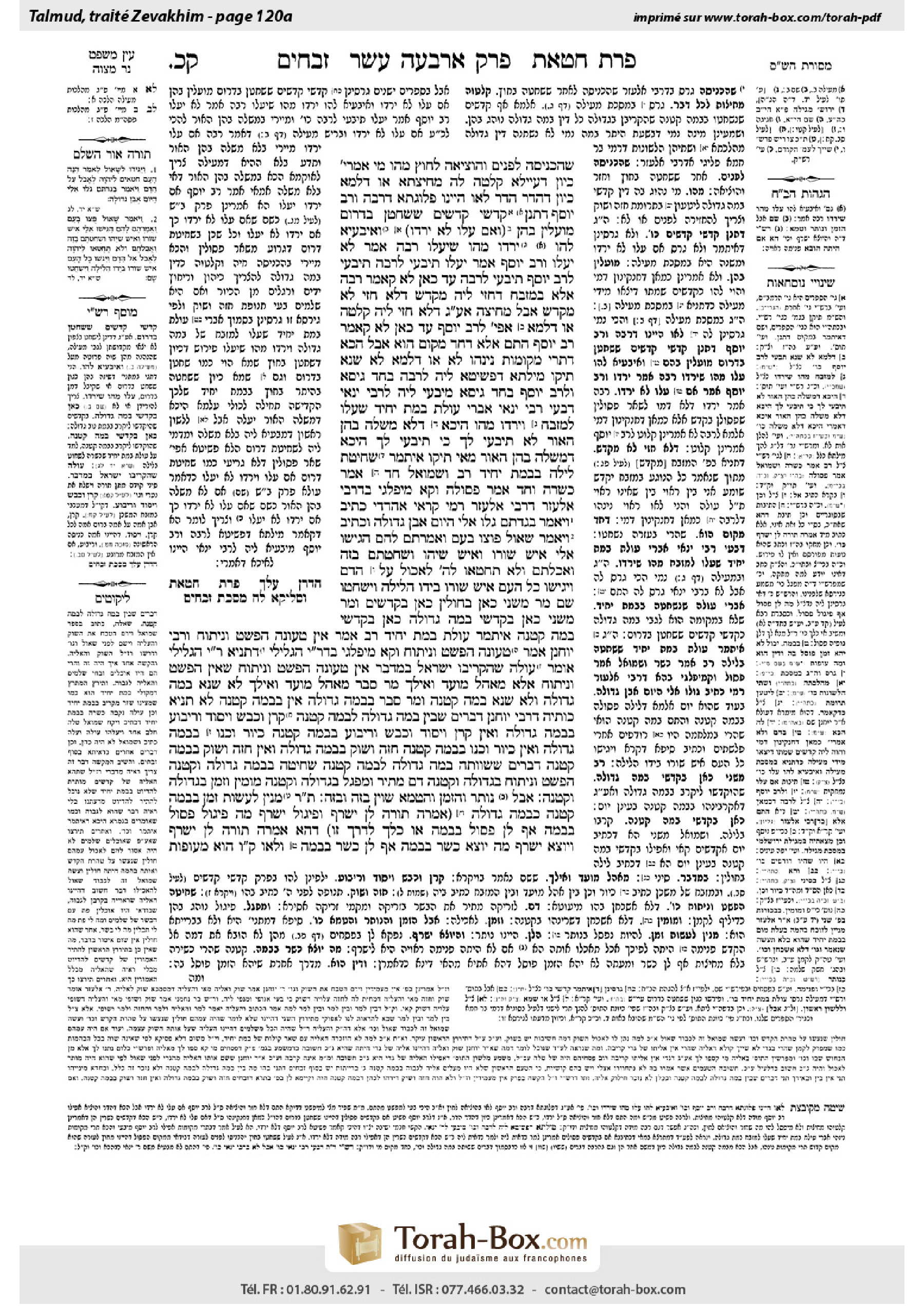
Zevachim 120a: Talmud study for Daf Yomi
Daf Yomi is the daily study of one Talmud folio. Explore 37 tractates with scans, Hebrew text, Sefaria English and AI-generated French translations where annotated.
Passage selection and English or AI-generated French translation are available where the scan has annotations. Daf Study is independent of Torah-Box and Sefaria.
Browse Zevachim · זבחים · All tractatesZevachim 120a text and translations
This page of Zevachim includes the Aramaic text, an English translation and an AI-generated French translation, alongside the scan above.
זבחים ק״כ א · Aramaic and Hebrew text
שֶׁהִכְנִיסָהּ לִפְנִים וְהוֹצִיאָהּ לַחוּץ – מַהוּ? מִי אָמְרִינַן: כֵּיוָן דַּעֲיַילָא – קָלְטָה לַהּ מְחִיצְתָּא; אוֹ דִלְמָא, כֵּיוָן דַּהֲדַר – הֲדַר?
לָאו הַיְינוּ פְּלוּגְתָּא דְּרַבָּה וְרַב יוֹסֵף? דִּתְנַן: קׇדְשֵׁי קָדָשִׁים שֶׁשְּׁחָטָן בַּדָּרוֹם – מוֹעֲלִין בָּהֶן, וְאִם עָלוּ לֹא יֵרְדוּ.
וְאִיבַּעְיָא לְהוּ: יָרְדוּ, מַהוּ שֶׁיַּעֲלוּ? רַבָּה אָמַר: לֹא יַעֲלוּ, וְרַב יוֹסֵף אָמַר: יַעֲלוּ.
תִּיבְּעֵי לְרַבָּה, תִּיבְּעֵי לְרַב יוֹסֵף. תִּיבְּעֵי לְרַבָּה: עַד כָּאן לָא קָאָמַר רַבָּה – אֶלָּא בְּמִזְבֵּחַ; דַּחֲזֵי לֵיהּ מְקַדֵּשׁ, דְּלָא חֲזֵי לָא מְקַדֵּשׁ; אֲבָל מְחִיצָה, אַף עַל גַּב דְּלָא חֲזֵי לַיהּ – קָלְטָה.
אוֹ דִלְמָא, אֲפִילּוּ לְרַב יוֹסֵף – עַד כָּאן לָא קָאָמַר רַב יוֹסֵף הָתָם, אֶלָּא דְּחַד מָקוֹם הוּא; אֲבָל הָכָא, דִּתְרֵי מְקוֹמוֹת נִינְהוּ – לָא. אוֹ דִלְמָא לָא שְׁנָא? תֵּיקוּ.
מִילְּתָא דִּפְשִׁיטָא לֵיהּ לְרַבָּה בְּחַד גִּיסָא, וּלְרַב יוֹסֵף בְּחַד גִּיסָא – מִיבְּעֵי לֵיהּ לְרַבִּי יַנַּאי. דְּבָעֵי רַבִּי יַנַּאי: אֵבְרֵי עוֹלַת בָּמַת יָחִיד, שֶׁעָלוּ לַמִּזְבֵּחַ וְיָרְדוּ – מַהוּ? הֵיכָא דְּלֹא מָשְׁלָה בָּהֶן הָאוּר – לָא תִּיבְּעֵי לָךְ; כִּי תִּיבְּעֵי לָךְ – הֵיכָא דְּמָשְׁלָה בָּהֶן הָאוּר. מַאי? תֵּיקוּ.
אִיתְּמַר: שְׁחִיטַת לַיְלָה בְּבָמַת יָחִיד – רַב וּשְׁמוּאֵל; חַד אָמַר: כְּשֵׁרָה, וְחַד אָמַר: פְּסוּלָה. וְקָא מִיפַּלְגִי בִּדְרַבִּי אֶלְעָזָר;
דְּרַבִּי אֶלְעָזָר רָמֵי קְרָאֵי אַהֲדָדֵי – כְּתִיב: ״וַיֹּאמֶר בְּגַדְתֶּם גֹּלּוּ אֵלַי הַיּוֹם אֶבֶן גְּדוֹלָה״,
וּכְתִיב: ״וַיֹּאמֶר שָׁאוּל פֻּצוּ בָעָם וַאֲמַרְתֶּם לָהֶם הַגִּישׁוּ אֵלַי אִישׁ שׁוֹרוֹ וְאִישׁ שְׂיֵהוּ, וּשְׁחַטְתֶּם בָּזֶה וַאֲכַלְתֶּם, וְלֹא תֶחֶטְאוּ לַה׳ לֶאֱכוֹל עַל הַדָּם. וַיַּגִּשׁוּ כׇל הָעָם אִישׁ שׁוֹרוֹ בְיָדוֹ הַלַּיְלָה, וַיִּשְׁחֲטוּ שָׁם״.
מָר מְשַׁנֵּי: כָּאן בְּחוּלִּין, כָּאן בְּקָדָשִׁים. וּמַר מְשַׁנֵּי: כָּאן בְּקׇדְשֵׁי בָּמָה גְּדוֹלָה, כָּאן בְּקׇדְשֵׁי בָּמָה קְטַנָּה.
אִיתְּמַר: עוֹלַת בָּמַת יָחִיד – רַב אָמַר: אֵין טְעוּנָה הֶפְשֵׁט וְנִיתּוּחַ, וְרַבִּי יוֹחָנָן אָמַר: טְעוּנָה הֶפְשֵׁט וְנִיתּוּחַ. וְקָא מִיפַּלְגִי בִּדְרַבִּי יוֹסֵי הַגְּלִילִי – דְּתַנְיָא, רַבִּי יוֹסֵי הַגְּלִילִי אוֹמֵר: עוֹלָה שֶׁהִקְרִיבוּ יִשְׂרָאֵל בַּמִּדְבָּר – אֵין טְעוּנָה הֶפְשֵׁט וְנִיתּוּחַ; שֶׁאֵין הֶפְשֵׁט וְנִיתּוּחַ אֶלָּא מֵאֹהֶל מוֹעֵד וְאֵילָךְ.
מָר סָבַר: מֵאֹהֶל מוֹעֵד וְאֵילָךְ – לָא שְׁנָא בָּמָה גְּדוֹלָה, וְלָא שְׁנָא בָּמָה קְטַנָּה. וּמָר סָבַר: בְּבָמָה גְּדוֹלָה אִין, בְּבָמָה קְטַנָּה לָא.
תַּנְיָא כְּוָתֵיהּ דְּרַבִּי יוֹחָנָן: דְּבָרִים שֶׁבֵּין בָּמָה גְּדוֹלָה לְבָמָה קְטַנָּה – קֶרֶן וְכֶבֶשׁ וִיסוֹד וְרִיבּוּעַ בְּבָמָה גְּדוֹלָה, וְאֵין קֶרֶן וִיסוֹד וְכֶבֶשׁ וְרִיבּוּעַ בְּבָמָה קְטַנָּה. כִּיּוֹר וְכַנּוֹ בְּבָמָה גְּדוֹלָה, וְאֵין כִּיּוֹר וְכַנּוֹ בְּבָמָה קְטַנָּה. חָזֶה וָשׁוֹק בְּבָמָה גְּדוֹלָה, וְאֵין חָזֶה וָשׁוֹק בְּבָמָה קְטַנָּה.
דְּבָרִים שֶׁשָּׁוְותָה בָּמָה גְּדוֹלָה לְבָמָה קְטַנָּה: שְׁחִיטָה בְּבָמָה גְּדוֹלָה וּקְטַנָּה, הֶפְשֵׁט וְנִיתּוּחַ בִּגְדוֹלָה וּקְטַנָּה, דָּם מַתִּיר וּמְפַגֵּל בִּגְדוֹלָה וּקְטַנָּה, מוּמִין וּזְמַן בִּגְדוֹלָה וּקְטַנָּה.
אֲבָל נוֹתָר וְהַזְּמַן וְהַטָּמֵא – שָׁוִין בָּזֶה וּבָזֶה.
תָּנוּ רַבָּנַן: מִנַּיִן לַעֲשׂוֹת זְמַן בְּבָמָה קְטַנָּה כְּבָמָה גְּדוֹלָה? אָמְרָה תּוֹרָה: לָן יִשָּׂרֵף, וּפִיגּוּל יִשָּׂרֵף; מָה פִּיגּוּל – פָּסוּל בְּבָמָה, אַף לָן – פָּסוּל בְּבָמָה.
אוֹ כְּלָךְ לְדֶרֶךְ זוֹ – דְּהָא אָמְרָה תּוֹרָה: לָן יִשָּׂרֵף, וְיוֹצֵא יִשָּׂרֵף; מָה יוֹצֵא – כָּשֵׁר בְּבָמָה, אַף לָן – כָּשֵׁר בְּבָמָה. וְלָאו קַל וָחוֹמֶר הוּא מֵעוֹפוֹת:
Zevachim 120a · English translation
that one brought inside and subsequently took outside, what is the halakha? Does it have the status of a sacrificial item of a public altar? The Gemara clarifies the question: Do we say that once it was brought in the partition has already absorbed it, and all halakhot of sacrificial items of a public altar apply; or perhaps once it returns, i.e., was taken outside again, it returns to its prior status as an offering of a private altar?
The Gemara asks: Isn’t this issue a disagreement between Rabba and Rav Yosef? As we learned in a mishna (Me’ila 2a): With regard to offerings of the most sacred order, e.g., a sin offering or a guilt offering, that were slaughtered in the south of the Temple courtyard, and not in the north as dictated by halakha, and are therefore disqualified, one who derives benefit from them is liable for misuse of consecrated property, and despite the fact that they should not ascend the altar, if they ascended they shall not descend.
And a dilemma was raised before the Sages: If they did descend the altar, what is the halakha with regard to ascending again? Rabba says: They shall not ascend, and Rav Yosef says: They shall ascend. Consequently, they disagree with regard to the issue of whether an item that is not fit to be sacrificed in a consecrated area acquires the sanctity of that area even if it is removed from there.
The Gemara responds: The disagreements are not identical, as the dilemma can be raised according to the opinion of Rabba, and the dilemma can be raised according to the opinion of Rav Yosef. The Gemara elaborates: It is possible to raise the dilemma according to the opinion of Rabba, as Rabba says his statement: Offerings of the most sacred order that were slaughtered in the south shall not descend if they ascended, only with regard to the altar, as the altar consecrates that which is fit for it, while it does not consecrate that which is not fit for it. But with regard to the partition of the public altar, even though an offering that was consecrated for a private altar is not fit for that altar, the partition nevertheless absorbs the offering and it is sacrificed there. Consequently, all the halakhot of the public altar apply to that offering, even if it is taken outside.
Or perhaps the dilemma of the burnt offering of a private altar can be raised even according to the opinion of Rav Yosef. Rav Yosef states his opinion there, that offerings of the most sacred order that were slaughtered in the south of the Temple courtyard and descended the altar shall ascend again, only because the altar and the offering are both located in one place, i.e., the Temple courtyard. But here in Rabbi Zeira’s case, where the private altar and public altar are two separate places, the halakhot of the public altar do not apply if the offering was taken outside the designated location. Or perhaps there is no difference, and the opinions of Rabba and Rav Yosef in one case are identical to their opinions in the other. The Gemara concludes: The dilemma shall stand unresolved.
The Gemara notes that a matter that is obvious to Rabba on one side, i.e., that these offerings shall not ascend the altar again, and to Rav Yosef on the other side, i.e., that they shall ascend again, was raised as a dilemma by Rabbi Yannai. As Rabbi Yannai raises a dilemma: What is the halakha with regard to the limbs of a burnt offering of a private altar that ascended the altar and descended? The Gemara notes: In a case where the fire has not yet taken hold of them, do not raise the dilemma, as they certainly shall not ascend again. When should you raise the dilemma? Raise it in a case where the fire has taken hold of them: What is the halakha? The Gemara concludes: The dilemma shall stand unresolved.
§ Additionally, with regard to a private altar it was stated: With regard to the slaughter of offerings at night on a private altar, Rav and Shmuel disagree: One says that it is valid, and one says that it is not valid. The Gemara explains: And they disagree with regard to the resolution to a contradiction that was raised by Rabbi Elazar.
As Rabbi Elazar raised a contradiction between two verses: It is written in the context of Saul’s war with the Philistines: “And the people flew upon the spoil and took sheep and cattle and calves and slew them on the ground; and the people ate them with the blood. Then they told Saul, saying: ‘Behold, the people sin against the Lord in that they eat with the blood. And he said: You have dealt treacherously; roll a great stone to me this day” (I Samuel 14:32–33). That stone was made into a private altar upon which offerings could be slaughtered and sacrificed. Evidently, Saul was particular about slaughtering offerings during the day and not at night, despite the fact that it was a private altar and not a public altar.
And immediately thereafter it is written: “And Saul said: Disperse yourselves among the people and say to them: Bring me here every man his ox and every man his sheep, and slay them here and eat and sin not against the Lord in eating with the blood. And all the people brought every man his ox with him that night, and slew them there” (I Samuel 14:34). This verse states explicitly that the slaughter took place at night and not during the day.
Rav and Shmuel disagree with regard to the resolution of this contradiction: One Sage answers that here, i.e., when the slaughter took place at night, it was of non-sacred animals, while there, i.e., when Saul was particular about slaughtering during the day, it was the slaughter of sacrificial animals. According to this opinion, the sacrificial service was performed only during the day, even on a private altar. And the other Sage answers that both verses are referring to the slaughter of offerings: Here, in the verse that states that Saul was particular about slaughtering during the day, it is referring to the sacrificial animals of a great public altar, while there, in the verse that states that the slaughter took place at night, it is referring to sacrificial animals of a small private altar.
§ It was stated that with regard to the burnt offering of a private altar, Rav says: It does not require flaying and cutting into pieces, which the Torah requires of a burnt offering (see Leviticus 1:6), and Rabbi Yoḥanan says: It does require flaying and cutting into pieces. The Gemara explains: And they disagree with regard to the meaning of a statement of Rabbi Yosei HaGelili. As it is taught in a baraita that Rabbi Yosei HaGelili says: The burnt offering that the Jewish people sacrificed in the wilderness, i.e., at Mount Sinai before the establishment of the Tabernacle, did not require flaying and cutting into pieces, because the requirement of flaying and cutting into pieces applied only from the Tent of Meeting and onward, as this halakha was first taught in the Tent of Meeting.
One Sage, Rabbi Yoḥanan, holds that from the Tent of Meeting and onward there is a requirement of flaying and cutting into pieces, and there is no difference whether the offering is brought upon a great public altar, and there is no difference whether it is brought upon a small private altar. And one Sage, Rav, holds that with regard to a great public altar, yes, flaying and cutting are required, but with regard to a small private altar they are not.
It is taught in a baraita in accordance with the opinion of Rabbi Yoḥanan: What are the matters that are different between a great public altar and a small private altar? The corner of the altar, the ramp, the base of the altar, and the square shape are required in a great public altar, but the corner, the base, the ramp, and the square shape are not required in a small private altar. The Basin and its base are required in a great public altar, but the Basin and its base are not required in a small private altar. The breast and thigh of a peace offering, which are given to a priest, are waved at a great public altar, but the breast and thigh are not waved at a small private altar.
And there are other matters in which a great public altar is identical to a small private altar: Slaughter is required at both a great public altar and a small private altar. Flaying a burnt offering and cutting it into pieces is required at both a great public altar and a small private altar. Sprinkling the blood permits the meat to be eaten, and if at that time the priest thought of eating or sacrificing this offering outside its appropriate time, this renders the offering piggul both at a great public altar and at a small private altar. Likewise, the halakha that blemishes disqualify an offering and the halakha that there is a limited time for eating offerings are in effect at both a great public altar and a small private altar.
§ Following the detailing of the differences between a communal altar and a private altar, the mishna teaches: But the halakha that portions of the offering left over [notar] beyond the time it is permitted must be burned and that one who eats them incurs karet, and the halakha that intent to sacrifice or partake of the offering beyond its designated time renders the offering piggul, and the prohibition against performing the sacrificial service or eating consecrated meat while ritually impure are equal in this, i.e., a private altar, and that, i.e., a public altar.
With regard to this the Sages taught in a baraita: From where is it derived that time, i.e., the halakha that an offering left over beyond its designated time is disqualified, in the case of a small private altar should be made equivalent to the halakha in the case of a great public altar? The Torah stated: An offering that was left overnight must be burned, and likewise the Torah stated that an offering that was sacrificed with the intent to consume it after its designated time [piggul] must be burned. Therefore, another parallel may be drawn between them: Just as piggul is disqualified in the case of a private altar, so too, an offering that was left overnight is disqualified in the case of a private altar.
Or go this way, and say that because the Torah stated: An offering that was left overnight must be burned, and likewise, the Torah stated that an offering that leaves the Temple courtyard must be burned, the following conclusion may be drawn: Just as an offering that leaves the Temple courtyard is valid in the case of a private altar because it has no set perimeter, so too, an offering that was left overnight is valid in the case of a private altar, and it may therefore be concluded that the halakha of time does not apply to offerings on a private altar. The Gemara asks: And is it not an a fortiori inference from the halakha of bird offerings that in the case of a private altar, time should render an offering disqualified?
Zevachim 120a · Traduction française (IA)
Pour celui qui l’a fait entrer puis l’a ressorti, quelle est la halakha ? A-t-il le statut d’un sacrifice destiné à l’autel public ? La Guemara précise la question : faut-il dire qu’une fois entré, il a déjà été absorbé par la cloison et que toutes les halakhot des sacrifices destinés à l’autel public s’appliquent à lui, ou peut-être que, dès qu’il revient, c’est-à-dire qu’il est de nouveau emporté à l’extérieur, il retrouve son statut antérieur d’offrande destinée à un autel privé ?
La Guemara demande : cette question ne fait-elle pas déjà l’objet d’un désaccord entre Rabba et Rav Yosef ? En effet, nous avons appris dans une Michna (Meïla 2a) : les sacrifices de sainteté éminente, par exemple un sacrifice expiatoire ou un sacrifice de culpabilité, qui ont été égorgés au sud de la cour du Temple, et non au nord comme le prescrit la halakha, sont invalides. Celui qui en tire profit est coupable de détournement d’un bien consacré et, bien qu’ils ne devraient pas monter sur l’autel, s’ils y sont montés, ils ne doivent pas en être descendus.
Une question fut soumise aux Sages : s’ils sont descendus de l’autel, quelle est la halakha quant à leur remontée ? Rabba dit : ils ne doivent pas y remonter ; Rav Yosef dit : ils doivent y remonter. Ils sont donc en désaccord sur la question de savoir si un élément qui n’est pas apte à être offert dans un lieu consacré acquiert la sainteté de ce lieu, même s’il en est retiré.
La Guemara répond : les deux désaccords ne sont pas identiques, car on peut soulever cette question selon l’opinion de Rabba comme selon celle de Rav Yosef. La Guemara développe : on peut soulever la question selon l’opinion de Rabba, car Rabba affirme que les sacrifices de sainteté éminente égorgés au sud ne doivent pas être descendus s’ils sont montés, mais il ne parle que de l’autel : celui-ci sanctifie ce qui lui est apte, mais ne sanctifie pas ce qui ne lui est pas apte. En revanche, pour ce qui est de la cloison de l’autel public, même si une offrande consacrée à un autel privé n’est pas apte à être offerte sur cet autel, la cloison l’absorbe néanmoins et elle y est sacrifiée. Par conséquent, toutes les halakhot de l’autel public s’appliquent à cette offrande, même si elle est emportée à l’extérieur.
Ou peut-être peut-on soulever la question de l’holocauste destiné à un autel privé même selon l’opinion de Rav Yosef. Rav Yosef affirme là que les sacrifices de sainteté éminente égorgés au sud de la cour du Temple et descendus de l’autel doivent y remonter, uniquement parce que l’autel et l’offrande se trouvent tous deux au même endroit, c’est-à-dire dans la cour du Temple. Mais ici, dans le cas de Rabbi Zeira, où l’autel privé et l’autel public sont deux endroits distincts, les halakhot de l’autel public ne s’appliquent pas si l’offrande a été emportée hors de l’emplacement prévu. Ou peut-être n’y a-t-il aucune différence, et les opinions de Rabba et de Rav Yosef dans un cas sont identiques à leurs opinions dans l’autre. La Guemara conclut : la question demeure sans réponse.
La Guemara relève que Rabbi Yannai souleva comme question une difficulté dont la réponse est évidente pour Rabba d’un côté — à savoir que ces sacrifices ne doivent pas remonter sur l’autel — et pour Rav Yosef de l’autre — à savoir qu’ils doivent y remonter. En effet, Rabbi Yannai pose la question suivante : quelle est la halakha concernant les membres d’un holocauste destiné à un autel privé, qui sont montés sur l’autel puis en sont descendus ? La Guemara précise : si le feu ne s’en est pas encore emparé, il n’y a pas lieu de soulever la question, car ils ne doivent certainement pas y remonter. Dans quel cas faut-il la soulever ? Si le feu s’en est emparé : quelle est alors la halakha ? La Guemara conclut : la question demeure sans réponse.
§ En outre, au sujet d’un autel privé, Rav et Shmuel sont en désaccord concernant l’égorgement des sacrifices pendant la nuit sur un autel privé : l’un dit qu’il est valide, l’autre qu’il ne l’est pas. La Guemara explique que leur désaccord porte sur la résolution d’une contradiction soulevée par Rabbi Elazar.
En effet, Rabbi Elazar a relevé une contradiction entre deux versets. Dans le récit de la guerre de Saül contre les Philistins, il est écrit : « Le peuple se jeta sur le butin, prit des brebis, des bœufs et des veaux, les égorgea à même le sol, et le peuple les mangea avec le sang. On le rapporta à Saül en disant : “Voici que le peuple pèche contre le Seigneur en mangeant avec le sang.” Il dit : “Vous avez agi avec perfidie ; roulez vers moi aujourd’hui une grande pierre” » (I Samuel 14:32–33). Cette pierre fut transformée en autel privé, sur lequel on pouvait égorger et offrir des sacrifices. De toute évidence, Saül tenait à ce que les sacrifices soient égorgés pendant le jour et non la nuit, bien qu’il s’agît d’un autel privé et non d’un autel public.
Or, immédiatement après, il est écrit : « Saül dit : “Dispersez-vous parmi le peuple et dites-leur : Que chaque homme m’amène son bœuf et sa brebis ; égorgez-les ici, mangez et ne péchez pas contre le Seigneur en mangeant avec le sang.” Tout le peuple apporta chacun son bœuf cette nuit-là et les égorgea là » (I Samuel 14:34). Ce verset dit explicitement que l’égorgement eut lieu la nuit et non le jour.
Rav et Shmuel sont en désaccord sur la manière de résoudre cette contradiction. L’un des Sages répond qu’ici, c’est-à-dire lorsque l’égorgement eut lieu la nuit, il s’agissait d’animaux non consacrés, tandis que là, c’est-à-dire lorsque Saül tenait à ce que l’égorgement ait lieu le jour, il s’agissait de sacrifices. Selon cette opinion, le service sacrificiel n’était accompli que pendant le jour, même sur un autel privé. L’autre Sage répond que les deux versets parlent d’égorgement de sacrifices : ici, dans le verset qui indique que Saül tenait à ce que l’égorgement ait lieu le jour, il s’agit des sacrifices destinés à un grand autel public ; là, dans le verset qui indique que l’égorgement eut lieu la nuit, il s’agit des sacrifices destinés à un petit autel privé.
§ Il a été dit qu’au sujet de l’holocauste destiné à un autel privé, Rav affirme qu’il n’est pas nécessaire de dépouiller l’animal ni de le découper en morceaux, comme l’exige la Torah pour un holocauste (voir Lévitique 1:6), tandis que Rabbi Yoḥanan affirme qu’il faut le dépouiller et le découper en morceaux. La Guemara explique que leur désaccord porte sur le sens d’une déclaration de Rabbi Yosei HaGelili. En effet, une baraïta enseigne que Rabbi Yosei HaGelili dit : l’holocauste que le peuple juif offrit dans le désert, c’est-à-dire au mont Sinaï avant l’établissement du Tabernacle, n’avait pas à être dépouillé ni découpé en morceaux, car cette obligation ne s’appliqua qu’à partir de la Tente d’assignation, où cette halakha fut enseignée pour la première fois.
Un Sage, Rabbi Yoḥanan, considère qu’à partir de la Tente d’assignation, il est obligatoire de dépouiller l’animal et de le découper en morceaux, et qu’il n’y a pas de différence entre une offrande apportée sur un grand autel public et une offrande apportée sur un petit autel privé. L’autre Sage, Rav, considère que, sur un grand autel public, il faut dépouiller et découper l’animal, mais que ce n’est pas nécessaire sur un petit autel privé.
Une baraïta est enseignée conformément à l’opinion de Rabbi Yoḥanan : quels sont les éléments qui diffèrent entre un grand autel public et un petit autel privé ? La corne de l’autel, la rampe, la base de l’autel et sa forme carrée sont requises pour un grand autel public, mais pas pour un petit autel privé. La cuve et son socle sont requis pour un grand autel public, mais pas pour un petit autel privé. La poitrine et la cuisse d’un sacrifice de paix, qui sont données au prêtre, sont balancées sur un grand autel public, mais ne le sont pas sur un petit autel privé.
D’autres éléments sont communs à un grand autel public et à un petit autel privé : l’égorgement est requis sur l’un comme sur l’autre. Il faut dépouiller un holocauste et le découper en morceaux sur l’un comme sur l’autre. L’aspersion du sang autorise la consommation de la viande et, si le prêtre a alors eu l’intention de manger ou d’offrir ce sacrifice après le délai prescrit, il devient piggoul, aussi bien sur un grand autel public que sur un petit autel privé. De même, les règles selon lesquelles les défauts physiques invalident une offrande et la consommation des sacrifices est limitée dans le temps s’appliquent sur l’un comme sur l’autre.
§ Après avoir détaillé les différences entre un autel communautaire et un autel privé, la Michna enseigne : Mais la règle selon laquelle les portions restantes de l’offrande [notar], au-delà du délai autorisé, doivent être brûlées et celui qui les mange encourt le retranchement, ainsi que la règle selon laquelle l’intention d’offrir ou de consommer l’offrande après le délai qui lui est imparti la rend piggoul, et l’interdiction d’accomplir le service sacrificiel ou de manger de la viande consacrée en état d’impureté rituelle sont identiques dans ce cas, c’est-à-dire pour un autel privé, et dans celui-là, c’est-à-dire pour un autel public.
À ce sujet, les Sages ont enseigné dans une baraïta : d’où déduit-on que la règle relative au temps — c’est-à-dire celle selon laquelle une offrande conservée au-delà du délai qui lui est imparti est invalide — doit, dans le cas d’un petit autel privé, être identique à celle qui s’applique à un grand autel public ? La Torah a déclaré qu’une offrande laissée toute la nuit doit être brûlée, et elle a également déclaré qu’une offrande sacrifiée avec l’intention d’être consommée après le délai qui lui est imparti [piggul] doit être brûlée. On peut donc établir un autre parallèle entre elles : de même que le piggoul est invalide dans le cas d’un autel privé, une offrande laissée toute la nuit est elle aussi invalide dans le cas d’un autel privé.
Ou bien suivons un autre raisonnement : puisque la Torah a déclaré qu’une offrande laissée toute la nuit doit être brûlée, et qu’elle a également déclaré qu’une offrande qui sort de la cour du Temple doit être brûlée, on peut en tirer la conclusion suivante : de même qu’une offrande qui sort de la cour du Temple reste valide dans le cas d’un autel privé, puisqu’il n’a pas de périmètre déterminé, une offrande laissée toute la nuit reste elle aussi valide dans le cas d’un autel privé. On peut donc conclure que la règle relative au temps ne s’applique pas aux sacrifices offerts sur un autel privé. La Guemara demande : n’est-ce pas une déduction a fortiori tirée de la règle concernant les sacrifices d’oiseaux, selon laquelle, dans le cas d’un autel privé, le facteur temps devrait rendre une offrande invalide ?
Traduction française générée par IA à partir de l’édition anglaise de Sefaria. Vérifie toujours un passage avec le texte source.
Text from Sefaria: William Davidson Edition - Vocalized Aramaic (CC BY NC); William Davidson Edition - English (CC BY NC).