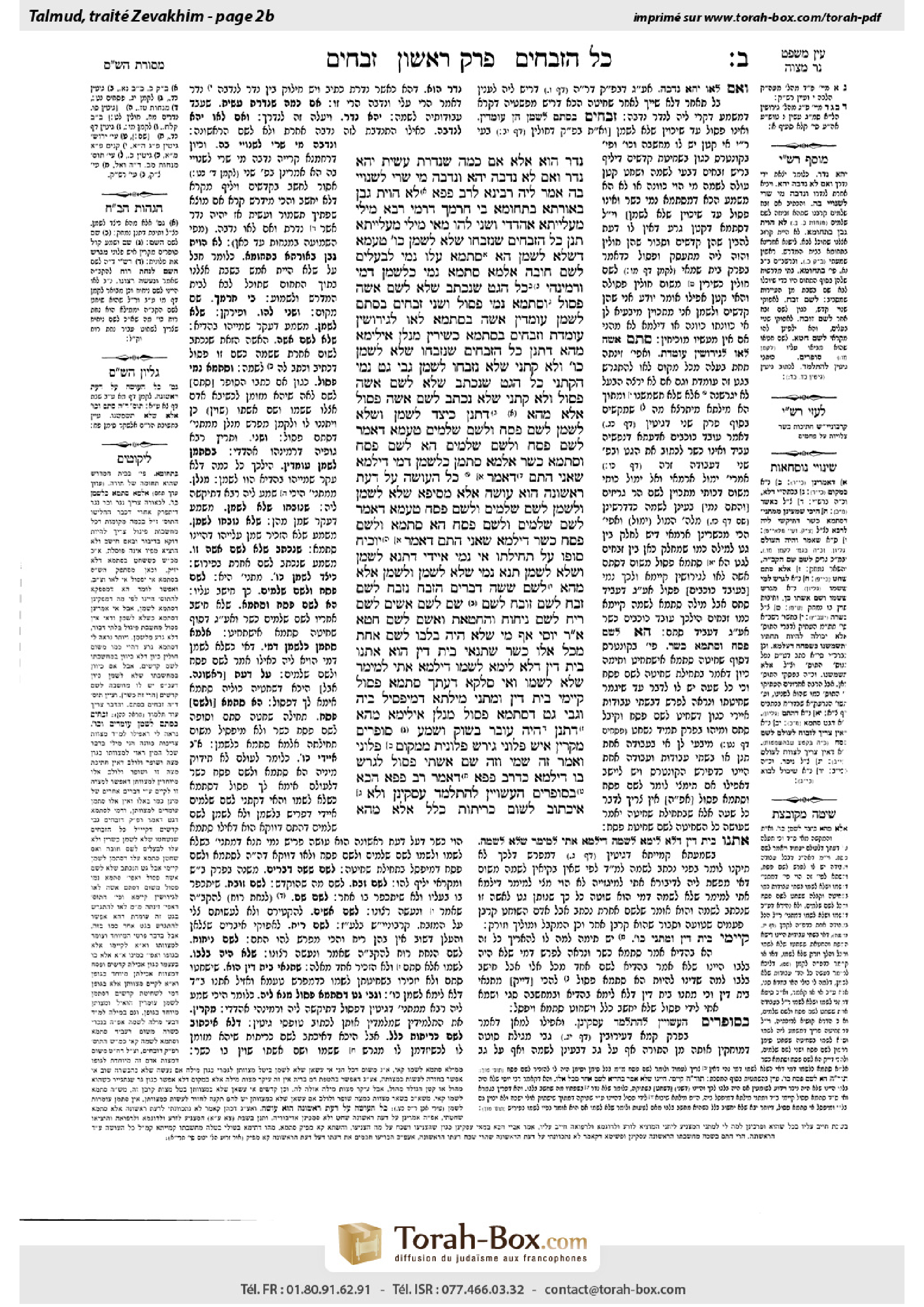
Zevachim 2b: Talmud study for Daf Yomi
Daf Yomi is the daily study of one Talmud folio. Explore 37 tractates with scans, Hebrew text, Sefaria English and AI-generated French translations where annotated.
Passage selection and English or AI-generated French translation are available where the scan has annotations. Daf Study is independent of Torah-Box and Sefaria.
Browse Zevachim · זבחים · All tractatesZevachim 2b text and translations
This page of Zevachim includes the Aramaic text, an English translation and an AI-generated French translation, alongside the scan above.
זבחים ב׳ ב · Aramaic and Hebrew text
נֶדֶר הוּא! אֶלָּא אִם כְּמָה שֶׁנָּדַרְתָּ עָשִׂיתָ – יְהֵא נֶדֶר, וְאִם לֹא – נְדָבָה יְהֵא;
וּנְדָבָה מִי שְׁרֵי לְשַׁנּוֹיֵי בַּהּ?
אֲמַר לֵיהּ רָבִינָא לָרַב פָּפָּא: לָא הֲוֵית גַּבַּן בְּאוּרְתָּא בִּתְחוּמָא בֵּי חַרְמָךְ – דְּרָמֵי רָבָא מִילֵּי מְעַלְּיָיתָא אַהֲדָדֵי, וְשַׁנִּי לְהוּ.
מַאי מִילֵּי מְעַלְּיָיתָא? תְּנַן: כׇּל הַזְּבָחִים שֶׁנִּזְבְּחוּ שֶׁלֹּא לִשְׁמָן כּוּ׳. טַעְמָא דְּשֶׁלֹּא לִשְׁמָן; הָא סְתָמָא – עָלוּ נָמֵי לַבְּעָלִים לְשֵׁם חוֹבָה; אַלְמָא סְתָמָא נָמֵי כְּלִשְׁמָן דָּמֵי.
וּרְמִינְהִי: כׇּל הַגֵּט שֶׁנִּכְתַּב שֶׁלֹּא לְשֵׁם אִשָּׁה – פָּסוּל. וּסְתָמָא נָמֵי פָּסוּל!
וְשַׁנִּי: זְבָחִים – בִּסְתָם לִשְׁמָן עוֹמְדִין, אִשָּׁה – בִּסְתָמָא לָאו לְגֵירוּשִׁין עוֹמֶדֶת.
וּזְבָחִים בִּסְתָמָא כְּשֵׁירִין מְנָלַן? אִילֵּימָא מֵהָא דִּתְנַן: כׇּל הַזְּבָחִים שֶׁנִּזְבְּחוּ שֶׁלֹּא לִשְׁמָן כּוּ׳ – וְלָא קָתָנֵי ״שֶׁלֹּא נִזְבְּחוּ לִשְׁמָן״; גַּבֵּי גֵּט נָמֵי, הָקָתָנֵי: כׇּל הַגֵּט שֶׁנִּכְתַּב שֶׁלֹּא לְשֵׁם אִשָּׁה פָּסוּל – וְלָא קָתָנֵי ״שֶׁלֹּא נִכְתַּב לְשֵׁם אִשָּׁה פָּסוּל״!
אֶלָּא מֵהָא דִּתְנַן: כֵּיצַד לִשְׁמָן וְשֶׁלֹּא לִשְׁמָן? לְשֵׁם פֶּסַח וּלְשֵׁם שְׁלָמִים. טַעְמָא דְּאָמַר לְשֵׁם פֶּסַח וּלְשֵׁם שְׁלָמִים, הָא לְשֵׁם פֶּסַח וּסְתָמָא – כָּשֵׁר; אַלְמָא סְתָמָן כְּלִשְׁמָן דְּמֵי.
דִּילְמָא שָׁאנֵי הָתָם, דְּאָמַר: כׇּל הָעוֹשֶׂה – עַל דַּעַת רִאשׁוֹנָה הוּא עוֹשֶׂה!
אֶלָּא מִסֵּיפָא: שֶׁלֹּא לִשְׁמָן וְלִשְׁמָן – לְשֵׁם שְׁלָמִים וּלְשֵׁם פֶּסַח. טַעְמָא דְּאָמַר לְשֵׁם שְׁלָמִים וּלְשֵׁם פֶּסַח, הָא סְתָמָא וּלְשֵׁם פֶּסַח – כָּשֵׁר.
דִּילְמָא שָׁאנֵי הָתָם, דְּאָמַר: יוֹכִיחַ סוֹפוֹ עַל תְּחִילָּתוֹ!
אִי נָמֵי, אַיְּידֵי דִּתְנָא ״לִשְׁמָן וְשֶׁלֹּא לִשְׁמָן״, תְּנָא נָמֵי ״שֶׁלֹּא לִשְׁמָן וְלִשְׁמָן״!
אֶלָּא מֵהָא: לְשֵׁם שִׁשָּׁה דְּבָרִים הַזֶּבַח נִזְבָּח – לְשֵׁם זֶבַח, לְשֵׁם זוֹבֵחַ, לְשֵׁם שֵׁם, לְשֵׁם אִשִּׁים, לְשֵׁם רֵיחַ, לְשֵׁם נִיחוֹחַ. וְהַחַטָּאת וְאָשָׁם – לְשֵׁם חֵטְא.
אָמַר רַבִּי יוֹסֵי: אַף מִי שֶׁלֹּא הָיָה בְּלִבּוֹ לְשֵׁם אַחַת מִכׇּל אֵלּוּ – כָּשֵׁר, שֶׁתְּנַאי בֵּית דִּין הוּא. אַתְנוֹ בֵּית דִּין דְּלָא לֵימָא ״לִשְׁמוֹ״, דִּילְמָא אָתֵי לְמֵימַר ״שֶׁלֹּא לִשְׁמוֹ״.
וְאִי סָלְקָא דַעְתָּךְ סְתָמָא פָּסוּל, קָיְימִי בֵּית דִּין וּמַתְנִי מִילְּתָא דְּמִיפְּסִיל בֵּיהּ?!
וְגַבֵּי גֵּט דִּסְתָמָא פָּסוּל – מְנָלַן?
אִילֵּימָא מֵהָא דִּתְנַן: הָיָה עוֹבֵר בַּשּׁוּק, וְשָׁמַע סוֹפְרִים מַקְרִין: ״אִישׁ פְּלוֹנִי גֵּירַשׁ פְּלוֹנִית מִמָּקוֹם פְּלוֹנִי״, וְאָמַר: ״זֶה שְׁמִי וְזֶה שֵׁם אִשְׁתִּי״ – פָּסוּל לְגָרֵשׁ בּוֹ.
דִּילְמָא כִּדְרַב פָּפָּא – דְּאָמַר רַב פָּפָּא: הָכָא בְּסוֹפְרִים הָעֲשׂוּיִין לְהִתְלַמֵּד עָסְקִינַן; וְלָא אִיכְּתוּב לְשׁוּם כְּרִיתוּת כְּלָל!
אֶלָּא מֵהָא:
Zevachim 2b · English translation
It is already referred to as a vow offering [neder]. Rather, the verse indicates that if you did what you vowed to do, i.e., you sacrificed your vow offering properly, it shall be a satisfactory vow offering; and if you did not sacrifice it properly, it shall be rendered a voluntary gift offering unrelated to the vow, and shall not satisfy the obligation of your vow.
The Gemara concludes: And is it permitted to deviate from protocol in the sacrifice of a gift offering ab initio? Clearly it is not. Evidently, even if one of the sacrificial rites was performed for the sake of sacrificing a different offering, it is still prohibited to perform any of the other sacrificial rites in the incorrect manner.
§ Ravina said to Rav Pappa: Since you were not with us last night within the Shabbat limit of Bei Ḥarmakh, you did not hear that Rava raises a contradiction between two superior mishnaic statements and teaches their resolution.
What are these superior statements? We learned in the mishna: All slaughtered offerings that were slaughtered not for their sake are fit, but they did not satisfy the obligation of the owner. Rava infers: The reason they do not satisfy the obligation of the owner is specifically that they were slaughtered not for their sake. But if offerings were slaughtered without specification of intent, they, as well, satisfied the obligation of the owner. Apparently, if one performs any action without specification of intent, it is also considered as if he performed it expressly for its sake.
And Rava raises a contradiction from another mishna (Gittin 24a): Any bill of divorce that was written not for the sake of the woman in question is not valid. And it is derived from the continuation of that mishna that if a bill of divorce was written without specification as to which woman it is referring, it is also not valid.
And Rava resolves the contradiction: Ordinary slaughtered offerings stand designated for their own sake. From the time that the offering is consecrated, its presumed end is that it will be slaughtered for the type of offering for which is was consecrated. Therefore, even if the one slaughtering it has no particular intention, it is in effect considered slaughtered for its own sake. By contrast, an ordinary wife does not stand designated for divorce. Therefore, a bill of divorce is never presumed to be referring to a given woman unless it is specified explicitly.
§ The Gemara asks: And from where do we derive that slaughtered offerings are fit and even satisfy the obligation of the owner if slaughtered without specification? If we say it is from that which we learned in the mishna: All slaughtered offerings that were slaughtered not for their sake are fit, but these offerings did not satisfy the obligation of the owner, and it does not teach this using the language: All slaughtered offerings that were not slaughtered for their sake are fit, but these offerings did not satisfy the obligation of the owner, this cannot be. One cannot infer from this language that slaughter without specification is valid, since the Mishna also teaches with regard to a bill of divorce: Any bill of divorce that was written not for the sake of the woman is not valid, and it does not teach: That was not written for the sake of the woman is not valid, and it is a given that a bill of divorce written without specification is not valid.
Rather, perhaps it is derived from that which we learned in a mishna (13a): How are offerings slaughtered for their sake and then not for their sake? For example, one might slaughter the Paschal offering for the sake of a Paschal offering and then for the sake of a peace offering. The Gemara infers: The reason such an offering is unfit is that he says that he is slaughtering it for the sake of a Paschal offering and then he says that he is slaughtering it for the sake of a peace offering. But if he says that he is slaughtering it for the sake of a Paschal offering, and then slaughters it without specification, it is fit. Apparently, slaughtering an offering without specification is considered as if one slaughtered it for its sake.
The Gemara responds: Perhaps there it is different, as the mishna is saying that anyone who performs an action performs it with his original intent in mind. Therefore, since he specified initially that he was slaughtering the offering for the sake of a Paschal offering, there are no grounds to assume that he then changed his mind. Here, by contrast, he pronounced no initial statement of proper intent.
Rather, perhaps this halakha is derived from the latter clause of that mishna: How are offerings slaughtered not for their sake and then for their sake? For example, one might slaughter the Paschal offering for the sake of a peace offering and then for the sake of a Paschal offering. The Gemara infers: The reason it is unfit is that he says he is slaughtering it for the sake of a peace offering and then he says he is slaughtering it for the sake of a Paschal offering. But if he started slaughtering it without specification and then slaughtered it for the sake of a Paschal offering, it is fit. Apparently, if one slaughters an offering without specification it still satisfies the obligation of the owner.
The Gemara responds: Perhaps there it is different, as the mishna is saying that his ultimate intent proves the nature of his original intent. Since his ultimate intent was to sacrifice a Paschal offering, that was presumably his original intent as well. Here, by contrast, there is no ultimate expression of proper intent.
Alternatively, it can be explained that even if one’s ultimate intent is not considered proof of his original intent, the mishna still uses the same term in both clauses to preserve symmetry. Since in the former clause the tanna taught using the language: For their sake and then not for their sake, teaching that original intent is considered proof of ultimate intent, the tanna also taught the second clause using the language: Not for their sake and then for their sake. In any event, there is no proof from that mishna that an offering slaughtered without specification satisfies its owner’s obligation.
Rather, perhaps this halakha is derived from that mishna (46b), which states: The offering is slaughtered for the sake of six matters: For the sake of the particular offering; for the sake of the one sacrificing the offering, i.e., the owner; for the sake of God; for the sake of consumption by the fires of the altar; for the sake of sacrificing it in a manner that gives an aroma; and for the sake of pleasing God. And the sin offering and a guilt offering are slaughtered for the sake of atonement for the sin.
The mishna on 46b continues: Rabbi Yosei said: Even in the case of one who did not have in mind to slaughter the offering for the sake of any one of these, the offering is fit, since this is a stipulation of the court. The Gemara explains Rabbi Yosei’s opinion: The court stipulated that one should not say that he is slaughtering the offering for its sake, lest he come to say that he is slaughtering it not for its sake. Therefore one should not specify his intent at all.
The Gemara infers: And if it enters your mind that if one slaughters an offering without specification it is unfit, would the court arise and stipulate a matter that disqualifies the offering? Clearly, an offering slaughtered without specification is fit and satisfies the obligation of the owner.
§ The Gemara asks: And with regard to a bill of divorce, from where do we derive that if it is written without specification as to which woman it is referring, it is not valid?
If we say it is inferred from that which we learned in a mishna (Gittin 24a): In the case of a man who was passing through the marketplace, and he heard scribes who write bills of divorce dictating to their students: The man so-and-so divorces so-and-so from the place of such and such, and the man said: This is my name and that is the name of my wife, and he desires to use this bill for his divorce, this bill is unfit to divorce his wife with it, that is not a proof.
It can be explained: Perhaps the mishna is in accordance with the explanation of Rav Pappa. As Rav Pappa says: Here we are dealing with scribes who are wont to practice writing bills of divorce; and this bill of divorce is a draft and was not written for the sake of severance, i.e., divorce, at all. But if a bill of divorce is written to be used for divorce, perhaps it is fit even if written without specifying the woman in question.
Rather, derive this halakha from the subsequent clause in that mishna:
Zevachim 2b · Traduction française (IA)
Il est déjà désigné comme une offrande votive [neder]. Le verset indique plutôt que si tu as accompli ce que tu as voué, c’est-à-dire si tu as offert correctement ton offrande votive, celle-ci sera une offrande votive agréée ; mais si tu ne l’as pas offerte correctement, elle sera considérée comme une offrande volontaire sans rapport avec le vœu et ne satisfera pas à l’obligation découlant de celui-ci.
La Guemara conclut : est-il permis de déroger d’emblée au protocole lors du sacrifice d’une offrande volontaire ? Certainement pas. Il apparaît donc que même si l’un des rites sacrificiels a été accompli avec l’intention d’offrir un autre sacrifice, il reste interdit d’accomplir les autres rites sacrificiels de manière incorrecte.
§ Ravina dit à Rav Pappa : Puisque tu n’étais pas avec nous hier soir, dans le périmètre sabbatique de Bei Ḥarmakh, tu n’as pas entendu que Rava soulève une contradiction entre deux énoncés remarquables de la Michna et enseigne comment la résoudre.
Quels sont ces énoncés remarquables ? Nous avons appris dans la Michna : Tous les sacrifices abattus sans que ce soit pour leur propre compte sont valides, mais ils n’ont pas acquitté l’obligation de leur propriétaire. Rava en déduit que la raison pour laquelle ils n’acquittent pas l’obligation de leur propriétaire tient précisément au fait qu’ils ont été abattus sans que ce soit pour leur propre compte. Mais si des sacrifices ont été abattus sans intention déterminée, ils ont eux aussi acquitté l’obligation de leur propriétaire. Apparemment, toute action accomplie sans intention déterminée est également considérée comme ayant été accomplie expressément pour son propre compte.
Rava soulève une contradiction à partir d’une autre Michna (Guittin 24a) : Tout acte de divorce qui a été rédigé sans que ce soit pour la femme concernée n’est pas valide. Or, il ressort de la suite de cette Michna que si un acte de divorce a été rédigé sans préciser de quelle femme il s’agit, il n’est pas valide non plus.
Rava résout la contradiction : les sacrifices ordinaires sont présumés destinés à être offerts pour leur propre compte. Dès qu’un sacrifice est consacré, on présume qu’il sera abattu selon le type de sacrifice pour lequel il a été consacré. Par conséquent, même si celui qui l’abat n’a pas d’intention particulière, on considère en pratique qu’il a été abattu pour son propre compte. En revanche, une femme ordinaire n’est pas présumée destinée au divorce. On ne présume donc jamais qu’un acte de divorce concerne une femme donnée, à moins que cela soit explicitement précisé.
§ La Guemara demande : Et d’où déduisons-nous que les sacrifices abattus sans intention déterminée sont valides et acquittent même l’obligation de leur propriétaire ? Si nous disons que cela découle de ce que nous avons appris dans la Michna : « Tous les sacrifices abattus sans que ce soit pour leur propre compte sont valides, mais ils n’ont pas acquitté l’obligation de leur propriétaire », et que la Michna ne formule pas cela ainsi : « Tous les sacrifices qui n’ont pas été abattus pour leur propre compte sont valides, mais ils n’ont pas acquitté l’obligation de leur propriétaire », cela ne peut pas être. On ne peut déduire de cette formulation que l’abattage sans intention déterminée est valide, puisque la Michna dit aussi, à propos d’un acte de divorce : « Tout acte de divorce rédigé sans que ce soit pour la femme concernée n’est pas valide », et non : « Tout acte de divorce qui n’a pas été rédigé pour la femme concernée n’est pas valide », alors qu’il va de soi qu’un acte de divorce rédigé sans intention déterminée n’est pas valide.
Peut-être cela découle-t-il plutôt de ce que nous avons appris dans une Michna (13a) : Comment des sacrifices peuvent-ils être abattus d’abord pour leur propre compte, puis non pour leur propre compte ? Par exemple, on peut abattre le sacrifice pascal pour un sacrifice pascal, puis pour un sacrifice de paix. La Guemara en déduit que la raison pour laquelle un tel sacrifice est invalide est qu’il dit qu’il l’abat pour un sacrifice pascal, puis qu’il dit qu’il l’abat pour un sacrifice de paix. Mais s’il dit qu’il l’abat pour un sacrifice pascal, puis l’abat sans intention déterminée, le sacrifice est valide. Apparemment, abattre un sacrifice sans intention déterminée est considéré comme l’avoir abattu pour son propre compte.
La Guemara répond : Peut-être le cas est-il différent, car la Michna veut dire que quiconque accomplit une action la fait en gardant à l’esprit son intention initiale. Par conséquent, puisqu’il a précisé au départ qu’il abattait le sacrifice pour un sacrifice pascal, rien ne permet de supposer qu’il a ensuite changé d’avis. Ici, en revanche, il n’a formulé au départ aucune déclaration exprimant une intention correcte.
Peut-être cette halakha découle-t-elle plutôt de la dernière clause de cette Michna : Comment des sacrifices peuvent-ils être abattus d’abord non pour leur propre compte, puis pour leur propre compte ? Par exemple, on peut abattre le sacrifice pascal pour un sacrifice de paix, puis pour un sacrifice pascal. La Guemara en déduit que la raison pour laquelle il est invalide est qu’il dit qu’il l’abat pour un sacrifice de paix, puis qu’il dit qu’il l’abat pour un sacrifice pascal. Mais s’il a commencé à l’abattre sans intention déterminée, puis l’a abattu pour un sacrifice pascal, le sacrifice est valide. Apparemment, si l’on abat un sacrifice sans intention déterminée, il acquitte néanmoins l’obligation de son propriétaire.
La Guemara répond : Peut-être le cas est-il différent, car la Michna veut dire que son intention finale prouve la nature de son intention initiale. Puisque son intention finale était d’offrir un sacrifice pascal, c’était vraisemblablement aussi son intention initiale. Ici, en revanche, aucune intention correcte n’est exprimée à la fin.
On peut aussi expliquer que, même si l’intention finale d’une personne n’est pas considérée comme une preuve de son intention initiale, la Michna emploie néanmoins les mêmes termes dans les deux clauses afin de préserver la symétrie. Puisque, dans la première clause, le tanna a formulé ainsi : « pour leur propre compte, puis non pour leur propre compte », enseignant que l’intention initiale est considérée comme une preuve de l’intention finale, le tanna a également formulé la deuxième clause ainsi : « non pour leur propre compte, puis pour leur propre compte ». Quoi qu’il en soit, cette Michna ne prouve pas qu’un sacrifice abattu sans intention déterminée acquitte l’obligation de son propriétaire.
Peut-être cette halakha découle-t-elle plutôt de cette Michna (46b), qui énonce : Le sacrifice est abattu en vue de six choses : en vue du sacrifice concerné ; en vue de celui qui offre le sacrifice, c’est-à-dire son propriétaire ; en vue de Dieu ; en vue de la consommation par les feux de l’autel ; en vue de l’offrir de manière à produire un parfum agréable ; et en vue d’être agréé par Dieu. Le sacrifice expiatoire et le sacrifice de culpabilité sont abattus en vue d’expier la faute.
La Michna de 46b poursuit : Rabbi Yossei a dit : Même dans le cas de quelqu’un qui n’avait pas l’intention d’abattre le sacrifice en vue de l’une de ces choses, le sacrifice est valide, car telle est la stipulation du tribunal. La Guemara explique l’opinion de Rabbi Yossei : le tribunal a stipulé qu’on ne devait pas dire qu’on abat le sacrifice pour son propre compte, de peur qu’on en vienne à dire qu’on l’abat non pour son propre compte. Il faut donc ne préciser aucune intention.
La Guemara en déduit : si l’on pensait qu’un sacrifice abattu sans intention déterminée est invalide, le tribunal se lèverait-il pour stipuler une règle qui invalide le sacrifice ? Il est évident qu’un sacrifice abattu sans intention déterminée est valide et acquitte l’obligation de son propriétaire.
§ La Guemara demande : Et concernant un acte de divorce, d’où déduisons-nous que s’il est rédigé sans préciser de quelle femme il s’agit, il n’est pas valide ?
Si nous disons que cela se déduit de ce que nous avons appris dans une Michna (Guittin 24a) : dans le cas d’un homme qui traversait le marché et entendit des scribes rédiger des actes de divorce en dictant à leurs élèves : « Un tel divorce une telle, depuis tel endroit », et que cet homme dit : « Voici mon nom, et celui-là est le nom de ma femme », souhaitant utiliser cet acte pour divorcer d’elle, cet acte ne convient pas pour divorcer de sa femme ; cela ne constitue pas une preuve.
On peut expliquer que la Michna suit l’interprétation de Rav Pappa. En effet, Rav Pappa dit : Ici, nous parlons de scribes qui ont l’habitude de s’exercer à rédiger des actes de divorce ; cet acte de divorce est un brouillon et n’a aucunement été rédigé en vue d’une séparation, c’est-à-dire d’un divorce. Mais si un acte de divorce est rédigé en vue d’être utilisé pour un divorce, il est peut-être valide même s’il a été rédigé sans préciser la femme concernée.
Il faut plutôt déduire cette halakha de la clause suivante de cette Michna :
Traduction française générée par IA à partir de l’édition anglaise de Sefaria. Vérifie toujours un passage avec le texte source.
Text from Sefaria: William Davidson Edition - Vocalized Aramaic (CC BY NC); William Davidson Edition - English (CC BY NC).