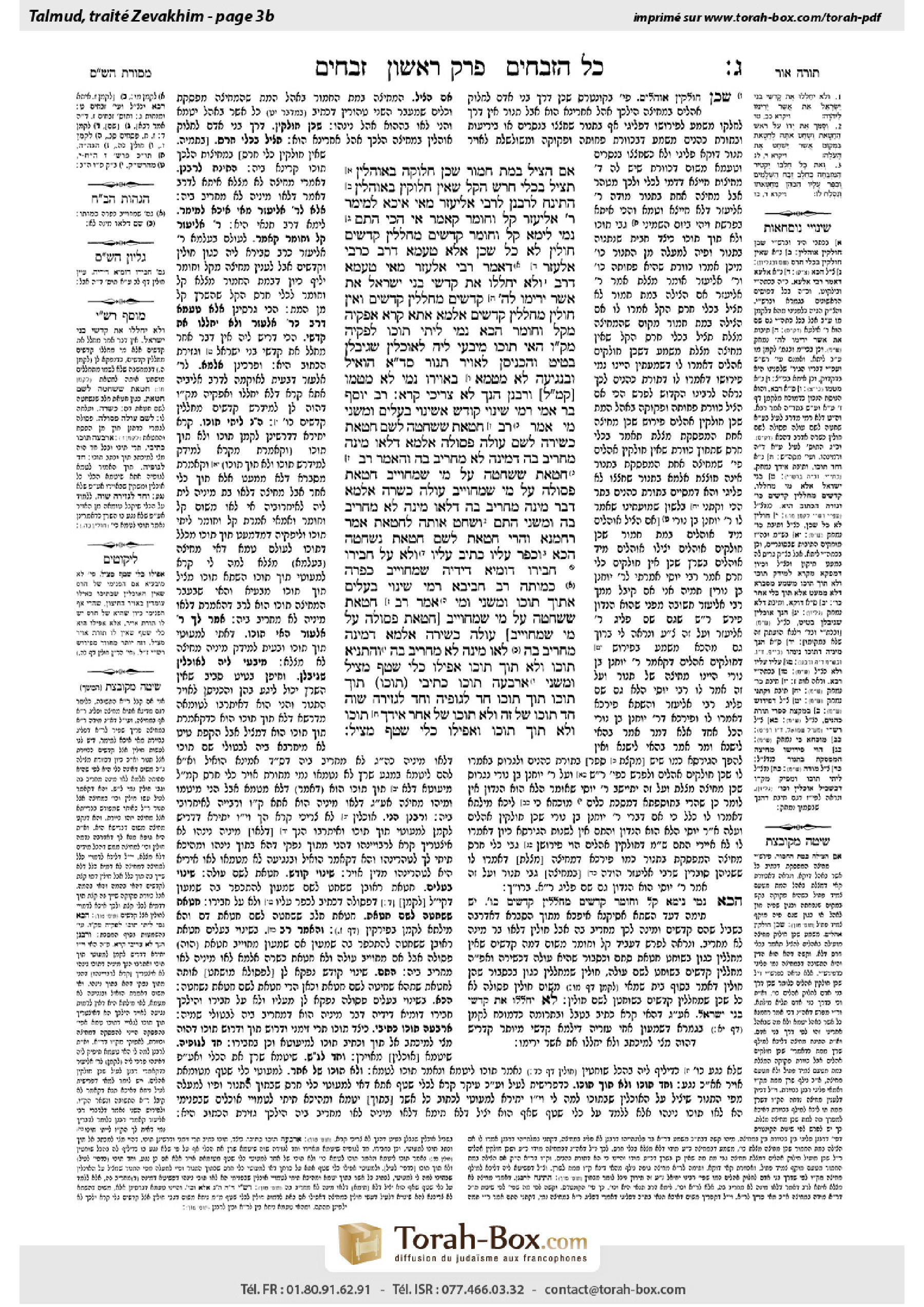
Zevachim 3b: Talmud study for Daf Yomi
Daf Yomi is the daily study of one Talmud folio. Explore 37 tractates with scans, Hebrew text, Sefaria English and AI-generated French translations where annotated.
Passage selection and English or AI-generated French translation are available where the scan has annotations. Daf Study is independent of Torah-Box and Sefaria.
Browse Zevachim · זבחים · All tractatesZevachim 3b text and translations
This page of Zevachim includes the Aramaic text, an English translation and an AI-generated French translation, alongside the scan above.
זבחים ג׳ ב · Aramaic and Hebrew text
אִם הִצִּיל בְּמֵת חָמוּר – שֶׁכֵּן חֲלוּקָה בְּאוֹהָלִין, תַּצִּיל בִּכְלִי חֶרֶשׂ הַקַּל – שֶׁאֵין חֲלוּקִין בְּאוֹהָלִין.
הָתִינַח לְרַבָּנַן; לְרַבִּי אֱלִיעֶזֶר מַאי אִיכָּא לְמֵימַר?
רַבִּי אֱלִיעֶזֶר קַל וָחוֹמֶר קָאָמַר.
אִי הָכִי, הָתָם נָמֵי לֵימָא קַל וָחוֹמֶר: קֳדָשִׁים מְחַלְּלִין קֳדָשִׁים – חוּלִּין לֹא כׇּל שֶׁכֵּן?!
אֶלָּא טַעְמָא דְּרַב – כְּרַבִּי אֶלְעָזָר; דְּאָמַר רַבִּי אֶלְעָזָר: מַאי טַעְמָא דְּרַב? ״וְלֹא יְחַלְּלוּ אֶת קׇדְשֵׁי בְּנֵי יִשְׂרָאֵל אֵת אֲשֶׁר יָרִימוּ לַה׳״ – קֳדָשִׁים מְחַלְּלִין קֳדָשִׁים, וְאֵין חוּלִּין מְחַלְּלִין קֳדָשִׁים.
אַלְמָא אֲתָא קְרָא אַפְּקֵיהּ מִקַּל וָחוֹמֶר; הָכָא נָמֵי – לֵיתֵי ״תּוֹכוֹ״ לַפְּקֵיהּ מִקַּל וָחוֹמֶר!
הַאי ״תּוֹכוֹ״ – מִיבְּעֵי לֵיהּ לָאֳוכָלִין שֶׁגִּיבְּלָן בְּטִיט, וְהִכְנִיסָן לַאֲוִיר תַּנּוּר. סָלְקָא דַּעְתָּךְ אָמֵינָא: הוֹאִיל וּבִנְגִיעָה לֹא מְטַמֵּא, בַּאֲוִירוֹ נָמֵי לָא מְטַמּוּ [קָא מַשְׁמַע לַן].
וְרַבָּנַן – הָנָךְ לָא צְרִיכִי קְרָא.
רַב יוֹסֵף בַּר אַמֵּי רָמֵי שִׁינּוּי קוֹדֶשׁ אַשִּׁינּוּי בְּעָלִים, וּמְשַׁנֵּי.
מִי אָמַר רַב: חַטָּאת שֶׁשְּׁחָטָהּ לְשֵׁם חַטַּאת – כְּשֵׁירָה, לְשֵׁם עוֹלָה – פְּסוּלָה; אַלְמָא דְּלָאו מִינַהּ מַחֲרִיב בַּהּ, דְּמִינַהּ לָא מַחֲרִיב בַּהּ?!
וְהָאָמַר רַב: חַטָּאת שֶׁשְּׁחָטָהּ עַל מִי שֶׁמְּחוּיָּיב חַטָּאת – פְּסוּלָה, עַל מִי שֶׁמְּחוּיָּיב עוֹלָה – כְּשֵׁרָה; אַלְמָא דְּבַר מִינַהּ מַחֲרִיב בַּהּ, דְּלָאו מִינַהּ לָא מַחֲרִיב בַּהּ!
וּמְשַׁנֵּי: הָתָם ״וְשָׁחַט אֹתָהּ לְחַטָּאת״ אָמַר רַחֲמָנָא, וַהֲרֵי חַטָּאת לְשֵׁם חַטָּאת נִשְׁחֲטָה.
הָכָא ״וְכִפֶּר עָלָיו״ כְּתִיב – עָלָיו וְלֹא עַל חֲבֵירוֹ; חֲבֵירוֹ דּוּמְיָא דִידֵיהּ, שֶׁמְּחוּיָּיב כַּפָּרָה כְּמוֹתָהּ.
רַב חֲבִיבָא רָמֵי שִׁינּוּי בְּעָלִים אַתּוֹךְ תּוֹכוֹ, וּמְשַׁנֵּי.
וּמִי אָמַר רַב: חַטָּאת שֶׁשְּׁחָטָהּ עַל מִי שֶׁמְּחוּיָּיב [חַטָּאת – פְּסוּלָה, עַל מִי שֶׁמְּחוּיָּיב] עוֹלָה – כְּשֵׁירָה; אַלְמָא דְּמִינַהּ מַחֲרִיב בַּהּ, לָאו מִינַהּ לָא מַחֲרִיב בַּהּ?!
וְהָתַנְיָא: ״תּוֹכוֹ״ – וְלֹא תּוֹךְ תּוֹכוֹ, אֲפִילּוּ כְּלִי שֶׁטֶף מַצִּיל!
וּמְשַׁנֵּי: אַרְבְּעָה ״תּוֹכוֹ״ כְּתִיבִי (תּוֹכוֹ) – ״תּוֹךְ״, ״תּוֹכוֹ״, ״תּוֹךְ״, ״תּוֹכוֹ״.
חַד – לְגוּפֵיהּ; וְחַד – לִגְזֵירָה שָׁוָה;
חַד – תּוֹכוֹ שֶׁל זֶה וְלֹא תּוֹכוֹ שֶׁל אַחֵר; אִידַּךְ – ״תּוֹכוֹ״ וְלֹא תּוֹךְ תּוֹכוֹ, וַאֲפִילּוּ כְּלִי שֶׁטֶף מַצִּיל.
Zevachim 3b · English translation
If a partition protects an item from impurity imparted by a corpse, which is severe, this is only because such impurity is unique in that it is imparted to that which is in the same tent, i.e., under the same roof, and tents are divided by partitions. If so, should a partition protect food from impurity imparted in an earthenware vessel, which, although mild, is not divided by partitions, like tents are?
The Gemara notes: The comparison between non-sacred meat vis-à-vis offerings and a partition in an earthenware vessel works out well according to the opinion of the Rabbis, who hold that a partition does not prevent transmission of impurity inside an earthenware vessel. But according to the opinion of Rabbi Eliezer, who maintains that a partition is effective in an earthenware oven, what can be said? How is this compatible with the principle that an item is not affected by something not of its type?
The Gemara responds: Rabbi Eliezer agrees with this principle. Yet he says that a partition in an earthenware vessel is effective due to his a fortiori inference, which overrides the principle that an item is not affected by something not of its type.
The Gemara challenges: If that is so, that an a fortiori inference overrides this principle, let us say an a fortiori inference there as well, with regard to a sin offering that was slaughtered for the consumption of non-sacred meat: If slaughtering sacrificial animals for the sake of other sacrificial animals desecrates those sacrificial animals, all the more so is it not clear that slaughtering them for the consumption of non-sacred meat desecrates them?
The Gemara responds: Rather, the reasoning behind the statement of Rav that a sin offering slaughtered for the consumption of non-sacred meat is fit is not in accordance with this principle at all, but it is in accordance with the opinion of Rabbi Elazar. As Rabbi Elazar says: What is the reasoning behind the statement of Rav? The verse: “And they shall not desecrate the sacred items of the children of Israel, which they set apart unto the Lord” (Leviticus 22:15), teaches that only improper intentions for the sake of sacred items, i.e., offerings, desecrate sacred items, but non-sacred intent does not desecrate sacred items.
The Gemara notes: Apparently, an inference from a verse can come to rule out a conflicting a fortiori inference. If so, here too, with regard to a partition in an oven, let the verse “and every earthen vessel into whose interior any of them falls” come to rule out Rabbi Eliezer’s a fortiori inference that a partition prevents food in an oven from becoming impure.
The Gemara responds: This expression: “Whose interior,” does not indicate that a partition is ineffective, as it is necessary to teach another halakha, namely, that food that one kneaded with clay, covering it from all sides, and put in the airspace of an oven that had the carcass of a creeping animal in it is impure. Because it might enter your mind to say that since the food cannot become impure by touching an impure item, as the clay serves as an interposition, it also cannot become impure by being put in the airspace of an impure oven. The phrase “in whose interior any of them falls” teaches us that the food does contract impurity.
The Gemara asks: And as for the Rabbis, who apparently do interpret the verse as teaching that a partition is ineffective in preventing the contracting of impurity in an earthenware vessel, how do they derive that food covered with clay and placed in an impure oven is impure? The Gemara answers: These matters do not need a verse to teach them. Such food has the same status as any other food in an impure oven, and the halakha therefore is self-evident.
§ Rav Yosef bar Ami raises a contradiction between Rav’s statement with regard to deviation with regard to the type of offering, i.e., slaughtering for the sake of a different type of offering, and Rav’s statement with regard to deviation with regard to the owner, i.e., slaughtering for the sake of someone other than the offering’s owner, and he then resolves the contradiction.
The contradiction is as follows: Did Rav say that a sin offering that one slaughtered for the sake of another sin offering, i.e., one that the owner is obligated to bring for a different transgression, is fit, but that if one slaughtered it for the sake of a burnt offering it is unfit? Apparently, slaughtering an offering with an improper intention not of its type ruins it; whereas intent that is of its type does not ruin it.
But doesn’t Rav say that a sin offering that one slaughtered for a person who is not its owner but who nevertheless is obligated to bring a sin offering is unfit, whereas if one slaughtered it for a person who is obligated to bring a burnt offering, it is fit? Apparently, an improper intention that is of its type ruins the offering, whereas intent not of its type does not ruin it.
And he resolves the contradiction as follows: There, with regard to deviation from the type of offering, the Merciful One states in the Torah: “And slaughter it for a sin offering” (Leviticus 4:33). And here a sin offering was slaughtered for the sake of a sin offering, and therefore although it was for the sake of a different sin offering, it remains fit.
Here, concerning deviation with regard to the owner, it is written in the Torah concerning a sin offering: “And he shall be forgiven” (Leviticus 4:26), indicating that specifically he, the owner, but not another person, shall be forgiven. Therefore, if a sin offering is slaughtered for the sake of another person, it is unfit. The other person to whom this is referring is presumably similar to him, the owner of the sin offering, in that he is obligated to make atonement similar to that of the owner. Therefore, if the other person is obligated to bring a burnt offering and not a sin offering, this disqualification does not apply.
§ Rav Ḥaviva raises a contradiction between Rav’s statement concerning deviation with regard to the owner and the aforementioned baraita concerning the interior of its interior, i.e., a vessel placed in an earthenware vessel, and resolves the contradiction.
The contradiction is as follows: But did Rav say that a sin offering that one slaughtered for a person other than its owner but who is also obligated to bring a sin offering is unfit, whereas if one slaughtered it for a person obligated to bring a burnt offering, it is fit? Apparently, an improper intention that is of its type ruins it, whereas intent that is not of its type does not ruin it.
But isn’t it taught in a baraita that if the carcass of a creeping animal is found inside an earthenware vessel, the vessel’s interior is rendered impure but not the interior of its interior, and even a vessel purified through rinsing, if placed in the earthenware vessel, protects food inside it from contracting impurity? Evidently, impurity in the airspace of an earthenware vessel can be contained by something not of its type.
And Rav Ḥaviva resolves the contradiction as follows: The expression: Whose interior [tokho], is written four times. In other words, in the verse: “And every earthen vessel into whose interior [tokho] any of them falls, anything that is in its interior [tokho] shall be impure” (Leviticus 11:33), the word tokho is mentioned twice, and each time, the verse could have written: The interior. Since the possessive: Its, is added to each instance, the verse is interpreted exegetically as though the word interior [tokh] were mentioned four times: Interior [tokh], whose interior [tokho], interior [tokh], and its interior [tokho].
One of these is necessary to teach the matter itself, that an impure earthenware vessel imparts impurity to food in its airspace; and one instance is used for a verbal analogy between the two instances of the word interior, from which it is derived that an earthenware vessel itself contracts impurity from impure items in its airspace.
One indicates that the interior airspace of this, i.e., an earthenware vessel, renders food impure, but not the interior of another type of vessel, which imparts impurity only through contact; and the other instance indicates that its interior, but not the interior of its interior, imparts impurity, and that even a vessel purified through rinsing, if placed in the earthenware vessel, protects food inside it from becoming impure. Consequently, it is derived from a verse that inside an earthenware vessel, other vessels not of its type can block the transmission of impurity. Since this halakha is derived from a verse written in that context, there is no reason to assume that a similar halakha would apply to slaughter.
Zevachim 3b · Traduction française (IA)
Si une cloison protège un objet contre l’impureté transmise par un cadavre, qui est grave, c’est uniquement parce que cette impureté a ceci de particulier qu’elle se transmet à ce qui se trouve sous la même tente, c’est-à-dire sous le même toit, et que les tentes sont séparées par des cloisons. Dans ce cas, une cloison devrait-elle protéger la nourriture contre l’impureté transmise dans un récipient en terre cuite, qui, bien que moins grave, n’est pas divisée par des cloisons, contrairement aux tentes ?
La Guemara fait remarquer : La comparaison entre la viande profane par rapport aux offrandes et une cloison dans un récipient en terre cuite fonctionne bien selon l’opinion des Rabbins, qui soutiennent qu’une cloison n’empêche pas la transmission de l’impureté à l’intérieur d’un récipient en terre cuite. Mais que peut-on dire selon l’opinion de Rabbi Eliezer, qui soutient qu’une cloison est efficace dans un four en terre cuite ? Comment cela s’accorde-t-il avec le principe selon lequel un objet n’est pas affecté par quelque chose qui n’est pas de son espèce ?
La Guemara répond : Rabbi Eliezer reconnaît ce principe. Pourtant, il affirme qu’une cloison dans un récipient en terre cuite est efficace en vertu de son raisonnement a fortiori, qui l’emporte sur le principe selon lequel un objet n’est pas affecté par quelque chose qui n’est pas de son espèce.
La Guemara objecte : Si tel est le cas, si un raisonnement a fortiori l’emporte sur ce principe, faisons aussi un raisonnement a fortiori dans ce cas, à propos d’un sacrifice expiatoire abattu en vue de la consommation de viande profane : si le fait d’abattre des animaux consacrés en vue d’autres animaux consacrés rend ces animaux consacrés impropres, à plus forte raison le fait de les abattre en vue de la consommation de viande profane ne les rend-il pas impropres ?
La Guemara répond : Il faut plutôt dire que la déclaration de Rav selon laquelle un sacrifice expiatoire abattu en vue de la consommation de viande profane est valide ne repose pas du tout sur ce principe, mais sur l’opinion de Rabbi Elazar. En effet, Rabbi Elazar dit : Quel est le fondement de la déclaration de Rav ? Le verset « Ils ne profaneront pas les choses saintes des enfants d’Israël, qu’ils prélèvent pour l’Éternel » (Lévitique 22,15) enseigne que seules des intentions inadéquates en vue de choses saintes, c’est-à-dire d’offrandes, profanent les choses saintes, tandis qu’une intention profane ne les profane pas.
La Guemara fait remarquer : Apparemment, une déduction tirée d’un verset peut écarter un raisonnement a fortiori contraire. Dans ce cas, ici aussi, à propos d’une cloison dans un four, que le verset « et tout récipient en terre cuite à l’intérieur duquel tombe l’un d’entre eux » serve à écarter le raisonnement a fortiori de Rabbi Eliezer, selon lequel une cloison empêche la nourriture dans un four de devenir impure.
La Guemara répond : L’expression « à l’intérieur duquel » n’indique pas qu’une cloison est inefficace ; elle est nécessaire pour enseigner une autre halakha, à savoir que la nourriture que l’on a pétrie avec de l’argile en la recouvrant de tous côtés, puis placée dans l’espace intérieur d’un four où se trouvait la carcasse d’un animal rampant, est impure. Car on aurait pu penser que, puisque cette nourriture ne peut pas devenir impure par contact avec un objet impur, l’argile faisant écran, elle ne peut pas non plus devenir impure en étant placée dans l’espace intérieur d’un four impur. L’expression « à l’intérieur duquel tombe l’un d’entre eux » nous enseigne que la nourriture contracte bien l’impureté.
La Guemara demande : Quant aux Rabbins, qui interprètent apparemment le verset comme enseignant qu’une cloison n’empêche pas la contraction de l’impureté dans un récipient en terre cuite, comment déduisent-ils que de la nourriture recouverte d’argile et placée dans un four impur est impure ? La Guemara répond : Il n’est pas nécessaire de recourir à un verset pour enseigner cela. Une telle nourriture a le même statut que toute autre nourriture se trouvant dans un four impur ; la halakha va donc de soi.
§ Rav Yosef bar Ami soulève une contradiction entre la déclaration de Rav concernant un écart quant au type d’offrande, c’est-à-dire le fait d’abattre un animal en vue d’un autre type d’offrande, et celle de Rav concernant un écart quant au propriétaire, c’est-à-dire le fait d’abattre un animal en vue d’une personne autre que le propriétaire de l’offrande, puis résout cette contradiction.
La contradiction est la suivante : Rav a-t-il dit qu’un sacrifice expiatoire abattu en vue d’un autre sacrifice expiatoire, c’est-à-dire d’un sacrifice que le propriétaire est tenu d’apporter pour une autre transgression, est valide, mais que, s’il est abattu en vue d’un holocauste, il est invalide ? Apparemment, abattre une offrande avec une intention inadéquate, en vue d’une offrande d’une autre espèce, la rend invalide, tandis qu’une intention en vue d’une offrande de la même espèce ne la rend pas invalide.
Mais Rav ne dit-il pas qu’un sacrifice expiatoire abattu pour une personne qui n’en est pas le propriétaire, mais qui est néanmoins tenue d’apporter un sacrifice expiatoire, est invalide, tandis que, s’il est abattu pour une personne tenue d’apporter un holocauste, il est valide ? Apparemment, une intention inadéquate en vue d’une offrande de la même espèce rend l’offrande invalide, tandis qu’une intention en vue d’une offrande d’une autre espèce ne la rend pas invalide.
Il résout la contradiction ainsi : Dans le premier cas, concernant un écart quant au type d’offrande, le Miséricordieux dit dans la Torah : « Et il l’abattra en sacrifice expiatoire » (Lévitique 4,33). Or, ici, un sacrifice expiatoire a été abattu en vue d’un sacrifice expiatoire ; même s’il s’agissait d’un autre sacrifice expiatoire, il reste donc valide.
Ici, concernant un écart quant au propriétaire, la Torah écrit au sujet d’un sacrifice expiatoire : « Et il lui sera pardonné » (Lévitique 4,26), ce qui indique que c’est précisément à lui, le propriétaire, et non à une autre personne, qu’il sera pardonné. Par conséquent, si un sacrifice expiatoire est abattu en vue d’une autre personne, il est invalide. Cette autre personne est vraisemblablement semblable au propriétaire du sacrifice expiatoire en ce qu’elle est tenue d’obtenir une expiation comparable à la sienne. Ainsi, si cette autre personne est tenue d’apporter un holocauste et non un sacrifice expiatoire, cette invalidation ne s’applique pas.
§ Rav Ḥaviva soulève une contradiction entre la déclaration de Rav concernant un écart quant au propriétaire et la baraïta susmentionnée concernant l’intérieur de l’intérieur, c’est-à-dire un récipient placé dans un récipient en terre cuite, puis résout cette contradiction.
La contradiction est la suivante : Rav a-t-il dit qu’un sacrifice expiatoire abattu pour une personne autre que son propriétaire, mais qui est elle aussi tenue d’apporter un sacrifice expiatoire, est invalide, tandis que, s’il est abattu pour une personne tenue d’apporter un holocauste, il est valide ? Apparemment, une intention inadéquate en vue d’une offrande de la même espèce le rend invalide, tandis qu’une intention en vue d’une offrande d’une autre espèce ne le rend pas invalide.
Mais n’est-il pas enseigné dans une baraïta que, si la carcasse d’un animal rampant se trouve à l’intérieur d’un récipient en terre cuite, l’intérieur du récipient devient impur, mais pas l’intérieur de l’intérieur ; et que même un récipient purifié par rinçage, s’il est placé dans le récipient en terre cuite, protège la nourriture qu’il contient de la contraction de l’impureté ? Il ressort de là que l’impureté présente dans l’espace intérieur d’un récipient en terre cuite peut être bloquée par un objet qui n’est pas de son espèce.
Rav Ḥaviva résout la contradiction ainsi : L’expression « son intérieur » [tokho] apparaît quatre fois. Autrement dit, dans le verset « Et tout récipient en terre cuite à l’intérieur duquel [tokho] tombe l’un d’entre eux, tout ce qui se trouve à l’intérieur [tokho] sera impur » (Lévitique 11,33), le mot tokho est mentionné deux fois, et chaque fois, le verset aurait pu dire « l’intérieur ». Puisque le possessif « son » est ajouté dans les deux occurrences, le verset est interprété comme si le mot « intérieur » [tokh] apparaissait quatre fois : « intérieur » [tokh], « son intérieur » [tokho], « intérieur » [tokh] et « son intérieur » [tokho].
L’une de ces occurrences est nécessaire pour enseigner la règle elle-même, à savoir qu’un récipient en terre cuite impur transmet l’impureté à la nourriture se trouvant dans son espace intérieur ; une autre sert à établir une analogie verbale entre les deux occurrences du mot « intérieur », d’où l’on déduit qu’un récipient en terre cuite lui-même contracte l’impureté au contact d’objets impurs se trouvant dans son espace intérieur.
Une occurrence indique que l’espace intérieur de ce récipient, c’est-à-dire d’un récipient en terre cuite, rend la nourriture impure, mais pas l’espace intérieur d’un récipient d’un autre type, qui ne transmet l’impureté que par contact. L’autre occurrence indique que l’intérieur de ce récipient, mais pas l’intérieur de son intérieur, transmet l’impureté, et qu’un récipient purifié par rinçage, même placé dans le récipient en terre cuite, protège la nourriture qu’il contient de la contamination. On déduit donc d’un verset qu’à l’intérieur d’un récipient en terre cuite, d’autres récipients qui ne sont pas de son espèce peuvent bloquer la transmission de l’impureté. Puisque cette halakha est déduite d’un verset écrit dans ce contexte, rien ne permet de supposer qu’une halakha semblable s’appliquerait à l’abattage.
Traduction française générée par IA à partir de l’édition anglaise de Sefaria. Vérifie toujours un passage avec le texte source.
Text from Sefaria: William Davidson Edition - Vocalized Aramaic (CC BY NC); William Davidson Edition - English (CC BY NC).