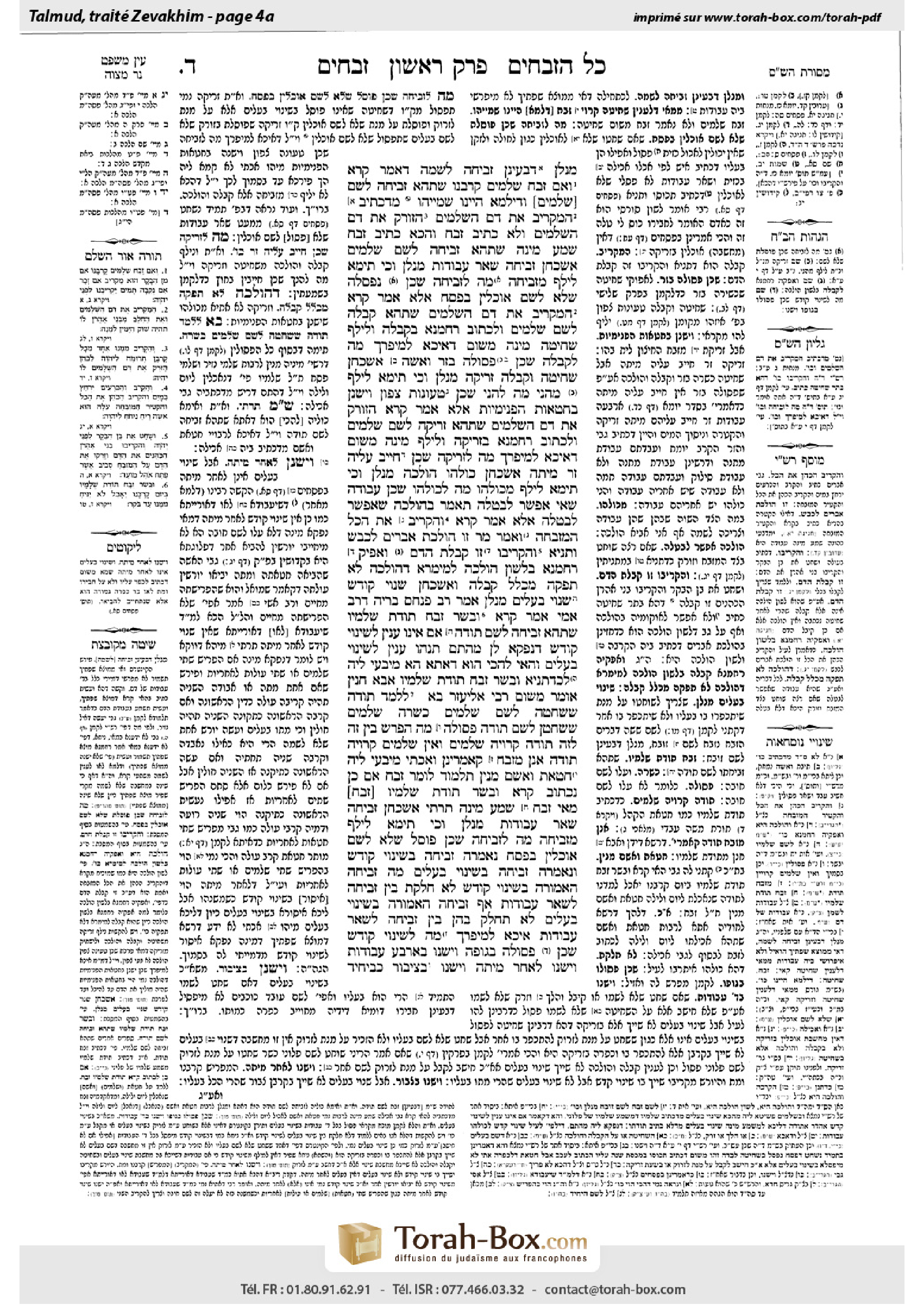
Zevachim 4a: Talmud study for Daf Yomi
Daf Yomi is the daily study of one Talmud folio. Explore 37 tractates with scans, Hebrew text, Sefaria English and AI-generated French translations where annotated.
Passage selection and English or AI-generated French translation are available where the scan has annotations. Daf Study is independent of Torah-Box and Sefaria.
Browse Zevachim · זבחים · All tractatesZevachim 4a text and translations
This page of Zevachim includes the Aramaic text, an English translation and an AI-generated French translation, alongside the scan above.
זבחים ד׳ א · Aramaic and Hebrew text
מְנָלַן דְּבָעֵינַן זְבִיחָה לִשְׁמָהּ? דְּאָמַר קְרָא: ״וְאִם זֶבַח שְׁלָמִים קׇרְבָּנוֹ״ – שֶׁתְּהֵא זְבִיחָה לְשֵׁם [שְׁלָמִים].
וְדִילְמָא הַיְינוּ שְׁמַיְיהוּ!
מִדִּכְתִיב ״הַמַּקְרִיב אֶת דַּם הַשְּׁלָמִים״, ״הַזּוֹרֵק אֶת דַּם הַשְּׁלָמִים״ – וְלָא כְּתִיב ״זֶבַח״; וְהָכָא כְּתִיב ״זֶבַח״; שְׁמַע מִינַּהּ: שֶׁתְּהֵא זְבִיחָה לְשֵׁם שְׁלָמִים.
אַשְׁכְּחַן זְבִיחָה, שְׁאָר עֲבוֹדוֹת מְנָלַן?
וְכִי תֵּימָא לֵילַף מִזְּבִיחָה; מָה לִזְבִיחָה – שֶׁכֵּן נִפְסְלָה שֶׁלֹּא לְשֵׁם אוֹכְלִין בַּפֶּסַח!
אֶלָּא אָמַר קְרָא: ״הַמַּקְרִיב אֶת דַּם הַשְּׁלָמִים״ – שֶׁתְּהֵא קַבָּלָה לְשֵׁם שְׁלָמִים.
וְלִכְתּוֹב רַחֲמָנָא בְּקַבָּלָה, וְלֵילַף שְׁחִיטָה מִינַּהּ!
מִשּׁוּם דְּאִיכָּא לְמִיפְרַךְ – מָה לְקַבָּלָה שֶׁכֵּן פְּסוּלָה בְּזָר וְאִשָּׁה.
אַשְׁכְּחַן שְׁחִיטָה וְקַבָּלָה, זְרִיקָה מְנָלַן?
וְכִי תֵּימָא לֵילַף מֵהָנֵי – מָה לְהָנֵי שֶׁכֵּן טְעוּנוֹת צָפוֹן, וְיֶשְׁנָן בְּחַטָּאוֹת הַפְּנִימִיּוֹת!
אֶלָּא אָמַר קְרָא: ״הַזּוֹרֵק אֶת דַּם הַשְּׁלָמִים״ – שֶׁתְּהֵא זְרִיקָה לְשֵׁם שְׁלָמִים.
וְלִכְתּוֹב רַחֲמָנָא בִּזְרִיקָה, וְלֵילַף מִינַּהּ!
מִשּׁוּם דְּאִיכָּא לְמִיפְרַךְ – מָה לִזְרִיקָה, שֶׁכֵּן חַיָּיב עָלֶיהָ זָר מִיתָה.
אַשְׁכְּחַן כּוּלְּהוּ, הוֹלָכָה מְנָלַן?
וְכִי תֵּימָא לֵילַף מִכּוּלְּהוּ; מָה לְכוּלְּהוּ – שֶׁכֵּן עֲבוֹדָה שֶׁאִי אֶפְשָׁר לְבַטְּלָהּ; תֹּאמַר בְּהוֹלָכָה – שֶׁאֶפְשָׁר לְבַטְּלָהּ?!
אֶלָּא אָמַר קְרָא: ״וְהִקְרִיב אֶת הַכֹּל הַמִּזְבֵּחָה״, וְאָמַר מָר: זוֹ הוֹלָכַת אֵבָרִים לַכֶּבֶשׁ; וְתַנְיָא: ״וְהִקְרִיבוּ״ – זוֹ קַבָּלַת הַדָּם; וְאַפֵּיק רַחֲמָנָא בִּלְשׁוֹן הוֹלָכָה – לְמֵימְרָא דְּהוֹלָכָה לָא תַּפְּקַהּ מִכְּלַל קַבָּלָה.
וְאַשְׁכְּחַן שִׁנּוּי קוֹדֶשׁ, שִׁנּוּי בְּעָלִים מְנָלַן?
אָמַר רַב פִּנְחָס בְּרֵיהּ דְּרַב אַמֵּי, אָמַר קְרָא: ״וּבְשַׂר זֶבַח תּוֹדַת שְׁלָמָיו״ – שֶׁתְּהֵא זְבִיחָה לְשֵׁם תּוֹדָה. אִם אֵינוֹ עִנְיָן לְשִׁינּוּי קוֹדֶשׁ – דְּנָפְקָא לַן מֵהָתָם; תְּנֵהוּ עִנְיָן לְשִׁינּוּי בְעָלִים.
וְהַאי לְהָכִי הוּא דַּאֲתָא?! הָא מִיבְּעֵי לֵיהּ לְכִדְתַנְיָא: ״וּבְשַׂר זֶבַח תּוֹדַת שְׁלָמָיו״ – אַבָּא חָנִין אוֹמֵר מִשּׁוּם רַבִּי אֱלִיעֶזֶר: בָּא לְלַמֵּד, תּוֹדָה שֶׁשְּׁחָטָהּ לְשֵׁם שְׁלָמִים – כְּשֵׁרָה, שְׁלָמִים שֶׁשְּׁחָטָן לְשֵׁם תּוֹדָה – פְּסוּלָה. מָה הֶפְרֵשׁ בֵּין זֶה לָזֶה? תּוֹדָה קְרוּיָה שְׁלָמִים, וְאֵין שְׁלָמִים קְרוּיִין תּוֹדָה.
אֲנַן מִ״זֶּבַח״ קָאָמְרִינַן.
וְאַכַּתִּי מִיבְּעֵי לֵיהּ: חַטָּאת וְאָשָׁם מִנַּיִן? תַּלְמוּד לוֹמַר ״זֶבַח״!
אִם כֵּן, נִכְתּוֹב קְרָא: ״וּבְשַׂר תּוֹדַת שְׁלָמָיו [זֶבַח]״; מַאי ״זֶבַח״? שְׁמַע מִינַּהּ תַּרְתֵּי.
אַשְׁכְּחַן זְבִיחָה, שְׁאָר עֲבוֹדוֹת מְנָלַן?
וְכִי תֵּימָא לֵילַף מִזְּבִיחָה – מָה לִזְבִיחָה שֶׁכֵּן פּוֹסֵל שֶׁלֹּא לְשֵׁם אוֹכְלִין בַּפֶּסַח!
נֶאֶמְרָה זְבִיחָה בְּשִׁינּוּי קוֹדֶשׁ, וְנֶאֶמְרָה זְבִיחָה בְּשִׁינּוּי בְעָלִים; מָה זְבִיחָה הָאֲמוּרָה בְּשִׁינּוּי קוֹדֶשׁ – לֹא חִלַּקְתָּ בֵּין זְבִיחָה לִשְׁאָר עֲבוֹדוֹת, אַף זְבִיחָה הָאֲמוּרָה בְּשִׁינּוּי בְעָלִים – לֹא תְּחַלֵּק בָּהֶן בֵּין זְבִיחָה לִשְׁאָר עֲבוֹדוֹת.
אִיכָּא לְמִיפְרַךְ: מָה לְשִׁינּוּי קוֹדֶשׁ – שֶׁכֵּן פְּסוּלָהּ בְּגוּפָהּ, וְיֶשְׁנוֹ בְּאַרְבַּע עֲבוֹדוֹת,
וְיֶשְׁנוֹ לְאַחַר מִיתָה, וְיֶשְׁנוֹ בְּצִיבּוּר כִּבְיָחִיד!
Zevachim 4a · English translation
§ The Gemara asks: From where do we derive that we require that an offering’s slaughter be performed for its own sake? It is derived from a verse, as the verse states: “And if his offering is a sacrifice [zevaḥ] of peace offerings” (Leviticus 3:1), teaching that slaughter [zeviḥa] must be performed for the sake of a peace offering.
The Gemara challenges: But perhaps when the verse states: “A sacrifice of peace offerings,” “a sacrifice of peace offerings” is simply the name of this type of offering, and is not referring to intent of the one slaughtering it.
The Gemara answers: From the fact that it is written in other verses: “Who offers the blood of the peace offering” (Leviticus 7:33), and: “Who sprinkles the blood of the peace offering” (Leviticus 7:14), and the term: A sacrifice [zevaḥ], is not written, whereas here, in this verse, the term: “A sacrifice [zevaḥ] of peace offerings,” is written, learn from it that the slaughter [zeviḥa] must be performed for the sake of a peace offering.
The Gemara asks: We found a source for the halakha that slaughter must be performed for the sake of the offering being sacrificed. From where do we derive that the other sacrificial rites, i.e., collecting the blood, conveying it to the altar, and sprinkling it on the altar, must also be performed for the sake of the offering?
And if you would say: Let us derive from the fact that slaughter must be performed for the sake of the offering that the other sacrificial rites must be performed for the sake of the offering as well, this derivation can be refuted, as slaughter has a unique element of stringency: What is unique about slaughter? It is unique in that with regard to a Paschal offering, the offering is disqualified if it is slaughtered not for the sake of those who eat it. If the Paschal offering is slaughtered for the sake of people who are incapable of eating it, such as one who is too ill to eat, it is disqualified. By contrast, performing other rites with this intent does not disqualify the offering. Therefore, one cannot assume that a halakha that applies to slaughter applies to other rites as well.
The Gemara answers: Rather, the verse states: “Who sacrifices [hamakriv] the blood of the peace offering” (Leviticus 7:33), referring to the one who collects the blood of the offering, as the Gemara will explain. This phrase indicates that the collection of the blood must be performed for the sake of a peace offering.
The Gemara challenges: And let the Merciful One write this halakha in the Torah only with regard to the collection of the blood, and we would derive from it that slaughter must also be performed for the sake of the offering.
The Gemara answers: Because such a derivation can be refuted as follows: What is unique about collection of the blood? It is unique in that it is not valid if performed by a non-priest or a woman, whereas slaughter can be performed by any competent Jew. Therefore, one cannot assume that a halakha that applies to collection applies to slaughter as well.
The Gemara asks: We found a source for the halakha that slaughter and collection of the blood must be performed for the sake of the offering. From where do we derive that this halakha applies to the sprinkling of the blood as well?
And if you would say: Let us derive from these rites, i.e., slaughter and collection, that this halakha applies to the sprinkling of the blood as well, this derivation can be refuted: What is unique about these rites? They are unique in that for offerings of the most sacred order, it is required that they be performed in the north of the Temple courtyard. And furthermore, these rites are performed in the sacrifice of inner sin offerings as well as standard sin offerings. The sprinkling of the blood on the external altar, by contrast, is performed in all portions of the Temple courtyard, and it is not performed in the sacrifice of inner sin offerings, whose blood is sprinkled only in the Sanctuary.
The Gemara answers: Rather, the verse states: “Who sprinkles the blood of the peace offering” (Leviticus 7:14), indicating that the sprinkling of the blood must be performed for the sake of a peace offering.
The Gemara challenges: And let the Merciful One write this halakha only with regard to sprinkling, and we would derive from it that it applies to slaughter and collection as well.
The Gemara answers: That would not be sufficient, because such a derivation can be refuted, as sprinkling has a unique element of stringency. What is unique about sprinkling? It is unique in that a non-priest is liable to be punished with death at the hand of Heaven for performing it.
The Gemara asks: We found a source for this halakha with regard to all four rites save conveying the blood to the altar. From where do we derive that this latter rite must also be performed for the sake of the offering?
And if you would say: Let us derive from all the other rites that conveying the blood must also be performed for the sake of the offering, this derivation can also be refuted: What is unique about all of the other rites? They are unique in that each of them is an indispensable rite. Would you say that any requirement that applies to those rites necessarily applies also with regard to conveying the blood, which is dispensable? If an offering is slaughtered by the side of the altar, it is unnecessary to convey its blood to the altar.
The Gemara answers: Rather, the verse states: “And the priest shall sacrifice [vehikriv] the whole, and make it smoke upon the altar” (Leviticus 1:13), and the Master said that this is referring to conveying the limbs of the offering to the ramp of the altar. And it is taught in a baraita with regard to the verse: “And Aaron’s sons, the priests, shall present [vehikrivu] the blood” (Leviticus 1:5), that this is referring to the collection of the blood. And one can infer that the Merciful One expresses collection of the blood in the same language used for conveying, to say that you should not exclude conveying from the category of collection of the blood. Therefore, the halakhot of collection apply to conveying.
The Gemara asks further: And we found a source for the halakha concerning deviation with regard to the type of offering, i.e., that an offering may not be slaughtered for the sake of a different type of offering. From where do we derive the halakha concerning deviation with regard to the owner, i.e., that an offering may not be slaughtered for the sake of one who is not the owner?
Rav Pinḥas, son of Rav Ami, says: The verse states with regard to a thanks offering: “And the meat of the sacrifice [zevaḥ] of his thanksgiving peace offering shall be eaten on the day of his offering” (Leviticus 7:15), apparently indicating that its slaughter [zeviḥa] must be performed for the sake of a thanks offering. And if this language is not needed for the matter of deviation with regard to the type of offering, and in fact it is not, as we already derived this halakha from there, i.e., the verse cited concerning peace offerings, apply it to the matter of deviation with regard to the owner. It is thereby derived that an offering must be slaughtered for the sake of its owner.
The Gemara asks: But does this verse come to teach this halakha? Isn’t it necessary for that which is taught in a baraita: Concerning the phrase “and the meat of the sacrifice of his thanksgiving peace offering,” Abba Ḥanin says in the name of Rabbi Eliezer: It comes to teach that a thanks offering that one slaughtered for the sake of a peace offering is fit; whereas a peace offering that one slaughtered for the sake of a thanks offering is unfit. What is the difference between this offering and that offering? A thanks offering is called a peace offering in that verse, but a peace offering is not called a thanks offering.
The Gemara answers: We are saying that it is derived from the superfluous term: “Sacrifice [zevaḥ],” that the slaughter [zeviḥa] must be performed for the sake of the owner. The term “peace offering” teaches Abba Ḥanin’s ruling.
The Gemara disputes this: But the term “sacrifice [zevaḥ]” is still necessary to serve as the source for another halakhic midrash: From where is it derived that the meat of a sin offering and a guilt offering may be eaten only on the day the animal is sacrificed and the following night, like a thanks offering? The verse states: “And the meat of the sacrifice [zevaḥ] of his thanksgiving peace offering shall be eaten on the day of his offering.” The phrase teaches that not only thanks offerings, but any slaughtered offering [zevaḥ] is subject to this time limit unless the Torah specifies otherwise.
The Gemara answers: If that were so, i.e., if the term “sacrifice” indicated only that a sin offering and a guilt offering may be eaten only for the period of time for which a thanks offering may be eaten, let the verse write: And the meat of his thanksgiving peace offering sacrifice. What is indicated by the mention of the word sacrifice before the phrase “his thanksgiving peace offering”? Rather, conclude two conclusions from it.
The Gemara asks: We found a source for the halakha that slaughter must be performed for the sake of the owner. From where do we derive that the other sacrificial rites must also be performed for the sake of the owner?
And if you would say: Let us derive from slaughter that the other rites must be performed for the sake of the owner as well, this derivation can be refuted: What is unique about slaughter? It is unique in that with regard to a Paschal offering, slaughter not for the sake of those who eat it disqualifies the offering, whereas performing the other rites not for the sake of the owner does not.
The Gemara answers: A term of slaughter is stated with regard to deviation from the type of offering, and a term of slaughter is stated with regard to deviation with regard to the owner. Just as concerning the term slaughter stated with regard to deviation from the type of offering, you did not differentiate between slaughter and the other sacrificial rites, and all four rites must be performed for the sake of the offering, so too, concerning the term slaughter stated with regard to deviation in the context of the owner, you should not differentiate between slaughter and the other sacrificial rites.
The Gemara counters: This derivation can be refuted: What is unique about deviation from the type of offering, as opposed to deviation with regard to the owner? It is unique with regard to four matters: First, it is unique in that its disqualification concerns the essence of the offering itself. And second, it is unique in that deviation from the type of offering applies to the four sacrificial rites, whereas performing a rite for the sake of the owner is relevant only to the sprinkling of the blood, which atones for the owner.
And third, it is unique in that deviation from the type of offering applies even after the death of the owner, when the owner’s heir brings the offering, whereas intent for the sake of the owner is irrelevant after the owner has died. And fourth, it is unique in that deviation from the type of offering applies with regard to communal offerings as well as with regard to individual offerings, whereas employing the term owner is irrelevant with regard to communal offerings, which are owned by the public.
Zevachim 4a · Traduction française (IA)
§ La Guemara demande : D’où déduisons-nous que l’égorgement d’un sacrifice doit être accompli pour ce sacrifice même ? Cela se déduit d’un verset, comme il est écrit : « Et si son offrande est un sacrifice [zevaḥ] de paix » (Lévitique 3:1), ce qui enseigne que l’égorgement [zeviḥa] doit être accompli pour un sacrifice de paix.
La Guemara objecte : Mais peut-être que, lorsque le verset dit : « Un sacrifice de paix », l’expression « un sacrifice de paix » désigne simplement ce type de sacrifice et ne renvoie pas à l’intention de celui qui l’égorge.
La Guemara répond : Dans d’autres versets, il est écrit : « Celui qui offre le sang du sacrifice de paix » (Lévitique 7:33), et : « Celui qui asperge le sang du sacrifice de paix » (Lévitique 7:14), sans que le terme « sacrifice [zevaḥ] » y figure. Ici, en revanche, dans ce verset, figure l’expression « un sacrifice [zevaḥ] de paix ». Il faut donc en déduire que l’égorgement [zeviḥa] doit être accompli pour un sacrifice de paix.
La Guemara demande : Nous avons trouvé une source pour la halakha selon laquelle l’égorgement doit être accompli pour le sacrifice offert. D’où déduisons-nous que les autres rites sacrificiels, c’est-à-dire le recueil du sang, son transport jusqu’à l’autel et son aspersion sur l’autel, doivent eux aussi être accomplis pour le sacrifice ?
Et si tu dis : Déduisons du fait que l’égorgement doit être accompli pour le sacrifice que les autres rites sacrificiels doivent eux aussi l’être. Cette déduction peut être réfutée, car l’égorgement présente une rigueur particulière. Qu’a-t-il de particulier ? Dans le cas d’un sacrifice pascal, le sacrifice est disqualifié si son égorgement n’est pas accompli pour ceux qui le mangent. Si le sacrifice pascal est égorgé pour des personnes incapables de le manger, par exemple une personne trop malade pour le consommer, il est disqualifié. En revanche, accomplir les autres rites avec cette intention ne disqualifie pas le sacrifice. On ne peut donc pas supposer qu’une halakha qui s’applique à l’égorgement s’applique aussi aux autres rites.
La Guemara répond : Le verset dit plutôt : « Celui qui offre [hamakriv] le sang du sacrifice de paix » (Lévitique 7:33), expression qui désigne celui qui recueille le sang du sacrifice, comme la Guemara l’expliquera. Cette expression indique que le recueil du sang doit être accompli pour un sacrifice de paix.
La Guemara objecte : Que le Miséricordieux écrive cette halakha dans la Torah uniquement à propos du recueil du sang ; nous en déduirions alors que l’égorgement doit lui aussi être accompli pour le sacrifice.
La Guemara répond : Une telle déduction peut être réfutée ainsi : Qu’a de particulier le recueil du sang ? Il a ceci de particulier qu’il n’est valide que s’il est effectué par un prêtre, et non par un non-prêtre ou une femme, tandis que tout Juif apte peut procéder à l’égorgement. On ne peut donc pas supposer qu’une halakha qui s’applique au recueil s’applique également à l’égorgement.
La Guemara demande : Nous avons trouvé une source pour la halakha selon laquelle l’égorgement et le recueil du sang doivent être accomplis pour le sacrifice. D’où déduisons-nous que cette halakha s’applique aussi à l’aspersion du sang ?
Et si tu dis : Déduisons de ces rites, c’est-à-dire de l’égorgement et du recueil, que cette halakha s’applique aussi à l’aspersion du sang. Cette déduction peut être réfutée : Qu’ont de particulier ces rites ? Ils ont ceci de particulier que, pour les sacrifices du niveau de sainteté le plus élevé, ils doivent être accomplis dans la partie nord du parvis du Temple. De plus, ces rites interviennent aussi bien dans le sacrifice expiatoire intérieur que dans le sacrifice expiatoire ordinaire. En revanche, l’aspersion du sang sur l’autel extérieur s’effectue dans toutes les parties du parvis du Temple et n’intervient pas dans le sacrifice expiatoire intérieur, dont le sang est aspergé uniquement dans le Sanctuaire.
La Guemara répond : Le verset dit plutôt : « Celui qui asperge le sang du sacrifice de paix » (Lévitique 7:14), ce qui indique que l’aspersion du sang doit être accomplie pour un sacrifice de paix.
La Guemara objecte : Que le Miséricordieux écrive cette halakha uniquement à propos de l’aspersion ; nous en déduirions qu’elle s’applique aussi à l’égorgement et au recueil.
La Guemara répond : Cela ne suffirait pas, car une telle déduction peut être réfutée : l’aspersion présente une rigueur particulière. Qu’a-t-elle de particulier ? Un non-prêtre qui l’effectue encourt la mort par la main du Ciel.
La Guemara demande : Nous avons trouvé une source pour cette halakha concernant tous les rites, à l’exception du transport du sang jusqu’à l’autel. D’où déduisons-nous que ce dernier rite doit lui aussi être accompli pour le sacrifice ?
Et si tu dis : Déduisons de tous les autres rites que le transport du sang doit lui aussi être accompli pour le sacrifice. Cette déduction peut également être réfutée : Qu’ont de particulier les autres rites ? Chacun a ceci de particulier qu’il est indispensable. Dirais-tu que toute exigence qui s’applique à ces rites s’applique nécessairement aussi au transport du sang, qui, lui, est facultatif ? Si un sacrifice est égorgé à côté de l’autel, il n’est pas nécessaire d’en transporter le sang jusqu’à l’autel.
La Guemara répond : Le verset dit plutôt : « Le prêtre offrira [vehikriv] le tout et le fera fumer sur l’autel » (Lévitique 1:13), et le Maître a dit que cela désigne le transport des membres du sacrifice jusqu’à la rampe de l’autel. Une baraïta enseigne à propos du verset : « Les fils d’Aaron, les prêtres, présenteront [vehikrivu] le sang » (Lévitique 1:5), que cela désigne le recueil du sang. On peut en déduire que le Miséricordieux désigne le recueil du sang par le même terme que le transport, afin d’enseigner qu’il ne faut pas exclure le transport de la catégorie du recueil du sang. Par conséquent, les halakhot du recueil s’appliquent au transport.
La Guemara demande encore : Nous avons trouvé une source pour la halakha relative à la déviation quant au type de sacrifice, c’est-à-dire qu’un sacrifice ne peut être égorgé pour un autre type de sacrifice. D’où déduisons-nous la halakha relative à la déviation quant au propriétaire, c’est-à-dire qu’un sacrifice ne peut être égorgé pour quelqu’un qui n’en est pas le propriétaire ?
Rav Pinḥas, fils de Rav Ami, dit : À propos d’un sacrifice de reconnaissance, le verset dit : « La chair du sacrifice [zevaḥ] de son sacrifice de paix de reconnaissance sera mangée le jour de son offrande » (Lévitique 7:15), ce qui semble indiquer que son égorgement [zeviḥa] doit être accompli pour un sacrifice de reconnaissance. Si cette formulation n’est pas nécessaire pour la question de la déviation quant au type de sacrifice — et, de fait, elle ne l’est pas, puisque nous avons déjà déduit cette halakha de l’autre passage, à savoir du verset cité à propos des sacrifices de paix —, applique-la à la question de la déviation quant au propriétaire. On en déduit qu’un sacrifice doit être égorgé pour son propriétaire.
La Guemara demande : Mais ce verset vient-il enseigner cette halakha ? N’est-il pas nécessaire pour l’enseignement d’une baraïta : au sujet de l’expression « et la chair du sacrifice de son sacrifice de paix de reconnaissance », Abba Ḥanin dit au nom de Rabbi Eliezer : elle enseigne qu’un sacrifice de reconnaissance égorgé pour un sacrifice de paix est valide, tandis qu’un sacrifice de paix égorgé pour un sacrifice de reconnaissance est invalide. Quelle est la différence entre ces deux sacrifices ? Le sacrifice de reconnaissance est appelé « sacrifice de paix » dans ce verset, mais un sacrifice de paix n’est pas appelé « sacrifice de reconnaissance ».
La Guemara répond : Nous disons que c’est du terme superflu « sacrifice [zevaḥ] » que l’on déduit que l’égorgement [zeviḥa] doit être accompli pour le propriétaire. L’expression « sacrifice de paix » enseigne la règle d’Abba Ḥanin.
La Guemara conteste cette réponse : Mais le terme « sacrifice [zevaḥ] » est encore nécessaire comme source d’une autre interprétation halakhique : d’où déduit-on que la chair d’un sacrifice expiatoire et d’un sacrifice de culpabilité ne peut être mangée que le jour où l’animal est sacrifié et la nuit suivante, comme celle d’un sacrifice de reconnaissance ? Le verset dit : « La chair du sacrifice [zevaḥ] de son sacrifice de paix de reconnaissance sera mangée le jour de son offrande. » Cette expression enseigne que non seulement les sacrifices de reconnaissance, mais tout sacrifice égorgé [zevaḥ] est soumis à cette limite de temps, sauf indication contraire de la Torah.
La Guemara répond : Si tel était le cas, c’est-à-dire si le terme « sacrifice » indiquait uniquement que la chair d’un sacrifice expiatoire et d’un sacrifice de culpabilité ne peut être mangée que pendant la période où celle d’un sacrifice de reconnaissance peut être mangée, le verset aurait pu dire : « Et la chair du sacrifice de paix de reconnaissance sera mangée le jour de son offrande. » Pourquoi le mot « sacrifice » est-il mentionné avant l’expression « son sacrifice de paix de reconnaissance » ? Il faut plutôt en conclure deux enseignements.
La Guemara demande : Nous avons trouvé une source pour la halakha selon laquelle l’égorgement doit être accompli pour le propriétaire. D’où déduisons-nous que les autres rites sacrificiels doivent eux aussi être accomplis pour le propriétaire ?
Et si tu dis : Déduisons de l’égorgement que les autres rites doivent eux aussi être accomplis pour le propriétaire. Cette déduction peut être réfutée : Qu’a de particulier l’égorgement ? Dans le cas d’un sacrifice pascal, il a ceci de particulier que le sacrifice est disqualifié si son égorgement n’est pas accompli pour ceux qui le mangent, tandis qu’accomplir les autres rites sans intention pour le propriétaire ne le disqualifie pas.
La Guemara répond : Un terme relatif à l’égorgement est employé à propos de la déviation quant au type de sacrifice, et un terme relatif à l’égorgement est employé à propos de la déviation quant au propriétaire. De même que, concernant le terme relatif à l’égorgement employé à propos de la déviation quant au type de sacrifice, tu n’as pas établi de distinction entre l’égorgement et les autres rites sacrificiels, et que les quatre rites doivent tous être accomplis pour le sacrifice, de même, concernant le terme relatif à l’égorgement employé à propos de la déviation quant au propriétaire, tu ne dois pas établir de distinction entre l’égorgement et les autres rites sacrificiels.
La Guemara objecte : Cette déduction peut être réfutée : Qu’a de particulier la déviation quant au type de sacrifice, par opposition à la déviation quant au propriétaire ? Elle présente quatre particularités. Premièrement, l’invalidation porte sur l’essence même du sacrifice. Deuxièmement, la déviation quant au type de sacrifice s’applique aux quatre rites sacrificiels, tandis que l’accomplissement d’un rite pour le propriétaire ne concerne que l’aspersion du sang, qui apporte l’expiation au propriétaire.
Troisièmement, la déviation quant au type de sacrifice s’applique même après la mort du propriétaire, lorsque son héritier apporte le sacrifice, tandis que l’intention de l’accomplir pour le propriétaire n’a plus de pertinence après sa mort. Quatrièmement, la déviation quant au type de sacrifice s’applique aussi bien aux sacrifices communautaires qu’aux sacrifices individuels, tandis que la notion de propriétaire n’a pas de pertinence pour les sacrifices communautaires, qui appartiennent au public.
Traduction française générée par IA à partir de l’édition anglaise de Sefaria. Vérifie toujours un passage avec le texte source.
Text from Sefaria: William Davidson Edition - Vocalized Aramaic (CC BY NC); William Davidson Edition - English (CC BY NC).