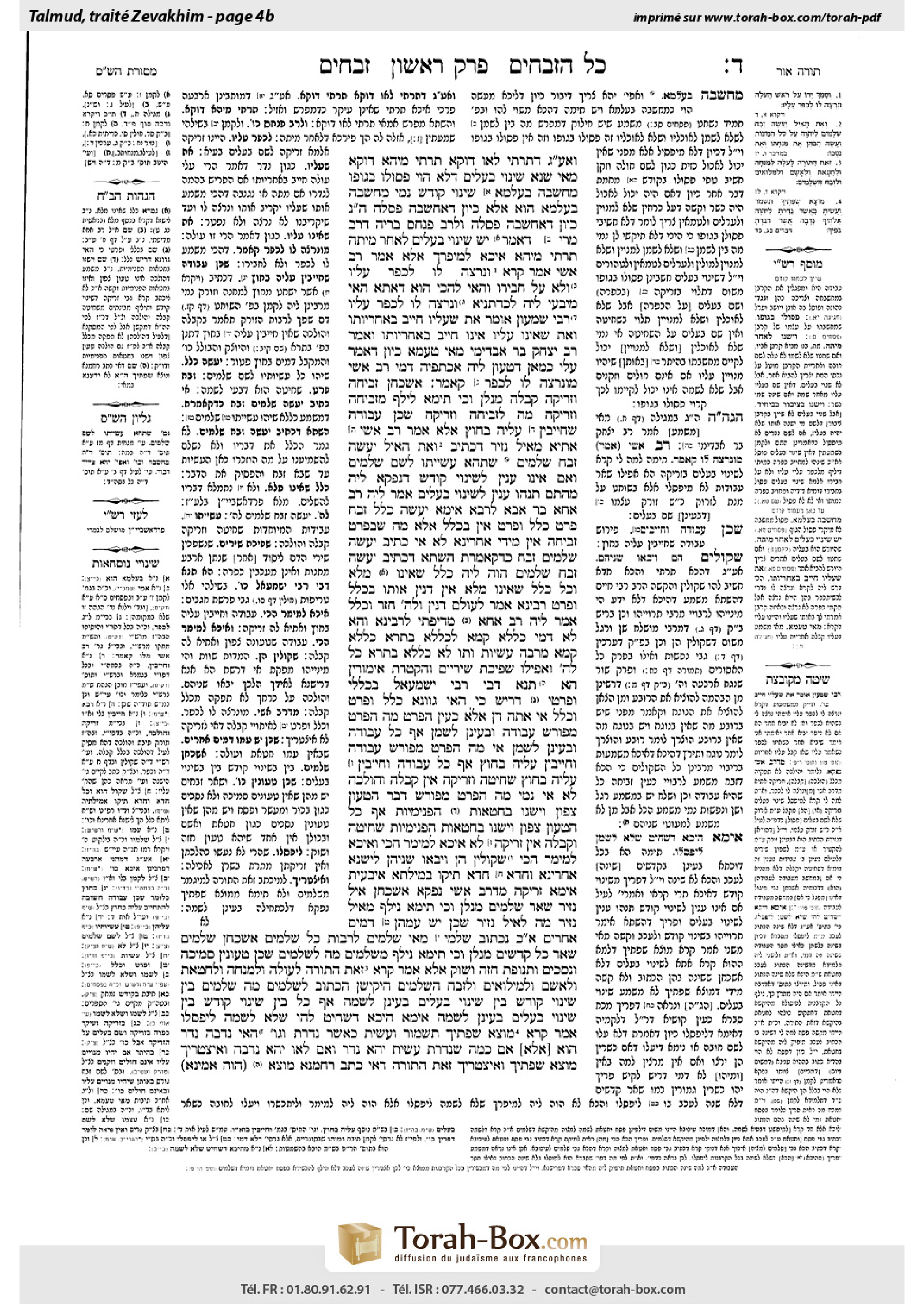
Zevachim 4b: Talmud study for Daf Yomi
Daf Yomi is the daily study of one Talmud folio. Explore 37 tractates with scans, Hebrew text, Sefaria English and AI-generated French translations where annotated.
Passage selection and English or AI-generated French translation are available where the scan has annotations. Daf Study is independent of Torah-Box and Sefaria.
Browse Zevachim · זבחים · All tractatesZevachim 4b text and translations
This page of Zevachim includes the Aramaic text, an English translation and an AI-generated French translation, alongside the scan above.
זבחים ד׳ ב · Aramaic and Hebrew text
וְאַף עַל גַּב דְּתַרְתֵּי לָאו דַּוְקָא, תַּרְתֵּי מִיהָא דַּוְקָא.
מַאי שְׁנָא שִׁינּוּי בְעָלִים דְּלָא הָוֵי פְּסוּלוֹ בְּגוּפוֹ – מַחְשָׁבָה בְּעָלְמָא; שִׁינּוּי קוֹדֶשׁ נָמֵי מַחְשָׁבָה בְּעָלְמָא הוּא! אֶלָּא כֵּיוָן דְּאַחְשְׁבַהּ – פַּסְלַהּ; הָכָא נָמֵי, כֵּיוָן דְּאַחְשְׁבַהּ – פַּסְלַהּ.
וּלְרַב פִּנְחָס בְּרֵיהּ דְּרַב מָרִי, דְּאָמַר יֵשׁ שִׁינּוּי בְעָלִים לְאַחַר מִיתָה – תַּרְתֵּי מִיהָא אִיכָּא לְמִיפְרַךְ!
אֶלָּא אָמַר רַב אָשֵׁי, אָמַר קְרָא: ״וְנִרְצָה לוֹ לְכַפֵּר עָלָיו״ – וְלֹא עַל חֲבֵירוֹ.
וְהַאי לְהָכִי הוּא דַּאֲתָא?! הַאי מִיבְּעֵי לֵיהּ לְכִדְתַנְיָא: ״וְנִרְצָה לוֹ לְכַפֵּר עָלָיו״ – רַבִּי שִׁמְעוֹן אוֹמֵר: אֶת שֶׁעָלָיו – חַיָּיב בְּאַחְרָיוּתוֹ, וְאֶת שֶׁאֵינוֹ עָלָיו – אֵינוֹ חַיָּיב בְּאַחְרָיוּתוֹ.
וְאָמַר רַב יִצְחָק בַּר אַבְדִּימִי: מַאי טַעְמָא? כֵּיוָן דְּאָמַר ״עָלַי״ – כְּמַאן דְּטָעוּן לֵיהּ אַכַּתְפֵּיהּ דָּמֵי.
רַב אָשֵׁי מִ״וְּנִרְצָה לוֹ לְכַפֵּר״ קָאָמַר.
אַשְׁכְּחַן זְבִיחָה וּזְרִיקָה, קַבָּלָה מְנָלַן?
וְכִי תֵּימָא לֵילַף מִזְּבִיחָה וּזְרִיקָה – מָה לִזְבִיחָה וּזְרִיקָה שֶׁכֵּן עֲבוֹדָה שֶׁחַיָּיבִין עָלֶיהָ בַּחוּץ!
אֶלָּא אָמַר רַב אָשֵׁי: אַתְיָא מֵאֵיל נָזִיר; דִּכְתִיב: ״וְאֶת הָאַיִל יַעֲשֶׂה זֶבַח שְׁלָמִים״ – שֶׁתְּהֵא עֲשִׂיָּיתוֹ לְשֵׁם שְׁלָמִים; וְאִם אֵינוֹ עִנְיָן לְשִׁינּוּי קוֹדֶשׁ – דְּנָפְקָא לֵיהּ מֵהָתָם, תְּנֵהוּ עִנְיָן לְשִׁינּוּי בְעָלִים.
אֲמַר לֵיהּ רַב אַחָא בַּר אַבָּא לְרָבָא, אֵימָא: ״יַעֲשֶׂה״ – כָּלַל, ״זֶבַח״ – פָּרַט; כְּלָל וּפְרָט – אֵין בַּכְּלָל אֶלָּא מַה שֶּׁבַּפְּרָט; זְבִיחָה אִין, מִידֵּי אַחֲרִינָא לָא!
אִי כְּתִיב ״יַעֲשֶׂה שְׁלָמִים זֶבַח״ – כִּדְקָאָמְרַתְּ; הַשְׁתָּא דִּכְתִיב ״יַעֲשֶׂה זֶבַח שְׁלָמִים״ – הָוֵה לֵיהּ כְּלָל שֶׁאֵינוֹ מָלֵא, וְכׇל כְּלָל שֶׁאֵינוֹ מָלֵא – אֵין דָּנִין אוֹתוֹ בִּכְלָל וּפְרָט.
רָבִינָא אָמַר: לְעוֹלָם דָּנִין, וְ״לַה׳״ חָזַר וְכָלַל.
אֲמַר לֵיהּ רַב אַחָא מִדִּיפְתִּי לְרָבִינָא: וְהָא לָא דָּמֵי כְּלָלָא קַמָּא לִכְלָלָא בָּתְרָא; כְּלָלָא קַמָּא – מְרַבֵּה עֲשִׂיּוֹת וְתוּ לָא, כְּלָלָא בָּתְרָא – כׇּל ״לַה׳״ וַאֲפִילּוּ שְׁפִיכַת שִׁירַיִים וְהַקְטָרַת אֵימוּרִין! הָא תַּנָּא דְּבֵי רַבִּי יִשְׁמָעֵאל בִּכְלָלֵי וּפְרָטֵי דָּרֵישׁ כִּי הַאי גַוְונָא:
כְּלָל וּפְרָט וּכְלָל – אִי אַתָּה דָן אֶלָּא כְּעֵין הַפְּרָט; מָה הַפְּרָט מְפוֹרָשׁ – עֲבוֹדָה וּבָעֵינַן לִשְׁמָן, אַף כׇּל עֲבוֹדָה וּבָעֵינַן לִשְׁמָן.
אִי מָה הַפְּרָט מְפוֹרָשׁ – עֲבוֹדָה וְחַיָּיבִין עָלֶיהָ בַּחוּץ, אַף כׇּל עֲבוֹדָה וְחַיָּיבִין עָלֶיהָ בַּחוּץ; שְׁחִיטָה וּזְרִיקָה – אִין, קַבָּלָה וְהוֹלָכָה – לָא!
אִי נָמֵי, מָה הַפְּרָט מְפוֹרָשׁ – דָּבָר הַטָּעוּן צָפוֹן וְיֶשְׁנוֹ בְּחַטָּאוֹת הַפְּנִימִיּוֹת, אַף כֹּל הַטָּעוּן צָפוֹן וְיֶשְׁנוֹ בְּחַטָּאוֹת הַפְּנִימִיּוֹת; שְׁחִיטָה וְקַבָּלָה – אִין, זְרִיקָה – לָא!
אִיכָּא לְמֵימַר הָכִי וְאִיכָּא לְמֵימַר הָכִי, שְׁקוּלִין הֵן וְיָבֹאוּ שְׁנֵיהֶן. לִישָּׁנָא אַחֲרִינָא: וַחֲדָא חֲדָא תֵּיקוּ בְּמִילְּתָא.
אִיבָּעֵית אֵימָא: זְרִיקָה – מִדְּרַב אָשֵׁי נָפְקָא.
אַשְׁכְּחַן אֵיל נְזִיר, שְׁאָר שְׁלָמִים מְנָלַן?
וְכִי תֵּימָא נֵילַף מֵאֵיל נָזִיר – מָה לְאֵיל נָזִיר, שֶׁכֵּן יֵשׁ עִמָּהֶן דָּמִים אֲחֵרִים!
אִם כֵּן, נִכְתּוֹב ״שְׁלָמָיו״; מַאי ״שְׁלָמִים״ – לְרַבּוֹת כׇּל שְׁלָמִים.
אַשְׁכְּחַן שְׁלָמִים, שְׁאָר כׇּל קֳדָשִׁים מְנָלַן?
וְכִי תֵּימָא נֵילַף מִשְּׁלָמִים, מָה לִשְׁלָמִים שֶׁכֵּן טְעוּנִין סְמִיכָה וּנְסָכִים וּתְנוּפַת חָזֶה וָשׁוֹק!
אֶלָּא אָמַר קְרָא: ״זֹאת הַתּוֹרָה לָעֹלָה וְלַמִּנְחָה וְלַחַטָּאת וְלָאָשָׁם וְלַמִּלּוּאִים וּלְזֶבַח הַשְּׁלָמִים״ – הַקִּישָׁן הַכָּתוּב לִשְׁלָמִים; מָה שְׁלָמִים – בֵּין שִׁינּוּי קוֹדֶשׁ בֵּין שִׁינּוּי בְעָלִים, בָּעֵינַן לִשְׁמָהּ; אַף כׇּל בֵּין שִׁינּוּי קוֹדֶשׁ בֵּין שִׁינּוּי בְעָלִים, בָּעֵינַן לִשְׁמָהּ.
אֵימָא הֵיכָא דְּשָׁחֵיט לְהוּ שֶׁלֹּא לִשְׁמָהּ – לִיפַּסְלוּ!
אָמַר קְרָא: ״מוֹצָא שְׂפָתֶיךָ תִּשְׁמֹר וְעָשִׂיתָ כַּאֲשֶׁר נָדַרְתָּ וְגוֹ׳״ – הַאי נְדָבָה?! נֶדֶר הוּא! [אֶלָּא] אִם כְּמָה שֶׁנָּדַרְתָּ עָשִׂיתָ – יְהֵא נֶדֶר, וְאִם לָאו – יְהֵא נְדָבָה.
וְאִיצְטְרִיךְ ״מוֹצָא שְׂפָתֶיךָ״, וְאִיצְטְרִיךְ ״זֹאת הַתּוֹרָה״; דְּאִי כְּתַב רַחֲמָנָא ״מוֹצָא״ – הֲוָה אָמֵינָא
Zevachim 4b · English translation
And although two of these distinctions are not precise, the other two are in any event precise distinctions, based upon which a distinction can be drawn.
The Gemara explains why two of the distinctions are not precise: What is different about deviation with regard to the owner, such that its disqualification does not concern the offering itself? It is that this merely constitutes a change of thought. Deviation from the type of offering is also merely a change of thought; the offering is not physically affected. Rather, this distinction between deviation with regard to the owner and deviation from the type of offering is false; one should claim that if deviation from the type of offering disqualifies it once the one who slaughtered it had that intent, here too, once the one who slaughtered it had intent to deviate from its owner, he disqualified it.
The Gemara explains the difficulty with the second distinction, the case where the owner died: And according to Rav Pineḥas, son of Rav Mari, who says that disqualification by deviation with regard to the owner applies even after the owner’s death, there is no distinction in this regard between deviation from the type of offering and deviation with regard to the owner. In any event, there are two remaining distinctions based on which the comparison between a deviation from the type of offering and a deviation with regard to the owner can be refuted.
Rather, Rav Ashi says that the halakha that it is prohibited to sprinkle the blood for the sake of one other than the owner is derived from a verse. The verse states: “And it shall be accepted for him to atone for him” (Leviticus 1:4), teaching that the sacrificial rite that atones for the owner, namely, the sprinkling of the blood, must be performed specifically for him, and not for another.
The Gemara asks: But does this verse come to teach this halakha? Isn’t it necessary for that which is taught in a baraita: With regard to the verse: “And it shall be accepted for him to atone for him [alav],” Rabbi Shimon says: This indicates that in a case where one consecrated an animal as an offering and it died or was lost, if it was initially incumbent upon him [alav] to bring an offering, i.e., if he had accepted upon himself a personal obligation to bring an offering, he bears responsibility for it, i.e., he is obligated to bring another offering in its stead. But if it was not incumbent upon him [alav] to bring an offering, i.e., if he consecrated a specific animal without accepting upon himself any personal obligation, he does not bear responsibility for it if it dies or is lost.
And Rav Yitzḥak bar Avdimi says: What is the reasoning behind this distinction? Once a person said: It is incumbent upon me to bring an offering, it is considered as though the offering is loaded upon his shoulders. He does not discharge his obligation until he brings some offering.
The Gemara answers: Rav Ashi says that the halakha that it is prohibited to sprinkle the blood for the sake of one other than the owner is derived from the phrase “And it shall be accepted for him,” not from the term “for him,” on which the baraita is based.
The Gemara asks: We found a source for the halakha that slaughter and the sprinkling of the blood must be performed for the sake of the owner. From where do we derive that the collection of the blood must also be performed for the sake of the owner?
And if you would say: Let us derive from slaughter and sprinkling that collection must also be performed for the sake of the owner, this derivation can be refuted: What is unique about slaughter and sprinkling? They are unique in that each is a rite for which one is liable to be punished with death at the hand of Heaven if he performs it outside the Temple.
Rather, Rav Ashi says that the halakha that the collection of the blood must also be performed for the sake of the owner is derived from the case of a nazirite’s ram. As it is written: “And he shall offer the ram for a sacrifice [zevaḥ] of peace offerings unto the Lord” (Numbers 6:17), indicating that its offering should be performed for the sake of a peace offering. And if the verse is not necessary for the matter of deviation from the type of offering, as we derived that from there, i.e., the verses cited earlier (4a), apply it to the matter of deviation with regard to the owner. It is thereby derived that its sacrificial rites must be performed for the sake of its owner.
Rav Aḥa bar Abba said to Rava, in objection to this derivation: Say that the term: “Shall offer,” is a generalization and: “A sacrifice [zevaḥ],” is a detail. According to the principles of biblical hermeneutics, where there is a generalization and a detail, the generalization includes only that which is specified in the detail. Accordingly, slaughter [zeviḥa], yes, must be performed for the sake of its owner; but no other rite must be performed for the sake of its owner in order for the offering to be fit.
The Gemara answers: If it had been written: Shall offer the ram for peace offerings as a sacrifice [zevaḥ], it would be as you say. The clause: Shall offer the ram for peace offerings, would be considered a generalization, and: Sacrifice [zevaḥ], would be a detail. Now that it is written: “Shall offer the ram for a sacrifice [zevaḥ] of peace offerings,” the term “shall offer” is an incomplete generalization, as the term “for a sacrifice” interrupts between “shall offer” and “peace offerings.” And one cannot derive a halakha from any incomplete generalization by employing the principle of a generalization and a detail.
Ravina says there is a different answer: Actually, one can derive a halakha from verses with incomplete generalizations using the principle of a generalization and a detail. And the reason this halakha applies to other rites besides slaughter is that by adding the term “unto the Lord,” it then makes a generalization.
Before Ravina concluded his interpretation, Rav Aḥa of Difti said to Ravina: But the former generalization is dissimilar to the latter generalization. The former generalization includes only the essential sacrificial actions and nothing more, whereas the latter generalization includes any sacrificial duty unto the Lord, and even pouring the remains of the blood on the base of the altar and burning the sacrificial portions of the offering on the altar. Ravina responded: The school of Rabbi Yishmael taught generalizations and details in cases like this.
Ravina concludes his explanation: Since the term: “Unto the Lord,” is another generalization, the verse is formulated as a generalization, and a detail, and a generalization, and you may deduce that the verse is referring only to items similar to the detail. Just as the mentioned detail, slaughter, is defined as an essential rite and we require that it be performed for the sake of the owner, so too, we require that every essential rite be performed for the sake of the owner.
The Gemara asks: If the verse is referring only to actions similar to the detail, not all of the essential rites are necessarily included. Perhaps it should be derived that just as the mentioned detail, slaughter, is defined as an essential rite, and one is liable to be punished with death at the hand of Heaven for performing it outside the Temple, so too, any essential rite for which one is liable to be punished with death at the hand of Heaven for performing it outside the Temple is included in the verse. Accordingly, slaughter and sprinkling the blood are included, but collection of the blood and conveying it are not.
Alternatively, it could be derived that just as the item mentioned in the detail is clearly defined as an action that requires performance in the north of the Temple courtyard and is performed in the sacrifice of inner sin offerings, so too, any rite that requires performance in the north and is performed in the sacrifice of inner sin offerings is included in the halakha. Accordingly, slaughter and collection are included; sprinkling the blood is not.
The Gemara answers: Both possibilities are equally valid; this derivation can be said and that derivation can be said. Either collection or sprinkling might be included in the halakha. Consequently, they are equal, and therefore both are included. Or according to another version of the Gemara’s answer, they are equal, and therefore each one, i.e., both collection and sprinkling, shall stand in its status.
The Gemara provides an alternative answer: If you wish, say instead that sprinkling is derived from the verse that Rav Ashi cited: “And it shall be accepted for him to atone for him.” Therefore, when the verse states: “And he shall offer the ram for a sacrifice of peace offerings unto the Lord,” indicating the inclusion of rites similar to slaughter, it is apparently referring not to sprinkling but to collection.
The Gemara asks: We found a source for the halakha that a nazirite’s ram must be sacrificed for the sake of its owner. From where do we derive that this halakha applies with regard to other peace offerings as well?
And if you would say: Let us derive from a nazirite’s ram that all peace offerings must be sacrificed for the sake of their owners, this derivation can be refuted: What is unique about a nazirite’s ram? It is unique in that there is other blood, i.e., there are other offerings, a sin offering and a burnt offering, that must be brought by a nazirite together with his ram.
The Gemara answers: If that is so, if this halakha is unique to a nazirite’s ram, let the verse write: His peace offerings [shelamav]. What is indicated by writing “peace offerings [shelamim]”? It is written to include all types of peace offerings.
The Gemara asks: We found a source for the halakha that a peace offering must be sacrificed for its own sake and for the sake of its owner. From where do we derive that this halakha applies with regard to all other offerings?
And if you would say: Let us derive from a peace offering that all offerings must be sacrificed with these intentions, this derivation can be refuted: What is unique about a peace offering? It is unique in that it requires placing hands on the head of the offering, and it is accompanied by libations, and it requires the waving of the breast and the right hind leg by the priest and owner together. No other offering possesses all three of these requirements.
The Gemara answers: Rather, the verse states: “This is the law of the burnt offering, of the meal offering, and of the sin offering, and of the guilt offering, and of the consecration offering, and of the sacrifice of peace offerings” (Leviticus 7:37). The verse juxtaposes all types of offerings with peace offerings, indicating that just as we require the sacrifice of a peace offering to be performed for its sake, both concerning deviation from the type of offering and concerning deviation with regard to the owner, so too, we require the sacrifice of every type of offering to be performed for its sake, both concerning deviation from the type of offering and concerning deviation with regard to the owner.
§ Having established the source for the requirement to sacrifice offerings with the rightful owner and the specific type of offering in mind, the Gemara inquires: Why not say that in a case where one slaughtered them not for their sake, they are disqualified? Why, according to the mishna, do they remain fit?
The Gemara answers: The verse states: “That which has gone out of your lips you shall observe and do; according to what you have vowed [nadarta] freely [nedava] to the Lord your God, that which you have promised with your mouth” (Deuteronomy 23:24). The Gemara interprets the words nadarta and nedava exegetically: How can the offering mentioned in this verse be a gift offering [nedava]? It is already referred to as a vow offering [neder]. Rather, the verse indicates that if you did what you had vowed to do, i.e., sacrificed your vow offering properly, it shall be a satisfactory vow offering; but if you did not sacrifice it properly, it shall be rendered a voluntary gift offering. Although it does not satisfy the obligation of your vow, it remains a valid offering.
And it was necessary for the Torah to include the verse: “That which has gone out of your lips,” and it was necessary to include the verse: “This is the law.” As, had the Merciful One written in the Torah only the verse: “That which has gone out of your lips,” I would say
Zevachim 4b · Traduction française (IA)
Et bien que deux de ces distinctions ne soient pas exactes, les deux autres sont néanmoins exactes et permettent de distinguer les deux cas.
La Guemara explique pourquoi deux des distinctions ne sont pas exactes : en quoi le fait de dévier quant au propriétaire est-il différent, de sorte que sa disqualification ne concerne pas l’offrande elle-même ? C’est parce qu’il ne s’agit que d’un changement d’intention. Dévier quant au type d’offrande ne constitue également qu’un changement d’intention ; l’offrande n’en est pas physiquement affectée. Cette distinction entre la déviation quant au propriétaire et celle quant au type d’offrande est donc erronée : il faut plutôt dire que, si la déviation quant au type d’offrande la disqualifie dès que celui qui l’a égorgée en a eu l’intention, alors ici aussi, dès que celui qui l’a égorgée a eu l’intention de dévier quant à son propriétaire, il l’a disqualifiée.
La Guemara explique la difficulté que pose la seconde distinction, le cas où le propriétaire est mort : selon Rav Pineḥas, fils de Rav Mari, qui affirme que la disqualification due à une déviation quant au propriétaire s’applique même après la mort de celui-ci, il n’y a à cet égard aucune différence entre dévier quant au type d’offrande et dévier quant au propriétaire. Il reste néanmoins deux distinctions permettant de réfuter la comparaison entre une déviation quant au type d’offrande et une déviation quant au propriétaire.
Rav Ashi dit plutôt que l’interdiction d’asperger le sang avec l’intention de le faire pour quelqu’un d’autre que le propriétaire se déduit d’un verset. Celui-ci dit : « Et elle sera agréée pour lui afin de faire expiation pour lui » (Lévitique 1,4), ce qui enseigne que le rite sacrificiel qui fait expiation pour le propriétaire, à savoir l’aspersion du sang, doit être accompli spécifiquement pour lui, et non pour un autre.
La Guemara demande : Mais ce verset vient-il enseigner cette halakha ? N’est-il pas nécessaire pour ce qui est enseigné dans une baraïta au sujet du verset : « Et elle sera agréée pour lui afin de faire expiation pour lui [alav] » ? Rabbi Shimon dit : cela indique que, si quelqu’un a consacré un animal comme offrande et que celui-ci est mort ou a été perdu, s’il lui incombait au départ [alav] d’apporter une offrande, c’est-à-dire s’il s’était imposé personnellement l’obligation d’en apporter une, il en reste responsable ; autrement dit, il doit apporter une autre offrande à sa place. Mais s’il ne lui incombait pas [alav] d’apporter une offrande, c’est-à-dire s’il avait consacré un animal précis sans s’imposer personnellement aucune obligation, il n’en reste pas responsable si l’animal meurt ou est perdu.
Et Rav Yitzḥak bar Avdimi dit : Quel est le fondement de cette distinction ? Dès qu’une personne a dit : « Il m’incombe d’apporter une offrande », c’est comme si l’offrande pesait sur ses épaules. Elle ne s’acquitte de son obligation qu’en apportant une offrande, quelle qu’elle soit.
La Guemara répond : Rav Ashi dit que l’interdiction d’asperger le sang avec l’intention de le faire pour quelqu’un d’autre que le propriétaire se déduit de l’expression « Et elle sera agréée pour lui », et non du terme « pour lui », sur lequel s’appuie la baraïta.
La Guemara demande : Nous avons trouvé une source établissant que l’égorgement et l’aspersion du sang doivent être accomplis pour le propriétaire. D’où déduisons-nous que le recueil du sang doit lui aussi être accompli pour le propriétaire ?
Et si tu dis : Déduisons de l’égorgement et de l’aspersion que le recueil doit lui aussi être accompli pour le propriétaire, cette déduction peut être réfutée : qu’ont de particulier l’égorgement et l’aspersion ? Chacun a ceci de particulier que son accomplissement hors du Temple expose à la peine de mort infligée par le Ciel.
Rav Ashi dit plutôt que l’obligation d’accomplir aussi le recueil du sang pour le propriétaire se déduit du cas du bélier du nazir. En effet, il est écrit : « Il offrira le bélier comme sacrifice [zevaḥ] de paix pour le Seigneur » (Nombres 6,17), ce qui indique que son offrande doit être accomplie comme sacrifice de paix. Et si le verset n’est pas nécessaire pour enseigner la déviation quant au type d’offrande, puisque nous l’avons déduite des versets cités précédemment (4a), appliquons-le à la déviation quant au propriétaire. On en déduit que ses rites sacrificiels doivent être accomplis pour son propriétaire.
Rav Aḥa bar Abba dit à Rava, pour contester cette déduction : Dis plutôt que le terme « il offrira » est une expression générale et que « un sacrifice [zevaḥ] » est un détail. Selon les principes de l’exégèse biblique, lorsqu’une expression générale est suivie d’un détail, la généralité ne comprend que ce qui est spécifié dans le détail. Ainsi, l’égorgement [zeviḥa], oui, doit être accompli pour le propriétaire ; mais aucun autre rite n’a besoin d’être accompli pour le propriétaire pour que l’offrande soit valide.
La Guemara répond : Si le texte avait dit : « Il offrira le bélier comme sacrifice de paix [zevaḥ] », tu aurais raison. « Il offrira le bélier comme sacrifice de paix » serait considéré comme une expression générale, et « sacrifice [zevaḥ] » comme un détail. Mais puisque le texte dit : « Il offrira le bélier comme sacrifice [zevaḥ] de paix », le terme « il offrira » constitue une généralité incomplète, car l’expression « comme sacrifice » s’intercale entre « il offrira » et « de paix ». Or on ne peut déduire une halakha d’une généralité incomplète en appliquant le principe de la généralité et du détail.
Ravina propose une autre réponse : en réalité, on peut déduire une halakha de versets comportant des généralités incomplètes en appliquant le principe de la généralité et du détail. Et si cette halakha s’applique à d’autres rites que l’égorgement, c’est parce que l’ajout des termes « pour le Seigneur » transforme alors le texte en une expression générale.
Avant que Ravina n’achève son explication, Rav Aḥa de Difti lui dit : Mais la première généralité n’est pas semblable à la seconde. La première ne comprend que les actes sacrificiels essentiels, et rien de plus, tandis que la seconde comprend tout service sacrificiel accompli pour le Seigneur, y compris le versement du reste du sang sur le socle de l’autel et la combustion des parties sacrificielles de l’offrande sur l’autel. Ravina répondit : L’école de Rabbi Yishmael a enseigné les généralités et les détails dans des cas de ce genre.
Ravina conclut son explication : puisque l’expression « pour le Seigneur » constitue une autre généralité, le verset est formulé sous la forme d’une généralité, d’un détail et d’une généralité ; on peut en déduire que le verset ne vise que les éléments semblables au détail. De même que le détail mentionné, l’égorgement, est défini comme un rite essentiel et que nous exigeons qu’il soit accompli pour le propriétaire, nous exigeons aussi que chaque rite essentiel soit accompli pour le propriétaire.
La Guemara demande : Si le verset ne vise que les actes semblables au détail, tous les rites essentiels ne sont pas nécessairement inclus. Peut-être faut-il déduire que, de même que le détail mentionné, l’égorgement, est défini comme un rite essentiel dont l’accomplissement hors du Temple expose à la peine de mort infligée par le Ciel, de même tout rite essentiel dont l’accomplissement hors du Temple expose à cette peine est inclus dans le verset. Ainsi, l’égorgement et l’aspersion du sang sont inclus, mais ni le recueil ni le transport du sang ne le sont.
Autre possibilité : il faudrait déduire que, de même que l’élément mentionné dans le détail est clairement défini comme un acte qui doit être accompli dans la partie nord de la cour du Temple et qui intervient dans le sacrifice des sacrifices expiatoires intérieurs, de même tout rite qui doit être accompli au nord et qui intervient dans le sacrifice des sacrifices expiatoires intérieurs est inclus dans cette halakha. Ainsi, l’égorgement et le recueil sont inclus, mais pas l’aspersion du sang.
La Guemara répond : les deux possibilités sont également valables ; on peut soutenir l’une comme l’autre. Le recueil ou l’aspersion peuvent donc être inclus dans cette halakha. Ils sont ainsi à égalité et, par conséquent, tous deux sont inclus. Selon une autre version de la réponse de la Guemara, ils sont à égalité et chacun, c’est-à-dire le recueil comme l’aspersion, conserve donc son statut.
La Guemara propose une autre réponse : si tu le souhaites, dis plutôt que l’aspersion se déduit du verset cité par Rav Ashi : « Et elle sera agréée pour lui afin de faire expiation pour lui ». Par conséquent, lorsque le verset dit : « Il offrira le bélier comme sacrifice de paix pour le Seigneur », incluant ainsi des rites semblables à l’égorgement, il se rapporte apparemment non pas à l’aspersion, mais au recueil.
La Guemara demande : Nous avons trouvé une source établissant que le bélier du nazir doit être sacrifié pour son propriétaire. D’où déduisons-nous que cette halakha s’applique également aux autres sacrifices de paix ?
Et si tu dis : Déduisons du bélier du nazir que tous les sacrifices de paix doivent être sacrifiés pour leurs propriétaires, cette déduction peut être réfutée : qu’a de particulier le bélier du nazir ? Il a ceci de particulier qu’il y a d’autres offrandes, à savoir un sacrifice expiatoire et un holocauste, que le nazir doit apporter avec son bélier.
La Guemara répond : S’il en est ainsi, si cette halakha est propre au bélier du nazir, que le verset dise « ses sacrifices de paix [shelamav] ». Que signifie alors « sacrifices de paix [shelamim] » ? Cette formulation est employée pour inclure tous les types de sacrifices de paix.
La Guemara demande : Nous avons trouvé une source établissant qu’un sacrifice de paix doit être sacrifié dans son but propre et pour son propriétaire. D’où déduisons-nous que cette halakha s’applique à toutes les autres offrandes ?
Et si tu dis : Déduisons du sacrifice de paix que toutes les offrandes doivent être sacrifiées avec ces intentions, cette déduction peut être réfutée : qu’a de particulier le sacrifice de paix ? Il a ceci de particulier qu’il exige l’imposition des mains sur la tête de l’offrande, qu’il est accompagné de libations et qu’il exige que le prêtre et le propriétaire agitent ensemble la poitrine et la cuisse droite. Aucune autre offrande ne comporte ces trois exigences à la fois.
La Guemara répond plutôt que le verset dit : « Telle est la loi de l’holocauste, de l’offrande végétale, du sacrifice expiatoire, du sacrifice de culpabilité, du sacrifice d’investiture et du sacrifice de paix » (Lévitique 7,37). Le verset rapproche tous les types d’offrandes des sacrifices de paix, ce qui indique que, de même que nous exigeons que le sacrifice de paix soit accompli dans son but propre, tant en ce qui concerne la déviation quant au type d’offrande que la déviation quant au propriétaire, nous exigeons également que chaque type d’offrande soit accompli dans son but propre, tant en ce qui concerne la déviation quant au type d’offrande que la déviation quant au propriétaire.
§ Après avoir établi la source de l’obligation de sacrifier les offrandes en ayant à l’esprit le propriétaire légitime et le type précis d’offrande, la Guemara demande : Pourquoi ne pas dire que, si elles ont été égorgées sans que ces intentions soient présentes à l’esprit, elles sont disqualifiées ? Pourquoi, selon la Michna, restent-elles valides ?
La Guemara répond : le verset dit : « Tu observeras et tu accompliras ce qui est sorti de tes lèvres ; conformément à ce que tu as voué [nadarta] librement [nedava] au Seigneur ton Dieu, ce que ta bouche a promis » (Deutéronome 23,24). La Guemara interprète les mots nadarta et nedava selon les règles de l’exégèse : comment l’offrande mentionnée dans ce verset pourrait-elle être un don volontaire [nedava], alors qu’elle est déjà désignée comme une offrande de vœu [neder] ? Le verset indique plutôt que, si tu as fait ce que tu avais voué, c’est-à-dire si tu as correctement sacrifié ton offrande de vœu, elle constitue une offrande de vœu agréée ; mais si tu ne l’as pas sacrifiée correctement, elle devient un don volontaire. Bien qu’elle ne satisfasse pas à l’obligation découlant de ton vœu, elle demeure une offrande valide.
Et il était nécessaire que la Torah inclue le verset « Tu observeras et tu accompliras ce qui est sorti de tes lèvres », et il était nécessaire qu’elle inclue le verset « Telle est la loi ». En effet, si le Miséricordieux n’avait écrit dans la Torah que le verset « Tu observeras et tu accompliras ce qui est sorti de tes lèvres », j’aurais dit
Traduction française générée par IA à partir de l’édition anglaise de Sefaria. Vérifie toujours un passage avec le texte source.
Text from Sefaria: William Davidson Edition - Vocalized Aramaic (CC BY NC); William Davidson Edition - English (CC BY NC).