Zevachim 55b: Talmud study for Daf Yomi
Daf Yomi is the daily study of one Talmud folio. Explore 37 tractates with scans, Hebrew text, Sefaria English and AI-generated French translations where annotated.
Passage selection and English or AI-generated French translation are available where the scan has annotations. Daf Study is independent of Torah-Box and Sefaria.
Browse Zevachim · זבחים · All tractatesZevachim 55b text and translations
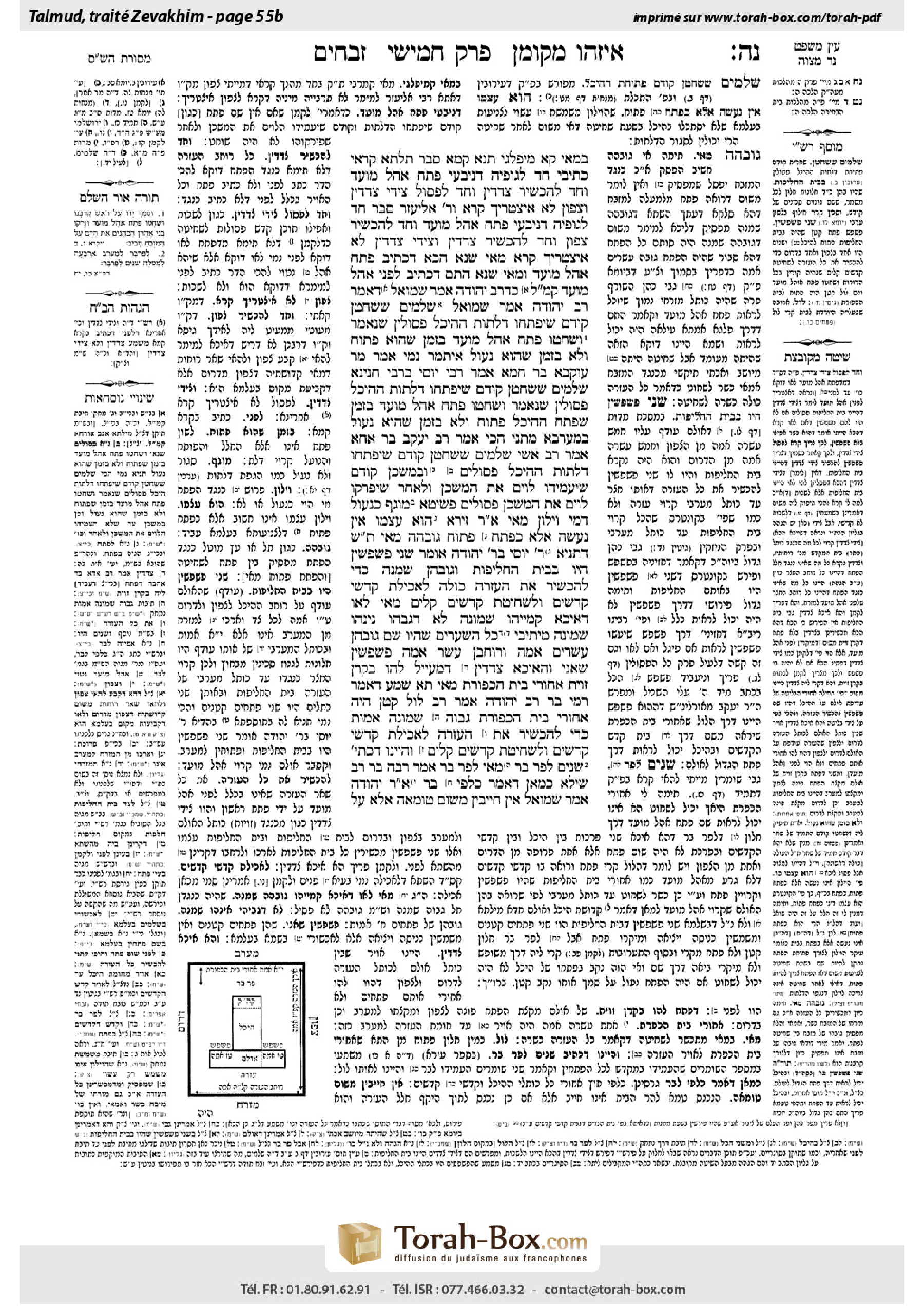
This page of Zevachim includes the Aramaic text, an English translation and an AI-generated French translation, alongside the scan above.
זבחים נ״ה ב · Aramaic and Hebrew text
בְּמַאי קָא מִיפַּלְגִי? תַּנָּא קַמָּא סָבַר: תְּלָתָא קְרָאֵי כְּתִיבִי; חַד לְגוּפֵיהּ – דְּנִיבְעֵי פֶּתַח אֹהֶל מוֹעֵד, וְחַד לְהַכְשִׁיר צְדָדִין, וְחַד לִפְסוֹל צִידֵּי צְדָדִין. וְצָפוֹן לָא אִיצְטְרִיךְ קְרָא.
וְרַבִּי אֱלִיעֶזֶר סָבַר: חַד לְגוּפֵיהּ – דְּנִיבְעֵי פֶּתַח אֹהֶל מוֹעֵד, וְחַד לְהַכְשִׁיר צָפוֹן, וְחַד לְהַכְשִׁיר צְדָדִין. וְצִידֵּי צְדָדִין לָא אִיצְטְרִיךְ קְרָא.
מַאי שְׁנָא הָכָא – דִּכְתִיב: ״פֶּתַח אֹהֶל מוֹעֵד״, וּמַאי שְׁנָא הָתָם – דִּכְתִיב: ״לִפְנֵי אֹהֶל מוֹעֵד״? קָא מַשְׁמַע לַן כִּדְרַב יְהוּדָה אָמַר שְׁמוּאֵל; דְּאָמַר רַב יְהוּדָה אָמַר שְׁמוּאֵל: שְׁלָמִים שֶׁשְּׁחָטָן קוֹדֶם שֶׁיִּפָּתְחוּ דַּלְתוֹת הַהֵיכָל – פְּסוּלִין, שֶׁנֶּאֱמַר: ״וּשְׁחָטוֹ פֶּתַח אֹהֶל מוֹעֵד״ – בִּזְמַן שֶׁהוּא פָּתוּחַ, וְלֹא בִּזְמַן שֶׁהוּא נָעוּל.
אִיתְּמַר נָמֵי, אָמַר מָר עוּקְבָא בַּר חָמָא אָמַר רַבִּי יוֹסֵי בְּרַבִּי חֲנִינָא: שְׁלָמִים שֶׁשְּׁחָטָן קוֹדֶם שֶׁיִּפָּתְחוּ דַּלְתוֹת הַהֵיכָל – פְּסוּלִין, שֶׁנֶּאֱמַר: ״וּשְׁחָטוֹ פֶּתַח אֹהֶל מוֹעֵד״ – בִּזְמַן שֶׁפֶּתַח הַהֵיכָל פָּתוּחַ, וְלֹא בִּזְמַן שֶׁהוּא נָעוּל.
בְּמַעְרְבָא מַתְנֵי הָכִי – אָמַר רַב יַעֲקֹב בַּר אַחָא אָמַר רַב אָשֵׁי: שְׁלָמִים שֶׁשְּׁחָטָן קוֹדֶם שֶׁיִּפָּתְחוּ דַּלְתוֹת הַהֵיכָל – פְּסוּלִים. וּבַמִּשְׁכָּן – קוֹדֶם שֶׁיַּעֲמִידוּ לְוִיִּם אֶת הַמִּשְׁכָּן, וּלְאַחַר שֶׁיְּפָרְקוּ לְוִיִּם אֶת הַמִּשְׁכָּן – פְּסוּלִים.
פְּשִׁיטָא – מוּגָף, כְּנָעוּל דָּמֵי. וִילוֹן מַאי? אָמַר רַבִּי זֵירָא: הוּא עַצְמוֹ אֵין נַעֲשֶׂה אֶלָּא כְּפֶתַח פָּתוּחַ.
גּוּבְהָא מַאי? תָּא שְׁמַע: דְּתַנְיָא, רַבִּי יוֹסֵי בְּרַבִּי יְהוּדָה אוֹמֵר: שְׁנֵי פִּשְׁפָּשִׁין הָיוּ בְּבֵית הַחֲלִיפוֹת, וְגוֹבְהָן שְׁמֹנָה; כְּדֵי לְהַכְשִׁיר אֶת הָעֲזָרָה כּוּלָּהּ לַאֲכִילַת קׇדְשֵׁי קָדָשִׁים, וְלִשְׁחִיטַת קָדָשִׁים קַלִּים.
מַאי, לָאו דְּאִיכָּא קַמַּיְיהוּ שְׁמוֹנֶה? לָא; דְּגָבְהוּ נִינְהוּ שְׁמוֹנֶה.
מֵיתִיבִי: כׇּל הַשְּׁעָרִים שֶׁהָיוּ שָׁם – גּוֹבְהָן עֶשְׂרִים אַמָּה, וְרוֹחְבָּן עֶשֶׂר אַמָּה! פִּשְׁפָּשִׁין שָׁאנֵי.
וְהָאִיכָּא צְדָדִין! דִּמְעַיֵּיל לְהוּ בְּקֶרֶן זָוִית.
אֲחוֹרֵי בֵּית הַכַּפּוֹרֶת מַאי? תָּא שְׁמַע, דְּאָמַר רָמֵי בַּר רַב יְהוּדָה אָמַר רַב: לוּל קָטָן הָיָה אֲחוֹרֵי בֵּית הַכַּפּוֹרֶת, גָּבוֹהַּ שְׁמוֹנֶה אַמּוֹת; כְּדֵי לְהַכְשִׁיר אֶת הָעֲזָרָה לַאֲכִילַת קׇדְשֵׁי קָדָשִׁים, וְלִשְׁחִיטַת קָדָשִׁים קַלִּים. וְהַיְינוּ דִּכְתִיב: ״שְׁנַיִם לַפַּרְבָּר״. מַאי ״לַפַּרְבָּר״? אָמַר רַבָּה בַּר רַב שֵׁילָא, כְּמַאן דְּאָמַר: כְּלַפֵּי בַּר.
אָמַר רַב יְהוּדָה אָמַר שְׁמוּאֵל: אֵין חַיָּיבִין מִשּׁוּם טוּמְאָה, אֶלָּא עַל
Zevachim 55b · English translation
The Gemara clarifies: With regard to what do they disagree? The first tanna holds that three verses are written. One verse serves to teach the halakha itself, that we require that the slaughter take place at the entrance of the Tent of Meeting. And one verse serves to render fit slaughter at the sides, i.e., the entire length of the Temple courtyard eastward from the entrance, and not only that part which is directly in front of the entrance. And one verse serves to disqualify the sides of the sides, i.e., those parts of the courtyard that are not in front of the entrance at all. And it was not necessary to have a verse teach the fitness of slaughtering in the north, as it can be derived via an a fortiori inference.
And Rabbi Eliezer holds that one verse is necessary to teach the halakha itself, that we require slaughter at the entrance of the Tent of Meeting. And one verse serves to render fit slaughter in the north of the courtyard. And one verse serves to render fit slaughter at the sides of the courtyard. But according to him, it was not necessary to have a verse teach that the sides of the sides are not fit for the slaughter of the offering.
§ The Gemara asks: What is different here that it is written: “At the entrance to the Tent of Meeting” (Leviticus 3:2), and what is different there that it is written: “Before the Tent of Meeting” (Leviticus 3:8, 13)? The Gemara answers: This teaches us a matter in accordance with that which Rav Yehuda says that Shmuel says. As Rav Yehuda says that Shmuel says: Peace offerings that one slaughtered in the Temple before the doors of the Sanctuary were opened are disqualified, as it is stated with regard to peace offerings: “And he shall slaughter it at the entrance to the Tent of Meeting” (Leviticus 3:2), which teaches that it must be slaughtered when the entrance is open and serves as an actual entrance, and not when it is locked. As long as the entrance to the Tent of Meeting, or in the Temple the doors to the Sanctuary, remain closed, one may not sacrifice the peace offerings, and if they are sacrificed, they are disqualified.
It was also stated: Mar Ukva bar Ḥama says that Rabbi Yosei, son of Rabbi Ḥanina, says: Peace offerings that one slaughtered before the doors of the Sanctuary were opened are disqualified, as it is stated in the verse: “He shall slaughter it at the entrance to the Tent of Meeting” (Leviticus 3:2). This means when the entrance of the Sanctuary is open, and not when it is locked.
In the West, Eretz Yisrael, they teach this halakha like this: Rav Ya’akov bar Aḥa says that Rav Ashi says: Peace offerings that one slaughtered before the doors of the Sanctuary were opened are disqualified. And in the Tabernacle, which had no doors, peace offerings that were slaughtered before the Levites erected the Tabernacle or after the Levites dismantled the Tabernacle are disqualified.
The Gemara comments: It is obvious that if the door is closed but not locked it has the same status as if it were locked. The Gemara asks: If there is a curtain covering the entrance, what is the halakha? Rabbi Zeira says: A curtain itself is made only to be used like an open entrance, and therefore it is not considered as if the entrance is closed.
The Gemara asks: What is the halakha if a tall item is blocking the entrance? The Gemara suggests: Come and hear a proof that a tall item does not render an entrance as closed, as it is taught in a baraita: Rabbi Yosei, son of Rabbi Yehuda, says: There were two wickets, i.e., openings, in the Chamber of Knives, and their height was eight cubits. The function of these openings was in order to render fit the entire Temple courtyard for the eating of offerings of the most sacred order, and to render fit all of the Temple courtyard for the slaughter of offerings of lesser sanctity. Due to the openings, the western area of the courtyard was considered to be “before the Tent of Meeting.”
The Gemara explains the inference: What, is the reference to eight cubits not referring to the fact that in front of the wickets there was an obstruction eight cubits high? Nevertheless, the area outside of it is considered open to the Chamber of Knives. The Gemara answers: No, their height was eight cubits, i.e., the wickets themselves were eight cubits high.
The Gemara raises an objection to this explanation from a mishna (Middot 35a), which teaches: All the gates that were there, in the Temple, were twenty cubits high and ten cubits wide. If so, how could these wickets be only eight cubits high? The Gemara answers: The wickets are different, and they are not considered gates.
The Gemara questions the ruling of the baraita. How did the wickets render fit the entire Temple courtyard? But there are the sides, i.e., to the north and south of the Chamber of Knives, and the wickets faced only to the west. The Gemara answers that they inserted the wickets in the corner of the Chamber, so that one opened to the northwest, and one to the northeast.
The Gemara asks: What is the halakha with regard to the area behind the Hall of the Ark Cover, i.e., behind the Sanctuary, from where one could not see the entrance of the Temple courtyard or the two wickets? The Gemara answers: Come and hear, as Rami bar Rav Yehuda says that Rav says: There was a small niche behind the Hall of the Ark Cover, which was eight cubits high. The function of this niche was in order to render fit the entire Temple courtyard for the eating of offerings of the most sacred order, and to render fit all of the Temple courtyard for the slaughter of offerings of lesser sanctity. And this is as it is written: “For the precinct westward, four at the causeway, and two at the precinct” (I Chronicles 26:18). What is the meaning of the term: “For the precinct [laparbar]”? Rabba bar Rav Sheila said: It is like one who says: Facing outward [kelappei bar].
§ Rav Yehuda says that Shmuel says: One is liable for entering the Temple courtyard in a state of ritual impurity only with regard to
Zevachim 55b · Traduction française (IA)
La Guemara précise : Sur quoi portent leurs divergences ? Le premier tanna considère que trois versets sont écrits. L’un enseigne la halakha elle-même : l’abattage doit avoir lieu à l’entrée de la Tente d’assignation. Un autre rend valide l’abattage sur les côtés, c’est-à-dire sur toute la longueur du parvis du Temple vers l’est à partir de l’entrée, et pas seulement dans la partie située directement devant l’entrée. Un troisième exclut les côtés des côtés, c’est-à-dire les parties du parvis qui ne se trouvent aucunement devant l’entrée. Il n’était pas nécessaire d’avoir un verset pour enseigner que l’abattage au nord est valide, car cela se déduit par un raisonnement a fortiori.
Rabbi Eliezer considère qu’un verset est nécessaire pour enseigner la halakha elle-même : l’abattage doit avoir lieu à l’entrée de la Tente d’assignation. Un autre verset rend valide l’abattage au nord du parvis. Un troisième rend valide l’abattage sur les côtés du parvis. Mais, selon lui, il n’était pas nécessaire d’avoir un verset pour enseigner que les côtés des côtés ne conviennent pas à l’abattage de l’offrande.
§ La Guemara demande : Pourquoi est-il écrit ici : « À l’entrée de la Tente d’assignation » (Lévitique 3:2), tandis qu’il est écrit là : « Devant la Tente d’assignation » (Lévitique 3:8, 13) ? La Guemara répond : Cela nous enseigne une règle conforme à ce que Rav Yehouda rapporte au nom de Shmuel. Car Rav Yehouda rapporte au nom de Shmuel : Les offrandes de paix abattues dans le Temple avant l’ouverture des portes du Sanctuaire sont disqualifiées, comme il est dit au sujet des offrandes de paix : « Il l’abattra à l’entrée de la Tente d’assignation » (Lévitique 3:2). Cela enseigne qu’il faut l’abattre lorsque l’entrée est ouverte et constitue une véritable entrée, et non lorsqu’elle est fermée. Tant que l’entrée de la Tente d’assignation — ou, dans le Temple, les portes du Sanctuaire — reste fermée, on ne peut pas offrir les offrandes de paix ; si elles sont offertes, elles sont disqualifiées.
Il a également été enseigné : Mar Oukva bar Ḥama rapporte au nom de Rabbi Yossei, fils de Rabbi Ḥanina : Les offrandes de paix abattues avant l’ouverture des portes du Sanctuaire sont disqualifiées, comme le dit le verset : « Il l’abattra à l’entrée de la Tente d’assignation » (Lévitique 3:2). Cela signifie qu’il faut l’abattre lorsque l’entrée du Sanctuaire est ouverte, et non lorsqu’elle est fermée.
En Occident, c’est-à-dire en Eretz Israël, on enseigne cette halakha ainsi : Rav Ya’akov bar Aḥa rapporte au nom de Rav Ashi : Les offrandes de paix abattues avant l’ouverture des portes du Sanctuaire sont disqualifiées. Et dans le Tabernacle, qui n’avait pas de portes, les offrandes de paix abattues avant que les Lévites dressent le Tabernacle ou après qu’ils l’ont démonté sont disqualifiées.
La Guemara fait remarquer : Il est évident qu’une porte fermée mais non verrouillée a le même statut qu’une porte verrouillée. La Guemara demande : Quel est le statut si un rideau couvre l’entrée ? Rabbi Zeira dit : Un rideau est précisément destiné à servir comme une entrée ouverte ; l’entrée n’est donc pas considérée comme fermée.
La Guemara demande : Quel est le statut si un objet élevé obstrue l’entrée ? La Guemara propose : Viens et entends une preuve qu’un objet élevé ne ferme pas une entrée, car il est enseigné dans une baraïta : Rabbi Yossei, fils de Rabbi Yehouda, dit : Il y avait deux guichets, c’est-à-dire deux ouvertures, dans la Chambre des Couteaux, et ils mesuraient huit coudées de haut. Ces ouvertures avaient pour fonction de rendre valide l’ensemble du parvis du Temple pour la consommation des offrandes de très haute sainteté, et l’ensemble du parvis pour l’abattage des offrandes de moindre sainteté. Grâce à ces ouvertures, la partie occidentale du parvis était considérée comme étant « devant la Tente d’assignation ».
La Guemara explique l’inférence : L’expression « huit coudées » ne désigne-t-elle pas une obstruction de huit coudées de haut située devant les guichets ? Malgré cela, la zone située au-delà était considérée comme ouverte sur la Chambre des Couteaux. La Guemara répond : Non, leur hauteur était de huit coudées, c’est-à-dire que les guichets eux-mêmes avaient huit coudées de haut.
La Guemara soulève une objection à cette explication à partir d’une Michna (Middot 35a), qui enseigne : Toutes les portes qui se trouvaient là, dans le Temple, mesuraient vingt coudées de haut et dix coudées de large. Si tel est le cas, comment ces guichets pouvaient-ils ne mesurer que huit coudées de haut ? La Guemara répond : Les guichets sont différents et ne sont pas considérés comme des portes.
La Guemara conteste la règle de la baraïta. Comment les guichets pouvaient-ils rendre valide l’ensemble du parvis du Temple ? Il y a les côtés, c’est-à-dire les zones au nord et au sud de la Chambre des Couteaux, alors que les guichets ne donnaient que vers l’ouest. La Guemara répond qu’on avait placé les guichets dans l’angle de la Chambre, de sorte que l’un s’ouvrait vers le nord-ouest et l’autre vers le nord-est.
La Guemara demande : Quel est le statut de la zone située derrière le Pavillon du Propitiatoire, c’est-à-dire derrière le Sanctuaire, d’où l’on ne pouvait voir ni l’entrée du parvis du Temple ni les deux guichets ? La Guemara répond : Viens et entends, car Rami bar Rav Yehouda rapporte au nom de Rav : Il y avait une petite niche derrière le Pavillon du Propitiatoire, haute de huit coudées. Cette niche avait pour fonction de rendre valide l’ensemble du parvis du Temple pour la consommation des offrandes de très haute sainteté, et l’ensemble du parvis pour l’abattage des offrandes de moindre sainteté. Et c’est ce qui est écrit : « Du côté ouest, quatre vers la chaussée, et deux vers le parvis » (I Chroniques 26:18). Quel est le sens du terme « vers le parvis [laparbar] » ? Rabba bar Rav Sheila a dit : C’est comme quelqu’un qui dit : « tourné vers l’extérieur [kelappei bar] ».
§ Rav Yehouda rapporte au nom de Shmuel : On n’est passible d’une peine pour être entré dans le parvis du Temple en état d’impureté rituelle que dans le cas de
Traduction française générée par IA à partir de l’édition anglaise de Sefaria. Vérifie toujours un passage avec le texte source.
Text from Sefaria: William Davidson Edition - Vocalized Aramaic (CC BY NC); William Davidson Edition - English (CC BY NC).