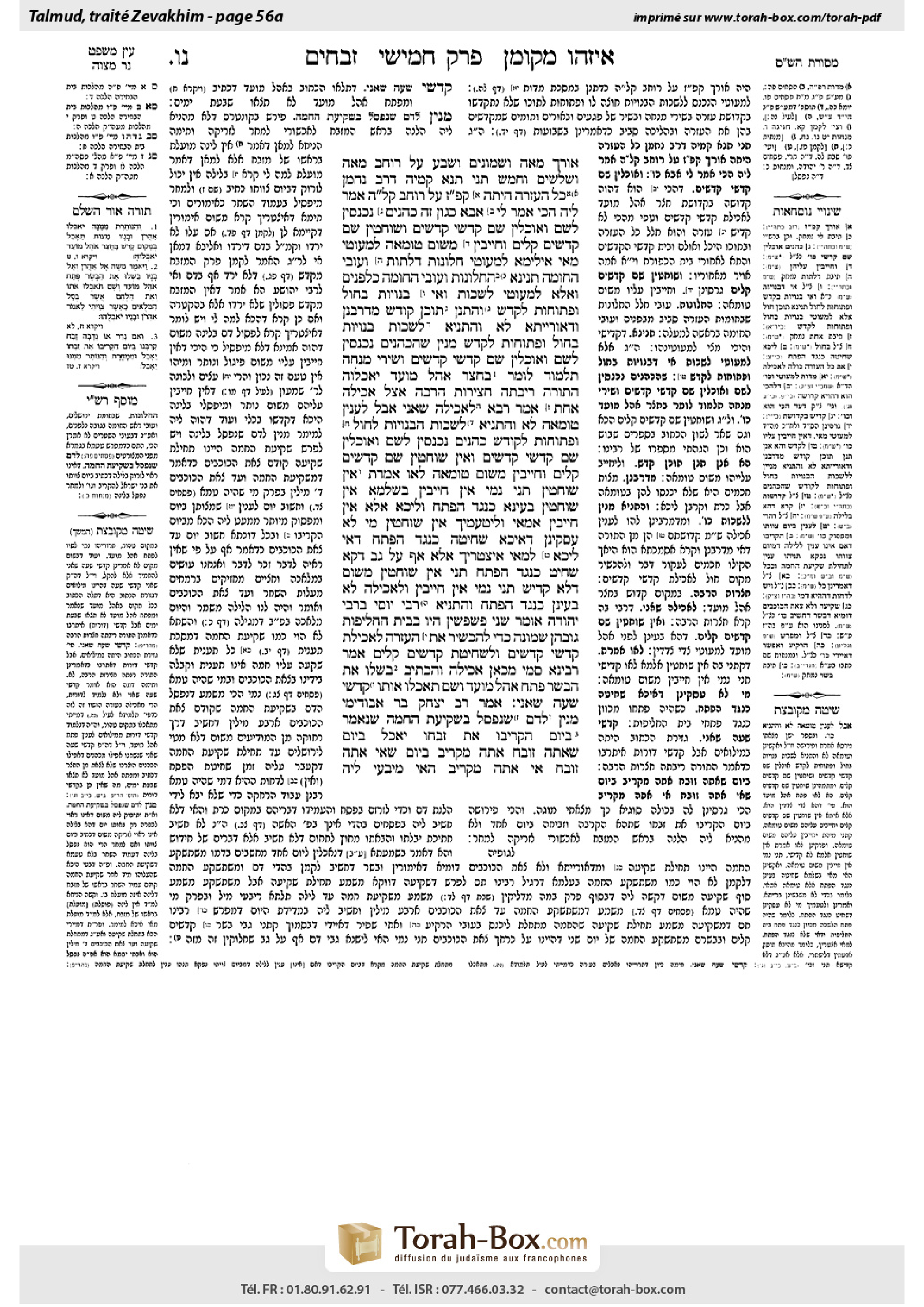
Zevachim 56a: Talmud study for Daf Yomi
Daf Yomi is the daily study of one Talmud folio. Explore 37 tractates with scans, Hebrew text, Sefaria English and AI-generated French translations where annotated.
Passage selection and English or AI-generated French translation are available where the scan has annotations. Daf Study is independent of Torah-Box and Sefaria.
Browse Zevachim · זבחים · All tractatesZevachim 56a text and translations
This page of Zevachim includes the Aramaic text, an English translation and an AI-generated French translation, alongside the scan above.
זבחים נ״ו א · Aramaic and Hebrew text
אוֹרֶךְ מֵאָה וּשְׁמוֹנִים וָשֶׁבַע עַל רוֹחַב מֵאָה וּשְׁלֹשִׁים וְחָמֵשׁ.
תָּנֵי תַּנָּא קַמֵּיהּ דְּרַב נַחְמָן: כׇּל הָעֲזָרָה הָיְתָה מֵאָה שְׁמוֹנִים וָשֶׁבַע עַל רוֹחַב מֵאָה שְׁלֹשִׁים וְחָמֵשׁ. אֲמַר לֵיהּ, הָכִי אָמַר לִי אַבָּא: כְּגוֹן זֶה – כֹּהֲנִים נִכְנָסִין לְשָׁם וְאוֹכְלִין שָׁם קׇדְשֵׁי קָדָשִׁים, וְשׁוֹחֲטִין שָׁם קָדָשִׁים קַלִּים, וְחַיָּיבִין מִשּׁוּם טוּמְאָה.
לְמַעוֹטֵי מַאי? אִילֵּימָא לְמַעוֹטֵי חַלּוֹנוֹת, דְּלָתוֹת וְעוֹבִי הַחוֹמָה – תְּנֵינָא: הַחַלּוֹנוֹת וְעוֹבִי הַחוֹמָה כְּלִפְנִים!
וְאֶלָּא לְמַעוֹטֵי לְשָׁכוֹת? וְאִי בְּנוּיוֹת בַּחוֹל וּפְתוּחוֹת לַקֹּדֶשׁ – וְהָתְנַן: תּוֹכָן קוֹדֶשׁ! מִדְּרַבָּנַן.
וּדְאוֹרָיְיתָא לָא?! וְהָתַנְיָא: לְשָׁכוֹת בְּנוּיוֹת בַּחוֹל, וּפְתוּחוֹת לַקֹּדֶשׁ. מִנַּיִן שֶׁהַכֹּהֲנִים נִכְנָסִין לְשָׁם וְאוֹכְלִים שָׁם קׇדְשֵׁי קָדָשִׁים וּשְׁיָרֵי מִנְחָה? תַּלְמוּד לוֹמַר: ״בַּחֲצַר אֹהֶל מוֹעֵד יֹאכְלוּהָ״ – הַתּוֹרָה רִיבְּתָה חֲצֵירוֹת הַרְבֵּה אֵצֶל אֲכִילָה אַחַת.
אָמַר רָבָא: לַאֲכִילָה שָׁאנֵי.
אֲבָל לְעִנְיַן טוּמְאָה לָא?! וְהָתַנְיָא: לְשָׁכוֹת הַבְּנוּיוֹת לַחוֹל וּפְתוּחוֹת לַקּוֹדֶשׁ – כֹּהֲנִים נִכְנָסִין לְשָׁם וְאוֹכְלִין שָׁם קׇדְשֵׁי קָדָשִׁים, וְאֵין שׁוֹחֲטִין שָׁם קָדָשִׁים קַלִּים, וְחַיָּיבִין מִשּׁוּם טוּמְאָה!
לָאו אָמְרַתְּ ״אֵין שׁוֹחֲטִין״? תְּנִי נָמֵי ״אֵין חַיָּיבִין״.
בִּשְׁלָמָא אֵין שׁוֹחֲטִין – בָּעֵינָא כְּנֶגֶד הַפֶּתַח, וְלֵיכָּא; אֶלָּא אֵין חַיָּיבִין – אַמַּאי?
וְלִיטַעְמָיךְ, אֵין שׁוֹחֲטִין – מִי לָא עָסְקִינַן דְּאִיכָּא שְׁחִיטָה כְּנֶגֶד הַפֶּתַח?! דְּאִי לֵיכָּא, לְמַאי אִיצְטְרִיךְ? אֶלָּא אַף עַל גַּב דְּקָא שָׁחֵיט כְּנֶגֶד הַפֶּתַח – תְּנִי ״אֵין שׁוֹחֲטִין״ מִשּׁוּם דְּלָא קָדֵישׁ; תְּנִי נָמֵי: ״אֵין חַיָּיבִין״.
וְלַאֲכִילָה לָא בָּעֵינַן כְּנֶגֶד הַפֶּתַח?! וְהָתַנְיָא, רַבִּי יוֹסֵי בְּרַבִּי יְהוּדָה אוֹמֵר: שְׁנֵי פִּשְׁפָּשִׁין הָיוּ בְּבֵית הַחֲלִיפוֹת, גּוֹבְהָן שְׁמוֹנֶה; כְּדֵי לְהַכְשִׁיר אֶת הָעֲזָרָה לַאֲכִילַת קׇדְשֵׁי קָדָשִׁים, וְלִשְׁחִיטַת קָדָשִׁים קַלִּים! אָמַר רָבִינָא: סְמִי מִכָּאן אֲכִילָה.
וְהָכְתִיב: ״בַּשְּׁלוּ אֶת הַבָּשָׂר פֶּתַח אֹהֶל מוֹעֵד, וְשָׁם תֹּאכְלוּ אוֹתוֹ״! קׇדְשֵׁי שָׁעָה שָׁאנֵי.
אָמַר רַב יִצְחָק בַּר אֲבוּדִימִי: מִנַּיִן לְדָם – שֶׁנִּפְסָל בִּשְׁקִיעַת הַחַמָּה? שֶׁנֶּאֱמַר: ״בַּיּוֹם הַקְרִיבוֹ אֶת זִבְחוֹ יֵאָכֵל״ – בְּיוֹם שֶׁאַתָּה זוֹבֵחַ אַתָּה מַקְרִיב, בְּיוֹם שֶׁאִי אַתָּה זוֹבֵחַ אִי אַתָּה מַקְרִיב.
הַאי מִיבְּעֵי לֵיהּ
Zevachim 56a · English translation
an area whose length is 187 cubits by 135 cubits in width.
A tanna taught a baraita before Rav Naḥman: The entire Temple courtyard was 187 cubits in length by 135 cubits in width. Rav Naḥman said to the tanna: My father said this to me: In an area such as this, the priests enter there and eat offerings of the most sacred order there, and slaughter offerings of lesser sanctity there, and are liable due to entering in a state of ritual impurity.
The Gemara asks: These specific dimensions serve to exclude what? If we say they are stated to exclude the windows, doors, and thickness of the wall, we learn the opposite in a mishna (Pesaḥim 85b): The windows in the wall and the thickness of the wall are considered as though they are inside the Temple courtyard.
But rather, they are stated to exclude the chambers in the Temple courtyard. The Gemara asks: And if it is referring to chambers that are built in the non-sacred area, which is outside this designated space, and open to the sacred area, but didn’t we learn in a mishna (Ma’aser Sheni 3:8): The inside of chambers that are built in the sacred area but are open to the non-sacred area is non-sacred, but their roofs are sacred. If they are built in a non-sacred area and open to a sacred area, their interior is sacred and their roofs are non-sacred? The Gemara answers: They have sanctity by rabbinic law.
The Gemara asks: And do they not have sanctity by Torah law? But isn’t it taught in a baraita: With regard to the chambers that are built in the non-sacred area of the Temple Mount and open to the sacred area, from where is it derived that the priests enter there and eat there offerings of the most sacred order and the remainders of meal offerings? The verse states with regard to a meal offering: “It shall be eaten without leaven in a holy place; in the courtyard of the Tent of Meeting they shall eat it.” (Leviticus 6:9). The verse could have simply stated: “In a holy place,” which indicates the courtyard. By also stating: “In the courtyard of the Tent of Meeting,” the Torah amplified many courtyards with one type of eating, i.e., of the meal offering. If the chambers do not have sanctity by Torah law, the Sages would not have permitted the priests to eat offerings of the most sacred order there.
Rava said: The halakha concerning eating is different. The Torah specifically includes these chambers in addition to the Temple courtyard itself for eating offerings of the most sacred order. By contrast, with regard to slaughtering offerings of lesser sanctity and the punishment for entering the courtyard in a state of ritual impurity, these chambers are not considered sacred by Torah law.
The Gemara asks: But with regard to ritual impurity, is one not liable to receive karet for entering these chambers? But isn’t it taught in a baraita: With regard to the chambers that are built in the non-sacred area and that open to the sacred area, priests enter there and eat offerings of the most sacred order there, but may not slaughter offerings of lesser sanctity there, and are liable to receive karet due to ritual impurity if they enter there while ritually impure?
Rava could answer: Did you not say in the baraita that they may not slaughter offerings of lesser sanctity in those chambers? If so, emend the text of the baraita and teach also: They are not liable to receive karet for entering in a state of ritual impurity.
The Gemara challenges: Granted, the priests may not slaughter there, because slaughtering an offering requires that it be performed before the entrance of the Temple courtyard, and if he slaughters it inside a chamber, it is not. But why would they not be liable for entering there in a state of ritual impurity?
The Gemara answers: And according to your reasoning, when it teaches that they may not slaughter there, are we not dealing even with a case in which there is an act of slaughter performed before the entrance, i.e., the entrance to the chamber directly faced the entrance of the Temple? As if not, for what purpose was it necessary to teach this at all? Rather, even though he slaughters the offering before the entrance, the baraita teaches that a priest may not slaughter offerings in the chambers because that area is not sacred. If so, teach also that they are not liable to receive karet for entering the chambers in a state of ritual impurity, as they are not sacred.
The Gemara asks: And for eating an offering, do we not require that this take place before the entrance of the Temple courtyard? But isn’t it taught in a baraita: Rabbi Yosei, son of Rabbi Yehuda, says: There were two wickets in the Chamber of Knives, and their height was eight cubits; the function of these openings was in order to render fit the entire Temple courtyard for the eating of offerings of the most sacred order, and to render fit all of the Temple courtyard for the slaughter of offerings of lesser sanctity? Ravina said: Remove from here the clause concerning eating. The eating of offerings does not have to take place before the entrance of the Temple courtyard.
The Gemara asks: But isn’t it written with regard to the offerings brought at the inauguration of the Tabernacle: “And Moses said to Aaron and to his sons: Cook the meat at the entrance of the Tent of Meeting; and eat it there” (Leviticus 8:31). This indicates that the eating of offerings had to be at the entrance of the Tent of Meeting. The Gemara answers: Offerings that were sacrificed only one time are different. Since they were specifically commanded for just that time, one cannot derive from there any halakhot with regard to offerings in general.
§ Rav Yitzḥak bar Avudimi says: From where is it derived that the blood of offerings becomes disqualified at sunset and can no longer be presented on the altar? This is as it is stated in the verse: “But if the sacrifice of his offering be a vow, or a gift offering, it shall be eaten on the day that he sacrifices his offering [zivḥo], and on the morrow” (Leviticus 7:16). This means that on the day that you slaughter [zove’aḥ] the offering you sacrifice it on the altar and present its blood. But on the day that you do not slaughter the offering you may not sacrifice it and present its blood.
The Gemara challenges: But he requires this verse
Zevachim 56a · Traduction française (IA)
une aire de 187 coudées de longueur sur 135 coudées de largeur.
Un tanna enseigna une baraïta devant Rav Naḥman : toute la cour du Temple mesurait 187 coudées de longueur sur 135 coudées de largeur. Rav Naḥman dit au tanna : « Mon père m’a dit ceci : dans une aire de cette dimension, les prêtres entrent et mangent des offrandes de sainteté suprême, y égorgent des offrandes de moindre sainteté, et sont passibles en cas d’entrée en état d’impureté rituelle. »
La Guemara demande : Qu’est-ce que ces dimensions précises viennent exclure ? Si l’on dit qu’elles viennent exclure les fenêtres, les portes et l’épaisseur du mur, on apprend le contraire d’une Michna (Pessaḥim 85b) : les fenêtres du mur et l’épaisseur du mur sont considérées comme faisant partie de la cour du Temple.
Il faut plutôt dire qu’elles viennent exclure les chambres de la cour du Temple. La Guemara demande : Et s’il s’agit de chambres bâties dans la zone profane, située hors de cet espace délimité, et ouvertes sur la zone sacrée, n’avons-nous pas appris dans une Michna (Ma’aser Chéni 3:8) : l’intérieur des chambres bâties dans la zone sacrée mais ouvertes sur la zone profane est profane, tandis que leurs toits sont sacrés ; si elles sont bâties dans la zone profane et ouvertes sur la zone sacrée, leur intérieur est sacré et leurs toits sont profanes ? La Guemara répond : Elles ont une sainteté d’ordre rabbinique.
La Guemara demande : N’ont-elles donc pas de sainteté selon la Torah ? N’est-il pas enseigné dans une baraïta : concernant les chambres bâties dans la zone profane du mont du Temple et ouvertes sur la zone sacrée, d’où sait-on que les prêtres y entrent et y mangent des offrandes de sainteté suprême ainsi que les restes des offrandes végétales ? Le verset dit au sujet d’une offrande végétale : « Elle sera mangée sans levain dans un lieu saint ; dans la cour de la Tente d’assignation, ils la mangeront » (Lévitique 6:9). Le verset aurait pu simplement dire : « Dans un lieu saint », ce qui désigne la cour. En ajoutant : « Dans la cour de la Tente d’assignation », la Torah a inclus de nombreuses cours où l’on peut consommer un même type d’offrande, à savoir l’offrande végétale. Si ces chambres n’avaient pas de sainteté selon la Torah, les Sages n’auraient pas autorisé les prêtres à y manger des offrandes de sainteté suprême.
Rava dit : La halakha concernant la consommation est différente. La Torah inclut expressément ces chambres, en plus de la cour du Temple elle-même, pour la consommation des offrandes de sainteté suprême. En revanche, pour ce qui est de l’égorgement des offrandes de moindre sainteté et de la peine encourue pour être entré dans la cour en état d’impureté rituelle, ces chambres ne sont pas considérées comme sacrées selon la Torah.
La Guemara demande : Mais, en matière d’impureté rituelle, n’est-on pas passible de karet pour être entré dans ces chambres ? N’est-il pas enseigné dans une baraïta : concernant les chambres bâties dans la zone profane et ouvertes sur la zone sacrée, les prêtres y entrent et y mangent des offrandes de sainteté suprême, mais ne peuvent pas y égorger des offrandes de moindre sainteté, et sont passibles de karet s’ils y entrent en état d’impureté rituelle ?
Rava pourrait répondre : N’as-tu pas dit dans la baraïta qu’ils ne peuvent pas égorger des offrandes de moindre sainteté dans ces chambres ? Dans ce cas, corrige le texte de la baraïta et enseigne aussi qu’ils ne sont pas passibles de karet pour y être entrés en état d’impureté rituelle.
La Guemara objecte : Certes, les prêtres ne peuvent pas y égorger, car l’égorgement d’une offrande doit être effectué devant l’entrée de la cour du Temple ; s’il l’égorge à l’intérieur d’une chambre, il ne l’égorge pas devant cette entrée. Mais pourquoi ne seraient-ils pas passibles pour être entrés dans ces chambres en état d’impureté rituelle ?
La Guemara répond : Et selon ton raisonnement, lorsque la baraïta enseigne qu’ils ne peuvent pas y égorger, ne traite-t-elle pas même d’un cas où l’égorgement est effectué devant une entrée, c’est-à-dire où l’entrée de la chambre faisait directement face à l’entrée du Temple ? Sinon, dans quel but aurait-il été nécessaire d’enseigner cela ? La baraïta enseigne plutôt que, même s’il égorge l’offrande devant l’entrée, un prêtre ne peut pas égorger d’offrandes dans les chambres, car cette zone n’est pas sacrée. Dans ce cas, enseigne aussi qu’ils ne sont pas passibles de karet pour être entrés dans les chambres en état d’impureté rituelle, puisqu’elles ne sont pas sacrées.
La Guemara demande : Et pour consommer une offrande, n’exige-t-on pas que cela ait lieu devant l’entrée de la cour du Temple ? N’est-il pas enseigné dans une baraïta : Rabbi Yosei, fils de Rabbi Yehuda, dit : il y avait deux ouvertures dans la Chambre des Couteaux, hautes de huit coudées ; ces ouvertures avaient pour fonction de rendre toute la cour du Temple propre à la consommation des offrandes de sainteté suprême, et propre à l’égorgement des offrandes de moindre sainteté ? Ravina dit : Supprime d’ici la clause concernant la consommation. La consommation des offrandes n’a pas à avoir lieu devant l’entrée de la cour du Temple.
La Guemara demande : Mais n’est-il pas écrit au sujet des offrandes apportées lors de l’inauguration du Tabernacle : « Moïse dit à Aaron et à ses fils : Faites cuire la viande à l’entrée de la Tente d’assignation, et mangez-la là » (Lévitique 8:31) ? Cela indique que les offrandes devaient être consommées à l’entrée de la Tente d’assignation. La Guemara répond : Les offrandes qui n’ont été sacrifiées qu’une seule fois sont différentes. Puisqu’elles ont fait l’objet d’un commandement particulier valable uniquement à cette occasion, on ne peut en déduire aucune halakha concernant les offrandes en général.
§ Rav Yitzḥak bar Avudimi dit : D’où sait-on que le sang des offrandes devient impropre au coucher du soleil et ne peut plus être présenté sur l’autel ? C’est ce qu’indique le verset : « Mais si le sacrifice de son offrande est un vœu ou une offrande volontaire, il sera mangé le jour où il offre son sacrifice [zivḥo], et le lendemain » (Lévitique 7:16). Cela signifie que le jour où tu égorges [zove’aḥ] l’offrande, tu l’offres sur l’autel et en présentes le sang. Mais le jour où tu n’égorges pas l’offrande, tu ne peux ni l’offrir ni en présenter le sang.
La Guemara objecte : Mais il a besoin de ce verset
Traduction française générée par IA à partir de l’édition anglaise de Sefaria. Vérifie toujours un passage avec le texte source.
Text from Sefaria: William Davidson Edition - Vocalized Aramaic (CC BY NC); William Davidson Edition - English (CC BY NC).