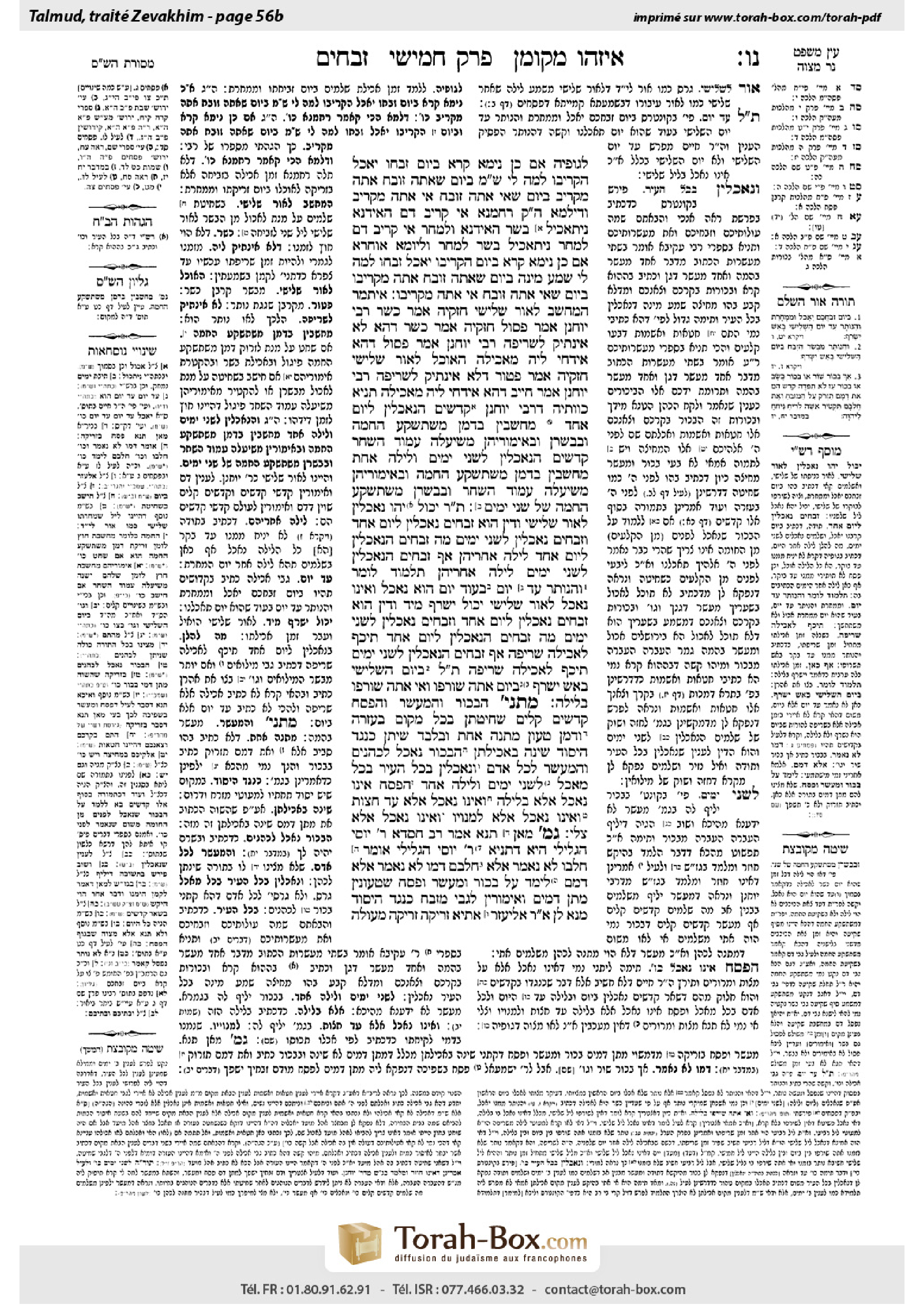
Zevachim 56b: Talmud study for Daf Yomi
Daf Yomi is the daily study of one Talmud folio. Explore 37 tractates with scans, Hebrew text, Sefaria English and AI-generated French translations where annotated.
Passage selection and English or AI-generated French translation are available where the scan has annotations. Daf Study is independent of Torah-Box and Sefaria.
Browse Zevachim · זבחים · All tractatesZevachim 56b text and translations
This page of Zevachim includes the Aramaic text, an English translation and an AI-generated French translation, alongside the scan above.
זבחים נ״ו ב · Aramaic and Hebrew text
לְגוּפֵיהּ! אִם כֵּן, נֵימָא קְרָא: ״בְּיוֹם זִבְחוֹ יֵאָכֵל״; ״הַקְרִיבוֹ״ לְמָה לִי? שְׁמַע מִינַּהּ: בְּיוֹם שֶׁאַתָּה זוֹבֵחַ אַתָּה מַקְרִיב, בְּיוֹם שֶׁאִי אַתָּה זוֹבֵחַ אִי אַתָּה מַקְרִיב.
וְדִילְמָא הָכִי קָאָמַר רַחֲמָנָא: אִי קָרֵיב דָּם הָאִידָּנָא – נִיתְאֲכֵיל בָּשָׂר הָאִידָּנָא וְלִמְחַר, אִי קָרֵיב דָּם לִמְחַר – נִיתְאֲכֵיל בָּשָׂר לִמְחַר וּלְיוֹמָא אוּחְרָא? אִם כֵּן, נֵימָא קְרָא: ״בְּיוֹם הַקְרִיבוֹ יֹאכַל״; ״זִבְחוֹ״ לְמָה לִי? שְׁמַע מִינַּהּ: בְּיוֹם שֶׁאַתָּה זוֹבֵחַ אַתָּה מַקְרִיבוֹ, בְּיוֹם שֶׁאִי אַתָּה זוֹבֵחַ אִי אַתָּה מַקְרִיבוֹ.
אִיתְּמַר: הַמְחַשֵּׁב לְאוֹר שְׁלִישִׁי – חִזְקִיָּה אָמַר: כָּשֵׁר, רַבִּי יוֹחָנָן אָמַר: פָּסוּל. חִזְקִיָּה אָמַר כָּשֵׁר – דְּהָא לָא אִינְּתִיק לִשְׂרֵיפָה; רַבִּי יוֹחָנָן אָמַר פָּסוּל – דְּהָא אִידְּחִי לֵיהּ מֵאֲכִילָה.
הָאוֹכֵל לְאוֹר שְׁלִישִׁי – חִזְקִיָּה אָמַר: פָּטוּר, דְּלָא אִינְּתִיק לִשְׂרֵיפָה; רַבִּי יוֹחָנָן אָמַר: חַיָּיב, דְּהָא אִידְּחִי לֵיהּ מֵאֲכִילָה.
תַּנְיָא כְּוָותֵיהּ דְּרַבִּי יוֹחָנָן: קָדָשִׁים הַנֶּאֱכָלִין לְיוֹם אֶחָד – מְחַשְּׁבִין בְּדָמָן מִשֶּׁתִּשְׁקַע הַחַמָּה, וּבִבְשָׂרָן וּבְאֵימוּרֵיהֶן מִשֶּׁיַּעֲלֶה עַמּוּד הַשַּׁחַר. קָדָשִׁים הַנֶּאֱכָלִין לִשְׁנֵי יָמִים וְלַיְלָה אַחַת – מְחַשְּׁבִין בְּדָמָן מִשֶּׁתִּשְׁקַע הַחַמָּה, וּבְאֵימוּרֵיהֶן מִשֶּׁיַּעֲלֶה עַמּוּד הַשַּׁחַר, וּבִבְשָׂרָן מִשֶּׁתִּשְׁקַע הַחַמָּה שֶׁל שְׁנֵי יָמִים.
תָּנוּ רַבָּנַן: יָכוֹל יְהוּ נֶאֱכָלִין לְאוֹר שְׁלִישִׁי? וְדִין הוּא – זְבָחִים נֶאֱכָלִין לְיוֹם אֶחָד, וּזְבָחִים נֶאֱכָלִין לִשְׁנֵי יָמִים; מָה זְבָחִים הַנֶּאֱכָלִין לְיוֹם אֶחָד – לַיְלָה אַחֲרֵיהֶן, אַף זְבָחִים הַנֶּאֱכָלִין לִשְׁנֵי יָמִים – לַיְלָה אַחֲרֵיהֶן.
תַּלְמוּד לוֹמַר: ״וְהַנּוֹתָר עַד יוֹם״ – בְּעוֹד יוֹם הוּא נֶאֱכָל, וְאֵינוֹ נֶאֱכָל לְאוֹר שְׁלִישִׁי.
יָכוֹל יִשָּׂרֵף מִיָּד? וְדִין הוּא – זְבָחִים נֶאֱכָלִין לְיוֹם אֶחָד, וּזְבָחִים נֶאֱכָלִין לִשְׁנֵי יָמִים; מָה זְבָחִים הַנֶּאֱכָלִין לְיוֹם אֶחָד – תֵּיכֶף לַאֲכִילָה שְׂרֵיפָה, אַף זְבָחִים הַנֶּאֱכָלִין לִשְׁנֵי יָמִים – תֵּיכֶף לַאֲכִילָה שְׂרֵיפָה.
תַּלְמוּד לוֹמַר: ״בַּיּוֹם הַשְּׁלִישִׁי בָּאֵשׁ יִשָּׂרֵף״ – בַּיּוֹם אַתָּה שׂוֹרְפוֹ, וְאִי אַתָּה שׂוֹרְפוֹ בַּלַּיְלָה.
מַתְנִי׳ הַבְּכוֹר וְהַמַּעֲשֵׂר וְהַפֶּסַח – קָדָשִׁים קַלִּים – שְׁחִיטָתָן בְּכׇל מָקוֹם בָּעֲזָרָה; וְדָמָן טָעוּן מַתָּנָה אֶחָת, וּבִלְבַד שֶׁיִּתֵּן כְּנֶגֶד הַיְסוֹד.
שִׁינָּה בַּאֲכִילָתָן. הַבְּכוֹר – נֶאֱכָל לַכֹּהֲנִים, וְהַמַּעֲשֵׂר – לְכׇל אָדָם; וְנֶאֱכָלִין בְּכׇל הָעִיר, בְּכׇל מַאֲכָל, לִשְׁנֵי יָמִים וְלַיְלָה אֶחָד. הַפֶּסַח – אֵינוֹ נֶאֱכָל אֶלָּא בַּלַּיְלָה, וְאֵינוֹ נֶאֱכָל אֶלָּא עַד חֲצוֹת, וְאֵינוֹ נֶאֱכָל אֶלָּא לִמְנוּיָו, וְאֵינוֹ נֶאֱכָל אֶלָּא צָלִי.
גְּמָ׳ מַאן תַּנָּא? אָמַר רַב חִסְדָּא: רַבִּי יוֹסֵי הַגְּלִילִי הִיא. דְּתַנְיָא, רַבִּי יוֹסֵי הַגְּלִילִי אוֹמֵר: ״חֶלְבּוֹ״ לֹא נֶאֱמַר אֶלָּא ״חֶלְבָּם״; ״דָּמוֹ״ לֹא נֶאֱמַר אֶלָּא ״דָּמָם״; לִימֵּד עַל בְּכוֹר וּמַעֲשֵׂר וּפֶסַח, שֶׁטְּעוּנִין מַתַּן דָּמִים וְאֵימוּרִין לְגַבֵּי מִזְבֵּחַ.
כְּנֶגֶד הַיְסוֹד מְנָא לַן? אָמַר רַבִּי אֱלִיעֶזֶר: אָתְיָא ״זְרִיקָה״–״זְרִיקָה״ מֵעוֹלָה.
Zevachim 56b · English translation
for the matter itself, to teach that a peace offering may be eaten for only two days? The Gemara answers: If so, let the verse state: On the day he slaughters it shall it be eaten, and the following day. Why do I need the verse to add the term “that he sacrifices it”? Conclude from the wording of the verse that on the day that you slaughter the offering you sacrifice the blood on the altar, but on a day that you do not slaughter the offering you do not sacrifice the blood on the altar.
The Gemara questions this proof: But perhaps this is what the Merciful One is saying: If the blood is sacrificed today, i.e., the day the offering was slaughtered, the meat may be eaten today and tomorrow. If the blood is sacrificed tomorrow, the meat may be eaten tomorrow and the following day. The Gemara answers: If so, let the verse state: On the day it is sacrificed it shall be eaten, and the following day. Why do I need the verse to state: “That he sacrifices his offering”? Conclude from the wording of the verse that on the day that you slaughter the offering you sacrifice the blood on the altar, but on a day that you do not slaughter the offering you do not sacrifice the blood on the altar.
§ It was stated: With regard to one who slaughters a peace offering and intends to eat it on the evening preceding the third day, Ḥizkiyya says: The offering is valid, and it is not disqualified due to his intention to eat it after its designated time [piggul]. And Rabbi Yoḥanan says: It is disqualified. The Gemara explains: Ḥizkiyya says that the offering is valid because on the evening preceding the third day, the peace offering has not yet been removed from its previous status and designated for burning. A peace offering is not burned until the third morning, as the verse states: “It shall be eaten the same day you offer it, and on the following day; and if anything remain until the third day, it shall be burned with fire” (Leviticus 19:6). Rabbi Yoḥanan says it is disqualified, because it has been rejected from being eaten.
These two amora’im have the same dispute concerning a similar matter: With regard to one who eats a peace offering on the evening preceding the third day, Ḥizkiyya says: He is exempt from karet, because the offering has not yet been removed from its previous status and designated for burning. And Rabbi Yoḥanan says: He is liable to receive karet, because it has been rejected from being eaten.
It is taught in a baraita in accordance with the opinion of Rabbi Yoḥanan: With regard to sacrificial animals that may be eaten for one day, if one intends to present their blood after sunset, or if one intends to eat their meat or to sacrifice their sacrificial portions after the first rays of dawn, the offering is considered to be piggul and is disqualified. With regard to sacrificial animals that may be eaten for two days and one night, if one intends to present their blood after sunset, or if one intends to sacrifice their sacrificial portions after the first rays of dawn, or if one intends to eat their meat after sunset following the second of the two days, the offering is considered to be piggul and is disqualified.
The Gemara cites another baraita on this topic. The Sages taught: One might have thought that peace offerings, which may be eaten for two days, may also be eaten on the evening preceding the third day. And this is the conclusion of a logical inference: Other offerings, e.g., thanks offerings, are eaten for one day, and peace offerings are eaten for two days. Just as with regard to offerings that are eaten for one day, the night follows the previous day, i.e., the offering may be eaten during the day and the subsequent night, so too, with regard to peace offerings that are eaten for two days, say that the night follows the day, and rule that they may be eaten on the night after the second day.
To counter this logic, the verse states: “And when you sacrifice a peace offering to God, you shall sacrifice it of your own will. It shall be eaten the same day you sacrifice it, and on the next day; and if any remains until the third day, it shall be burned with fire” (Leviticus 19:5–6). This teaches that it may be eaten while it is still daytime, i.e., during the second day, but it may not be eaten on the evening preceding the third day.
The baraita continues: If a peace offering may not be eaten beyond the second day, one might have thought that it should be burned immediately after the conclusion of the second day, and this too is the conclusion of a logical inference: Other offerings are eaten for one day, and peace offerings are eaten for two days. Just as with regard to offerings that are eaten for one day, immediately after the conclusion of their permitted time for eating should their burning commence, on the morning of the second day, so too, with regard to peace offerings that are eaten for two days say that immediately after the conclusion of their permitted time for eating should their burning commence, at night after the second day.
To counter this logic, the verse states: “And if any remains of the flesh of the sacrifice on the third day, it shall be burned with fire” (Leviticus 7:17), meaning: You must burn it during the day, but you may not burn it during the night.
MISHNA: The firstborn offering, the animal tithe offering, and the Paschal offering are offerings of lesser sanctity. Their slaughter is anywhere in the Temple courtyard, and their blood requires one placement, provided that the priest places it so that the blood goes on the base of the altar.
The halakha differs with regard to their consumption. The firstborn offering is eaten by the priests, and the animal tithe offering is eaten by any person, i.e., any ritually pure Jew. And they are eaten throughout the city of Jerusalem, prepared in any manner of food preparation, for two days and one night. The Paschal offering is eaten only at night, and it is eaten only until midnight, and it is eaten only by its registrants, i.e., those who registered in advance to partake of the offering, and it is eaten only roasted, not prepared in any other manner.
GEMARA: Who is the tanna who taught that the blood of these offerings is placed, not poured, so that it goes on the base of the altar? Rav Ḥisda says that it is Rabbi Yosei HaGelili, as it is taught in a baraita: Rabbi Yosei HaGelili says: The verse states: “But the firstborn of an ox, or the firstborn of a sheep, or the firstborn of a goat, you shall not redeem; they are sacred; you shall sprinkle their blood upon the altar and you shall burn their fat for an offering made by fire, for a pleasing aroma to the Lord” (Numbers 18:17). It is not stated: Its fat, but rather: “Their fat.” Similarly, it is not stated: Its blood, but rather: “Their blood.” This teaches with regard to a firstborn offering, which is mentioned explicitly in the verse, and an animal tithe offering, and a Paschal offering, which are similar in their sanctity to a firstborn offering, that they all require placement of their blood and the burning of their sacrificial portions on the altar.
The Gemara asks: From where do we derive that their blood must be placed so that it goes on the base of the altar? Rabbi Eliezer says: This is derived by way of a verbal analogy, with the meaning of the word “sprinkling” stated here derived from the meaning of the word “sprinkling” stated with regard to a burnt offering.
Zevachim 56b · Traduction française (IA)
pour la question elle-même, afin d’enseigner qu’un sacrifice de paix ne peut être consommé que pendant deux jours ? La Guemara répond : Si tel était le cas, que le verset dise : « Le jour où il l’égorge, il sera consommé, et le lendemain. » Pourquoi le verset doit-il ajouter les mots « que tu offres » ? Déduis de la formulation du verset que le jour où tu égorges le sacrifice, tu offres son sang sur l’autel, mais que le jour où tu ne l’égorges pas, tu n’offres pas son sang sur l’autel.
La Guemara conteste cette preuve : Mais peut-être le Miséricordieux dit-il ceci : si le sang est offert aujourd’hui, c’est-à-dire le jour où le sacrifice a été égorgé, la viande peut être consommée aujourd’hui et demain ; si le sang est offert demain, la viande peut être consommée demain et le jour suivant. La Guemara répond : Si tel était le cas, que le verset dise : « Le jour où il est offert, il sera consommé, et le lendemain. » Pourquoi le verset doit-il dire : « que tu offres ton sacrifice » ? Déduis de la formulation du verset que le jour où tu égorges le sacrifice, tu offres son sang sur l’autel, mais que le jour où tu ne l’égorges pas, tu n’offres pas son sang sur l’autel.
§ Il a été dit : Celui qui égorge un sacrifice de paix avec l’intention de le consommer le soir précédant le troisième jour : Ḥizkiyya dit que le sacrifice est valide et n’est pas disqualifié en raison de son intention de le consommer après le délai prescrit [piggul]. Rabbi Yoḥanan dit qu’il est disqualifié. La Guemara explique : selon Ḥizkiyya, le sacrifice est valide, car, le soir précédant le troisième jour, le sacrifice de paix n’a pas encore quitté son statut antérieur pour être destiné à la combustion. Un sacrifice de paix n’est brûlé que le matin du troisième jour, comme le dit le verset : « Il sera consommé le jour où vous l’offrirez, et le lendemain ; et s’il en reste jusqu’au troisième jour, il sera brûlé au feu » (Lévitique 19, 6). Rabbi Yoḥanan dit qu’il est disqualifié, car il a été écarté de la consommation.
Ces deux amoraïm sont en désaccord sur une question analogue : celui qui consomme un sacrifice de paix le soir précédant le troisième jour. Ḥizkiyya dit qu’il est exempt de karet, car le sacrifice n’a pas encore quitté son statut antérieur pour être destiné à la combustion. Rabbi Yoḥanan dit qu’il est passible de karet, car il a été écarté de la consommation.
Une baraïta enseigne conformément à l’opinion de Rabbi Yoḥanan : pour les sacrifices qui peuvent être consommés pendant un jour, si quelqu’un a l’intention d’en présenter le sang après le coucher du soleil, ou de consommer leur viande ou d’offrir leurs portions sacrificielles après les premières lueurs de l’aube, le sacrifice est considéré comme piggul et est disqualifié. Pour les sacrifices qui peuvent être consommés pendant deux jours et une nuit, si quelqu’un a l’intention d’en présenter le sang après le coucher du soleil, ou d’offrir leurs portions sacrificielles après les premières lueurs de l’aube, ou de consommer leur viande après le coucher du soleil qui suit le deuxième des deux jours, le sacrifice est considéré comme piggul et est disqualifié.
La Guemara cite une autre baraïta sur ce sujet. Les Sages ont enseigné : On aurait pu penser que les sacrifices de paix, qui peuvent être consommés pendant deux jours, peuvent aussi l’être le soir précédant le troisième jour. Cette conclusion découle d’un raisonnement logique : d’autres sacrifices, par exemple les sacrifices d’action de grâce, sont consommés pendant un jour, tandis que les sacrifices de paix sont consommés pendant deux jours. De même que, pour les sacrifices consommés pendant un jour, la nuit suit le jour précédent — c’est-à-dire que le sacrifice peut être consommé pendant la journée et la nuit qui suit —, de même, pour les sacrifices de paix consommés pendant deux jours, on pourrait dire que la nuit suit le jour et statuer qu’ils peuvent être consommés la nuit qui suit le deuxième jour.
Pour réfuter ce raisonnement, le verset dit : « Et lorsque vous offrirez à Dieu un sacrifice de paix, vous l’offrirez de votre plein gré. Il sera consommé le jour où vous l’offrirez et le lendemain ; et s’il en reste jusqu’au troisième jour, il sera brûlé au feu » (Lévitique 19, 5-6). Cela enseigne qu’il peut être consommé tant qu’il fait encore jour, c’est-à-dire pendant le deuxième jour, mais pas le soir précédant le troisième jour.
La baraïta poursuit : Si un sacrifice de paix ne peut pas être consommé au-delà du deuxième jour, on aurait pu penser qu’il devait être brûlé immédiatement après la fin du deuxième jour. Cette conclusion découle elle aussi d’un raisonnement logique : d’autres sacrifices sont consommés pendant un jour, tandis que les sacrifices de paix sont consommés pendant deux jours. De même que, pour les sacrifices consommés pendant un jour, la combustion doit commencer immédiatement après la fin de la période où ils peuvent être consommés, c’est-à-dire le matin du deuxième jour, de même, pour les sacrifices de paix consommés pendant deux jours, on pourrait dire que la combustion doit commencer immédiatement après la fin de la période où ils peuvent être consommés, c’est-à-dire la nuit suivant le deuxième jour.
Pour réfuter ce raisonnement, le verset dit : « Et s’il reste de la viande du sacrifice le troisième jour, elle sera brûlée au feu » (Lévitique 7, 17), ce qui signifie : tu dois la brûler pendant la journée, mais pas pendant la nuit.
MICHNA : Le sacrifice du premier-né, le sacrifice de la première dîme du bétail et le sacrifice pascal sont des sacrifices de moindre sainteté. Ils peuvent être égorgés n’importe où dans la cour du Temple, et leur sang requiert une aspersion, à condition que le prêtre l’applique de manière qu’il atteigne le soubassement de l’autel.
Les règles de leur consommation diffèrent. Le sacrifice du premier-né est consommé par les prêtres, tandis que le sacrifice de la première dîme du bétail est consommé par toute personne, c’est-à-dire par tout Juif rituellement pur. Ces sacrifices sont consommés partout dans la ville de Jérusalem, préparés de n’importe quelle manière, pendant deux jours et une nuit. Le sacrifice pascal est consommé uniquement la nuit, jusqu’à minuit seulement, par les seuls membres du groupe qui y sont inscrits, c’est-à-dire ceux qui se sont inscrits à l’avance pour prendre part au sacrifice, et uniquement rôti, sans autre mode de préparation.
GUEMARA : Quel est le tanna qui a enseigné que le sang de ces sacrifices est appliqué, et non versé, de manière à atteindre le soubassement de l’autel ? Rav Ḥisda dit qu’il s’agit de Rabbi Yosei HaGelili, comme l’enseigne une baraïta : Rabbi Yosei HaGelili dit : Le verset dit : « Mais le premier-né d’un bœuf, le premier-né d’un mouton ou le premier-né d’une chèvre, tu ne le rachèteras pas ; ils sont sacrés ; tu aspergeras leur sang sur l’autel et tu brûleras leur graisse en offrande consumée par le feu, en odeur agréable pour le Seigneur » (Nombres 18, 17). Il n’est pas dit « sa graisse », mais « leur graisse ». De même, il n’est pas dit « son sang », mais « leur sang ». Cela enseigne que le sacrifice du premier-né, explicitement mentionné dans le verset, ainsi que le sacrifice de la première dîme du bétail et le sacrifice pascal, dont la sainteté est semblable à celle du premier-né, requièrent tous que leur sang soit appliqué et que leurs portions sacrificielles soient brûlées sur l’autel.
La Guemara demande : D’où déduisons-nous que leur sang doit être appliqué de manière à atteindre le soubassement de l’autel ? Rabbi Eliezer dit : Cela se déduit d’une analogie verbale : le sens du mot « aspersion » employé ici est déduit du sens du mot « aspersion » employé à propos d’un holocauste.
Traduction française générée par IA à partir de l’édition anglaise de Sefaria. Vérifie toujours un passage avec le texte source.
Text from Sefaria: William Davidson Edition - Vocalized Aramaic (CC BY NC); William Davidson Edition - English (CC BY NC).