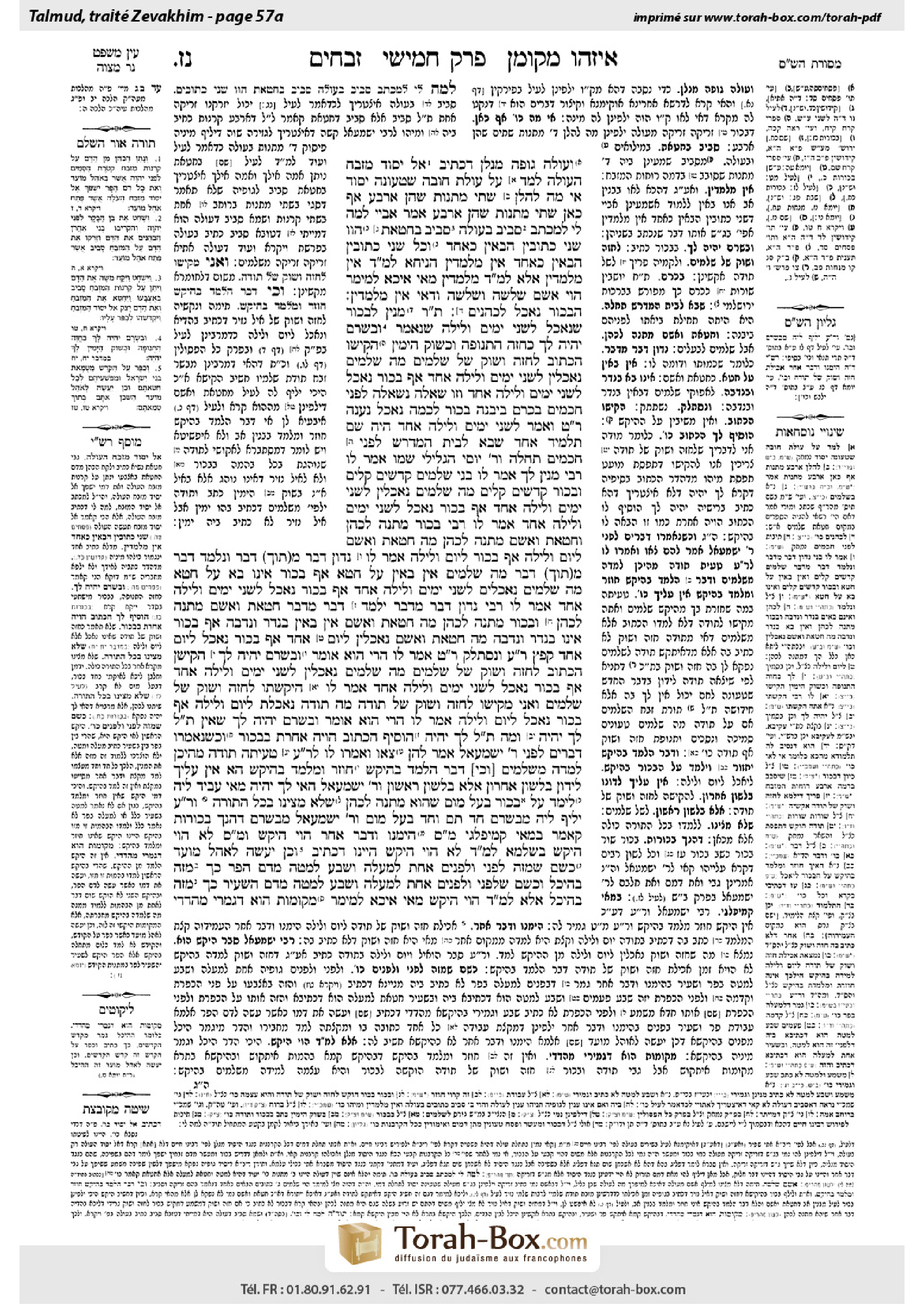
Zevachim 57a: Talmud study for Daf Yomi
Daf Yomi is the daily study of one Talmud folio. Explore 37 tractates with scans, Hebrew text, Sefaria English and AI-generated French translations where annotated.
Passage selection and English or AI-generated French translation are available where the scan has annotations. Daf Study is independent of Torah-Box and Sefaria.
Browse Zevachim · זבחים · All tractatesZevachim 57a text and translations
This page of Zevachim includes the Aramaic text, an English translation and an AI-generated French translation, alongside the scan above.
זבחים נ״ז א · Aramaic and Hebrew text
וְעוֹלָה גּוּפַהּ מְנָלַן? דִּכְתִיב: ״אֶל יְסוֹד מִזְבַּח הָעוֹלָה״ – לִמֵּד עַל עוֹלַת חוֹבָה שֶׁטְּעוּנָה יְסוֹד.
אִי – מָה לְהַלָּן שְׁתֵּי מַתָּנוֹת שֶׁהֵן אַרְבַּע, אַף כָּאן שְׁתֵּי מַתָּנוֹת שֶׁהֵן אַרְבַּע?!
אָמַר אַבָּיֵי: לְמָה לִי לְמִכְתַּב ״סָבִיב״ בְּעוֹלָה, ״סָבִיב״ בְּחַטָּאת? הָווּ שְׁנֵי כְּתוּבִין הַבָּאִין כְּאֶחָד, וְכׇל שְׁנֵי כְּתוּבִין הַבָּאִין כְּאֶחָד אֵין מְלַמְּדִין.
הָנִיחָא לְמַאן דְּאָמַר אֵין מְלַמְּדִין, אֶלָּא לְמַאן דְּאָמַר מְלַמְּדִין מַאי אִיכָּא לְמֵימַר? הָוֵי אָשָׁם שְׁלֹשָׁה, וּשְׁלֹשָׁה וַדַּאי אֵין מְלַמְּדִין.
הַבְּכוֹר נֶאֱכָל לַכֹּהֲנִים. תָּנוּ רַבָּנַן: מִנַּיִן לַבְּכוֹר שֶׁנֶּאֱכָל לִשְׁנֵי יָמִים וְלַיְלָה? שֶׁנֶּאֱמַר: ״וּבְשָׂרָם יִהְיֶה לָּךְ כַּחֲזֵה הַתְּנוּפָה וּכְשׁוֹק הַיָּמִין״ – הִקִּישׁוֹ הַכָּתוּב לְחָזֶה וָשׁוֹק שֶׁל שְׁלָמִים; מָה שְׁלָמִים נֶאֱכָלִין לִשְׁנֵי יָמִים וְלַיְלָה אֶחָד, אַף בְּכוֹר נֶאֱכָל לִשְׁנֵי יָמִים וְלַיְלָה אֶחָד.
וְזוֹ שְׁאֵלָה נִשְׁאֲלָה לִפְנֵי חֲכָמִים בַּכֶּרֶם בְּיַבְנֶה: בְּכוֹר לְכַמָּה נֶאֱכָל? נַעֲנָה רַבִּי טַרְפוֹן וְאָמַר: לִשְׁנֵי יָמִים וְלַיְלָה אֶחָד.
הָיָה שָׁם תַּלְמִיד אֶחָד שֶׁבָּא לְבֵית הַמִּדְרָשׁ לִפְנֵי חֲכָמִים תְּחִלָּה, וְרַבִּי יוֹסֵי הַגְּלִילִי שְׁמוֹ, אָמַר לוֹ: רַבִּי, מִנַּיִן לָךְ? אָמַר לוֹ: בְּנִי, שְׁלָמִים קָדָשִׁים קַלִּים, וּבְכוֹר קָדָשִׁים קַלִּים; מָה שְׁלָמִים נֶאֱכָלִין לִשְׁנֵי יָמִים וְלַיְלָה אֶחָד, אַף בְּכוֹר נֶאֱכָל לִשְׁנֵי יָמִים וְלַיְלָה אֶחָד.
אָמַר לוֹ: רַבִּי, בְּכוֹר מַתָּנָה לַכֹּהֵן, וְחַטָּאת וְאָשָׁם מַתָּנָה לַכֹּהֵן; מָה חַטָּאת וְאָשָׁם לְיוֹם וָלַיְלָה, אַף בְּכוֹר לְיוֹם וָלַיְלָה!
אָמַר לוֹ: נָדוּן דָּבָר מִתּוֹךְ דָּבָר, וְנִלְמַד דָּבָר מִתּוֹךְ דָּבָר; מָה שְׁלָמִים אֵין בָּאִין עַל חֵטְא – אַף בְּכוֹר אֵינוֹ בָּא עַל חֵטְא, מָה שְׁלָמִים נֶאֱכָלִים לִשְׁנֵי יָמִים וְלַיְלָה אֶחָד – אַף בְּכוֹר נֶאֱכָל לִשְׁנֵי יָמִים וְלַיְלָה אֶחָד.
אָמַר לוֹ: רַבִּי, נָדוּן דָּבָר מִדָּבָר, יִלְמַד דָּבָר מִדָּבָר; חַטָּאת וְאָשָׁם מַתָּנָה לַכֹּהֵן, וּבְכוֹר מַתָּנָה לַכֹּהֵן; מָה חַטָּאת וְאָשָׁם אֵין בָּאִין בְּנֶדֶר וּנְדָבָה – אַף בְּכוֹר אֵינוֹ בְּנֶדֶר וּנְדָבָה, מָה חַטָּאת וְאָשָׁם נֶאֱכָלִין לְיוֹם אֶחָד – אַף בְּכוֹר נֶאֱכָל לְיוֹם אֶחָד!
קָפַץ רַבִּי עֲקִיבָא, וְנִסְתַּלֵּק רַבִּי טַרְפוֹן. אָמַר לוֹ: הֲרֵי הוּא אוֹמֵר ״וּבְשָׂרָם יִהְיֶה לָּךְ״ – הִקִּישָׁן הַכָּתוּב לְחָזֶה וָשׁוֹק שֶׁל שְׁלָמִים; מָה שְׁלָמִים נֶאֱכָלִין לִשְׁנֵי יָמִים וְלַיְלָה אֶחָד, אַף בְּכוֹר נֶאֱכָל לִשְׁנֵי יָמִים וְלַיְלָה אֶחָד.
אָמַר לוֹ: הִיקַּשְׁתּוֹ לְחָזֶה וָשׁוֹק שֶׁל שְׁלָמִים, וַאֲנִי מַקִּישׁוֹ לְחָזֶה וָשׁוֹק שֶׁל תּוֹדָה – מָה תּוֹדָה נֶאֱכֶלֶת לְיוֹם וְלַיְלָה, אַף בְּכוֹר נֶאֱכָל לְיוֹם וְלַיְלָה!
אָמַר לוֹ: הֲרֵי הוּא אוֹמֵר: ״וּבְשָׂרָם יִהְיֶה לָךְ״ – שֶׁאֵין תַּלְמוּד לוֹמַר ״לְךָ יִהְיֶה״, וּמָה תַּלְמוּד לוֹמַר ״לְךָ יִהְיֶה״? הוֹסִיף הַכָּתוּב הֲוָיָה אַחֶרֶת בַּבְּכוֹר.
וּכְשֶׁנֶּאְמְרוּ דְּבָרִים לִפְנֵי רַבִּי יִשְׁמָעֵאל, אָמַר לָהֶן: צְאוּ וְאִמְרוּ לוֹ לְרַבִּי עֲקִיבָא: טָעִיתָה. תּוֹדָה מֵהֵיכָן לָמְדָה – מִשְּׁלָמִים; [וְכִי] דָּבָר הַלָּמֵד בְּהֶיקֵּשׁ חוֹזֵר וּמְלַמֵּד בְּהֶיקֵּשׁ?! הָא אֵין עָלֶיךָ לִידּוֹן בְּלָשׁוֹן אַחֲרוֹן, אֶלָּא בְּלָשׁוֹן רִאשׁוֹן.
וְרַבִּי יִשְׁמָעֵאל, הַאי ״לְךָ יִהְיֶה״ מַאי עָבֵיד לֵיהּ? לִימֵּד עַל בְּכוֹר בַּעַל מוּם שֶׁהוּא מַתָּנָה לַכֹּהֵן – שֶׁלֹּא מָצִינוּ בְּכׇל הַתּוֹרָה.
וְרַבִּי עֲקִיבָא יָלֵיף לֵיהּ מִ״בְּשָׂרָם״ – חַד תָּם וְחַד בַּעַל מוּם. וְרַבִּי יִשְׁמָעֵאל, מִ״בְּשָׂרָם״ דְּהָנָךְ בְּכוֹרוֹת קָאָמַר.
בְּמַאי קָמִיפַּלְגִי? מָר סָבַר: הֵימֶנּוּ וְדָבָר אַחֵר – הָוֵי הֶיקֵּשׁ; וּמָר סָבַר: לָא הָוֵי הֶיקֵּשׁ.
בִּשְׁלָמָא לְמַאן דְּאָמַר לָא הָוֵי הֶיקֵּשׁ, הַיְינוּ דִּכְתִיב: ״וְכֵן יַעֲשֶׂה לְאֹהֶל מוֹעֵד״ –
כְּשֵׁם שֶׁמַּזֶּה לִפְנַי וְלִפְנִים אַחַת לְמַעְלָה וְשֶׁבַע לְמַטָּה מִדַּם הַפָּר, כָּךְ מַזֶּה בַּהֵיכָל.
וּכְשֵׁם שֶׁלִּפְנַי וְלִפְנִים אַחַת לְמַעְלָה וְשֶׁבַע לְמַטָּה מִדַּם הַשָּׂעִיר, כָּךְ מַזֶּה בַּהֵיכָל.
אֶלָּא לְמַאן דְּאָמַר הָוֵי הֶיקֵּשׁ, מַאי אִיכָּא לְמֵימַר? מְקוֹמוֹת הוּא דְּגָמְרִי מֵהֲדָדֵי.
Zevachim 57a · English translation
The Gemara asks: And from where do we derive the halakha that a burnt offering itself has its blood presented on the altar in a place where there is a base? The Gemara answers: We derive it from a verse, as it is written: “And he shall pour all the blood of the bull at the base of the altar of the burnt offering” (Leviticus 4:7). This teaches that the blood of an obligatory burnt offering requires presentation at the base of the altar, as the verse specifically describes the base of the altar as connected to the burnt offering.
The Gemara asks: If it is derived from a burnt offering via a verbal analogy, one might think that just as there, a burnt offering requires two placements that are four, so too here, a firstborn offering, an animal tithe offering, and a Paschal offering should also require two placements that are four, and not just a single placement.
Abaye says: Why do I need the Torah to write: “And Aaron’s sons, the priests, shall present the blood, and sprinkle the blood around against the altar” (Leviticus 1:5), with regard to a burnt offering, to teach that the blood must be placed on all four sides of the altar, in addition to writing: “And Moses took the blood, and put it upon the corners of the altar around with his finger” (Leviticus 8:15), with regard to a sin offering? They are two verses that come as one, i.e., they teach the same matter; and any two verses that come as one do not teach their common aspect to apply to other cases. Therefore, a firstborn offering, an animal tithe offering, and a Paschal offering do not require two placements that are four.
The Gemara asks: This works out well according to the one who says that two verses that come as one do not teach their common aspect with regard to other cases. But according to the one who says that two verses that come as one do teach their common aspect with regard to other cases, what is there to say? The Gemara answers: Together with the verse stated with regard to a guilt offering, there are three verses, as it is written: “And its blood shall be sprinkled around the altar” (Leviticus 7:2), and three verses which come as one certainly do not teach their common aspect with regard to other cases.
§ The mishna teaches: The firstborn offering is eaten by the priests, throughout the city of Jerusalem, prepared in any manner of food preparation, for two days and one night. The Sages taught in a baraita: From where is it derived with regard to a firstborn offering that it is eaten for two days and the intervening night? It is derived from a verse, as it is stated with regard to a firstborn offering: “And their flesh shall be yours, as the breast of waving and as the right thigh” (Numbers 18:18). The verse juxtaposes the firstborn offering with the breast and thigh of peace offerings. Just as peace offerings are eaten for two days and one night, so too, a firstborn offering is eaten for two days and one night.
The baraita relates: And this question was asked before the Sages in the vineyard, i.e., the academy, in Yavne: For how many days and nights is a firstborn offering eaten? Rabbi Tarfon responded and said: For two days and one night.
There was one student there who came to the study hall before the Sages for the first time, and his name was Rabbi Yosei HaGelili. He said to Rabbi Tarfon: My teacher, from where do you derive this? Rabbi Tarfon said to him: My son, peace offerings are offerings of lesser sanctity, and a firstborn offering is an offering of lesser sanctity. Just as peace offerings are eaten for two days and one night, so too, a firstborn offering is eaten for two days and one night.
Rabbi Yosei HaGelili said to him: My teacher, there is a different comparison that can be made: A firstborn offering is given as a gift to the priest, and a sin offering and a guilt offering are each given as a gift to the priest. Just as a sin offering and a guilt offering are eaten for one day and one night, so too, a firstborn offering should be eaten for one day and one night.
Rabbi Tarfon said to him: Let us judge a matter from a matter to which it is most similar, i.e., a firstborn offering is an offering of lesser sanctity, as are peace offerings, and learn a matter from a matter, i.e., there is another comparison to be made: Just as peace offerings do not come as atonement for a sin, so too, a firstborn offering does not come as atonement for a sin. Just as peace offerings are eaten for two days and one night, so too, a firstborn offering is eaten for two days and one night.
Rabbi Yosei HaGelili said to him: My teacher, I can answer you in a similar way. Let us judge a matter from a matter to which it is most similar, i.e., a firstborn offering is more similar to a sin offering and a guilt offering, and learn a matter from a matter, i.e., there is another comparison to be made: A sin offering and a guilt offering are each given as a gift to the priest, and a firstborn offering is given as a gift to the priest. Just as a sin offering and a guilt offering do not come as a vow offering or as a gift offering, i.e., they are brought only by one obligated to bring them, so too, a firstborn offering does not come as a vow offering or as a gift offering. Just as a sin offering and a guilt offering are eaten for one day and one night, so too, a firstborn offering should be eaten for one day and one night.
Rabbi Akiva jumped into the discussion, and Rabbi Tarfon left. Rabbi Akiva said to Rabbi Yosei HaGelili: But the verse states: “And their flesh shall be yours, as the breast of waving and as the right thigh” (Numbers 18:18). The verse juxtaposes firstborn offerings with a breast and thigh of peace offerings. Just as peace offerings are eaten for two days and one night, so too, a firstborn offering is eaten for two days and one night.
Rabbi Yosei HaGelili said to Rabbi Akiva: You juxtaposed it with a breast and thigh of peace offerings. But since the Torah does not specify with which offering the firstborn is juxtaposed, I juxtapose it with a breast and thigh of a thanks offering, which are also given to a priest. Just as a thanks offering is eaten for one day and one night, so too, a firstborn offering should be eaten for one day and one night.
Rabbi Akiva said to Rabbi Yosei HaGelili: I concede that it is possible to juxtapose a firstborn offering with a thanks offering, but the verse states: “And their flesh shall be yours, as the breast of waving and as the right thigh, it shall be yours” (Numbers 18:18). Since there is no need for the verse to state a second time: “It shall be yours,” what is the meaning when the verse states a second time: “It shall be yours”? The verse adds another day on which it is permitted for a firstborn offering to be eaten, i.e., a second day.
The Gemara relates: And when these matters were said before Rabbi Yishmael, he said to his students: Go out and tell Rabbi Akiva: You were mistaken when you conceded to Rabbi Yosei HaGelili that the allotted time for eating a firstborn offering could have been derived from the allotted time for eating a thanks offering. Why? From where is it derived that the breast and thigh of a thanks offering are eaten by priests? It is derived from a juxtaposition with a peace offering. Nowhere is it stated explicitly that the breast and thigh of a thanks offering are eaten only by priests. And in the realm of consecrated matters, can a matter derived via a juxtaposition then teach its halakha via a juxtaposition? The Gemara (49b) demonstrated that it cannot. Consequently, you should not infer from the latter formulation of the verse, from the words “It shall be yours,” but rather, from the first formulation of the verse, as you claimed that the Torah juxtaposes a firstborn offering with the breast and thigh of a peace offering.
The Gemara asks: And what does Rabbi Yishmael do with this extra phrase: “It shall be yours”? This teaches about a blemished firstborn offering, that it is also given as a gift to the priest, as we have not found it written explicitly anywhere in the entire Torah what should be done with a blemished firstborn.
The Gemara asks: And from where does Rabbi Akiva derive that a blemished firstborn offering is also given as a gift to the priest? He derives it from the term “their flesh,” which is written in the plural. This teaches that both an unblemished firstborn offering and a blemished firstborn offering are given as gifts to the priest. The Gemara asks: And how does Rabbi Yishmael understand the plural term? The Gemara answers that he understands it to be saying that the priest receives gifts from the flesh of all these firstborn offerings mentioned in the verse, i.e., the firstborn of cattle, sheep, and goats.
The Gemara asks: Since Rabbi Akiva and Rabbi Yishmael both agree that a matter derived via a juxtaposition cannot then teach its halakha via a juxtaposition, with regard to what principle do they disagree? The Gemara answers: One Sage, Rabbi Yishmael, holds that a halakha derived both from that juxtaposition and from another principle is considered a juxtaposition. In this case, the specific detail that the breast and thigh of a thanks offering are given to a priest is derived from a juxtaposition with peace offerings. The length of time in which it may be eaten, one day and one night, is written explicitly. Since it is nevertheless considered a juxtaposition, it cannot be used to teach the halakha with regard to a firstborn offering. And one Sage, Rabbi Akiva, holds that such a case is not considered to be a juxtaposition, and therefore it can be used to teach another halakha via a juxtaposition.
The Gemara comments: Granted, according to the one who says that a matter derived via a juxtaposition and another principle is not considered a juxtaposition, this is the reason that it is written with regard to the rites performed by the High Priest on Yom Kippur: “And so shall he do for the Tent of Meeting that dwells with them in the midst of their impurity” (Leviticus 16:16).
The High Priest sprinkles the blood of two offerings, the bull and the goat. He sprinkles their blood between the staves of the Ark and on the Curtain separating the Sanctuary and Holy of Holies. In each location he sprinkles their blood once above and seven times below. The verse does not write all of the details of these sprinklings with regard to each offering, and the details of each are derived from what is written explicitly in the other, as follows: Just as the High Priest sprinkles in the innermost sanctum, between the staves of the Ark, once above and seven times below, with the blood of the bull, so he sprinkles on the Curtain in the Sanctuary.
And just as in the innermost sanctum he sprinkles once above and seven times below, with the blood of the goat, so he sprinkles on the Curtain in the Sanctuary. This is an instance of a halakha derived both from a juxtaposition and from another principle, and the stringency that a matter derived via a juxtaposition cannot also teach its halakha via a juxtaposition is not applied in this case.
But according to the one who says that this too is considered a juxtaposition, what can be said? How can these halakhot be derived? The Gemara answers: It is the locations where the blood is sprinkled that are derived from one another in the second juxtaposition. The first juxtaposition teaches one halakha, namely, that the blood of the bull and the blood of the goat are to be compared to one another. The second juxtaposition does not teach a halakha with regard to the blood of the bull and the blood of the goat per se; rather it teaches a comparison between the sprinkling performed in the Holy of Holies and the sprinkling performed in the Sanctuary. These are two unconnected juxtapositions.
Zevachim 57a · Traduction française (IA)
La Guemara demande : Et d’où déduit-on la halakha selon laquelle le sang d’un holocauste est lui-même présenté sur l’autel à un endroit où se trouve une base ? La Guemara répond : On le déduit d’un verset, comme il est écrit : « Il versera tout le sang du taureau à la base de l’autel de l’holocauste » (Lévitique 4:7). Cela enseigne que le sang d’un holocauste obligatoire doit être présenté à la base de l’autel, puisque le verset précise que la base est celle de l’autel de l’holocauste.
La Guemara demande : Si cela se déduit d’un holocauste au moyen d’une analogie verbale, on pourrait penser que, tout comme, dans ce cas, un holocauste requiert deux aspersions qui en valent quatre, de même, ici, une offrande de premier-né, une offrande de dîme animale et une offrande pascale devraient également requérir deux aspersions qui en valent quatre, et non une seule aspersion.
Abayé dit : Pourquoi la Torah doit-elle écrire, au sujet d’un holocauste : « Les fils d’Aaron, les prêtres, présenteront le sang, et ils aspergeront le sang tout autour de l’autel » (Lévitique 1:5), pour enseigner que le sang doit être placé sur les quatre côtés de l’autel, alors qu’elle écrit aussi, au sujet d’un sacrifice expiatoire : « Moïse prit le sang et en mit avec son doigt sur les cornes de l’autel, tout autour » (Lévitique 8:15) ? Ces deux versets enseignent la même chose ; or deux versets qui viennent enseigner la même chose ne transmettent pas leur point commun à d’autres cas. Par conséquent, une offrande de premier-né, une offrande de dîme animale et une offrande pascale ne requièrent pas deux aspersions qui en valent quatre.
La Guemara demande : Cela s’explique bien selon celui qui dit que deux versets qui viennent enseigner la même chose ne transmettent pas leur point commun à d’autres cas. Mais selon celui qui dit que deux versets qui viennent enseigner la même chose transmettent leur point commun à d’autres cas, que peut-on répondre ? La Guemara répond : Si l’on ajoute le verset énoncé au sujet d’un sacrifice de culpabilité, cela fait trois versets, comme il est écrit : « On aspergera son sang tout autour de l’autel » (Lévitique 7:2). Or trois versets qui viennent enseigner la même chose ne transmettent certainement pas leur point commun à d’autres cas.
§ La Michna enseigne : L’offrande de premier-né est consommée par les prêtres dans toute la ville de Jérusalem, préparée de n’importe quelle manière, pendant deux jours et une nuit. Les Sages ont enseigné dans une baraïta : D’où déduit-on qu’une offrande de premier-né se consomme pendant deux jours et la nuit intermédiaire ? On le déduit d’un verset, comme il est dit au sujet d’une offrande de premier-né : « Leur chair sera à toi, comme la poitrine de balancement et la cuisse droite » (Nombres 18:18). Le verset rapproche l’offrande de premier-né de la poitrine et de la cuisse des sacrifices de paix. De même que les sacrifices de paix se consomment pendant deux jours et une nuit, de même, l’offrande de premier-né se consomme pendant deux jours et une nuit.
La baraïta rapporte : Cette question fut posée aux Sages dans la vigne, c’est-à-dire l’académie, de Yavné : Pendant combien de jours et de nuits une offrande de premier-né se consomme-t-elle ? Rabbi Tarfon répondit : Pendant deux jours et une nuit.
Il y avait là un étudiant qui se présentait pour la première fois devant les Sages dans la maison d’étude ; il s’appelait Rabbi Yosei HaGelili. Il dit à Rabbi Tarfon : Mon maître, d’où déduisez-vous cela ? Rabbi Tarfon lui dit : Mon fils, les sacrifices de paix sont des offrandes de moindre sainteté, et l’offrande de premier-né est une offrande de moindre sainteté. De même que les sacrifices de paix se consomment pendant deux jours et une nuit, de même, l’offrande de premier-né se consomme pendant deux jours et une nuit.
Rabbi Yosei HaGelili lui dit : Mon maître, on peut établir une autre comparaison : l’offrande de premier-né est donnée au prêtre, et un sacrifice expiatoire comme un sacrifice de culpabilité sont chacun donnés au prêtre. De même qu’un sacrifice expiatoire et un sacrifice de culpabilité se consomment pendant un jour et une nuit, de même, l’offrande de premier-né devrait se consommer pendant un jour et une nuit.
Rabbi Tarfon lui dit : Comparons une chose à celle qui lui ressemble le plus : l’offrande de premier-né est une offrande de moindre sainteté, comme les sacrifices de paix ; puis tirons un enseignement d’une autre comparaison : de même que les sacrifices de paix ne sont pas offerts pour expier une faute, de même, l’offrande de premier-né n’est pas offerte pour expier une faute. Et de même que les sacrifices de paix se consomment pendant deux jours et une nuit, de même, l’offrande de premier-né se consomme pendant deux jours et une nuit.
Rabbi Yosei HaGelili lui dit : Mon maître, je peux vous répondre de façon similaire. Comparons une chose à celle qui lui ressemble le plus : l’offrande de premier-né ressemble davantage à un sacrifice expiatoire et à un sacrifice de culpabilité ; puis tirons un enseignement d’une autre comparaison : un sacrifice expiatoire et un sacrifice de culpabilité sont chacun donnés au prêtre, tout comme l’offrande de premier-né. De même qu’un sacrifice expiatoire et un sacrifice de culpabilité ne sont offerts ni comme offrande votive ni comme offrande volontaire, c’est-à-dire qu’ils ne sont apportés que par celui qui est tenu de les apporter, de même, l’offrande de premier-né n’est offerte ni comme offrande votive ni comme offrande volontaire. De même qu’un sacrifice expiatoire et un sacrifice de culpabilité se consomment pendant un jour et une nuit, de même, l’offrande de premier-né devrait se consommer pendant un jour et une nuit.
Rabbi Akiva intervint dans la discussion, et Rabbi Tarfon se retira. Rabbi Akiva dit à Rabbi Yosei HaGelili : Pourtant, le verset dit : « Leur chair sera à toi, comme la poitrine de balancement et la cuisse droite » (Nombres 18:18). Le verset rapproche les offrandes de premier-né de la poitrine et de la cuisse des sacrifices de paix. De même que les sacrifices de paix se consomment pendant deux jours et une nuit, de même, l’offrande de premier-né se consomme pendant deux jours et une nuit.
Rabbi Yosei HaGelili dit à Rabbi Akiva : Vous l’avez rapprochée de la poitrine et de la cuisse des sacrifices de paix. Mais puisque la Torah ne précise pas de quelle offrande le premier-né est rapproché, je le rapproche de la poitrine et de la cuisse d’un sacrifice d’action de grâce, qui sont également données au prêtre. De même qu’un sacrifice d’action de grâce se consomme pendant un jour et une nuit, de même, une offrande de premier-né devrait se consommer pendant un jour et une nuit.
Rabbi Akiva dit à Rabbi Yosei HaGelili : Je reconnais qu’il est possible de rapprocher une offrande de premier-né d’un sacrifice d’action de grâce, mais le verset dit : « Leur chair sera à toi, comme la poitrine de balancement et la cuisse droite ; elle sera à toi » (Nombres 18:18). Puisqu’il n’était pas nécessaire que le verset dise une seconde fois : « Elle sera à toi », que signifie cette seconde occurrence de ces mots ? Le verset ajoute un autre jour pendant lequel il est permis de consommer une offrande de premier-né, c’est-à-dire un deuxième jour.
La Guemara rapporte : Lorsque ces propos furent rapportés à Rabbi Yishmael, il dit à ses disciples : Allez dire à Rabbi Akiva : Vous avez eu tort d’admettre devant Rabbi Yosei HaGelili que la durée autorisée pour consommer une offrande de premier-né pouvait se déduire de celle d’un sacrifice d’action de grâce. Pourquoi ? D’où déduit-on que la poitrine et la cuisse d’un sacrifice d’action de grâce sont consommées par les prêtres ? On le déduit d’un rapprochement avec un sacrifice de paix. Nulle part il n’est indiqué explicitement que la poitrine et la cuisse d’un sacrifice d’action de grâce ne sont consommées que par les prêtres. Or, dans le domaine des choses consacrées, une chose dont la halakha est déduite par rapprochement peut-elle ensuite enseigner sa halakha au moyen d’un autre rapprochement ? La Guemara a démontré (49b) que ce n’est pas possible. Par conséquent, vous ne devriez pas déduire la halakha de la formulation finale du verset, des mots « elle sera à toi », mais plutôt de sa formulation initiale, comme vous l’avez soutenu : la Torah rapproche une offrande de premier-né de la poitrine et de la cuisse d’un sacrifice de paix.
La Guemara demande : Et que fait Rabbi Yishmael de cette expression supplémentaire : « Elle sera à toi » ? Elle enseigne qu’une offrande de premier-né présentant un défaut est elle aussi donnée au prêtre, car nous n’avons trouvé nulle part dans toute la Torah de mention explicite de ce qu’il faut faire d’un premier-né présentant un défaut.
La Guemara demande : Et d’où Rabbi Akiva déduit-il qu’une offrande de premier-né présentant un défaut est elle aussi donnée au prêtre ? Il le déduit du terme « leur chair », écrit au pluriel. Cela enseigne que l’offrande de premier-né sans défaut comme celle qui présente un défaut sont données au prêtre. La Guemara demande : Et comment Rabbi Yishmael comprend-il le terme au pluriel ? La Guemara répond qu’il y voit l’enseignement que le prêtre reçoit des dons provenant de la chair de tous les premiers-nés mentionnés dans le verset, c’est-à-dire des premiers-nés des bovins, des ovins et des caprins.
La Guemara demande : Puisque Rabbi Akiva et Rabbi Yishmael conviennent tous deux qu’une chose dont la halakha est déduite par rapprochement ne peut ensuite enseigner sa halakha au moyen d’un autre rapprochement, sur quel principe sont-ils en désaccord ? La Guemara répond : Un Sage, Rabbi Yishmael, soutient qu’une halakha déduite à la fois de ce rapprochement et d’un autre principe reste considérée comme un rapprochement. Dans ce cas, le fait que la poitrine et la cuisse d’un sacrifice d’action de grâce soient données au prêtre est déduit d’un rapprochement avec les sacrifices de paix. La durée pendant laquelle on peut le consommer, un jour et une nuit, est écrite explicitement. Puisque cela reste néanmoins considéré comme un rapprochement, on ne peut s’en servir pour enseigner la halakha concernant une offrande de premier-né. L’autre Sage, Rabbi Akiva, soutient qu’un tel cas n’est pas considéré comme un rapprochement ; on peut donc s’en servir pour enseigner une autre halakha au moyen d’un rapprochement.
La Guemara fait remarquer : Cela s’explique bien selon celui qui dit qu’une chose déduite par rapprochement et par un autre principe n’est pas considérée comme un rapprochement ; c’est pour cette raison qu’il est écrit, au sujet des rites accomplis par le grand prêtre à Yom Kippour : « Il fera de même pour la Tente d’assignation, qui demeure avec eux au milieu de leur impureté » (Lévitique 16:16).
Le grand prêtre asperge le sang de deux offrandes, le taureau et le bouc. Il asperge leur sang entre les barres de l’Arche et sur le rideau qui sépare le Sanctuaire du Saint des Saints. À chacun de ces endroits, il asperge leur sang une fois vers le haut et sept fois vers le bas. Le verset ne donne pas tous les détails de ces aspersions pour chacune des offrandes ; les détails de chacune sont déduits de ce qui est explicitement écrit pour l’autre, comme suit : de même que le grand prêtre asperge, dans le sanctuaire le plus intérieur, entre les barres de l’Arche, une fois vers le haut et sept fois vers le bas avec le sang du taureau, de même asperge-t-il sur le rideau dans le Sanctuaire.
Et de même que, dans le sanctuaire le plus intérieur, il asperge une fois vers le haut et sept fois vers le bas avec le sang du bouc, de même asperge-t-il sur le rideau dans le Sanctuaire. Il s’agit d’un cas où une halakha est déduite à la fois d’un rapprochement et d’un autre principe ; la restriction selon laquelle une chose déduite par rapprochement ne peut également servir à enseigner sa halakha au moyen d’un rapprochement ne s’applique pas ici.
Mais selon celui qui dit que cela aussi est considéré comme un rapprochement, que peut-on répondre ? Comment ces halakhot peuvent-elles être déduites ? La Guemara répond : Dans le second rapprochement, ce sont les lieux où le sang est aspergé qui sont rapprochés les uns des autres. Le premier rapprochement enseigne une halakha, à savoir que le sang du taureau et celui du bouc doivent être comparés. Le second rapprochement n’enseigne pas une halakha concernant le sang du taureau et celui du bouc en tant que tels ; il établit plutôt une comparaison entre l’aspersion accomplie dans le Saint des Saints et celle accomplie dans le Sanctuaire. Ces deux rapprochements sont indépendants.
Traduction française générée par IA à partir de l’édition anglaise de Sefaria. Vérifie toujours un passage avec le texte source.
Text from Sefaria: William Davidson Edition - Vocalized Aramaic (CC BY NC); William Davidson Edition - English (CC BY NC).