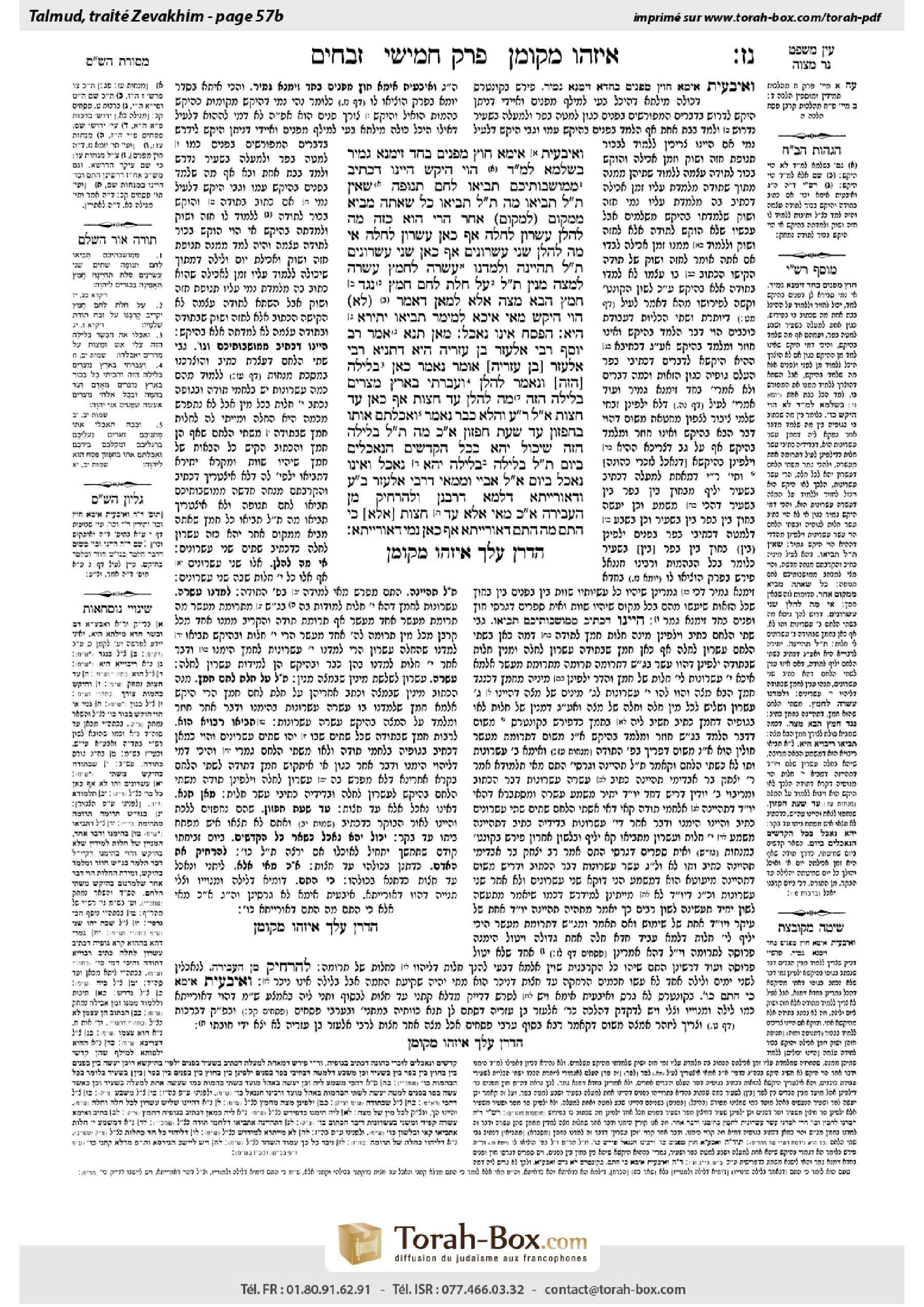
Zevachim 57b: Talmud study for Daf Yomi
Daf Yomi is the daily study of one Talmud folio. Explore 37 tractates with scans, Hebrew text, Sefaria English and AI-generated French translations where annotated.
Passage selection and English or AI-generated French translation are available where the scan has annotations. Daf Study is independent of Torah-Box and Sefaria.
Browse Zevachim · זבחים · All tractatesZevachim 57b text and translations
This page of Zevachim includes the Aramaic text, an English translation and an AI-generated French translation, alongside the scan above.
זבחים נ״ז ב · Aramaic and Hebrew text
וְאִיבָּעֵית אֵימָא: חוּץ מִפְּנִים בְּחַד זִימְנָא גְּמִיר.
בִּשְׁלָמָא לְמַאן דְּאָמַר [לָא] הָוֵי הֶיקֵּשׁ, הַיְינוּ דִּכְתִיב: ״מִמּוֹשְׁבֹתֵיכֶם תָּבִיאּוּ לֶחֶם תְּנוּפָה״ –
שֶׁאֵין תַּלְמוּד לוֹמַר ״תָּבִיאוּ״, מָה תַּלְמוּד לוֹמַר ״תָּבִיאוּ״? כֹּל שֶׁאַתָּה מֵבִיא מִמָּקוֹם (לְמָקוֹם) אַחֵר הֲרֵי הוּא כָּזֶה; מַה לְּהַלָּן עִשָּׂרוֹן לְחַלָּה, אַף כָּאן עִשָּׂרוֹן לְחַלָּה.
אִי – מָה לְהַלָּן שְׁנֵי עֶשְׂרוֹנִים, אַף כָּאן שְׁנֵי עֶשְׂרוֹנִים?! תַּלְמוּד לוֹמַר: ״תִּהְיֶינָה״.
וְלָמַדְנוּ עֲשָׂרָה לְחָמֵץ; עֲשָׂרָה לְמַצָּה מִנַּיִן? תַּלְמוּד לוֹמַר ״עַל חַלֹּת לֶחֶם חָמֵץ״ – נֶגֶד חָמֵץ הָבֵא מַצָּה.
אֶלָּא לְמַאן דְּאָמַר (לָא) הָוֵי הֶיקֵּשׁ, מַאי אִיכָּא לְמֵימַר? ״תָּבִיאוּ״ – יַתִּירָא הִיא.
הַפֶּסַח אֵינוֹ נֶאֱכָל. מַאן תַּנָּא? אָמַר רַב יוֹסֵף: רַבִּי אֶלְעָזָר בֶּן עֲזַרְיָה הִיא. דְּתַנְיָא, רַבִּי אֶלְעָזָר [בֶּן עֲזַרְיָה] אוֹמֵר: נֶאֱמַר כָּאן ״בַּלַּיְלָה [הַזֶּה]״, וְנֶאֱמַר לְהַלָּן: ״וְעָבַרְתִּי בְאֶרֶץ מִצְרַיִם בַּלַּיְלָה הַזֶּה״;
מַה לְהַלָּן עַד חֲצוֹת, אַף כָּאן עַד חֲצוֹת.
אָמַר לוֹ רַבִּי עֲקִיבָא, וַהֲלֹא כְּבָר נֶאֱמַר: ״וַאֲכַלְתֶּם אוֹתוֹ בְּחִפָּזוֹן״ – עַד שְׁעַת חִפָּזוֹן!
אִם כֵּן, מָה תַּלְמוּד לוֹמַר ״בַּלַּיְלָה הַזֶּה״? שֶׁיָּכוֹל יְהֵא כְּכׇל הַקֳּדָשִׁים הַנֶּאֱכָלִים בַּיּוֹם; תַּלְמוּד לוֹמַר ״בַּלַּיְלָה״ – בַּלַּיְלָה יְהֵא נֶאֱכָל, וְאֵינוֹ נֶאֱכָל בַּיּוֹם.
אֲמַר לֵיהּ אַבָּיֵי: וּמִמַּאי דְּרַבִּי אֶלְעָזָר בֶּן עֲזַרְיָה, וּדְאוֹרָיְיתָא? דִּלְמָא דְּרַבָּנַן, וּלְהַרְחִיק מִן הָעֲבֵירָה! אִם כֵּן, מַאי ״אֶלָּא עַד חֲצוֹת״? אֶלָּא כִּי הָתָם – מָה הָתָם דְּאוֹרָיְיתָא, אַף כָּאן נָמֵי דְּאוֹרָיְיתָא.
הֲדַרַן עֲלָךְ אֵיזֶהוּ מְקוֹמָן
Zevachim 57b · English translation
The Gemara suggests: And if you wish, say there is a different resolution: The sprinkling outside is derived from the sprinkling inside, all at once. There are not two comparisons here, one derived from the other, but rather a single, complex juxtaposition, from which all of the relevant halakhot are derived.
The Gemara comments: Granted, according to the one who says that a matter derived via a juxtaposition and another principle is not a juxtaposition, this is the reason that it is written with regard to the offering brought on Shavuot: “You shall bring out of your dwellings two wave loaves of two-tenths of an ephah; they shall be of fine flour” (Leviticus 23:17).
Since apparently there is no need for the verse to state: “You shall bring,” as it already states: “And you shall present a new meal offering to the Lord” (Leviticus 23:16), why must the verse state: “You shall bring”? It states this to teach that anything that you bring from another place that is similar to this offering, i.e., the leavened bread that accompanies a thanks offering, shall be prepared like this. Just as there, with regard to the two loaves, they must be prepared from a tenth of an ephah of flour for each loaf, so too here, each of the ten loaves of leavened bread that accompany a thanks offering must be prepared from a tenth of an ephah of flour for each loaf.
If they are compared, why not say that just as there, with regard to the two loaves, the total amount of flour is two-tenths of an ephah, so too here, with regard to the ten loaves that accompany a thanks offering, the total amount of flour for all ten should be two-tenths of an ephah? To counter this comparison, the verse states: “They shall be,” to serve as a restriction and teach that only these two loaves amount to a total of two-tenths of an ephah, but the bread accompanying the thanks offering does not amount to two-tenths of an ephah.
The Gemara continues: The ten loaves accompanying a thanks offering must each be a tenth of an ephah, and this has been derived from two sources: A juxtaposition with the offering of Shavuot and another principle, which is that which the verse states concerning the thanks offering, that there must be ten leavened loaves. And we have learned that ten-tenths of an ephah is required for the ten loaves of leavened bread. From where is it derived that ten-tenths of an ephah are required for the matza which also accompanies a thanks offering? After stating that thirty matzot accompany a thanks offering, the verse states: “With cakes of leavened bread” (Leviticus 7:13), to juxtapose the matza with the leavened bread. This teaches that one must bring matza of an amount corresponding to the leavened bread. In any event, this derivation can be employed according to the one who says that a matter derived via a juxtaposition and another principle is not a juxtaposition.
But according to the one who says that a matter derived via a juxtaposition and another principle is a juxtaposition, and therefore it cannot then teach its halakha via another juxtaposition, what is there to say? How can the measure of flour for the matza be derived from the measure of flour for the leavened bread? The Gemara answers: The first halakha, connecting the two loaves of Shavuot to the bread accompanying a thanks offering, is not derived via a juxtaposition, but rather via a superfluous word. The term “You shall bring,” written with regard to the two loaves, is extra, and is therefore considered as if it were written explicitly with regard to the leavened bread accompanying the thanks offering. Therefore, it is possible to derive the halakha concerning matza from the halakha concerning leavened bread via a juxtaposition.
§ The mishna teaches: The Paschal offering is eaten only at night and it is eaten only until midnight. The Gemara asks: Who is the tanna who taught this mishna? Rav Yosef said that it is Rabbi Elazar ben Azarya. As it is taught in a baraita: The verse states: “And they shall eat of the flesh on that night” (Exodus 12:8). Rabbi Elazar ben Azarya says: It is stated here: “On that night,” without stating when the night ends. And it is stated there, with regard to the plague that afflicted the firstborn Egyptians: “And I will pass through the land of Egypt on that night and I will strike every firstborn in the land of Egypt” (Exodus 12:12). With regard to the death of the firstborns the Torah states: “So said the Lord: At about midnight, I will go out into the midst of Egypt and every firstborn in Egypt shall die” (Exodus 11:4–5).
Rabbi Elazar ben Azarya continues: Just as in the verse there, the death of the firstborns occurred until midnight, as stated explicitly in the verse, so too, in the verse here, the mitzva to eat the Paschal offering continues until midnight but not beyond.
Rabbi Akiva said to Rabbi Elazar ben Azarya: But isn’t it already stated: “And so you shall eat it, with your loins girded, your shoes on your feet, your staffs in your hands, and you will eat it in haste, for it is the Paschal offering for the Lord” (Exodus 12:11)? This verse indicates that the Paschal offering may be eaten until the time of haste, i.e., until dawn, as the Jewish people left Egypt hastily the next morning.
The Gemara asks: If so, why must the verse state: “On that night,” with regard to eating the Paschal offering? The Gemara explains: This phrase is necessary, as one might have thought that the Paschal offering is like all the other offerings in that it should be eaten during the day, on the day it is sacrificed. To counter this reasoning, the verse states: “On that night,” to emphasize that this particular offering shall be eaten at night, but it shall not be eaten during the day.
Abaye said to Rav Yosef: And from where do you know that the mishna represents the opinion of Rabbi Elazar ben Azarya, and is stating that the Paschal offering must be eaten by midnight by Torah law? Perhaps the mishna is in accordance with the opinion of Rabbi Akiva, and is stating that the Paschal offering must be eaten by midnight by rabbinic law, and the reason for the rabbinic decree was to distance one from a sin. Rav Yosef replied: If so, what does the mishna mean when it says: It is eaten only until midnight? With regard to the other offerings the mishna teaches: Until midnight, without specifying: Only. Rather, one must say that it is like there, with regard to the other halakhot of the Paschal offering stated in the mishna. Just as there, the requirements are by Torah law, so too here, with regard to the final time for eating the meat, the requirement is also by Torah law.
Zevachim 57b · Traduction française (IA)
La Guemara propose : Et si tu préfères, dis qu’il existe une autre résolution : l’aspersion à l’extérieur est déduite de l’aspersion à l’intérieur, en une seule fois. Il ne s’agit pas de deux rapprochements, l’un étant déduit de l’autre, mais d’un seul rapprochement complexe, dont sont déduites toutes les halakhot pertinentes.
La Guemara fait remarquer : Certes, selon celui qui dit qu’un élément déduit au moyen d’un rapprochement et d’un autre principe ne relève pas d’un rapprochement, voici pourquoi il est écrit au sujet de l’offrande apportée à Chavouot : « Vous apporterez de vos lieux d’habitation deux pains de balancement, de deux dixièmes d’épha ; ils seront de fleur de farine » (Lévitique 23,17).
Puisqu’apparemment le verset n’a pas besoin de dire : « Vous apporterez », car il est déjà écrit : « Vous présenterez une offrande nouvelle au Seigneur » (Lévitique 23,16), pourquoi le verset doit-il dire : « Vous apporterez » ? Il le dit pour enseigner que tout ce que vous apportez d’un autre endroit et qui ressemble à cette offrande, c’est-à-dire le pain levé qui accompagne un sacrifice de reconnaissance, doit être préparé de la même manière. De même que là, pour les deux pains, chacun doit être préparé avec un dixième d’épha de farine, de même ici, chacun des dix pains levés qui accompagnent un sacrifice de reconnaissance doit être préparé avec un dixième d’épha de farine.
S’ils sont comparés, pourquoi ne pas dire que, de même que là, pour les deux pains, la quantité totale de farine est de deux dixièmes d’épha, de même ici, pour les dix pains qui accompagnent un sacrifice de reconnaissance, la quantité totale de farine pour les dix devrait être de deux dixièmes d’épha ? Pour écarter cette comparaison, le verset dit : « Ils seront », afin de poser une restriction et d’enseigner que seuls ces deux pains totalisent deux dixièmes d’épha, mais que le pain accompagnant le sacrifice de reconnaissance ne totalise pas deux dixièmes d’épha.
La Guemara poursuit : Chacun des dix pains qui accompagnent un sacrifice de reconnaissance doit faire un dixième d’épha, et cela a été déduit de deux sources : un rapprochement avec l’offrande de Chavouot et un autre principe, à savoir ce que le verset stipule au sujet du sacrifice de reconnaissance : il doit y avoir dix pains levés. Or, nous avons appris que les dix pains levés nécessitent dix dixièmes d’épha. D’où déduit-on que dix dixièmes d’épha sont nécessaires pour la matsa qui accompagne également un sacrifice de reconnaissance ? Après avoir indiqué que trente matsot accompagnent un sacrifice de reconnaissance, le verset dit : « Avec des gâteaux de pain levé » (Lévitique 7,13), rapprochant ainsi la matsa du pain levé. Cela enseigne qu’il faut apporter une quantité de matsa correspondant à celle du pain levé. Quoi qu’il en soit, cette déduction peut être utilisée selon celui qui dit qu’un élément déduit au moyen d’un rapprochement et d’un autre principe ne relève pas d’un rapprochement.
Mais selon celui qui dit qu’un élément déduit au moyen d’un rapprochement et d’un autre principe relève bien d’un rapprochement, et qu’il ne peut donc ensuite transmettre sa halakha au moyen d’un autre rapprochement, que répondre ? Comment la quantité de farine pour la matsa peut-elle être déduite de celle du pain levé ? La Guemara répond : La première halakha, qui relie les deux pains de Chavouot au pain accompagnant un sacrifice de reconnaissance, n’est pas déduite au moyen d’un rapprochement, mais plutôt au moyen d’un mot superflu. L’expression « Vous apporterez », écrite au sujet des deux pains, est superflue ; elle est donc considérée comme si elle était explicitement écrite au sujet du pain levé accompagnant le sacrifice de reconnaissance. Il est par conséquent possible de déduire la halakha concernant la matsa de celle concernant le pain levé au moyen d’un rapprochement.
§ La Michna enseigne : Le sacrifice pascal n’est mangé que la nuit et seulement jusqu’à minuit. La Guemara demande : Quel est le tanna qui a enseigné cette Michna ? Rav Yossef dit qu’il s’agit de Rabbi Elazar ben Azarya. Comme il est enseigné dans une baraïta : Le verset dit : « Ils mangeront la viande cette nuit-là » (Exode 12,8). Rabbi Elazar ben Azarya dit : Il est dit ici : « Cette nuit-là », sans préciser quand la nuit prend fin. Et il est dit là, au sujet de la plaie qui frappa les premiers-nés des Égyptiens : « Je traverserai le pays d’Égypte cette nuit-là et je frapperai tous les premiers-nés du pays d’Égypte » (Exode 12,12). Au sujet de la mort des premiers-nés, la Torah dit : « Ainsi parle le Seigneur : Vers minuit, je sortirai au milieu de l’Égypte, et tous les premiers-nés d’Égypte mourront » (Exode 11,4-5).
Rabbi Elazar ben Azarya poursuit : De même que, dans le verset cité là, la mort des premiers-nés eut lieu jusqu’à minuit, comme le verset l’indique explicitement, de même, dans le verset cité ici, la mitsva de manger le sacrifice pascal se poursuit jusqu’à minuit, mais pas au-delà.
Rabbi Akiva dit à Rabbi Elazar ben Azarya : Mais n’est-il pas déjà dit : « Vous le mangerez ainsi, la ceinture aux reins, les chaussures aux pieds, les bâtons à la main, et vous le mangerez à la hâte, car c’est le sacrifice pascal pour le Seigneur » (Exode 12,11) ? Ce verset indique que le sacrifice pascal peut être mangé jusqu’au moment de la hâte, c’est-à-dire jusqu’à l’aube, puisque les enfants d’Israël quittèrent l’Égypte à la hâte le lendemain matin.
La Guemara demande : Dans ce cas, pourquoi le verset doit-il dire : « Cette nuit-là », au sujet de la consommation du sacrifice pascal ? La Guemara explique : Cette expression est nécessaire, car on aurait pu penser que le sacrifice pascal est comme tous les autres sacrifices, en ce qu’il doit être mangé le jour où il est offert. Pour écarter ce raisonnement, le verset dit : « Cette nuit-là », afin de souligner que cette offrande particulière doit être mangée la nuit, mais pas le jour.
Abayé dit à Rav Yossef : Et d’où sais-tu que la Michna exprime l’opinion de Rabbi Elazar ben Azarya et enseigne que, selon la Torah, le sacrifice pascal doit être mangé avant minuit ? Peut-être la Michna suit-elle l’opinion de Rabbi Akiva et enseigne que le sacrifice pascal doit être mangé avant minuit en vertu d’une loi rabbinique, et que la raison de ce décret rabbinique est d’éloigner l’homme de la faute. Rav Yossef répondit : Dans ce cas, que signifie la formule de la Michna : « Il n’est mangé que jusqu’à minuit » ? Au sujet des autres sacrifices, la Michna enseigne : « Jusqu’à minuit », sans préciser : « seulement ». Il faut plutôt dire que c’est comme là, au sujet des autres halakhot du sacrifice pascal énoncées dans la Michna. De même que là, les exigences sont imposées par la Torah, de même ici, concernant le terme ultime de la consommation de la viande, l’exigence est également imposée par la Torah.
Traduction française générée par IA à partir de l’édition anglaise de Sefaria. Vérifie toujours un passage avec le texte source.
Text from Sefaria: William Davidson Edition - Vocalized Aramaic (CC BY NC); William Davidson Edition - English (CC BY NC).