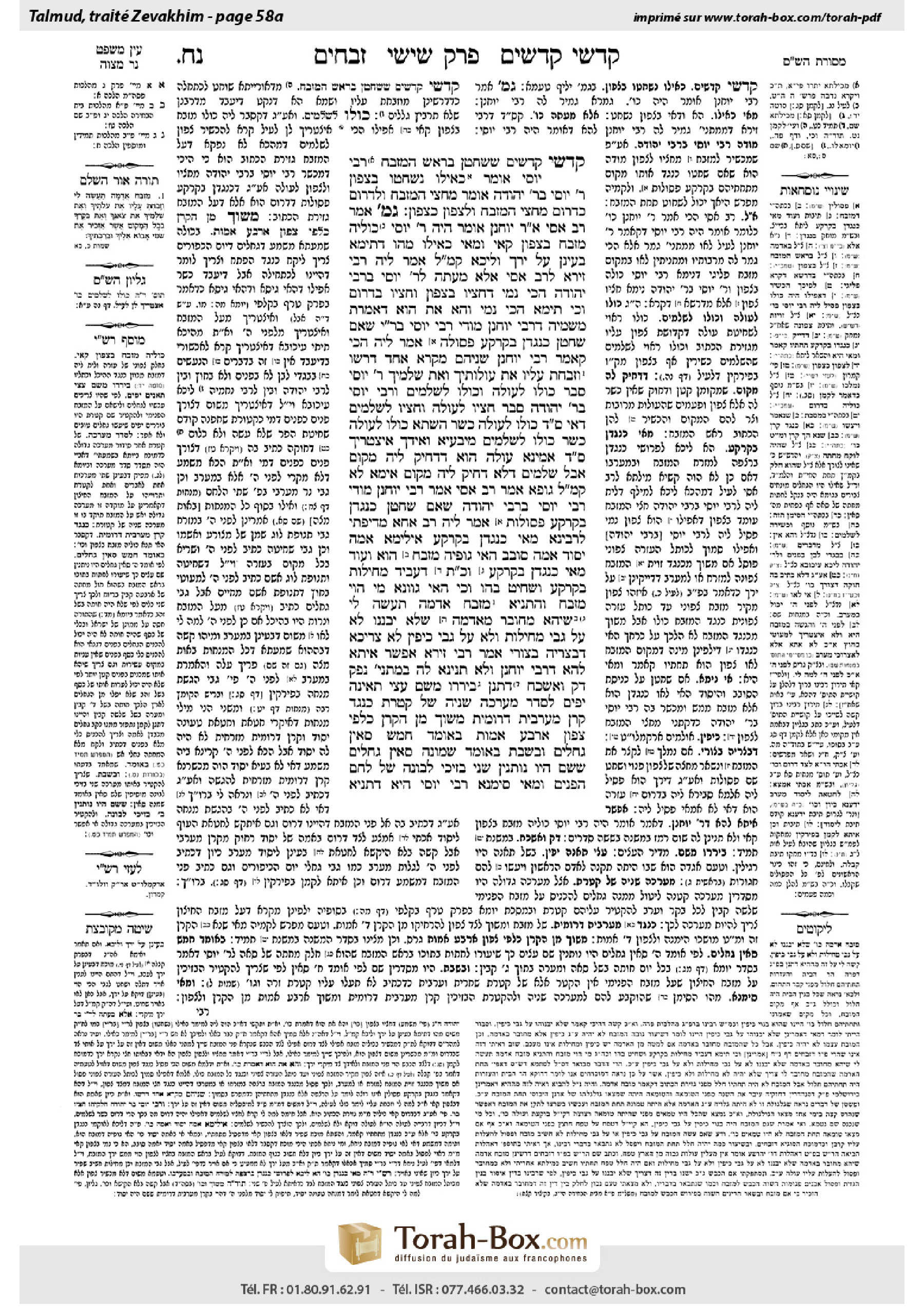
Zevachim 58a: Talmud study for Daf Yomi
Daf Yomi is the daily study of one Talmud folio. Explore 37 tractates with scans, Hebrew text, Sefaria English and AI-generated French translations where annotated.
Passage selection and English or AI-generated French translation are available where the scan has annotations. Daf Study is independent of Torah-Box and Sefaria.
Browse Zevachim · זבחים · All tractatesZevachim 58a text and translations
This page of Zevachim includes the Aramaic text, an English translation and an AI-generated French translation, alongside the scan above.
זבחים נ״ח א · Aramaic and Hebrew text
מַתְנִי׳ קׇדְשֵׁי קָדָשִׁים שֶׁשְּׁחָטָן בְּרֹאשׁ הַמִּזְבֵּחַ – רַבִּי יוֹסֵי אוֹמֵר: כְּאִילּוּ נִשְׁחֲטוּ בַּצָּפוֹן. רַבִּי יוֹסֵי בְּרַבִּי יְהוּדָה אוֹמֵר: מֵחֲצִי הַמִּזְבֵּחַ וְלַדָּרוֹם – כַּדָּרוֹם, מֵחֲצִי הַמִּזְבֵּחַ וְלַצָּפוֹן – כַּצָּפוֹן.
גְּמָ׳ אָמַר רַב אַסִּי אָמַר רַבִּי יוֹחָנָן: אוֹמֵר הָיָה ר׳ יוֹסֵי, כּוּלֵּיהּ מִזְבֵּחַ בְּצָפוֹן קָאֵי. וּמַאי ״כְּאִילּוּ״? מַהוּ דְּתֵימָא בָּעֵינַן ״עַל יָרֵךְ״ – וְלֵיכָּא; קָא מַשְׁמַע לַן.
אֲמַר לֵיהּ רַבִּי זֵירָא לְרַב אַסִּי: אֶלָּא מֵעַתָּה, לְרַבִּי יוֹסֵי בְּרַבִּי יְהוּדָה – הָכִי נָמֵי דְּחֶצְיוֹ בְּצָפוֹן וְחֶצְיוֹ בַּדָּרוֹם?!
וְכִי תֵּימָא הָכִי נָמֵי; וְהָא אַתְּ הוּא דְּאָמְרַתְּ מִשְּׁמֵיהּ דְּרַבִּי יוֹחָנָן: מוֹדֵי רַבִּי יוֹסֵי בְּרַבִּי יְהוּדָה שֶׁאִם שְׁחָטָן כְּנֶגְדָּן בַּקַּרְקַע – פְּסוּלָה!
אֲמַר לֵיהּ: הָכִי קָאָמַר רַבִּי יוֹחָנָן – שְׁנֵיהֶם מִקְרָא אֶחָד דָּרְשׁוּ: ״וְזָבַחְתָּ עָלָיו אֶת עֹלֹתֶיךָ וְאֶת שְׁלָמֶיךָ״ –
רַבִּי יוֹסֵי סָבַר: כּוּלּוֹ לְעוֹלָה וְכוּלּוֹ לִשְׁלָמִים. וְרַבִּי יוֹסֵי בְּרַבִּי יְהוּדָה סָבַר: חֶצְיוֹ לְעוֹלָה וְחֶצְיוֹ לִשְׁלָמִים;
דְּאִי סָלְקָא דַעְתָּךְ כּוּלּוֹ לְעוֹלָה כָּשֵׁר, הַשְׁתָּא כּוּלּוֹ לְעוֹלָה – כָּשֵׁר, כּוּלּוֹ לִשְׁלָמִים מִיבַּעְיָא?!
וְאִידָּךְ – אִיצְטְרִיךְ; סָלְקָא דַּעְתָּךְ אָמֵינָא: עוֹלָה הוּא דִּדְחִיק לֵיהּ מָקוֹם; אֲבָל שְׁלָמִים, דְּלָא דְּחִיק לֵיהּ מָקוֹם – אֵימָא לָא; קָא מַשְׁמַע לַן.
גּוּפָא – אָמַר רַב אַסִּי אָמַר רַבִּי יוֹחָנָן: מוֹדֵי רַבִּי יוֹסֵי בְּרַבִּי יְהוּדָה שֶׁאִם שְׁחָטָן כְּנֶגְדָּן בַּקַּרְקַע – פְּסוּלוֹת. אֲמַר לֵיהּ רַב אַחָא מִדִּיפְתִּי לְרָבִינָא: מַאי כְּנֶגְדָּן בַּקַּרְקַע? אִילֵימָא אַמָּה יְסוֹד אַמָּה סוֹבֵב – הַאי גּוּפֵיהּ מִזְבֵּחַ הוּא! וְעוֹד, מַאי ״כְּנֶגְדָּן בַּקַּרְקַע״?
וְכִי תֵּימָא דְּעָבֵיד מְחִילּוֹת בַּקַּרְקַע וְשָׁחֵיט בְּהוּ – וְכִי הַאי גַּוְונָא מִי הָוֵי מִזְבֵּחַ?! וְהָתַנְיָא: ״מִזְבַּח אֲדָמָה תַּעֲשֶׂה לִּי״ – שֶׁיְּהֵא מְחוּבָּר (מֵאֲדָמָה) [בַּאֲדָמָה]; שֶׁלֹּא יִבְנֶנּוּ לֹא עַל גַּבֵּי מְחִילּוֹת וְלֹא עַל גַּבֵּי כִּיפִּין.
לָא צְרִיכָא, דְּבַצְּרֵיהּ בַּצּוֹרֵי.
אָמַר רַבִּי זֵירָא: אֶפְשָׁר אִיתָא לְהָא דְּרַבִּי יוֹחָנָן, וְלָא תְּנֵינָא לַהּ בְּמַתְנִיתִין?!
נְפַק, דַּק וְאַשְׁכַּח – דִּתְנַן: בֵּירְרוּ מִשָּׁם עֲצֵי תְאֵינָה יָפִים לְסַדֵּר מַעֲרָכָה שְׁנִיָּה שֶׁל קְטֹרֶת; כְּנֶגֶד קֶרֶן מַעֲרָבִית דְּרוֹמִית, מָשׁוּךְ מִן הַקֶּרֶן כְּלַפֵּי צָפוֹן אַרְבַּע אַמּוֹת; בְּאוֹמֶד חָמֵשׁ סְאִין גֶּחָלִים. וּבְשַׁבָּת – בְּאוֹמֶד שְׁמוֹנֶה סְאִין גֶּחָלִים, שֶׁשָּׁם הָיוּ נוֹתְנִין שְׁנֵי בְּזִיכֵי לְבוֹנָה שֶׁל לֶחֶם הַפָּנִים.
וּמַאי סִימָנָא? רַבִּי יוֹסֵי הִיא, דְּתַנְיָא,
Zevachim 58a · English translation
MISHNA: It was taught in the previous chapter that offerings of the most sacred order are to be slaughtered in the northern section of the Temple courtyard. With regard to offerings of the most sacred order that one slaughtered atop the altar, Rabbi Yosei says: Their status is as though they were slaughtered in the north, and the offerings are therefore valid. Rabbi Yosei, son of Rabbi Yehuda, says: The status of the area from the halfway point of the altar and to the south is like that of the south, and offerings of the most sacred order slaughtered in that area are therefore disqualified. The status of the area from the halfway point of the altar and to the north is like that of the north.
GEMARA: Rav Asi says that Rabbi Yoḥanan says: Rabbi Yosei used to say: The entire altar stands in the north section of the Temple courtyard. The Gemara asks: And what is the meaning of Rabbi Yosei’s statement that if one slaughtered offerings of the most sacred order atop the altar it is as though they were slaughtered in the north, which indicates that they were not actually slaughtered in the north? The Gemara answers: Rabbi Yosei said this lest you say that we require that the offering be slaughtered “on the side of the altar northward” (Leviticus 1:11), i.e., on the ground beside the altar, and that requirement is not fulfilled when it is slaughtered on top of the altar. Therefore, Rabbi Yosei teaches us that the offering is still valid.
Rabbi Zeira said to Rav Asi: Rabbi Yoḥanan apparently understands that the reason Rabbi Yosei holds that an offering of the most sacred order slaughtered on the altar is valid is because the entire altar is in the northern section of the Temple courtyard. If that is so, shall one also say that according to Rabbi Yosei, son of Rabbi Yehuda, half of the altar was situated in the north of the Temple courtyard and half of it was situated in the south?
And if you would say that indeed that is so, wasn’t it you who said in the name of Rabbi Yoḥanan that Rabbi Yosei, son of Rabbi Yehuda, concedes that if one slaughtered offerings of the most sacred order on the ground opposite the northern half of the altar, the offering is disqualified? Accordingly, Rabbi Yosei, son of Rabbi Yehuda, apparently maintains that the altar is not located in the north at all.
Rav Asi said to Rabbi Zeira: Rabbi Yoḥanan’s statement with regard to Rabbi Yosei’s opinion is an independent statement rather than an inference from the mishna. And with regard to the dispute in the mishna, this is what Rabbi Yoḥanan says: Both of them derived their opinions from one verse: “An altar of earth you shall make for Me, and you shall slaughter upon it your burnt offerings and your peace offerings” (Exodus 20:21).
Rabbi Yosei maintains that the verse teaches that all of it, i.e., the entire altar, is fit for slaughtering a burnt offering, and all of it is also fit for slaughtering a peace offering. And Rabbi Yosei, son of Rabbi Yehuda, maintains that the verse teaches that half of it is fit for slaughtering a burnt offering and half of it is fit for slaughtering a peace offering.
The Gemara explains the reasoning of Rabbi Yosei, son of Rabbi Yehuda: As if it enters your mind that all of it is fit for slaughtering a burnt offering, now that all of it is fit for slaughtering a burnt offering, which must be slaughtered in the northern section of the Temple courtyard (see 53b), is it necessary to teach that it is also fit for slaughtering a peace offering, which may be slaughtered anywhere in the Temple courtyard (see 55a)? The verse therefore must be understood as teaching that half the altar is fit for slaughtering burnt offerings and half is fit for slaughtering peace offerings.
The Gemara asks: And how does the other Sage, Rabbi Yosei, respond to this reasoning? The Gemara answers: It was necessary for the verse to mention peace offerings. Otherwise, it could enter your mind to say that the verse allows one to slaughter only a burnt offering atop the altar, as the location where it may be slaughtered on the ground is narrow. But with regard to peace offerings, whose location for slaughter on the ground is not narrow, say that no, one may not slaughter them atop the altar. Therefore, the verse teaches us that peace offerings as well may be slaughtered atop the altar.
§ The Gemara discusses the matter itself: Rav Asi says that Rabbi Yoḥanan says: Rabbi Yosei, son of Rabbi Yehuda, concedes that if one slaughtered offerings of the most sacred order on the ground opposite the northern half of the altar, the offering is disqualified. Rav Aḥa of Difti said to Ravina: What is the meaning of the phrase: On the ground opposite the northern half of the altar? If we say it means that the offering was sacrificed upon the cubit-wide base of the altar or upon the cubit-wide surrounding ledge of the altar, this itself is part of the altar. And furthermore, what is the meaning of the phrase: On the ground opposite the northern half of the altar? The base and ledge are not on the ground.
And if you would say that the case is where one dug tunnels in the ground beneath the altar, and slaughtered the offerings in them, in a case like this would the altar itself be fit for use so that according to Rabbi Yosei, son of Rabbi Yehuda, one may slaughter the offerings of the most sacred order on the altar but not on the ground? But isn’t it taught in a baraita: The verse states: “An altar of earth you shall make for Me” (Exodus 20:21)? This verse indicates that the altar must be attached to the earth, so that one may not build it on top of tunnels nor on top of arches.
The Gemara answers: No, it is necessary to have the phrase: On the ground opposite the northern half of the altar, in order to teach the halakha in a case where one minimized the dimensions of the altar and slaughtered the offerings on the ground where the northern half of the altar had previously stood.
§ The Gemara returns to discuss Rabbi Yoḥanan’s statement that according to Rabbi Yosei the entire altar was located in the northern section of the Temple courtyard. The Gemara had mentioned that Rabbi Yoḥanan’s statement is an independent statement, not based on the mishna. Rabbi Zeira said: Is it possible that this statement of Rabbi Yoḥanan is correct and we did not learn it in any mishna?
Rabbi Zeira went out, examined the matter, and discovered a mishna that alludes to Rabbi Yoḥanan’s statement, as we learned in a mishna (Tamid 2:5): The priests selected fine wood of a fig tree from the chamber of firewood, with which to lay out a second arrangement of wood on the altar so that coals from this arrangement could be used for burning the incense. This second arrangement was located opposite the southwest corner of the altar, distanced from the corner northward by four cubits. They would arrange enough wood which, when burned, would produce approximately five se’a of coals. And on Shabbat, there was enough wood to produce approximately eight se’a of coals, as they would place there the two bowls of frankincense of the shewbread.
The Gemara asks: And what is the significance of the mishna’s defining the precise location of the arrangement and the fact that this is where the frankincense is burned? The Gemara embarks on a lengthy discussion to answer this question: This mishna is in accordance with the opinion of Rabbi Yosei, who holds that this arrangement of wood and the burning of the frankincense must be in that precise location, as it is taught in a baraita:
Zevachim 58a · Traduction française (IA)
MICHNA : Il a été enseigné dans le chapitre précédent que les offrandes de sainteté suprême doivent être égorgées dans la partie nord du parvis du Temple. À propos des offrandes de sainteté suprême qu’on a égorgées sur l’autel, Rabbi Yossei dit : leur statut est comme si elles avaient été égorgées au nord ; elles sont donc valides. Rabbi Yossei, fils de Rabbi Yehouda, dit : la partie de l’autel qui s’étend de son milieu vers le sud a le statut du sud ; les offrandes de sainteté suprême qui y sont égorgées sont donc invalides. La partie de l’autel qui s’étend de son milieu vers le nord a le statut du nord.
GUEMARA : Rav Assi dit au nom de Rabbi Yoḥanan : Rabbi Yossei avait coutume de dire que l’autel tout entier se trouve dans la partie nord du parvis du Temple. La Guemara demande : Quel est alors le sens de la déclaration de Rabbi Yossei selon laquelle, si l’on égorge des offrandes de sainteté suprême sur l’autel, c’est comme si elles avaient été égorgées au nord, ce qui indique qu’elles ne l’ont pas été réellement au nord ? La Guemara répond : Rabbi Yossei a dit cela pour éviter qu’on ne dise qu’il faut que l’offrande soit égorgée « du côté nord de l’autel » (Lévitique 1,11), c’est-à-dire sur le sol, à côté de l’autel, et que cette exigence n’est pas remplie lorsqu’on l’égorge sur l’autel. Rabbi Yossei nous enseigne donc que l’offrande reste valide.
Rabbi Zeïra dit à Rav Assi : Rabbi Yoḥanan semble comprendre que, selon Rabbi Yossei, si une offrande de sainteté suprême égorgée sur l’autel est valide, c’est parce que l’autel tout entier se trouve dans la partie nord du parvis du Temple. Si tel est le cas, faut-il également dire que, selon Rabbi Yossei, fils de Rabbi Yehouda, la moitié de l’autel se trouvait au nord du parvis du Temple et l’autre moitié au sud ?
Et si tu dis que c’est bien le cas, n’est-ce pas toi qui as dit au nom de Rabbi Yoḥanan que Rabbi Yossei, fils de Rabbi Yehouda, reconnaît que si l’on égorge des offrandes de sainteté suprême sur le sol, en face de la moitié nord de l’autel, l’offrande est invalide ? Il semble donc que, selon Rabbi Yossei, fils de Rabbi Yehouda, l’autel ne se trouve pas du tout au nord.
Rav Assi dit à Rabbi Zeïra : La déclaration de Rabbi Yoḥanan concernant l’opinion de Rabbi Yossei est une affirmation indépendante, et non une déduction tirée de la Michna. Quant à la controverse de la Michna, voici ce que dit Rabbi Yoḥanan : tous deux ont tiré leurs opinions d’un même verset : « Tu me feras un autel de terre, et tu y égorgeras tes holocaustes et tes sacrifices de paix » (Exode 20,21).
Selon Rabbi Yossei, le verset enseigne que l’autel tout entier convient pour égorger un holocauste, et qu’il convient aussi tout entier pour égorger un sacrifice de paix. Selon Rabbi Yossei, fils de Rabbi Yehouda, le verset enseigne que la moitié de l’autel convient pour égorger des holocaustes et l’autre moitié pour égorger des sacrifices de paix.
La Guemara explique le raisonnement de Rabbi Yossei, fils de Rabbi Yehouda : si tu supposes que l’autel tout entier convient pour égorger un holocauste, lequel doit être égorgé dans la partie nord du parvis du Temple (voir 53b), est-il nécessaire d’enseigner qu’il convient également pour égorger un sacrifice de paix, qui peut être égorgé n’importe où dans le parvis du Temple (voir 55a) ? Le verset doit donc être compris comme enseignant que la moitié de l’autel convient pour égorger des holocaustes et l’autre moitié pour égorger des sacrifices de paix.
La Guemara demande : Et comment l’autre Sage, Rabbi Yossei, répond-il à ce raisonnement ? La Guemara répond : Il était nécessaire que le verset mentionne les sacrifices de paix. Sinon, on aurait pu penser que le verset autorise à égorger sur l’autel uniquement un holocauste, puisque l’espace où celui-ci peut être égorgé sur le sol est restreint. Mais, pour les sacrifices de paix, dont l’espace où ils peuvent être égorgés sur le sol n’est pas restreint, on aurait pu dire qu’il n’est pas permis de les égorger sur l’autel. Le verset nous enseigne donc que les sacrifices de paix aussi peuvent être égorgés sur l’autel.
§ La Guemara revient sur le sujet lui-même : Rav Assi dit au nom de Rabbi Yoḥanan que Rabbi Yossei, fils de Rabbi Yehouda, reconnaît que si l’on égorge des offrandes de sainteté suprême sur le sol, en face de la moitié nord de l’autel, l’offrande est invalide. Rav Aḥa de Difti dit à Ravina : que signifie l’expression « sur le sol, en face de la moitié nord de l’autel » ? Si l’on dit qu’elle désigne le cas où l’offrande a été égorgée sur la base de l’autel, large d’une coudée, ou sur son rebord qui l’entoure, lui aussi large d’une coudée, ces éléments font eux-mêmes partie de l’autel. De plus, que signifie l’expression « sur le sol, en face de la moitié nord de l’autel » ? La base et le rebord ne sont pas sur le sol.
Et si tu dis qu’il s’agit du cas où l’on a creusé des tunnels sous l’autel et égorgé les offrandes à l’intérieur, dans un tel cas l’autel lui-même serait-il apte à être utilisé, de sorte que, selon Rabbi Yossei, fils de Rabbi Yehouda, on puisse égorger les offrandes de sainteté suprême sur l’autel, mais pas sur le sol ? Pourtant, il est enseigné dans une baraïta : le verset dit : « Tu me feras un autel de terre » (Exode 20,21). Ce verset indique que l’autel doit être solidaire du sol ; on ne peut donc pas le construire au-dessus de tunnels ni au-dessus de voûtes.
La Guemara répond : Non, la précision « sur le sol, en face de la moitié nord de l’autel » est nécessaire pour enseigner la halakha dans le cas où l’on a réduit les dimensions de l’autel et égorgé les offrandes sur le sol, à l’endroit où se trouvait auparavant la moitié nord de l’autel.
§ La Guemara revient sur la déclaration de Rabbi Yoḥanan selon laquelle, d’après Rabbi Yossei, l’autel tout entier se trouvait dans la partie nord du parvis du Temple. La Guemara avait indiqué que la déclaration de Rabbi Yoḥanan était indépendante et ne reposait pas sur la Michna. Rabbi Zeïra dit : Est-il possible que cette déclaration de Rabbi Yoḥanan soit juste et que nous ne l’ayons apprise dans aucune Michna ?
Rabbi Zeïra sortit, examina la question et découvrit une Michna qui fait allusion à la déclaration de Rabbi Yoḥanan, car nous avons appris dans une Michna (Tamid 2,5) : Les prêtres choisissaient du bois de figuier de qualité dans la chambre du bois, pour disposer sur l’autel un deuxième bûcher dont les braises serviraient à brûler l’encens. Ce deuxième bûcher se trouvait en face de l’angle sud-ouest de l’autel, à quatre coudées de cet angle vers le nord. Ils disposaient assez de bois pour produire, en brûlant, environ cinq séas de braises. Le Chabbat, ils en disposaient assez pour produire environ huit séas de braises, car ils y plaçaient les deux bols d’encens du pain de proposition.
La Guemara demande : Quelle est l’importance de la précision de la Michna quant à l’emplacement du bûcher, ainsi que de la mention que l’encens y est brûlé ? La Guemara entreprend une longue discussion pour répondre à cette question : cette Michna est conforme à l’opinion de Rabbi Yossei, qui estime que ce bûcher et la combustion de l’encens doivent se trouver à cet endroit précis, comme il est enseigné dans une baraïta :
Traduction française générée par IA à partir de l’édition anglaise de Sefaria. Vérifie toujours un passage avec le texte source.
Text from Sefaria: William Davidson Edition - Vocalized Aramaic (CC BY NC); William Davidson Edition - English (CC BY NC).