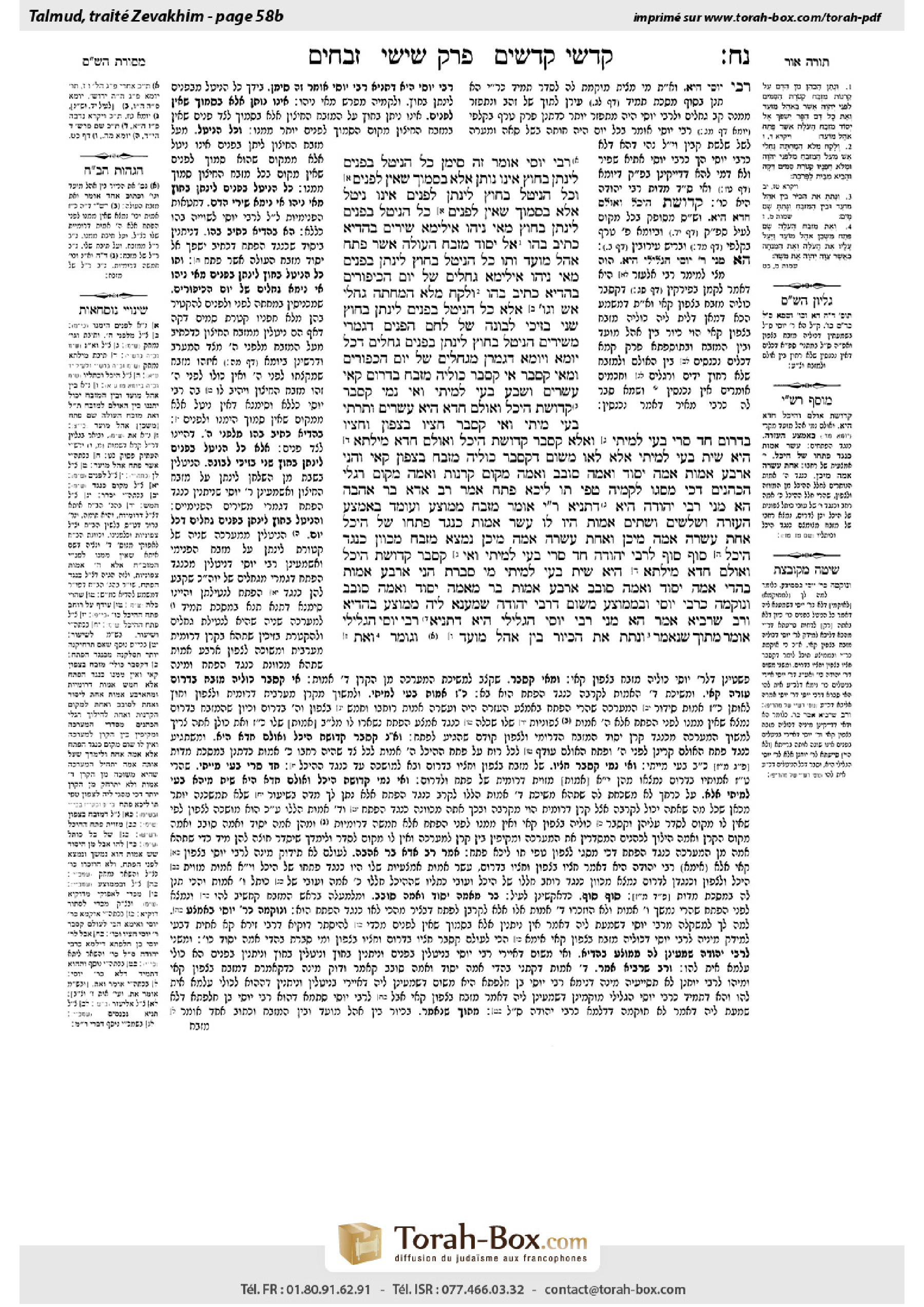
Zevachim 58b: Talmud study for Daf Yomi
Daf Yomi is the daily study of one Talmud folio. Explore 37 tractates with scans, Hebrew text, Sefaria English and AI-generated French translations where annotated.
Passage selection and English or AI-generated French translation are available where the scan has annotations. Daf Study is independent of Torah-Box and Sefaria.
Browse Zevachim · זבחים · All tractatesZevachim 58b text and translations
This page of Zevachim includes the Aramaic text, an English translation and an AI-generated French translation, alongside the scan above.
זבחים נ״ח ב · Aramaic and Hebrew text
רַבִּי יוֹסֵי אוֹמֵר: זֶה סִימָן – כׇּל הַנִּיטָּל בִּפְנִים לִינָּתֵן בַּחוּץ, אֵינוֹ נוֹתֵן אֶלָּא בְּסָמוּךְ שֶׁאֵין לִפְנִים;
וְכׇל הַנִּיטָּל בַּחוּץ לִינָּתֵן לִפְנִים, אֵינוֹ נִיטָּל אֶלָּא בְּסָמוּךְ שֶׁאֵין לִפְנִים.
כָּל הַנִּיטָּל בִּפְנִים לִינָּתֵן בַּחוּץ – מַאי נִיהוּ? אִילֵּימָא שִׁירַיִם, בְּהֶדְיָא כְּתִיב בְּהוּ: ״אֶל יְסוֹד מִזְבַּח הָעוֹלָה אֲשֶׁר פֶּתַח אֹהֶל מוֹעֵד״!
וְתוּ, כֹּל הַנִּיטָּל בַּחוּץ לִינָּתֵן בִּפְנִים – מַאי נִיהוּ? אִילֵּימָא גֶּחָלִים שֶׁל יוֹם הַכִּיפּוּרִים, בְּהֶדְיָא כְּתִיב בְּהוּ: ״וְלָקַח מְלֹא הַמַּחְתָּה גַּחֲלֵי אֵשׁ וְגוֹ׳״!
אֶלָּא כׇּל הַנִּיטָּל בִּפְנִים לִינָּתֵן בַּחוּץ – שְׁנֵי בְּזִיכֵי לְבוֹנָה שֶׁל לֶחֶם הַפָּנִים, דְּגָמְרִי מִשִּׁירַיִם.
הַנִּיטָּל בַּחוּץ לִינָּתֵן בִּפְנִים – גֶּחָלִים דְּכֹל יוֹמָא וְיוֹמָא, דְּגָמְרָן מִגֶּחָלִים שֶׁל יוֹם הַכִּפּוּרִים.
וּמַאי קָסָבַר? אִי קָסָבַר כּוּלֵּיהּ מִזְבֵּחַ בְּדָרוֹם קָאֵי, עֶשְׂרִים וְשֶׁבַע בָּעֵי לְמֵיתֵי!
וְאִי נָמֵי קָסָבַר קְדוּשַּׁת הֵיכָל וְאוּלָם חֲדָא הִיא, עֶשְׂרִים וְתַרְתֵּי בָּעֵי מֵיתֵי!
וְאִי קָסָבַר חֶצְיוֹ בַּצָּפוֹן וְחֶצְיוֹ בַּדָּרוֹם, חַד סְרֵי בָּעֵי לְמֵיתֵי! וְאֶלָּא קָסָבַר קְדוּשַּׁת הֵיכָל וְאוּלָם חֲדָא מִילְּתָא הִיא? שֵׁית בָּעֵי לְמֵיתֵי!
אֶלָּא לָאו מִשּׁוּם דְּקָסָבַר כּוּלֵּיהּ מִזְבֵּחַ בְּצָפוֹן קָאֵי?
וְהָנֵי אַרְבַּע אַמּוֹת – אַמָּה יְסוֹד, וְאַמָּה סוֹבֵב, וְאַמָּה מָקוֹם קְרָנוֹת, וְאַמָּה מְקוֹם רַגְלֵי הַכֹּהֲנִים; דְּכִי מְסַגּוּ לְקַמֵּיהּ טְפֵי – תּוּ לֵיכָּא פֶּתַח.
אָמַר רַב אַדָּא בַּר אַהֲבָה: הָא מַנִּי – רַבִּי יְהוּדָה הִיא. דְּתַנְיָא, רַבִּי יְהוּדָה אוֹמֵר: מִזְבֵּחַ מְמוּצָּע וְעוֹמֵד בְּאֶמְצַע הָעֲזָרָה; ושְׁלֹשִׁים וּשְׁתַּיִם אַמּוֹת הָיוּ לוֹ – עֶשֶׂר אַמּוֹת כְּנֶגֶד פִּתְחוֹ שֶׁל הֵיכָל, אַחַת עֶשְׂרֵה אַמָּה מִיכָּן, וְאַחַת עֶשְׂרֵה אַמָּה מִיכָּן; נִמְצָא מִזְבֵּחַ מְכוָּּון כְּנֶגֶד הֵיכָל.
סוֹף סוֹף, לְרַבִּי יְהוּדָה חַד סְרֵי בָּעֵי לְמֵיתֵי; וְאִי קָסָבַר קְדוּשַּׁת הֵיכָל וְאוּלָם חֲדָא מִילְּתָא הִיא, שֵׁית בָּעֵי לְמֵיתֵי!
מִי סָבְרַתְּ הָנֵי אַרְבַּע אַמּוֹת – בַּהֲדֵי אַמָּה יְסוֹד וְאַמָּה סוֹבֵב?! אַרְבַּע אַמּוֹת בַּר מֵאַמָּה יְסוֹד וְאַמָּה סוֹבֵב.
וְנוֹקְמַהּ כְּרַבִּי יוֹסֵי, וּבִמְמוּצָּע! מִשּׁוּם דְּרַבִּי יְהוּדָה שְׁמַעְנָא לֵיהּ מְמוּצָּע בְּהֶדְיָא.
וְרַב שֵׁרֵבְיָא אָמַר: הָא מַנִּי – רַבִּי יוֹסֵי הַגְּלִילִי הִיא. דְּתַנְיָא: רַבִּי יוֹסֵי הַגְּלִילִי אוֹמֵר, מִתּוֹךְ שֶׁנֶּאֱמַר: ״וְנָתַתָּ אֶת הַכִּיּוֹר בֵּין אֹהֶל מוֹעֵד״ וְגוֹמֵר, ״וְאֶת
Zevachim 58b · English translation
Rabbi Yosei says: This is the principle of where sacrificial items are placed on the inner and outer altars: Any sacrificial item that is taken from the altar located inside the Sanctuary in order to be placed on the altar outside the Sanctuary, in the Temple courtyard, may be placed only on the area of that altar that is near the Sanctuary, so that there is no area closer to the inside of the Sanctuary. It must therefore be placed on the part of the external altar closest to the entrance to the Sanctuary.
And any sacrificial item that is taken from the altar outside the Sanctuary, in the Temple courtyard, in order to be placed on the altar located inside the Sanctuary, may be taken only from the area of the external altar that is near the Sanctuary, so that there is no area closer to the inside of the Sanctuary, i.e., from the part of the external altar closest to the entrance to the Sanctuary.
The Gemara clarifies: With regard to the statement concerning any sacrificial item that is taken from the altar located inside the Sanctuary in order to be placed on the altar outside the Sanctuary, what are these items? If we say they are the remaining blood of the sin offerings whose blood is presented on the inner altar, there is no reason for Rabbi Yosei to formulate his principle, as it is explicitly written concerning them: “And all the remaining blood of the bull he shall pour out at the base of the altar of the burnt offering, which is at the entrance to the Tent of Meeting” (Leviticus 4:7). This verse describes how the blood of the inner sin offerings that remained after the sprinkling was to be poured out on the base of the west side of the altar, which is the side closest to the entrance to the Sanctuary.
And furthermore, with regard to the statement about any sacrificial item that is taken from the altar outside the Sanctuary, in the Temple courtyard, in order to be placed on the altar located inside the Sanctuary, what are these items? If we say these are the coals of the Yom Kippur service, which must be taken from the western side of the altar, it is explicitly written concerning them: “And he shall take a coal pan full of coals of fire from off the altar before the Lord” (Leviticus 16:12). The expression “before the Lord” is a reference to the western side of the altar, which is the side closest to the Sanctuary.
The Gemara continues: Rather, Rabbi Yosei’s statement with regard to any sacrificial item that is taken from the altar located inside the Sanctuary in order to be placed on the altar outside the Sanctuary is referring to the two bowls of frankincense of the shewbread. According to Rabbi Yosei, they must be burned on the western side of the altar, as he derives this halakha from the location on the base of the altar where the remaining blood of the inner sin offerings is poured.
Rabbi Yosei’s next statement, that any sacrificial item that is taken from the altar outside the Sanctuary in order to be placed on the altar located inside the Sanctuary may be taken only from the area of the external altar that is near the Sanctuary, is referring to the coals that are taken from the external altar each and every day and placed on the inner altar in order to burn the incense. According to Rabbi Yosei these coals must be taken from the western side of the altar, as we derive this halakha from the location on the altar from where the coals of the Yom Kippur service must be taken.
The Gemara discusses Rabbi Yosei’s opinion that the second arrangement of wood was placed four cubits north of the southwest corner of the altar: And what does Rabbi Yosei hold about the placement of the altar in the Temple courtyard? If he holds that the entire altar stands in the south side of the Temple courtyard, then only the five northernmost cubits of the altar are opposite the entrance to the Sanctuary. Accordingly, in order for the arrangement of wood to be opposite the entrance to the Sanctuary, one is required to move it twenty-seven cubits north of the southwest corner of the altar.
The Gemara continues: And even if Rabbi Yosei holds that the level of sanctity of the Sanctuary and the Entrance Hall is the same, so that the arrangement of wood can be opposite the Entrance Hall, which is ten cubits wider than the Sanctuary, his opinion is still difficult. In order for the arrangement of wood to be opposite the Entrance Hall, one is required to move it twenty-two cubits north of the southwest corner of the altar.
The Gemara continues: And even if Rabbi Yosei holds that half of the altar was located in the north side of the Temple courtyard and half in the south, in order for the arrangement of wood to be opposite the entrance to the Sanctuary one is still required to move it eleven cubits to the north of the southwest corner of the altar. And if one suggests that, rather, he holds that the sanctity of the Sanctuary and the Entrance Hall is one matter, i.e., equal, one is still required to move the arrangement of wood six cubits from the southwest corner in order to be opposite the Entrance Hall.
Rather, is it not that Rabbi Yosei’s opinion that the arrangement of wood was located four cubits from the altar’s southwest corner is due to the fact that he holds that the entire altar stands in the north side of the Temple courtyard? Accordingly, only the five southernmost cubits of the altar were opposite the entrance to the Sanctuary.
And of these four cubits from which the arrangement of wood was distanced from the southwest corner of the altar, one cubit was the base of the altar; and one cubit was the surrounding ledge of the altar; and one cubit was the place where the corners of the altar were located; and another cubit was the place of the feet of the priests, i.e., space for the priests to walk around the perimeter of the surface of the altar in order to perform the sacrificial rites. The arrangement of wood was located specifically in that location, as if one were to move it farther away from the southwest corner of the altar, it would no longer be opposite the entrance to the Sanctuary. This proves that according to Rabbi Yosei, the entire altar was located in the northern side of the Temple courtyard, as stated by Rabbi Yoḥanan.
The Gemara challenges this proof by suggesting an alternative explanation of the mishna in Tamid: Rav Adda bar Ahava said: In accordance with whose opinion is this mishna? It is in accordance with the opinion of Rabbi Yehuda, as it is taught in a baraita: Rabbi Yehuda says: The altar was centered and standing precisely in the middle of the Temple courtyard, and it was thirty-two cubits wide. Ten cubits were opposite the entrance to the Sanctuary, eleven cubits were to this side of the entrance to the Sanctuary, and eleven cubits were to that side of the entrance to the Sanctuary. It turns out that the length of the altar was aligned opposite the width of the Sanctuary, which itself was thirty-two cubits wide.
The Gemara asks: Ultimately, according to Rabbi Yehuda, one is still required to move the arrangement of wood eleven cubits from the southwest corner in order for it to be opposite the entrance to the Sanctuary. And even if he holds that the sanctity of the Sanctuary and the Entrance Hall is one matter, i.e., equal, one is still required to move the arrangement of wood six cubits in order to be opposite the Entrance Hall. Therefore, the mishna, which states that the arrangement of wood is four cubits north of the southwest corner, cannot be in accordance with the opinion of Rabbi Yehuda.
The Gemara responds: Do you hold that these four cubits include the cubit of the base of the altar and the cubit of the surrounding ledge of the altar? Actually, the four cubits are aside from the cubit of the base of the altar and the cubit of the surrounding ledge of the altar. Accordingly, the arrangement of wood was actually a total of six cubits from the southwest corner of the altar, and the mishna can be in accordance with the opinion of Rabbi Yehuda.
The Gemara asks why Rav Adda bar Ahava interpreted the mishna to be in accordance with the opinion of Rabbi Yehuda: But let him interpret it to be in accordance with the opinion of Rabbi Yosei and explain that the altar is located in the center of the Temple courtyard. The Gemara explains: Rav Adda bar Ahava interpreted the mishna to be in accordance with the opinion of Rabbi Yehuda because we heard that Rabbi Yehuda explicitly said that the altar was positioned in the center of the Temple courtyard, whereas we did not hear that Rabbi Yosei maintains such an opinion.
And Rav Sherevya said: In accordance with whose opinion is this mishna in Tamid, which holds that the entire altar was located in the northern part of the Temple courtyard? It is in accordance with the opinion of Rabbi Yosei HaGelili, as it is taught in a baraita: Rabbi Yosei HaGelili says: Since it is stated: “And you shall set the Basin between the Tent of Meeting and the altar” (Exodus 40:7), and another verse states: “And
Zevachim 58b · Traduction française (IA)
Rabbi Yosei dit : Tel est le principe concernant l’emplacement des éléments sacrificiels sur les autels intérieur et extérieur : tout élément sacrificiel pris sur l’autel situé à l’intérieur du Sanctuaire afin d’être placé sur l’autel extérieur, dans la cour du Temple, ne peut être placé que sur la partie de cet autel proche du Sanctuaire, de sorte qu’aucune partie ne soit plus proche de l’intérieur du Sanctuaire. Il doit donc être placé sur la partie de l’autel extérieur la plus proche de l’entrée du Sanctuaire.
Et tout élément sacrificiel pris sur l’autel extérieur, dans la cour du Temple, afin d’être placé sur l’autel situé à l’intérieur du Sanctuaire, ne peut être prélevé que sur la partie de l’autel extérieur proche du Sanctuaire, de sorte qu’aucune partie ne soit plus proche de l’intérieur du Sanctuaire, c’est-à-dire sur la partie de l’autel extérieur la plus proche de l’entrée du Sanctuaire.
La Guemara précise : En ce qui concerne l’affirmation selon laquelle tout élément sacrificiel pris sur l’autel situé à l’intérieur du Sanctuaire afin d’être placé sur l’autel extérieur, de quels éléments s’agit-il ? Si l’on dit qu’il s’agit du sang restant des sacrifices expiatoires dont le sang est présenté sur l’autel intérieur, Rabbi Yosei n’a aucune raison de formuler son principe, car il est explicitement écrit à leur sujet : « Et tout le sang restant du taureau, il le versera à la base de l’autel de l’holocauste, qui se trouve à l’entrée de la Tente d’assignation » (Lévitique 4:7). Ce verset décrit comment le sang restant des sacrifices expiatoires intérieurs, après l’aspersion, devait être versé à la base du côté ouest de l’autel, qui est le côté le plus proche de l’entrée du Sanctuaire.
En outre, en ce qui concerne l’affirmation selon laquelle tout élément sacrificiel pris sur l’autel extérieur, dans la cour du Temple, afin d’être placé sur l’autel situé à l’intérieur du Sanctuaire, de quels éléments s’agit-il ? Si l’on dit qu’il s’agit des braises du service de Yom Kippour, qui doivent être prises du côté ouest de l’autel, il est explicitement écrit à leur sujet : « Et il prendra un encensoir rempli de braises ardentes prises sur l’autel, devant l’Éternel » (Lévitique 16:12). L’expression « devant l’Éternel » désigne le côté ouest de l’autel, qui est le côté le plus proche du Sanctuaire.
La Guemara poursuit : En réalité, l’affirmation de Rabbi Yosei concernant tout élément sacrificiel pris sur l’autel situé à l’intérieur du Sanctuaire afin d’être placé sur l’autel extérieur fait référence aux deux bols d’encens du pain de proposition. Selon Rabbi Yosei, ils doivent être brûlés du côté ouest de l’autel, comme il déduit cette halakha de l’endroit où le sang restant des sacrifices expiatoires intérieurs est versé, à la base de l’autel.
La déclaration suivante de Rabbi Yosei — selon laquelle tout élément sacrificiel pris sur l’autel extérieur afin d’être placé sur l’autel situé à l’intérieur du Sanctuaire ne peut être prélevé que sur la partie de l’autel extérieur proche du Sanctuaire — fait référence aux braises prises chaque jour sur l’autel extérieur et placées sur l’autel intérieur afin d’y brûler l’encens. Selon Rabbi Yosei, ces braises doivent être prises du côté ouest de l’autel, car nous déduisons cette halakha de l’endroit de l’autel où doivent être prises les braises du service de Yom Kippour.
La Guemara examine l’opinion de Rabbi Yosei selon laquelle le deuxième bûcher était disposé à quatre coudées au nord de l’angle sud-ouest de l’autel : que pense Rabbi Yosei de l’emplacement de l’autel dans la cour du Temple ? S’il estime que l’autel se trouve entièrement du côté sud de la cour du Temple, seules les cinq coudées les plus au nord de l’autel font face à l’entrée du Sanctuaire. Par conséquent, pour que le bûcher soit en face de l’entrée du Sanctuaire, il faudrait le déplacer de vingt-sept coudées au nord de l’angle sud-ouest de l’autel.
La Guemara poursuit : Même si Rabbi Yosei estime que le degré de sainteté du Sanctuaire et du Vestibule est le même, de sorte que le bûcher puisse se trouver en face du Vestibule, qui est dix coudées plus large que le Sanctuaire, son opinion reste difficile à comprendre. Pour que le bûcher soit en face du Vestibule, il faudrait le déplacer de vingt-deux coudées au nord de l’angle sud-ouest de l’autel.
La Guemara poursuit : Même si Rabbi Yosei estime que la moitié de l’autel se trouvait du côté nord de la cour du Temple et l’autre moitié du côté sud, il faudrait encore déplacer le bûcher de onze coudées au nord de l’angle sud-ouest de l’autel pour qu’il soit en face de l’entrée du Sanctuaire. Et si l’on suggère qu’il estime plutôt que le degré de sainteté du Sanctuaire et du Vestibule est le même, il faudrait encore déplacer le bûcher de six coudées depuis l’angle sud-ouest pour qu’il soit en face du Vestibule.
N’est-ce pas plutôt que, si Rabbi Yosei situe le bûcher à quatre coudées de l’angle sud-ouest de l’autel, c’est parce qu’il estime que l’autel se trouve entièrement du côté nord de la cour du Temple ? Par conséquent, seules les cinq coudées les plus au sud de l’autel faisaient face à l’entrée du Sanctuaire.
Sur ces quatre coudées séparant le bûcher de l’angle sud-ouest de l’autel, une coudée correspondait à la base de l’autel, une coudée à la corniche qui l’entourait, une coudée à l’emplacement des angles de l’autel et une autre coudée à l’espace réservé aux pieds des prêtres, c’est-à-dire à l’espace où ils circulaient autour du périmètre de la surface de l’autel pour accomplir les rites sacrificiels. Le bûcher se trouvait précisément à cet endroit, car si on l’éloignait davantage de l’angle sud-ouest de l’autel, il ne serait plus en face de l’entrée du Sanctuaire. Cela prouve que, selon Rabbi Yosei, l’autel se trouvait entièrement dans la partie nord de la cour du Temple, comme l’a affirmé Rabbi Yoḥanan.
La Guemara conteste cette preuve en proposant une autre explication de la Michna de Tamid. Rav Adda bar Ahava dit : De quelle opinion cette Michna relève-t-elle ? De celle de Rabbi Yehuda, car il est enseigné dans une baraïta : Rabbi Yehuda dit : L’autel était placé au centre, exactement au milieu de la cour du Temple, et il mesurait trente-deux coudées de largeur. Dix coudées faisaient face à l’entrée du Sanctuaire, onze coudées se trouvaient de ce côté de l’entrée du Sanctuaire et onze coudées de l’autre côté. Il s’ensuit que la longueur de l’autel était alignée en face de la largeur du Sanctuaire, qui mesurait elle-même trente-deux coudées de largeur.
La Guemara demande : En définitive, selon Rabbi Yehuda, il faut encore déplacer le bûcher de onze coudées depuis l’angle sud-ouest pour qu’il soit en face de l’entrée du Sanctuaire. Et même s’il estime que le degré de sainteté du Sanctuaire et du Vestibule est le même, il faut encore déplacer le bûcher de six coudées pour qu’il soit en face du Vestibule. Par conséquent, la Michna, qui indique que le bûcher se trouve à quatre coudées au nord de l’angle sud-ouest, ne peut pas être conforme à l’opinion de Rabbi Yehuda.
La Guemara répond : Penses-tu que ces quatre coudées comprennent la coudée de la base de l’autel et celle de la corniche qui l’entoure ? En réalité, les quatre coudées s’ajoutent à la coudée de la base de l’autel et à celle de la corniche qui l’entoure. Par conséquent, le bûcher se trouvait en réalité à six coudées au total de l’angle sud-ouest de l’autel, et la Michna peut être conforme à l’opinion de Rabbi Yehuda.
La Guemara demande pourquoi Rav Adda bar Ahava a interprété la Michna conformément à l’opinion de Rabbi Yehuda : qu’il l’interprète plutôt conformément à l’opinion de Rabbi Yosei et explique que l’autel se trouve au centre de la cour du Temple. La Guemara explique : Rav Adda bar Ahava a interprété la Michna conformément à l’opinion de Rabbi Yehuda, car nous avons entendu Rabbi Yehuda dire explicitement que l’autel était placé au centre de la cour du Temple, tandis que nous n’avons pas entendu Rabbi Yosei soutenir une telle opinion.
Et Rav Sherevya dit : De quelle opinion cette Michna de Tamid, selon laquelle l’autel se trouvait entièrement dans la partie nord de la cour du Temple, relève-t-elle ? De celle de Rabbi Yosei HaGelili, car il est enseigné dans une baraïta : Rabbi Yosei HaGelili dit : Puisqu’il est dit : « Tu placeras le bassin entre la Tente d’assignation et l’autel » (Exode 40:7), et qu’un autre verset dit : « Et
Traduction française générée par IA à partir de l’édition anglaise de Sefaria. Vérifie toujours un passage avec le texte source.
Text from Sefaria: William Davidson Edition - Vocalized Aramaic (CC BY NC); William Davidson Edition - English (CC BY NC).