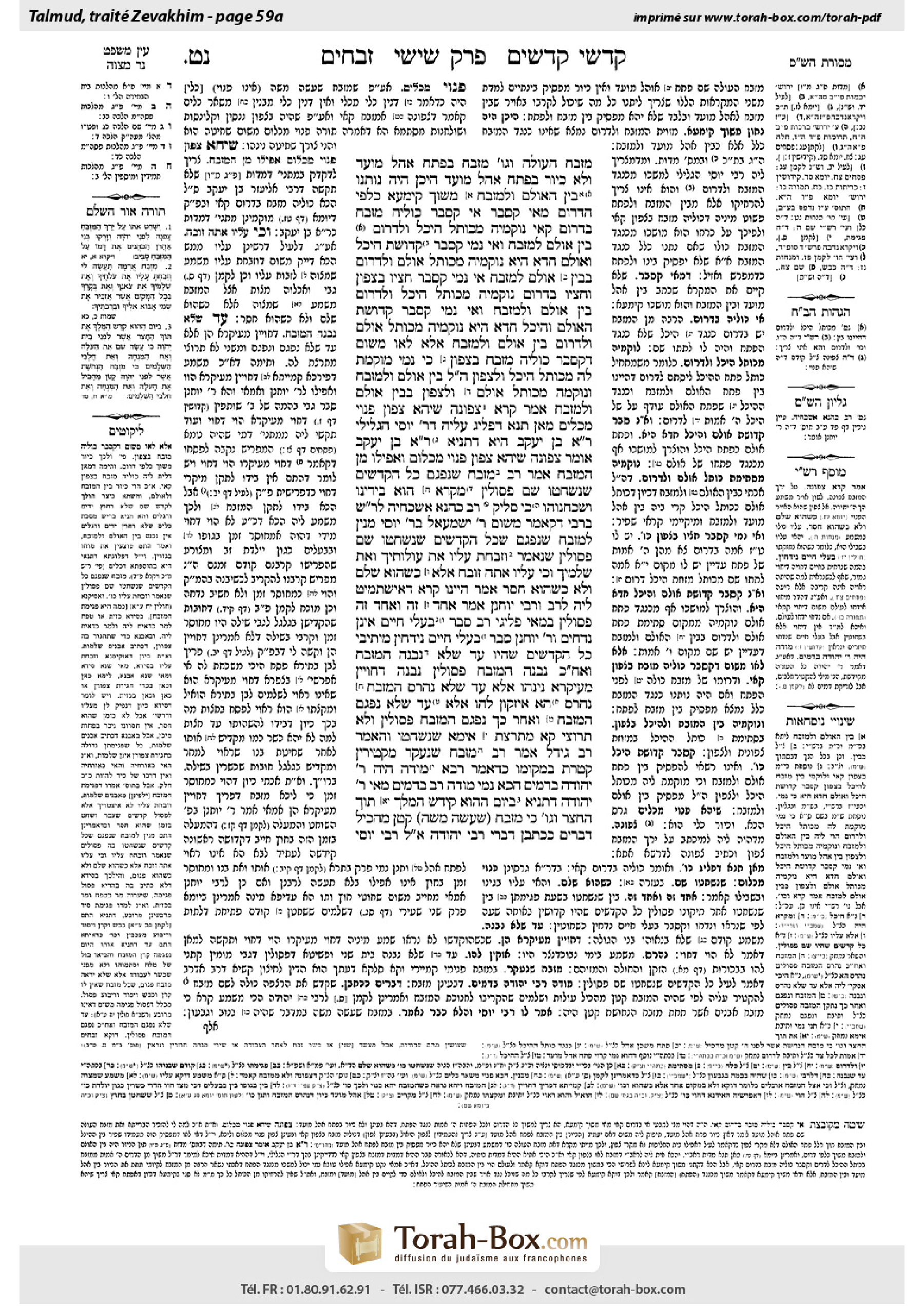
Zevachim 59a: Talmud study for Daf Yomi
Daf Yomi is the daily study of one Talmud folio. Explore 37 tractates with scans, Hebrew text, Sefaria English and AI-generated French translations where annotated.
Passage selection and English or AI-generated French translation are available where the scan has annotations. Daf Study is independent of Torah-Box and Sefaria.
Browse Zevachim · זבחים · All tractatesZevachim 59a text and translations
This page of Zevachim includes the Aramaic text, an English translation and an AI-generated French translation, alongside the scan above.
זבחים נ״ט א · Aramaic and Hebrew text
מִזְבַּח הָעוֹלָה וְגוֹ׳״ – מִזְבֵּחַ בְּפֶתַח אֹהֶל מוֹעֵד, וְלֹא כִּיּוֹר בְּפֶתַח אֹהֶל מוֹעֵד. הֵיכָן הָיָה נוֹתְנוֹ? בֵּין הָאוּלָם וְלַמִּזְבֵּחַ, מָשׁוּךְ קִימְעָא כְּלַפֵּי הַדָּרוֹם.
מַאי קָסָבַר? אִי קָסָבַר כּוּלֵּיהּ מִזְבֵּחַ בְּדָרוֹם קָאֵי – נוֹקְמֵיהּ מִכּוֹתֶל הֵיכָל וְלַדָּרוֹם, בֵּין אוּלָם לַמִּזְבֵּחַ!
וְאִי נָמֵי קָסָבַר קְדוּשַּׁת הֵיכָל וְאוּלָם חֲדָא הִיא – נוֹקְמֵיהּ מִכּוֹתֶל אוּלָם וְלַדָּרוֹם, בְּבֵין אוּלָם לַמִּזְבֵּחַ!
אִי נָמֵי קָסָבַר חֶצְיוֹ בַּצָּפוֹן וְחֶצְיוֹ בַּדָּרוֹם – נוֹקְמֵיהּ מִכּוֹתֶל הֵיכָל וְלַדָּרוֹם, בֵּין אוּלָם וְלַמִּזְבֵּחַ!
וְאִי נָמֵי קָסָבַר קְדוּשַּׁת הָאוּלָם וְהֵיכָל חֲדָא הִיא – נוֹקְמֵיהּ מִכּוֹתֶל אוּלָם וְלַדָּרוֹם, בֵּין אוּלָם וְלַמִּזְבֵּחַ! אֶלָּא לָאו מִשּׁוּם דְּקָסָבַר כּוּלֵּיהּ מִזְבֵּחַ בַּצָּפוֹן?
כִּי נָמֵי מוֹקְמַתְּ לַהּ מִכּוֹתֶל הֵיכָל וְלַצָּפוֹן – הָוֵה לֵיהּ בֵּין אוּלָם וְלַמִּזְבֵּחַ;
וְנוֹקְמַהּ מִכּוֹתֶל אוּלָם וְלַצָּפוֹן, בְּבֵין אוּלָם וְלַמִּזְבֵּחַ!
אָמַר קְרָא: ״צָפוֹנָה״ – שֶׁיְּהֵא צָפוֹן פָּנוּי מִכֵּלִים.
מַאן תַּנָּא דִּפְלִיג עֲלֵיהּ דְּרַבִּי יוֹסֵי הַגְּלִילִי? רַבִּי אֱלִיעֶזֶר בֶּן יַעֲקֹב הִיא. דְּתַנְיָא, רַבִּי אֱלִיעֶזֶר בֶּן יַעֲקֹב אוֹמֵר: ״צָפוֹנָה״ – שֶׁיְּהֵא צָפוֹן פָּנוּי מִכְּלוּם, וַאֲפִילּוּ מִן הַמִּזְבֵּחַ.
אָמַר רַב: מִזְבֵּחַ שֶׁנִּפְגַּם – כׇּל הַקֳּדָשִׁים שֶׁנִּשְׁחֲטוּ שָׁם פְּסוּלִין. מִקְרָא הוּא בְּיָדֵינוּ, וּשְׁכַחְנוּהוּ. כִּי סְלֵיק רַב כָּהֲנָא, אַשְׁכְּחֵיהּ לְרַבִּי שִׁמְעוֹן בְּרַבִּי דְּקָאָמַר מִשּׁוּם רַבִּי יִשְׁמָעֵאל בְּרַבִּי יוֹסֵי: מִנַּיִן לַמִּזְבֵּחַ שֶׁנִּפְגַּם – שֶׁכׇּל הַקֳּדָשִׁים שֶׁנִּשְׁחֲטוּ שָׁם פְּסוּלִין?
שֶׁנֶּאֱמַר: ״וְזָבַחְתָּ עָלָיו אֶת עֹלֹתֶיךָ וְאֶת שְׁלָמֶיךָ״ – וְכִי עָלָיו אַתָּה זוֹבֵחַ?! אֶלָּא כְּשֶׁהוּא שָׁלֵם, וְלֹא כְּשֶׁהוּא חָסֵר. אָמַר: הַיְינוּ קְרָא דְּאִישְׁתְּמִיט לֵיהּ לְרַב.
וְרַבִּי יוֹחָנָן אָמַר: אֶחָד זֶה וְאֶחָד זֶה פְּסוּלִין. בְּמַאי פְּלִיגִי? רַב סָבַר: בַּעֲלֵי חַיִּים אֵינָן נִדְחִים, וְרַבִּי יוֹחָנָן סָבַר: בַּעֲלֵי חַיִּים נִידְחִין.
מֵיתִיבִי: כׇּל הַקֳּדָשִׁים שֶׁהָיוּ עַד שֶׁלֹּא נִבְנָה הַמִּזְבֵּחַ, וְאַחַר כָּךְ נִבְנָה הַמִּזְבֵּחַ – פְּסוּלִין. נִבְנָה?! דְּחוּיִין מֵעִיקָּרָא נִינְהוּ!
אֶלָּא עַד שֶׁלֹּא נֶהֱרַס הַמִּזְבֵּחַ. נֶהֱרַס?! הָא אִיזְּקוּן לְהוּ!
אֶלָּא עַד שֶׁלֹּא נִפְגַּם הַמִּזְבֵּחַ, וְאַחַר כָּךְ נִפְגַּם הַמִּזְבֵּחַ – פְּסוּלִין. וְלָא תָּרוֹצֵי קָא מְתָרְצַתְּ? אֵימָא: שֶׁנִּשְׁחֲטוּ.
וְהָאָמַר רַב גִּידֵּל אָמַר רַב: מִזְבֵּחַ שֶׁנֶּעֱקַר – מַקְטִירִין קְטֹרֶת בִּמְקוֹמוֹ!
כִּדְאָמַר רָבָא: מוֹדֶה הָיָה רַבִּי יְהוּדָה בְּדָמִים; הָכָא נָמֵי – מוֹדֶה רַב בְּדָמִים.
מַאי רַבִּי יְהוּדָה? דְּתַנְיָא: ״בַּיּוֹם הַהוּא קִידַּשׁ הַמֶּלֶךְ תּוֹךְ הֶחָצֵר וְגוֹ׳, כִּי מִזְבֵּחַ (שֶׁעָשָׂה מֹשֶׁה) קָטָן מֵהָכִיל״ – דְּבָרִים כִּכְתָבָן. דִּבְרֵי רַבִּי יְהוּדָה.
אָמַר לוֹ רַבִּי יוֹסֵי,
Zevachim 59a · English translation
the altar of the burnt offering he set at the entrance to the Tabernacle of the Tent of Meeting.” (Exodus 40:29), indicating that no object was allowed to be located between the altar and the Tent of Meeting, whose parallel, in the Temple, was the Sanctuary. Rabbi Yosei HaGelili derives from these verses that only the altar stood at the entrance to the Tent of Meeting, but the Basin did not stand at the entrance to the Tent of Meeting. Where would they place the Basin? It was placed between the Entrance Hall and the altar, extended slightly toward the south. Therefore, although the Basin was closer to the Sanctuary than the altar was, it did not actually stand between the altar and the Sanctuary.
The Gemara seeks to clarify: What does Rabbi Yosei HaGelili hold? If he holds that the entire altar stands in the south section of the Temple courtyard, let him stand the Basin anywhere from where the wall of the Sanctuary begins and southward, so that it is not opposite the entrance to the Sanctuary but it is between the Entrance Hall and the altar. This would allow for the optimal fulfillment of both verses (Exodus 40:29; Leviticus 4:7), as the Basin would be located between the altar and the Sanctuary without interposing between the altar and the entrance to the Sanctuary.
The Gemara continues: And even if he holds that the level of sanctity of the Sanctuary and the Entrance Hall is the same, in which case the Basin could not be located opposite the entrance to the Entrance Hall as this too would be considered a violation of the second verse, let him stand the Basin anywhere from where the wall of the Entrance Hall begins and southward, so that it is not opposite the entrance to the Entrance Hall but is in between the Entrance Hall and the altar. From the fact that Rabbi Yosei HaGelili did not say that, it is clear he held that the altar was not located in the southern section of the Temple courtyard.
Alternatively, if Rabbi Yosei HaGelili holds that half of the altar was located in the north section of the Temple courtyard and half of it was located in the south, let him stand the Basin anywhere from where the wall of the Sanctuary begins and southward, so that it is not opposite the entrance to the Sanctuary but between the Entrance Hall and the altar. Since the entrance to the Sanctuary was five cubits wide and stood in the middle of the courtyard, and the altar was thirty-two cubits long, there would have been eleven cubits to both the north and the south of the entrance to the Sanctuary where the Basin could be placed in order to be located between the altar and the Sanctuary without interposing between the altar and the entrance to the Sanctuary.
And even if Rabbi Yosei HaGelili holds that the level of sanctity of the Entrance Hall and that of the Sanctuary is the same, in which case the Basin could not be located opposite the entrance to the Entrance Hall because this too would be considered a violation of the second verse, let him stand the Basin anywhere from where the wall of the Entrance Hall begins and southward, so that it is not opposite the entrance to the Entrance Hall but in between the Entrance Hall and the altar. Why does Rabbi Yosei HaGelili require that the Basin be placed south of the altar? The Gemara concludes: Rather, is it not due to the fact that Rabbi Yosei HaGelili holds that the entire altar stood in the north section of the Temple courtyard?
The Gemara asks: Even if this is the case, why does Rabbi Yosei HaGelili require that the Basin be located to the south of the altar so that it is not actually in between the altar and the Sanctuary? Even if you stand it anywhere from where the wall of the Sanctuary begins and northward, it would not interpose between the altar and the entrance to the Sanctuary but it would actually be located in between the Entrance Hall and the altar.
And even if Rabbi Yosei HaGelili holds that the sanctity of the Entrance Hall is equal to that of the Sanctuary, and that the Basin cannot interpose between the altar and the entrance to the Entrance Hall, stand the Basin anywhere from where the wall of the Entrance Hall begins and northward, so that it is not opposite the entrance to the Entrance Hall but it is located in between the Entrance Hall and the altar.
The Gemara answers: That suggestion is technically not feasible, as the verse states: “And he shall slaughter it on the side of the altar northward [tzafona]” (Leviticus 1:11). This verse indicates that the north section of the Temple courtyard must be vacant of all vessels, including the Basin. This concludes the Gemara’s explanation of Rav Sherevya’s assertion that the mishna in Tamid, which holds that the altar was located in the northern part of the Temple courtyard, is in accordance with the opinion of Rabbi Yosei HaGelili.
The Gemara asks: Who is the tanna who disagrees with Rabbi Yosei HaGelili? The Gemara answers: It is Rabbi Eliezer ben Yaakov, as it is taught in a baraita that Rabbi Eliezer ben Yaakov says: The verse states: “Northward before the Lord” (Leviticus 1:11). This indicates that the north section of the Temple courtyard must be vacant of everything, and even of the altar. Therefore, he maintains that the entire altar stood in the southern section of the Temple courtyard.
§ Rav says: In a case of an altar that was damaged, all sacrificial animals that were slaughtered there are disqualified. Rav continues: We have a verse as the source for this halakha but we have forgotten which one it is. When Rav Kahana, Rav’s disciple, ascended from Babylonia to Eretz Yisrael, he found Rabbi Shimon, son of Rabbi Yehuda HaNasi, saying in the name of Rabbi Yishmael, son of Rabbi Yosei: From where is it derived that in the case of an altar that was damaged, that all sacrificial animals that were slaughtered there are disqualified?
It is derived from a verse, as it is stated in the verse with regard to the altar: “An altar of earth you shall make for Me, and you shall slaughter upon it your burnt offerings and your peace offerings [shelamekha]” (Exodus 20:21). Is it true that you slaughter sacrificial animals on the altar itself? They are slaughtered on the ground near the altar. No, rather, the verse indicates that one is able to slaughter the sacrificial animals on account of the altar, i.e., when the altar is complete [shalem], but not when it is lacking, i.e., damaged. Rav Kahana said: This is the verse that eluded Rav.
And Rabbi Yoḥanan says: Both this one and that one are disqualified, i.e., all animals that were designated as offerings when the altar was in a damaged state are disqualified, even if they were not yet slaughtered. The Gemara asks: With regard to what issue do Rav and Rabbi Yoḥanan disagree? The Gemara answers: Rav holds that living animals are not permanently deferred, and Rabbi Yoḥanan holds that living animals are permanently deferred. If the altar is damaged and it is therefore impossible to sacrifice offerings, Rav holds that only offerings that were already slaughtered become permanently deferred, whereas Rabbi Yoḥanan holds that even those that were not yet slaughtered become permanently deferred.
The Gemara raises an objection to Rav’s opinion, based on a baraita: In the case of all sacrificial animals that were consecrated before the altar was built, and then the altar was subsequently built, the animals are disqualified. The Gemara assumes that this baraita is referring to animals that were consecrated before the building of the altar in the Second Temple. The Gemara responds: In a case where the animals were consecrated before the altar was built, the animals are considered initially deferred, i.e., deferred from the time they were initially consecrated. In this case all agree they are not permanently deferred and they can be sacrificed when the altar is built.
Rather, explain the baraita as follows: If the animals were consecrated before the altar was destroyed in the First Temple, and then the altar was destroyed and rebuilt, the animals are still disqualified. The Gemara questions this reading: Can the baraita be referring to a case where the altar was destroyed in the First Temple? Didn’t the animals become too old for sacrifice by the time the altar was constructed in the Second Temple?
The Gemara emends the baraita yet again: Rather, the baraita is referring to a case where one consecrated the animals before the altar was damaged, and subsequently the altar was damaged. The halakha is that the animals are disqualified. It seems from this baraita that even sacrificial animals that were not yet slaughtered when the altar became damaged are nevertheless permanently disqualified, in contrast to the opinion of Rav. The Gemara rejects this proof: But did you not already have to emend the text of the baraita? Emend it differently and say that the case is where the animals were slaughtered before the altar became damaged. Accordingly, there is no proof from this baraita with regard to the deferral of living animals.
Rav said that sacrificial animals that were slaughtered in the Temple courtyard when the altar was in a damaged state are disqualified. The Gemara asks: But doesn’t Rav Giddel say that Rav says: In a case where the golden altar became uprooted from its location in the Sanctuary, one may burn the incense in its place? Apparently, it is not essential to have the altar in order to sacrifice offerings.
The Gemara answers: It is like that which Rava says (60a): Although Rabbi Yehuda maintains that the entire Temple courtyard is fit for burning the sacrificial portions of offerings, Rabbi Yehuda would concede with regard to the presenting of the blood that it must be performed specifically on the altar. Here too, the Gemara says, Rav concedes with regard to the blood that an altar is required. Consequently, if consecrated offerings were slaughtered when the altar was in a damaged state, since the blood may not be presented, the offering is disqualified.
Having briefly mentioned Rabbi Yehuda’s opinion, the Gemara asks: What is the context of the statement of Rabbi Yehuda? The Gemara answers: As it is taught in a baraita: The verse states with regard to the inauguration of the Temple in the time of King Solomon: “On that day the king sanctified the middle of the court that was before the House of the Lord; as there he offered the burnt offering, and the meal offering, and the fat of the peace offerings; because the copper altar that was before the Lord was too small to receive the burnt offering, and the meal offering, and the fat of the peace offerings” (I Kings 8:64). The matters in the verse are to be understood as they are written, i.e., that the altar in the Temple was too small to receive all of the offerings that Solomon sacrificed, and Solomon therefore sanctified the Temple courtyard so that it, too, could function as an altar; this is the statement of Rabbi Yehuda.
Rabbi Yosei said to him:
Zevachim 59a · Traduction française (IA)
« L’autel de l’holocauste, il le plaça à l’entrée de la Tente d’assignation » (Exode 40,29). Cela indique qu’aucun objet ne pouvait se trouver entre l’autel et la Tente d’assignation, dont l’équivalent, dans le Temple, était le Sanctuaire. Rabbi Yosei HaGelili déduit de ces versets que seul l’autel se trouvait à l’entrée de la Tente d’assignation, mais pas le bassin. Où plaçait-on le bassin ? On le plaçait entre le Vestibule et l’autel, légèrement décalé vers le sud. Ainsi, bien que le bassin fût plus proche du Sanctuaire que l’autel, il ne se trouvait pas véritablement entre l’autel et le Sanctuaire.
La Guemara cherche à préciser : quelle est la position de Rabbi Yosei HaGelili ? S’il considère que l’autel tout entier se trouve dans la partie sud de la cour du Temple, qu’on place le bassin n’importe où depuis le début du mur du Sanctuaire vers le sud, de sorte qu’il ne soit pas en face de l’entrée du Sanctuaire, tout en se trouvant entre le Vestibule et l’autel. Cela permettrait d’accomplir au mieux les deux versets (Exode 40,29 ; Lévitique 4,7), puisque le bassin se trouverait entre l’autel et le Sanctuaire sans s’interposer entre l’autel et l’entrée du Sanctuaire.
La Guemara poursuit : même s’il considère que le Sanctuaire et le Vestibule ont le même degré de sainteté, auquel cas le bassin ne pourrait pas se trouver en face de l’entrée du Vestibule, car cela aussi serait considéré comme une transgression du second verset, qu’on place le bassin n’importe où depuis le début du mur du Vestibule vers le sud, de sorte qu’il ne soit pas en face de l’entrée du Vestibule, tout en se trouvant entre le Vestibule et l’autel. Puisque Rabbi Yosei HaGelili ne l’a pas proposé, il est clair qu’il estimait que l’autel ne se trouvait pas dans la partie sud de la cour du Temple.
Autre possibilité : si Rabbi Yosei HaGelili considère que la moitié de l’autel se trouvait dans la partie nord de la cour du Temple et l’autre moitié dans sa partie sud, qu’on place le bassin n’importe où depuis le début du mur du Sanctuaire vers le sud, de sorte qu’il ne soit pas en face de l’entrée du Sanctuaire, tout en se trouvant entre le Vestibule et l’autel. Comme l’entrée du Sanctuaire avait cinq coudées de largeur et se trouvait au milieu de la cour, tandis que l’autel avait trente-deux coudées de longueur, il y aurait eu onze coudées de part et d’autre de l’entrée du Sanctuaire, au nord comme au sud, où le bassin aurait pu être placé entre l’autel et le Sanctuaire sans s’interposer entre l’autel et l’entrée du Sanctuaire.
Et même si Rabbi Yosei HaGelili considère que le Vestibule et le Sanctuaire ont le même degré de sainteté, auquel cas le bassin ne pourrait pas se trouver en face de l’entrée du Vestibule, car cela aussi serait considéré comme une transgression du second verset, qu’on place le bassin n’importe où depuis le début du mur du Vestibule vers le sud, de sorte qu’il ne soit pas en face de l’entrée du Vestibule, tout en se trouvant entre le Vestibule et l’autel. Pourquoi Rabbi Yosei HaGelili exige-t-il que le bassin soit placé au sud de l’autel ? La Guemara conclut : n’est-ce pas plutôt parce que Rabbi Yosei HaGelili considère que l’autel tout entier se trouvait dans la partie nord de la cour du Temple ?
La Guemara demande : même si tel est le cas, pourquoi Rabbi Yosei HaGelili exige-t-il que le bassin se trouve au sud de l’autel, de sorte qu’il ne soit pas véritablement entre l’autel et le Sanctuaire ? Même si on le plaçait n’importe où depuis le début du mur du Sanctuaire vers le nord, il ne s’interposerait pas entre l’autel et l’entrée du Sanctuaire, tout en se trouvant effectivement entre le Vestibule et l’autel.
Et même si Rabbi Yosei HaGelili considère que le Vestibule a le même degré de sainteté que le Sanctuaire et que le bassin ne peut pas s’interposer entre l’autel et l’entrée du Vestibule, qu’on place le bassin n’importe où depuis le début du mur du Vestibule vers le nord, de sorte qu’il ne soit pas en face de l’entrée du Vestibule, tout en se trouvant entre le Vestibule et l’autel.
La Guemara répond : cette proposition n’est pas réalisable, car le verset dit : « On l’égorgera du côté nord [tzafona] de l’autel » (Lévitique 1,11). Ce verset indique que la partie nord de la cour du Temple doit être libre de tout ustensile, y compris le bassin. Ainsi s’achève l’explication par la Guemara de l’affirmation de Rav Sherevya selon laquelle la Michna de Tamid, qui estime que l’autel se trouvait dans la partie nord de la cour du Temple, est conforme à l’opinion de Rabbi Yosei HaGelili.
La Guemara demande : quel est le tanna en désaccord avec Rabbi Yosei HaGelili ? La Guemara répond : c’est Rabbi Eliezer ben Yaakov, comme l’enseigne une baraïta : Rabbi Eliezer ben Yaakov dit : le verset dit : « Du côté nord, devant le Seigneur » (Lévitique 1,11). Cela indique que la partie nord de la cour du Temple doit être libre de toute chose, même de l’autel. Il soutient donc que l’autel tout entier se trouvait dans la partie sud de la cour du Temple.
§ Rav dit : lorsqu’un autel a été endommagé, tous les animaux destinés aux sacrifices qui y ont été égorgés sont invalides. Rav ajoute : nous avons un verset comme source de cette halakha, mais nous avons oublié lequel. Lorsque Rav Kahana, le disciple de Rav, monta de Babylonie en Eretz Israël, il trouva Rabbi Shimon, fils de Rabbi Yehuda HaNasi, qui disait au nom de Rabbi Yishmael, fils de Rabbi Yosei : d’où apprend-on que, lorsqu’un autel a été endommagé, tous les animaux destinés aux sacrifices qui y ont été égorgés sont invalides ?
On l’apprend d’un verset, comme il est dit au sujet de l’autel : « Tu me feras un autel de terre, et tu y égorgeras tes holocaustes et tes sacrifices de paix [shelamekha] » (Exode 20,21). Est-il vrai que l’on égorge les animaux destinés aux sacrifices sur l’autel lui-même ? On les égorge à terre, près de l’autel. Non, le verset indique plutôt que l’on peut égorger les animaux destinés aux sacrifices grâce à l’autel, c’est-à-dire lorsque l’autel est complet [shalem], mais pas lorsqu’il est incomplet, autrement dit endommagé. Rav Kahana dit : c’est ce verset qui avait échappé à Rav.
Et Rabbi Yoḥanan dit : les uns comme les autres sont invalides, c’est-à-dire que tous les animaux désignés comme sacrifices alors que l’autel était endommagé sont invalides, même s’ils n’ont pas encore été égorgés. La Guemara demande : sur quel point Rav et Rabbi Yoḥanan sont-ils en désaccord ? La Guemara répond : Rav considère que les animaux vivants ne sont pas définitivement repoussés, tandis que Rabbi Yoḥanan considère qu’ils le sont. Si l’autel est endommagé et qu’il est donc impossible d’offrir des sacrifices, Rav estime que seuls les sacrifices déjà égorgés sont définitivement repoussés, tandis que Rabbi Yoḥanan estime que même ceux qui n’ont pas encore été égorgés le sont.
La Guemara soulève une objection à l’opinion de Rav à partir d’une baraïta : tous les animaux destinés aux sacrifices qui ont été consacrés avant la construction de l’autel, puis que l’on a construit l’autel, sont invalides. La Guemara suppose que cette baraïta parle d’animaux consacrés avant la construction de l’autel du Second Temple. La Guemara répond : lorsque les animaux ont été consacrés avant la construction de l’autel, ils sont considérés comme ayant été écartés dès le départ, c’est-à-dire dès leur consécration initiale. Dans ce cas, tous reconnaissent qu’ils ne sont pas définitivement repoussés et qu’ils peuvent être offerts une fois l’autel construit.
Expliquons plutôt la baraïta ainsi : si les animaux ont été consacrés avant la destruction de l’autel du Premier Temple, puis que l’autel a été détruit et reconstruit, les animaux restent invalides. La Guemara conteste cette interprétation : la baraïta peut-elle parler d’un cas où l’autel a été détruit pendant le Premier Temple ? Les animaux ne seraient-ils pas devenus trop vieux pour être offerts au moment de la construction de l’autel du Second Temple ?
La Guemara rectifie encore une fois la baraïta : elle parle plutôt d’un cas où quelqu’un a consacré les animaux avant que l’autel ne soit endommagé, puis où l’autel a été endommagé. La halakha est que les animaux sont invalides. Cette baraïta semble donc indiquer que même les animaux destinés aux sacrifices qui n’avaient pas encore été égorgés lorsque l’autel a été endommagé sont néanmoins définitivement invalides, contrairement à l’opinion de Rav. La Guemara rejette cette preuve : n’avez-vous pas déjà dû rectifier le texte de la baraïta ? Rectifiez-le autrement et dites qu’il s’agit d’animaux égorgés avant que l’autel ne soit endommagé. Par conséquent, cette baraïta ne prouve rien au sujet du rejet des animaux vivants.
Rav a dit que les animaux destinés aux sacrifices qui ont été égorgés dans la cour du Temple alors que l’autel était endommagé sont invalides. La Guemara demande : mais Rav Giddel ne rapporte-t-il pas que Rav dit : si l’autel d’or a été arraché de son emplacement dans le Sanctuaire, on peut brûler l’encens à cet emplacement ? Il semble donc que la présence de l’autel ne soit pas indispensable pour offrir des sacrifices.
La Guemara répond : c’est comme le dit Rava (60a) : bien que Rabbi Yehuda soutienne que toute la cour du Temple convient pour brûler les parts sacrificielles des offrandes, il reconnaîtrait, concernant la présentation du sang, qu’elle doit se faire précisément sur l’autel. Ici aussi, dit la Guemara, Rav reconnaît qu’un autel est nécessaire pour le sang. Par conséquent, si des sacrifices consacrés ont été égorgés alors que l’autel était endommagé, l’offrande est invalide, puisque le sang ne peut pas être présenté.
Après avoir brièvement mentionné l’opinion de Rabbi Yehuda, la Guemara demande : dans quel contexte Rabbi Yehuda a-t-il formulé cette déclaration ? La Guemara répond : comme l’enseigne une baraïta : au sujet de l’inauguration du Temple à l’époque du roi Salomon, le verset dit : « Ce jour-là, le roi sanctifia le milieu de la cour qui était devant la Maison du Seigneur ; car c’est là qu’il offrit l’holocauste, l’oblation et la graisse des sacrifices de paix ; car l’autel de cuivre qui était devant le Seigneur était trop petit pour recevoir l’holocauste, l’oblation et la graisse des sacrifices de paix » (I Rois 8,64). Il faut comprendre les termes du verset tels qu’ils sont écrits, c’est-à-dire que l’autel du Temple était trop petit pour recevoir toutes les offrandes que Salomon offrait ; Salomon sanctifia donc la cour du Temple afin qu’elle puisse, elle aussi, servir d’autel. Telle est l’opinion de Rabbi Yehuda.
Rabbi Yosei lui dit :
Traduction française générée par IA à partir de l’édition anglaise de Sefaria. Vérifie toujours un passage avec le texte source.
Text from Sefaria: William Davidson Edition - Vocalized Aramaic (CC BY NC); William Davidson Edition - English (CC BY NC).