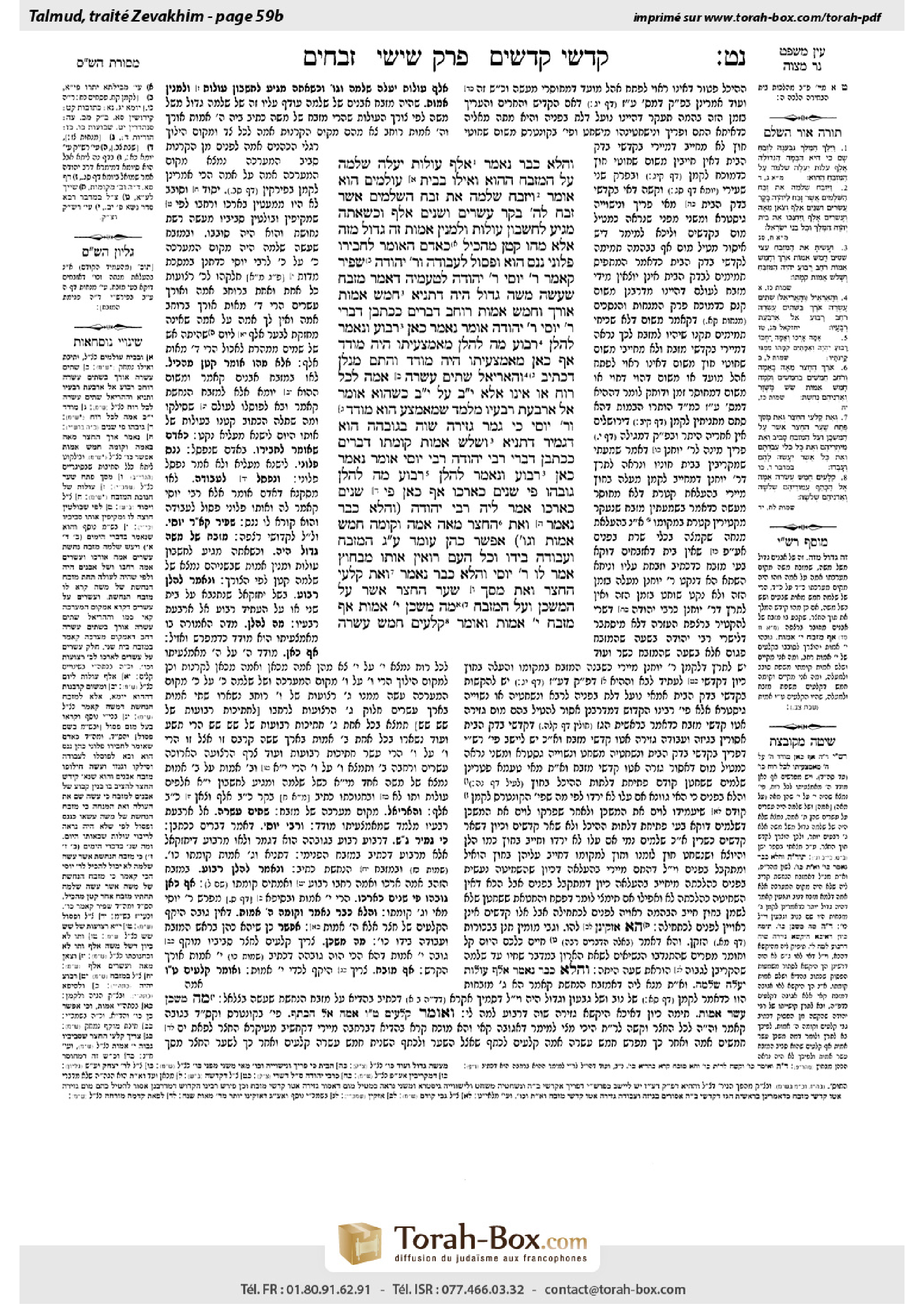
Zevachim 59b: Talmud study for Daf Yomi
Daf Yomi is the daily study of one Talmud folio. Explore 37 tractates with scans, Hebrew text, Sefaria English and AI-generated French translations where annotated.
Passage selection and English or AI-generated French translation are available where the scan has annotations. Daf Study is independent of Torah-Box and Sefaria.
Browse Zevachim · זבחים · All tractatesZevachim 59b text and translations
This page of Zevachim includes the Aramaic text, an English translation and an AI-generated French translation, alongside the scan above.
זבחים נ״ט ב · Aramaic and Hebrew text
וַהֲלֹא כְּבָר נֶאֱמַר: ״אֶלֶף עֹלוֹת יַעֲלֶה שְׁלֹמֹה עַל הַמִּזְבֵּחַ הַהוּא״, וְאִילּוּ בְּבֵית עוֹלָמִים הוּא אוֹמֵר: ״וַיִּזְבַּח שְׁלֹמֹה אֵת זֶבַח הַשְּׁלָמִים אֲשֶׁר זָבַח לַה׳ בָּקָר עֶשְׂרִים וּשְׁנַיִם אֶלֶף״;
וּכְשֶׁאַתָּה מַגִּיעַ לְחֶשְׁבּוֹן עוֹלוֹת וּלְמִנְיַן אַמּוֹת – זֶה גָּדוֹל מִזֶּה!
אֶלָּא מַהוּ ״קָטָן מֵהָכִיל״, כְּאָדָם הָאוֹמֵר לַחֲבֵירוֹ: ״פְּלוֹנִי נַנָּס הוּא״ – וּפָסוּל לַעֲבוֹדָה.
וְרַבִּי יְהוּדָה – שַׁפִּיר קָאָמַר רַבִּי יוֹסֵי! רַבִּי יְהוּדָה לְטַעְמֵיהּ, דְּאָמַר: מִזְבֵּחַ שֶׁעָשָׂה מֹשֶׁה – גָּדוֹל הָיָה. דְּתַנְיָא: ״חָמֵשׁ אַמּוֹת אֹרֶךְ וְחָמֵשׁ אַמּוֹת רֹחַב״ – דְּבָרִים כִּכְתָבָן. דִּבְרֵי רַבִּי יוֹסֵי.
רַבִּי יְהוּדָה אוֹמֵר: נֶאֱמַר כָּאן ״רָבוּעַ״, וְנֶאֱמַר לְהַלָּן ״רָבוּעַ״; מָה לְהַלָּן מֵאֶמְצָעִיתוֹ הָיָה מוֹדֵד, אַף כָּאן מֵאֶמְצָעִיתוֹ הָיָה מוֹדֵד.
וְהָתָם מְנָלַן? דִּכְתִיב: ״וְהָאֲרִיאֵל שְׁתֵּים עֶשְׂרֵה אַמָּה לְכׇל רוּחַ״. אוֹ אֵינוֹ אֶלָּא שְׁתֵּים עֶשְׂרֵה עַל שְׁתֵּים עֶשְׂרֵה? כְּשֶׁהוּא אוֹמֵר: ״אַל אַרְבַּעַת רְבָעָיו״ – מְלַמֵּד שֶׁמֵּאֶמְצַע הוּא מוֹדֵד.
וְרַבִּי יוֹסֵי, כִּי גְּמִר גְּזֵירָה שָׁוָה – בְּגוֹבְהָהּ הוּא דִּגְמִיר. דְּתַנְיָא: ״וְשָׁלֹשׁ אַמּוֹת קוֹמָתוֹ״ – דְּבָרִים כִּכְתָבָן. דִּבְרֵי רַבִּי יְהוּדָה.
רַבִּי יוֹסֵי אוֹמֵר: נֶאֱמַר כָּאן ״רָבוּעַ״, וְנֶאֱמַר לְהַלָּן ״רָבוּעַ״; מָה לְהַלָּן – גּוֹבְהוֹ פִּי שְׁנַיִם כְּאׇרְכּוֹ, אַף כָּאן – פִּי שְׁנַיִם כְּאׇרְכּוֹ.
אֲמַר לֵיהּ רַבִּי יְהוּדָה, וַהֲלֹא כְּבָר נֶאֱמַר: ״וְאֶת הֶחָצֵר מֵאָה אַמָּה וְקוֹמָה חָמֵשׁ אַמּוֹת וְגוֹ׳״ – אֶפְשָׁר כֹּהֵן עוֹמֵד עַל גַּבֵּי הַמִּזְבֵּחַ וַעֲבוֹדָה בְּיָדוֹ, וְכׇל הָעָם רוֹאִין אוֹתוֹ מִבַּחוּץ?!
אָמַר לוֹ רַבִּי יוֹסֵי, וַהֲלֹא כְּבָר נֶאֱמַר: ״וְאֵת קַלְעֵי הֶחָצֵר וְאֶת מָסַךְ שַׁעַר הֶחָצֵר אֲשֶׁר עַל הַמִּשְׁכָּן וְעַל הַמִּזְבֵּחַ״ – מָה מִשְׁכָּן עֶשֶׂר אַמּוֹת, אַף מִזְבֵּחַ עֶשֶׂר אַמּוֹת; וְאוֹמֵר: ״קְלָעִים חֲמֵשׁ עֶשְׂרֵה
Zevachim 59b · English translation
But isn’t it already stated with regard to the altar that Moses built: “A thousand burnt offerings did Solomon offer upon that altar” (I Kings 3:4), while with regard to the Eternal House, i.e., the Temple, it states: “And Solomon offered for the sacrifice of peace offerings, which he offered to the Lord, two and twenty thousand cattle and one hundred and twenty thousand sheep” (I Kings 8:63)?
And when you arrive at the calculation of burnt offerings and the number of cubits for each altar, this was greater than that, i.e., Solomon sacrificed more offerings per square cubit on Moses’ altar than he did on the altar in the Temple upon its inauguration. Therefore, it is difficult to suggest that the altar in the Temple was not large enough to accommodate the number of offerings that Solomon sacrificed.
Rabbi Yosei presents an alternative understanding of the verse: Rather, what is the meaning of the phrase “because the copper altar…was too small to receive”? It is not referring to the altar built by Solomon, but rather to the copper altar built in the time of Moses, which was disqualified from use from the day of the Temple’s inauguration on. Rather than stating outright that the altar became disqualified, the verse employed a euphemism, like a person who says to his friend: So-and-so is a dwarf [nanas], and what he really means to say is that he is disqualified from performing the Temple service. Similarly, rather than stating outright that the altar built in the time of Moses became disqualified, the verse states that it was too small to accommodate the offerings sacrificed in the Temple.
The Gemara asks: And how does Rabbi Yehuda respond to this claim? Rabbi Yosei is saying well, i.e., his claim is persuasive. The Gemara explains: Rabbi Yehuda conforms to his standard line of reasoning, as he says that the altar that Moses built was large. As it is taught in a baraita: The verse states that the altar built in the time of Moses was: “Five cubits long and five cubits wide” (Exodus 27:1). The matters in the verse are to be understood as they are written; this is the statement of Rabbi Yosei.
Rabbi Yehuda says: It is stated here that the altar built in the time of Moses was: “Square” (Exodus 27:1), and it is stated there, in Ezekiel’s prophetic description of the altar, that it is: “Square” (Ezekiel 43:16). Just as there, in Ezekiel’s vision, he was measuring the distance in each direction from its center, so too here, the verse was measuring the altar that Moses built from its center. Accordingly, the altar built by Moses was ten cubits by ten cubits. As a result, Solomon sacrificed more offerings per square cubit of space on the altar in the Temple than he did on the altar built by Moses. It is therefore possible that the altar in the Temple was not sufficient to accommodate the offerings, and Solomon consecrated the Temple courtyard to serve as an altar.
The Gemara asks: And from where do we derive that the altar mentioned there, in Ezekiel, was measured from its center? The Gemara answers: As it is written: “And the hearth shall be twelve cubits long by twelve wide, square, to its four sides” (Ezekiel 43:16). The Gemara asks: Does the verse mean twelve cubits in each direction from the center of the altar, so that in total it was twenty-four by twenty-four cubits? Or perhaps the altar was only a total of twelve by twelve cubits. The Gemara answers: When the verse states: “To its four sides,” it teaches that Ezekiel was measuring from the center of the altar.
The Gemara asks: And how does Rabbi Yosei respond to Rabbi Yehuda’s claim? The Gemara answers: When he learns the verbal analogy, he learns it with regard to the altar’s height. As it is taught in a baraita: The verse states with regard to the altar built in the time of Moses: “And its height shall be three cubits” (Exodus 27:1). The matters in the verse are to be understood as they are written, i.e., that the height of the altar was three cubits. This is the statement of Rabbi Yehuda.
Rabbi Yosei says: It is stated here that the altar built in the time of Moses was: “Square” (Exodus 27:1), and it is stated there that the incense altar was: “Square” (Exodus 30:2). The verbal analogy indicates that just as there, with regard to the incense altar, its height was twice its length, so too here, the height of the altar built in the time of Moses was twice its length, i.e., ten cubits.
Rabbi Yehuda said to Rabbi Yosei: But isn’t it already stated: “The length of the court shall be a hundred cubits…and the height five cubits” (Exodus 27:18)? Is it possible that the priest would stand atop the altar and hold the items with which he would perform the sacrificial service in his hand, and the whole nation could see him from outside the courtyard? That would constitute a lack of respect for the service in the Tabernacle.
Rabbi Yosei said back to him: But isn’t it already stated: “And the curtains of the court, and the screen for the door of the gate of the court which is by the Tabernacle and by the altar” (Numbers 4:26)? This verse juxtaposes the Tabernacle with the altar to teach that just as the Tabernacle was ten cubits high, so too, the altar was ten cubits high. And another verse states: “The curtains were fifteen
Zevachim 59b · Traduction française (IA)
Mais n’est-il pas déjà dit, au sujet de l’autel que Moïse avait construit : « Salomon offrit mille holocaustes sur cet autel » (I Rois 3:4), tandis qu’au sujet de la Maison éternelle, c’est-à-dire du Temple, il est dit : « Salomon offrit en sacrifice de paix au Seigneur vingt-deux mille bovins et cent vingt mille moutons » (I Rois 8:63) ?
Or, si l’on compare le nombre d’holocaustes au nombre de coudées carrées de chaque autel, le rapport était plus élevé pour celui-ci que pour celui-là : autrement dit, Salomon offrit davantage de sacrifices par coudée carrée sur l’autel de Moïse que sur l’autel du Temple lors de son inauguration. Il est donc difficile de soutenir que l’autel du Temple n’était pas assez grand pour accueillir le nombre de sacrifices offerts par Salomon.
Rabbi Yosei propose une autre interprétation du verset : que signifie donc l’expression « car l’autel de cuivre… était trop petit pour recevoir » ? Elle ne se rapporte pas à l’autel construit par Salomon, mais à l’autel de cuivre construit à l’époque de Moïse, qui fut disqualifié dès le jour de l’inauguration du Temple. Au lieu de dire explicitement que l’autel était devenu impropre, le verset emploie un euphémisme, comme quelqu’un qui dit à son ami : « Untel est un nain [nanas] », alors qu’il veut dire qu’il est impropre à accomplir le service du Temple. De même, au lieu d’affirmer explicitement que l’autel construit à l’époque de Moïse était devenu impropre, le verset dit qu’il était trop petit pour accueillir les sacrifices offerts dans le Temple.
La Guemara demande : Et comment Rabbi Yehuda répond-il à cet argument ? Rabbi Yosei a raison, c’est-à-dire que son argument est convaincant. La Guemara explique : Rabbi Yehuda s’en tient à sa position habituelle, selon laquelle l’autel construit par Moïse était grand. En effet, il est enseigné dans une baraïta : le verset indique que l’autel construit à l’époque de Moïse mesurait « cinq coudées de long et cinq coudées de large » (Exode 27:1). Les termes du verset doivent être compris tels qu’ils sont écrits ; telle est l’opinion de Rabbi Yosei.
Rabbi Yehuda dit : Il est dit ici que l’autel construit à l’époque de Moïse était « carré » (Exode 27:1), et il est dit là, dans la description prophétique de l’autel par Ézéchiel, qu’il était « carré » (Ézéchiel 43:16). De même que là, dans la vision d’Ézéchiel, celui-ci mesurait la distance dans chaque direction à partir du centre, de même, ici, le verset mesurait l’autel construit par Moïse à partir de son centre. Par conséquent, l’autel construit par Moïse mesurait dix coudées sur dix. Salomon offrit donc davantage de sacrifices par coudée carrée sur l’autel du Temple que sur l’autel construit par Moïse. Il est dès lors possible que l’autel du Temple n’ait pas suffi à accueillir tous les sacrifices et que Salomon ait consacré la cour du Temple pour qu’elle serve d’autel.
La Guemara demande : Et d’où déduisons-nous que l’autel mentionné là, dans Ézéchiel, était mesuré à partir de son centre ? Comme il est écrit : « Le foyer aura douze coudées de long et douze de large, carré de ses quatre côtés » (Ézéchiel 43:16). La Guemara demande : Le verset signifie-t-il qu’il y avait douze coudées dans chaque direction à partir du centre de l’autel, de sorte qu’il mesurait au total vingt-quatre coudées sur vingt-quatre ? Ou peut-être l’autel mesurait-il seulement douze coudées sur douze en tout ? La Guemara répond : En disant « de ses quatre côtés », le verset enseigne qu’Ézéchiel mesurait à partir du centre de l’autel.
La Guemara demande : Et comment Rabbi Yosei répond-il à l’argument de Rabbi Yehuda ? La Guemara répond : Lorsqu’il établit l’analogie verbale, il l’applique à la hauteur de l’autel. En effet, il est enseigné dans une baraïta : au sujet de l’autel construit à l’époque de Moïse, le verset dit : « Sa hauteur sera de trois coudées » (Exode 27:1). Les termes du verset doivent être compris tels qu’ils sont écrits, c’est-à-dire que l’autel avait trois coudées de haut. Telle est l’opinion de Rabbi Yehuda.
Rabbi Yosei dit : Il est dit ici que l’autel construit à l’époque de Moïse était « carré » (Exode 27:1), et il est dit là que l’autel des parfums était « carré » (Exode 30:2). L’analogie verbale indique que, de même que là, la hauteur de l’autel des parfums était le double de sa longueur, de même, ici, la hauteur de l’autel construit à l’époque de Moïse était le double de sa longueur, soit dix coudées.
Rabbi Yehuda dit à Rabbi Yosei : Mais n’est-il pas déjà dit : « La longueur du parvis sera de cent coudées… et sa hauteur de cinq coudées » (Exode 27:18) ? Est-il possible que le prêtre se tienne au sommet de l’autel, les objets nécessaires au service sacrificiel à la main, tandis que tout le peuple pourrait le voir depuis l’extérieur du parvis ? Cela manquerait de respect envers le service accompli dans le Tabernacle.
Rabbi Yosei lui répondit : Mais n’est-il pas déjà dit : « Les tentures du parvis et le rideau de la porte de l’entrée du parvis, qui est près du Tabernacle et de l’autel » (Nombres 4:26) ? Ce verset rapproche le Tabernacle de l’autel pour enseigner que, de même que le Tabernacle avait dix coudées de haut, de même l’autel avait dix coudées de haut. Et un autre verset dit : « Les tentures avaient quinze
Traduction française générée par IA à partir de l’édition anglaise de Sefaria. Vérifie toujours un passage avec le texte source.
Text from Sefaria: William Davidson Edition - Vocalized Aramaic (CC BY NC); William Davidson Edition - English (CC BY NC).