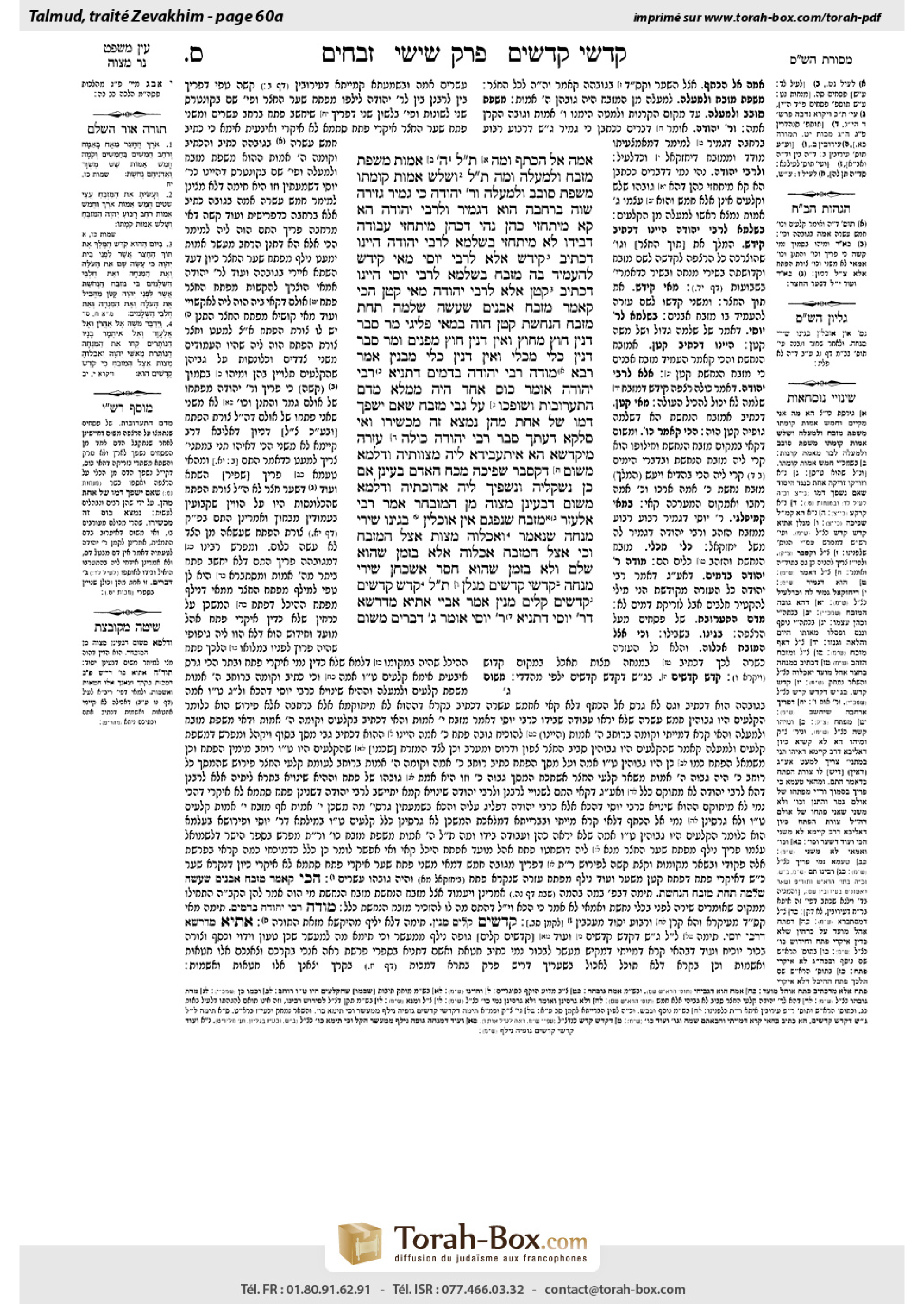
Zevachim 60a: Talmud study for Daf Yomi
Daf Yomi is the daily study of one Talmud folio. Explore 37 tractates with scans, Hebrew text, Sefaria English and AI-generated French translations where annotated.
Passage selection and English or AI-generated French translation are available where the scan has annotations. Daf Study is independent of Torah-Box and Sefaria.
Browse Zevachim · זבחים · All tractatesZevachim 60a text and translations
This page of Zevachim includes the Aramaic text, an English translation and an AI-generated French translation, alongside the scan above.
זבחים ס׳ א · Aramaic and Hebrew text
אַמָּה אֶל הַכָּתֵף״. וּמָה תַּלְמוּד לוֹמַר ״חָמֵשׁ אַמּוֹת״? מִשְּׂפַת מִזְבֵּחַ וּלְמַעְלָה.
וּמָה תַּלְמוּד לוֹמַר ״וְשָׁלֹשׁ אַמּוֹת קוֹמָתוֹ״? מִשְּׂפַת סוֹבֵב וּלְמַעְלָה.
וְרַבִּי יְהוּדָה, כִּי גְּמִיר גְּזֵירָה שָׁוָה – בְּרָחְבָּהּ הוּא דִּגְמִיר.
וּלְרַבִּי יְהוּדָה, הָא קָא מִיתְחֲזֵי כֹּהֵן! נְהִי דְּכֹהֵן מִיתְחֲזֵי; עֲבוֹדָה דִּבְיָדוֹ – לָא מִיתְחֲזֵי.
בִּשְׁלָמָא לְרַבִּי יְהוּדָה, הַיְינוּ דִּכְתִיב ״קִידֵּשׁ״; אֶלָּא לְרַבִּי יוֹסֵי, מַאי ״קִידֵּשׁ״? לְהַעֲמִיד בָּהּ מִזְבֵּחַ.
בִּשְׁלָמָא לְרַבִּי יוֹסֵי, הַיְינוּ דִּכְתִיב ״קָטָן״; אֶלָּא לְרַבִּי יְהוּדָה, מַאי ״קָטָן״? הָכִי קָאָמַר: מִזְבַּח אֲבָנִים שֶׁעָשָׂה שְׁלֹמֹה תַּחַת מִזְבַּח הַנְּחֹשֶׁת – קָטָן הֲוָה.
בְּמַאי פְּלִיגִי? מָר סָבַר: דָּנִין חוּץ מִחוּץ, וְאֵין דָּנִין חוּץ מִפְּנִים;
וּמָר סָבַר: דָּנִין כְּלִי מִכְּלִי, וְאֵין דָּנִין כְּלִי מִבִּנְיָן.
אָמַר רָבָא: מוֹדֶה רַבִּי יְהוּדָה בְּדָמִים. דְּתַנְיָא, רַבִּי יְהוּדָה אוֹמֵר: כּוֹס אֶחָד הָיָה מְמַלֵּא מִדַּם הַתַּעֲרוֹבוֹת, וְשׁוֹפְכוֹ עַל גַּבֵּי מִזְבֵּחַ; שֶׁאִם יִשָּׁפֵךְ דָּמוֹ שֶׁל אַחַת מֵהֶן – נִמְצָא זֶה מַכְשִׁירוֹ.
וְאִי סָלְקָא דַעְתָּךְ סָבַר רַבִּי יְהוּדָה כּוּלַּהּ עֲזָרָה מִיקַּדְּשָׁא – הָא אִיתְעֲבִידָא לֵיהּ מִצְוְותֵיהּ!
וְדִלְמָא מִשּׁוּם דְּקָסָבַר שְׁפִיכָה מִכֹּחַ הָאָדָם בָּעֵינַן? אִם כֵּן, נִשְׁקְלֵיהּ וְנִשְׁפֹּיךְ לֵיהּ אַדּוּכְתֵּיהּ!
וְדִלְמָא מִשּׁוּם דְּבָעֵינַן מִצְוָה מִן הַמּוּבְחָר?
אָמַר רַבִּי אֶלְעָזָר: מִזְבֵּחַ שֶׁנִּפְגַּם – אֵין אוֹכְלִים בְּגִינוֹ שְׁיָרֵי מִנְחָה, שֶׁנֶּאֱמַר: ״וְאִכְלוּהָ מַצּוֹת אֵצֶל הַמִּזְבֵּחַ״ – וְכִי אֵצֶל הַמִּזְבֵּחַ אֲכָלוּהָ?! אֶלָּא בִּזְמַן שֶׁהוּא שָׁלֵם, וְלֹא בִּזְמַן שֶׁהוּא חָסֵר.
אַשְׁכְּחַן שְׁיָרֵי מִנְחָה, קׇדְשֵׁי קֳדָשִׁים מְנָלַן? תַּלְמוּד לוֹמַר: ״קֹדֶשׁ קָדָשִׁים״.
קָדָשִׁים קַלִּים מִנַּיִן? אָמַר אַבָּיֵי: אָתְיָא מִדְּרָשָׁא דְּרַבִּי יוֹסֵי, דְּתַנְיָא: רַבִּי יוֹסֵי אוֹמֵר שְׁלֹשָׁה דְּבָרִים מִשּׁוּם
Zevachim 60a · English translation
cubits for the one side” (Exodus 38:14), which indicates that the height of the curtains surrounding the courtyard of the Tabernacle was fifteen cubits. And what is the meaning when the verse states: “And the height five cubits” (Exodus 27:18)? It is referring to the height of the curtains from the upper edge of the altar and above; the curtains surrounding the courtyard were five cubits higher than the altar.
Rabbi Yosei continues: And what is the meaning when the verse states: “And you shall make the altar…and its height shall be three cubits” (Exodus 27:1)? The verse means that the altar measures three cubits from the edge of the surrounding ledge and above.
The Gemara asks: And how does Rabbi Yehuda, who understands that the copper altar built in the time of Moses was actually three cubits high, interpret the verbal analogy based upon the word “square,” from which Rabbi Yosei derived that the height of the copper altar was ten cubits? The Gemara answers: When he learns the verbal analogy, he learns it with regard to the altar’s width, not its height. This is based on the verse in Ezekiel (see 59b). Accordingly, it teaches that the altar built in the time of Moses was ten cubits by ten cubits.
The Gemara asks: And according to Rabbi Yehuda, who maintains that the altar was three cubits high and the curtains surrounding the courtyard of the Tabernacle were five cubits high, isn’t the priest visible while performing the service atop the altar? The Gemara answers: Granted, the priest is visible, but the items with which he performs the sacrificial service that are in his hand are not visible.
The Gemara returns to the original dispute between Rabbi Yehuda and Rabbi Yosei with regard to whether or not Solomon consecrated the floor of the Temple courtyard. Granted, according to Rabbi Yehuda, who maintains that the floor of the Temple courtyard was consecrated so that it could serve as an altar, this is the meaning of that which is written: “The king sanctified the middle of the court” (I Kings 8:64). But according to Rabbi Yosei, what is the meaning of the phrase “the king sanctified”? The Gemara answers: It means that Solomon sanctified the courtyard in order to stand the altar in it.
The Gemara continues: Granted, according to Rabbi Yosei, who maintains that the surface of the altar built in the time of Moses was five cubits by five cubits, this is the meaning of that which is written in the continuation of that verse: “Because the copper altar that was before the Lord was too small to receive.” But according to Rabbi Yehuda, who maintains that its surface area was ten cubits by ten cubits, what is the meaning of the phrase “too small”? The Gemara answers: The verse is referring to the altar built by Solomon, and this is what it is saying: The stone altar that Solomon built in place of the copper altar built in the time of Moses was too small to accommodate the large quantity of offerings.
The Gemara asks: With regard to what principle do Rabbi Yehuda and Rabbi Yosei disagree that causes them to interpret differently the verbal analogy based on the word “square”? The Gemara answers: One Sage, Rabbi Yehuda, holds that we derive the dimensions of the external altar built in the time of Moses from the external altar described in Ezekiel; but we do not derive the dimensions of the external altar from the dimensions of the inner altar, used for burning the incense.
And one Sage, Rabbi Yosei, holds that we derive the dimensions of a portable vessel, i.e., the copper altar built in the time of Moses, from the dimensions of another portable vessel, i.e., the golden incense altar built at that time; but we do not derive the dimensions of a portable vessel from the dimensions of an edifice, i.e., the stone altar in the Temple.
§ Rava says: Although Rabbi Yehuda maintains that the entire Temple courtyard is fit for burning the sacrificial portions of offerings, he concedes with regard to the blood and holds that it must be presented on the altar, as it is taught in a baraita: Rabbi Yehuda says: On Passover eve, a priest would fill one cup with the blood of the many offerings brought that day and that was now mixed together on the floor. And then he would pour it on the altar, so that if all of the blood of one of the offerings had been spilled and was never presented on the altar, this cup would contain a small amount of that blood and pouring it on the altar would render the offering fit.
Rava explains his proof: And if it enters your mind that Rabbi Yehuda maintains the entire Temple courtyard was consecrated so that it had the status of the altar, then the mitzva of sacrificing the Paschal offering was performed even if the blood spilled on the ground of the courtyard and was never presented on the altar.
The Gemara attempts to reject this proof: Perhaps Rabbi Yehuda requires pouring a cup of the mixture of blood on the altar due to the fact that he holds we require pouring of the blood of the Paschal offering by human force. Since the blood on the floor of the courtyard was not poured there by a person, the mitzva has not yet been fulfilled despite the fact that the floor has the same status as the altar. The Gemara responds: If so, let the priest take the cup of the mixture of blood and pour it in its place on the floor rather than on the altar.
The Gemara rejects Rava’s proof: But perhaps Rabbi Yehuda requires the blood to be poured on the altar only due to the fact that we require the mitzva to be performed in the optimal manner. Even if Rabbi Yehuda holds that the floor of the courtyard has the same status as the altar, he would agree that it is preferable for the blood to be poured on the altar itself.
§ Rabbi Elazar says: In the case of an altar that was damaged, one may not eat the remainder of a meal offering on its account, as it is stated: “Take the meal offering…and eat it without leaven beside the altar; for it is most holy” (Leviticus 10:12). The verse is difficult: But did the priests have to eat the meal offering beside the altar? A priest may eat sacrificial items even of the most sacred order anywhere in the Temple courtyard. Rather, the verse means that one may eat the meal offering only at a time when the altar is complete, but not at a time when it is lacking.
The Gemara continues: We found a source for this halakha with regard to the remainder of a meal offering; from where do we derive that this halakha applies to all offerings of the most sacred order? The Gemara answers: The end of the verse states: “For it is most holy.” Since this term is also used with regard to the other offerings of the most sacred order, it is derived through verbal analogy that these offerings may not be eaten if the altar is damaged.
The Gemara continues: From where is it derived that this halakha also applies to offerings of lesser sanctity? Abaye said: It is derived from the exposition of Rabbi Yosei, as it is taught in a baraita: Rabbi Yosei says three halakhic matters in the name of
Zevachim 60a · Traduction française (IA)
coudées pour un côté » (Exode 38:14), ce qui indique que les tentures entourant le parvis du Tabernacle avaient quinze coudées de hauteur. Que signifie alors le verset : « Et la hauteur, cinq coudées » (Exode 27:18) ? Il fait référence à la hauteur des tentures à partir du bord supérieur de l’autel : elles s’élevaient de cinq coudées au-dessus de celui-ci.
Rabbi Yossé poursuit : Que signifie alors le verset : « Tu feras l’autel… et sa hauteur sera de trois coudées » (Exode 27:1) ? Le verset signifie que l’autel mesure trois coudées depuis le bord de la corniche qui l’entoure vers le haut.
La Guemara demande : Comment Rabbi Yehouda, qui considère que l’autel de cuivre construit à l’époque de Moïse avait en réalité trois coudées de hauteur, interprète-t-il l’analogie verbale fondée sur le mot « carré », dont Rabbi Yossé a déduit que l’autel de cuivre avait dix coudées de hauteur ? La Guemara répond : Lorsqu’il applique l’analogie verbale, il la fait porter sur la largeur de l’autel, et non sur sa hauteur. Il s’appuie pour cela sur le verset d’Ézéchiel (voir 59b). Il en ressort que l’autel construit à l’époque de Moïse mesurait dix coudées sur dix.
La Guemara demande : Selon Rabbi Yehouda, qui soutient que l’autel avait trois coudées de hauteur et que les tentures entourant le parvis du Tabernacle avaient cinq coudées de hauteur, le prêtre n’est-il pas visible lorsqu’il accomplit le service au sommet de l’autel ? La Guemara répond : Certes, le prêtre est visible, mais les objets qu’il tient en main pour accomplir le service sacrificiel ne le sont pas.
La Guemara revient au différend initial entre Rabbi Yehouda et Rabbi Yossé : Salomon a-t-il consacré ou non le sol du parvis du Temple ? Selon Rabbi Yehouda, qui soutient que le sol du parvis du Temple fut consacré afin de pouvoir servir d’autel, on comprend ce qui est écrit : « Le roi sanctifia le milieu du parvis » (I Rois 8:64). Mais selon Rabbi Yossé, que signifie l’expression « le roi sanctifia » ? La Guemara répond : Cela signifie que Salomon consacra le parvis afin d’y installer l’autel.
La Guemara poursuit : Selon Rabbi Yossé, qui soutient que la surface de l’autel construit à l’époque de Moïse mesurait cinq coudées sur cinq, on comprend ce qui est écrit dans la suite de ce verset : « Car l’autel de cuivre qui était devant le Seigneur était trop petit pour recevoir. » Mais selon Rabbi Yehouda, qui soutient que sa surface mesurait dix coudées sur dix, que signifie l’expression « trop petit » ? La Guemara répond : Le verset fait référence à l’autel construit par Salomon et dit ceci : l’autel de pierre que Salomon construisit à la place de l’autel de cuivre construit à l’époque de Moïse était trop petit pour recevoir la grande quantité d’offrandes.
La Guemara demande : Sur quel principe Rabbi Yehouda et Rabbi Yossé sont-ils en désaccord, ce qui les conduit à interpréter différemment l’analogie verbale fondée sur le mot « carré » ? La Guemara répond : Un Sage, Rabbi Yehouda, soutient que l’on déduit les dimensions de l’autel extérieur construit à l’époque de Moïse de celles de l’autel extérieur décrit par Ézéchiel ; mais on ne déduit pas les dimensions de l’autel extérieur de celles de l’autel intérieur, utilisé pour brûler l’encens.
L’autre Sage, Rabbi Yossé, soutient que l’on déduit les dimensions d’un ustensile transportable, c’est-à-dire l’autel de cuivre construit à l’époque de Moïse, de celles d’un autre ustensile transportable, c’est-à-dire l’autel d’or destiné à l’encens construit à cette époque ; mais on ne déduit pas les dimensions d’un ustensile transportable de celles d’un édifice, c’est-à-dire l’autel de pierre du Temple.
§ Rava dit : Bien que Rabbi Yehouda soutienne que tout le parvis du Temple convient pour brûler les parties sacrificielles des offrandes, il reconnaît, en ce qui concerne le sang, qu’il doit être présenté sur l’autel, comme l’enseigne une baraïta : Rabbi Yehouda dit : La veille de Pessa’h, un prêtre remplissait une coupe du sang des nombreuses offrandes apportées ce jour-là, sang qui s’était alors mélangé sur le sol. Puis il le versait sur l’autel, afin que, si tout le sang de l’une des offrandes avait été répandu et n’avait jamais été présenté sur l’autel, cette coupe en contienne une petite quantité et que son versement sur l’autel rende l’offrande apte.
Rava explique sa preuve : Si l’on pouvait penser que Rabbi Yehouda soutient que tout le parvis du Temple a été consacré et qu’il a ainsi le statut de l’autel, alors la mitsva d’offrir le sacrifice de Pessa’h aurait été accomplie même si le sang s’était répandu sur le sol du parvis sans jamais être présenté sur l’autel.
La Guemara tente de réfuter cette preuve : Peut-être Rabbi Yehouda exige-t-il que l’on verse une coupe du mélange de sang sur l’autel parce qu’il soutient que le sang du sacrifice de Pessa’h doit être versé par une personne. Puisque le sang répandu sur le sol du parvis n’y a pas été versé par une personne, la mitsva n’a pas encore été accomplie, bien que le sol ait le même statut que l’autel. La Guemara répond : Dans ce cas, que le prêtre prenne la coupe contenant le mélange de sang et la verse à l’endroit où le sang se trouve, sur le sol, plutôt que sur l’autel.
La Guemara réfute la preuve de Rava : Mais peut-être Rabbi Yehouda exige-t-il que le sang soit versé sur l’autel uniquement parce que la mitsva doit être accomplie de la manière optimale. Même si Rabbi Yehouda soutient que le sol du parvis a le même statut que l’autel, il admettrait qu’il est préférable de verser le sang sur l’autel lui-même.
§ Rabbi Elazar dit : Si un autel a été endommagé, on ne peut pas manger le reste d’une offrande végétale, comme il est dit : « Prenez l’offrande végétale… et mangez-la sans levain près de l’autel, car elle est très sainte » (Lévitique 10:12). Ce verset pose une difficulté : Les prêtres devaient-ils manger l’offrande végétale près de l’autel ? Un prêtre peut manger les offrandes, même celles du plus haut degré de sainteté, n’importe où dans le parvis du Temple. Le verset signifie plutôt que l’on ne peut manger l’offrande végétale que lorsque l’autel est complet, mais pas lorsqu’il est endommagé.
La Guemara poursuit : Nous avons trouvé une source pour cette halakha concernant le reste d’une offrande végétale ; d’où déduit-on que cette halakha s’applique à toutes les offrandes du plus haut degré de sainteté ? La Guemara répond : La fin du verset dit : « Car elle est très sainte. » Puisque cette expression est également employée à propos des autres offrandes du plus haut degré de sainteté, on déduit par analogie verbale que ces offrandes ne peuvent pas être consommées si l’autel est endommagé.
La Guemara poursuit : D’où déduit-on que cette halakha s’applique également aux offrandes de moindre sainteté ? Abayé dit : On le déduit de l’enseignement de Rabbi Yossé, comme l’enseigne une baraïta : Rabbi Yossé énonce trois halakhot au nom de
Traduction française générée par IA à partir de l’édition anglaise de Sefaria. Vérifie toujours un passage avec le texte source.
Text from Sefaria: William Davidson Edition - Vocalized Aramaic (CC BY NC); William Davidson Edition - English (CC BY NC).