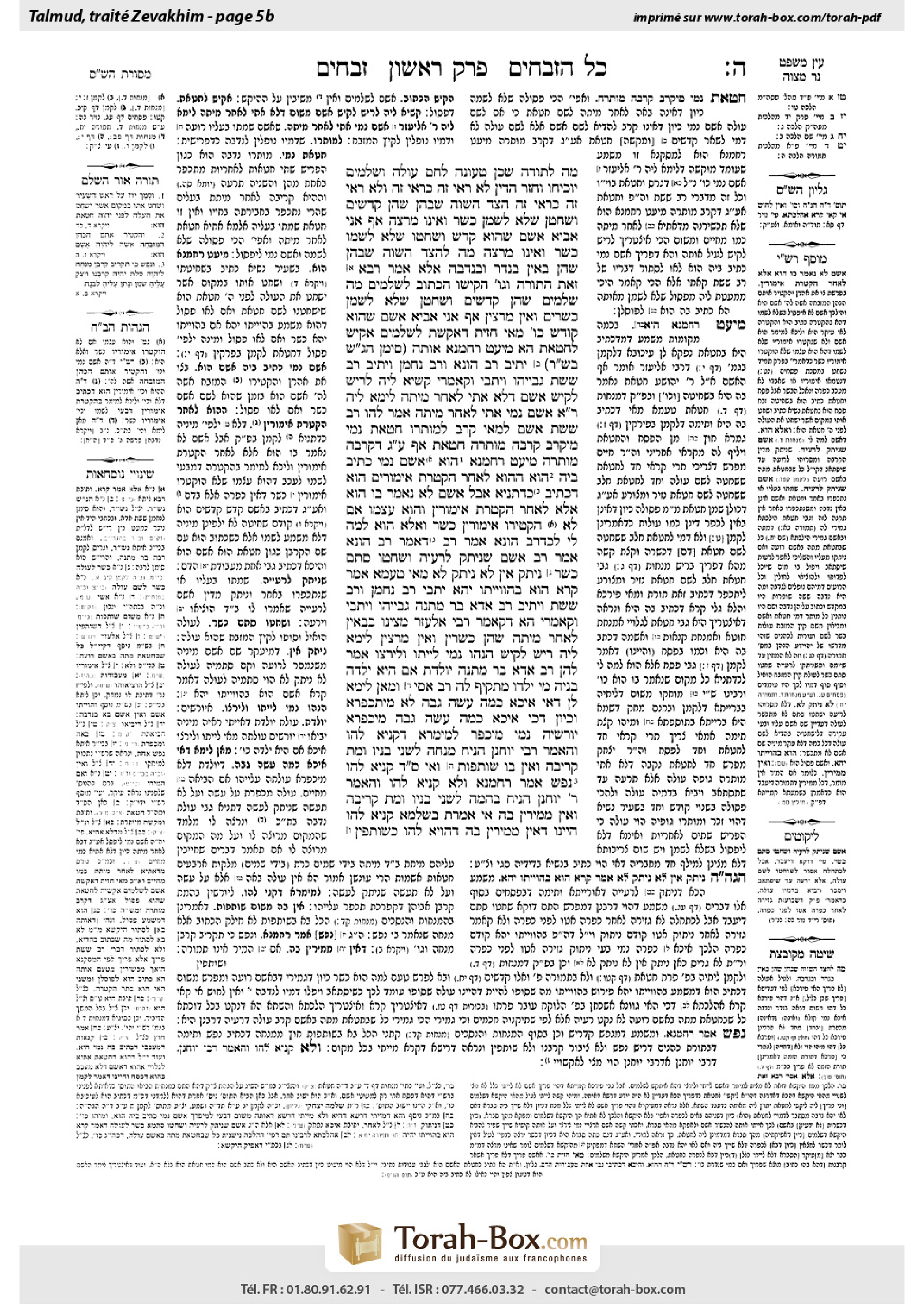
Zevachim 5b: Talmud study for Daf Yomi
Daf Yomi is the daily study of one Talmud folio. Explore 37 tractates with scans, Hebrew text, Sefaria English and AI-generated French translations where annotated.
Passage selection and English or AI-generated French translation are available where the scan has annotations. Daf Study is independent of Torah-Box and Sefaria.
Browse Zevachim · זבחים · All tractatesZevachim 5b text and translations
This page of Zevachim includes the Aramaic text, an English translation and an AI-generated French translation, alongside the scan above.
זבחים ה׳ ב · Aramaic and Hebrew text
מָה לְתוֹדָה, שֶׁכֵּן טְעוּנָה לֶחֶם!
עוֹלָה וּשְׁלָמִים יוֹכִיחוּ. וְחָזַר הַדִּין. לֹא רְאִי זֶה כִּרְאִי זֶה, וְלֹא רְאִי זֶה כִּרְאִי זֶה; הַצַּד הַשָּׁוֶה שֶׁבָּהֶן – שֶׁהֵן קֳדָשִׁים, וּשְׁחָטָן שֶׁלֹּא לִשְׁמָן כָּשֵׁר וְאֵינוֹ מְרַצֶּה; אַף אֲנִי אָבִיא אָשָׁם – שֶׁהוּא קֹדֶשׁ, וּשְׁחָטוֹ שֶׁלֹּא לִשְׁמוֹ כָּשֵׁר וְאֵינוֹ מְרַצֶּה.
מָה לְהַצַּד הַשָּׁוֶה שֶׁבָּהֶן, שֶׁהֵן בָּאִין בְּנֶדֶר וּבִנְדָבָה!
אֶלָּא אָמַר רָבָא: ״זֹאת הַתּוֹרָה וְגוֹ׳״ – הִקִּישׁוֹ הַכָּתוּב לִשְׁלָמִים; מָה שְׁלָמִים שֶׁהֵן קֳדָשִׁים, וּשְׁחָטָן שֶׁלֹּא לִשְׁמָן כְּשֵׁרִים וְאֵין מְרַצִּין; אַף אֲנִי אָבִיא אָשָׁם שֶׁהוּא קוֹדֶשׁ כּוּ׳.
מַאי חָזֵית דְּאַקֵּשְׁתְּ לִשְׁלָמִים? אַקֵּישׁ לְחַטָּאת!
הָא מַיעֵט רַחֲמָנָא ״אוֹתָהּ״.
(סִימָן: הנ״ש בש״ר)
יָתֵיב רַב הוּנָא וְרַב נַחְמָן, וְיָתֵיב רַב שֵׁשֶׁת גַּבַּיְיהוּ, וְיָתְבִי וְקָאָמְרִי: קַשְׁיָא לֵיהּ לְרֵישׁ לָקִישׁ – אָשָׁם דְּלָא אָתֵי לְאַחַר מִיתָה; לֵימָא לֵיהּ רַבִּי אֶלְעָזָר: אָשָׁם נָמֵי אָתֵי לְאַחַר מִיתָה!
אֲמַר לְהוּ רַב שֵׁשֶׁת: אָשָׁם לְמַאי קָרֵב – לְמוֹתָרוֹ; חַטָּאת נָמֵי מִיקְרָב קָרְבָה מוֹתָרַהּ!
חַטָּאת – אַף עַל גַּב דְּקָרְבָה מוֹתָרַהּ, מִיעֵט רַחֲמָנָא ״הוּא״.
אָשָׁם נָמֵי כְּתִיב בֵּיהּ ״הוּא״!
הַהוּא לְאַחַר הַקְטָרַת אֵימוּרִים הוּא דִּכְתִיב, כִּדְתַנְיָא; אֲבָל אָשָׁם לֹא נֶאֱמַר בּוֹ ״הוּא״ אֶלָּא לְאַחַר הַקְטָרַת אֵימוּרִין, וְהוּא עַצְמוֹ – אִם לֹא הַקְטִירוּ אֵימוּרִין כָּשֵׁר.
וְאֶלָּא ״הוּא״ לְמָה לִי? לְכִדְרַב הוּנָא אָמַר רַב – דְּאָמַר רַב הוּנָא אָמַר רַב: אָשָׁם שֶׁנִּיתַּק לִרְעִיָּה, וּשְׁחָטוֹ סְתָם – כָּשֵׁר.
נִיתַּק – אִין, לֹא נִיתַּק – לָא; מַאי טַעְמָא? אָמַר קְרָא: ״הוּא״ – בַּהֲוָויָיתוֹ יְהֵא.
יָתְבִי רַב נַחְמָן וְרַב שֵׁשֶׁת, וְיָתֵיב רַב אַדָּא בַּר מַתְנָה גַּבַּיְיהוּ, וְיָתְבִי וְקָאָמְרִי: הָא דְּקָאָמַר רַבִּי אֶלְעָזָר מָצִינוּ בְּבָאִין לְאַחַר מִיתָה שֶׁהֵן כְּשֵׁרִין וְאֵין מְרַצִּין – לֵימָא לֵיהּ רֵישׁ לָקִישׁ: הָנְהוּ נָמֵי לֵייתוֹ וְלִירַצּוֹ!
אָמַר לָהֶן רַב אַדָּא בַּר מַתְנָה: יוֹלֶדֶת – אִם הִיא יָלְדָה, בָּנֶיהָ מִי יָלְדוּ?!
מַתְקֵיף לַהּ רַב אַסִּי: וּמַאן לֵימָא לַן דְּאִי אִיכָּא כַּמָּה עֲשֵׂה גַּבַּהּ לָא מִיתְכַּפְּרָא? וְכֵיוָן דְּכִי אִיכָּא כַּמָּה עֲשֵׂה גַּבַּהּ מִיכַּפְּרָא, יוֹרְשֶׁיהָ נָמֵי מִיכַּפַּר.
לְמֵימְרָא דְּקַנְיָא לְהוּ?! וְהָאָמַר רַבִּי יוֹחָנָן: הִנִּיחַ מִנְחָה לִשְׁנֵי בָנָיו וָמֵת – קְרֵיבָה, וְאֵין בּוֹ שׁוּתָּפוּת. וְאִי סָלְקָא דַעְתָּךְ קַנְיָא לְהוּ, ״נֶפֶשׁ״ אָמַר רַחֲמָנָא!
וְלָא קַנְיָא לְהוּ?! וְהָאָמַר רַבִּי יוֹחָנָן: הִנִּיחַ בְּהֵמָה לִשְׁנֵי בָנָיו וָמֵת – קְרֵיבָה, וְאֵין מְמִירִין בָּהּ. אִי אָמְרַתְּ בִּשְׁלָמָא קַנְיָא לְהוּ – הַיְינוּ דְּאֵין מְמִירִין בָּהּ, דְּהָוְיָא לְהוּ כְּשׁוּתָּפִין,
Zevachim 5b · English translation
The Gemara rejects this as well: What is unique about a thanks offering? It is unique in that it requires a meal offering of forty loaves of bread.
The Gemara answers: If so, a burnt offering and a peace offering can prove the point, as loaves are not brought with them. And the inference has reverted to its starting point. The halakha is derived from a combination of the two sources: The aspect of this case, a burnt offering and a peace offering, is not like the aspect of that case, a thanks offering, and the aspect of that case is not like the aspect of this case. Their common element is that they are offerings, and if one slaughtered them not for their sake, they are fit but do not propitiate God. So too, I shall include a guilt offering in this halakha, as it is an offering, and therefore if one slaughtered it not for its sake, it is fit but does not propitiate God.
The Gemara rejects this as well: What is unique about the common element of a thanks offering, a burnt offering, and a peace offering? It is unique in that these offerings are brought either as a vow offering or as a gift offering, whereas a guilt offering is brought only to fulfill an obligation.
Rather, Rava says: The verse: “This is the law of the burnt offering, of the meal offering, and of the sin offering, and of the guilt offering, and of the consecration offering, and of the sacrifice of peace offerings” (Leviticus 7:37), juxtaposes a guilt offering with a peace offering, indicating that just as peace offerings are offerings and if one slaughtered them not for their sake, they are fit but do not propitiate, so too, I shall include a guilt offering, as it is an offering, and therefore if it is slaughtered not for its sake, although it is fit, it does not satisfy the obligation of its owner.
The Gemara asks: What did you see, i.e., why do you think it is reasonable, that you compared a guilt offering to a peace offering? Why not compare it to a sin offering, which is disqualified in such a case?
The Gemara answers: The Merciful One excluded all other offerings from the halakha concerning a sin offering in this matter, as derived from the verse: “And slaughter it for a sin offering” (Leviticus 4:33).
The Gemara provides a mnemonic for the amora’im who participated in the two following discussions: Heh, nun, shin; beit, shin, reish.
Rav Huna and Rav Naḥman were sitting, and Rav Sheshet was sitting with them. And they were sitting and saying: Reish Lakish raised his difficulty with regard to a guilt offering, since it is not brought after its owner’s death. Let Rabbi Elazar say to him that a guilt offering is also essentially brought after its owner’s death, since it is sold once it develops a blemish, and the proceeds are used to buy a burnt offering.
Rav Sheshet said to them: This claim can be refuted: What element of a guilt offering is sacrificed after its owner’s death? Only its remainder, i.e., the money from its sale that is used to purchase an animal to be sacrificed. And if so, it is no different from a sin offering, the remainder of which is also sacrificed, and a sin offering itself is entirely disqualified if slaughtered not for its sake.
Rav Huna and Rav Naḥman explained: A sin offering that was slaughtered not for its sake is disqualified even though its remainder is sacrificed, because the Merciful One specifically excludes a sin offering from being a fit offering if sacrificed not for its own sake, as derived from the verse: “And he shall lay his hand upon the head of the goat, and slaughter it in the place where they slaughter the burnt offering before the Lord; it is a sin offering” (Leviticus 4:24). The redundant phrase “it is a sin offering” teaches that a sin offering is disqualified if sacrificed not for its own sake.
The Gemara asks: Isn’t it also written with regard to a guilt offering: “And the priest shall make them smoke upon the altar for an offering made by fire unto the Lord; it is a guilt offering” (Leviticus 7:5)? Why is a guilt offering not disqualified when it is slaughtered not for its sake?
The Gemara answers: That verse is written not with regard to the main sacrificial rites, but with regard to the stage after the burning of the offering’s sacrificial portions on the altar, as it is taught in a baraita: But with regard to a guilt offering, the term “It is a guilt offering” is stated only after the burning of the sacrificial portions. And since the guilt offering itself is fit even if the sacrificial portions were not burned at all, it is certainly fit if they were burned not for the sake of a guilt offering.
The Gemara asks: But if so, why do I need the term “It is a guilt offering” to be stated at all? The Gemara answers: It is necessary for that which Rav Huna says that Rav says. As Rav Huna says that Rav says: With regard to a guilt offering whose owner died or whose transgression was otherwise atoned for, and that was therefore consigned by the court to grazing until it develops a blemish so that it can be sold and the proceeds used to purchase a burnt offering, if, before it developed a blemish, someone slaughtered it without specification of its purpose, it is fit as a burnt offering.
The Gemara infers: If it was consigned to grazing, yes, it is fit as a burnt offering if slaughtered. By inference, if it was not consigned to grazing, it is not fit. What is the reason for this? The verse states: “It is a guilt offering,” indicating that it shall remain as it is, i.e., as a guilt offering, unless it is consigned by the court to fulfill another purpose.
§ Rav Naḥman and Rav Sheshet were sitting, and Rav Adda bar Mattana was sitting with them. And they were sitting and saying: In response to that which Rabbi Elazar said to Reish Lakish: We have found a precedent for this situation in the case of offerings that are brought after their owners’ death, as they are fit but they do not propitiate God, let Reish Lakish say to him: These offerings should also be brought and propitiate God with regard to the heirs. Why did Reish Lakish not challenge Rabbi Elazar’s assumption?
Rav Adda bar Mattana said to them: How can the offering of a woman after childbirth propitiate God after her death? If she gave birth, did her children give birth?
Rav Asi objects to this reasoning: And who shall say to us that if a woman has several violations of positive mitzvot for which to atone, she does not atone by means of the burnt offering she brings after childbirth for her purification? Clearly, such offerings can atone for transgressions other than those for which they are brought. And since, when she has several violations of positive mitzvot she atones by means of the offering, so too, if she dies, her heirs atone by this offering for their own violations of positive mitzvot.
The Gemara asks: Is this to say that the offering is acquired by the heirs, and this is why it atones for their transgressions? But doesn’t Rabbi Yoḥanan say that if one left his two sons a meal offering and then died, the offering must be sacrificed, and it does not have the status of a meal offering brought in partnership? And if it enters your mind that the offering is acquired by the heirs, it should be considered a meal offering brought in partnership, which is unfit, as the Merciful One states in the Torah: “And when one brings a meal offering unto the Lord” (Leviticus 2:1). The word “one” teaches that two people cannot bring a meal offering together. Clearly, the heirs do not inherit the offering, and if so, it should not atone for their transgressions.
The Gemara asks: And is the offering not acquired by them? But doesn’t Rabbi Yoḥanan himself say that if one left his two sons an animal offering and then died, the offering must be sacrificed, and they cannot effect substitution of another animal for it? Even if they declare another animal to be a substitute for it, that animal is not consecrated. Granted, if you say that the offering is acquired by them, this is the reason that they cannot effect substitution of another animal for it: It is because they are like partners,
Zevachim 5b · Traduction française (IA)
La Guemara rejette également cette explication : qu’est-ce qui caractérise le sacrifice d’action de grâce ? Il se distingue par le fait qu’il nécessite une offrande végétale de quarante pains.
La Guemara répond : dans ce cas, l’holocauste et le sacrifice de paix peuvent servir de preuve, puisqu’on n’apporte pas de pains avec eux. Le raisonnement revient alors à son point de départ. La halakha se déduit d’une combinaison des deux cas : le cas présent, celui de l’holocauste et du sacrifice de paix, diffère de celui du sacrifice d’action de grâce, et celui-ci diffère du cas présent. Leur point commun est qu’ils sont des sacrifices et que, si on les a égorgés sans que ce soit dans l’intention requise, ils restent valides, mais ne rendent pas Dieu propice. De même, j’inclurai le sacrifice de culpabilité dans cette halakha, puisqu’il s’agit d’un sacrifice ; par conséquent, s’il est égorgé sans que ce soit dans l’intention requise, il reste valide, mais ne rend pas Dieu propice.
La Guemara rejette également cette explication : qu’est-ce qui caractérise le point commun entre le sacrifice d’action de grâce, l’holocauste et le sacrifice de paix ? Ces sacrifices se distinguent par le fait qu’on les apporte soit comme sacrifices votifs, soit comme offrandes volontaires, tandis que le sacrifice de culpabilité n’est apporté que pour s’acquitter d’une obligation.
Rava dit plutôt : le verset « Voici la loi de l’holocauste, de l’offrande végétale, du sacrifice expiatoire, du sacrifice de culpabilité, du sacrifice de consécration et du sacrifice de paix » (Lévitique 7, 37) rapproche le sacrifice de culpabilité du sacrifice de paix. Cela indique que, de même que les sacrifices de paix sont des sacrifices et que, si on les a égorgés sans que ce soit dans l’intention requise, ils restent valides mais ne rendent pas Dieu propice, de même j’inclurai le sacrifice de culpabilité, puisqu’il s’agit d’un sacrifice ; par conséquent, s’il est égorgé sans que ce soit dans l’intention requise, il reste valide, mais ne satisfait pas à l’obligation de son propriétaire.
La Guemara demande : qu’as-tu vu, c’est-à-dire pourquoi te semble-t-il raisonnable de comparer le sacrifice de culpabilité au sacrifice de paix ? Pourquoi ne pas le comparer au sacrifice expiatoire, qui est invalidé dans un tel cas ?
La Guemara répond : le Miséricordieux a exclu tous les autres sacrifices de la halakha concernant le sacrifice expiatoire dans ce cas, comme on le déduit du verset : « Et il l’égorgera comme sacrifice expiatoire » (Lévitique 4, 33).
La Guemara donne un moyen mnémotechnique pour les amoraïm qui participent aux deux discussions suivantes : hé, noun, chin ; beth, chin, rech.
Rav Houna et Rav Naḥman étaient assis, et Rav Chéchet était assis avec eux. Ils étaient assis et disaient : Rech Lakich a soulevé une difficulté au sujet du sacrifice de culpabilité, puisqu’on ne l’apporte pas après la mort de son propriétaire. Rabbi Elazar pourrait lui répondre qu’en réalité, un sacrifice de culpabilité est lui aussi apporté après la mort de son propriétaire : lorsqu’il développe un défaut, on le vend et on utilise le produit de la vente pour acheter un holocauste.
Rav Chéchet leur dit : on peut réfuter cet argument. Quelle partie du sacrifice de culpabilité est-elle sacrifiée après la mort de son propriétaire ? Seulement ce qui en reste, c’est-à-dire l’argent issu de sa vente, qui sert à acheter un animal destiné à être sacrifié. Dans ce cas, il ne diffère pas du sacrifice expiatoire, dont le reste est lui aussi sacrifié, alors que le sacrifice expiatoire lui-même est entièrement invalidé si on l’égorge sans que ce soit dans l’intention requise.
Rav Houna et Rav Naḥman expliquèrent : un sacrifice expiatoire égorgé sans que ce soit dans l’intention requise est invalidé, même si ce qui en reste est sacrifié, car le Miséricordieux exclut expressément le sacrifice expiatoire de la catégorie des sacrifices valides lorsqu’ils sont sacrifiés sans que ce soit dans l’intention requise, comme on le déduit du verset : « Il posera sa main sur la tête du bouc et l’égorgera à l’endroit où l’on égorge l’holocauste devant l’Éternel ; c’est un sacrifice expiatoire » (Lévitique 4, 24). L’expression redondante « c’est un sacrifice expiatoire » enseigne qu’un sacrifice expiatoire est invalidé s’il est sacrifié sans que ce soit dans l’intention requise.
La Guemara demande : n’est-il pas également écrit au sujet d’un sacrifice de culpabilité : « Le prêtre les fera fumer sur l’autel, comme offrande consumée par le feu pour l’Éternel ; c’est un sacrifice de culpabilité » (Lévitique 7, 5) ? Pourquoi le sacrifice de culpabilité n’est-il pas invalidé lorsqu’on l’égorge sans que ce soit dans l’intention requise ?
La Guemara répond : ce verset ne concerne pas les rites sacrificiels principaux, mais l’étape qui suit la combustion des parties sacrificielles de l’offrande sur l’autel, comme l’enseigne une baraïta : pour le sacrifice de culpabilité, l’expression « c’est un sacrifice de culpabilité » n’est énoncée qu’après la combustion des parties sacrificielles. Et puisque le sacrifice de culpabilité lui-même reste valide même si ses parties sacrificielles n’ont pas été brûlées du tout, il est à plus forte raison valide si elles ont été brûlées sans que ce soit dans l’intention d’un sacrifice de culpabilité.
La Guemara demande : mais dans ce cas, pourquoi fallait-il énoncer l’expression « c’est un sacrifice de culpabilité » ? La Guemara répond : elle est nécessaire pour ce que Rav Houna rapporte au nom de Rav. En effet, Rav Houna rapporte au nom de Rav : s’agissant d’un sacrifice de culpabilité dont le propriétaire est mort ou dont la faute a été expiée d’une autre manière, et que le tribunal a donc destiné au pâturage jusqu’à ce qu’il développe un défaut, afin qu’il puisse être vendu et que le produit de la vente serve à acheter un holocauste, si quelqu’un l’a égorgé sans préciser son intention avant qu’il ne développe un défaut, il est valide comme holocauste.
La Guemara déduit : s’il a été destiné au pâturage, alors il est valide comme holocauste s’il est égorgé. On en déduit que s’il n’a pas été destiné au pâturage, il n’est pas valide. Pour quelle raison ? Le verset dit : « C’est un sacrifice de culpabilité », ce qui indique qu’il doit rester tel quel, c’est-à-dire être un sacrifice de culpabilité, à moins que le tribunal ne le destine à un autre usage.
§ Rav Naḥman et Rav Chéchet étaient assis, et Rav Adda bar Mattana était assis avec eux. Ils étaient assis et disaient : en réponse à ce que Rabbi Elazar a dit à Rech Lakich — nous avons trouvé un précédent pour cette situation dans le cas des sacrifices apportés après la mort de leurs propriétaires, qui restent valides mais ne rendent pas Dieu propice —, Rech Lakich aurait pu lui dire que ces sacrifices devraient eux aussi être apportés et rendre Dieu propice pour les héritiers. Pourquoi Rech Lakich n’a-t-il pas contesté l’hypothèse de Rabbi Elazar ?
Rav Adda bar Mattana leur dit : comment le sacrifice d’une femme après un accouchement pourrait-il rendre Dieu propice après sa mort ? Si elle a accouché, ses enfants ont-ils accouché ?
Rav Assi objecte à ce raisonnement : et qui nous dit qu’une femme qui a commis plusieurs transgressions de mitsvot positives pour lesquelles elle doit obtenir le pardon ne l’obtient pas au moyen de l’holocauste qu’elle apporte après un accouchement pour sa purification ? De toute évidence, de tels sacrifices peuvent expier d’autres transgressions que celles pour lesquelles on les apporte. Et puisque, lorsqu’elle a commis plusieurs transgressions de mitsvot positives, elle obtient l’expiation au moyen du sacrifice, de même, si elle meurt, ses héritiers obtiennent par ce sacrifice l’expiation de leurs propres transgressions de mitsvot positives.
La Guemara demande : faut-il en conclure que le sacrifice devient la propriété des héritiers, et que c’est pour cela qu’il expie leurs transgressions ? Pourtant, Rabbi Yoḥanan dit que si quelqu’un a laissé à ses deux fils une offrande végétale, puis est mort, l’offrande doit être sacrifiée et n’a pas le statut d’une offrande végétale apportée en partenariat. Or, si tu envisages que le sacrifice devient la propriété des héritiers, il devrait être considéré comme une offrande végétale apportée en partenariat, ce qui est invalide, car le Miséricordieux dit dans la Torah : « Quand quelqu’un apporte une offrande végétale à l’Éternel » (Lévitique 2, 1). Le mot « quelqu’un » enseigne que deux personnes ne peuvent pas apporter ensemble une offrande végétale. De toute évidence, les héritiers n’héritent pas du sacrifice ; dans ce cas, il ne devrait pas expier leurs transgressions.
La Guemara demande : et le sacrifice ne devient-il pas leur propriété ? Pourtant, Rabbi Yoḥanan lui-même dit que si quelqu’un a laissé à ses deux fils un sacrifice animal, puis est mort, le sacrifice doit être offert, et ils ne peuvent pas lui substituer un autre animal. Même s’ils déclarent qu’un autre animal le remplace, cet animal n’est pas consacré. Certes, si tu dis que le sacrifice devient leur propriété, voici pourquoi ils ne peuvent pas lui substituer un autre animal : c’est parce qu’ils sont comme des associés,
Traduction française générée par IA à partir de l’édition anglaise de Sefaria. Vérifie toujours un passage avec le texte source.
Text from Sefaria: William Davidson Edition - Vocalized Aramaic (CC BY NC); William Davidson Edition - English (CC BY NC).