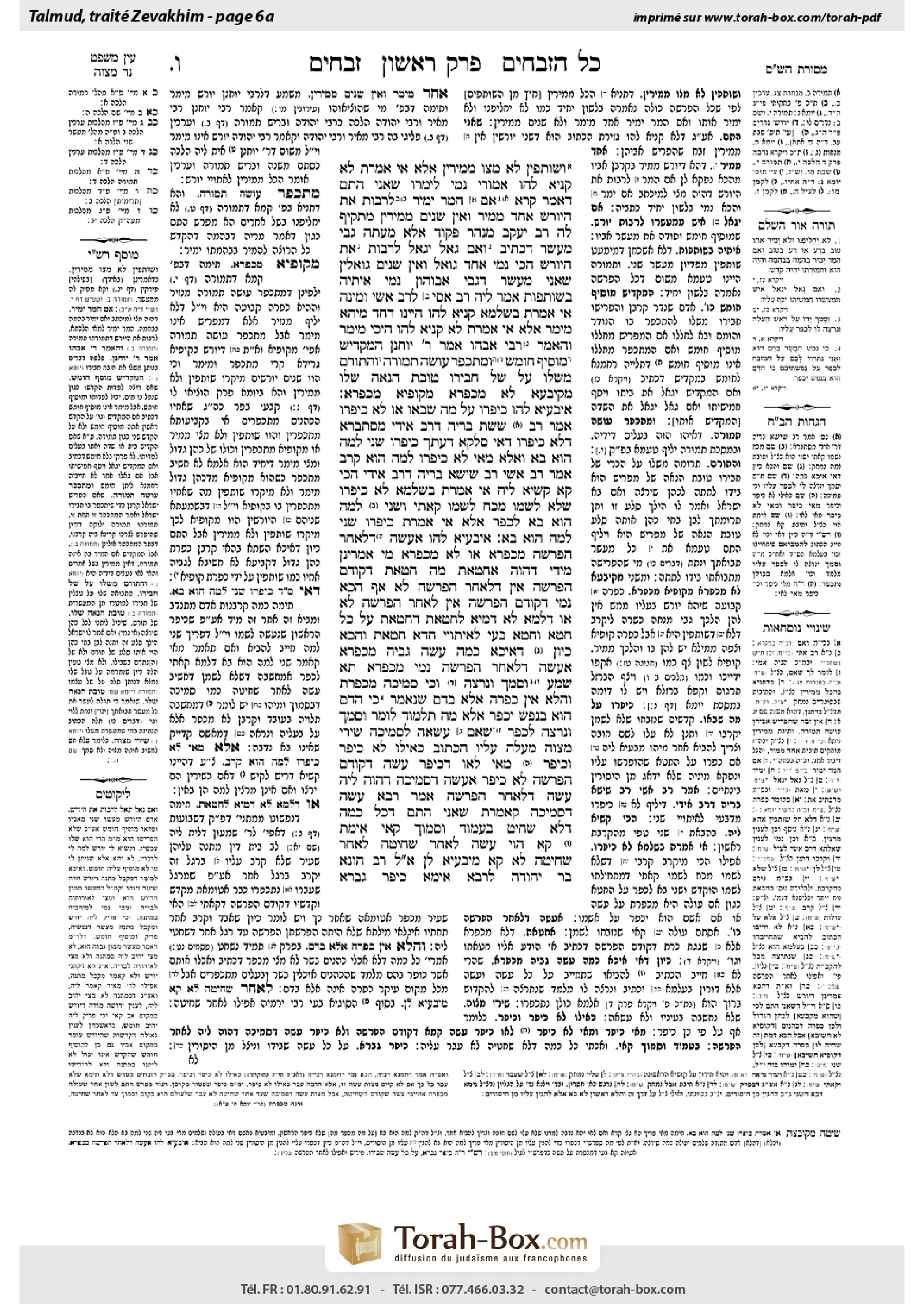
Zevachim 6a: Talmud study for Daf Yomi
Daf Yomi is the daily study of one Talmud folio. Explore 37 tractates with scans, Hebrew text, Sefaria English and AI-generated French translations where annotated.
Passage selection and English or AI-generated French translation are available where the scan has annotations. Daf Study is independent of Torah-Box and Sefaria.
Browse Zevachim · זבחים · All tractatesZevachim 6a text and translations
This page of Zevachim includes the Aramaic text, an English translation and an AI-generated French translation, alongside the scan above.
זבחים ו׳ א · Aramaic and Hebrew text
וְשׁוּתָּפִין לָא מָצוּ מְמִירִין. אֶלָּא אִי אָמְרַתְּ לָא קַנְיָא לְהוּ – אָמוֹרֵי נָמֵי לִימְרוּ!
שָׁאנֵי הָתָם, דְּאָמַר קְרָא: ״אִם הָמֵר יָמִיר״ – לְרַבּוֹת אֶת הַיּוֹרֵשׁ; אֶחָד מֵמִיר וְאֵין שְׁנַיִם מְמִירִין.
מַתְקֵיף לַהּ רַב יַעֲקֹב מִנְּהַר פְּקוֹד: אֶלָּא מֵעַתָּה, גַּבֵּי מַעֲשֵׂר דִּכְתִיב: ״וְאִם גָּאֹל יִגְאַל״ לְרַבּוֹת אֶת הַיּוֹרֵשׁ – הָכִי נָמֵי אֶחָד גּוֹאֵל וְאֵין שְׁנַיִם גּוֹאֲלִין?!
שָׁאנֵי מַעֲשֵׂר, דְּגַבֵּי אֲבוּהוֹן נָמֵי אִיתֵיהּ בְּשׁוּתָּפוּת.
אֲמַר לֵיהּ רַב אַסִּי לְרַב אָשֵׁי: וּמִינַּהּ – אִי אָמְרַתְּ בִּשְׁלָמָא קַנְיָא לְהוּ, הַיְינוּ דְּחַד מִיהָא מֵימַר; אֶלָּא אִי אָמְרַתְּ לָא קַנְיָא לְהוּ, הֵיכִי מֵימַר?
וְהָאָמַר רַבִּי אֲבָהוּ אָמַר רַבִּי יוֹחָנָן: הַמַּקְדִּישׁ מוֹסִיף חוֹמֶשׁ, וּמִתְכַּפֵּר עוֹשֶׂה תְּמוּרָה, וְהַתּוֹרֵם מִשֶּׁלּוֹ עַל שֶׁל חֲבֵירוֹ – טוֹבַת הֲנָאָה שֶׁלּוֹ!
מִקִּיבְעָא לָא מְכַפְּרָא, מִקּוּפְיָא מְכַפְּרָא.
אִיבַּעְיָא לְהוּ: כִּיפְּרוּ עַל מַה שֶּׁבָּאוּ, אוֹ לֹא כִּיפְּרוּ?
אָמַר רַב שֵׁשֶׁת בְּרֵיהּ דְּרַב אִידִי: מִסְתַּבְּרָא דְּלֹא כִּיפְּרוּ; דְּאִי סָלְקָא דַעְתָּךְ כִּיפְּרוּ, שֵׁנִי לָמָה הוּא בָּא?
וְאֶלָּא מַאי, לֹא כִּיפְּרוּ?! לָמָה הוּא קָרֵב?
אָמַר רַב אָשֵׁי, רַב שִׁישָׁא בְּרֵיהּ דְּרַב אִידִי הָכִי קָא קַשְׁיָא לֵיהּ: אִי אָמְרַתְּ בִּשְׁלָמָא לֹא כִּיפְּרוּ – שֶׁלֹּא לִשְׁמוֹ מִכֹּחַ לִשְׁמוֹ קָאָתֵי, וְשֵׁנִי לָמָה הוּא בָּא – לְכַפֵּר; אֶלָּא אִי אָמְרַתְּ כִּיפְּרוּ – שֵׁנִי לָמָה הוּא בָּא?
אִיבַּעְיָא לְהוּ: אַעֲשֵׂה דִּלְאַחַר הַפְרָשָׁה – מְכַפְּרָא, אוֹ לָא מְכַפְּרָא?
מִי אָמְרִינַן מִידֵּי דְּהָוֵה אַחַטָּאת; מָה חַטָּאת – דְּקוֹדֶם הַפְרָשָׁה אִין, דִּלְאַחַר הַפְרָשָׁה לָא; אַף הָכָא נָמֵי – דְּקוֹדֶם הַפְרָשָׁה אִין, לְאַחַר הַפְרָשָׁה לָא?
אוֹ דִלְמָא לָא דָּמְיָא לְחַטָּאת; דְּחַטָּאת – עַל כׇּל חֵטְא וְחֵטְא בָּעֵי לְאֵיתוֹיֵי חֲדָא חַטָּאת, וְהָכָא – כֵּיוָן דְּאִיכָּא כַּמָּה עֲשֵׂה גַּבֵּיהּ מְכַפְּרָא, אַעֲשֵׂה דִּלְאַחַר הַפְרָשָׁה נָמֵי מְכַפְּרָא?
תָּא שְׁמַע: ״וְסָמַךְ... וְנִרְצָה״ – וְכִי סְמִיכָה מְכַפֶּרֶת?! וַהֲלֹא אֵין כַּפָּרָה אֶלָּא בַּדָּם, שֶׁנֶּאֱמַר: ״כִּי הַדָּם הוּא בַּנֶּפֶשׁ יְכַפֵּר״! אֶלָּא מָה תַּלְמוּד לוֹמַר: ״וְסָמַךְ... וְנִרְצָה... לְכַפֵּר״? שֶׁאִם עֲשָׂאָהּ לִסְמִיכָה שְׁיָרֵי מִצְוָה – מַעֲלֶה עָלָיו הַכָּתוּב כְּאִילּוּ לֹא כִּיפֵּר, וְכִיפֵּר.
מַאי לָאו דְּכִיפֵּר – עֲשֵׂה דְּקוֹדֶם הַפְרָשָׁה, לֹא כִּיפֵּר – אַעֲשֵׂה דִּסְמִיכָה, דְּהָוֵה לֵיהּ עֲשֵׂה דִּלְאַחַר הַפְרָשָׁה?
אָמַר רָבָא: עֲשֵׂה דִּסְמִיכָה קָאָמְרַתְּ?! שָׁאנֵי הָתָם, דְּכֹל כַּמָּה דְּלָא שָׁחֵיט – בַּ״עֲמוֹד וּסְמוֹךְ״ קָאֵי; אֵימַת קָא הָוֵי עֲשֵׂה – לְאַחַר שְׁחִיטָה; לְאַחַר שְׁחִיטָה לָא קָא מִיבַּעְיָא לַן.
אֲמַר לֵיהּ רַב הוּנָא בַּר יְהוּדָה לְרָבָא, אֵימָא: כִּיפֵּר – גַּבְרָא,
Zevachim 6a · English translation
and partners cannot effect substitution of other animals for their offering. But if you say that it is not acquired by them, and the animal is the property solely of the deceased father, let them also effect substitution on his behalf, as heirs are able to effect substitution for their deceased parents’ offerings.
The Gemara answers: There it is different, as although the verse states: “If he shall at all change [hamer yamir] animal for animal” (Leviticus 27:10), the superfluous word hamer serving to include the heir as one who is able to effect substitution, nevertheless the subject’s singular form teaches that only one heir can effect substitution, but two heirs cannot effect substitution.
Rav Ya’akov of Nehar Pekod objects to this derivation: If that is so, one should say the same with regard to the redemption of the second tithe, as it is written: “And if a man will redeem [gaol yigal] any of his tithe, he shall add to it the fifth part thereof” (Leviticus 27:31), with the superfluous word gaol serving to include the heir as one who must add the one-fifth. So too, it should be derived from the verb’s singular form that if one heir redeems the tithe, he must add one-fifth of its value, but if two heirs redeem it, they do not need to add one-fifth. In fact, the halakha is that partners must also add one-fifth.
The Gemara answers: Redemption of the tithe is different, as the father had the ability to redeem the tithe even in partnership with another when alive. Therefore, the heirs can do so as well. By contrast, substitution of an offering cannot be effected by partners.
Rav Asi said to Rav Ashi: But from this halakha itself, that two heirs cannot effect substitution of an offering, it can be proven that they acquire the offering of the deceased. Granted, if you say it is acquired by them, this is the reason that one heir, in any event, can effect substitution of another animal for the offering. But if you say it is not acquired by them, how can even one heir effect substitution?
But doesn’t Rabbi Abbahu say that Rabbi Yoḥanan says: If one consecrates his own animal to atone for someone else and he then redeems it, he adds one-fifth of its value, as he would for any other offering he owned, but if the one for whom it atones redeems it, he need not add one-fifth, since he is not the owner. Nevertheless, only the one for whom the offering atones can render another animal a substitute for it, as in this respect only he is considered its owner. Rabbi Yoḥanan’s statement concludes: And if one separates teruma from his own produce to exempt the produce of another from the obligation to have teruma separated from it, the benefit of discretion is his. Only the one who separated the teruma is entitled to determine which priest receives it. Since an heir is able to effect substitution, apparently the offering atones for his transgression. This supports the claim that the heir acquires the offering.
Rav Ashi responds: The offering does not atone for the transgressions of the heirs by its essence, as it was not consecrated for their atonement, and they do not acquire it. Therefore, two heirs of a meal offering can bring it, as explained above. Yet, it does atone for them incidentally [mikkufeya]. Therefore, an heir can effect substitution of another animal for it.
§ With regard to the halakha that offerings slaughtered not for their sake are fit to be sacrificed but do not satisfy the obligations of their owners, a dilemma was raised before the Sages: After these offerings are sacrificed, did they atone for the sins for which they came, or did they not atone for them?
Rav Sheshet, son of Rav Idi, said: It stands to reason that they did not atone, as, if it enters your mind that they did atone, for what purpose is the second offering brought? Why is the owner required to bring another offering if the first atoned for his sin?
The Gemara challenges this reasoning: Rather, what is the alternative? That they did not atone? If so, for what purpose is the first offering sacrificed?
Rav Ashi said: This is what is difficult for Rav Sheisha, i.e., Rav Sheshet, son of Rav Idi: Granted, if you say that such an offering did not atone, it is brought even when slaughtered not for its sake on the strength of its prior consecration for its sake. And in that case, for what purpose is the second offering brought? It is brought to atone for the sin. But if you say that offerings that were slaughtered not for their sake atoned for the sin, for what purpose is the second offering brought?
§ A dilemma was raised before the Sages: When one brings a burnt offering, which atones for violations of positive mitzvot, does it atone even for a violation of a positive mitzva that one committed after designating the animal as an offering, or does it not atone for such a violation?
The Gemara elaborates: Do we say that the halakha in this case is just as it is with regard to a sin offering, in that just as a sin offering does atone for a sin that one committed before designation of the animal but does not atone for a sin that one committed after designation, here too, a burnt offering does atone for violations that one committed before designation but does not atone for those committed after designation?
Or, perhaps a burnt offering is not similar to a sin offering, as with regard to a sin offering one must bring one sin offering for each and every sin he commits. But here, since a burnt offering atones even for one who has committed several violations of positive mitzvot, one may claim that it also atones even for the violation of a positive mitzva that one committed after designation of the animal.
The Gemara suggests: Come and hear proof from a baraita: The verse states: “And he shall place his hand on the head of the burnt offering, and it shall be accepted for him to atone for him” (Leviticus 1:4). And does placing hands atone for one’s sins? But isn’t atonement achieved only by the sprinkling of the blood, as it is stated: “For it is the blood that makes atonement by reason of the life” (Leviticus 17:11)? Rather, what is the meaning when the verse states: “And he shall place…and it shall be accepted for him to atone”? This teaches that if one deemed the ritual of placing hands to be a non-essential mitzva and consequently failed to perform it, the verse ascribes to him blame as though the offering did not atone for his sins; and nevertheless, the offering atoned for his sins.
What, does the final clause of the baraita not mean that the offering atoned for the violation of any positive mitzva that the owner committed before designation of the animal, but it did not atone for violation of the positive mitzva of placing hands on the head of the offering, as that constitutes a violation of a positive mitzva after designation of the animal? Apparently, a burnt offering does not atone for the violations committed after the animal’s designation.
Rava said in response: You say that the positive mitzva of placing hands is proof? There it is different, since as long as he does not slaughter the offering, he remains obligated to stand and place his hands on its head. He has not yet violated the mitzva. When does the violation of this positive mitzva occur? It occurs after the slaughter, at which point fulfillment of the mitzva is no longer possible. And with regard to a violation committed after the slaughter, we do not raise the dilemma; clearly a burnt offering does not atone for such a violation.
Rav Huna bar Yehuda said to Rava: Say the baraita means that the offering atoned for the transgression of the person,
Zevachim 6a · Traduction française (IA)
et les associés ne peuvent pas effectuer de substitution en remplaçant leur sacrifice par d’autres animaux. Mais si tu dis que le sacrifice ne leur appartient pas et que l’animal est la propriété du seul père défunt, qu’ils puissent eux aussi effectuer une substitution en son nom, puisque les héritiers peuvent effectuer une substitution pour les sacrifices de leurs parents défunts.
La Guemara répond : Là, c’est différent, car bien que le verset dise : « S’il procède effectivement à une substitution [hamer yamir], animal pour animal » (Lévitique 27, 10), le mot superflu hamer servant à inclure l’héritier parmi ceux qui peuvent effectuer une substitution, la forme singulière du sujet enseigne néanmoins qu’un seul héritier peut effectuer une substitution, mais que deux héritiers ne le peuvent pas.
Rav Ya’akov de Nehar Pekod objecte à cette déduction : Si c’est ainsi, il faudrait dire la même chose au sujet du rachat de la seconde dîme, car il est écrit : « Et si un homme rachète [gaol yigal] une partie de sa dîme, il y ajoutera le cinquième de sa valeur » (Lévitique 27, 31), le mot superflu gaol servant à inclure l’héritier parmi ceux qui doivent ajouter un cinquième. De même, il faudrait déduire de la forme singulière du verbe que si un héritier rachète la dîme, il doit ajouter un cinquième de sa valeur, mais que si deux héritiers la rachètent, ils n’ont pas besoin d’ajouter un cinquième. En réalité, la halakha est que les associés doivent eux aussi ajouter un cinquième.
La Guemara répond : Le rachat de la dîme est différent, car, de son vivant, le père pouvait racheter la dîme même en association avec quelqu’un d’autre. Les héritiers peuvent donc en faire autant. En revanche, des associés ne peuvent pas effectuer une substitution pour un sacrifice.
Rav Asi dit à Rav Ashi : Mais cette halakha elle-même, selon laquelle deux héritiers ne peuvent pas effectuer une substitution pour un sacrifice, prouve qu’ils acquièrent le sacrifice du défunt. De fait, si tu dis qu’il leur appartient, c’est pour cette raison qu’un héritier peut, en tout état de cause, effectuer une substitution en remplaçant le sacrifice par un autre animal. Mais si tu dis qu’il ne leur appartient pas, comment un seul héritier pourrait-il même effectuer une substitution ?
Mais Rabbi Abbahu ne dit-il pas que Rabbi Yoḥanan dit : Si quelqu’un consacre son propre animal pour expier la faute d’un autre et qu’il le rachète ensuite, il ajoute un cinquième de sa valeur, comme il le ferait pour tout autre sacrifice lui appartenant ; mais si la personne pour laquelle le sacrifice expie le rachète, elle n’a pas besoin d’ajouter un cinquième, puisqu’elle n’en est pas propriétaire. Néanmoins, seule la personne pour laquelle le sacrifice expie peut désigner un autre animal comme substitut de celui-ci, car, à cet égard, elle seule est considérée comme son propriétaire. La déclaration de Rabbi Yoḥanan se conclut ainsi : Et si quelqu’un prélève la terouma sur ses propres produits afin de dispenser les produits d’un autre de l’obligation d’en prélever, le droit de décision lui revient. Seule la personne qui a prélevé la terouma a le droit de déterminer quel prêtre la recevra. Puisqu’un héritier peut effectuer une substitution, il semble que le sacrifice expie sa faute. Cela confirme l’affirmation selon laquelle l’héritier acquiert le sacrifice.
Rav Ashi répond : Le sacrifice n’expie pas par nature les fautes des héritiers, puisqu’il n’a pas été consacré pour leur expiation et qu’ils ne l’acquièrent pas. C’est pourquoi deux héritiers peuvent apporter une offrande de farine, comme cela a été expliqué plus haut. Pourtant, le sacrifice expie leurs fautes de manière incidente [mikkufeya]. C’est pourquoi un héritier peut effectuer une substitution en remplaçant celui-ci par un autre animal.
§ À propos de la halakha selon laquelle les sacrifices abattus sans l’intention requise restent aptes à être offerts, mais ne satisfont pas aux obligations de leurs propriétaires, les Sages ont soulevé un dilemme : Une fois ces sacrifices offerts, ont-ils expié les fautes pour lesquelles ils ont été apportés, ou ne les ont-ils pas expiées ?
Rav Sheshet, fils de Rav Idi, dit : Il semble qu’ils n’aient pas expié, car, si tu envisages qu’ils aient expié, dans quel but apporte-t-on le second sacrifice ? Pourquoi le propriétaire doit-il en apporter un autre si le premier a expié sa faute ?
La Guemara conteste ce raisonnement : Quelle est alors l’autre possibilité ? Qu’ils n’aient pas expié ? Dans ce cas, dans quel but le premier sacrifice est-il offert ?
Rav Ashi dit : Voici ce qui pose problème à Rav Sheisha, c’est-à-dire Rav Sheshet, fils de Rav Idi : De fait, si tu dis qu’un tel sacrifice n’a pas expié, il est offert même lorsqu’il a été abattu sans l’intention requise, en vertu de sa consécration antérieure avec l’intention requise. Dans ce cas, dans quel but apporte-t-on le second sacrifice ? Il est apporté pour expier la faute. Mais si tu dis que les sacrifices abattus sans l’intention requise ont expié la faute, dans quel but apporte-t-on le second sacrifice ?
§ Les Sages ont soulevé un dilemme : Lorsqu’on apporte un holocauste, qui expie les transgressions des mitsvot positives, expie-t-il aussi la transgression d’une mitsva positive commise après que l’animal a été désigné comme sacrifice, ou n’expie-t-il pas une telle transgression ?
La Guemara développe : La halakha en l’occurrence est-elle identique à celle du sacrifice expiatoire ? De même qu’un sacrifice expiatoire expie une faute commise avant la désignation de l’animal, mais n’expie pas une faute commise après cette désignation, de même, ici, un holocauste expie les transgressions commises avant la désignation, mais n’expie pas celles commises après ?
Ou peut-être qu’un holocauste ne ressemble pas à un sacrifice expiatoire, car, dans le cas d’un sacrifice expiatoire, il faut en apporter un pour chaque faute commise. Mais ici, puisque l’holocauste expie même pour celui qui a commis plusieurs transgressions de mitsvot positives, on peut soutenir qu’il expie aussi la transgression d’une mitsva positive commise après la désignation de l’animal.
La Guemara propose : Venons entendre une preuve tirée d’une baraïta : le verset dit : « Il posera sa main sur la tête de l’holocauste, et celui-ci sera agréé pour lui, afin d’expier pour lui » (Lévitique 1, 4). Le fait de poser les mains expie-t-il les fautes ? L’expiation ne s’accomplit-elle pas uniquement par l’aspersion du sang, comme il est dit : « Car c’est le sang qui expie en raison de la vie » (Lévitique 17, 11) ? Que signifie donc le verset lorsqu’il dit : « Il posera… et celui-ci sera agréé pour lui, afin d’expier » ? Cela enseigne que si quelqu’un a considéré l’imposition des mains comme une mitsva non indispensable et ne l’a donc pas accomplie, le verset lui impute une faute, comme si le sacrifice n’avait pas expié ses fautes ; et pourtant, le sacrifice a expié ses fautes.
La dernière clause de la baraïta ne signifie-t-elle pas que le sacrifice a expié toute transgression d’une mitsva positive commise par le propriétaire avant la désignation de l’animal, mais qu’il n’a pas expié la transgression de la mitsva positive consistant à poser les mains sur la tête du sacrifice, puisqu’il s’agit là d’une transgression d’une mitsva positive commise après la désignation de l’animal ? Apparemment, un holocauste n’expie pas les transgressions commises après la désignation de l’animal.
Rava répondit : Tu invoques comme preuve la mitsva positive de l’imposition des mains ? Là, c’est différent, car tant qu’il n’a pas abattu le sacrifice, il reste tenu de se tenir debout et de poser les mains sur sa tête. Il n’a pas encore transgressé la mitsva. Quand cette mitsva positive est-elle transgressée ? Après l’abattage, moment où il n’est plus possible de l’accomplir. Nous ne soulevons pas le dilemme au sujet d’une transgression commise après l’abattage ; il est clair qu’un holocauste n’expie pas une telle transgression.
Rav Houna bar Yehouda dit à Rava : Dis plutôt que la baraïta signifie que le sacrifice a expié la transgression de la personne,
Traduction française générée par IA à partir de l’édition anglaise de Sefaria. Vérifie toujours un passage avec le texte source.
Text from Sefaria: William Davidson Edition - Vocalized Aramaic (CC BY NC); William Davidson Edition - English (CC BY NC).